
Electric Resistance Welding Pipes Tubes Market Share, Growth & Forecast by 2034
Coverage: by Material (Steel, Copper and alloys, Nickel and alloys, Others.); Application (Oil and gas, Infrastructure and construction, Power generation, Automotive, Engineering, Others), and Geography (North America, Europe, Asia Pacific, and South and Central America)
- Status : Data Released
- Report Code : TIPRE00013042
- Category : Chemicals and Materials
- No. of Pages : 150
- Available Report Formats :


- Last update date : September 28, 2026


2025 Market Size
US$ 16.2 Bn
Base year value
2034 Forecast
US$ 27.14 Bn
Projected by 2034
CAGR 2026-2034
5.90 %
Growth rate
Addressable Market
US$ 196.33 Bn
(2026-2034)
The Electric Resistance Welding Pipes and Tubes Market size was valued at US$ 16.2 Billion in 2025 and is projected to reach US$ 27.14 Billion by 2034, registering a CAGR of 5.90% during 2026-2034. The market covers pipes and tubes manufactured through electric resistance welding using steel, copper, and alloys, and nickel and alloys for oil and gas, infrastructure and construction, power generation, automotive, and engineering applications. Demand is shaped by the balance between welded-pipe cost efficiency, dimensional precision, material performance, and increasingly demanding application specifications.
North America represents a substantial demand center for Electric Resistance Welding Pipes and Tubes Market because pipeline rehabilitation, water infrastructure, industrial construction, automotive production, and energy transportation require consistent supplies of welded tubular products. The region accounted for ~24% of global demand in 2025 and is expected to expand at ~5.5% CAGR through 2034. The Electric Resistance Welding Pipes and Tubes size is supported by established tube-processing capacity, domestic steel availability, and procurement requirements that favor traceability and locally manufactured products. Continued investment in gas infrastructure and industrial facilities provides an additional demand base, while suppliers increasingly differentiate through higher-strength grades, automated inspection, and lower-carbon steel inputs.
Electric Resistance Welding Pipes Tubes Market Assessment and Insights
- North America: North America held ~24% of global Electric Resistance Welding Pipes and Tubes Market share in 2025 and is projected to grow at ~5.5% CAGR. The region benefits from established ERW manufacturing, energy infrastructure replacement, water transmission projects, and automotive tube consumption. This combination supports a relatively stable demand for standardized as well as application-specific welded products.
- U.S.: The U.S. represented ~78% of North American demand in 2025 and is expected to grow at ~5.6% CAGR. Oil and gas infrastructure, engineered water systems, automotive tubing, and domestic-content procurement requirements support consumption. Manufacturers with domestic production footprints can compete through shorter delivery cycles and compliance with project-specific specifications.
- Europe: Europe represented ~21% of global demand in 2025 and is expected to expand at ~4.8% CAGR. Germany, Italy, France, the UK, and Spain provide important industrial demand, with Germany particularly significant because of its engineering, automotive, energy transition, and machinery manufacturing base. Decarbonization requirements are increasingly influencing steel and tube procurement.
- Asia Pacific: Asia Pacific accounted for ~43% of global demand in 2025 and is forecast to grow at ~6.5% CAGR. China, Japan, India, and South Korea combine large steel-processing ecosystems with automotive, infrastructure, energy, and industrial demand. Regional competitiveness is reinforced by integrated steelmaking, broad downstream conversion capacity, and growing domestic infrastructure investment.
- Largest Segment: Steel is the largest material segment and is expected to expand at ~5.8% CAGR through 2034. Its broad availability, established welding technologies, extensive grade portfolio, and suitability for structural, energy, automotive, and engineering applications give it a substantially wider addressable market than specialty alloy materials.
- High-Growth Segment: Automotive is the high-growth application segment, projected to expand at ~6.5% CAGR. Vehicle lightweighting, higher-strength tubular structures, chassis applications, exhaust and fluid systems, and increasing use of precision-welded tubes support adoption. Tube producers are responding with tighter dimensional tolerances, improved weld quality, and high-formability grades.
- Key companies analyzed in detail: ArcelorMittal S.A.; Orion Steel Companies; JFE Steel Corporation; Maharashtra Seamless Limited; Nippon Steel Corporation; Welspun Corp Limited; NWPX Infrastructure, Inc.; Mannesmann Line Pipe GmbH; Tata Steel Europe Limited; Tenaris S.A.
Source: The Insight Partners' analysis based on proprietary research, government publications, company annual reports, investor presentations, industry databases, and expert interviews.
The Electric Resistance Welding Pipes and Tubes Market has progressed from standardized carbon-steel tubing to specialized welded tubing with superior dimensionality, strength, weld integrity, inspection, and more advanced technology. Electric resistance high-frequency welding allows for the continuous production of ERW pipes from sheet steel and reduces the number of process steps required compared to other pipe manufacturing options. Improvements in edge conditioning, welding processes, heat treating, ultrasonic testing, and automatic dimensional control have broadened the applications for ERW products.
End use specifications in the Electric Resistance Welding Pipes and Tubes Market have become increasingly specific. Requirements for oil and gas users include weld integrity, toughness, corrosion resistance, pressure capabilities, and adherence to API specifications. Automotive customers value flexibility, surface characteristics, dimensional consistency, reduced weight, and on time delivery. The needs of engineering and construction customers tend to focus more on performance capabilities, availability, fabricating convenience, and certification. Product lines at Nippon Steel, JFE Steel, and ArcelorMittal are examples of this shift to high-value welded tubes instead of commodity pipe.
Recent developments within the industry further support this technological shift. In 2025, Tata Steel showcased API X65 ERW pipes for the high-pressure transport of pure hydrogen gas. This illustrates the application of ERW production in new forms of energy production. It represents the integration of steelmaking, pipe making, and hydrogen certification within the process of developing an innovative product.
Over the course of 2034, it is anticipated that there will be a shift towards a more local and specification-based supply chain in the Electric Resistance Welding Pipes and Tubes Market. The North American and European end users are increasingly worried about factors such as supply reliability, carbon embeddedness, and proximity to the fabrication projects. Meanwhile, Asian producers will continue to enjoy the benefits of the massive scale steel transformation ecosystem.
The energy transition infrastructure will result in new material specifications and will not just replace traditional demands. Hydrogen piping, carbon management systems, district energy, renewables infrastructure, and industrial retrofits need materials that have properties to withstand pressure, hydrogen compatibility, corrosion, toughness, and welding performance. The commercialization process will thus favor companies that will be able to combine metallurgy with pipe forming, welding, and application engineering.
Electric Resistance Welding Pipes Tubes Market Report Scope
| Report Attribute | Details |
|---|---|
| Market size in 2025 | US$ 16.2 Billion |
| Market Size by 2034 | US$ 27.14 Billion |
| Global CAGR (2026 - 2034) | 5.90% |
| Historical Data | 2021-2024 |
| Forecast period | 2026-2034 |
Electric Resistance Welding Pipes Tubes Market Analysis
Electric Resistance Welding Pipes and Tubes market forecasts are directly correlated with the formation of tubular products from flat steel, copper-based alloys, and nickel-based alloys. The demand chain starts with investments in equipment and goes through the process of purchasing coil/strips, forming and welding, then finishing, testing, and distribution to wholesalers, fabricators, OEMs, contractors, and pipeline operators. Welded pipes can be manufactured in a continuous mode with precisely regulated parameters of the product, which is valuable where efficiency and reliability of the production process matter.
Steel is the prevailing raw material due to the availability of integrated steel producers, who can influence chemical composition, physical characteristics, quality of strip surfaces, and mechanical properties of steel prior to its transformation into pipe products. This provides an opportunity for companies with integrated production facilities for steel and tubular products to obtain an advantage over competitors. ERW producers have flexibility in regulating weld rate, forming pressure, heat input, edge treatment, and processing after welding.
Oil & gas continues to be an important demand driver; however, there are no signs that the industry has come to rely solely on hydrocarbons. Water transfer applications, municipal works, industrial works, automotive applications, power generation, heat exchange systems, and machine engineering use create a broad range of customers. The resultant demand profile will help smooth out the cyclical effects in each of the sectors. Welspun Corp provides ERW and HFIW pipe technology in addition to general line pipes and addresses both the oil & gas and water infrastructure markets.
Increasingly, competition is being focused around product qualification, manufacturing flexibility, delivery reliability, and meeting customer engineering needs. Nippon Steel incorporates ERW technology along with tube manufacturing and non-destructive testing. JFE Steel incorporates HFW/ERW, seamless, and SAW/UOE pipe production capacities. ArcelorMittal produces ERW automotive and mechanical tubing in North America and ERW welding tubing in Europe.
Investments, therefore, go not into additional welding capacity but rather in automation, inspection, energy efficiency, low carbon steel and special grades of steel. The 2025 JFE Steel decision to invest in a large electric arc furnace in Japan is a good illustration of the broader linkage between steel making decarbonization and the tubular products availability.
● REPORT CUSTOMIZATION
Tailor This Report To Align With Your Specific Business Requirements
This report can be customized to align precisely with your business objectives, scope, and target markets. Customization options include tailored segmentation, geography, competitive analysis, and strategic insights to support informed decision-making.
Customize This Report →WHAT YOU CAN ADJUST
- ● Segmentations
- ● Geography
- ● Competitive Analysis
- ● Language Preferences
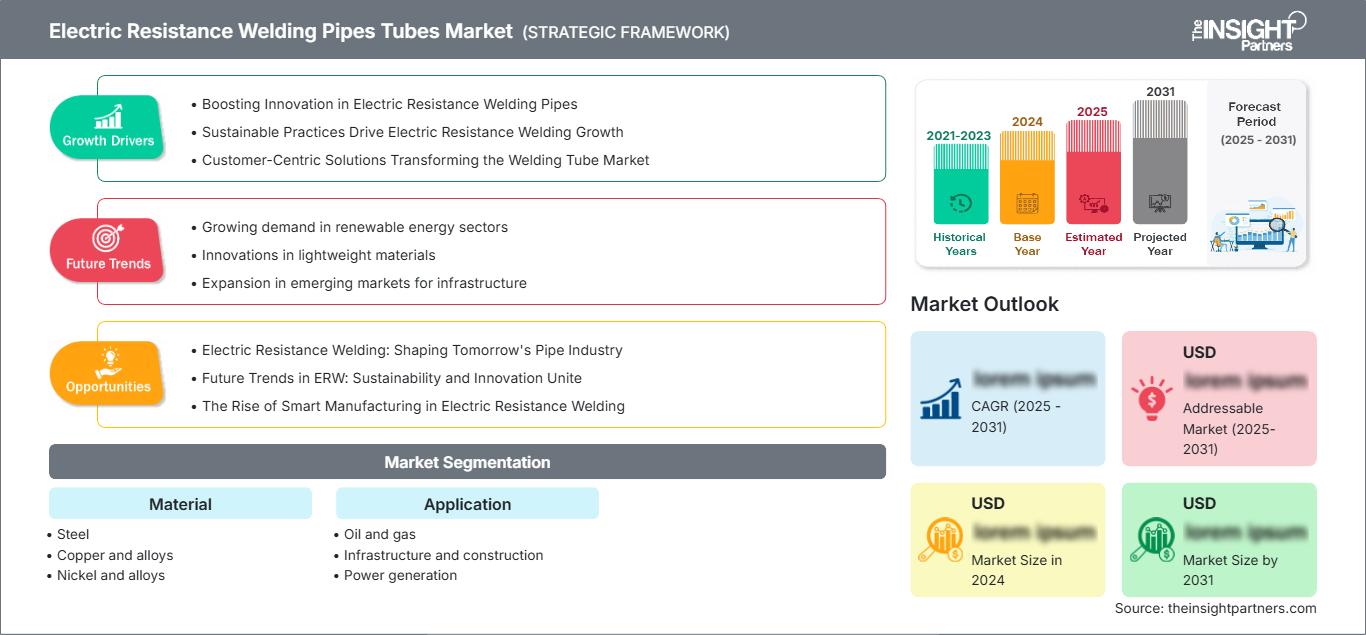
Electric Resistance Welding Pipes Tubes Market: Strategic Insights
Regional Insights
North America Electric Resistance Welding Pipes and Tubes Market
The Electric Resistance Welding Pipes and Tubes Market report shows that North America accounted for ~24% of global demand in 2025 and is projected to grow at ~5.5% CAGR through 2034. The area is blessed with a well-developed oil and gas infrastructure, water infrastructure, automobile production facilities, and steel processing facilities. Increasingly, replacement needs, local content provisions, and the necessity of short supply chains are factors affecting demand for engineered tubulars.
United States is the main demand source in the area because of the following reasons – energy transportation infrastructure, municipal water infrastructure, automobile manufacturing, and industrial construction. ArcelorMittal produces ERW automotive and mechanical tubing in the North American region, whereas NWPX Infrastructure produces engineered water transmission tubulars. The contributions of Canada in the region come from energy and industrial applications as well as from local pipe manufacturing.
U.S. Electric Resistance Welding Pipes and Tubes Market
The U.S. represented ~78% of North American demand in 2025 and is expected to grow at ~5.6% CAGR. Diverse demands arise from the use of products in areas such as oil and gas, water infrastructure, automobile manufacturing, construction and industrial machinery. Issues of domestic content and procurement may favor companies that manufacture locally and have their own certification process especially in the case of public infrastructure and energy projects.
There has been a trend in recent years towards more specification-demanding customers. This is because customers in industries like automotive and industrial machinery require accurate dimensions and mechanical properties, while those in the pipeline industry need chemistry control and seam integrity.
Europe Electric Resistance Welding Pipes and Tubes Market
Europe represented ~21% of global demand in 2025 and is projected to grow at ~4.8% CAGR. Germany is an important demand market due to the automotive industry, machinery, engineering, construction, and energy infrastructure sectors that create various needs for welded tubing products. Italy creates a good demand base for machinery and manufacturing, while France is represented by infrastructure and energy demands, along with aerospace engineering and industries.
Carbon accounting and environmental information at the product level become more and more important in European competition. ArcelorMittal has been developing its low-carbon tubular product line and production facilities, while Mannesmann business units of Salzgitter are taking part in Germany's hydrogen core-network projects. Such developments mean that tubing purchases start taking into account performance and steel production emissions.
APAC Electric Resistance Welding Pipes and Tubes Market
APAC accounted for ~43% of global demand in 2025 and is forecast to expand at ~6.5% CAGR. China provides the largest industrial base, while Japan and South Korea contribute advanced automotive, machinery, energy, and specialty steel capabilities. India is emerging as a particularly important growth market because infrastructure construction, city gas distribution, automotive production, and domestic steel conversion are expanding simultaneously.
Japan combines advanced pipe metallurgy with sophisticated inspection and automotive applications. South Korea benefits from shipbuilding, energy infrastructure, and heavy industry. India has a broad domestic tube manufacturing ecosystem, with Tata Steel and Welspun Corp expanding product differentiation. The region's structural advantage comes from integrated steel supply, large manufacturing clusters, and continued infrastructure development.
Middle East & Africa Electric Resistance Welding Pipes and Tubes Market
The Middle East and Africa market is supported by energy infrastructure, water systems, industrial projects, and urban development. Gulf countries generate demand for energy and process infrastructure, while water transmission and desalination-related construction create additional applications. Local manufacturing and regional sourcing are becoming more relevant as governments pursue industrial localization. The region is expected to expand at ~5.3% CAGR, with project specifications increasingly determining grade, coating, and inspection requirements.
Segmentation Analysis
The market is segmented by Material (Steel, Copper and alloys, Nickel and alloys) and Application (Oil and gas, Infrastructure and construction, Power generation, Automotive, Engineering).
Material
Steel is the dominant material category and is expected to grow at ~5.8% CAGR. It includes carbon, alloy, and specialized high-strength steels used across energy, structural, automotive, and engineering applications. Integrated steelmakers can optimize strip chemistry and surface quality for downstream welding, supporting consistent weld performance and reducing conversion variability.
- Steel: The principal material for structural, energy, automotive, and general engineering applications. Its broad grade availability and established forming and welding infrastructure support extensive adoption.
- Copper and alloys: Used where electrical conductivity, thermal transfer, corrosion resistance, or specialized fabrication characteristics justify higher material costs. Demand is concentrated in selected power, heat-transfer, and engineering applications.
- Nickel and alloys: Serve demanding environments requiring high corrosion resistance, elevated-temperature performance, or resistance to aggressive process media. Their strategic importance is higher than their broad-volume contribution because qualification requirements create technical barriers to substitution.
Application
Oil and gas remain a major application area because ERW technology can support line pipe, casing-related products, distribution infrastructure, and process applications where specifications permit welded construction. The segment is expected to grow at ~5.4% CAGR as pipeline replacement and gas infrastructure investment balance the maturity of some hydrocarbon markets.
- Oil and gas: Requires controlled weld quality, pressure performance, toughness, corrosion resistance, and adherence to industry specifications. Pipeline and distribution projects remain key demand sources.
- Infrastructure and construction: Covers structural tubes, water infrastructure, building systems, and civil-engineering applications. Local procurement, fabrication efficiency, and dimensional consistency influence purchasing.
- Power generation: Uses welded tubes and pipes in boilers, heat-transfer systems, utilities, and supporting infrastructure. Reliability and high-temperature performance are important selection criteria.
- Automotive: Demands high-formability, lightweight, dimensionally precise tubes for vehicle structures, chassis, and fluid-management systems. OEM qualification and just-in-time delivery create strong supplier relationships.
- Engineering: Includes machinery, industrial equipment, process systems, and fabricated assemblies. Buyers prioritize customized dimensions, surface quality, mechanical performance, and reliable availability.
Opportunity Snapshot
| Application | Revenue Contribution (High/Medium/Low) | Trend Tag | Adoption Stage |
|---|---|---|---|
| Oil and gas | High | Gas networks | Mature |
| Infrastructure and construction | High | Urban renewal | Mature |
| Power generation | Medium | Heat systems | Mature |
| Automotive | High | Lightweighting | Scaling |
| Engineering | Medium | Precision tubes | Scaling |
Electric Resistance Welding Pipes Tubes Market Growth Drivers and Impact Analysis
Expansion of Gas, Water, and Industrial Infrastructure
Investment in gas distribution, water transmission, industrial facilities, and infrastructure rehabilitation directly expands the addressable base for welded pipe. ERW technology is particularly suitable where repeatable dimensions, efficient production, and standardized grades are required. Urbanization and network replacement create recurring procurement rather than one-time project demand, allowing manufacturers with regional production and distribution networks to maintain higher utilization.
The effect extends through the value chain. Infrastructure contractors require predictable pipe availability, distributors value standardized dimensions and broad grade coverage, and pipe producers, therefore, invest in flexible forming and finishing systems. This creates opportunities for suppliers that can combine manufacturing scale with project-specific certification and delivery capabilities.
Higher Performance Requirements in Energy Applications
Energy infrastructure increasingly requires stronger materials, improved toughness, reliable weld seams, and resistance to challenging service environments. Higher-pressure gas transportation and emerging hydrogen systems raise the technical requirements placed on welded pipe. Tata Steel's development of hydrogen-qualified API X65 ERW pipe illustrates how manufacturers are extending conventional ERW platforms into new energy applications.
This driver changes competition from simple production economics toward metallurgy, process control, qualification, and testing. Producers able to validate weld performance and material behavior under specialized operating conditions can access applications with greater technical barriers and stronger customer qualification requirements.
Automotive Lightweighting and Precision Manufacturing
Automotive manufacturers are increasing the use of high-strength tubular components to reduce vehicle weight while maintaining structural performance. ERW tubes can provide consistent geometry and favorable material utilization for chassis, body, suspension, and other engineered applications. Demand is supported by vehicle-platform redesign, manufacturing automation, and tighter dimensional requirements.
The commercial implication is a shift toward higher-value tube specifications. Suppliers must maintain consistent weld quality and surface characteristics while supporting short production cycles and customer-specific dimensions. This favors manufacturers with integrated material development, forming, inspection, and secondary-processing capabilities.
Electric Resistance Welding Pipes Tubes Market Future Trends
Low-Carbon Welded Tube Procurement
Electric Resistance Welding Pipes and Tubes trends are increasingly connected to the decarbonization of steelmaking. Customers are beginning to evaluate not only tube performance but also the emissions associated with steel production and processing. Green-steel products, environmental product declarations, recycled inputs, and electric-furnace steelmaking are therefore becoming commercially relevant.
The change affects producers, distributors, infrastructure, and buyers. JFE Steel's green-steel commercialization through the pipe and tube distribution channel demonstrates how lower-carbon steel can move into smaller-lot tubular applications rather than remaining confined to large industrial contracts.
Advanced Weld Monitoring and Automated Inspection
The Electric Resistance Welding Pipes and Tubes Market trends show that welding quality is becoming increasingly data-driven. Automated controls, ultrasonic testing, eddy-current inspection, dimensional measurement, and digital production records enable manufacturers to detect defects earlier and maintain traceability. The trend is particularly important for energy and automotive applications, where weld failure can generate substantial safety, warranty, or operational consequences.
Future competitiveness will depend on combining high production throughput with inspection systems that provide continuous quality assurance. This favors digitally integrated mills capable of connecting material chemistry, forming conditions, welding parameters, inspection results, and customer certification.
ERW Expansion Into Hydrogen Infrastructure
Hydrogen is creating a new technical pathway for welded pipes. Existing natural-gas infrastructure cannot simply be assumed to be suitable for hydrogen service because material compatibility, weld behavior, pressure, leakage, and embrittlement considerations require specific qualification. Manufacturers are therefore developing and validating grades and pipe configurations specifically for hydrogen transportation.
The trend will affect steel chemistry, welding procedures, testing protocols, and project certification. Producers that establish validated hydrogen-compatible ERW portfolios can position themselves for infrastructure projects associated with hydrogen production, storage, transmission, and industrial use.
Electric Resistance Welding Pipes Tubes Market Opportunities
Hydrogen-Ready ERW Pipe Platforms
Hydrogen transportation presents an opportunity for manufacturers to adapt existing ERW assets to higher-value energy-transition applications. Pipeline developers, gas-network operators, hydrogen producers, and industrial users require materials with documented performance under hydrogen service conditions. The opportunity is strongest for producers that can integrate high-strength steelmaking, controlled welding, nondestructive testing, and third-party qualification.
Asia and Europe provide particularly attractive development environments because hydrogen-network investment is being accompanied by technical standardization and industrial decarbonization programs. Companies can capture value by developing qualified pipe grades, offering engineering support, and building traceability into the product from steelmaking through delivery.
Low-Carbon Automotive and Infrastructure Tubes
Automotive OEMs, construction companies, and infrastructure contractors are increasingly exposed to embodied-carbon targets. This creates an opportunity for tube producers to combine ERW efficiency with lower-emission steel inputs and verified environmental data. The commercial proposition extends beyond material supply because customers can use product-level environmental information in procurement and project reporting.
Manufacturers with integrated steelmaking and tube operations are well-positioned to develop such offerings because they can control both the material and conversion stages. The strongest opportunity lies in standardized product families where lower-carbon specifications can be offered without requiring customers to redesign established fabrication processes.
Recent Developments
- September 2026: Tuflesa, part of Bornay Group, signed an agreement with SMS group to modernize the sizing section of its ERW-RD-240 pipe production line in Spain. The project will replace four existing sizing stands to improve dimensional accuracy and production efficiency. Installation is planned during the company's summer 2027 maintenance shutdown, strengthening Tuflesa's capabilities for high-tolerance welded pipe production.
- April 2026: Utva Silosi AD Kovin selected Danieli as the supplier for a new ERW pipe production line at its facility in Serbia. Danieli Centro Tube will install a high-frequency welding line designed to produce pipes with diameters of up to 50 mm and wall thicknesses of up to 3 mm at speeds exceeding 160 meters per minute. The line is scheduled for commissioning in the first half of 2027 and will target structural and automotive applications.
Frequently Asked Questions

- Comprehensive Market Sizing and Forecast Analysis
- Detailed Segmentation Analysis
- In-Depth Market Dynamics Assessment
- Regional and Country-Level Insights
- Competitive Landscape and Company Benchmarking
- Strategic Business Intelligence
Recent Reports
Testimonials

The Insight Partners' SCADA System Market report is comprehensive, with valuable insights on current trends and future forecasts. The team was highly professional, responsive, and supportive throughout. We are very satisfied and highly recommend their services.
RAN KEDEM Partner, Reali Technologies LTDs
I requested a report on a very specific software market and the team produced the report in a few days. The information was very relevant and well presented. I then requested some changes and additions to the report. The team was again very responsive and I got the final report in less than a week.
JEAN-HERVE JENN Chairman, Future Analytica
We worked with The Insight Partners for an important market study and forecast. They gave us clear insights into opportunities and risks, which helped shape our plans. Their research was easy to use and based on solid data. It helped us make smart, confident decisions. We highly recommend them.
PIYUSH NAGPAL Sr. Vice President, High Beam Global
The Insight Partners delivered insightful, well-structured market research with strong domain expertise. Their team was professional and responsive throughout. The user-friendly website made accessing industry reports seamless. We highly recommend them for reliable, high-quality research services
YUKIHIKO ADACHI CEO, Deep Blue, LLC.
This is the first time I have purchased a market report from The Insight Partners.While I was unsure at first, I visited their web site and felt more comfortable to take the risk and purchase a market report.I am completely satisfied with the quality of the report and customer service. I had several questions and comments with the initial report, but after a couple of dialogs over email with their analyst I believe I have a report that I can use as input to our strategic planning process.Thank you so much for taking the extra time and making this a positive experience.I will definitely recommend your service to others and you will be my first call when we need further market data.
JOHN SUZUKI President and Chief Executive Officer, Board Director, BK Technologies
I wish to appreciate your support and the professionalism you displayed in the course of attending to my request for information regarding to infectious disease IVD market in Nigeria. I appreciate your patience, your guidance, and the fact that you were willing to offer a discount, which eventually made it possible for us to close a deal. I look forward to engaging The Insight Partners in the future, all thanks to the impression you have created in me as a result of this first encounter.
DR CHIJIOKE ONYIA MANAGING DIRECTOR, PineCrest Healthcare Ltd.Reason to Buy
- Informed Decision-Making
- Understanding Market Dynamics
- Competitive Analysis
- Identifying Emerging Markets
- Customer Insights
- Market Forecasts
- Risk Mitigation
- Boosting Operational Efficiency
- Strategic Planning
- Investment Justification
- Tracking Industry Innovations
- Aligning with Regulatory Trends





 Get Free Sample for