
Electronic Conductive Plastic Market Size, Share & Growth by 2034
Coverage: By Type (Polyethylene (PE), Polypropylene (PP), Polyvinyl Chloride (PVC), Engineering Plastics, Others); Application (Aerospace, Industrial Applications, Power station industries, Electronics and Electrical, Others) , and Geography (North America, Europe, Asia Pacific, and South and Central America)
- Status : Data Released
- Report Code : TIPRE00019517
- Category : Chemicals and Materials
- No. of Pages : 150
- Available Report Formats :


- Last update date : August 10, 2026


2025 Market Size
US$ 617.17 Mn
Base year value
2034 Forecast
US$ 810.26 Mn
Projected by 2034
CAGR 2026-2034
3.07 %
Growth rate
Addressable Market
US$ 6,480.84 Mn
(2026-2034)
The global Electronic Conductive Plastic market was valued at US$ 617.17 million in 2025 and is expected to reach US$ 810.26 million by 2034; it is estimated to record a CAGR of 3.07% during 2026-2034.
Electronic Conductive Plastic Market Assessment and Insights
- North America: Accounted for an estimated share of 28%–32% in 2025 and is projected to grow at a CAGR range of 3.0%–4.0% during 2026–2034. Demand is supported by aerospace applications, industrial electronics, and advanced polymer adoption.
- US: Represented approximately 75%–80% of North America’s market share in 2025 and is expected to expand at a CAGR range of 3.1%–4.1% during 2026–2034. Aerospace systems, electrical components, and industrial applications drive consumption.
- Europe: Held an estimated share of 25%–29% in 2025 and is forecast to grow at a CAGR range of 2.8%–3.8% during 2026–2034. Germany, France, and the UK contribute through automotive electronics, industrial manufacturing, and engineering plastics demand.
- Asia Pacific: Accounted for approximately 30%–35% share in 2025 and is expected to register a CAGR range of 3.8%–4.8% during 2026–2034. China, Japan, South Korea, and India support growth through electronics production and industrial expansion.
- Largest Segment: Engineering Plastics accounted for an estimated Electronic Conductive Plastic Market share of 35%–40% in 2025 and is projected to grow at a CAGR range of 3.5%–4.5% during 2026–2034.
- High Growth Segment: Electronics and electrical applications accounted for approximately 30%–35% share in 2025 and are expected to grow at a CAGR range of 4.0%–5.0% during 2026–2034.
- Key companies analyzed in detail: Asbury Carbons, Inc., BASF SE, Cabot Corporation, CAPLINQ Corporation, Electriplast Corporation, Ensinger GmbH, Nanocyl SA, Premix Oy, RTP Company, SIMONA AG.
Source: The Insight Partners' analysis based on proprietary research, government publications, company annual reports, investor presentations, industry databases, and expert interviews.
The Electronic Conductive Plastic Market has developed significantly with advancements in polymer modification technologies, conductive filler integration, and material engineering capabilities. Manufacturers are combining polymers with carbon-based materials, conductive additives, and specialized compounds to achieve improved electrical performance while maintaining flexibility and lightweight characteristics. Growing requirements for electromagnetic shielding, electrostatic discharge protection, and component miniaturization are influencing product innovation. The shift from conventional metallic materials toward engineered polymer solutions is creating new opportunities across electronics, aerospace, and industrial applications. Increasing focus on efficient manufacturing processes and customized material formulations is further shaping competitive strategies among suppliers.
Future expansion of the market is expected to be influenced by material innovation, industrial automation, and increasing adoption of advanced electronic systems. Emerging economies are developing manufacturing capabilities that require lightweight and durable conductive materials. Investments in electric mobility, smart electronics, and aerospace technologies are creating additional application opportunities. Regulatory focus on efficiency and sustainability is encouraging manufacturers to develop recyclable and environmentally responsible conductive polymers. Companies are strengthening research capabilities to improve conductivity, mechanical performance, and processing compatibility for evolving application requirements.
Electronic Conductive Plastic Market Report Scope
| Report Attribute | Details |
|---|---|
| Market size in 2025 | US$ 617.17 Million |
| Market Size by 2034 | US$ 810.26 Million |
| Global CAGR (2026 - 2034) | 3.07% |
| Historical Data | 2021-2024 |
| Forecast period | 2026-2034 |
Electronic Conductive Plastic Market Analysis
Electronic Conductive Plastic Market growth is supported by increasing adoption of lightweight conductive materials across electronics, industrial equipment, and specialized engineering applications. The value chain includes polymer producers, conductive additive suppliers, compound manufacturers, component producers, and end-use industries. Conductive plastics are increasingly used where traditional conductive materials create limitations related to weight, corrosion resistance, or design flexibility.
Demand is influenced by developments in electronics manufacturing, aerospace engineering, and industrial automation. Material suppliers are focusing on improving conductivity levels, processing efficiency, and compatibility with advanced manufacturing techniques to address changing requirements across global industries.
Electronic Conductive Plastic Market analysis indicates that competition is shaped by product innovation, conductive filler expertise, and application-specific material development. Companies including BASF SE, Cabot Corporation, Ensinger GmbH, and RTP Company are strengthening their portfolios through advanced polymer compounds and engineered material solutions.
Asbury Carbons, Inc. and Nanocyl SA contribute through conductive carbon materials and nanotechnology-based additives. CAPLINQ Corporation, Electriplast Corporation, Premix Oy, and SIMONA AG support specialized applications through customized conductive polymer solutions. Strategic investments are focused on improving material performance, expanding application coverage, and developing solutions for emerging sectors such as electronics, aerospace, and industrial technologies.
● REPORT CUSTOMIZATION
Tailor This Report To Align With Your Specific Business Requirements
This report can be customized to align precisely with your business objectives, scope, and target markets. Customization options include tailored segmentation, geography, competitive analysis, and strategic insights to support informed decision-making.
Customize This Report →WHAT YOU CAN ADJUST
- ● Segmentations
- ● Geography
- ● Competitive Analysis
- ● Language Preferences
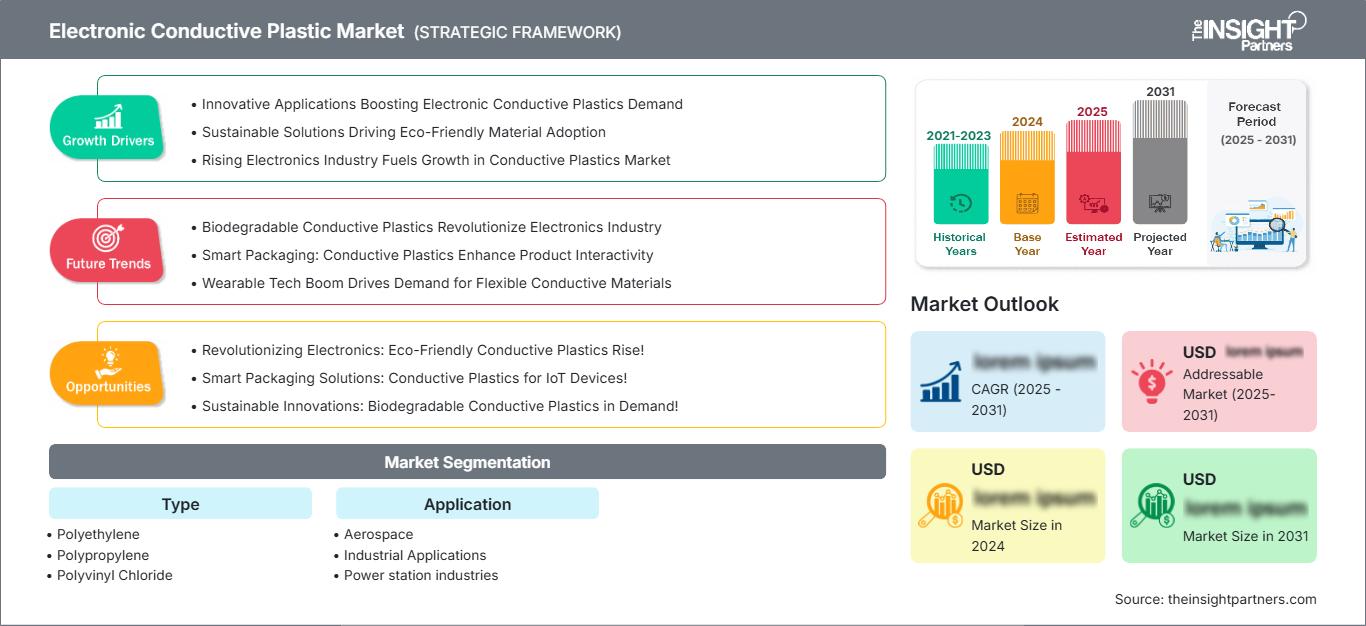
Electronic Conductive Plastic Market: Strategic Insights
Regional Insights
North America Electronic Conductive Plastic Market
North America market is supported by established aerospace, defense, electronics, and industrial manufacturing sectors. The region accounted for an estimated 28%–32% share in 2025 and is projected to expand at a CAGR range of 3.0%–4.0% during 2026–2034. The US remains the largest contributor due to advanced material development capabilities, strong industrial infrastructure, and increasing demand for lightweight conductive components.
The region is witnessing greater adoption of conductive polymers for electromagnetic interference shielding, electrostatic discharge protection, and specialized engineering applications. Companies are investing in customized formulations to meet performance requirements across aerospace electronics, industrial equipment, and advanced electrical systems. Growth is also supported by automation trends and increasing integration of electronic components into industrial machinery, creating demand for durable and efficient conductive plastic solutions.
U.S. Electronic Conductive Plastic Market
The U.S. market represented approximately 75%–80% of North America’s share in 2025 and is expected to grow at a CAGR range of 3.1%–4.1% during 2026–2034. Strong aerospace manufacturing, semiconductor-related activities, and industrial automation are key factors supporting market expansion. The presence of advanced polymer producers and material technology companies strengthens domestic supply capabilities.
Major applications include electronic housings, protective components, industrial sensors, and aerospace systems requiring lightweight conductive materials. Manufacturers are focusing on improved conductivity, thermal stability, and processing compatibility to support evolving product requirements. Increasing demand for advanced electronics, electric systems, and precision industrial components is encouraging wider adoption of conductive plastics. The country continues to remain a significant innovation hub for engineered polymer development and application testing.
Europe Electronic Conductive Plastic Market
Europe accounted for an estimated share of 25%–29% in 2025 and is projected to grow at a CAGR range of 2.8%–3.8% during 2026–2034. Germany represents a leading market due to its automotive electronics, industrial manufacturing, and engineering plastics ecosystem. The UK contributes through aerospace applications, research capabilities, and advanced material development activities.
Germany’s demand is influenced by automotive electrification, industrial automation, and precision manufacturing requirements. Conductive plastics are increasingly used in components requiring weight reduction and electrical performance.
France, Italy, and Spain are adopting conductive polymer solutions across industrial equipment, electronics, and transportation applications. European manufacturers are emphasizing sustainable material development, recycling compatibility, and efficient processing technologies. The region’s focus on advanced manufacturing and energy-efficient systems continues to create opportunities for conductive plastic suppliers.
APAC Electronic Conductive Plastic Market
APAC had a market share of around 30%–35% in 2025 and is projected to exhibit a CAGR of 3.8%–4.8% from 2026 to 2034. China is the leading regional market for copper-clad aluminum wire due to electronics manufacturing, industrial activities, and extensive polymer processing abilities.
Japan and South Korea are contributing to growth through semiconductor, electronics, and engineering applications, whereas India and Australia are witnessing growing adoption driven by industrial development. Growing electronics manufacturing, investments in manufacturing, and infrastructure development are driving the regional growth. Rising demand for lightweight conductive materials in electrical systems and industrial applications is pushing suppliers to increase their manufacturing capabilities in Asia-Pacific.
Middle East & Africa Electronic Conductive Plastic Market
Middle East & Africa market is developing steadily, supported by industrial diversification, infrastructure modernization, and increasing electronics adoption. The region is estimated to expand at a CAGR range of 2.5%–3.5% during 2026–2034. Saudi Arabia and the UAE are emerging markets due to investments in industrial facilities and technology-driven applications.
South Africa contributes through industrial manufacturing and electrical equipment demand, while other Middle Eastern and African countries are gradually adopting advanced polymer solutions. Growing infrastructure projects, energy-related applications, and modernization of industrial systems are creating opportunities for conductive plastic suppliers. The region remains an emerging market with increasing interest in lightweight and durable material alternatives.
Segmentation Analysis
Type
The type segment of the Electronic Conductive Plastic Market includes Polyethylene, Polypropylene, Polyvinyl Chloride, and Engineering Plastics. Engineering Plastics represented the leading category with a 2025 market share range of 35%–40% and is projected to grow at a CAGR range of 3.5%–4.5% during 2026–2034. These materials are preferred due to high mechanical strength, thermal stability, and suitability for demanding applications.
- Polyethylene is used in applications requiring chemical resistance, flexibility, and lightweight characteristics. It supports conductive packaging, protective components, and specialized industrial applications where durability and processing efficiency are important.
- Polypropylene provides balanced mechanical properties, cost efficiency, and chemical resistance. It is increasingly adopted in industrial components and electrical applications requiring lightweight conductive polymer solutions.
- Polyvinyl Chloride offers versatility, durability, and established processing methods. Its conductive variants support applications requiring controlled electrical properties and resistance against environmental conditions.
- Engineering Plastics deliver superior performance through enhanced strength, temperature resistance, and dimensional stability. They are widely preferred for aerospace, electronics, and industrial applications requiring advanced material characteristics.
Application
The application segment of the market includes Aerospace, Industrial Applications, Power station industries, and Electronics and Electrical. Electronics and Electrical represented the high-growth category with an estimated share of 30%–35% in 2025 and is expected to grow at a CAGR range of 4.0%–5.0% during 2026–2034. Increasing electronic integration and demand for conductive protection solutions are supporting adoption.
- Aerospace applications utilize conductive plastics for lightweight structures, electromagnetic shielding components, and electrical protection systems. Material performance requirements drive demand for advanced polymer solutions.
- Industrial Applications involve conductive plastics in machinery components, sensors, equipment housings, and automation systems. Demand is influenced by industrial modernization and component efficiency requirements.
- Power station industries use conductive polymers in specialized electrical systems and protective components requiring durability, reliability, and controlled conductivity.
- Electronics and Electrical applications represent a rapidly expanding area due to increasing electronic device complexity, miniaturization trends, and demand for electromagnetic interference management solutions.
Opportunity Snapshot
| Application | Revenue Contribution | Trend Tag | Adoption Stage |
| Aerospace | Medium | Lightweight Systems | Scaling |
| Industrial Applications | High | Smart Automation | Mature |
| Power station industries | Medium | Grid Modernization | Scaling |
| Electronics and Electrical | High | EMI Shielding | Scaling |
Electronic Conductive Plastic Market Growth Drivers and Impact Analysis
Increasing Demand for Electromagnetic Interference Shielding Solutions
The growing use of electronic products in vehicles, aircraft, machinery, and consumer electronics is driving demand for electromagnetic interference shielding materials. Conductive plastics offer lighter-weight alternatives to traditional metallic shielding materials and also enable more complex component designs. The growing use of connected devices, automation, and electronic assemblies is driving a greater need for materials with controlled electrical conductivity. Special polymer formulations are being developed that include carbon fillers and other conductive materials. This is shaping product development approaches and is prompting manufacturers to develop customized conductive plastics.
Growth of Lightweight Materials in Advanced Engineering Applications
With the shift toward lightweight materials in aerospace, electronics, and other industries, the use of conductive plastics is becoming more widespread. Industries have been looking for options to minimize component weight without sacrificing functionality. Conductive polymers thus provide an option whereby companies can use lightweight components where necessary without impacting their functionality. Aerospace and electronics companies have been focusing more on materials that enable miniaturization. As energy conservation, fuel efficiency, and energy utilization become priorities, demand for conductive plastics has increased. This trend has led to greater investment by material producers in polymers with improved thermal stability and processability.
Expansion of Electronics Manufacturing and Industrial Automation
Growing electronics production and industrial automation activities are creating new opportunities for conductive plastic applications. The manufacturing system components, including automated systems, sensors, control units, and electronics, require materials that ensure effective conductivity and protection against electrostatic discharge. With the growth of the semiconductor and electronics assembly industries, there is an increasing demand for improved polymer materials. Conductive plastics are being used in the manufacture of housing components, protective structures, and other industrial parts owing to their design capabilities and benefits. Investment in automation infrastructure in developed and developing nations is expected to drive demand for conductive polymers.
Electronic Conductive Plastic Market Future Trends
Development of Sustainable Conductive Polymer Formulations
Electronic Conductive Plastic Market trends are increasingly influenced by sustainability initiatives and the development of environmentally responsible material solutions. Manufacturing is moving towards developing eco-friendly polymers, biological additives, and novel production technologies to reduce harmful environmental impact while retaining conductivity. In the future, innovations will focus on improving the electrical and mechanical properties and the sustainability of these materials. Currently, manufacturers are conducting research to develop conductive materials in line with the principles of the circular economy. This process will stimulate advances in polymer chemistry and the adoption of such materials by the industries.
Integration of Conductive Plastics in Emerging Electronic Systems
Future demand for conductive plastics will continue to grow because of the adoption of smart devices, sensors, electric mobility solutions, and industrial machines. Such devices require materials that enable miniaturization, exhibit electrical properties, and are easy to manufacture. Manufacturers of such materials are increasingly developing materials that offer better conductivity, heat-transfer capabilities, and ease of manufacturing. The increasing complexity of electronic structures has led to the development of specialized conductive polymers for new applications. It is anticipated that companies will continue to enhance their cooperation with component manufacturers to develop application-oriented materials for next-generation electronic systems.
Electronic Conductive Plastic Market Opportunities
Expansion Across Electric Mobility and Smart Electronics Applications
Electronic Conductive Plastic Market Forecasts highlight growth driven by the use of electric mobility, smart electronics, and connectivity, which require lightweight materials with conductive properties. Electric vehicles comprise various electronic parts, sensors, and electrical systems, in which conductive plastics can be useful for weight savings and electromagnetic shielding. The growing demand for smart gadgets and electronic products is also driving demand for innovative materials. Companies can take advantage of such opportunities by introducing unique materials with properties like heat resistance, electrical efficiency, and durability. Entry into new applications will allow manufacturers to move beyond conventional industrial applications.
Increasing Adoption in Emerging Manufacturing Economies
Manufacturing plants in the Asia-Pacific, Latin America, and other emerging markets present good opportunities for conductive plastic manufacturers. The increase in electronics manufacturing, industrial automation, and infrastructure developments requires high-quality polymer products. Market opportunities are likely to improve further as manufacturers establish local production facilities. Market penetration could be improved by providing application-specific products, technical expertise, and collaborating with component manufacturers. The process of industrialization and the use of high-quality materials in emerging markets represent improved opportunities for business growth.
Recent Developments
- July 2025: Premix, LyondellBasell, and Maillefer have collaborated to create a recyclable power cable system using advanced polypropylene materials and innovative manufacturing technology. This solution offers a high-performance alternative for medium-voltage (MV) and high-voltage (HV) cable insulation and semiconductive screens compared to conventional XLPE systems.
- July 2025: Cosmo Plastech, part of Cosmo Films, has launched an Electrostatic Discharge (ESD) Plastic Sheet (PET) to meet the increasing packaging needs of India's growing electronics sector. As India becomes a global hub for electronics manufacturing due to initiatives like "Make in India" and rising local demand for devices, the necessity for high-quality, reliable ESD-safe materials is becoming crucial. The introduction of this PET-based ESD sheet is well-timed to address this emerging demand.
Frequently Asked Questions

- Comprehensive Market Sizing and Forecast Analysis
- Detailed Segmentation Analysis
- In-Depth Market Dynamics Assessment
- Regional and Country-Level Insights
- Competitive Landscape and Company Benchmarking
- Strategic Business Intelligence
Recent Reports
Testimonials

The Insight Partners' SCADA System Market report is comprehensive, with valuable insights on current trends and future forecasts. The team was highly professional, responsive, and supportive throughout. We are very satisfied and highly recommend their services.
RAN KEDEM Partner, Reali Technologies LTDs
I requested a report on a very specific software market and the team produced the report in a few days. The information was very relevant and well presented. I then requested some changes and additions to the report. The team was again very responsive and I got the final report in less than a week.
JEAN-HERVE JENN Chairman, Future Analytica
We worked with The Insight Partners for an important market study and forecast. They gave us clear insights into opportunities and risks, which helped shape our plans. Their research was easy to use and based on solid data. It helped us make smart, confident decisions. We highly recommend them.
PIYUSH NAGPAL Sr. Vice President, High Beam Global
The Insight Partners delivered insightful, well-structured market research with strong domain expertise. Their team was professional and responsive throughout. The user-friendly website made accessing industry reports seamless. We highly recommend them for reliable, high-quality research services
YUKIHIKO ADACHI CEO, Deep Blue, LLC.
This is the first time I have purchased a market report from The Insight Partners.While I was unsure at first, I visited their web site and felt more comfortable to take the risk and purchase a market report.I am completely satisfied with the quality of the report and customer service. I had several questions and comments with the initial report, but after a couple of dialogs over email with their analyst I believe I have a report that I can use as input to our strategic planning process.Thank you so much for taking the extra time and making this a positive experience.I will definitely recommend your service to others and you will be my first call when we need further market data.
JOHN SUZUKI President and Chief Executive Officer, Board Director, BK Technologies
I wish to appreciate your support and the professionalism you displayed in the course of attending to my request for information regarding to infectious disease IVD market in Nigeria. I appreciate your patience, your guidance, and the fact that you were willing to offer a discount, which eventually made it possible for us to close a deal. I look forward to engaging The Insight Partners in the future, all thanks to the impression you have created in me as a result of this first encounter.
DR CHIJIOKE ONYIA MANAGING DIRECTOR, PineCrest Healthcare Ltd.Reason to Buy
- Informed Decision-Making
- Understanding Market Dynamics
- Competitive Analysis
- Identifying Emerging Markets
- Customer Insights
- Market Forecasts
- Risk Mitigation
- Boosting Operational Efficiency
- Strategic Planning
- Investment Justification
- Tracking Industry Innovations
- Aligning with Regulatory Trends





 Get Free Sample for