
Electronic Gastroenteritis Endoscope Market Demand, Size & Forecast by 2034
Coverage: By Product (Colonoscopy, Upper GI Endoscopy, and Other); End Use (Hospitals, Clinics, Others), and Geography (North America, Europe, Asia Pacific, and South and Central America)
- Status : Data Released
- Report Code : TIPRE00022297
- Category : Life Sciences
- No. of Pages : 150
- Available Report Formats :


- Last update date : July 03, 2026


2025 Market Size
US$ 1.59 Bn
Base year value
2034 Forecast
US$ 2.91 Bn
Projected by 2034
CAGR 2026-2034
7.85 %
Growth rate
Addressable Market
US$ 21.28 Bn
(2026-2034)
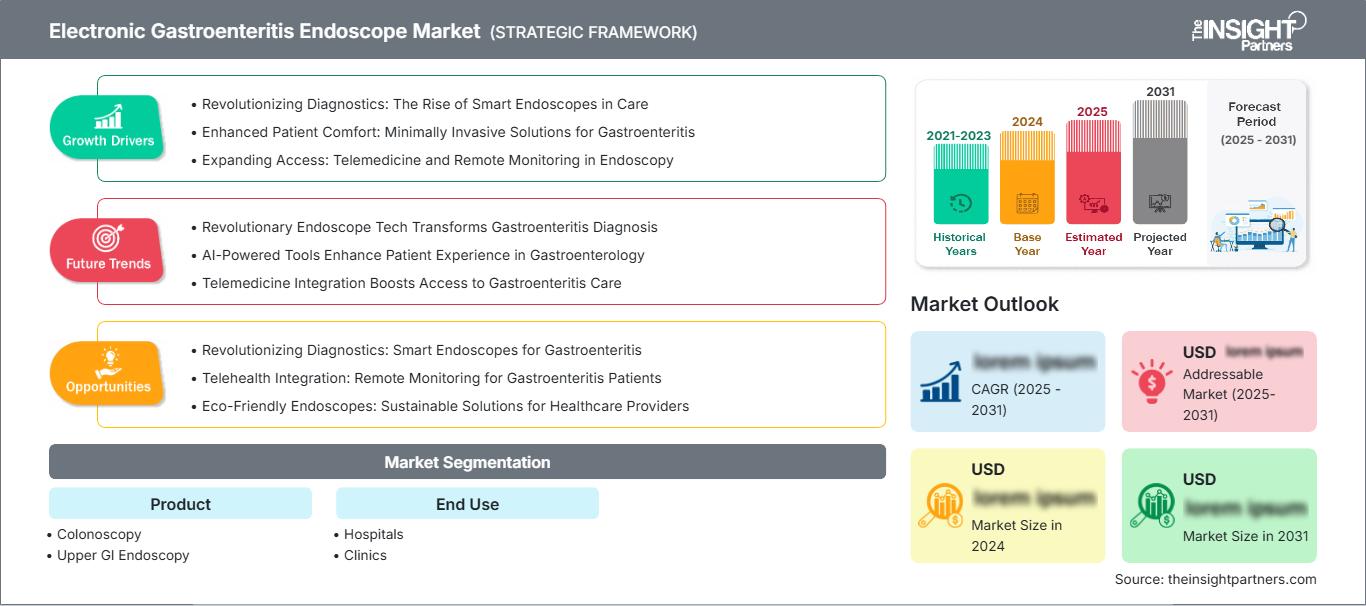
Electronic Gastroenteritis Endoscope Market was valued at US$ 1.59 Billion in 2025 and is projected to reach US$ 2.91 Billion by 2034, registering a CAGR of 7.85% during 2026–2034. Rising gastrointestinal disease prevalence, increasing adoption of minimally invasive diagnostic procedures, and continuous improvements in imaging quality are strengthening market demand. Healthcare providers continue investing in advanced visualization platforms to improve diagnostic precision and procedural efficiency while supporting broader adoption across developed and emerging healthcare systems.
North America is expected to maintain its leadership throughout the forecast period, supported by favorable reimbursement policies, expanding colorectal cancer screening programs, and rapid replacement of conventional visualization systems with digital platforms. The regional market is estimated to expand at a CAGR of 7.2–7.8% during 2026–2034, with hospitals increasingly investing in AI-enabled endoscopy solutions, infection prevention technologies, and integrated workflow management systems to enhance patient outcomes and operational efficiency.
Electronic Gastroenteritis Endoscope Market Assessment and Insights
- North America: North America accounted for 36–40% share in 2025 and is projected to grow at a CAGR of 7.2–7.8% during 2026–2034. Advanced healthcare infrastructure, extensive colorectal screening initiatives, and rapid adoption of AI-assisted endoscopy platforms continue supporting regional market expansion.
- U.S.: The U.S. represented 82–86% of the North American market in 2025 and is anticipated to record a CAGR of 7.3–7.9% during 2026–2034, driven by increasing outpatient endoscopy volumes and sustained capital investments by healthcare providers.
- Europe: Europe captured 26–30% share in 2025 and is forecast to expand at a CAGR of 6.8–7.4% during 2026–2034. Germany, the UK, and France remain the principal contributors owing to mature healthcare systems and organized gastrointestinal disease screening initiatives.
- Asia Pacific: Asia Pacific represented 22–26% share in 2025 and is expected to register the fastest regional expansion with a CAGR of 8.7–9.3% during 2026–2034. China, Japan, India, and South Korea continue increasing investments in endoscopy infrastructure and hospital modernization.
- Largest Segment: Hospitals remained the largest end-use segment with a market share of 68–72% in 2025 and are projected to grow at a CAGR of 7.5–8.1% during 2026–2034, supported by high procedural volumes and access to advanced imaging technologies.
- High Growth Segment: Upper GI Endoscopy is anticipated to witness the strongest expansion with a market share of 44–48% in 2025 and a CAGR of 8.2–8.8% during 2026–2034, reflecting growing diagnosis of upper gastrointestinal disorders and wider utilization of high-definition imaging systems.
- Key companies analyzed in detail: Olympus Corporation, FUJIFILM Holdings Corporation, HOYA Corporation, KARL STORZ SE & Co. KG, Stryker Corporation, Richard Wolf GmbH, Shanghai Aohua Photoelectricity Endoscope Co., Ltd., Huger Medical Instrument Co., Ltd., Optim LLC, and PENTAX Medical.
Source: The Insight Partners' analysis based on proprietary research, government publications, company annual reports, investor presentations, industry databases, and expert interviews.
Innovations such as digital imaging, high-definition optics, narrow-band imaging, and artificial intelligence-based lesion detection technology have enabled considerable growth within the Electronic Gastroenteritis Endoscope market. The incorporation of cloud-enabled image management capabilities, ergonomic designs and reusability with increased robustness of devices is common among manufacturers to increase procedural efficiency and reduce life-cycle costs. There has been increased geographical diversification of supply chains within the Electronic Gastroenteritis Endoscope market due to the disruptions witnessed within the last few years, driving the localization of manufacturing facilities and sourcing of components. This will further increase the size of the Electronic Gastroenteritis Endoscope market, and support its diagnostic accuracy and adoption within tertiary hospitals and dedicated gastroenterology clinics.
Looking into the future, investments in the healthcare sector in the Asia Pacific region, Latin America, and certain Middle Eastern economies will redefine the competitive landscape with increased procedural capacity and upgrading of hospital infrastructure. The focus on infection control, traceability, and digital interoperability by regulatory bodies is driving innovation in the industry. Investments in artificial intelligence, robotically assisted endoscopy, and imaging ecosystems will further broaden the scope of the Electronic Gastroenteritis Endoscope market.
Electronic Gastroenteritis Endoscope Market Report Scope
| Report Attribute | Details |
|---|---|
| Market size in 2025 | US$ 1.59 Billion |
| Market Size by 2034 | US$ 2.91 Billion |
| Global CAGR (2026 - 2034) | 7.85% |
| Historical Data | 2021-2024 |
| Forecast period | 2026-2034 |
Electronic Gastroenteritis Endoscope Market Analysis
Increased interest in the prevention of colorectal cancer, inflammatory bowel diseases, peptic ulcers, and other gastroenteritis problems is continuing to drive the use of procedures related to the product in question globally. Increasing interest in early diagnostics based on minimally invasive technologies is driving investments into high-resolution imaging systems, which can increase the precision of visualization. An increasing number of older people is contributing to demand due to the higher frequency of gastrointestinal diseases among aged patients. Thus, the trend towards increasing Electronic Gastroenteritis Endoscope use will continue owing to positive demographics and the spread of organized screening programs in developed healthcare markets.
Component suppliers, optical equipment suppliers, software vendors, sterilization equipment suppliers, distributors, hospitals, and specialty ambulatory centers represent the market ecosystem. Improvements in CMOS imaging sensors, illumination systems, and software for image documentation continue increasing value along the entire supply chain. Also, manufacturers pay increased attention to maintenance costs and longevity of devices to make purchasing for hospitals more attractive. These developments are having a positive impact on the Electronic Gastroenteritis Endoscope market analysis.
Competition remains concentrated among established global manufacturers with diversified product portfolios, extensive distribution capabilities, and strong research investments. Olympus Corporation, FUJIFILM Holdings Corporation, HOYA Corporation through its PENTAX Medical division, KARL STORZ SE & Co. KG, Stryker Corporation, Richard Wolf GmbH, Shanghai Aohua Photoelectricity Endoscope Co., Ltd., Huger Medical Instrument Co., Ltd., Optim LLC, and other regional participants continue expanding product capabilities through technological differentiation and strategic collaborations. Companies increasingly emphasize artificial intelligence integration, enhanced visualization software, and workflow optimization to strengthen customer retention.
Investment activity continues shifting toward digital endoscopy platforms capable of integrating clinical imaging, data analytics, and remote consultation capabilities within unified healthcare environments. Healthcare institutions increasingly evaluate procurement decisions based on infection control performance, interoperability, service support, and total ownership costs rather than acquisition price alone. These evolving purchasing priorities are reshaping competitive positioning while reinforcing the Electronic Gastroenteritis Endoscope share across advanced healthcare facilities. Simultaneously, expanding outpatient care infrastructure and growing public healthcare expenditure continue supporting favorable long-term Electronic Gastroenteritis Endoscope trends across both mature and emerging healthcare economies.
● REPORT CUSTOMIZATION
Tailor This Report To Align With Your Specific Business Requirements
This report can be customized to align precisely with your business objectives, scope, and target markets. Customization options include tailored segmentation, geography, competitive analysis, and strategic insights to support informed decision-making.
Customize This Report →WHAT YOU CAN ADJUST
- ● Segmentations
- ● Geography
- ● Competitive Analysis
- ● Language Preferences
Electronic Gastroenteritis Endoscope Market: Strategic Insights
Regional Insights
North America Electronic Gastroenteritis Endoscope Market
North America accounted for 36–40% of the global market in 2025 and is projected to expand at a CAGR of 7.2–7.8% during 2026–2034. Strong procedural volumes, favorable reimbursement frameworks, and widespread colorectal cancer screening programs continue supporting sustained adoption of electronic gastroenteritis endoscopes. Healthcare providers are increasingly replacing aging endoscopy systems with high-definition platforms incorporating artificial intelligence-assisted lesion detection and digital image management capabilities.
The United States and Canada continue investing in hospital modernization, outpatient endoscopy centers, and infection prevention technologies to improve patient safety and procedural efficiency. Growing demand for minimally invasive gastrointestinal diagnostics, coupled with rising prevalence of inflammatory bowel disease and gastrointestinal cancers, is expected to sustain regional leadership throughout the forecast period. Continuous technology upgrades and extensive manufacturer presence further reinforce North America's competitive position.
U.S. Electronic Gastroenteritis Endoscope Market
The U.S. represented 82–86% of the North American market in 2025 and is anticipated to record a CAGR of 7.3–7.9% during 2026–2034. Increasing adoption of outpatient gastrointestinal procedures, high awareness regarding preventive screening, and continuous replacement of legacy endoscopy equipment contribute to market expansion. Hospitals continue integrating artificial intelligence-enabled visualization systems that improve diagnostic confidence while reducing procedure time and enhancing workflow efficiency.
Leading manufacturers maintain extensive commercial operations, training facilities, and research collaborations throughout the country, accelerating commercialization of advanced imaging technologies. Rising utilization of electronic documentation, integrated endoscopy reporting systems, and cloud-enabled image management solutions supports greater operational efficiency. Continued investment in ambulatory surgical centers and value-based healthcare models further strengthens long-term market prospects across the United States.
Europe Electronic Gastroenteritis Endoscope Market
Europe accounted for 26–30% of the global market in 2025 and is projected to grow at a CAGR of 6.8–7.4% during 2026–2034. Government-supported screening initiatives, mature healthcare infrastructure, and increasing adoption of digital endoscopy technologies continue driving regional demand. Germany remains the leading national market because of its advanced hospital network, high procedural volumes, and early implementation of innovative visualization systems.
The United Kingdom continues expanding colorectal cancer screening participation while modernizing hospital diagnostic capabilities through digital healthcare investment. Germany benefits from strong domestic medical technology manufacturing, comprehensive reimbursement systems, and widespread utilization of minimally invasive gastrointestinal procedures. These structural advantages continue supporting steady equipment replacement cycles and sustained demand for premium electronic endoscopy platforms.
France, Italy, and Spain collectively contribute significant regional demand through increasing investments in public healthcare infrastructure and gastrointestinal disease management. Hospitals across these countries continue upgrading imaging systems to improve diagnostic accuracy while reducing procedural complications. Rising awareness of preventive screening and favorable demographic trends are expected to sustain moderate but consistent regional expansion throughout the forecast period.
APAC Electronic Gastroenteritis Endoscope Market
Asia Pacific represented 22–26% of the global market in 2025 and is forecast to register the fastest regional expansion with a CAGR of 8.7–9.3% during 2026–2034. China leads regional demand through extensive hospital construction and expanding domestic medical device manufacturing.
Japan and South Korea continue investing in advanced endoscopy technologies, supported by established healthcare systems and strong clinical expertise in gastrointestinal diagnostics. Manufacturers increasingly introduce high-definition imaging systems tailored for regional healthcare providers.
India and Australia are experiencing growing adoption due to healthcare infrastructure modernization, increasing insurance coverage, and expanding specialist care networks. Government initiatives supporting early disease diagnosis and medical technology investments are expected to accelerate long-term regional market development.
Middle East & Africa Electronic Gastroenteritis Endoscope Market
The Middle East & Africa market is anticipated to expand at a CAGR of 6.4–7.0% during 2026–2034. Saudi Arabia remains the leading contributor owing to sustained investment in hospital expansion and specialized gastrointestinal care facilities.
The United Arab Emirates continues strengthening private healthcare infrastructure through adoption of advanced digital diagnostic technologies, while South Africa maintains steady demand supported by tertiary hospitals and academic healthcare institutions.
The remaining Middle East and African countries are gradually increasing investments in healthcare infrastructure and diagnostic capacity. Continued modernization of medical facilities, supported by broader economic diversification and healthcare reform initiatives, is expected to create additional opportunities for electronic endoscopy manufacturers.
Segmentation Analysis
Product
The Product segment is projected to grow at a CAGR of 7.8–8.4% during 2026–2034. Continuous technological innovation, including high-definition visualization, narrow-band imaging, artificial intelligence-assisted diagnostics, and improved ergonomic designs, is driving adoption across healthcare facilities. Increasing emphasis on early gastrointestinal disease detection and minimally invasive procedures further supports sustained investment in advanced electronic endoscopy systems by hospitals and specialty clinics.
- Colonoscopy: Colonoscopy systems continue representing a substantial portion of product demand because of expanding colorectal cancer screening programs, routine surveillance procedures, and increasing utilization within tertiary hospitals seeking improved diagnostic accuracy and procedural efficiency.
- Upper GI Endoscopy: Upper GI Endoscopy demonstrates strong strategic importance owing to increasing diagnosis of esophageal, gastric, and duodenal disorders. Advanced imaging technologies, enhanced visualization capabilities, and growing outpatient procedure volumes continue supporting widespread clinical adoption.
End Use
The End Use segment is expected to expand at a CAGR of 7.5–8.1% during 2026–2034. Increasing procedural volumes, expanding healthcare infrastructure, and greater investment in digital visualization technologies continue influencing purchasing decisions across healthcare providers. Growing preference for minimally invasive gastrointestinal diagnosis and improved patient management supports sustained equipment replacement and new installations throughout the forecast period.
- Hospitals: Hospitals remain the dominant end users because they perform high volumes of diagnostic and therapeutic gastrointestinal procedures while maintaining access to advanced imaging platforms, multidisciplinary specialists, and comprehensive infection control infrastructure.
- Clinics: Clinics are steadily increasing adoption of electronic gastroenteritis endoscopes as outpatient gastrointestinal procedures become more common. Investments in compact digital platforms, shorter patient turnaround times, and cost-efficient diagnostic services continue strengthening this sub-segment's strategic importance.
Opportunity Snapshot
| Segment Name | Revenue Contribution | Trend Tag | Adoption Stage |
| Hospitals | High | AI Endoscopy | Mature |
| Clinics | Medium | Outpatient Care | Scaling |
Electronic Gastroenteritis Endoscope Market Growth Drivers and Impact Analysis
Growing Burden of Gastrointestinal Diseases and Screening Programs
The growing number of GI disorders that includes cancers of the colon or rectum, inflammatory bowel disease, peptic ulcers, and chronic gastritis keeps driving the demand for more sophisticated endoscopic diagnostic procedures. There is an increased pressure from health care organizations in developed and developing nations on conducting screenings for those at risk, resulting in more endoscopic procedures being conducted in hospitals and specialized centers. Early detection of diseases leads not only to better treatment results but also to motivating health care institutions to purchase new high-definition electronic endoscopy equipment that will be able to provide better images and documentation. Increased longevity and aging populations also drive the demand due to the fact that GI diseases tend to occur more often as people get older.
Technological Advancements Improving Diagnostic Accuracy
New technology innovations in the field of imaging have revolutionized the diagnostic process of gastrointestinal ailments through the ability to diagnose minute alterations on the mucosa with high accuracy. Through improved high-definition optics, narrow band imaging, use of artificial intelligence to identify polyps, better image processing and integrated digital reporting software, the process becomes both more precise and more reliable for clinicians. Hospitals also favor products that not only offer better visualization but are efficient in workflow and compatible with hospital information management systems. Endoscope manufacturers have also developed ergonomically improved endoscopes with durable tubing and advanced infection prevention technologies, lowering the cost of maintenance.
Expansion of Healthcare Infrastructure Across Emerging Economies
Healthcare infrastructure growth in Asia-Pacific, Middle-East, and select parts of Latin America has provided good conditions for adoption of endoscopy devices. The governments are still working on building tertiary hospitals and specialized centers of digestive diseases treatment, along with upgrading existing medical facilities, to provide more accessibility to healthcare services. There is also a growth in the number of private health service providers, who are increasing their diagnostic capabilities to deal with the growing numbers of patients and the importance of preventive gastrointestinal disease management. Better insurance and training programs for physicians add up to the demand for endoscopy procedures. Thus, the demand for electronic gastroenteritis endoscopes will grow continuously.
Electronic Gastroenteritis Endoscope Market Future Trends
Artificial Intelligence Integration Becoming Standard Clinical Practice
The role of artificial intelligence in gastrointestinal endoscopy is predicted to evolve into an everyday tool for helping with the detection of lesions in real-time, automatic classification of images, and standardized reporting. It is becoming more and more common for providers to look for methods that help minimize variation in diagnosis while at the same time increasing physician efficiency and bettering the patient’s outcome. Machine learning algorithms in conjunction with high-definition visualization technology may not only continue to detect polyps but also diagnose various conditions related to the gastrointestinal system. Moreover, future software upgrades provided via digital ecosystem connections can provide additional diagnostic capability without a need to replace all hardware.
Connected Digital Endoscopy Ecosystems Supporting Data-Driven Care
The development of electronic gastroenteritis endoscopy systems is moving towards an integrated digital approach by combining imaging equipment, electronic medical records, cloud-based storage, and clinical analytics. More and more hospitals realize the benefits of having centralized image management, teleconsultation features, and documentation for operational effectiveness. The manufacturers will need to develop additional interoperable functions to streamline workflow at various healthcare institutions. The use of secure digital data management will also assist physicians with collaboration and training. Integrated endoscopy ecosystems will become a significant competitive advantage in the international market in the future as the adoption of digital transformation in healthcare grows.
Electronic Gastroenteritis Endoscope Market Opportunities
Expansion of Ambulatory Gastroenterology Centers
Increasing ambulatory care demand is generating attractive investment potential for manufacturers who can provide small and economical electronic endoscopy systems. The rise in demand for outpatient GI procedures comes due to the fact that they have shorter recovery times, reduced treatment costs, and patient-friendly nature. Modern clinics and ASCs seek systems which have more efficient workflow and lower maintenance needs, in addition to having flexibility of installation. Manufacturers who can design an adaptable portfolio of products in order to fit the outpatient setting will help to increase their market presence along with service-based revenue streams.
Localized Manufacturing and Regional Distribution Expansion
There is much scope for enhancing long-term competitive edge by making use of increased localization of manufacturing, assembly facilities, and technical services. This diversified network of production provides protection from the risk that may arise in the supply chain as well as increases their ability to respond to regional procurement needs and regulations. Building up strong regional distribution networks helps accelerate the process of delivery of products as well as improves customer support and training of physicians. Increasingly, healthcare markets are becoming more receptive to those suppliers who can provide after-sales service along with cost-effective solutions.
Recent Developments
- October 2025: Olympus Corporation launched OLYSENSE CAD/AI in the U.S. and Europe, expanding its artificial intelligence portfolio for gastrointestinal endoscopy. The platform supports computer-aided lesion detection and workflow optimization, enabling clinicians to improve diagnostic consistency while strengthening intelligent endoscopy capabilities across major healthcare markets.
- May 2025: Olympus Corporation received U.S. FDA 510(k) clearance for its EZ1500 series endoscopes featuring Extended Depth of Field (EDOF) technology as part of the EVIS X1 platform. The innovation delivers continuously sharp imaging across varying focal distances, supporting improved visualization during gastrointestinal examinations.
- April 2025: FUJIFILM Holdings Corporation introduced the ELUXEO 8000 Therapeutic Endoscopy Solution in the Indian market during MUMBAI LIVE Endoscopy 2025. The platform incorporates 4K imaging, advanced CMOS sensors, and therapeutic capabilities designed to improve visualization quality, workflow efficiency, and minimally invasive gastrointestinal procedures.
Frequently Asked Questions

- Comprehensive Market Sizing and Forecast Analysis
- Detailed Segmentation Analysis
- In-Depth Market Dynamics Assessment
- Regional and Country-Level Insights
- Competitive Landscape and Company Benchmarking
- Strategic Business Intelligence
Recent Reports
Testimonials

The Insight Partners' SCADA System Market report is comprehensive, with valuable insights on current trends and future forecasts. The team was highly professional, responsive, and supportive throughout. We are very satisfied and highly recommend their services.
RAN KEDEM Partner, Reali Technologies LTDs
I requested a report on a very specific software market and the team produced the report in a few days. The information was very relevant and well presented. I then requested some changes and additions to the report. The team was again very responsive and I got the final report in less than a week.
JEAN-HERVE JENN Chairman, Future Analytica
We worked with The Insight Partners for an important market study and forecast. They gave us clear insights into opportunities and risks, which helped shape our plans. Their research was easy to use and based on solid data. It helped us make smart, confident decisions. We highly recommend them.
PIYUSH NAGPAL Sr. Vice President, High Beam Global
The Insight Partners delivered insightful, well-structured market research with strong domain expertise. Their team was professional and responsive throughout. The user-friendly website made accessing industry reports seamless. We highly recommend them for reliable, high-quality research services
YUKIHIKO ADACHI CEO, Deep Blue, LLC.
This is the first time I have purchased a market report from The Insight Partners.While I was unsure at first, I visited their web site and felt more comfortable to take the risk and purchase a market report.I am completely satisfied with the quality of the report and customer service. I had several questions and comments with the initial report, but after a couple of dialogs over email with their analyst I believe I have a report that I can use as input to our strategic planning process.Thank you so much for taking the extra time and making this a positive experience.I will definitely recommend your service to others and you will be my first call when we need further market data.
JOHN SUZUKI President and Chief Executive Officer, Board Director, BK Technologies
I wish to appreciate your support and the professionalism you displayed in the course of attending to my request for information regarding to infectious disease IVD market in Nigeria. I appreciate your patience, your guidance, and the fact that you were willing to offer a discount, which eventually made it possible for us to close a deal. I look forward to engaging The Insight Partners in the future, all thanks to the impression you have created in me as a result of this first encounter.
DR CHIJIOKE ONYIA MANAGING DIRECTOR, PineCrest Healthcare Ltd.Reason to Buy
- Informed Decision-Making
- Understanding Market Dynamics
- Competitive Analysis
- Identifying Emerging Markets
- Customer Insights
- Market Forecasts
- Risk Mitigation
- Boosting Operational Efficiency
- Strategic Planning
- Investment Justification
- Tracking Industry Innovations
- Aligning with Regulatory Trends





 Get Free Sample for