
Elemental Analysis Market Share, Growth & Demand by 2034
Coverage: By Element Type (Inorganic Elemental Analysis, Organic Elemental Analysis); Technology (Destructive Technologies, Nondestructive Technologies); Application (Healthcare, Food and Beverage, Environment, Others), and Geography (North America, Europe, Asia Pacific, and South and Central America)
- Status : Data Released
- Report Code : TIPRE00003485
- Category : Life Sciences
- No. of Pages : 150
- Available Report Formats :


- Last update date : July 16, 2026


2025 Market Size
US$ 4.77 Bn
Base year value
2034 Forecast
US$ 8.77 Bn
Projected by 2034
CAGR 2026-2034
7.01 %
Growth rate
Addressable Market
US$ 61.17 Bn
(2026-2034)
The elemental analysis market size was valued at US$ 4.77 Billion in 2025 and is projected to reach US$ 8.77 Billion by 2034, expanding at a CAGR of 7.01% during 2026–2034. Market expansion is supported by increasing quality assurance requirements across regulated industries, wider deployment of analytical instrumentation in industrial laboratories, and the growing need for precise elemental characterization in manufacturing, environmental monitoring, healthcare, and food safety applications.
North America is expected to maintain its leadership throughout the forecast period, registering an estimated CAGR of 6.6–7.0%. Sustained investments in laboratory modernization, stringent regulatory compliance for pharmaceuticals and environmental testing, and continuous adoption of advanced spectroscopy and chromatography platforms continue to strengthen regional demand. Strong research infrastructure and widespread industrial automation further reinforce market expansion across the United States and Canada.
Elemental Analysis Market Assessment and Insights
- North America: Holds 34–38% elemental analysis market share in 2025, growing at a CAGR of 6.6–7.0% during 2026–2034, driven by strong regulatory compliance, pharmaceutical innovation, and advanced laboratory infrastructure.
- US: Accounts for 82–86% of the North American market in 2025, expanding at a 6.8–7.2% CAGR due to increasing investments in analytical laboratories, pharmaceutical quality control, and advanced elemental analysis technologies.
- Europe: Represents 26–30% share in 2025, growing at a 6.4–6.8% CAGR, led by Germany, the UK, and France through stringent industrial quality standards, expanding environmental monitoring programs, and strong research capabilities.
- Asia Pacific: Holds 27–31% share in 2025, expanding at a 7.8–8.3% CAGR, led by China, Japan, and India with manufacturing expansion, industrial modernization, and increasing investments in scientific research and laboratory infrastructure.
- Largest Segment: Inorganic Elemental Analysis holds the largest market share in 2025, growing at a 6.8–7.2% CAGR due to its extensive application in environmental testing, mining, metallurgy, pharmaceuticals, and industrial quality assurance.
- High Growth Segment: Healthcare is projected to register the fastest growth at a CAGR of 8.0–8.5% during 2026–2034, driven by expanding precision diagnostics, pharmaceutical quality control, and increasing biomaterial research activities.
- Key companies analyzed in detail: Thermo Fisher Scientific Inc.; Agilent Technologies, Inc.; Revvity, Inc.; Bruker Corporation; AMETEK, Inc.; HORIBA, Ltd.; Rigaku Corporation; Shimadzu Corporation; Analytik Jena GmbH+Co. KG; Elementar Analysensysteme GmbH.
Source: The Insight Partners' analysis based on proprietary research, government publications, company annual reports, investor presentations, industry databases, and expert interviews.
The rapid growth of analytical instruments in recent years has greatly changed the market over the last decade. The use of automation, electronic processes, and better detection capability is being used in higher throughput instruments to ensure consistency in the analysis process. The manufacturers are constantly developing instruments that are able to analyze increasingly complicated samples and do it faster.
The elemental analysis market forecast indicates that the market growth is expected to be dependent on investments in new manufacturing economies, regulatory compliance, and laboratory modernization. Governments are improving their monitoring processes for the environment, while pharmaceuticals, semiconductors, food processing, and advanced materials industries are continuously investing in quality control.
Elemental Analysis Market Report Scope
| Report Attribute | Details |
|---|---|
| Market size in 2025 | US$ 4.77 Billion |
| Market Size by 2034 | US$ 8.77 Billion |
| Global CAGR (2026 - 2034) | 7.01% |
| Historical Data | 2021-2024 |
| Forecast period | 2026-2034 |
Elemental Analysis Market Analysis
There is rising demand for elemental analysis instruments as industries demand higher levels of accuracy when it comes to the verification of composition of their products for reasons such as quality assurance and compliance with certain regulations. This technology is used by pharmaceutical companies, food processors, environmental agencies, hospitals, and materials manufacturers for regulatory reporting and validation of processes. Innovations in spectrometry, combustion analysis, X-rays, and hybrid analysis instruments not only increase lab efficiency but also make it possible to detect trace level elements faster and more accurately.
The ecosystem consists of various vendors such as instrument makers, detectors, software providers, calibrators, lab service providers, distributors, and end-users in many industries that are regulated. There is increasing focus on automation, digitalization of labs, and predictive maintenance which enhances equipment utilization and drives replacements.
The competitive landscape continues to be defined by constant innovations of products, software, mergers, and acquisitions, as well as the growth in global services offerings. Such companies as Thermo Fisher Scientific Inc., Agilent Technologies, Inc., Revvity, Inc., Bruker Corporation, AMETEK, Inc., HORIBA, Ltd., Rigaku Corporation, Shimadzu Corporation, Analytik Jena GmbH+Co. KG, and Elementar Analysensysteme GmbH compete in the market because of their diversified analysis offerings, expertise, and extensive presence in international markets.
There is an increasing trend for companies to invest in intelligent automation, digital laboratory systems, software solutions aimed at particular applications, and local service delivery, which should improve customer retention. Collaborations with academic institutions, pharmaceutical companies, industry labs, and governmental organizations should help validate the technology and expand into new applications such as batteries, semiconductors, renewable energy, and environmental monitoring.
● REPORT CUSTOMIZATION
Tailor This Report To Align With Your Specific Business Requirements
This report can be customized to align precisely with your business objectives, scope, and target markets. Customization options include tailored segmentation, geography, competitive analysis, and strategic insights to support informed decision-making.
Customize This Report →WHAT YOU CAN ADJUST
- ● Segmentations
- ● Geography
- ● Competitive Analysis
- ● Language Preferences
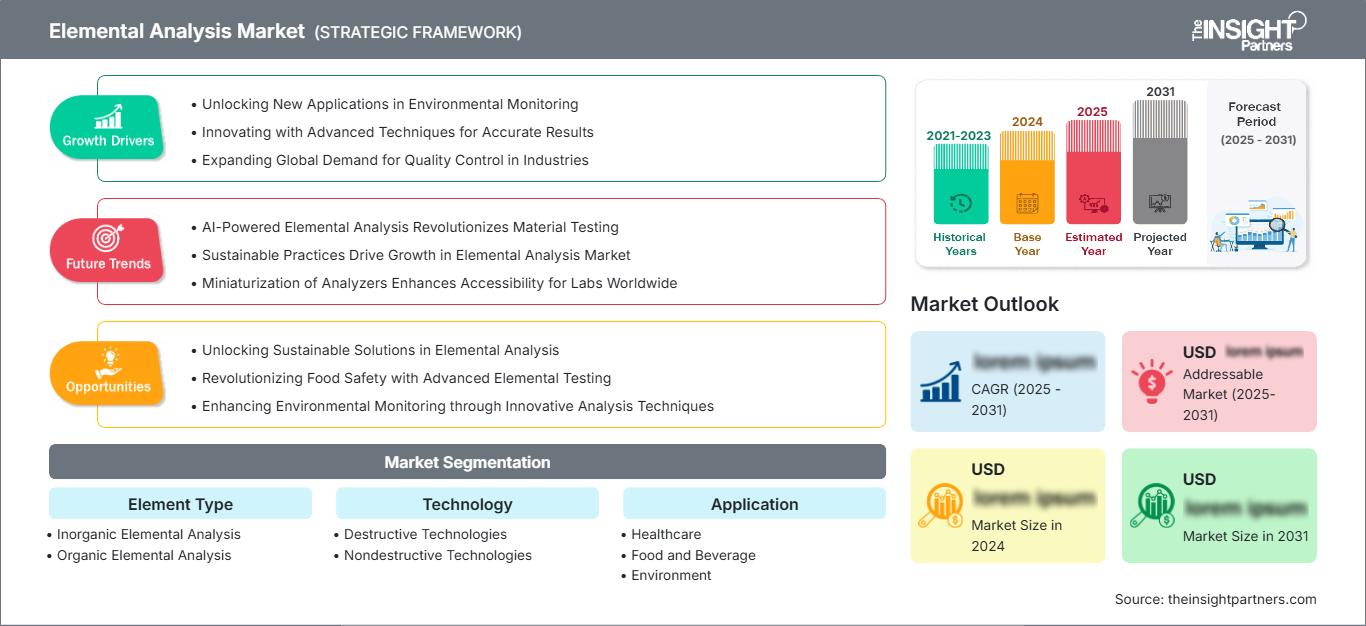
Elemental Analysis Market: Strategic Insights
Regional Insights
North America Elemental Analysis Market
North America accounted for 34–38% of the global market in 2025 and is projected to expand at a CAGR of 6.6–7.0% during 2026–2034. Stable investments in laboratory modernization and analytical precision continue to support regional growth.
The region benefits from stringent regulatory frameworks governing pharmaceuticals, environmental testing, food safety, and industrial manufacturing. Growing deployment of automated analytical platforms and digital laboratory systems further enhances operational efficiency across research organizations and commercial laboratories.
U.S. Elemental Analysis Market
The United States represented approximately 82–86% of the North American market in 2025 and is anticipated to register a CAGR of 6.8–7.2% through 2034. The country maintains one of the world's most advanced analytical laboratory infrastructures.
The leading manufacturers have large-scale operations of research, manufacture, and services in the country. Applications of elemental analysis are increasing continuously in health care, quality assurance in the pharmaceuticals industry, environmental testing, semiconductor manufacture, and materials characterization.
Europe Elemental Analysis Market
According to the elemental analysis market report, Europe held an estimated 26–30% share of the global market in 2025 and is forecast to record a CAGR of 6.4–6.8%. Strong industrial standards and harmonized regulatory requirements continue supporting sustained investment in analytical instrumentation.
Germany leads the market due to its advanced manufacturing sector, chemical production, automotive engineering, and extensive industrial quality assurance infrastructure. Continuous investment in precision manufacturing supports long-term demand for high-performance elemental analysis systems.
The United Kingdom continues expanding analytical capabilities across pharmaceutical research, environmental laboratories, and academic institutions. France, Italy, and Spain also contribute significantly through food quality testing, healthcare diagnostics, industrial process monitoring, and increasing adoption of laboratory automation technologies.
APAC Elemental Analysis Market
Asia Pacific represented 27–31% of global revenue in 2025 and is expected to achieve the fastest regional expansion at a CAGR of 7.8–8.3% during the forecast period. Industrialization and laboratory capacity expansion continue strengthening regional demand.
China leads the elemental analysis market through extensive manufacturing, mining, electronics, and pharmaceutical production. Japan contributes to advanced analytical research, while South Korea strengthens semiconductor and materials testing. India expands laboratory infrastructure across healthcare and environmental applications, and Australia maintains steady demand through mining, agriculture, and environmental monitoring.
Government initiatives supporting scientific research, industrial modernization, and environmental compliance continue encouraging adoption of high-precision elemental analysis technologies across both public and private laboratories throughout the region.
Middle East & Africa Elemental Analysis Market
The Middle East and Africa elemental analysis market is expected to witness steady expansion with a CAGR of 6.1–6.5% through 2034. Demand is supported by increasing investments in industrial laboratories, environmental compliance, and energy sector modernization.
Saudi Arabia remains the largest regional market owing to petrochemical expansion and industrial diversification initiatives. The United Arab Emirates continues investing in research infrastructure and advanced manufacturing, while South Africa supports demand through mining and metallurgical analysis.
The remaining MEA countries are gradually strengthening laboratory capabilities for food safety, environmental monitoring, water quality assessment, and infrastructure development, creating new opportunities for analytical instrument suppliers over the long term.
Segmentation Analysis
Element Type
Element Type represents the foundational segmentation of the Elemental Analysis Market. Inorganic Elemental Analysis remains the leading segment and is anticipated to grow at a CAGR of 6.8–7.2% during 2026–2034, supported by broad utilization across environmental testing, metallurgy, pharmaceuticals, mining, and industrial quality control where accurate elemental composition is essential for regulatory compliance and production efficiency.
- Inorganic Elemental Analysis: Widely adopted for trace metal determination, geological analysis, pharmaceutical validation, environmental monitoring, industrial process control, and material certification requiring highly accurate elemental quantification across diverse sample matrices.
- Organic Elemental Analysis: Increasingly utilized for carbon, hydrogen, nitrogen, sulfur, and oxygen determination in chemicals, polymers, pharmaceuticals, energy materials, academic research, and advanced materials development requiring precise compositional characterization.
Technology
Continuous technological innovation has significantly enhanced analytical sensitivity, throughput, automation, and reproducibility across elemental analysis workflows, allowing laboratories to improve operational efficiency while reducing turnaround time and ensuring regulatory compliance.
- Destructive Technologies: Preferred where comprehensive quantitative analysis and maximum analytical accuracy are required, particularly for pharmaceutical testing, mining applications, metallurgy, environmental laboratories, and advanced materials characterization.
- Nondestructive Technologies: Growing adoption for rapid screening, industrial inspection, cultural heritage preservation, semiconductor manufacturing, electronics quality assurance, and production monitoring where preserving sample integrity remains essential.
Application
Application diversity continues expanding as elemental analysis becomes increasingly important for quality assurance, research, environmental protection, and regulatory compliance across multiple industries worldwide.
- Healthcare: Supports pharmaceutical manufacturing, clinical research, biomaterials characterization, medical device quality assurance, toxicology studies, and precision diagnostics through highly sensitive elemental composition analysis.
- Food and Beverage: Enables contaminant detection, nutritional verification, ingredient authentication, product quality assurance, regulatory compliance, and supply chain traceability across processed foods and agricultural products.
- Environment: Facilitates soil, water, wastewater, air, and industrial emission analysis for pollution monitoring, environmental remediation, regulatory reporting, sustainability initiatives, and long-term ecological protection programs.
Opportunity Snapshot
| Segment Name | Revenue Contribution | Trend Tag | Adoption Stage |
| Healthcare | High | Precision Medicine | Scaling |
| Food and Beverage | Medium | Heavy Metals | Mature |
| Environment | High | Emission Testing | Scaling |
Elemental Analysis Market Growth Drivers and Impact Analysis
Expanding Regulatory Requirements for Product Quality and Safety
The standards for quality remain under development in the areas of pharmaceuticals manufacturing, food products processing, environmental analysis, chemical products, and industrial production. Companies turn to elemental analysis systems in order to control materials, analyze contaminations, check production processes, and comply with new standards in their countries and abroad. The growing importance of traceability and consistent testing led companies to invest in the state-of-the-art laboratories that would provide accurate, repeatable, and auditable testing. With the increase in the number of regulations, both public and private laboratories start to replace their old equipment with more automated, sensitive systems.
Rising Demand for High-Precision Materials Characterization
There is a growing need for manufacturers in electronics, semiconductors, battery materials, aerospace, mining, specialty chemicals, and advanced materials to characterize their products in terms of elemental composition for greater uniformity and efficiency in the production process. State-of-the-art analytical instrumentation facilitates identification of the elements present in trace quantities that affect the quality and performance of such materials. With the growing complexity in production processes, there is a need for the labs to have analytical instruments that offer speed while maintaining precision in analysis. The increasing number of electric vehicle batteries, renewable energy solutions, and high performance electronic parts also increases the importance of elemental analysis.
Growing Laboratory Automation and Digital Workflow Integration
Labs in the modern world are now giving preference to automation to increase efficiency, decrease human interaction and ensure accuracy of the data collected. Elemental analysis systems come equipped with automatic sample handling, intelligent calibration, integration with cloud lab information management systems and advanced software that supports automation of reporting. Automation of such processes helps to decrease time spent on analyses while reducing the risk of errors and improving the documentation process. Predictive maintenance and remote diagnostics of instruments as well as centralized data storage help organizations decrease the overall cost of using instruments throughout their lifecycle.
Elemental Analysis Market Future Trends
Artificial Intelligence Enhancing Analytical Interpretation
A notable elemental analysis market trend is the growing integration of AI into elemental analysis to enhance spectral interpretation, anomaly detection, predictive calibration, and automated quality control. Advanced algorithms have the ability to analyze complex analytical data quickly, thereby enabling labs to save time on the interpretation process while increasing the accuracy of the process between various analysts and lab locations. The integration of machine learning into laboratory management systems will also facilitate intelligent reporting and efficient work processes. With the continuous increase in the complexity of analytical data, decision support from AI could soon become a standard feature in next-gen elemental analysis systems.
Portable and Field-Deployable Analytical Instruments
There is a growing need for smaller-scale devices for elemental analysis that can provide laboratory level accuracy in the field. This is because mining companies, environmental inspections, construction projects, emergency response groups, and manufacturing plants all have the need for fast elemental analysis on site, without the need to transport the samples back to the laboratory for further analysis. In order to meet this demand, manufacturers are producing smaller devices that can offer high battery life, wireless capabilities, and increased sensitivity.
Elemental Analysis Market Opportunities
Expansion Across Emerging Research and Industrial Laboratories
The rapid pace of industrialization coupled with the increasing capability to conduct scientific research provides a significant number of opportunities in the elemental analysis market. The governments remain committed to investment in laboratories, environmental monitoring, pharmaceutical manufacture, and higher education facilities. This creates a consistent need for advanced analytical equipment along with the availability of technical support and training at the local level. Businesses that create regional sales and service networks will be able to build long-term customer relations while generating additional revenue from software, calibrations, and consumable parts.
Customized Solutions for High-Growth Industry Applications
The growing tendency toward specialization within the areas of pharmaceuticals, semiconductors manufacturing, renewable energy materials, food safety, and other chemical applications provides prospects for the development of application-oriented elemental analysis systems. Consumers are showing greater interest in systems that incorporate optimized hardware, specific analytical software, regulatory documents, and specialized applications. Manufacturers who are able to offer application-oriented analytical solutions with the help of consulting and validation activities will have competitive advantages over those manufacturers who concentrate only on instrumentation solutions. Collaboration with industrial manufacturers, universities, and government laboratories is another option for speeding up innovation in the elemental analysis market.
Recent Developments
- March 2026: Rigaku Corporation launched the NEX QC II Series benchtop X-ray fluorescence (XRF) analyzers at Pittcon 2026. The new systems are designed to improve industrial quality control through faster elemental measurements, enhanced usability, and expanded application capabilities across metals, chemicals, mining, and manufacturing laboratories, strengthening the company's analytical instrumentation portfolio.
- January 2026: Agilent launched the Agilent 9500 Triple Quadrupole ICP-MS, a next-generation inductively coupled plasma mass spectrometer designed to simplify advanced trace elemental analysis. The system introduces the company's Dual-Cell System with Air Cell and Advanced Helium Mode to improve productivity and reduce acquisition time for environmental, pharmaceutical, food, and industrial laboratories.
- August 2025: Rigaku Corporation introduced the XHEMIS TX-3000 total reflection X-ray fluorescence (TXRF) analytical system for semiconductor manufacturing. The platform enables highly sensitive detection of trace contaminants on wafer surfaces, supporting increasingly stringent quality requirements and improved production yields for next-generation semiconductor fabrication processes.
Frequently Asked Questions

- Comprehensive Market Sizing and Forecast Analysis
- Detailed Segmentation Analysis
- In-Depth Market Dynamics Assessment
- Regional and Country-Level Insights
- Competitive Landscape and Company Benchmarking
- Strategic Business Intelligence
Recent Reports
Testimonials

The Insight Partners provided valuable market intelligence that supported our global go-to-market strategy. Their team was professional, responsive, and attentive to our feedback, providing thoughtful analysis and helpful methodological clarifications throughout the project.
Junmo Kim Chief Financial Officer (CFO), Enertech Co., Ltd.
The Insight Partners' SCADA System Market report is comprehensive, with valuable insights on current trends and future forecasts. The team was highly professional, responsive, and supportive throughout. We are very satisfied and highly recommend their services.
RAN KEDEM Partner, Reali Technologies LTDs
I requested a report on a very specific software market and the team produced the report in a few days. The information was very relevant and well presented. I then requested some changes and additions to the report. The team was again very responsive and I got the final report in less than a week.
JEAN-HERVE JENN Chairman, Future Analytica
We worked with The Insight Partners for an important market study and forecast. They gave us clear insights into opportunities and risks, which helped shape our plans. Their research was easy to use and based on solid data. It helped us make smart, confident decisions. We highly recommend them.
PIYUSH NAGPAL Sr. Vice President, High Beam Global
The Insight Partners delivered insightful, well-structured market research with strong domain expertise. Their team was professional and responsive throughout. The user-friendly website made accessing industry reports seamless. We highly recommend them for reliable, high-quality research services
YUKIHIKO ADACHI CEO, Deep Blue, LLC.
This is the first time I have purchased a market report from The Insight Partners.While I was unsure at first, I visited their web site and felt more comfortable to take the risk and purchase a market report.I am completely satisfied with the quality of the report and customer service. I had several questions and comments with the initial report, but after a couple of dialogs over email with their analyst I believe I have a report that I can use as input to our strategic planning process.Thank you so much for taking the extra time and making this a positive experience.I will definitely recommend your service to others and you will be my first call when we need further market data.
JOHN SUZUKI President and Chief Executive Officer, Board Director, BK Technologies
I wish to appreciate your support and the professionalism you displayed in the course of attending to my request for information regarding to infectious disease IVD market in Nigeria. I appreciate your patience, your guidance, and the fact that you were willing to offer a discount, which eventually made it possible for us to close a deal. I look forward to engaging The Insight Partners in the future, all thanks to the impression you have created in me as a result of this first encounter.
DR CHIJIOKE ONYIA MANAGING DIRECTOR, PineCrest Healthcare Ltd.Reason to Buy
- Informed Decision-Making
- Understanding Market Dynamics
- Competitive Analysis
- Identifying Emerging Markets
- Customer Insights
- Market Forecasts
- Risk Mitigation
- Boosting Operational Efficiency
- Strategic Planning
- Investment Justification
- Tracking Industry Innovations
- Aligning with Regulatory Trends





 Get Free Sample for