
EMI Shielding Material Market Size, Trends & Demand by 2034
Coverage: By Components (Conductive Coatings and Paints, EMI Shielding Tapes and Laminates, Conductive Polymers, Others); Application (Consumer Electronics, Telecommunication and IT, Automotive, Aerospace And Defense, Others) , and Geography (North America, Europe, Asia Pacific, and South and Central America)
- Status : Data Released
- Report Code : TIPRE00021622
- Category : Chemicals and Materials
- No. of Pages : 150
- Available Report Formats :


- Last update date : August 13, 2026


2025 Market Size
US$ 8.88 Bn
Base year value
2034 Forecast
US$ 13.63 Bn
Projected by 2034
CAGR 2026-2034
4.88 %
Growth rate
Addressable Market
US$ 102.19 Bn
(2026-2034)
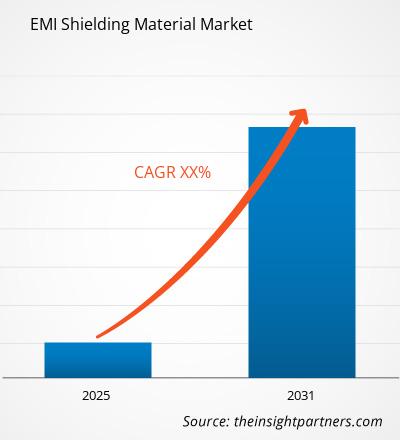
The EMI Shielding Material market was valued at US$ 8.88 billion in 2025 and is expected to reach US$ 13.63 billion by 2034; it is estimated to record a CAGR of 4.88% during 2026-2034.
EMI Shielding Material Market Assessment and Insights
- North America The region accounted for an estimated share of 30–34% in 2025 and is expected to grow at a CAGR range of 5.0–6.0% during 2026–2034. Growth is supported by aerospace electronics, automotive electrification, defense systems, and advanced communication networks.
- US The country represented an estimated share of 24–28% in 2025 and is projected to expand at a CAGR range of 5.1–6.1% from 2026–2034. Demand is driven by semiconductor innovation, military electronics, and 5G infrastructure deployment.
- Europe Europe held an estimated share of 22–26% in 2025 and is anticipated to grow at a CAGR range of 4.8–5.8% during 2026–2034. Germany, the UK, France, and Italy are key contributors due to automotive electronics and industrial automation.
- Asia Pacific The region captured an estimated share of 32–36% in 2025 and is expected to achieve a CAGR range of 5.7–6.7% between 2026–2034. China, Japan, South Korea, and India are driving expansion through electronics manufacturing and communication infrastructure.
- Largest Segment Conductive coatings and paints represented the largest component category, accounting for an estimated market share of 35–39% in 2025, with a CAGR range of 5.2–6.2% during 2026–2034.
- High Growth Segment Conductive polymers are projected as the fastest-growing component category, holding an estimated share of 20–24% in 2025 and expanding at a CAGR range of 6.0–7.0% during 2026–2034.
- Key companies analyzed in detail: 3M Company, Parker Hannifin Corporation (Chomerics Division), ETS-Lindgren Inc., HEICO Corporation, DuPont de Nemours, Inc. (Laird Performance Materials), Marktek, Inc., Omega Shielding Products, Inc., RTP Company, Schaffner Holding AG, Tech-Etch, Inc.
Source: The Insight Partners' analysis based on proprietary research, government publications, company annual reports, investor presentations, industry databases, and expert interviews.
The evolution of the Market has been characterized by an increase in the use of new shielding materials from metallic to lighter and flexible shielding materials suited for certain uses. There have been developments in coatings, conductive polymer composites, and precision-made shielding products that increase performance within smaller electronic equipment. Lighter material and greater durability with flexibility are being used by companies. This has seen the growth of the applications of these materials within electric vehicles, wireless communication technology, medical electronics, and high frequency applications.
The future EMI Shielding Material Market growth will be determined by the development of semiconductor technology ecosystems, communication infrastructure, and defense electronics. The rise in new manufacturing sites within Asia Pacific and localizing efforts in North America will see further developments in the industry. Emphasis on electromagnetic compatibility standards and growth of connected systems will fuel the growth of materials.
EMI Shielding Material Market Report Scope
| Report Attribute | Details |
|---|---|
| Market size in 2025 | US$ 8.88 Billion |
| Market Size by 2034 | US$ 13.63 Billion |
| Global CAGR (2026 - 2034) | 4.88% |
| Historical Data | 2021-2024 |
| Forecast period | 2026-2034 |
EMI Shielding Material Market Analysis
The development of the EMI Shielding Material Market is predominantly driven by the increased complexity of the electronic system as well as increased packaging density. Electronic components require proper shielding in order to avoid disturbance of their work. Value chain involves raw material suppliers, shielding material manufacturers, component manufacturers, electronic equipment manufacturers, and consumers. Supply drivers are determined by availability of materials used for shielding, including conductive fillers, polymers, metals foils, and coatings. Suppliers of raw materials for shielding materials are increasingly producing specific formulations for particular applications, including heat resistance, corrosion resistance, flexibility, and high frequency attenuation.
The growing number of batteries in electric vehicles is causing additional demand for shielding material used in battery systems, power electronics, and advanced driver-assistance systems. The growth of telecommunications infrastructure, including higher frequency networks, is driving procurement decisions for equipment manufacturers.
The EMI Shielding Material Market report reveals that there exists stiff competition in the market, driven by technology differences, strategic alliances and product development based on applications. Major companies like 3M Company, Parker Hannifin Corporation (Chomerics Division), ETS-Lindgren Inc., and DuPont de Nemours, Inc. (Laird Performance Materials) have increased their competitive advantage through the use of advanced material solutions and shielding technology. Specialized companies such as Tech-Etch, Inc., Omega Shielding Products, Inc., and Schaffner Holding AG are emphasizing customized components used in aerospace, industrial and electronics applications.
Market trends in investment include composite materials, polymer technologies and capabilities for production of high performance electronic systems. Market players are increasing their research efforts to meet growing demands in applications related to electric cars, autonomous systems and advanced wireless networks. Strategic positioning is now more dependent on material innovations, production scalability and provision of integrated shielding solutions.
● REPORT CUSTOMIZATION
Tailor This Report To Align With Your Specific Business Requirements
This report can be customized to align precisely with your business objectives, scope, and target markets. Customization options include tailored segmentation, geography, competitive analysis, and strategic insights to support informed decision-making.
Customize This Report →WHAT YOU CAN ADJUST
- ● Segmentations
- ● Geography
- ● Competitive Analysis
- ● Language Preferences
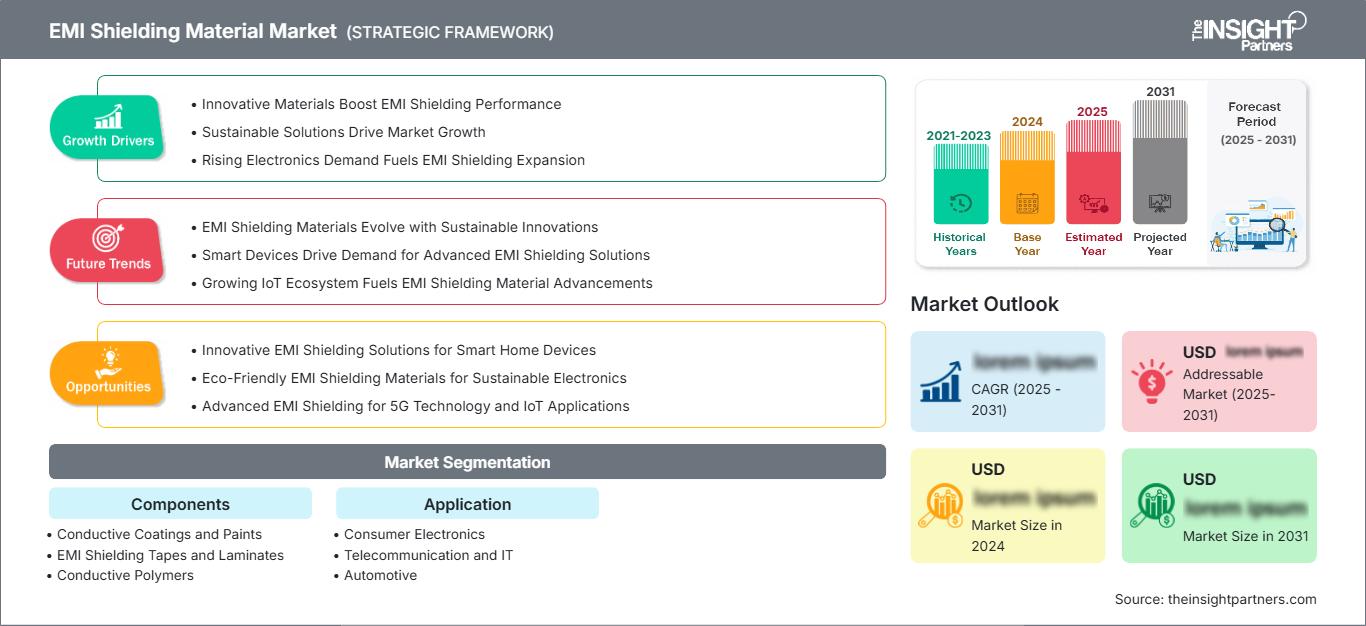
EMI Shielding Material Market: Strategic Insights
Regional Insights
North America EMI Shielding Material Market
North America accounted for an estimated share of 30–34% of the EMI Shielding Material Market Share in 2025 and is projected to expand at a CAGR range of 5.0–6.0% between 2026–2034. The region benefits from strong aerospace, defense, semiconductor, and automotive electronics ecosystems. Increasing deployment of advanced communication systems and stringent electromagnetic compatibility requirements are supporting demand for engineered shielding solutions.
United States still leads the way on this continent because of its well-developed capabilities in electronics production, modernizing its military systems, and developing technologies for electric vehicles. Canada and Mexico are also making their contributions with respect to automotive industry and developing industrial electronics. The availability of materials producers and component makers improves the regional supply chains, whereas rising number of connected devices provides more protection opportunities for material producers.
U.S. EMI Shielding Material Market
The U.S. Market represented an estimated 75–82% share of the North American market in 2025 and is expected to grow at a CAGR range of 5.1–6.1% during 2026–2034. The country maintains a strong position due to its advanced aerospace and defense sector, extensive semiconductor ecosystem, and increasing electronic content in vehicles. Government investments in defense electronics and domestic semiconductor manufacturing are supporting long-term demand.
Key uses are military communications equipment, avionics equipment, consumer products, medical devices, and automotive systems. Companies that are in the country are designing and manufacturing advanced and effective shielding solutions for meeting demands for miniaturized electronic components and high-frequency operations. Increased adoption of electric cars and autonomous driving technologies is adding to the need for EMC solutions in automotive systems.
Europe EMI Shielding Material Market
Europe accounted for 22–26% of the market share in 2025 and is forecast to register a CAGR range of 4.8–5.8% between 2026–2034. Germany leads regional demand due to its strong automotive manufacturing base, industrial automation capabilities, and focus on advanced electronics integration. The UK, France, Italy, and Spain are also contributing through aerospace, defense, and telecommunications applications.
Aerospace electronics, defense communication electronics, and technology development through research have been driving the UK market. Electric vehicle manufacturing and digitization have remained the driving factors for the German market. Demand from automotive electronics, renewable energy systems, and industrial machinery has been driving the French, Italian, and Spanish markets. Europe's regulations focusing on electromagnetic compatibility standards are motivating manufacturers to use reliable shielding materials.
APAC EMI Shielding Material Market
APAC is anticipated to have a market share of about 32–36% of the Market in 2025 and grow at a compound annual growth rate of 5.7–6.7% during 2026–2034. China is the leading regional contributor, owing to increased capabilities in electronics manufacturing and communication network development. Japan and South Korea contribute to the demand because of their semiconductor and advanced electronics industry.
The Indian and Australian economies are the new regional contributors, as they are making more investments in electronics manufacturing and defense technologies. Various government initiatives to promote local manufacturing, develop digital infrastructure, and adopt electric mobility are helping build opportunities within the region. The existence of a huge electronics manufacturing chain and increasing connected devices' production are also helping.
Middle East & Africa EMI Shielding Material Market
The Middle East & Africa Market is estimated to account for a smaller regional share in 2025 and is projected to expand at a CAGR range of 4.5–5.5% between 2026–2034. Saudi Arabia leads regional adoption through investments in telecommunications, defense infrastructure, and industrial modernization projects. The UAE is also contributing through aerospace and smart infrastructure initiatives.
South Africa remains an important market due to mining automation, telecommunications expansion, and industrial electronics applications. Rest of MEA countries are gradually adopting shielding solutions through infrastructure development and energy sector digitization. Growing investments in communication networks and electronic systems used in energy and industrial applications are expected to support regional market development.
Segmentation Analysis
Components
Components represented the largest segment of the Market, with a CAGR range of 5.2–6.2% during 2026–2034. The segment includes materials designed to reduce electromagnetic interference through conductive and absorptive mechanisms. Increasing demand for lightweight solutions in compact electronic devices, automotive systems, and communication equipment is encouraging manufacturers to develop advanced formulations with improved conductivity and durability.
- Conductive Coatings and Paints are widely used for protecting electronic enclosures and components requiring uniform shielding coverage. Their application flexibility across consumer electronics, automotive systems, and industrial equipment supports strong market adoption.
- EMI Shielding Tapes and Laminates provide effective protection through flexible installation and high-performance conductive layers. They are preferred in electronic assemblies where space limitations require lightweight and adaptable shielding solutions.
- Conductive Polymers are gaining importance due to their lightweight characteristics, design flexibility, and compatibility with modern electronic systems. Their increasing use in automotive and portable electronics supports broader adoption.
Application
Application segment is expected to register a CAGR range of 5.5–6.5% during 2026–2034, supported by rising electronic integration across industries. Increasing dependence on wireless connectivity, electrification, and automation is driving demand for shielding materials across diverse applications. Manufacturers are developing application-specific solutions to address different frequency ranges, environmental conditions, and performance requirements.
- Consumer Electronics represents a significant application area due to increasing demand for smartphones, wearable devices, laptops, and compact electronic products. Miniaturization trends are increasing the requirement for effective shielding materials.
- Telecommunication and IT applications are expanding due to network infrastructure upgrades, data centers, and advanced communication equipment. Shielding materials help maintain signal integrity and operational reliability in high-frequency environments.
- Automotive adoption is increasing with electric vehicles, autonomous systems, and advanced electronic architectures. Shielding solutions are required for battery systems, sensors, control units, and power electronics.
- Aerospace And Defense applications rely on high-performance shielding materials for mission-critical electronics, communication systems, and aircraft technologies. Reliability, durability, and resistance to harsh environments remain important selection factors.
Opportunity Snapshot
| Application | Revenue Contribution | Trend Tag | Adoption Stage |
| Consumer Electronics | High | Device Miniaturization | Mature |
| Telecommunication and IT | High | 5G Infrastructure | Scaling |
| Automotive | Medium | EV Electronics | Scaling |
| Aerospace And Defense | Medium | Mission Electronics | Mature |
EMI Shielding Material Market Growth Drivers and Impact Analysis
Rising Electronic Complexity Across Connected Devices
Increasing integration of electronic components in consumer devices, vehicles, industrial systems, and communication equipment is creating stronger requirements for electromagnetic interference protection. Modern products contain higher component densities and operate across multiple frequency ranges, increasing the possibility of signal disruption. This is encouraging manufacturers to adopt advanced shielding materials that provide reliable attenuation without adding significant weight or bulk. The expansion of smart devices, connected appliances, and industrial automation systems is directly influencing material demand. Suppliers are responding through development of conductive coatings, flexible laminates, and polymer-based solutions that support compact designs while maintaining electromagnetic compatibility performance across different operating environments.
Expansion of Electric and Autonomous Vehicle Electronics
The increasing adoption of electric vehicles and advanced driver assistance systems is creating new demand for shielding solutions used in battery systems, sensors, power electronics, and control modules. Electric vehicles contain numerous electronic components operating simultaneously, making electromagnetic compatibility essential for vehicle safety and performance. Automotive manufacturers are increasingly integrating lightweight shielding materials that reduce interference while supporting vehicle efficiency goals. The transition toward connected and autonomous mobility platforms is further increasing the requirement for specialized shielding solutions capable of managing high-frequency signals. Material suppliers are developing application-specific products that address thermal exposure, vibration, and durability requirements within automotive environments.
Growth of Advanced Communication Infrastructure
Expansion of wireless networks, data centers, and high-speed communication infrastructure is strengthening demand for electromagnetic protection materials. Advanced communication systems operate at increasingly higher frequencies, requiring effective shielding solutions to maintain signal quality and prevent interference between components. The rollout of next-generation networks and increasing dependence on digital connectivity are encouraging telecommunications equipment manufacturers to adopt improved shielding technologies. Data center expansion is also contributing to demand as operators require reliable electronic systems with reduced interference risks. Companies are investing in innovative materials that combine conductivity, flexibility, and thermal management capabilities to address the evolving requirements of communication and information technology applications.
EMI Shielding Material Market Future Trends
Development of Lightweight Multifunctional Shielding Materials
The EMI Shielding Material Market trends are expected to focus on lightweight multifunctional materials that combine electromagnetic protection with additional properties such as thermal management, mechanical strength, and environmental resistance. Researchers and manufacturers are exploring advanced composites, conductive polymers, and hybrid material structures to meet requirements from electric vehicles, aerospace systems, and compact electronics. These materials can help reduce overall system weight while improving operational reliability. Increasing preference for miniaturized devices and efficient electronic architectures is expected to accelerate adoption of multifunctional shielding solutions. The trend toward integrated material performance will influence product development strategies and encourage collaboration between material suppliers and electronic equipment manufacturers.
Integration of Sustainable Shielding Material Solutions
Sustainability considerations are expected to influence future material innovation as industries seek alternatives with improved environmental performance. Manufacturers are increasingly evaluating recyclable polymers, reduced material consumption approaches, and production methods that lower environmental impact while maintaining shielding effectiveness. The growing emphasis on sustainable electronics manufacturing is likely to encourage development of eco-conscious shielding products. Automotive and consumer electronics companies are particularly focused on improving lifecycle performance of components used in their products. As environmental standards continue to evolve, material suppliers that can balance shielding performance with sustainability requirements may gain opportunities across global electronics value chains.
EMI Shielding Material Market Opportunities
Expansion in Emerging Electronics Manufacturing Hubs
Emerging electronics manufacturing centers in Asia Pacific, Latin America, and selected Middle Eastern economies present opportunities for EMI Shielding Material Market Forecast. Increasing investments in local semiconductor production, electronic assembly capabilities, and digital infrastructure are creating new application areas. Manufacturers can benefit by establishing regional supply networks, developing partnerships with electronics producers, and offering customized shielding solutions suited to local production requirements. Growing adoption of smartphones, communication equipment, and electric mobility technologies in developing markets is expected to create additional demand. Companies focusing on localized technical support and application engineering capabilities may strengthen their competitive positioning in these expanding markets.
Advanced Shielding Solutions for High-Frequency Applications
The increasing use of high-frequency electronic systems creates opportunities for companies developing specialized shielding technologies. Applications including advanced telecommunications, aerospace electronics, radar systems, and next-generation automotive platforms require materials capable of maintaining performance under demanding conditions. Suppliers investing in research and development of high-performance conductive composites, precision-engineered laminates, and specialized coatings can address these evolving requirements. Collaboration with equipment manufacturers and system integrators can accelerate commercialization of innovative solutions. As electronic architectures become more complex, demand is expected to shift toward customized materials designed for specific frequency ranges, environmental conditions, and application requirements.
Recent Developments
- January 2026: Electroninks has expanded its collaboration with SIIX Corporation to enhance additive high-frequency EMI shielding solutions for various electronics applications, particularly in Japan and globally. SIIX has introduced specialized spray coating equipment to support prototype trials. This partnership integrates Electroninks’ advanced conductive ink technology with SIIX’s extensive manufacturing capabilities, aiming to assist customers in implementing EMI shielding in diverse sectors, including automotive.
- May 2026: Naintec is expanding its MXene-based electromagnetic interference (EMI) shielding business to meet the increasing demand from 6G communications, AI servers, and electric vehicles. Announced on May 11, the company is developing ultra-thin, absorptive shielding materials that leverage MXene’s high electrical conductivity and two-dimensional structure, offering lightweight solutions compared to traditional metal-based materials.
Frequently Asked Questions

- Comprehensive Market Sizing and Forecast Analysis
- Detailed Segmentation Analysis
- In-Depth Market Dynamics Assessment
- Regional and Country-Level Insights
- Competitive Landscape and Company Benchmarking
- Strategic Business Intelligence
Recent Reports
Testimonials

The Insight Partners' SCADA System Market report is comprehensive, with valuable insights on current trends and future forecasts. The team was highly professional, responsive, and supportive throughout. We are very satisfied and highly recommend their services.
RAN KEDEM Partner, Reali Technologies LTDs
I requested a report on a very specific software market and the team produced the report in a few days. The information was very relevant and well presented. I then requested some changes and additions to the report. The team was again very responsive and I got the final report in less than a week.
JEAN-HERVE JENN Chairman, Future Analytica
We worked with The Insight Partners for an important market study and forecast. They gave us clear insights into opportunities and risks, which helped shape our plans. Their research was easy to use and based on solid data. It helped us make smart, confident decisions. We highly recommend them.
PIYUSH NAGPAL Sr. Vice President, High Beam Global
The Insight Partners delivered insightful, well-structured market research with strong domain expertise. Their team was professional and responsive throughout. The user-friendly website made accessing industry reports seamless. We highly recommend them for reliable, high-quality research services
YUKIHIKO ADACHI CEO, Deep Blue, LLC.
This is the first time I have purchased a market report from The Insight Partners.While I was unsure at first, I visited their web site and felt more comfortable to take the risk and purchase a market report.I am completely satisfied with the quality of the report and customer service. I had several questions and comments with the initial report, but after a couple of dialogs over email with their analyst I believe I have a report that I can use as input to our strategic planning process.Thank you so much for taking the extra time and making this a positive experience.I will definitely recommend your service to others and you will be my first call when we need further market data.
JOHN SUZUKI President and Chief Executive Officer, Board Director, BK Technologies
I wish to appreciate your support and the professionalism you displayed in the course of attending to my request for information regarding to infectious disease IVD market in Nigeria. I appreciate your patience, your guidance, and the fact that you were willing to offer a discount, which eventually made it possible for us to close a deal. I look forward to engaging The Insight Partners in the future, all thanks to the impression you have created in me as a result of this first encounter.
DR CHIJIOKE ONYIA MANAGING DIRECTOR, PineCrest Healthcare Ltd.Reason to Buy
- Informed Decision-Making
- Understanding Market Dynamics
- Competitive Analysis
- Identifying Emerging Markets
- Customer Insights
- Market Forecasts
- Risk Mitigation
- Boosting Operational Efficiency
- Strategic Planning
- Investment Justification
- Tracking Industry Innovations
- Aligning with Regulatory Trends





 Get Free Sample for