
Encapsulation Resins Market Share, Growth & Forecast by 2034
Coverage: By Type (Micro Encapsulation, Macro Encapsulation, Nano Encapsulation, Others); Material (Polyurethane Resins, Epoxy Resins, Silicone Resins, Others); End User (Pharmaceutical, Agrochemical, Food and Beverages, Construction, Others) , and Geography (North America, Europe, Asia Pacific, and South and Central America)
- Status : Data Released
- Report Code : TIPRE00022227
- Category : Chemicals and Materials
- No. of Pages : 150
- Available Report Formats :


- Last update date : September 02, 2026


2025 Market Size
US$ 4.53 Bn
Base year value
2034 Forecast
US$ 5.39 Bn
Projected by 2034
CAGR 2026-2034
1.95 %
Growth rate
Addressable Market
US$ 44.96 Bn
(2026-2034)
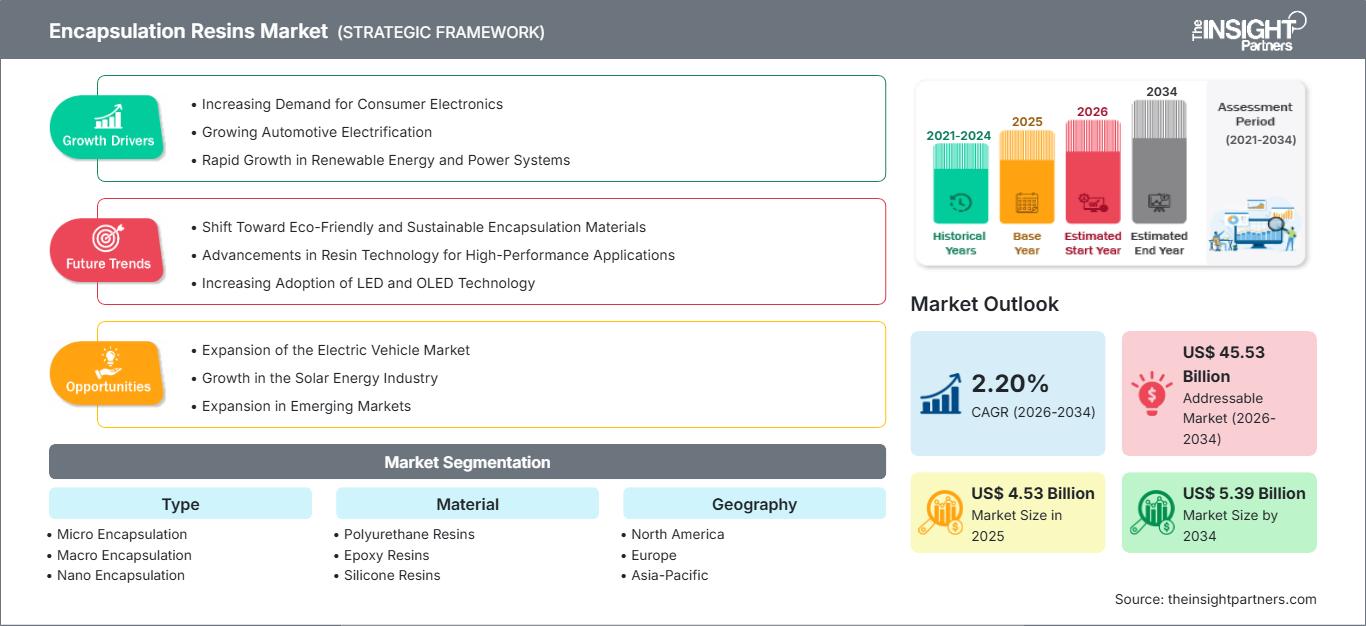
The Encapsulation Resins market was valued at US$ 4.53 billion in 2025 and is expected to reach US$ 5.39 billion by 2034; it is estimated to record a CAGR of 1.95% during 2026-2034.
Encapsulation Resins Market Assessment and Insights
- North America: North America is estimated to hold 24–27% share in 2025; this Encapsulation Resins Market share reflects its mature formulation base and is projected to grow at a 2.0–2.5% CAGR between 2026–2034, supported by established food, fragrance, pharmaceutical, and agricultural formulation industries.
- US: The US represents 82–85% of North America's 2025 share, with a 2.0–2.4% CAGR between 2026–2034, supported by advanced formulation capabilities and specialty ingredient demand.
- Europe: Europe accounts for 25–28% share in 2025 and is expected to expand at a 1.8–2.3% CAGR between 2026–2034, led by Germany, France, the UK, Italy, and Switzerland.
- Asia Pacific: Asia Pacific represents 31–35% share in 2025 and is projected to grow at a 3.0–3.5% CAGR between 2026–2034, led by China, Japan, India, South Korea, and Australia.
- Largest Segment: Micro Encapsulation holds a 55–59% market share in 2025 and is projected to grow at a 2.4–2.8% CAGR between 2026–2034, reflecting broad commercial adoption.
- High Growth Segment: Polyurethane Resins hold a 35–39% market share in 2025 and are expected to expand at a 2.8–3.2% CAGR between 2026–2034, supported by versatile barrier properties.
- Key companies analyzed in detail: Balchem Corporation, Encapsys, LLC, Givaudan SA, DSM-Firmenich AG, International Flavors & Fragrances Inc., Lycored Corp., Sensient Technologies Corporation, Symrise AG, Syngenta Crop Protection AG, Ashland Inc.
Source: The Insight Partners' analysis based on proprietary research, government publications, company annual reports, investor presentations, industry databases, and expert interviews.
Encapsulation technology has advanced to become engineered processes for controlling release, enhancing stability, and segregating delicate components away from undesirable environments. The manufacturing process involves emulsification, polymerization, spraying, coacervation, among other controlled processes. Resins are formulated based on the requirements for the encapsulated particles to be robust, resistant to moisture, compatible with the active component, and release the active component.
Opportunities for market expansion are expected to be created in Asia-Pacific and some emerging nations, owing to increasing consumption of processed foods, personal care products, agricultural inputs, and nutraceuticals in the forecast period. Increasing regulatory pressure on the use of persistent materials will promote biodegradable solutions.
Encapsulation Resins Market Report Scope
| Report Attribute | Details |
|---|---|
| Market size in 2025 | US$ 4.53 Billion |
| Market Size by 2034 | US$ 5.39 Billion |
| Global CAGR (2026 - 2034) | 1.95% |
| Historical Data | 2021-2024 |
| Forecast period | 2026-2034 |
Encapsulation Resins Market Analysis
Encapsulation Resins Market growth drivers include requirements to protect sensitive, reactive, volatile or insoluble materials through processing and storage. The industry supply chain covers raw material providers, formulation experts, encapsulation processers, raw material producers, brand owners and end-user markets. Controlled release applications within food, fragrance, personal care, pharmaceutical, agricultural and functional ingredients drive demand.
Supply factors include resin availability, feedstock costs, process expertise, equipment and compliance issues. Various resin types, such as polyurethane, epoxy and silicone systems, offer distinct properties such as flexibility, resistance, stability, permeability and release characteristics. Customers increasingly evaluate complete formulations.
Differentiation in the Encapsulation Resins Market report study is dependent on formulation technology, intellectual property, sustainability, and customization of release properties. Givaudan SA, DSM-Firmenich AG, International Flavors & Fragrances Inc., and Symrise AG have excellent strategic positioning within fragrances and flavors applications. Balchem Corporation and Lycored Corp. have technologies applicable to functional foods and nutritional applications. Encapsys, LLC specializes in encapsulation technologies for tough formulations.
The strategic positioning is also driven by the variety of end-user applications. Sensient Technologies Corporation has strength in ingredients and formulations, while Syngenta Crop Protection AG has strength in crop protection. Ashland Inc. has specialties in materials technology. The investments will be made in sustainability, process development, testing, and regional capacities.
● REPORT CUSTOMIZATION
Tailor This Report To Align With Your Specific Business Requirements
This report can be customized to align precisely with your business objectives, scope, and target markets. Customization options include tailored segmentation, geography, competitive analysis, and strategic insights to support informed decision-making.
Customize This Report →WHAT YOU CAN ADJUST
- ● Segmentations
- ● Geography
- ● Competitive Analysis
- ● Language Preferences
Encapsulation Resins Market: Strategic Insights
Regional Insights
North America Encapsulation Resins Market
North America is estimated to hold 24–27% share in 2025 and is projected to record a 2.0–2.5% CAGR through 2034. The US is dominant, supported by food, nutrition, pharmaceutical, agricultural, and personal-care industries. Established encapsulation capabilities create recurring demand for resins that provide controlled release, improved stability, and protection against moisture, oxidation, or chemical interaction.
Strong R&D infrastructure and customer willingness to adopt formulation technologies support the region. Pharmaceuticals and nutraceuticals require precise delivery, while fragrance companies seek durable release. Sustainability considerations encourage lower-impact alternatives.
U.S. Encapsulation Resins Market
The US contributes 82-85% of North America’s 2025 market share and is expected to witness a CAGR of 2.0-2.4% through 2034. The contribution can be attributed to its significant number of established companies involved in manufacturing foods, medicines, crops, personal care products, and other specialty ingredients. These include Balchem Corporation, Encapsys, LLC, and Ashland Inc., among others.
Micro encapsulation continues to be crucial in order to ensure protection of ingredients, as well as control over the release. Flavor stability and nutrition protection are key considerations within food and beverage industry applications, while controlled release of active ingredients is more relevant in pharmaceuticals, whereas protection during storage and delivery is the main focus in the crop protection category.
Europe Encapsulation Resins Market
Europe is estimated to represent 25–28% share in 2025 and is projected to expand at a 1.8–2.3% CAGR. Germany leads the regional market, followed by France, the UK, Italy, and Switzerland. European demand is strongly influenced by sustainability requirements, formulation safety, and restrictions affecting certain coating materials. These conditions favor suppliers capable of demonstrating performance and regulatory compatibility.
Encapsulation systems that offer higher stability and release control along with eco-friendly properties are gaining demand in the UK market. Application development support and analytical service needs are driven by research-oriented consumers. The well-established sectors of the country form a strong foundation for application specialization.
Germany is the largest market in Europe owing to its strong presence of chemicals, pharmaceuticals, foods, and specialty materials industries. Processing capability, documentation, and performance are the key criteria followed by the manufacturers while selecting encapsulation materials. The market demands include functional ingredients, agrochemicals, fragrances, and industrial products. Engineering skills of the country enable the manufacturers to achieve precision processing and pilot plant tests.
France, Italy, and Spain have diversified demand for applications ranging from fragrances, cosmetics, food and pharmaceutical, and agricultural applications. The presence of the fragrance and beauty industry of France is its major advantage, while in Italy the strengths lie in the food and specialty processing industry. In Spain, food ingredients and agriculture applications have growth potential.
APAC Encapsulation Resins Market
The share of APAC is 31-35%, and it is predicted that the CAGR will be 3.0-3.5% in 2025. Thus, this region will have the highest growth rate. The major markets in this region are China, Japan, India, South Korea, and Australia. New applications can be found in food processing, personal care, pharmaceuticals, crop protection, and specialty ingredients.
The reason for the fast development in China is the large manufacturing sector and domestic consumption; India provides increasing demands for functional ingredients, agrochemicals, and pharmaceutical formulations; Japan and South Korea focus on high technology in materials and formulations; Australia provides new opportunities in agriculture and nutrition.
Middle East & Africa Encapsulation Resins Market
Middle East & Africa is forecast to record a CAGR growth of 2.4% to 2.9%, with Saudi Arabia and UAE being the key drivers. The major end-user industries include food processing, pharmaceuticals, personal care, agriculture, and specialty chemicals. South Africa is currently the largest market in sub-Saharan Africa, and other MEA countries have potential markets.
Saudi Arabia and UAE have diversified their economies and have plans related to food security and manufacturing. South Africa already has a developed ecosystem for food, agriculture, and pharmaceuticals. Encapsulation increases the stability of the ingredients in tough storage conditions; hence, the suppliers that have reliable raw materials and support are preferred.
Segmentation Analysis
Type
The Type segment is expected to grow at a 2.3–2.7% CAGR from 2026–2034. Micro Encapsulation remains the broadest commercial technology because it can be adapted to food ingredients, fragrances, pharmaceuticals, agriculture, and functional compounds. Macro and nano approaches serve more specialized applications where particle dimensions, protection, targeting, or release behavior justify additional processing complexity.
- Micro Encapsulation: Micro Encapsulation has the broadest application base because it balances protection, controlled release, processing scalability, and cost. Demand is strong in flavors, fragrances, nutrients, crop inputs, and pharmaceuticals.
- Macro Encapsulation: Macro Encapsulation serves applications requiring larger protected structures or simpler release mechanisms. Its strategic role remains relevant where handling, gradual release, and formulation robustness are more important than nanoscale delivery precision.
- Nano Encapsulation: Nano Encapsulation is strategically important for high-value applications requiring enhanced dispersion, protection, or targeted delivery. Adoption remains more specialized because manufacturing complexity, regulatory considerations, and formulation validation can increase development requirements.
Material
The Material segment is projected to expand at a 2.1–2.5% CAGR from 2026–2034. Resin selection depends on permeability, flexibility, chemical resistance, thermal behavior, compatibility, and intended release mechanism. Polyurethane systems offer versatility, while epoxy and silicone systems address specialized performance requirements where stability or environmental resistance is critical.
- Polyurethane Resins: Polyurethane Resins occupy an important position because their flexible chemistry supports controlled-release structures and diverse processing conditions. They are strategically relevant where barrier performance must be balanced with mechanical properties.
- Epoxy Resins: Epoxy Resins are valued for strong adhesion, chemical resistance, and durable protective characteristics. Their role is concentrated in applications requiring robust encapsulation structures and resistance to demanding processing or environmental conditions.
- Silicone Resins: Silicone Resins provide thermal stability, flexibility, and chemical resistance, making them useful for specialized formulations. Their strategic importance increases where long-term stability and performance under temperature variation are essential.
End User
End User includes Pharmaceutical, Agrochemical, Food and Beverages, Construction, and Others. This segment is assessed to record 2.2–2.7% CAGR during 2026–2034. Pharmaceutical and food applications emphasize stability and controlled delivery, agrochemicals focus on release efficiency and active protection, while construction applications require durability and functional material protection.
- Pharmaceutical: Pharmaceutical users employ encapsulation to improve active stability, manage release profiles, enhance formulation performance, and protect sensitive ingredients, with technical adoption governed by safety, reproducibility, manufacturing quality, and regulatory requirements.
- Agrochemical: Agrochemical formulations use encapsulation to manage active release, protect ingredients from premature degradation, improve handling characteristics, and potentially enhance application efficiency while supporting increasingly precise crop-protection strategies.
- Food and Beverages: Food manufacturers use encapsulation to protect flavors, vitamins, probiotics, colors, oils, and other functional ingredients while improving shelf stability, sensory characteristics, processing tolerance, and controlled ingredient release.
- Construction: Construction applications employ resin encapsulation for protective, self-healing, adhesive, coating, and functional-material systems where durability, environmental resistance, controlled chemical release, and extended service performance create value.
Opportunity Snapshot
| End User | Revenue Contribution | Trend Tag | Adoption Stage |
|---|---|---|---|
| Pharmaceutical | High | Precision Delivery | Mature |
| Agrochemical | Medium | Controlled Release | Scaling |
| Food and Beverages | High | Bioactive Protection | Scaling |
| Construction | Medium | Smart Materials | Emerging |
| Others | Low | Specialty Delivery | Scaling |
Encapsulation Resins Market Growth Drivers and Impact Analysis
Rising Demand for Controlled-Release Formulations
Controlled release is becoming more valuable because manufacturers want to protect sensitive ingredients, improve stability, reduce interactions, and deliver actives at defined stages. Food and beverage applications can preserve flavors, colors, nutrients, and functional ingredients during processing and storage. Personal-care and fragrance companies use similar approaches to extend sensory performance. Pharmaceutical and agricultural formulators can improve handling and delivery. This breadth reduces dependence on one end-use market and supports adaptable resin systems. Impact is strongest where conventional formulations face oxidation, moisture sensitivity, volatility, or poor compatibility. Encapsulation functions as a formulation-enabling technology rather than a simple protective coating.
Expansion of Functional Food and Nutraceutical Applications
Functional foods and nutraceutical products increasingly incorporate vitamins, minerals, botanical extracts, probiotics, flavors, and other sensitive ingredients. Encapsulation helps address taste, odor, stability, solubility, and compatibility challenges that can limit formulation flexibility. This creates demand for resin systems capable of protecting active compounds without compromising product quality or release characteristics. The opportunity extends across beverages, supplements, fortified foods, and specialized nutrition products. Suppliers can benefit by developing materials compatible with different processing temperatures, moisture conditions, and consumption formats. Companies with application laboratories can work with food and nutrition manufacturers to optimize particle size, wall composition, loading efficiency, and release behavior.
Greater Need for Sustainable Encapsulation Materials
Environmental scrutiny is changing how encapsulation materials are evaluated. Customers increasingly seek alternatives that reduce persistence, improve biodegradability, or simplify regulatory compliance without sacrificing protection and release performance. This trend is particularly relevant to fragrance, personal care, food, and agricultural applications where encapsulation systems can encounter environmental or consumer scrutiny. The commercial impact is creating a development pathway for bio-based, biodegradable, recyclable, or lower-impact resin chemistries. Givaudan SA's work on biodegradable fragrance encapsulation illustrates the direction of innovation, while broader formulation industries are evaluating alternatives to conventional persistent materials. Suppliers able to combine environmental credentials with scalable manufacturing and stable performance can gain qualification advantages. However, successful adoption depends on cost, processing compatibility, regulatory acceptance, and consistent release behavior.
Encapsulation Resins Market Future Trends
Precision Release and Multifunctional Encapsulation
The Encapsulation Resins Market trends toward more precisely engineered systems capable of controlling when, where, and how an active ingredient is released. Future formulations are likely to combine protection from oxygen or moisture, improved dispersion, triggered release, and compatibility with complex product matrices. Advances in particle engineering, polymer chemistry, and process control should allow manufacturers to tailor capsule properties more closely to end-use requirements. Fragrance companies may prioritize release through touch, moisture, or friction, while pharmaceutical and nutrition applications can emphasize protection through processing and subsequent release. Agricultural products may seek controlled delivery that improves active-ingredient utilization. These developments increase the importance of application-specific resin design and analytical testing.
Transition Toward Lower-Impact Resin Platforms
Future development will increasingly focus on reducing environmental impact without compromising performance. Resin producers are likely to investigate biodegradable polymers, bio-derived feedstocks, lower-solvent processes, and materials addressing restrictions on persistent substances. Adoption will vary because applications impose different technical and regulatory requirements. Fragrance and personal-care formulations may move faster, while agricultural and pharmaceutical products can require longer qualification. Process efficiency will also matter because lower energy use and reduced waste improve sustainability. Competitive advantage should favor platforms demonstrating environmental benefits, scalable production, reliable release profiles, and equipment compatibility.
Encapsulation Resins Market Opportunities
Regional Production for High-Growth Asian Applications
Encapsulation Resins Market Forecasts indicate that expanding production and technical support in Asia can capture demand from food, nutrition, personal care, pharmaceuticals, and crop protection. China and India offer attractive conditions because large domestic industries create opportunities across multiple end uses. Regional manufacturing can reduce lead times and logistics exposure while enabling local formulation adjustments. Application laboratories near customers can accelerate qualification and troubleshooting. Partnerships with ingredient manufacturers and consumer-product companies can improve access. Investment should prioritize scalable resin systems and quality-control infrastructure. Capacity can improve response times for localized sourcing.
Premium Sustainable Solutions for Fragrance and Personal Care
Fragrance and personal-care applications offer premium opportunities because brands increasingly seek long-lasting performance alongside environmental differentiation. Suppliers can invest in biodegradable or lower-impact capsule technologies while maintaining controlled release and formulation compatibility. Givaudan SA's PlanetCaps development demonstrates commercial movement toward biodegradable fragrance encapsulation. Companies can differentiate through performance, regulatory documentation, sensory testing, and formulation support rather than resin price alone. Partnerships with fragrance houses, cosmetic formulators, and consumer brands can accelerate qualification. Pilot facilities and analytical capabilities can demonstrate release performance under real-use conditions. The opportunity favors suppliers integrating resin chemistry with application expertise.
Recent Developments
- May 2026: Sumitomo Bakelite Co., Ltd. has developed and trial-launched the EME-L series, a reliable liquid encapsulant that minimizes warpage, aimed at meeting the demands of larger and more complex semiconductor packages influenced by AI advancements.
- April 2026: ALH Systems has launched NP1490, a water-clear polyurethane resin designed for high-performance LED encapsulation and clear casting. In a short film, Mick Reynolds highlights the resin's significant advancements, particularly its clarity, which surpasses traditional polyurethane systems that often display haze or yellowing. NP1490 achieves a true "water-white" finish, making it ideal for optical applications, while also maintaining durability and stability, a crucial aspect of its formulation.
Frequently Asked Questions

- Comprehensive Market Sizing and Forecast Analysis
- Detailed Segmentation Analysis
- In-Depth Market Dynamics Assessment
- Regional and Country-Level Insights
- Competitive Landscape and Company Benchmarking
- Strategic Business Intelligence
Recent Reports
Testimonials

The Insight Partners' SCADA System Market report is comprehensive, with valuable insights on current trends and future forecasts. The team was highly professional, responsive, and supportive throughout. We are very satisfied and highly recommend their services.
RAN KEDEM Partner, Reali Technologies LTDs
I requested a report on a very specific software market and the team produced the report in a few days. The information was very relevant and well presented. I then requested some changes and additions to the report. The team was again very responsive and I got the final report in less than a week.
JEAN-HERVE JENN Chairman, Future Analytica
We worked with The Insight Partners for an important market study and forecast. They gave us clear insights into opportunities and risks, which helped shape our plans. Their research was easy to use and based on solid data. It helped us make smart, confident decisions. We highly recommend them.
PIYUSH NAGPAL Sr. Vice President, High Beam Global
The Insight Partners delivered insightful, well-structured market research with strong domain expertise. Their team was professional and responsive throughout. The user-friendly website made accessing industry reports seamless. We highly recommend them for reliable, high-quality research services
YUKIHIKO ADACHI CEO, Deep Blue, LLC.
This is the first time I have purchased a market report from The Insight Partners.While I was unsure at first, I visited their web site and felt more comfortable to take the risk and purchase a market report.I am completely satisfied with the quality of the report and customer service. I had several questions and comments with the initial report, but after a couple of dialogs over email with their analyst I believe I have a report that I can use as input to our strategic planning process.Thank you so much for taking the extra time and making this a positive experience.I will definitely recommend your service to others and you will be my first call when we need further market data.
JOHN SUZUKI President and Chief Executive Officer, Board Director, BK Technologies
I wish to appreciate your support and the professionalism you displayed in the course of attending to my request for information regarding to infectious disease IVD market in Nigeria. I appreciate your patience, your guidance, and the fact that you were willing to offer a discount, which eventually made it possible for us to close a deal. I look forward to engaging The Insight Partners in the future, all thanks to the impression you have created in me as a result of this first encounter.
DR CHIJIOKE ONYIA MANAGING DIRECTOR, PineCrest Healthcare Ltd.Reason to Buy
- Informed Decision-Making
- Understanding Market Dynamics
- Competitive Analysis
- Identifying Emerging Markets
- Customer Insights
- Market Forecasts
- Risk Mitigation
- Boosting Operational Efficiency
- Strategic Planning
- Investment Justification
- Tracking Industry Innovations
- Aligning with Regulatory Trends





 Get Free Sample for