
Energy-Efficient Materials Market Share, Size & Demand by 2034
Coverage: By Type (Fiberglass, Mineral Wool, Cellulose, Polyisocyanurate, Extruded Polystyrene, Expanded Polystyrene, Others); End-Use (Building and Construction, Consumer Electronics, Aerospace Industry, Chemical Industry, Automotive Industry, Food Industry, Paper and Pulp Industry, Others), and Geography (North America, Europe, Asia Pacific, and South and Central America)
- Status : Data Released
- Report Code : TIPRE00017575
- Category : Chemicals and Materials
- No. of Pages : 150
- Available Report Formats :


- Last update date : August 19, 2026


2025 Market Size
US$ 35.46 Bn
Base year value
2034 Forecast
US$ 109.12 Bn
Projected by 2034
CAGR 2026-2034
13.30 %
Growth rate
Addressable Market
US$ 627.29 Bn
(2026-2034)
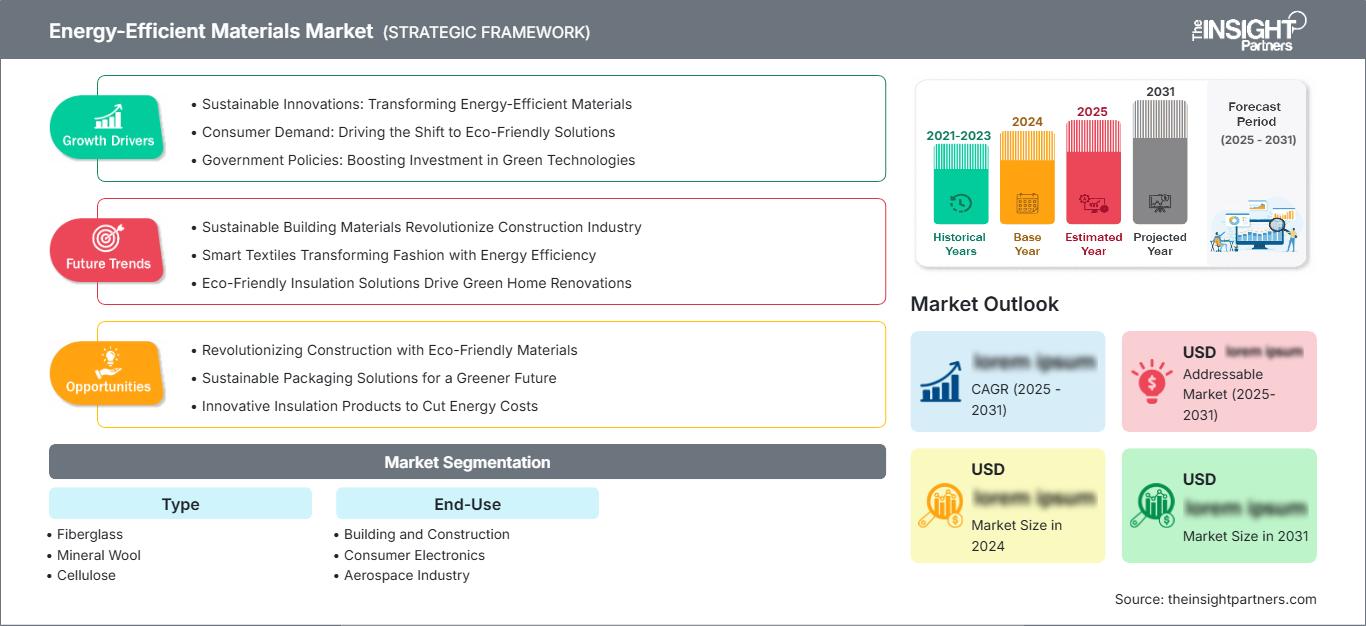
The Energy-Efficient Materials Market size is valued at US$ 35.46 billion in 2025 and expected to reach US$ 109.12 billion by 2034, growing at a CAGR of 13.30% during the forecast period, 2026-2034. Increasing need for energy-efficient materials due to regulations for building efficiency, industrial decarbonization, need for better insulation, and reduction of heating and cooling loads is driving demand. These materials include fiberglass, mineral wool, cellulose, polyisocyanurate, extruded polystyrene, and expanded polystyrene in several industrial end uses.
North America is one of the major markets that is driven by renovation of existing buildings, construction of residential buildings, investments in commercial infrastructure, and increasing need for energy performance. The North America Energy-Efficient Materials Market is further driven by replacement insulation, upgrading building envelope, and increased demand for insulation materials offering thermal resistance without bulkiness. Increasing emphasis on operating costs and carbon emissions is further driving demand for lifecycle materials.
Energy-Efficient Materials Market Assessment and Insights
- North America: North America accounted for a 28–32% Energy-Efficient Materials Market share in 2025 and is projected to expand at a CAGR of 11.8–12.6% during 2026–2034, supported by residential retrofits, commercial construction, energy codes, and insulation replacement.
- US: The US represented 79–83% of North America's 2025 demand and is expected to grow at a CAGR of 11.5–12.3% through 2034, supported by housing activity, remodeling, and building-envelope efficiency.
- Europe: Europe held a 27–31% share in 2025 and is expected to grow at a CAGR of 12.7–13.5%, led by Germany, France, the UK, Italy, and Spain, with renovation policies strengthening insulation demand.
- Asia Pacific: Asia Pacific represented a 30–34% share in 2025 and is forecast to grow at a CAGR of 14.3–15.2%, led by China, India, Japan, South Korea, and Australia amid urbanization and energy-efficiency programs.
- Largest Segment: Building and Construction held a 69–73% market share in 2025 and is projected to grow at a CAGR of 12.9–13.6%, reflecting dominant insulation demand.
- High Growth Segment: Polyisocyanurate represented a 13–17% market share in 2025 and is expected to grow at a CAGR of 14.4–15.2%, supported by high thermal resistance.
- Key companies analyzed in detail: AGC Inc.; Guardian Industries, LLC; Morley Glass & Glazing Limited; Nippon Sheet Glass Co., Ltd.; Compagnie de Saint-Gobain S.A.; SCHOTT AG; sedak GmbH & Co. KG; Türkiye Şişe ve Cam Fabrikaları A.Ş.; Vitro, S.A.B. de C.V.; Owens Corning.
Source: The Insight Partners' analysis based on proprietary research, government publications, company annual reports, investor presentations, industry databases, and expert interviews.
The Energy-Efficient Materials Market has been shifting from traditional insulation materials to advanced systems that are geared towards optimizing insulation for heat management, fire safety, moisture regulation, durability, ease of installation, and carbon emissions throughout its lifetime. Fiberglass and mineral wool will still play a major role due to existing production channels, while rigid foam serves well where thermal resistance needs to be maximized due to envelope restrictions.
According to the Energy-Efficient Materials Market forecast, future advancements will lie in increasing the efficiency of the insulation material through the use of low-carbon manufacturing processes, recycling of feedstock, and building envelope systems. Europe will experience growth thanks to renovation requirements, whereas North America will capitalize on retrofit and replacement needs. The Asia Pacific region will see the highest growth as cities and industries will require better thermal management in their construction.
Energy-Efficient Materials Market Report Scope
| Report Attribute | Details |
|---|---|
| Market size in 2025 | US$ 35.46 Billion |
| Market Size by 2034 | US$ 109.12 Billion |
| Global CAGR (2026 - 2034) | 13.30% |
| Historical Data | 2021-2024 |
| Forecast period | 2026-2034 |
Energy-Efficient Materials Market Analysis
Growth of the Energy-Efficient Materials Industry is directly related to energy efficiency of buildings and industrial facilities. According to the statistics of the International Energy Agency, 30% of all energy consumed by humans comes from buildings, and heating and cooling still remain among significant sources of energy consumption in developed countries. Insulation materials help to lower heat conduction via walls, roofs, floors, and equipment systems, thus generating demand in both new construction and renovations. Value chain includes raw material supply, insulation production, converting, distribution, construction, architecture, real estate development, and building operation.
Material choice depends on thermal conductivity, insulation thickness, moisture-proofing, fire resistance, mechanical properties, acoustics, ease of installation, and regulations. Fiberglass and mineral wool have an advantage because of developed production and installation networks. Polyisocyanurate, XPS, and EPS are preferred in case when board insulation and/or moisture proofing and/or thermal performance are required. Cellulose is useful for the cases which need higher level of recycled content and loose-fill installation. Supply situation is sensitive to energy prices, resins prices, minerals prices, transportation, and capacity utilization.
According to the Energy-Efficient Materials Market report, competitors include increasing competition in lifecycle performance. The Compagnie de Saint-Gobain S.A. has wide-ranging insulation expertise in glass wool and mineral wool. Owens Corning has a stronghold in fiberglass insulation. Kingspan relates to the high-performance insulated envelope, though it is an additional competitor for the analysis purpose and not one of the companies in the list originally mentioned. ROCKWOOL and Knauf Insulation are some mineral-wool competitors in the competition landscape.
The investment focus has shifted towards manufacturing efficiency, expansion of geography, low-carbon manufacturing and product systems than materials alone. Owens Corning is ramping up its capacity in fiberglass in Kansas, while Kingspan has increased its manufacturing capacity in multiple regions. ROCKWOOL is increasing its manufacturing and electrification capacity in the US market. Such investments mean that the capacity build-ups are in line with construction demands while making the process efficient and environmentally friendly.
● REPORT CUSTOMIZATION
Tailor This Report To Align With Your Specific Business Requirements
This report can be customized to align precisely with your business objectives, scope, and target markets. Customization options include tailored segmentation, geography, competitive analysis, and strategic insights to support informed decision-making.
Customize This Report →WHAT YOU CAN ADJUST
- ● Segmentations
- ● Geography
- ● Competitive Analysis
- ● Language Preferences
Energy-Efficient Materials Market: Strategic Insights
Regional Insights
North America Energy-Efficient Materials Market
North America accounted for 28–32% of the Energy-Efficient Materials Market in 2025 and is projected to grow at a CAGR of 11.8–12.6% through 2034. The region benefits from substantial residential and commercial building stock, replacement activity, remodeling, and continued investment in high-performance building envelopes. Fiberglass and foam insulation remain widely used because contractors understand their installation requirements and distributors maintain established supply networks.
The United States is dominant in terms of regional demand, whereas Canada plays a role in the form of insulation in cold climate and construction renovation work. The use of residential walls and attics is one application area, while commercial roof, façade, warehouse, and industrial buildings generate demand for rigid insulation. Thermal properties, moisture handling, recycling, and fire properties are now key focus areas in the production of rigid insulation.
U.S. Energy-Efficient Materials Market
The US accounted for 79-83% of North American's 2025 demand and is expected to grow at a CAGR of 11.5-12.3% between 2026 and 2034. Residential remodeling, replacement insulation, residential building, commercial construction, and industrial construction continue to be major demand drivers. Fiberglass is set to reap benefits due to cost-efficient installation, while mineral wool and rigid foam find new uses for their flame-resistant and higher thermal performance capabilities.
Owens Corning has a strong US fiberglass insulation market position, while other producers offer fiberglass insulation through regional manufacturing and systems. Demand applications tend to follow trends towards more effective envelopes, particularly in regions with significant heating/cooling requirements. Data centers, logistics centers, manufacturing centers, and institutional buildings are further demand growth segments as asset owners consider the energy efficiency of buildings throughout their lifespans.
Europe Energy-Efficient Materials Market
Europe constituted 27–31% of total demand in 2025 and is expected to grow at a CAGR of 12.7–13.5% during 2024–2034. About 75% of buildings in EU have low energy performance, while the annual rate of renovation is about 1%, providing great potential for renovations. The updated Energy Performance of Buildings Directive intends to speed up renovations and increase performance of buildings.
The UK market pays more attention to retrofit and improvement of energy performance in existing buildings, whereas Germany stays an insulation market leader due to the existing building stock, climate, and well-developed construction industry. France, Italy, and Spain can be considered as markets of potential growth through renovations, new constructions, and climate-specific insulation needs. The following types of materials compete on fire, thermal, moisture resistance, sustainability, and installation features: mineral wool, fiberglass, cellulose, EPS, XPS, and PIR.
APAC Energy-Efficient Materials Market
APAC held a 30–34% share in 2025 and is expected to record the fastest regional expansion at a CAGR of 14.3–15.2% through 2034. China is the leading market, supported by large-scale construction and industrial development. India is expanding from a comparatively lower penetration base, while Japan, South Korea, and Australia have established energy-efficiency requirements and higher-performance construction practices.
China and India provide the largest volume opportunities because of urbanization and expanding commercial infrastructure. Japan and South Korea emphasize building performance, manufacturing quality, and advanced materials, while Australia benefits from thermal-performance requirements and renovation. Growth is expected across residential buildings, commercial facilities, manufacturing plants, warehouses, cold-chain infrastructure, and industrial applications where insulation can reduce energy losses.
Middle East & Africa Energy-Efficient Materials Market
Middle East and Africa is projected to grow at a CAGR of 10.6–11.5% through 2034. Saudi Arabia and the UAE are leading demand centers because of major infrastructure programs, high cooling requirements, commercial development, and large-scale construction. Energy-efficient insulation can reduce heat transfer through roofs and walls, supporting lower cooling requirements in high-temperature environments.
South Africa contributes through commercial construction, industrial facilities, and retrofit projects, while the rest of MEA remains strongly project-driven. Rigid foam, mineral wool, fiberglass, and specialized insulation systems are relevant across building envelopes and industrial applications. Growth should increasingly depend on energy-performance specifications, sustainability objectives, local manufacturing, and the availability of technically qualified installation contractors.
Segmentation Analysis
Type
Type is projected to grow at a CAGR of 13.1–13.8% during 2026–2034. The Energy-Efficient Materials Market scope across material types reflects different combinations of thermal resistance, density, fire performance, moisture behavior, cost, and installation requirements. Fiberglass and mineral wool provide broad applicability, while rigid foams address applications requiring high thermal resistance within constrained thicknesses.
- Fiberglass: Fiberglass maintains a strong position in residential and commercial insulation because of established manufacturing capacity, comparatively accessible installation, and suitability for walls, roofs, attics, and HVAC applications.
- Mineral Wool: Mineral wool is strategically important where fire resistance, acoustic performance, dimensional stability, and thermal insulation are simultaneously required, particularly in commercial and industrial construction.
- Cellulose: Cellulose benefits from recycled-fiber content and loose-fill installation, making it relevant to retrofit projects where sustainability and cavity coverage are important purchasing considerations.
- Polyisocyanurate: Polyisocyanurate offers high thermal resistance at relatively low thickness, supporting roofs, walls, and building-envelope applications where available space is constrained.
- Extruded Polystyrene: XPS provides rigid, moisture-resistant insulation suited to foundations, below-grade applications, roofs, and areas exposed to demanding moisture conditions.
- Expanded Polystyrene: EPS offers lightweight rigid insulation with broad construction use, competitive economics, and adaptable densities for walls, roofs, foundations, and specialized building systems.
End-Use
End-Use is expected to grow at a CAGR of 12.9–13.6% during 2026–2034. Building and Construction remains the principal demand center because insulation directly affects building-envelope energy performance. Industrial and product-specific applications provide additional growth where thermal stability, process efficiency, lightweight construction, and controlled operating environments influence material selection.
- Building and Construction: Building and construction is the principal application, covering walls, roofs, floors, façades, attics, foundations, and HVAC systems across residential, commercial, institutional, and industrial structures.
- Consumer Electronics: Consumer electronics uses energy-efficient materials where thermal management, lightweight structures, electrical insulation, and protection of sensitive components influence product reliability and operating performance.
- Aerospace Industry: Aerospace applications require lightweight thermal and acoustic insulation capable of meeting demanding fire, smoke, durability, and weight requirements within tightly controlled aircraft environments.
- Chemical Industry: Chemical facilities use insulation to control process temperatures, protect personnel, reduce heat loss, and maintain equipment efficiency across pipes, vessels, reactors, and processing systems.
- Automotive Industry: Automotive applications use insulation for thermal and acoustic management while controlling weight, supporting cabin comfort, battery systems, powertrain components, and underbody applications.
- Food Industry: Food-processing and cold-chain facilities use insulation to maintain controlled temperatures, reduce energy losses, and support hygienic operating environments across storage, processing, and distribution infrastructure.
- Paper and Pulp Industry: Paper and pulp facilities use insulation around steam systems, process equipment, piping, and drying operations to reduce thermal losses and improve energy management.
Opportunity Snapshot
| Segment Name | Revenue Contribution | Trend Tag | Adoption Stage |
| Building and Construction | High | Deep Retrofit | Scaling |
| Consumer Electronics | Low | Thermal Control | Scaling |
| Aerospace Industry | Low | Lightweight Thermal | Mature |
| Chemical Industry | Medium | Process Insulation | Scaling |
| Automotive Industry | Medium | Battery Thermal | Scaling |
| Food Industry | Medium | Cold Chain | Scaling |
| Paper and Pulp Industry | Medium | Steam Efficiency | Mature |
Energy-Efficient Materials Market Growth Drivers and Impact Analysis
Expansion of building renovation and energy-performance requirements
The largest structural driver is the need to improve the energy performance of existing buildings. The European Commission states that approximately 75% of EU buildings have poor energy performance and that annual renovation activity is only around 1%. This gap creates a substantial addressable base for wall, roof, floor, attic, and façade insulation. Similar opportunities exist in North America, where older residential and commercial buildings require replacement or supplementary insulation. Retrofit projects favor materials that can be installed with limited disruption and provide measurable thermal improvements. Fiberglass, mineral wool, cellulose, and rigid foams can address different retrofit configurations. As energy-performance requirements become more demanding, insulation becomes an increasingly important component of building renovation strategies, supporting demand beyond new construction.
Growing cooling requirements and industrial energy optimization
Rising temperatures and expanding cooling requirements are increasing the importance of insulation across buildings and industrial facilities. The IEA identifies space cooling as a growing source of energy demand, particularly in emerging and developing economies where rising incomes, population growth, and hotter summers are increasing cooling needs. Effective insulation reduces unwanted heat transfer and can improve the performance of air-conditioning systems. In industrial environments, insulation also protects process temperatures and reduces energy losses from pipes, tanks, vessels, and equipment. Demand is therefore expanding beyond traditional residential construction into warehouses, cold-chain facilities, data centers, manufacturing plants, and process industries. This broadens the addressable market and supports adoption of higher-performance materials where energy savings can justify increased upfront material costs.
Demand for lower-carbon and resource-efficient insulation products
Sustainability is increasingly influencing insulation selection alongside thermal performance and cost. Manufacturers are evaluating recycled content, renewable inputs, production emissions, waste reduction, and product durability. Cellulose benefits from its recycled-fiber characteristics, while mineral wool and fiberglass producers are increasing attention to recycled inputs and process efficiency. Kingspan reported using 1.05 million tonnes of recycled and renewable content in materials during 2025, illustrating the scale of material-efficiency initiatives among major manufacturers. Buyers are also increasingly considering environmental product declarations and lifecycle impacts. This trend can shift purchasing toward products that demonstrate both operational energy savings and lower embodied impact, creating opportunities for manufacturers that can substantiate environmental claims through standardized documentation.
Energy-Efficient Materials Market Future Trends
Higher-performance insulation with lower material thickness
Energy-Efficient Materials Market trends are moving toward materials that deliver greater thermal resistance within thinner assemblies. This is particularly important in urban construction, retrofit projects, transportation applications, and buildings where wall or roof thickness affects usable floor area. Polyisocyanurate and other rigid foams are well positioned for such applications because high thermal performance can be achieved with relatively compact boards. At the same time, mineral wool and fiberglass manufacturers are improving product density, fiber structure, binder systems, and installation formats. Future development should focus on balancing thermal conductivity with fire resistance, moisture management, mechanical stability, acoustic properties, recycled content, and cost. Product systems rather than standalone materials are likely to gain importance as architects and contractors seek predictable whole-envelope performance.
Integration of insulation with prefabricated building-envelope systems
Insulation is increasingly being integrated into prefabricated panels, modular construction systems, roofing assemblies, façades, and complete building-envelope solutions. Kingspan's insulated building-envelope strategy illustrates this transition toward systems that combine insulation with other envelope components. Prefabrication can improve dimensional consistency, reduce installation time, and lower dependence on labor availability at construction sites. It can also facilitate quality control and improve repeatability across large projects. The trend is relevant to warehouses, logistics centers, data centers, industrial buildings, and commercial facilities where construction speed is important. Over time, suppliers that combine insulation materials with structural, weatherproofing, roofing, or façade components may capture more value per project than manufacturers selling commodity insulation alone.
Energy-Efficient Materials Market Opportunities
Retrofit-focused insulation systems for aging building stock
The renovation of inefficient buildings represents an attractive opportunity because existing structures frequently have limited insulation and high heating or cooling requirements. Retrofit products can target attics, cavity walls, roofs, façades, basements, and HVAC systems without requiring complete rebuilding. European renovation policy provides a strong structural foundation, while North American remodeling and replacement activity supports demand for practical insulation systems. Suppliers can differentiate through products designed for restricted spaces, simplified installation, low dust generation, moisture resistance, and compatibility with existing structures. Digital assessment tools can further improve project selection by identifying thermal losses and estimating potential savings. Manufacturers that build contractor networks and technical-support capabilities can increase adoption because installation quality materially affects insulation performance. This opportunity also supports cellulose, fiberglass, mineral wool, and rigid foam products across different building configurations.
Localized manufacturing for high-growth emerging markets
Investment in localized production represents another opportunity, particularly in Asia Pacific and selected Middle Eastern markets. Transporting bulky insulation products over long distances can materially affect delivered costs, making regional manufacturing strategically important. China, India, Southeast Asia, and the Middle East are expanding construction and industrial capacity while facing increasing energy-management requirements. Local plants can reduce logistics costs, adapt products to climate-specific requirements, and improve delivery reliability. Manufacturers can also use regional facilities to develop contractor relationships and respond to local building codes. Owens Corning, Kingspan, and ROCKWOOL have demonstrated continued investment in production capacity across major regions, while Saint-Gobain maintains broad insulation manufacturing capabilities. Further localization should support market penetration as energy-efficient construction moves beyond mature markets.
Recent Developments
- May 2026: Ahlstrom has launched a new generation of glass microfiber media for HVAC filtration, produced in Turin, Italy. This product addresses the demand for high-performance air filtration by being free of intentionally added PFAS while still offering durable water-repellent properties. The media features advanced fiber engineering, resulting in up to 20% lower initial pressure drop and improved pressure build-up compared to standard glass media, enhancing energy efficiency and maintaining stable filtration performance throughout its lifespan.
- May 2026: Covestro is investing in a new steam compressor at its Dormagen site in Germany, which is its largest energy efficiency project to date. This modernization aims to reduce the company's energy consumption in Germany by 2% annually compared to 2025, saving a low three-digit GWh of energy and over 40,000 tons of CO2 emissions each year. The investment amounts to a low double-digit million euros.
Frequently Asked Questions

- Comprehensive Market Sizing and Forecast Analysis
- Detailed Segmentation Analysis
- In-Depth Market Dynamics Assessment
- Regional and Country-Level Insights
- Competitive Landscape and Company Benchmarking
- Strategic Business Intelligence
Recent Reports
Testimonials

The Insight Partners' SCADA System Market report is comprehensive, with valuable insights on current trends and future forecasts. The team was highly professional, responsive, and supportive throughout. We are very satisfied and highly recommend their services.
RAN KEDEM Partner, Reali Technologies LTDs
I requested a report on a very specific software market and the team produced the report in a few days. The information was very relevant and well presented. I then requested some changes and additions to the report. The team was again very responsive and I got the final report in less than a week.
JEAN-HERVE JENN Chairman, Future Analytica
We worked with The Insight Partners for an important market study and forecast. They gave us clear insights into opportunities and risks, which helped shape our plans. Their research was easy to use and based on solid data. It helped us make smart, confident decisions. We highly recommend them.
PIYUSH NAGPAL Sr. Vice President, High Beam Global
The Insight Partners delivered insightful, well-structured market research with strong domain expertise. Their team was professional and responsive throughout. The user-friendly website made accessing industry reports seamless. We highly recommend them for reliable, high-quality research services
YUKIHIKO ADACHI CEO, Deep Blue, LLC.
This is the first time I have purchased a market report from The Insight Partners.While I was unsure at first, I visited their web site and felt more comfortable to take the risk and purchase a market report.I am completely satisfied with the quality of the report and customer service. I had several questions and comments with the initial report, but after a couple of dialogs over email with their analyst I believe I have a report that I can use as input to our strategic planning process.Thank you so much for taking the extra time and making this a positive experience.I will definitely recommend your service to others and you will be my first call when we need further market data.
JOHN SUZUKI President and Chief Executive Officer, Board Director, BK Technologies
I wish to appreciate your support and the professionalism you displayed in the course of attending to my request for information regarding to infectious disease IVD market in Nigeria. I appreciate your patience, your guidance, and the fact that you were willing to offer a discount, which eventually made it possible for us to close a deal. I look forward to engaging The Insight Partners in the future, all thanks to the impression you have created in me as a result of this first encounter.
DR CHIJIOKE ONYIA MANAGING DIRECTOR, PineCrest Healthcare Ltd.Reason to Buy
- Informed Decision-Making
- Understanding Market Dynamics
- Competitive Analysis
- Identifying Emerging Markets
- Customer Insights
- Market Forecasts
- Risk Mitigation
- Boosting Operational Efficiency
- Strategic Planning
- Investment Justification
- Tracking Industry Innovations
- Aligning with Regulatory Trends





 Get Free Sample for