
Engineered Quartz Market Trends, Size & Forecast by 2034
Coverage: By Type (Countertops, Flooring, Wall, Others); Application (Residential, Commercial) , and Geography (North America, Europe, Asia Pacific, and South and Central America)
- Status : Data Released
- Report Code : TIPRE00019920
- Category : Chemicals and Materials
- No. of Pages : 150
- Available Report Formats :


- Last update date : August 27, 2026


2025 Market Size
US$ 9.43 Bn
Base year value
2034 Forecast
US$ 16.69 Bn
Projected by 2034
CAGR 2026-2034
6.55 %
Growth rate
Addressable Market
US$ 118.12 Bn
(2026-2034)
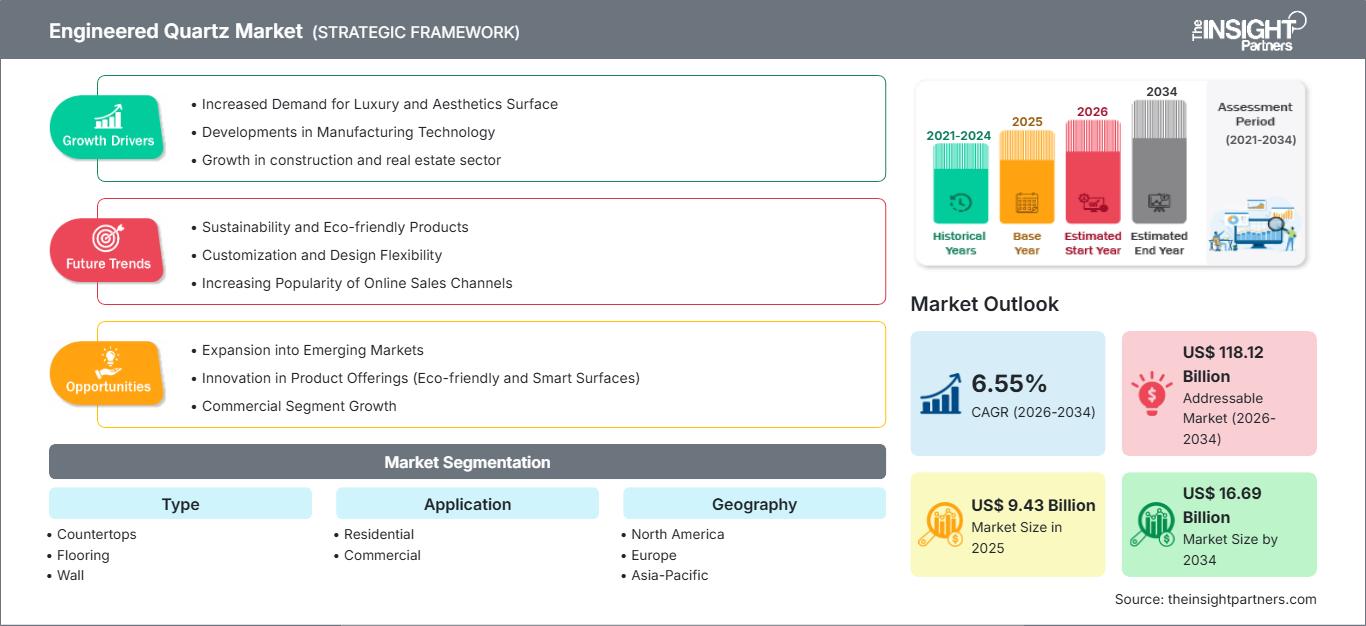
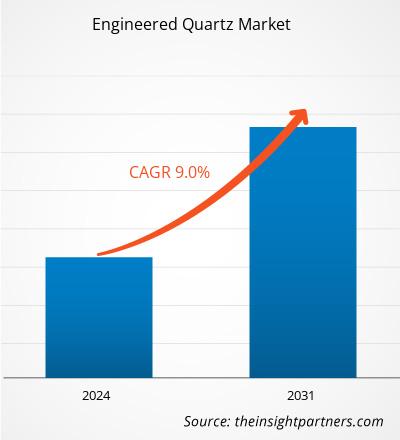
The Engineered Quartz Market was valued at US$ 9.43 Billion in 2025 and is projected to reach US$ 16.69 Billion by 2034, registering a CAGR of 6.55% during 2026–2034. The market encompasses engineered quartz surfaces manufactured by combining quartz aggregates with binders, pigments, and performance-enhancing materials for interior surface applications. Demand is supported by continued adoption of durable, low-maintenance surfaces across residential and commercial construction, alongside product innovation focused on aesthetics, fabrication performance, and material sustainability.
North America remains an important consumption center, supported by remodeling activity, replacement of conventional countertop materials, and established distribution networks serving fabricators, designers, contractors, and retailers. The regional outlook is also shaped by manufacturers introducing lower-silica and alternative mineral surfaces in response to workplace safety considerations. Regulatory attention to respirable crystalline silica is encouraging suppliers to diversify formulations while maintaining the durability, appearance, and fabrication characteristics expected from premium engineered surfaces. OSHA specifies a 50 μg/m³ permissible exposure limit for respirable crystalline silica as an 8-hour time-weighted average in general industry. The Engineered Quartz Market size continues to reflect demand for premium surfacing materials and evolving regulatory requirements.
Engineered Quartz Market Assessment and Insights
- North America: North America is estimated to account for 34–38% share in 2025 and expand at a CAGR of 5.8–6.5% during 2026–2034, supported by renovation demand, established fabrication infrastructure, premium product adoption, and extensive designer and distributor networks.
- US: The US is estimated to represent 78–82% of North America’s 2025 value and grow at a CAGR of 5.7–6.4% during 2026–2034, driven by remodeling, countertop replacement, and commercial interior projects.
- Europe: Europe is estimated to hold 22–26% share in 2025 and grow at a CAGR of 5.9–6.7%, with Germany, the UK, France, Italy, and Spain providing significant demand through residential renovation, hospitality, and design-led commercial construction.
- Asia Pacific: Asia Pacific is estimated to represent 24–28% share in 2025 and register a CAGR of 7.2–8.0%, led by China, India, Japan, South Korea, and Australia, where construction activity, urbanization, and expanding interior-design applications support consumption.
- Largest Segment: Countertops are estimated to hold 63–68% market share in 2025 and grow at a CAGR of 6.4–7.0%, reflecting strong residential kitchen and bathroom applications.
- High Growth Segment: Wall applications are estimated to hold 10–14% share in 2025 and expand at a CAGR of 7.1–8.0%, supported by premium interior cladding and integrated surface design.
- Key companies analyzed in detail: Baba Super Minerals Private Limited, Caesarstone Ltd., Hyundai L&C Canada Inc., Prism Johnson Limited, M S International, Inc., Nhat Huy Group, Pokarna Engineered Stone Limited, Vicostone Joint Stock Company, Cosentino, S.A., Compac Surfaces, S.L.
Source: The Insight Partners' analysis based on proprietary research, government publications, company annual reports, investor presentations, industry databases, and expert interviews.
Quartz countertops have advanced from standard varieties to wider product lines that offer better veining, marble-like effects, large slabs, and more favorable fabricating properties. More manufacturers are incorporating recycled materials, altering mineral formulations, and using other binders in order to minimize environmental and occupational hazards. One such company is Caesarstone, which launched Mineral surfaces in 2025 with crystalline silica content lower than 40%, while its ICON line contains a patent-pending formula consisting of around 80% of recycled products.
Looking ahead, geographic diversification and formulation innovation are expected to shape competitive positioning. Producers are increasing attention to lower-silica materials, recycled content, waste valorization, digital design support, and premium surface aesthetics. Australia provides a significant regulatory signal, having prohibited the manufacture, supply, processing, and installation of specified engineered-stone benchtops, panels, and slabs from July 2024, followed by import restrictions from January 2025. These developments are expected to influence the Engineered Quartz Market share by reshaping product portfolios, investment priorities, and regional competitive dynamics.
Engineered Quartz Market Report Scope
| Report Attribute | Details |
|---|---|
| Market size in 2025 | US$ 9.43 Billion |
| Market Size by 2034 | US$ 16.69 Billion |
| Global CAGR (2026 - 2034) | 6.55% |
| Historical Data | 2021-2024 |
| Forecast period | 2026-2034 |
Engineered Quartz Market Analysis
Demand is anchored by the material’s combination of visual consistency, stain resistance, low maintenance, and fabrication flexibility. Residential kitchens and bathrooms remain core consumption areas, while commercial interiors broaden the addressable opportunity through hospitality, offices, retail, healthcare, and multifamily projects. The value chain includes quartz and mineral suppliers, resin and pigment providers, slab manufacturers, distributors, fabricators, architects, interior designers, contractors, and end users. Manufacturing economics depend on raw material availability, energy consumption, production yield, polishing efficiency, slab breakage, logistics, and inventory management. The Engineered Quartz Market report evaluates these demand drivers, value-chain dynamics, and operational factors influencing industry performance.
Supply patterns have become increasingly diverse based on formulation, design capacity, certification, scale of production, and closeness to large markets of consumption. Indian, Vietnamese, Chinese, Spanish, Italian, and other manufacturing sources manufacture for both domestic and export distribution. The importance of North American demand for foreign manufacturers comes from the development of its ecosystem for fabrication and distribution processes. Occupational exposure requirements have also become an issue in processing, as OSHA has set exposure assessment and controls as needed.
Competition combines global surface brands with vertically integrated manufacturers and export-oriented producers. Caesarstone, Cosentino, Vicostone, MSI, Pokarna, Nhat Huy Group, and other participants compete through product breadth, color development, slab availability, distribution reach, design support, and fabrication relationships. Cosentino has increasingly emphasized material circularity, including a 2025 innovation challenge seeking marketable uses for Silestone manufacturing waste, which the company reported at more than 100,000 tons annually. The Engineered Quartz Market forecast reflects the growing importance of sustainability initiatives, product innovation, and competitive differentiation strategies.
Strategic positioning is shifting toward multi-material portfolios rather than reliance on conventional quartz alone. Caesarstone has expanded beyond quartz into porcelain and advanced fusion surfaces, while Cosentino continues to develop Silestone alongside other surface categories. This diversification reduces dependence on a single formulation and enables suppliers to respond to changing regulatory requirements and design preferences. Smaller and regional producers can compete through customization, rapid delivery, competitive pricing, private-label manufacturing, and strong relationships with fabricators and distributors. These developments are shaping the Engineered Quartz Market trends toward greater product diversification, sustainability, and customer-focused differentiation.
● REPORT CUSTOMIZATION
Tailor This Report To Align With Your Specific Business Requirements
This report can be customized to align precisely with your business objectives, scope, and target markets. Customization options include tailored segmentation, geography, competitive analysis, and strategic insights to support informed decision-making.
Customize This Report →WHAT YOU CAN ADJUST
- ● Segmentations
- ● Geography
- ● Competitive Analysis
- ● Language Preferences
Engineered Quartz Market: Strategic Insights
Regional Insights
North America Engineered Quartz Market
North America is estimated to account for 34–38% of the global Engineered Quartz Market value in 2025 and record a CAGR of 5.8–6.5% through 2034. The US is the leading national market, driven by kitchen renovations, bathroom renovations, multifamily buildings, hospitality projects, and existing countertop fabrication systems. Engineered quartz will be applicable in cases where customers seek uniform aesthetics, longevity, and easy maintenance.
Canada comes in with renovations and new constructions, and Mexico has an advantage with growing construction and closer access to North American supply chains. There is also a growing emphasis on safer fabrication methods and new surface formulations due to the respiratory crystalline silica risks still facing the workforce. Thus, manufacturers are developing new low-silica mineral and other materials with premium aesthetics. The North American demand will remain structurally robust, but substitution effects could affect future surface demand.
U.S. Engineered Quartz Market
The US is estimated to represent 78–82% of North America's 2025 Engineered Quartz Market value and is projected to grow at a CAGR of 5.7–6.4% during 2026–2034. Residential remodeling remains the principal application environment, particularly kitchen countertops, bathroom vanities, islands, and replacement surfaces. Commercial demand adds incremental volume through hotels, offices, retail developments, and multifamily housing.
The US Engineered Quartz Market benefits from strong participation by Caesarstone, M S International, Inc., and other established surface suppliers, alongside extensive fabricator and distributor networks. Premium designs increasingly mimic natural marble and quartzite, while manufacturers emphasize stain resistance, maintenance simplicity, and design continuity. OSHA's crystalline silica standard establishes a 50 μg/m³ permissible exposure limit for applicable general-industry workplaces, reinforcing the importance of exposure-control practices during fabrication.
Europe Engineered Quartz Market
Europe is estimated to represent 22–26% share of the Engineered Quartz Market in 2025 and grow at a CAGR of 5.9–6.7%, with Spain serving as a major production and design center. Demand is supported by residential renovation, hospitality development, premium kitchens, bathrooms, and commercial interior applications. European producers increasingly combine surface aesthetics with recycled inputs and lower-impact manufacturing.
The UK Engineered Quartz Market is supported by renovation, kitchen replacement, and premium residential interiors. Germany has an advantage because of its large construction, renovation, and design industry, while France continues to have demand for its products in residential and hospitality applications. Italy and Spain continue to be key design and manufacturing markets; moreover, Spanish manufacturers play a prominent role in the development of engineered surfaces. Growing interest of regulators in silica exposure raises the importance of alternatives. As a result, European manufacturers invest in recycling, efficiency, and variety of surfaces, but keep premium properties intact.
APAC Engineered Quartz Market
Asia Pacific is estimated to account for 24–28% share of the Engineered Quartz Market in 2025 and grow at a CAGR of 7.2–8.0%, making it the fastest-growing major regional market. China continues to be the dominant country, owing to its manufacturing ability, construction, and exports. India plays a significant role due to housing interiors, top-tier interiors, and quartz slab exports.
Japan and South Korea contribute demand from mature markets for quality interior materials, whereas Australia is a different market structure due to the prohibition of engineered stone. The Australian prohibition applies to particular engineered-stone benchtops, panels, and slabs, and there have been import bans in place since January 2025.
Middle East & Africa Engineered Quartz Market
The Middle East and Africa Engineered Quartz Market represents a smaller but developing opportunity, supported by hospitality, commercial real estate, luxury residential projects, and infrastructure-led construction. The demand in Saudi Arabia and the UAE is generated by big development projects, luxury hotels, mixed-use projects, and high-end residential construction.
The contribution from South Africa comes through renovation of residential spaces and commercial interiors, while other Middle Eastern and African countries continue to be associated with the cycle of construction and surface imports. The region is projected to grow at a CAGR of 6.3% – 7.2% between 2026 and 2034. Saudi Arabia will continue to be one of the top countries because of big development projects, which need durable interior surfaces.
Segmentation Analysis
Type
The type segment of the Engineered Quartz Market remains the principal product segmentation, covering countertops, flooring, and wall applications. Countertops dominate because engineered quartz combines visual consistency, durability, stain resistance, and relatively simple maintenance. The segment is projected to grow at a CAGR of 6.4–7.0% during 2026–2034, while flooring and wall applications broaden the material's architectural relevance.
- Countertops: Countertops maintain the strongest market position because kitchens, bathrooms, islands, and vanity installations require durable, non-porous-looking surfaces with extensive color and pattern choices. Their integration with established fabrication networks reinforces repeat demand.
- Flooring: Flooring applications provide opportunities where consistent design, abrasion resistance, and coordinated interiors are important. Adoption is influenced by commercial projects, premium residential interiors, hospitality spaces, and projects requiring coordinated surface palettes.
- Wall: Wall applications are gaining strategic importance as designers use large-format engineered surfaces for feature walls, bathroom surrounds, backsplashes, and integrated interiors. Demand benefits from aesthetic continuity and reduced visual joints.
Application
The application segment of the Engineered Quartz Market comprises residential and commercial demand and is projected to grow at a CAGR of 6.6–7.2% during 2026–2034. Residential projects remain the largest consumption base, while commercial adoption is supported by hospitality, offices, retail, healthcare, and multifamily developments requiring durable, design-oriented surfaces.
- Residential: Residential applications represent the core demand base, particularly kitchen countertops, bathroom vanities, islands, and renovation projects. Homeowners value consistent patterns, easy maintenance, and extensive design selections.
- Commercial: Commercial projects support higher-volume installations across hotels, restaurants, offices, retail, healthcare, and multifamily properties. Procurement decisions increasingly consider lifecycle performance, design consistency, installation efficiency, and material availability.
Opportunity Snapshot
| Application | Revenue Contribution | Trend Tag | Adoption Stage |
|---|---|---|---|
| Residential | High | Kitchen Remodeling | Mature |
| Commercial | Medium | Hospitality Interiors | Scaling |
Engineered Quartz Market Growth Drivers and Impact Analysis
Premium Interior Design and Marble-Look Demand
As far as design trends are concerned, preference is shifting toward surfaces that will duplicate the appearance of depth seen in marble, quartzite, and other premium materials but provide greater uniformity from slab to slab. This means that there are new opportunities for quartz surface makers to distinguish their products by way of veining, color depth, surface finish, and large format designs instead of just durability. This will be especially well-received in high-end residential kitchens and baths where consumers view their countertops and wall surfaces as integral parts of the interior design scheme. Commercial hospitality projects are also taking advantage of coordinated surfaces as an identity for interiors.
Expansion of Renovation and Replacement Activity
Renovation and replacement create repeated demand, as there is a need for the existing kitchens, bathrooms, hospitality interiors and commercial interiors to be regularly updated. The engineered quartz enjoys an advantage in situations where materials capable of providing the look of renewal, while not being high maintenance, are sought out during refurbishment. In the residential market, countertop replacement may take place independently of renovations in the home and thereby make it easier to upgrade surfaces. Property owners in the commercial market also take advantage of interior refurbishments to improve their assets and tenant experience. This gives a more varied demand than the construction cycle. The effect becomes even more important in mature markets where existing homes are present and remodeling takes up a significant part of the construction spending.
Manufacturing Scale and International Supply Networks
Engineered quartz is able to leverage an existing global supply chain with mineral producers, slab producers, distributors, fabricators, and designers as participants. Locations that have access to quartz, processing ability, cheap labor, and export capabilities can cater to several geographic regions. India and Vietnam have established good export environments, whereas Europe and North America have efficient downstream processes and distribution networks in place. Manufacturers can benefit from large-scale operations, which will enable them to spread out their costs and create large color palettes. However, international supply chains are prone to costs such as freight charges, trade policies, energy costs, exchange rates, and inventory needs. It would be possible for organizations to limit supply chain disruptions by having diversified manufacturing and strong regional distribution capabilities.
Engineered Quartz Market Future Trends
Low-Silica and Alternative Mineral Surface Development
The future of product development is likely to be characterized by more formulations that will be able to cut down on crystalline silica while retaining durability and aesthetics as well as performance during the manufacturing process. Regulations and health issues are compelling companies to think beyond their usual formulas. The introduction of the Mineral and ICON surfaces by Caesarstone is a good example of such efforts, with Mineral having less than 40% crystalline silica while ICON is described as a fusion surface that consists of 80% recycled material. This may spur research on materials that are capable of replicating the performance of quartz but without using crystalline silica.
Circular Material Integration and Manufacturing Waste Valorization
It is expected that circularity will increasingly be incorporated into surface design engineering, including not only the use of recycled materials but also waste generation and recovery through manufacture, water reuse, efficient energy use, and material loops. The Cosentino plan to find commercial applications for Silestone manufacturing waste by 2025 is one example of how producers are investigating value from material flows that arise through calibration and polishing processes. Future material collections could therefore provide more information on recycled content and material origins, with increasing measurement of waste intensity and efficiency occurring within manufacturing operations. Such approaches could provide greater environmental benefits and differentiation within markets that increasingly assess building materials based on their lifecycle rather than simply aesthetics and cost.
Engineered Quartz Market Opportunities
Regional Manufacturing and Localization Strategies
There are prospects for companies to develop manufacturing and finishing facilities in close proximity to high-consumption areas in order to cut down on delivery time and mitigate logistical risks. This would prove particularly important in the case of large-format slabs when transport issues play a role in the economics of delivery. Companies that already have manufacturing facilities in place can take advantage of both their export scale and the presence of regional warehouses, partnerships in manufacturing and localized collections. There are new markets in India, Southeast Asia, the Middle East and selected Latin American countries which provide companies with diversification prospects beyond the traditional markets of North America and Europe. Localized operations may also help to deal with differences in regulations and certification and customer preferences.
Integrated Surface Solutions for Commercial Interiors
The commercial space provides an avenue for expanding engineered quartz beyond its traditional uses on kitchen countertops by creating comprehensive surface solutions. More developers, hoteliers, hospitals, retailers, and office designers are looking for coordinated materials to use on reception desks, vanity surfaces, wall elements, tables, and other interior design surfaces. They can capitalize on this trend by offering coordinated collections, large slabs, accessories, pre-finished components, and visualization tools. Such an approach results in more material used per project and fosters better business relationships with architects and design firms. Furthermore, it enables premium pricing since consumers get to look at the entire interior palette instead of purchasing individual slabs.
Recent Developments
- May 2026: CRL Stone launched its new 2026 CRL Quartz brochure, presenting its complete engineered quartz collection with more than 40 colours spanning marble-inspired, neutral, industrial, terrazzo, and statement designs. The brochure also highlights Low Silica and Silica Free options, application guidance, technical specifications, warranties, and certifications for residential and commercial projects, reflecting growing emphasis on design variety and safer surface solutions.
- May 2026: Esprit Stones Limited approved an investment of INR 35 crore to establish a new pressing line for engineered quartz surfaces at its Udaipur, Rajasthan facility. The expansion is expected to add capacity of 5,000 slabs per month to the existing 9,600 slabs per month, with commissioning targeted between January and March 2027, strengthening the company's production capacity and global market positioning.
Frequently Asked Questions

- Comprehensive Market Sizing and Forecast Analysis
- Detailed Segmentation Analysis
- In-Depth Market Dynamics Assessment
- Regional and Country-Level Insights
- Competitive Landscape and Company Benchmarking
- Strategic Business Intelligence
Recent Reports
Testimonials

The Insight Partners' SCADA System Market report is comprehensive, with valuable insights on current trends and future forecasts. The team was highly professional, responsive, and supportive throughout. We are very satisfied and highly recommend their services.
RAN KEDEM Partner, Reali Technologies LTDs
I requested a report on a very specific software market and the team produced the report in a few days. The information was very relevant and well presented. I then requested some changes and additions to the report. The team was again very responsive and I got the final report in less than a week.
JEAN-HERVE JENN Chairman, Future Analytica
We worked with The Insight Partners for an important market study and forecast. They gave us clear insights into opportunities and risks, which helped shape our plans. Their research was easy to use and based on solid data. It helped us make smart, confident decisions. We highly recommend them.
PIYUSH NAGPAL Sr. Vice President, High Beam Global
The Insight Partners delivered insightful, well-structured market research with strong domain expertise. Their team was professional and responsive throughout. The user-friendly website made accessing industry reports seamless. We highly recommend them for reliable, high-quality research services
YUKIHIKO ADACHI CEO, Deep Blue, LLC.
This is the first time I have purchased a market report from The Insight Partners.While I was unsure at first, I visited their web site and felt more comfortable to take the risk and purchase a market report.I am completely satisfied with the quality of the report and customer service. I had several questions and comments with the initial report, but after a couple of dialogs over email with their analyst I believe I have a report that I can use as input to our strategic planning process.Thank you so much for taking the extra time and making this a positive experience.I will definitely recommend your service to others and you will be my first call when we need further market data.
JOHN SUZUKI President and Chief Executive Officer, Board Director, BK Technologies
I wish to appreciate your support and the professionalism you displayed in the course of attending to my request for information regarding to infectious disease IVD market in Nigeria. I appreciate your patience, your guidance, and the fact that you were willing to offer a discount, which eventually made it possible for us to close a deal. I look forward to engaging The Insight Partners in the future, all thanks to the impression you have created in me as a result of this first encounter.
DR CHIJIOKE ONYIA MANAGING DIRECTOR, PineCrest Healthcare Ltd.Reason to Buy
- Informed Decision-Making
- Understanding Market Dynamics
- Competitive Analysis
- Identifying Emerging Markets
- Customer Insights
- Market Forecasts
- Risk Mitigation
- Boosting Operational Efficiency
- Strategic Planning
- Investment Justification
- Tracking Industry Innovations
- Aligning with Regulatory Trends





 Get Free Sample for