
Engineered Thermoplastic Polyurethane Market Share, Demand & Growth by 2034
Coverage: By Type (Foam, Elastomer); Application (Performance Footwear, Automotive, Hose and Tube, Others) , and Geography (North America, Europe, Asia Pacific, and South and Central America)
- Status : Data Released
- Report Code : TIPRE00019506
- Category : Chemicals and Materials
- No. of Pages : 150
- Available Report Formats :


- Last update date : August 27, 2026


2025 Market Size
US$ 2.94 Bn
Base year value
2034 Forecast
US$ 4.28 Bn
Projected by 2034
CAGR 2026-2034
4.26 %
Growth rate
Addressable Market
US$ 32.79 Bn
(2026-2034)
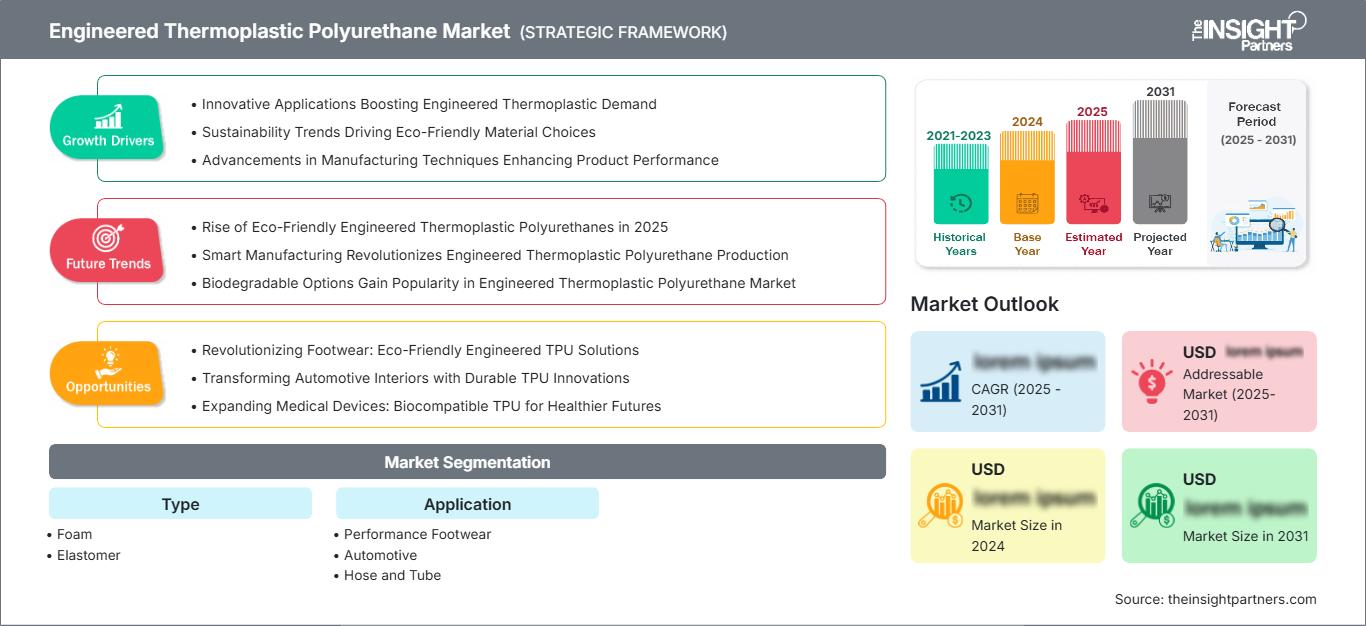
The global Engineered Thermoplastic Polyurethane market was valued at US$ 2.94 billion in 2025 and is expected to reach US$ 4.28 billion by 2034; it is estimated to record a CAGR of 4.26% during 2026-2034.
Engineered Thermoplastic Polyurethane Market Assessment and Insights
- North America: North America is estimated to account for 27–31% share in 2025 and grow at a CAGR of 4.4–5.1% during 2026–2034, supported by automotive components, technical footwear, industrial tubing, advanced manufacturing, and established polymer processing infrastructure.
- US: The US is estimated to represent 80–84% of North America’s 2025 value and expand at a CAGR of 4.3–5.0%, supported by automotive applications, performance footwear, industrial equipment, and specialty polymer demand.
- Europe: Europe is estimated to hold 25–29% share in 2025 and grow at a CAGR of 4.5–5.2%, led by Germany, Italy, France, and the UK, with automotive engineering, footwear, industrial components, and sustainability initiatives supporting demand.
- Asia Pacific: Asia Pacific is estimated to account for 34–38% share in 2025 and register a CAGR of 5.2–5.9%, led by China, Japan, South Korea, India, and Southeast Asia through manufacturing expansion and footwear and automotive production.
- Largest Segment: Elastomer is estimated to hold 71–76% market share in 2025 and grow at a CAGR of 4.6–5.1%, reflecting broad adoption across molded, extruded, and flexible applications.
- High Growth Segment: Foam is estimated to represent 24–29% share in 2025 and expand at a CAGR of 5.3–6.1%, supported by lightweight footwear, cushioning, energy absorption, and advanced foaming technologies.
- Key companies analyzed in detail: American Polyfilm, Inc., Avient Corporation, BASF SE, Coim Group, Covestro AG, Huntsman International LLC, Kuraray Co., Ltd., Miracll Chemicals Co., Ltd., The Lubrizol Corporation, Wanhua Chemical Group Co., Ltd.
Source: The Insight Partners' analysis based on proprietary research, government publications, company annual reports, investor presentations, industry databases, and expert interviews.
The material landscape has shifted from conventional flexible polymer applications toward engineered TPU grades optimized for lightweighting, abrasion resistance, low-temperature flexibility, chemical resistance, and sophisticated processing. BASF positions Elastollan for extrusion, injection molding, and blow molding, while current product development increasingly connects TPU with foaming, automation, footwear performance, and automotive interior applications.
Future expansion is expected to emphasize circular feedstocks, recycled content, low-density grades, automated processing, and regional manufacturing. BASF introduced Elastollan GripTec in 2026 for sports footwear, combining grip, durability, design flexibility, and recyclability, while Lubrizol continues developing TPU technologies for automotive, footwear, textiles, electronics, and other applications. These developments are expected to strengthen Engineered Thermoplastic Polyurethane Market share through innovation, sustainability, and expanded end-use adoption.
Engineered Thermoplastic Polyurethane Market Report Scope
| Report Attribute | Details |
|---|---|
| Market size in 2025 | US$ 2.94 Billion |
| Market Size by 2034 | US$ 4.28 Billion |
| Global CAGR (2026 - 2034) | 4.26% |
| Historical Data | 2021-2024 |
| Forecast period | 2026-2034 |
Engineered Thermoplastic Polyurethane Market Analysis
Demand is supported by TPU’s combination of elasticity, strength, abrasion resistance, chemical resistance, and thermoplastic processing. Performance footwear uses soft and hard grades for cushioning, soles, heels, reinforcement, and specialized components, while automotive applications use TPU in interior and exterior components requiring durability and low-temperature flexibility. Hose and tube applications benefit from resistance to wear, oils, and environmental conditions. The value chain spans chemical feedstocks, TPU polymerization, compounding, additive formulation, pellet production, distributors, converters, molders, extruders, footwear manufacturers, automotive suppliers, and industrial equipment producers. The Engineered Thermoplastic Polyurethane Market report analyzes these demand drivers, application trends, and value-chain dynamics influencing industry growth.
Supply dynamics are influenced by raw-material prices, energy costs, production capacity, formulation technology, regional logistics, and customer qualification requirements. Large producers compete through broad grade portfolios and technical support, whereas specialized suppliers focus on customized formulations and application-specific performance. Asia Pacific provides an important manufacturing base, particularly China, where producers such as Miracll Chemicals operate dedicated TPU businesses. North America and Europe remain important high-value markets because of sophisticated automotive, industrial, footwear, and polymer-processing ecosystems.
Competitive intensity reflects the presence of multinational chemical companies and specialized TPU producers. BASF, Covestro, Huntsman, Lubrizol, Avient, Kuraray, and Wanhua compete through material performance, application engineering, global supply, sustainability, and customer qualification. Huntsman, for example, supplies TPU for footwear, textiles, automotive, wire and cable, wheels, belting, hoses, films, and adhesive applications. Its 2025 ISCC+ certification for TPU sites reinforces the growing role of traceability and sustainable feedstocks in supplier positioning.
Strategic positioning is increasingly centered on application-specific innovation rather than commodity volume alone. Covestro highlights TPU solutions for footwear, technical textiles, automotive applications, and films, while Lubrizol develops TPU technologies for adhesive, film, sheet, and molded-part applications. Avient extends TPU capabilities into healthcare and specialty formulations, demonstrating the importance of technical customization. The Engineered Thermoplastic Polyurethane Market forecast reflects the growing role of specialized product development, performance differentiation, and end-use innovation in driving future growth.
● REPORT CUSTOMIZATION
Tailor This Report To Align With Your Specific Business Requirements
This report can be customized to align precisely with your business objectives, scope, and target markets. Customization options include tailored segmentation, geography, competitive analysis, and strategic insights to support informed decision-making.
Customize This Report →WHAT YOU CAN ADJUST
- ● Segmentations
- ● Geography
- ● Competitive Analysis
- ● Language Preferences
Engineered Thermoplastic Polyurethane Market: Strategic Insights
Regional Insights
North America Engineered Thermoplastic Polyurethane Market
North America is estimated to account for 27–31% of global value in 2025 and expand at a CAGR of 4.4–5.1% during 2026–2034. The US represents the leading regional market, supported by automotive manufacturing, performance footwear, industrial equipment, specialty tubing, and advanced polymer conversion. Demand is strengthened by established injection molding and extrusion capabilities and by customers seeking materials that combine rubber-like flexibility with thermoplastic processing. These factors are shaping key Engineered Thermoplastic Polyurethane Market trends across the region.
Canada contributes through automotive components, industrial products, footwear, and specialty polymer applications, while Mexico benefits from its integrated manufacturing relationship with the US automotive and industrial sectors. TPU suppliers are increasingly developing grades for lightweight components, abrasion-resistant parts, flexible tubing, films, and specialized molded products. BASF identifies TPU applications spanning hoses, cable sheathing, belts, films, and profiles, reinforcing the breadth of downstream demand.
U.S. Engineered Thermoplastic Polyurethane Market
The US is estimated to represent 80–84% of North America's 2025 value and is projected to grow at a CAGR of 4.3–5.0% during 2026–2034. Automotive components, performance footwear, industrial equipment, flexible tubing, films, and specialty molded products provide a diversified base of demand. TPU adoption is supported by the ability to tailor hardness, elasticity, abrasion resistance, and chemical performance, supporting continued Engineered Thermoplastic Polyurethane Market growth.
American Polyfilm, Inc., Avient Corporation, BASF SE, Huntsman International LLC, and The Lubrizol Corporation have relevant capabilities serving US customers through specialized polymer grades and application support. Lubrizol identifies automotive, footwear, furniture, textiles, and electronics among TPU application areas, while Avient supplies flexible TPU grades for specialized tubing and overmolding.
Europe Engineered Thermoplastic Polyurethane Market
Europe is estimated to account for 25–29% share in 2025 and grow at a CAGR of 4.5–5.2%, with Germany serving as a leading market. The region benefits from advanced automotive engineering, industrial manufacturing, footwear production, technical textiles, and increasingly stringent sustainability expectations. TPU suppliers are responding through recycled content, renewable feedstocks, process efficiency, and application-specific formulations. This Engineered Thermoplastic Polyurethane Market analysis highlights the growing importance of sustainability, material innovation, and specialized performance requirements across Europe.
There is demand in Germany for automotive and industrial production applications. Demand is present in Italy and France due to footwear, fashion, industrial, and automotive applications. The UK helps with applications in industrial goods, footwear, and specialty manufacturing. Covestro and BASF have wide-ranging TPU production in Europe, whereas Huntsman has applications in footwear, automotive, textiles, and industrial goods. The 2025 ISCC+ certification by Huntsman shows the growing trend towards traceable materials in the region.
APAC Engineered Thermoplastic Polyurethane Market
Asia Pacific is estimated to hold 34–38% share of the Engineered Thermoplastic Polyurethane Market in 2025 and grow at a CAGR of 5.2–5.9%, making it the largest regional market. China leads through extensive chemical manufacturing, footwear production, automotive manufacturing, and polymer processing. Japan and South Korea provide technologically advanced demand, while India is supported by footwear manufacturing and industrialization.
Southeast Asia adds demand through expanding footwear and automotive supply chains. China-based Miracll Chemicals is an established TPU producer, while BASF's Shanghai facility has been qualified to produce food-contact Elastollan grades, improving regional supply responsiveness.
Middle East & Africa Engineered Thermoplastic Polyurethane Market
The Middle East and Africa Engineered Thermoplastic Polyurethane Market represent a smaller but developing market, estimated to expand at a CAGR of 4.6–5.5% during 2026–2034. Saudi Arabia and the UAE lead through industrial diversification, infrastructure investment, automotive-related activity, and demand for durable industrial components. South Africa contributes through manufacturing, mining-related equipment, footwear, and flexible polymer applications.
The rest of MEA remains dependent on imported polymer materials and regional industrial development. Hose, tube, cable, footwear, and molded-part applications offer opportunities where abrasion resistance, flexibility, and chemical durability are important. Increasing industrial localization and infrastructure development should support the gradual adoption of engineered polymer solutions.
Segmentation Analysis
Type
Type represents a fundamental dimension of the Engineered Thermoplastic Polyurethane Market, comprising Foam and Elastomer. Elastomers currently account for the broader application base because they can be processed through extrusion and injection molding into flexible components. The segment is projected to grow at a CAGR of 4.6–5.1% during 2026–2034, supported by automotive, footwear, hose, tube, and industrial applications. BASF identifies TPU suitability for extrusion, injection molding, and blow molding, supporting broad processing adoption.
- Foam: Foam applications benefit from low density, cushioning, resilience, and energy absorption. Demand is concentrated in performance footwear and lightweight applications, where manufacturers seek reduced weight without sacrificing durability, flexibility, and comfort.
- Elastomer: Elastomer applications maintain the largest demand base across automotive components, footwear parts, hoses, tubes, films, profiles, and industrial products. Their balance of flexibility, strength, abrasion resistance, and processability supports diverse component requirements.
Application
The application defines the downstream scope of the Engineered Thermoplastic Polyurethane Market through Performance Footwear, Automotive, and Hose and Tube. The application segment is projected to grow at a CAGR of 4.7–5.3% during 2026–2034. Performance footwear remains an important application because TPU supports lightweight, durable, flexible, and visually differentiated footwear components. Automotive demand benefits from material lightweighting and performance requirements, while hose and tube applications rely on durability and resistance properties.
- Performance Footwear: Performance footwear uses TPU for midsoles, outsoles, heels, reinforcements, and cushioning structures. Product development increasingly emphasizes grip, low weight, automated manufacturing, durability, and recyclable material systems.
- Automotive: Automotive applications use TPU for interior and exterior components, flexible parts, protective surfaces, and specialized components. Lightweighting, abrasion resistance, low-temperature flexibility, and design freedom support material substitution.
- Hose and Tube: Hose and tube applications require flexibility, wear resistance, chemical resistance, and reliable performance under demanding conditions. TPU is suitable for extrusion-based products used in industrial and specialized fluid-handling environments.
Opportunity Snapshot
| Application | Revenue Contribution | Trend Tag | Adoption Stage |
|---|---|---|---|
| Performance Footwear | High | Lightweight Soles | Mature |
| Automotive | High | Interior Lightweighting | Scaling |
| Hose and Tube | Medium | Flexible Tubing | Mature |
Engineered Thermoplastic Polyurethane Market Growth Drivers and Impact Analysis
Demand for Lightweight and High-Performance Components
Lightweighting is becoming a priority in the automotive industry, in footwear manufacturing, for industrial equipment, and for consumer goods, as there is a desire for manufacturers to reduce component weight without compromising on mechanical performance. TPU can have characteristics like flexibility, abrasion resistance, tensile strength, and design capabilities, which means that manufacturers can substitute other heavy materials or materials that have a less efficient production process. Automotive companies can use TPU for parts that require impact resistance and low-temperature flexibility. Footwear manufacturers can use it for lightweight soles and cushioning systems. BASF has shown the qualities of TPU used in the automotive industry, such as wear resistance, tensile strength, tear resistance, low-temperature flexibility, and damping capability.
Growth of Performance and Technical Footwear
Performance footwear remains a source of constant demand for materials that will give cushioning, grip, abrasion-resistance, and durability. TPU comes in various hardness forms; thus, different grades are used for applications that include cushioning parts, compact soles, heels, reinforcement, and other footwear components. The footwear segment of BASF shows the range of applications from sports, hiking, outdoor, safety, and casual footwear. New product development also shows this possibility: GripTec by BASF was launched in 2026 for running, hiking, lifestyle, and children's footwear, while Lubrizol has developed TPU applications for footwear midsoles.
Expansion of Sustainable Polymer Formulations
Sustainability is affecting TPU purchasing strategies as shoe brands, car companies, and industry buyers look for recycled materials, renewable materials, and sustainable material solutions. Being a thermoplastic makes it possible to recycle and process it, opening up possibilities for designing recycling-oriented material products. In their 2025 footwear innovations, BASF launched Elastollan RC with 100% recycled content, along with recycling and feedstock innovations. Huntsman's recent ISCC+ certification is another indicator that people have become conscious about the supply chain and feedstock innovation.
Engineered Thermoplastic Polyurethane Market Future Trends
Advanced Foaming and Automated Processing
Foaming technology is poised to become an important technological trend as manufacturers develop light parts for better comfort and resource efficiency. For example, the BASF GripTec product line up to 2026 shows how TPU research is coupled with efficient manufacturing, whereas BASF's previous collaboration with Hyundai Transys utilized supercritical fluid injection foaming on TPU to produce modular seating systems for automobiles. As a result, lightweight abrasion-resistant parts with a soft touch and high aesthetic value have been developed. The same methodology can be applied to use TPU in car interior design, sports goods, and footwear parts, with the need for lightweight construction and efficient manufacturing.
Circular and Bio-Based TPU Formulations
Circular approaches are going to get increasingly important in product development due to customers’ sustainability demands and the efficiency of resources. Indeed, BASF has launched its recycled TPU solutions for use in footwear, whereas Lubrizol has presented its bio-based TPU technology, which features characteristics that make it suitable for harsh applications. Also, Covestro has started to present its TPU solutions along with other circular material solutions. The future developments are going to involve the combination of feedstock, which is either recycled or renewable, with specific application characteristics.
Engineered Thermoplastic Polyurethane Market Opportunities
Localization of TPU Production in High-Growth Manufacturing Hubs
Localization provides suppliers a chance to improve their standing within the APAC region and similar areas that are heavy on manufacturing through the improvement of lead times and technical responsiveness. China already has an established ecosystem for TPU production, while India and Southeast Asia are developing themselves in terms of footwear, automotive, electronics, and industrial manufacturing. Localization will lessen logistical risks while making it possible to tailor grades to local process conditions. The Shanghai certification by BASF for producing food contact Elastollan is one example of how localization can increase the speed with which customers have access to custom grades.
Expansion into Specialized High-Value Applications
Application-specific products allow the possibility to enhance value capture by concentrating more on performance criteria rather than bulk quantities. In the case of medical tubing, technical fabrics, automotive interiors, flexible electronics, protective films, and specialty footwear, there can be different combinations of characteristics like stretch, abrasion resistance, chemical resistance, transparency, softness, and barrier properties required. For instance, Avient’s NEUSoft TPU range allows the supplier to demonstrate application-specific products for catheter tubing and overmolding needs, whereas Covestro and Lubrizol continue to support TPUs for technical textiles, footwear, films, automotive, and adhesive applications.
Recent Developments
- February 2026: The Lubrizol Corporation launched Tolerathane™ Thermoplastic Polyurethane (TPU), a new medical-grade TPU specifically developed for implantable medical devices. The material is designed to provide enhanced biostability, softness, and design flexibility, addressing requirements for medical applications where long-term material performance and patient comfort are important. The launch expands Lubrizol’s engineered TPU portfolio into higher-value healthcare applications and demonstrates the growing use of specialized TPU formulations beyond conventional industrial, automotive, and footwear applications.
- April 2025: Covestro AG launched Desmopan® FLY, an advanced TPU series engineered for supercritical fluid (SCF) injection foaming technology. The material enables the production of uniform fine-cell foams with lightweight characteristics, cushioning, energy return, durability, and dimensional stability. The technology is particularly targeted at performance footwear, while also offering potential applications in sports equipment, furniture, and electronics. Covestro also installed an advanced SCF injection foaming system at its TPU Asia-Pacific R&D Center in Taiwan to support customer development and accelerate commercialization. The absence of chemical blowing agents and crosslinking additives supports recyclability of the resulting TPU components.
Frequently Asked Questions

- Comprehensive Market Sizing and Forecast Analysis
- Detailed Segmentation Analysis
- In-Depth Market Dynamics Assessment
- Regional and Country-Level Insights
- Competitive Landscape and Company Benchmarking
- Strategic Business Intelligence
Recent Reports
Testimonials

The Insight Partners provided valuable market intelligence that supported our global go-to-market strategy. Their team was professional, responsive, and attentive to our feedback, providing thoughtful analysis and helpful methodological clarifications throughout the project.
Junmo Kim Chief Financial Officer (CFO), Enertech Co., Ltd.
The Insight Partners' SCADA System Market report is comprehensive, with valuable insights on current trends and future forecasts. The team was highly professional, responsive, and supportive throughout. We are very satisfied and highly recommend their services.
RAN KEDEM Partner, Reali Technologies LTDs
I requested a report on a very specific software market and the team produced the report in a few days. The information was very relevant and well presented. I then requested some changes and additions to the report. The team was again very responsive and I got the final report in less than a week.
JEAN-HERVE JENN Chairman, Future Analytica
We worked with The Insight Partners for an important market study and forecast. They gave us clear insights into opportunities and risks, which helped shape our plans. Their research was easy to use and based on solid data. It helped us make smart, confident decisions. We highly recommend them.
PIYUSH NAGPAL Sr. Vice President, High Beam Global
The Insight Partners delivered insightful, well-structured market research with strong domain expertise. Their team was professional and responsive throughout. The user-friendly website made accessing industry reports seamless. We highly recommend them for reliable, high-quality research services
YUKIHIKO ADACHI CEO, Deep Blue, LLC.
This is the first time I have purchased a market report from The Insight Partners.While I was unsure at first, I visited their web site and felt more comfortable to take the risk and purchase a market report.I am completely satisfied with the quality of the report and customer service. I had several questions and comments with the initial report, but after a couple of dialogs over email with their analyst I believe I have a report that I can use as input to our strategic planning process.Thank you so much for taking the extra time and making this a positive experience.I will definitely recommend your service to others and you will be my first call when we need further market data.
JOHN SUZUKI President and Chief Executive Officer, Board Director, BK Technologies
I wish to appreciate your support and the professionalism you displayed in the course of attending to my request for information regarding to infectious disease IVD market in Nigeria. I appreciate your patience, your guidance, and the fact that you were willing to offer a discount, which eventually made it possible for us to close a deal. I look forward to engaging The Insight Partners in the future, all thanks to the impression you have created in me as a result of this first encounter.
DR CHIJIOKE ONYIA MANAGING DIRECTOR, PineCrest Healthcare Ltd.Reason to Buy
- Informed Decision-Making
- Understanding Market Dynamics
- Competitive Analysis
- Identifying Emerging Markets
- Customer Insights
- Market Forecasts
- Risk Mitigation
- Boosting Operational Efficiency
- Strategic Planning
- Investment Justification
- Tracking Industry Innovations
- Aligning with Regulatory Trends





 Get Free Sample for