
Engineering Resins Market Size, Trends & Growth by 2034
Coverage: by Type (Polycarbonate, Acetal Copolymer Polyoxymethlence, Acetal Homopolymer Polyoxymethlence, Acrylic, Nylon, Polyethylene, Polypropylene, Polyvinylchloride, Teflon); Application (Bumpers, Chemical Tanks, Electrical Insulators, Inhalers, Others); End Use Industry (Automotive, Building and Construction, Electrical Engineering, Healthcare, Packaging, Others) , and Geography (North America, Europe, Asia Pacific, and South and Central America)
- Status : Data Released
- Report Code : TIPRE00008759
- Category : Chemicals and Materials
- No. of Pages : 150
- Available Report Formats :


- Last update date : August 27, 2026


2025 Market Size
US$ 17.09 Bn
Base year value
2034 Forecast
US$ 31.8 Bn
Projected by 2034
CAGR 2026-2034
7.15 %
Growth rate
Addressable Market
US$ 220.71 Bn
(2026-2034)
The Engineering Resins Market was valued at US$ 17.09 Billion in 2025 and is projected to reach US$ 31.8 Billion by 2034, registering a CAGR of 7.15% during 2026–2034. Demand is being shaped by lightweighting, electrical insulation, dimensional stability, chemical resistance, and increasing material substitution across transportation, healthcare, packaging, and industrial equipment. Product development is increasingly focused on high-performance grades that combine durability, regulatory compliance, processability, and lower environmental impact.
North America remains an important manufacturing and consumption base, supported by automotive electrification, medical-device production, advanced electronics, and industrial automation. The Engineering Resins Market size is expected to expand at an estimated 6.5–7.2% CAGR during 2026–2034. Replacement of metals in selected components, demand for flame-retardant materials, and investment in domestic manufacturing capacity should support regional consumption, particularly for polycarbonate, nylon, acrylic, and acetal-based materials.
Engineering Resins Market Assessment and Insights
- North America: North America accounted for a 24–28% Engineering Resins Market share in 2025 and is projected to grow at a 6.5–7.2% CAGR between 2026–2034, supported by automotive electrification, healthcare manufacturing, electronics, and industrial automation.
- US: The US represented 19–22% of global demand in 2025 and is expected to grow at a 6.4–7.1% CAGR between 2026–2034, led by medical devices, vehicles, electronics, and machinery.
- Europe: Europe held a 21–25% share in 2025 and is forecast to expand at a 5.8–6.6% CAGR between 2026–2034, with Germany, France, Italy, and the UK supporting automotive, industrial, electrical, and healthcare applications.
- Asia Pacific: Asia Pacific represented 39–43% share in 2025 and is expected to register a 7.8–8.6% CAGR between 2026–2034, driven by China, Japan, South Korea, and India through electronics, automotive, construction, and manufacturing.
- Largest Segment: Polycarbonate represented a 24–28% market share in 2025, with a 7.0–7.6% CAGR during 2026–2034, reflecting broad use in automotive, electrical, healthcare, and durable applications.
- High Growth Segment: Healthcare represented a 10–13% share in 2025 and is projected to grow at a 7.8–8.5% CAGR during 2026–2034, supported by medical devices, inhalation systems, and sterile components.
- Key companies analyzed in detail: Arkema S.A., BASF SE, DuPont de Nemours, Inc., Honeywell International Inc., SABIC, LG Chem, Ltd., Mitsubishi Chemical Corporation, Solvay SA, Sumitomo Chemical Co., Ltd., INEOS Styrolution Group GmbH.
Source: The Insight Partners' analysis based on proprietary research, government publications, company annual reports, investor presentations, industry databases, and expert interviews.
The industry has shifted from traditional engineering resins to application-specific resin grades designed to withstand high temperatures, be flame-retardant, dimensionally precise, chemical resistant, and lightweight. The trend towards electrification of vehicles has boosted development of materials for connectors, housings, sensors, and structural parts, whereas electronics firms need resins with controlled electrical properties. BASF categorizes engineering plastics by their automotive, electrical and electronics, home appliance, precision technology, and medical technology applications.
In terms of future trends, material suppliers will focus on local production, use of recycled and biogenic raw materials, traceability, and compliance with regulations. Local production is strategically relevant, since material processors look for shortening of their supply chains and access to grades. In India, BASF developed its specialty Ultradur PBT grades locally in 2025, which included flame-retardant and hydrolysis-resistant materials in order to react to its customers' demands.
Engineering Resins Market Report Scope
| Report Attribute | Details |
|---|---|
| Market size in 2025 | US$ 17.09 Billion |
| Market Size by 2034 | US$ 31.8 Billion |
| Global CAGR (2026 - 2034) | 7.15% |
| Historical Data | 2021-2024 |
| Forecast period | 2026-2034 |
Engineering Resins Market Analysis
This demand factor is based on the capacity of the engineering resins to substitute metals, glass, and regular plastics where factors such as weight, strength, heat resistance, or design flexibility play an essential role. Consequently, the Engineering Resins Market will continue to be connected to the development of electric cars, electronics, automation, healthcare, and high-performance packaging.
The value chain encompasses the raw materials (either petrochemical or bio-sourced), polymerization, compounding, reinforcement, conversion process, component manufacture, and assembly. Engineering resin suppliers use more and more additives such as fiber glass, mineral fillers, impact modifiers, flame retardants, etc. to formulate resin grades specifically designed for particular uses. The market structure remains dependent on feedstock prices, energy prices, production capacities, transportation, and local trade regulations. The imposition of anti-dumping duties on imported POM copolymers by China until 2025 is one example.
Competitive dynamics in the Engineering Resins Market include diversified portfolios, application engineering, localized manufacturing, technical services, and prolonged OEM qualifications. BASF, SABIC, LG Chem, Mitsubishi Chemical Corporation, Solvay SA, Arkema S.A., and Sumitomo Chemical Co., Ltd. engage in competition through differentiated grades of polymers and specialty compounds. DuPont de Nemours, Inc., Honeywell International Inc., and INEOS Styrolution Group GmbH enhance competitive dynamics via their proven material platforms and downstream connections.
Increasingly, strategic positioning in the Engineering Resins Market is based on value-added grades rather than volume alone. LG Chem has emphasized engineering plastics for electric vehicles and electronic devices while creating specialty materials that are more difficult technologically. SABIC has developed specialty thermoplastics for electronics, medical applications, and sustainable formulations. Consequently, investment has been made into application engineering, recycled materials, flame retardant systems, and materials able to meet increasingly stringent regulations.
● REPORT CUSTOMIZATION
Tailor This Report To Align With Your Specific Business Requirements
This report can be customized to align precisely with your business objectives, scope, and target markets. Customization options include tailored segmentation, geography, competitive analysis, and strategic insights to support informed decision-making.
Customize This Report →WHAT YOU CAN ADJUST
- ● Segmentations
- ● Geography
- ● Competitive Analysis
- ● Language Preferences
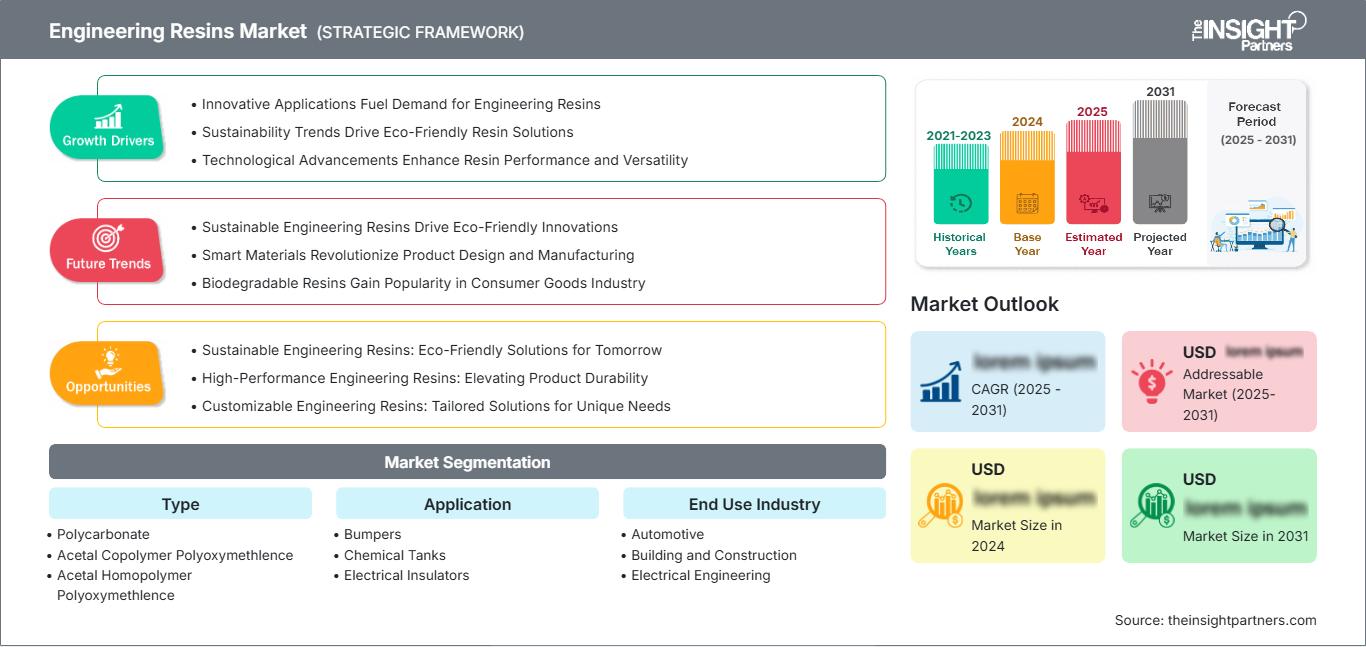
Engineering Resins Market: Strategic Insights
Regional Insights
North America Engineering Resins Market
North America held a 24–28% Engineering Resins Market in 2025 and is projected to grow at a 6.5–7.2% CAGR through 2034. The area benefits from existing automotive, healthcare, electronics, aerospace, and industrial manufacturing ecosystems. Engineering resins are now commonly employed in the production of light weight parts, electrical systems, connectors, housings, and precision-molded parts. Demand is driven by vehicle electrification and advanced manufacturing investments. The United States is the leading consumer in the region, backed by strong OEMs and medical device manufacturing. Mexico is making a contribution to the region by means of its automotive and electronics assembly. Canada, in turn, is contributing to the region’s transportation, industrial machinery, and healthcare markets. Manufacturers are responding to rising cost and volatility issues by adopting regional production and inventory methods.
U.S. Engineering Resins Market
The US represented 78–82% of North American demand in 2025 and is expected to grow at a 6.4–7.1% CAGR through 2034. These are still important end uses. The local compounders and the worldwide suppliers of resins cater to the needs of OEMs that demand materials with certification, stable formulations, and technical assistance.
The demand trend for this product is toward those with high heat resistance, flame retardance, reinforcement, and recycled content. During 2026, BASF increased prices for some engineering plastic products in North America, including those made from polyamide and POM. The existence of large manufacturers and advanced converters makes it easier to qualify for new grades, especially for automotive electrical components, medical equipment, and industrial high-performance parts.
Europe Engineering Resins Market
Europe represented a 21–25% Engineering Resins Market in 2025 and is projected to expand at a 5.8–6.6% CAGR through 2034. Germany continues to be the top country-level market driven by its automobile engineering, machinery, electrical products, and manufacturing. United Kingdom, France, Italy, and Spain add to the demand coming from transportation, healthcare, packaging and manufacturing.
Automobiles and machinery in Germany lead to substantial use of polyamides, polycarbonates, acrylics, and acetals. France has its demand coming from automobiles, aerospace, healthcare, and manufacturing industries, while Italy and Spain derive theirs from automobiles parts, packaging machinery, appliances, and construction related manufacturing. Increasingly material safety, recyclability, emissions, and food contact regulations are shaping the demand in Europe, leading to qualification of the special formulations with their properties.
APAC Engineering Resins Market
APAC accounted for 39–43% Engineering Resins Market in 2025 and is expected to grow at a 7.8–8.6% CAGR, making it the leading regional market. China is the largest producer, followed by Japan, South Korea, India, and Australia. Electronics, auto manufacturing, industrial equipment, construction, and packaging drive the demand.
Local industry and government support for manufacturing investments bolster demand. India is increasingly becoming an important manufacturing hub, while China remains important in electronics and auto supply chains. The ISCC PLUS certification of BASF’s engineering plastics plant in Shanghai and Zhanjiang in July 2026 increases locally certified sustainable materials in auto and electronics sectors.
Middle East & Africa Engineering Resins Market
Middle East and Africa represent a smaller regional base but offer a projected 5.5–6.4% CAGR through 2034. Petroleum integration, diversification, and infrastructural development help Saudi Arabia and the UAE, whereas South Africa promotes automobile, electrical, mining, and industrial use. The Middle East has advantages in terms of feedstock and downstream manufacturing capabilities.
Saudi Arabia is the largest regional market with industrial development and polymer manufacturing capability, while the UAE gains through logistics and manufacturing investments, and South Africa is still important for automobile components and industrial machinery. The demand for engineering resins is set to increase as the region advances into higher value-added products and manufacturing of components and infrastructural development.
Segmentation Analysis
Type
Type segment in the Engineering Resins Market is a fundamental basis of competition because resin selection determines mechanical strength, thermal stability, chemical resistance, processing characteristics, and application compatibility. The segment is projected to grow at a 6.8–7.6% CAGR during 2026–2034, with polycarbonate and nylon benefiting from broad industrial applications.
- Polycarbonate: Polycarbonate holds a strong market position because of impact resistance, optical clarity, dimensional stability, and heat performance. It is strategically important for automotive components, electrical housings, healthcare products, and durable consumer applications.
- Acetal Copolymer Polyoxymethlence: Acetal Copolymer Polyoxymethlence is valued for low friction, wear resistance, dimensional stability, and machinability, supporting precision gears, valves, mechanical components, and automotive systems.
- Acetal Homopolymer Polyoxymethlence: Acetal Homopolymer Polyoxymethlence serves applications requiring stiffness, fatigue resistance, and low moisture absorption. Its engineering characteristics support precision components and demanding mechanical assemblies.
- Acrylic: Acrylic provides transparency, weatherability, surface quality, and design flexibility, making it relevant for lighting, displays, optical components, healthcare equipment, and selected automotive applications.
- Nylon: Nylon remains important for strength, abrasion resistance, and temperature performance. Reinforced grades increasingly support lightweight automotive parts, electrical components, industrial machinery, and structural applications.
- Polyethylene: Polyethylene contributes chemical resistance, toughness, and processability, supporting selected engineering applications where durability and resistance to aggressive environments are required.
- Polypropylene: Polypropylene provides low density, chemical resistance, and cost advantages. Advanced reinforced grades increasingly support automotive components, appliances, packaging-related systems, and industrial parts.
- Polyvinylchloride: Polyvinylchloride remains relevant for chemical resistance, electrical insulation, and construction applications. Formulation flexibility allows producers to tailor rigidity, flexibility, flame behavior, and durability.
- Teflon: Teflon is valued for exceptional chemical resistance, low friction, and temperature stability, supporting specialized electrical, industrial, chemical-processing, and healthcare applications requiring demanding surface performance.
Application
Application influences resin selection according to mechanical, thermal, chemical, and regulatory requirements. The segment is expected to grow at a 6.7–7.5% CAGR during 2026–2034, with healthcare and electrical applications gaining importance as precision and safety requirements increase.
- Bumpers: Bumpers require impact resistance, lightweighting, weatherability, and paintability. Engineering resin formulations enable manufacturers to reduce component weight while maintaining dimensional integrity and surface quality under variable operating conditions.
- Chemical Tanks: Chemical Tanks require resistance to corrosive chemicals, stress cracking, and environmental exposure. Resin selection focuses on long-term durability, leak prevention, and reliable performance in industrial storage systems.
- Electrical Insulators: Electrical Insulators depend on dielectric strength, flame resistance, thermal stability, and dimensional control. Engineering resins support connectors, housings, insulation systems, and electrical protection components.
- Inhalers: Inhalers require precise molding, chemical compatibility, dimensional consistency, and appropriate regulatory characteristics. Engineering resins support drug-delivery components where repeatable performance and controlled manufacturing tolerances are essential.
End Use Industry
End Use Industry determines the performance requirements and qualification standards applied to resin grades. The segment is forecast to expand at a 7.0–7.8% CAGR during 2026–2034, with automotive and electrical engineering remaining major demand centers.
- Automotive: Automotive applications increasingly use engineering resins for lightweighting, electrification, sensors, connectors, interior components, and under-the-hood systems requiring thermal and mechanical durability.
- Building and Construction: Building and Construction demand is linked with electrical systems, plumbing-related components, insulation, fittings, and durable products requiring chemical resistance and long service life.
- Electrical Engineering: Electrical Engineering requires materials combining dielectric performance, flame resistance, dimensional stability, and thermal endurance, supporting connectors, housings, switches, and insulation components.
- Healthcare: Healthcare applications emphasize biocompatibility, sterilization compatibility, dimensional precision, and regulatory compliance, supporting medical devices, inhalers, diagnostic equipment, and specialized components.
- Packaging: Packaging applications increasingly use high-performance resins where durability, barrier performance, lightweighting, heat resistance, and processing efficiency provide advantages in specialized packaging formats.
Opportunity Snapshot
| End Use Industry | Revenue Contribution (High/Medium/Low) | Trend Tag | Adoption Stage |
|---|---|---|---|
| Automotive | High | EV Lightweighting | Scaling |
| Building and Construction | Medium | Durable Systems | Mature |
| Electrical Engineering | High | Thermal Safety | Scaling |
| Healthcare | Medium | Device Precision | Scaling |
| Packaging | Medium | Barrier Design | Mature |
Engineering Resins Market Growth Drivers and Impact Analysis
Vehicle Electrification and Lightweight Component Design
Electromobiles need larger amounts of electrical connectors, sensor housings, charging components, battery-associated parts, and thermal management parts. Engineering plastics have the ability to offer lightweight along with electrical insulation, dimension stability, flame retardancy, and design freedom, enabling OEMs to integrate parts and cut down system weight. BASF states that engineering plastics play an increasingly significant role in the electrical and electronic applications of the automobile industry due to the increasing importance of driver assistance, networking, and electromobility. Such a change in requirements impacts the focus of qualifications because suppliers have to prove their performance in higher electrical loading conditions, thermal cycles, vibrations, and long periods of service life.
Expansion of Electronics and Electrical Equipment Manufacturing
The increasing density of electronics in vehicles, appliances, industrial equipment, communication systems, and consumer devices is expanding the requirement for precise insulating and structural materials. Engineered resins feature controllable dielectric properties, dimensional stability, flame retardancy, and thin-wall molding characteristics, enabling manufacturers to make small parts while maintaining the requisite safety features. BASF's range of electronic products is designed specifically to address the need for insulation and thermal protection. The business relevance is not only about the volumes of resin sales but the higher technical differentiation of more valuable formulations, which may require meeting certain stringent certification requirements related to the electrical performance. Those suppliers that combine their expertise in polymer technology with compounding, simulations, testing, and application assistance are well placed to get into customers' design process earlier.
Increasing Regulatory Requirements for Safer and Sustainable Materials
Regulatory requirements are impacting formulations, certifications, traceability, and material selections. Compliance to specific safety standards is becoming increasingly important within applications such as food-contact, medical, electrical, transport, and construction. The development by BASF in 2026 of differentiated Ultradur grades for drinking water and food contact applications is an example of how suppliers are modifying their portfolios in response to changing requirements, which include EU regulations regarding BPA-free products. Meanwhile, recycled/renewable feedstock becomes commercially viable as customers look to make sustainable gains without compromising on performance. In this context, barriers to entry are high since effective grades have to be tested, certified, validated, and secured. Manufacturers who can integrate sustainability into performance criteria will be able to access opportunities in regulated applications.
Engineering Resins Market Future Trends
Certified Circular and Lower-Carbon Resin Platforms
The Engineering Resins Market trends show that in the future, development of products will involve a blend of both engineering performance and quantifiable circularity. Manufacturers will be looking at extending product grades that have either mechanically recycled, chemically recycled, or renewable feedstocks while still retaining properties such as flame retardancy, toughness, dimensional stability, and processability. The concept of mass balance will be becoming more applicable in cases where segregation of the sustainable feedstocks physically becomes impossible. Certification of ISCC PLUS in 2026 by BASF for engineering plastics manufacturing in China exemplifies how independent traceability of sustainable material supply is coming into play. Customers will need to look at both the recycled content and its chain of custody, carbon footprint, regulatory aspects, and application performance.
Higher-Performance Materials for Electrified and Intelligent Systems
According to the Engineering Resins Market forecast, engineering resin development is expected to increasingly target systems that combine electrical, thermal, mechanical, and electromagnetic requirements. Electric vehicles, photovoltaic equipment, advanced sensors, robotics, and connected industrial systems require materials capable of operating reliably under heat, vibration, electrical stress, and outdoor exposure. SABIC's 2026 launch of laser-weldable NORYL V0 resins for photovoltaic manufacturing illustrates the movement toward materials engineered around specific production processes and energy applications. Future grades are likely to incorporate optimized reinforcement, flame-retardant systems, thermal-management characteristics, and controlled electrical properties. Application-specific materials should therefore gain importance as OEMs seek fewer components, faster assembly, improved reliability, and greater design freedom.
Engineering Resins Market Opportunities
Localized Production in High-Growth Manufacturing Economies
Producers can capture incremental demand by expanding localized compounding, technical service, and distribution in India, Southeast Asia, China, and other manufacturing centers. Local supply reduces lead times, improves inventory responsiveness, and allows grades to be adapted to regional OEM requirements. BASF's localization of specialty Ultradur PBT production in India demonstrates this strategy, particularly for automotive and electronics customers. Investment opportunities extend beyond polymer capacity into application laboratories, mold-flow support, recycling partnerships, and qualification centers. Suppliers with local technical teams can shorten customer development cycles and strengthen relationships with component manufacturers. For investors, the most attractive opportunities are likely to involve differentiated grades supported by application engineering rather than undifferentiated resin capacity alone.
Medical and Precision Applications Requiring Certified Materials
Healthcare and precision applications offer attractive opportunities because material qualification is generally more demanding than in less regulated applications. Inhalers, diagnostic components, surgical equipment, drug-delivery systems, and laboratory devices require dimensional precision, sterilization compatibility, chemical resistance, and documented biocompatibility. SABIC showcased biocompatible materials and medical-grade thermoplastics at MD&M West 2026, including materials aimed at drug delivery and patient-testing applications. Suppliers can pursue higher-value opportunities by combining resin formulation with design support, testing, prototyping, and regulatory documentation. Partnerships with medical-device manufacturers can create longer qualification cycles but also improve customer retention because approved materials are difficult to replace without renewed validation.
Recent Developments
- December 2025: PRO-SET Formulated Resin Systems, LLC acquired Wessex Resins and Adhesives Ltd., its long-standing European licensing partner, to expand its high-performance composite resins and adhesives business across Europe, the Middle East, Africa, and parts of Asia. Wessex manufactures epoxy resin systems for infusion, laminating, tooling, coatings, and adhesives, strengthening PRO-SET’s regional manufacturing and distribution capabilities.
- March 2025: Formlabs launched Tough 1500 Resin V2 and the second-generation Form Cure station for its SLA 3D-printing ecosystem. Tough 1500 Resin V2 delivers 10 times higher fracture toughness, 3 times higher Gardner impact strength, and more than 150% elongation at break, while the new curing system reduces post-processing time and supports faster production workflows.
Frequently Asked Questions

- Comprehensive Market Sizing and Forecast Analysis
- Detailed Segmentation Analysis
- In-Depth Market Dynamics Assessment
- Regional and Country-Level Insights
- Competitive Landscape and Company Benchmarking
- Strategic Business Intelligence
Recent Reports
Testimonials

The Insight Partners provided valuable market intelligence that supported our global go-to-market strategy. Their team was professional, responsive, and attentive to our feedback, providing thoughtful analysis and helpful methodological clarifications throughout the project.
Junmo Kim Chief Financial Officer (CFO), Enertech Co., Ltd.
The Insight Partners' SCADA System Market report is comprehensive, with valuable insights on current trends and future forecasts. The team was highly professional, responsive, and supportive throughout. We are very satisfied and highly recommend their services.
RAN KEDEM Partner, Reali Technologies LTDs
I requested a report on a very specific software market and the team produced the report in a few days. The information was very relevant and well presented. I then requested some changes and additions to the report. The team was again very responsive and I got the final report in less than a week.
JEAN-HERVE JENN Chairman, Future Analytica
We worked with The Insight Partners for an important market study and forecast. They gave us clear insights into opportunities and risks, which helped shape our plans. Their research was easy to use and based on solid data. It helped us make smart, confident decisions. We highly recommend them.
PIYUSH NAGPAL Sr. Vice President, High Beam Global
The Insight Partners delivered insightful, well-structured market research with strong domain expertise. Their team was professional and responsive throughout. The user-friendly website made accessing industry reports seamless. We highly recommend them for reliable, high-quality research services
YUKIHIKO ADACHI CEO, Deep Blue, LLC.
This is the first time I have purchased a market report from The Insight Partners.While I was unsure at first, I visited their web site and felt more comfortable to take the risk and purchase a market report.I am completely satisfied with the quality of the report and customer service. I had several questions and comments with the initial report, but after a couple of dialogs over email with their analyst I believe I have a report that I can use as input to our strategic planning process.Thank you so much for taking the extra time and making this a positive experience.I will definitely recommend your service to others and you will be my first call when we need further market data.
JOHN SUZUKI President and Chief Executive Officer, Board Director, BK Technologies
I wish to appreciate your support and the professionalism you displayed in the course of attending to my request for information regarding to infectious disease IVD market in Nigeria. I appreciate your patience, your guidance, and the fact that you were willing to offer a discount, which eventually made it possible for us to close a deal. I look forward to engaging The Insight Partners in the future, all thanks to the impression you have created in me as a result of this first encounter.
DR CHIJIOKE ONYIA MANAGING DIRECTOR, PineCrest Healthcare Ltd.Reason to Buy
- Informed Decision-Making
- Understanding Market Dynamics
- Competitive Analysis
- Identifying Emerging Markets
- Customer Insights
- Market Forecasts
- Risk Mitigation
- Boosting Operational Efficiency
- Strategic Planning
- Investment Justification
- Tracking Industry Innovations
- Aligning with Regulatory Trends





 Get Free Sample for