
Epoxy Paints and Coatings Market Demand, Share & Growth by 2034
Coverage: by Technology (Waterborne, Solvent Borne, Powder Based) ; Application (Adhesives, Construction, Electrical and Electronics, Transportation, Paints and coating, Others) , and Geography (North America, Europe, Asia Pacific, and South and Central America)
- Status : Data Released
- Report Code : TIPRE00005760
- Category : Chemicals and Materials
- No. of Pages : 150
- Available Report Formats :


- Last update date : September 01, 2026


2025 Market Size
US$ 38.79 Bn
Base year value
2034 Forecast
US$ 52.41 Bn
Projected by 2034
CAGR 2026-2034
3.4 %
Growth rate
Addressable Market
US$ 414.17 Bn
(2026-2034)
The global Epoxy Paints and Coatings market was valued at US$ 38.79 billion in 2025 and is expected to reach US$ 52.41 billion by 2034; it is estimated to record a CAGR of 3.4% during 2026-2034.
Epoxy Paints and Coatings Market Assessment and Insights
- North America: North America held a 26–30% share in 2025 and is projected to grow at a CAGR of 3.1–3.7% during 2026–2034, supported by industrial refurbishment, infrastructure maintenance, transportation production, and protective coating applications.
- US: The US represented 22–25% of global demand in 2025 and is expected to expand at a CAGR of 3.0–3.6%, supported by industrial maintenance, construction, transportation, and electrical equipment manufacturing.
- Europe: Europe accounted for a 22–26% share in 2025 and is expected to grow at a CAGR of 3.2–3.8%, with Germany, France, Italy, Spain, and the UK supporting industrial, construction, automotive, and infrastructure applications.
- Asia Pacific: Asia Pacific represented a 43–47% share in 2025 and is projected to expand at a CAGR of 4.1–4.8%, led by China, India, Japan, South Korea, and Southeast Asian manufacturing economies.
- Largest Segment: Waterborne technology held a 40–44% market share in 2025 and is projected to grow at a CAGR of 4.1–4.7%, reflecting lower-emission formulation demand.
- High Growth Segment: Powder Based technology represented a 17–21% share in 2025 and is projected to grow at a CAGR of 4.4–5.1%, supported by durable low-emission coating requirements.
- Key companies analyzed in detail: Akzo Nobel N.V.; Axalta Coating Systems, LLC; BASF SE; Jotun A/S; Kansai Paint Co., Ltd.; Masco Corporation; Nippon Paint Holdings Co., Ltd.; PPG Industries, Inc.; RPM International Inc.; The Sherwin-Williams Company.
Source: The Insight Partners' analysis based on proprietary research, government publications, company annual reports, investor presentations, industry databases, and expert interviews.
The Epoxy Paints & Coatings market has evolved from traditional solvent-based protective coatings to the greater adoption of water-borne, high solids, powdered, and advanced epoxy systems. Suppliers have focused on achieving faster curing times, improved adhesion, chemical resistance, thinner film applications, and efficient application in one fell swoop. This has resulted in a trend towards coatings capable of performing their function with a reduction in solvent exposure, energy utilization, and rework.
In the future, there is expected to be more demand coming from rising Asian economies as well as select infrastructure markets in the Middle East as the number of industrial facilities, transport systems, and energy assets grow. There will be a push towards low VOC coatings from regulatory authorities, while asset owners will increasingly be looking at the longevity of the coating beyond the initial cost of application.
Epoxy Paints and Coatings Market Report Scope
| Report Attribute | Details |
|---|---|
| Market size in 2025 | US$ 38.79 Billion |
| Market Size by 2034 | US$ 52.41 Billion |
| Global CAGR (2026 - 2034) | 3.4% |
| Historical Data | 2021-2024 |
| Forecast period | 2026-2034 |
Epoxy Paints and Coatings Market Analysis
Demand is facilitated by construction activities, maintenance of industrial assets, transportation equipment, electric manufacturing, and corrosion protection. Epoxy Paints And Coatings Market growth ecology encompasses resin manufacturers, curing agent providers, pigment manufacturers, formulators, applicators, distributors, equipment manufacturers, contractors, and OEMs. Each actor affects the performance of the coatings through formulation compatibility, substrate preparation, application techniques, curing process, and performance service requirement.
The dynamics of supply continue to be affected by epoxy resin, solvents, pigments, additives, and energy costs. Manufacturers are increasingly relying on formulations to manage price fluctuations of raw materials against performance. Water-based and powder coating technologies have an advantage due to low emission regulations, while solvent-borne epoxy is still applicable in harsh industrial applications.
The competitive situation highlighted in the Epoxy Paints And Coatings Market would depend on the extent of the use of technology, application engineering, geography, and complete coating systems. The companies Akzo Nobel N.V., PPG Industries, Inc., Jotun A/S, and The Sherwin-Williams Company are engaged in protective and industrial coatings while BASF SE, Axalta Coating Systems, LLC, Kansai Paint Co., Ltd., Nippon Paint Holdings Co., Ltd., RPM International Inc., and Masco Corporation contribute to make the competition intense due to formulation and geographic coverage differences.
The capital investment will include development in low-VOC chemistry, fast curing time, corrosion protection, and application efficiency. One company, PPG Industries, Inc., introduced glass-flake epoxy coatings in the offshore energy industry in 2026 with particular attention to durability and corrosion protection in the harsh environment. The same company continues to produce solvent-free epoxy floor coatings similar to the competitors.
● REPORT CUSTOMIZATION
Tailor This Report To Align With Your Specific Business Requirements
This report can be customized to align precisely with your business objectives, scope, and target markets. Customization options include tailored segmentation, geography, competitive analysis, and strategic insights to support informed decision-making.
Customize This Report →WHAT YOU CAN ADJUST
- ● Segmentations
- ● Geography
- ● Competitive Analysis
- ● Language Preferences
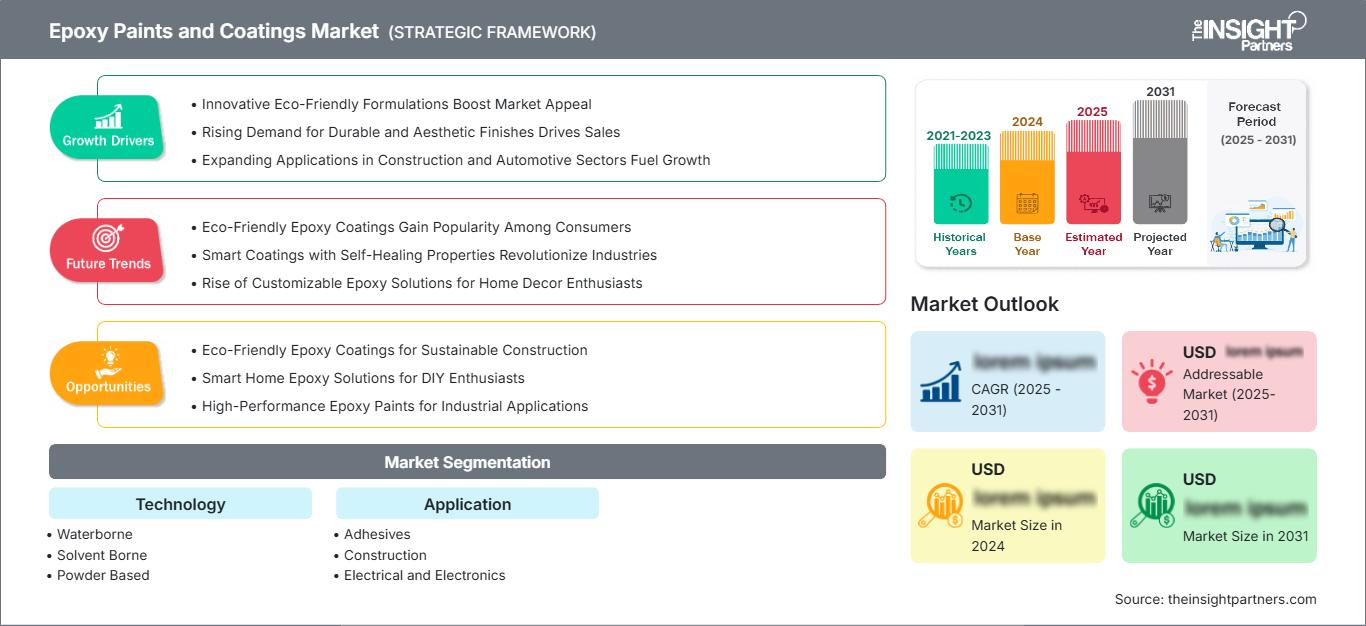
Epoxy Paints and Coatings Market: Strategic Insights
Regional Insights
North America Epoxy Paints And Coatings Market
North America held a share of 26–30% in the global Epoxy Paints And Coatings Market Share in 2025 and is expected to grow at a CAGR of 3.1–3.7% from 2026 to 2034. The region is characterized by availability of industrial infrastructure, manufacturing of transport equipment, commercial construction, manufacture of electrical equipment, and infrastructure repair works. US remains the major source of demand whereas Canada is contributing through energy, infrastructure, industrial, and transport uses.
The trend in regional demand towards coatings with a balance between high durability and low emissions is growing. Industrial floors, steel structures, pipelines, manufacturing plants, and transport equipment require abrasion-, chemical-, moisture-, and corrosion-resistance. Regulations on coating operations in the US that are environmentally focused are promoting the shift to low-VOC coatings.
U.S. Epoxy Paints And Coatings Market
North America constituted 82%-86% of US demand in 2025, which is expected to have a CAGR of 3.0%-3.6%. The United States has been experiencing extensive consumption from industries, construction, transport, electricals, warehousing, and infrastructure repairs. Companies like PPG Industries, Inc., Axalta Coating Systems, LLC, and The Sherwin-Williams Company supply formulations and distribution.
New trends include systems that offer corrosion resistance, ease of application, and regulation compliance. Some applications still include industrial floorings, protection of steel, manufacturing plants, transport vehicles, and infrastructure upgrades. There is a favorable regulatory climate for the growth of waterborne, high solid, powder, and other low emission systems, although there is room for the solvent-based coating system under certain conditions.
Europe Epoxy Paints And Coatings Market
Europe had a share of 22–26% in 2025 and is expected to grow at a CAGR of 3.2–3.8%, where Germany is leading the regional demand. The UK, France, Italy, and Spain offer additional consumption in terms of automotive manufacturing, industrial manufacturing, construction, rehabilitation of infrastructure, marine work, and energy projects. Environmental factors continue to play an important role in formulating products.
UK continues to demand through its infrastructure work, industrial renovations, marine work, and manufacturing. Germany offers demand from automotive and industrial equipment manufacturing and its strong engineering skills. France is helped by transport, aerospace infrastructure, industrial manufacturing, and construction work. Italy and Spain provide demand due to machinery, automotive, marine work, construction, and infrastructure work. Overall, the region demands low emission formulation and long service intervals.
APAC Epoxy Paints And Coatings Market
APAC accounted for 43%–47% of the global demand in 2025 and is expected to register a CAGR of 4.1%–4.8% to be the leading region. In the APAC region, China dominates, followed by Japan, South Korea, India, and Australia. The reasons include industrialization, construction activities, transportation equipment manufacturing, electronics, energy, and infrastructure development.
China enjoys a lot of manufacturing and infrastructural activities, whereas Japan and South Korea contribute their share through automotive, electronics, shipbuilding, and industrial segments. India is increasing its infrastructural and manufacturing capacities, whereas Australia has contributions from mining, energy, construction, and industrial maintenance. The focus on VOC emissions in regulations is prompting steady formulations changes, especially waterborne ones.
Middle East & Africa Epoxy Paints And Coatings Market
The demand from the Middle East and Africa is fueled by energy, construction, industries, water, and transportation infrastructure. Saudi Arabia leads in terms of demand, followed by the UAE and South Africa. The rest of MEA drives the market through infrastructure development. This region is forecasted to grow at a CAGR of 3.0% - 3.8%.
Industrial diversification, energy infrastructure, port and transport development, and construction have been the focus of investments in Saudi Arabia and the UAE. South Africa contributes via mining, industries, energy, and infrastructure management. Epoxy coatings are still significant in applications where corrosion, abrasion, chemicals, and difficult environmental conditions pose risks to asset sustainability.
Segmentation Analysis
Technology
Technology selection determines VOC profile, application method, curing behavior, equipment requirements, and final coating performance. The technology segment is projected to grow at a CAGR of 3.7–4.3% during 2026–2034. Waterborne systems benefit from environmental requirements, solvent-borne products retain demanding industrial applications, and powder formulations gain relevance where durable, low-emission finishes can be produced efficiently.
- Waterborne: Waterborne epoxy systems are gaining strategic importance as formulators improve adhesion, chemical resistance, and film formation while reducing solvent content. They are increasingly suitable for construction, industrial flooring, electrical, and selected protective applications.
- Solvent Borne: Solvent-borne epoxy remains important for heavy-duty applications requiring strong substrate tolerance, rapid curing, chemical resistance, and reliable performance under challenging environmental conditions, particularly industrial and protective coating operations.
- Powder Based: Powder-based epoxy systems provide durable films with limited solvent emissions and efficient material utilization. Their suitability for controlled industrial application environments supports use in equipment, electrical components, transportation, and metal substrates.
Application
Application requirements vary substantially by substrate, exposure conditions, coating thickness, curing environment, and expected service life. The application segment is projected to grow at a CAGR of 3.5–4.2% during 2026–2034. Construction and transportation provide significant volume, while electrical and electronics applications emphasize insulation, adhesion, and dimensional stability. Specialized industrial uses require chemical and corrosion resistance.
- Adhesives: Epoxy-based adhesive applications rely on strong bonding, dimensional stability, chemical resistance, and controlled curing. They support structural assembly where durable adhesion can reduce mechanical fastening and improve component integration.
- Construction: Construction applications use epoxy systems for industrial floors, concrete protection, structural maintenance, and specialized surfaces where abrasion, chemicals, moisture, and heavy traffic require durable protection.
- Electrical and Electronics: Electrical and electronics applications use epoxy formulations for insulation, encapsulation, component protection, and protective finishes where dielectric performance, adhesion, dimensional stability, and environmental resistance are essential.
- Transportation: Transportation applications require durable surfaces capable of resisting corrosion, impact, chemicals, and weather exposure. Epoxy systems are used across vehicles, components, infrastructure, and selected manufacturing operations.
- Paints and coating: Paints and coating applications represent broad protective and decorative use across industrial assets, metal structures, equipment, floors, and infrastructure where adhesion, corrosion protection, chemical resistance, and service life are important.
Opportunity Snapshot
| Application | Revenue Contribution | Trend Tag | Adoption Stage |
| Adhesives | Medium | Structural Bonding | Mature |
| Construction | High | Floor Protection | Mature |
| Electrical and Electronics | Medium | Insulation Protection | Scaling |
| Transportation | High | Fleet Durability | Mature |
| Paints and coating | High | Corrosion Control | Mature |
Epoxy Paints and Coatings Market Growth Drivers and Impact Analysis
Industrial Asset Protection and Maintenance Spending
Industrial facilities increasingly require coating systems that extend equipment and infrastructure service life while limiting shutdowns and maintenance frequency. Epoxy formulations provide strong adhesion, chemical resistance, abrasion resistance, and corrosion protection across floors, steel structures, tanks, pipelines, machinery, and processing environments. This creates recurring demand because coating systems require inspection, repair, recoating, and refurbishment throughout an asset's operating cycle. The economic impact is particularly relevant where corrosion or surface deterioration can interrupt production. Asset owners increasingly evaluate coatings according to lifecycle cost, application downtime, durability, and maintenance requirements rather than purchase price alone. Suppliers can therefore capture value through technical specification, substrate assessment, application support, and complete coating systems. This driver also supports specialized high-build and glass-flake epoxy solutions for aggressive environments.
Infrastructure Modernization and Construction Activity
Infrastructure modernization is expanding the addressable base for durable coating systems across bridges, transportation facilities, warehouses, industrial floors, water infrastructure, commercial buildings, and public assets. Epoxy coatings are particularly valuable on concrete and steel substrates exposed to heavy traffic, moisture, chemicals, and mechanical wear. Construction contractors increasingly specify systems according to expected service conditions, surface preparation requirements, curing time, and maintenance intervals. Demand also benefits from refurbishment because existing structures require protection even when new construction activity moderates. The resulting market impact differs by geography: mature economies emphasize renovation and asset preservation, while emerging economies generate demand through new infrastructure and industrial capacity. Suppliers with strong contractor networks, technical training, and application support can improve specification rates and reduce project execution risks.
Environmental Regulation and Low-VOC Formulation Development
Environmental regulation is accelerating formulation changes across coating manufacturers and industrial users. Regulatory frameworks targeting VOC and hazardous air pollutant emissions encourage the adoption of waterborne, powder, high-solids, and other lower-emission technologies. The US EPA identifies waterborne, powder, and other low- or no-VOC coatings as important approaches for reducing coating-related emissions. This transition is influencing research expenditure, production equipment, application practices, and customer qualification processes. Manufacturers must improve film formation, curing, adhesion, and chemical resistance while reducing solvent content. Consequently, product development is becoming more formulation-intensive, with suppliers seeking to preserve epoxy performance characteristics under lower-emission conditions. This driver creates opportunities for differentiated technologies that meet regulatory requirements without imposing significant productivity or performance penalties on applicators.
Epoxy Paints and Coatings Market Future Trends
Smart Formulation and Faster-Curing Systems
Future formulation development will increasingly combine faster curing with improved application tolerance and extended service life. Manufacturers are likely to optimize curing-agent chemistry, resin functionality, and additive packages to shorten recoat intervals without compromising adhesion or chemical resistance. Faster curing can reduce facility downtime, improve contractor productivity, and increase throughput in controlled manufacturing environments. Digital formulation tools and application modeling may also improve prediction of film performance across temperature, humidity, and substrate conditions. As industrial customers seek lower total ownership costs, coatings that deliver rapid return to service could gain preference over products selected solely on purchase price. Development will also focus on maintaining performance when coating thickness, application equipment, or environmental conditions vary from ideal specifications.
Bisphenol-Free and Regulatory-Ready Coating Systems
Regulatory scrutiny of substances used in coatings and packaging is expected to accelerate Epoxy Paints And Coatings Market Trends of alternative chemistries that maintain established epoxy performance. Akzo Nobel N.V. has already demonstrated this direction through its Accelshield portfolio, including waterborne BPAni solutions designed to provide flexibility, chemical resistance, and corrosion protection while addressing changing regulatory expectations. Future product development is likely to focus on eliminating or reducing substances of concern without creating performance trade-offs. This will require expanded compatibility testing, long-term exposure assessment, and customer qualification. Suppliers able to anticipate regulatory changes rather than react after restrictions become mandatory may reduce reformulation costs and shorten commercialization timelines, particularly in packaging, transportation, industrial, and infrastructure applications.
Epoxy Paints and Coatings Market Opportunities
Low-Emission Industrial Flooring Solutions
Industrial flooring presents an attractive opportunity because warehouses, factories, laboratories, garages, logistics facilities, and manufacturing plants require surfaces that tolerate abrasion, chemicals, impact, and repeated traffic. Suppliers can target this opportunity through solvent-free, low-VOC, self-leveling, and fast-return-to-service epoxy systems. Jotun A/S, for example, markets Jotafloor EP SL as a solvent-free, amine-cured epoxy flooring system designed for demanding industrial environments. The opportunity extends beyond coating sales into substrate preparation, application equipment, maintenance contracts, and technical services. Providers can improve margins by offering complete flooring systems rather than standalone products. Demand should remain resilient where industrial expansion and warehouse modernization increase the need for durable, easily maintained floors.
Regional Production and Application-Service Expansion
The Epoxy Paints And Coatings Market Forecast offers opportunities for suppliers to establish localized production and technical service capabilities in high-growth industrial economies. Regional plants can reduce transportation costs, improve responsiveness to contractors, and adapt formulations to local substrates and climatic conditions. India, Southeast Asia, the Middle East, and selected African markets offer opportunities linked to infrastructure, manufacturing, energy, and industrial maintenance. Investors can prioritize blending and formulation facilities, technical laboratories, contractor training centers, and distribution partnerships rather than relying solely on imported finished coatings. Localization can also reduce supply-chain exposure to resin and solvent disruptions. Companies that combine local technical support with globally consistent quality standards may strengthen customer retention and improve specification access across project-based markets.
Recent Developments
- May 2025: Tnemec Company, Inc. launched Series 288 and Series 289 Enviro-Pox, two new waterborne epoxy products designed to provide durable corrosion protection while supporting lower-emission coating requirements. The products strengthen Tnemec’s waterborne epoxy portfolio and address applications where performance, environmental considerations, and ease of application are important.
- March 2026: PPG Industries, Inc. introduced PPG SIGMASHIELD 950 and PPG SIGMASHIELD 899 GF, glass-flake reinforced epoxy coatings designed for offshore energy, oil and gas, and infrastructure applications. The products target demanding environments requiring corrosion, abrasion, impact, and water resistance, strengthening PPG’s portfolio of high-performance protective epoxy coating solutions.
Frequently Asked Questions

- Comprehensive Market Sizing and Forecast Analysis
- Detailed Segmentation Analysis
- In-Depth Market Dynamics Assessment
- Regional and Country-Level Insights
- Competitive Landscape and Company Benchmarking
- Strategic Business Intelligence
Recent Reports
Testimonials

The Insight Partners provided valuable market intelligence that supported our global go-to-market strategy. Their team was professional, responsive, and attentive to our feedback, providing thoughtful analysis and helpful methodological clarifications throughout the project.
Junmo Kim Chief Financial Officer (CFO), Enertech Co., Ltd.
The Insight Partners' SCADA System Market report is comprehensive, with valuable insights on current trends and future forecasts. The team was highly professional, responsive, and supportive throughout. We are very satisfied and highly recommend their services.
RAN KEDEM Partner, Reali Technologies LTDs
I requested a report on a very specific software market and the team produced the report in a few days. The information was very relevant and well presented. I then requested some changes and additions to the report. The team was again very responsive and I got the final report in less than a week.
JEAN-HERVE JENN Chairman, Future Analytica
We worked with The Insight Partners for an important market study and forecast. They gave us clear insights into opportunities and risks, which helped shape our plans. Their research was easy to use and based on solid data. It helped us make smart, confident decisions. We highly recommend them.
PIYUSH NAGPAL Sr. Vice President, High Beam Global
The Insight Partners delivered insightful, well-structured market research with strong domain expertise. Their team was professional and responsive throughout. The user-friendly website made accessing industry reports seamless. We highly recommend them for reliable, high-quality research services
YUKIHIKO ADACHI CEO, Deep Blue, LLC.
This is the first time I have purchased a market report from The Insight Partners.While I was unsure at first, I visited their web site and felt more comfortable to take the risk and purchase a market report.I am completely satisfied with the quality of the report and customer service. I had several questions and comments with the initial report, but after a couple of dialogs over email with their analyst I believe I have a report that I can use as input to our strategic planning process.Thank you so much for taking the extra time and making this a positive experience.I will definitely recommend your service to others and you will be my first call when we need further market data.
JOHN SUZUKI President and Chief Executive Officer, Board Director, BK Technologies
I wish to appreciate your support and the professionalism you displayed in the course of attending to my request for information regarding to infectious disease IVD market in Nigeria. I appreciate your patience, your guidance, and the fact that you were willing to offer a discount, which eventually made it possible for us to close a deal. I look forward to engaging The Insight Partners in the future, all thanks to the impression you have created in me as a result of this first encounter.
DR CHIJIOKE ONYIA MANAGING DIRECTOR, PineCrest Healthcare Ltd.Reason to Buy
- Informed Decision-Making
- Understanding Market Dynamics
- Competitive Analysis
- Identifying Emerging Markets
- Customer Insights
- Market Forecasts
- Risk Mitigation
- Boosting Operational Efficiency
- Strategic Planning
- Investment Justification
- Tracking Industry Innovations
- Aligning with Regulatory Trends





 Get Free Sample for