
EPP Foam Market Trends, Demand & Growth by 2034
EPP Foam Market Size and Forecasts (2021 - 2034), Global and Regional Share, Trends, and Growth Opportunity Analysis Report Coverage : by Type (Low-Density, High-Density & Porous Polypropylene); Application (Automotive, Packaging, Consumer Products, HVAC, Marine, Aerospace, Medical, Sports & Leisure, Fibers & Fabrics); and Geography (North America, Europe, Asia Pacific, and South and Central America)
- Status : Data Released
- Report Code : TIPRE00040235
- Category : Chemicals and Materials
- No. of Pages : 150
- Available Report Formats :


- Last update date : November 20, 2026


2025 Market Size
US$ 2.16 Bn
Base year value
2034 Forecast
US$ 4.79 Bn
Projected by 2034
CAGR 2026-2034
9.25 %
Growth rate
Addressable Market
US$ 31.05 Bn
(2026-2034)
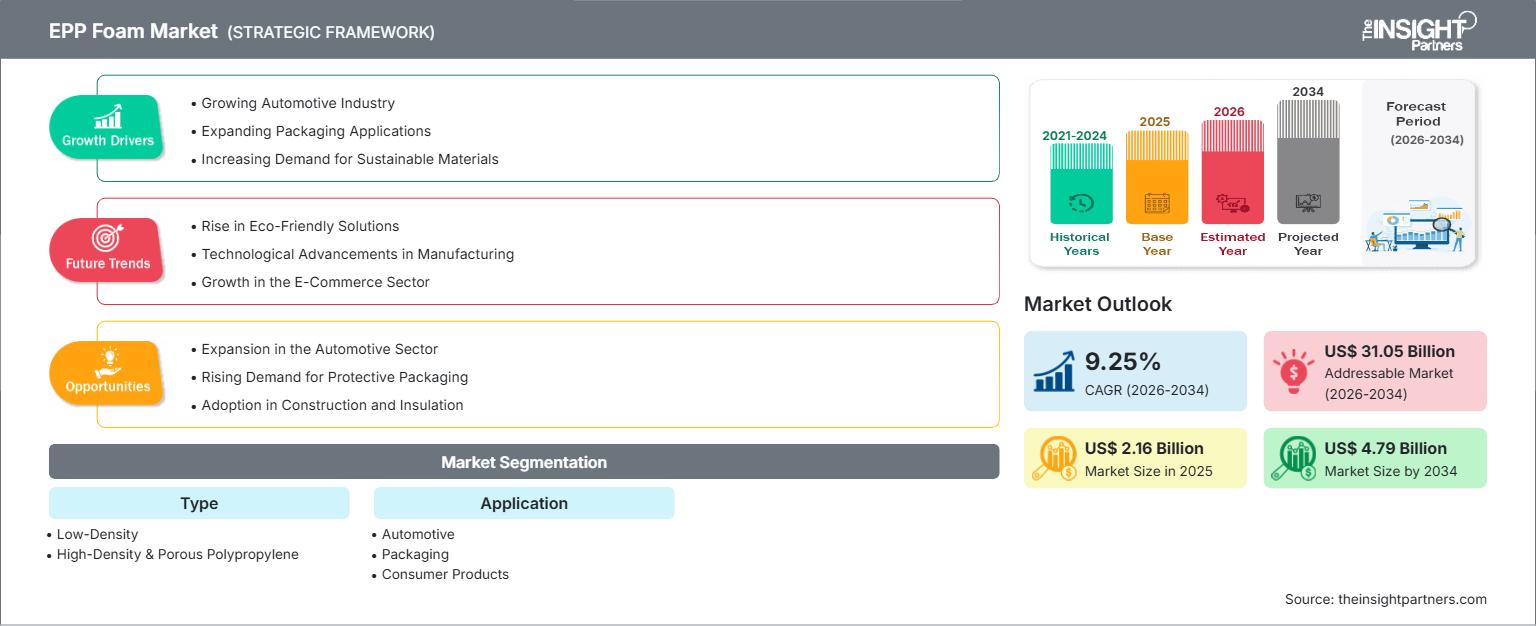
The EPP Foam Market size is valued at US$ 2.16 Billion in 2025 and is projected to reach US$ 4.79 Billion by 2034, registering a CAGR of 9.25% during 2026–2034. The market covers expanded polypropylene foam materials differentiated by density and cellular structure and consumed across automotive, packaging, consumer products, HVAC, marine, aerospace, medical, sports and leisure, and fibers and fabrics applications. Demand is supported by lightweighting, impact absorption, thermal and acoustic insulation, recyclability, and the replacement of heavier materials in engineered components.
North America is expected to maintain substantial demand through 2034, supported by automotive lightweighting, protective packaging, electric vehicle component development, and increasing use of recyclable polymeric materials. The regional outlook is reinforced by established foam processing capabilities and application engineering across transportation, HVAC, consumer products, and specialized industrial uses, resulting in a modeled CAGR of ~8% through 2034.
EPP Foam Market Assessment and Insights
Regional Outlook
- North America: ~29% of the global EPP Foam Market share in 2025 | ~8% CAGR through 2034. Market position: North America holds a substantial position due to established automotive manufacturing, engineering-intensive foam conversion, protective packaging demand, and adoption of lightweight materials for vehicle interiors, battery protection, HVAC components, and reusable transport systems.
- U.S.: ~82% of North American market revenue in 2025 | ~8% CAGR through 2034. Market position: The U.S. accounts for most North American demand, supported by automotive production, electric vehicle development, reusable packaging systems, aerospace manufacturing, and continued material substitution toward lightweight impact-absorbing components.
- Europe: ~25% of the global market in 2025 | ~8% CAGR through 2034. Market position: Europe represents a mature market with established EPP processing and recycling capabilities. Germany is the leading country in Europe, supported by automotive manufacturing, industrial packaging, HVAC equipment, and sustainability-driven material development.
- Asia Pacific: ~38% of the global market in 2025 | ~11% CAGR through 2034. Market position: Asia Pacific is the fastest-growing region, supported by automotive capacity expansion, electronics and appliance manufacturing, packaging conversion, and increasing local production of engineered lightweight materials. China is the leading country in the Asia Pacific.
Segment Outlook
- Low-Density: ~55% Share in 2025 | ~9% CAGR through 2034. Market position: Low-density EPP dominates because weight reduction, cushioning, energy absorption, and insulation are central requirements across automotive interiors, packaging, HVAC housings, sports products, and other applications where material efficiency influences product design.
- Packaging: ~18% Share in 2025 | ~11% CAGR through 2034. Market position: Packaging is the high-growth main segment as reusable transport packaging, protective dunnage, and molded cushioning increasingly require lightweight, durable, recyclable materials that can withstand repeated handling and reduce damage during logistics operations.
Competitive Coverage
BASF SE, JSP Corporation, Hanwha Advanced Materials, BEWI ASA, Sonoco Products Company, Engineered Foam Products Ltd., Kaneka Corporation, Furukawa Electric Co., Ltd., Chemische Fabrik Budenheim KG, Yanfeng Automotive Trim Systems Co., Ltd.
Methodology
The Insight Partners follows Data Collection & Secondary Research, Primary Research, Data Analysis, and Data Triangulation & Final Review to validate market estimates and insights.
Source: The Insight Partners' analysis based on proprietary research, government publications, company annual reports, investor presentations, industry databases, and expert interviews.
The evolution of material science has transformed EPP from basic cushioning into components that offer lightness, structure, resilience, insulation, acoustic performance, and impact absorption. Newer grades have become more advanced for automotive structure, battery protection, reusable packaging, HVAC, and consumer items. Manufacturing trends include better bead expansion, increased efficiency of molding processes, incorporation of recycle content, and density adjustment according to applications. JSP identifies applications for ARPRO in automotive, packaging, HVAC, and consumer categories, while Furukawa Electric develops carbon-dioxide foaming technology for recyclable, non-cross-linked polypropylene sheets.
The future outlook will be characterized by local manufacturing, circular material system, and new high performance grades. Capacity addition in the Asia Pacific region will benefit due to growth in automotive and industrial manufacturing, whereas Europe will focus on recycled material content and material efficiency. North America’s EPP manufacturers and converters will increasingly tie their product innovation to electric vehicles platform and reusable logistics system. Consequently, investments will shift from mere capacity addition to formulation, molding, recycling, and application engineering of materials. The regulatory pressure for material reduction may boost the demand for recyclable polypropylene systems.
EPP Foam Market Report Scope
| Report Attribute | Details |
|---|---|
| Market size in 2025 | US$ 2.16 Billion |
| Market Size by 2034 | US$ 4.79 Billion |
| Global CAGR (2026 - 2034) | 9.25% |
| Historical Data | 2021-2024 |
| Forecast period | 2026-2034 |
EPP Foam Market Analysis
The EPP Foam Market Size depends on the interaction between polymers, production of beads/sheets, expansion processes, molding, converting components, and assembly processes. Automotive segment is critical for EPP foams since they can withstand impacts without deformation and help decrease weight of parts. Packaged goods need durable cushioning and dunnage. HVAC applications will need heat insulation and dimensional stability properties. The value chain thus involves production of raw materials, technologies, molders, component makers, OESMs, packaging companies, and recycling services.
The EPP Foam Market forecast shows that supply chain dynamics have become increasingly focused on local manufacture and logistics due to the fact that molded EPP parts tend to take up considerable space in comparison with their material weight. This can be seen from the setting up of Pune-based manufacturing by JSP, whereas BEWI has increased its EPP manufacturing and automotive parts capability in Germany. Competition has become based on factors such as grade availability, molding know-how, geographic proximity, recycled content ability, and technical support.
The Competitive Landscape section of the EPP Foam Market report shows that the competition in this market is made up of specialized foam materials manufacturers as well as diversified advanced materials and packaging companies. JSP provides ARPRO for automotive, packaging, HVAC, consumer and many more applications, while Hanwha Advanced Materials has integrated EPP into its automotive lightweight materials range. BASF provides Neopolen solutions for automotive impact loaded parts, reusable packaging, transport containers, toys and sports goods.
The role of sustainability formulations, automobile integration design, and regional manufacturing has become crucial for strategic positioning. JSP has diversified the production network of ARPRO globally, whereas BEWI has made investments in the raw material production of EPP and resources related to long-term automotive projects. The company Furukawa Electric is also working on developing sustainable polypropylene foam through recycled and natural materials.
● REPORT CUSTOMIZATION
Tailor This Report To Align With Your Specific Business Requirements
This report can be customized to align precisely with your business objectives, scope, and target markets. Customization options include tailored segmentation, geography, competitive analysis, and strategic insights to support informed decision-making.
Customize This Report →WHAT YOU CAN ADJUST
- ● Segmentations
- ● Geography
- ● Competitive Analysis
- ● Language Preferences
EPP Foam Market: Strategic Insights
Regional Insights
North America EPP Foam Market
North America accounts for ~29% of the global market in 2025 and is projected to expand at ~8% CAGR through 2034. There exists an advanced automotive value chain, excellent packaging capabilities, and demand for lightweight materials. Expanded polypropylene is employed wherever impact resistance, resiliency, insulation, and lightness could help decrease component weight or improve product longevity.
Demand drivers include the USA as the primary consumption hub, thanks to auto manufacturing, EV components, aerospace projects, reusable logistics packaging, and HVAC equipment. Mexico supplies the regional automotive value chain with locally produced components, while Canada adds extra demand through transportation and industrial manufacturing industries. The competition among regional players is increasing in application engineering, recycled content grades, and closeness to OEM production. Demand will remain wide since EPP could be applied in both structure and protection applications without significant changes in the downstream product design.
U.S. EPP Foam Market
The U.S. represents ~82% of the North American market revenue in 2025 and is expected to grow at ~8% CAGR through 2034. The demand for EPP is driven by applications in the interior of vehicles, energy absorbing parts, re-usable transport packaging, HVAC items, consumer goods, and protective uses. The lightweight and durable features of EPP make it suitable for substitution in situations where rigid plastics or other heavy materials create issues with either weight or durability.
Examples of major companies in the EPP industry include JSP, BASF SE, Hanwha Advanced Materials, and Sonoco Products Company, among others. These companies cater to different sectors of the industrial ecosystem in the United States, such as automotive and packaging. In the automotive sector, there is demand for lightweight interior and seating components, bumpers, storage bins, and batteries.
Europe EPP Foam Market
Europe represents ~25% of the global market in 2025 and is projected to grow at ~8% CAGR through 2034. Germany is the leading nation in Europe, thanks to its automobile manufacturing sector, machinery sector, packaging conversion capabilities, and polymer-processing infrastructure. The contribution of France and Italy is via the manufacture of automobiles, consumer goods, packaging, and equipment. On the other hand, there is demand from the UK in transport, packaging, HVAC, and consumer uses. The demand in Spain includes automobiles and industrial packaging.
These aspects have been complemented by investments in EPP component manufacturing and applications. There has been increased production of EPP components at the BEWI Schkopau plant, serving the automotive sector in terms of localization of the supply chain. Sustainability is yet another structural factor. The buying public in Europe considers recycled material, recyclability, material efficiency, and life cycle considerations in choosing polymeric components. Recyclability and the lightweight nature of EPP favor such consideration in product and recovery system design.
This results in evolution from molded cushioning to engineering applications in the European market. Automotive seats, trimmings, energy absorption, battery protection, reusable packaging, and HVAC components create different demand sources. Competition is influenced by technical performance, localization, sustainability materials, and collaboration with OEMs in designing components.
APAC EPP Foam Market
Asia Pacific holds ~38% of the global market in 2025 and is expected to record ~11% CAGR through 2034, making it the fastest-growing region. China is the leading country in the Asia Pacific, supported by automotive manufacturing, consumer products, electronics, logistics, packaging conversion, and expanding electric vehicle production. Japan and South Korea provide strong technology and automotive demand, while India and Australia contribute through expanding manufacturing and industrial applications.
The growth of the region is facilitated through the localizing of supply chains for automobiles and the use of lightweight materials. This is evident in JSP’s Pune plant that has shown the growth in the localization of EPP manufacturing in India and also in Hanwha Advanced Materials that has production and R&D facilities in Asia among other regions.
Middle East & Africa EPP Foam Market
The Middle East & Africa are expected to expand at ~7% CAGR through 2034. Saudi Arabia and the UAE are important markets because industrial diversification, logistics infrastructure, construction activity, and automotive-related investments create opportunities for lightweight protective and insulation materials. South Africa adds automotive manufacturing and packaging demand, while the Rest of MEA contributes through construction, HVAC, consumer products, and industrial applications.
The regional opportunity is related to investments in infrastructure and industry localization. EPP may be used for insulation of HVAC, reusable packaging, automotive parts, protective packaging, and some marine uses. Success will depend on the availability of conversion facilities, access to specialized molds, economics of imports, and construction of recycling infrastructure. More investments in manufacturing and logistics may gradually increase the range of applications.

Segmentation Analysis
Type
The EPP Foam Market by type is divided into Low-Density, High-Density, and Porous Polypropylene. Low-Density represents the largest type segment with a modeled CAGR of ~9% during 2026–2034. Its combination of lightweight construction, cushioning, energy absorption, and insulation supports broad use across transportation, packaging, HVAC, and consumer applications. High-Density grades address applications requiring greater structural performance and dimensional stability, while porous polypropylene provides opportunities where controlled cellular structures and specialized weight-performance characteristics are required.
- Low-Density: Low-density EPP is widely selected where weight reduction and cushioning are primary requirements. Automotive interiors, protective packaging, reusable dunnage, sports products, and HVAC components benefit from its low mass and resilience, supporting broad application penetration.
- High-Density: High-density EPP is suited to components requiring stronger structural behavior, dimensional stability, and impact management. Its strategic importance increases in automotive structures, protective systems, and engineered products where durability takes priority over minimum material weight.
- Porous Polypropylene: Porous polypropylene provides controlled cellular structures for specialized lightweight and insulation requirements. Demand is concentrated in applications requiring tailored permeability, cushioning, or surface characteristics, creating opportunities for customized material development and application-specific processing.
Application
The application segmentation covers Automotive, Packaging, Consumer Products, HVAC, Marine, Aerospace, Medical, Sports & Leisure, and Fibers & Fabrics. Automotive is the largest application at ~45% share in 2025 and is expected to expand at ~10% CAGR. Packaging is the high-growth application at ~11% CAGR as reusable logistics systems and protective packaging increase adoption of durable, recyclable foam.
- Automotive: Automotive applications use EPP for energy absorption, seating structures, trim, storage systems, acoustic management, and battery-related protection. Lightweighting and electric vehicle architecture increase the need for materials combining strength, resilience, insulation, and low mass.
- Packaging: Packaging demand centers on reusable dunnage, transport containers, cushioning, and protective systems. EPP's recovery after impact and resistance to repeated handling make it suitable for closed-loop logistics and applications where product damage reduction matters.
- Consumer Products: Consumer products include household goods, appliances, toys, furniture components, and other lightweight molded products. Demand depends on design flexibility, durability, surface finish, and the ability to combine cushioning with structural performance.
- HVAC: HVAC applications use EPP for insulation, housings, and components requiring low thermal conductivity and moisture resistance. Its lightweight structure can simplify handling and installation while supporting thermal and acoustic performance.
- Marine: Marine applications use EPP where buoyancy, impact absorption, moisture resistance, and low weight are required. Potential uses include flotation-related components, protective structures, seating, and equipment packaging exposed to demanding operating environments.
- Aerospace: Aerospace applications emphasize weight reduction, energy absorption, insulation, and fire-performance requirements. EPP adoption is more specialized than in automotive markets, with opportunities concentrated in carefully qualified interior, protective, and equipment-related applications.
- Medical: Medical applications require cleanliness, consistent processing, protection, and controlled material properties. EPP can support transport protection, equipment components, and cushioning applications where lightweight construction and impact resistance improve handling.
- Sports & Leisure: Sports and leisure products use EPP for helmets, protective equipment, recreational products, and lightweight components. Repeated-impact performance and shape recovery provide functional benefits in products exposed to frequent handling or impact.
- Fibers & Fabrics: Fibers and fabrics applications represent a specialized area where polypropylene-based foam structures can support lightweight constructions and functional material systems. Development depends on processing compatibility, bonding requirements, and product-specific performance specifications.
Opportunity Snapshot
| Application | Revenue Contribution | Trend Tag | Adoption Stage |
|---|---|---|---|
| Automotive | High | EV Lightweighting | Mature |
| Packaging | Medium | Reusable Logistics | Scaling |
| Consumer Products | Medium | Lightweight Design | Scaling |
| HVAC | Medium | Thermal Insulation | Scaling |
| Marine | Low | Buoyant Components | Emerging |
| Aerospace | Low | Weight Reduction | Emerging |
| Medical | Low | Protective Systems | Emerging |
| Sports & Leisure | Medium | Impact Protection | Scaling |
| Fibers & Fabrics | Low | Foam Structures | Emerging |
EPP Foam Market Growth Drivers and Impact Analysis
Automotive Lightweighting and Electric Vehicle Integration
Vehicle lightweighting is a major demand mechanism because manufacturers must improve energy efficiency without compromising safety or occupant protection. EPP combines low density with impact absorption, resilience, structural support, and insulation, allowing designers to consolidate functions within lightweight components. Its use can extend from headrests and seating structures to trim panels, storage systems, bumpers, and battery-related applications. The transition toward electric vehicles strengthens this mechanism because battery mass increases the value of lightweight components elsewhere in the vehicle. JSP identifies EPP applications across seating, trim, stowage, pedestrian safety, and battery systems, while Hanwha Advanced Materials incorporates EPP into its broader lightweight automotive materials portfolio.
Reusable Packaging and Material Efficiency Requirements
Packaging applications are expanding as manufacturers seek protection systems that can withstand repeated handling and support reusable logistics. EPP's resilience allows molded components to recover after impact, reducing the need for single-use cushioning in selected supply chains. Its low weight can further reduce handling requirements and transportation burdens. Automotive dunnage, electronics protection, industrial containers, and reusable transport packaging provide multiple demand channels. Material efficiency is becoming increasingly important as companies evaluate not only product protection but also material recovery and end-of-life options. BASF identifies Neopolen for reusable packaging and transport containers, while JSP positions ARPRO for reusable transport packaging and dunnage.
Recyclability and Lower-Impact Foam Development
Recyclability is becoming a product-development criterion rather than a secondary attribute. EPP can be recycled within appropriate collection and processing systems, allowing manufacturers to incorporate recycled content into selected grades and components. Material producers are therefore developing formulations that reduce dependence on virgin feedstocks while preserving mechanical performance. Furukawa Electric developed EFCELL using recycled and plant-derived inputs, with the company targeting lower product-level carbon emissions than its conventional material. JSP likewise offers ARPRO grades containing recycled content. These developments can expand customer acceptance where sustainability specifications increasingly influence procurement and component design.
EPP Foam Market Future Trends
Circular EPP Systems and Higher Recycled Content
The EPP Foam Market trends are expected to increasingly center on circular material flows in which post-industrial and post-consumer polypropylene is collected, processed, and returned to foam production. The commercial challenge is maintaining density, cell structure, surface quality, and mechanical performance while increasing recycled content. Automotive applications are particularly relevant because OEM sustainability requirements can influence material specifications throughout the supply chain. BEWI has developed EPP containing recycled material for automotive applications, while JSP offers recycled-content ARPRO grades. Over time, successful circular systems are likely to depend on standardized collection, cleaner feedstock streams, traceability, and closer coordination between component manufacturers and recycling operators.
Process-Efficient Molding and Application-Specific Grades
Manufacturers are likely to invest further in molding technologies that reduce cycle time, energy use, cooling requirements, and material waste while improving dimensional consistency. JSP and Alessiohitech demonstrated a zero-tooling approach for EPP molding that targets lower steam consumption and shorter production cycles. Such process improvements can change the economics of smaller-volume applications and enable more complex molded geometries. At the material level, suppliers are expected to develop grades optimized for battery protection, acoustic management, thermal insulation, reusable packaging, and lightweight structural components. The combination of processing efficiency and application-specific formulations can broaden EPP adoption beyond established automotive and packaging uses.
EPP Foam Market Opportunities
Localized Production in High-Growth Automotive Economies
Manufacturers have an opportunity to establish localized EPP production and molding capabilities in automotive economies where imported foam components create logistics and responsiveness constraints. India provides a relevant example because JSP started production at its Pune facility in 2025 to support growing automotive demand and develop a local supply framework. Similar opportunities exist where vehicle production is expanding, and suppliers are moving closer to OEM plants. Local facilities can shorten delivery cycles, enable application engineering with customers, reduce transportation of bulky molded components, and support customized grades. Investment strategies can combine bead or material production with molding partnerships, recycling arrangements, and technical centers to create a more integrated regional supply model.
Specialized EPP Solutions for Battery and Thermal Management
Electric vehicle battery systems create opportunities for specialized EPP solutions that combine lightweight protection, thermal management, impact absorption, and dimensional stability. The opportunity extends beyond conventional bumper and interior applications because battery architecture requires protection against vibration, impact, and thermal stresses while vehicle manufacturers remain focused on mass reduction. Suppliers can develop grades and molded structures designed around specific battery packs, cooling systems, and adjacent components. Collaboration with automotive OEMs and Tier 1 suppliers can improve design integration because EPP performance depends on geometry, density, joining methods, and surrounding materials. Companies with established automotive engineering capabilities are positioned to extend foam technologies into these emerging component architectures.
Recent Developments
- August 2026: Engineered Foam Products Ltd. - EFP Group completed the acquisition of Cordek Ltd., expanding its engineered foam and technical manufacturing platform into specialized construction applications. Cordek brings expertise in ground engineering products and bespoke formwork, while EFP contributes established EPS and EPP molding capabilities. The transaction broadens the group's engineered-material portfolio and strengthens its ability to serve construction customers with customized lightweight solutions.
- February 2025: Furukawa Electric Co., Ltd. - Furukawa Electric developed a non-crosslinked low-foamed polypropylene sheet using plant-derived resin, targeting applications including packaging, electronic equipment, and medical equipment components. The development combines extrusion foaming technology with renewable feedstock integration and supports broader demand for lower-impact polypropylene foam products. The company planned mass production of the new products during 2025, expanding the sustainability-focused material portfolio.
Frequently Asked Questions

- Comprehensive Market Sizing and Forecast Analysis
- Detailed Segmentation Analysis
- In-Depth Market Dynamics Assessment
- Regional and Country-Level Insights
- Competitive Landscape and Company Benchmarking
- Strategic Business Intelligence
Recent Reports
Testimonials

The Insight Partners provided valuable market intelligence that supported our global go-to-market strategy. Their team was professional, responsive, and attentive to our feedback, providing thoughtful analysis and helpful methodological clarifications throughout the project.
Junmo Kim Chief Financial Officer (CFO), Enertech Co., Ltd.
The Insight Partners' SCADA System Market report is comprehensive, with valuable insights on current trends and future forecasts. The team was highly professional, responsive, and supportive throughout. We are very satisfied and highly recommend their services.
RAN KEDEM Partner, Reali Technologies LTDs
I requested a report on a very specific software market and the team produced the report in a few days. The information was very relevant and well presented. I then requested some changes and additions to the report. The team was again very responsive and I got the final report in less than a week.
JEAN-HERVE JENN Chairman, Future Analytica
We worked with The Insight Partners for an important market study and forecast. They gave us clear insights into opportunities and risks, which helped shape our plans. Their research was easy to use and based on solid data. It helped us make smart, confident decisions. We highly recommend them.
PIYUSH NAGPAL Sr. Vice President, High Beam Global
The Insight Partners delivered insightful, well-structured market research with strong domain expertise. Their team was professional and responsive throughout. The user-friendly website made accessing industry reports seamless. We highly recommend them for reliable, high-quality research services
YUKIHIKO ADACHI CEO, Deep Blue, LLC.
This is the first time I have purchased a market report from The Insight Partners.While I was unsure at first, I visited their web site and felt more comfortable to take the risk and purchase a market report.I am completely satisfied with the quality of the report and customer service. I had several questions and comments with the initial report, but after a couple of dialogs over email with their analyst I believe I have a report that I can use as input to our strategic planning process.Thank you so much for taking the extra time and making this a positive experience.I will definitely recommend your service to others and you will be my first call when we need further market data.
JOHN SUZUKI President and Chief Executive Officer, Board Director, BK Technologies
I wish to appreciate your support and the professionalism you displayed in the course of attending to my request for information regarding to infectious disease IVD market in Nigeria. I appreciate your patience, your guidance, and the fact that you were willing to offer a discount, which eventually made it possible for us to close a deal. I look forward to engaging The Insight Partners in the future, all thanks to the impression you have created in me as a result of this first encounter.
DR CHIJIOKE ONYIA MANAGING DIRECTOR, PineCrest Healthcare Ltd.Reason to Buy
- Informed Decision-Making
- Understanding Market Dynamics
- Competitive Analysis
- Identifying Emerging Markets
- Customer Insights
- Market Forecasts
- Risk Mitigation
- Boosting Operational Efficiency
- Strategic Planning
- Investment Justification
- Tracking Industry Innovations
- Aligning with Regulatory Trends





 Get Free Sample for