
Europe Liquid Handling Equipment Market Size, Share & Demand by 2034
Coverage: By Product Type (Liquid Handling Pumps [Syringe Pumps, Peristaltic Pumps, Piston Pumps, Diaphragm Pumps, and Others], Liquid Handling Components [Workstations, Dispensing Modules, Flow Sensors, Fluidic Manifolds, Valves, and Tubing and Connectors] and Consumables [Pipette Tips, Reagent Reservoirs, Microplates, and Tubes and Accessories]), Modality (Automated Liquid Handling, Semi Automated Liquid Handling and Manual Liquid Handling), System Configuration (Benchtop, Standalone and Integrated Robotic Platforms), Workflow (Sample Preparation, Reagent Dispensing, Serial Dilution, Plate Replication and Reformatting, and Others), Technology (Air Displacement Technology, Positive Displacement Technology, Acoustic Liquid Handling, Disposable Tip-Based Systems, and Non-Contact Dispensing Systems), Application (Drug Discovery and Development [Chromatography (HPLC or UHPLC), Stem Cell Research and Analysis, Density and Analytical Measurement, Genomics and Proteomics, and Others] and Clinical Diagnostics [PCR, Molecular Diagnostics and Others]), End User (Pharmaceutical and Biotechnology Companies, IVD Device Manufacturers, Clinical and Diagnostic Laboratories, Academic and Research Institutes, CROs and CDMOs, Analytical Instrument Manufacturers, and Others), and Geography (Germany, France, Italy, Spain, United Kingdom, Austria, Switzerland, Belgium, Netherlands, Rest of Europe)
- Status : Published
- Report Code : TIPRE00043876
- Category : Life Sciences
- No. of Pages : 414
- Available Report Formats :


- Last update date : September 07, 2026


2025 Market Size
US$ 1,765.72 Mn
Base year value
2034 Forecast
US$ 2,994.10 Mn
Projected by 2034
CAGR 2026-2034
6.0 %
Growth rate
Addressable Market
US$ 21,507.87 Mn
(2026-2034)
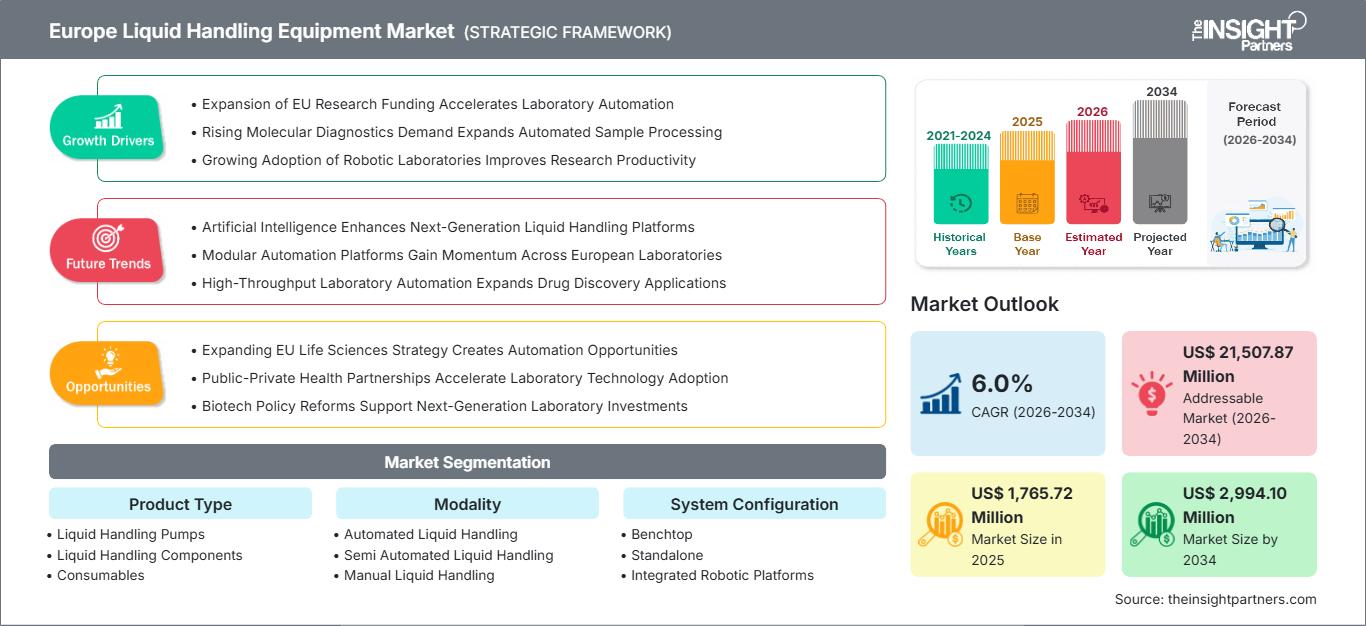
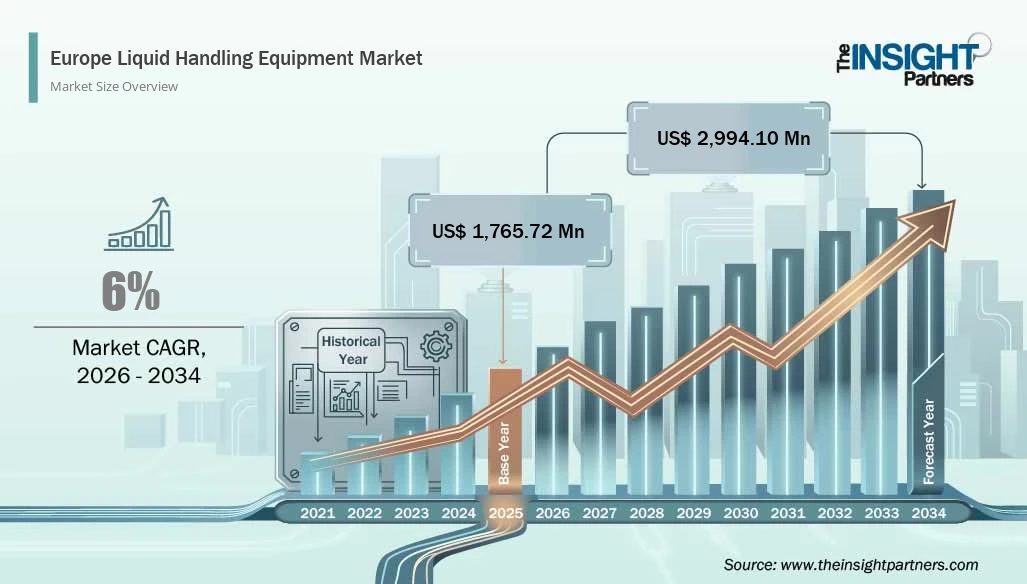
The Europe Liquid Handling Equipment Market is projected to expand from US$ 1,765.72 Million in 2025 to US$ 2,994.10 Million by 2034, registering a CAGR of 6.00% during 2026–2034. The market encompasses liquid handling pumps, components, consumables, automated and manual modalities, robotic configurations, workflow-specific systems, and multiple dispensing technologies supporting drug discovery, development, and clinical diagnostics across European laboratories.
The European region is anticipated to witness growth at a CAGR of 5.7%–6.2% through 2026 to 2034 due to sustained automation spending within laboratories as well as growth in genomics, biopharmaceutical development, and high-throughput testing. Adoption is becoming more reliant on workflow standardization, efficient work, reproducibility, and interoperability among liquid handlers, robots, scheduling systems, lab information management systems, and analytical instrumentation.
Europe Liquid Handling Equipment Market Assessment and Insights
- Germany: UK is expected to account for a 20–24% share in 2025 and expand at a CAGR of 5.5–6.0% during 2026–2034, supported by biopharmaceutical automation and high-throughput molecular workflows.
- UK: The UK is estimated to represent 15–20% of revenue in 2025 and grow at a CAGR of 6.5–7.0%, led by pharmaceutical R&D and diagnostics.
- Largest Segment: Consumables represent an estimated 40–44% market share in 2025 and are expected to grow at a 5.6–6.1% CAGR through 2034, supported by recurring laboratory usage.
- High Growth Segment: Automated Liquid Handling is estimated at a 34–38% share in 2025 and is projected to grow at a 7.4–8.0% CAGR as laboratories automate complex workflows.
- Key companies analyzed in detail: Thermo Fisher Scientific Inc., Danaher Corporation, Eppendorf SE, INTEGRA Biosciences AG, Tecan Trading AG, Sartorius AG, Hamilton Company, Analytik Jena GmbH+Co. KG, Corning Incorporated, and Gilson Inc.
Source: The Insight Partners' analysis based on proprietary research, government publications, company annual reports, investor presentations, industry databases, and expert interviews.
The technology has advanced from the individual pipettors to systems that integrate precision dispensing, microplate handling, robotics, scheduling, and workflow digitization in Europe Liquid Handling Equipment Market. While air-displacement continues to be widely utilized for standard applications, positive-displacement, acoustic dispensing, and disposable-tip configurations cater to specific needs related to volatile liquids, small volumes, contamination prevention, and increased throughput. Consumables have strategic importance due to the consistent use of tips connecting the installed base with ongoing lab activities.
Future demand is expected to expand beyond large-scale pharmaceutical labs into decentralized diagnostics, startups in biotechnology, core labs in universities, and specialized genomics labs in Europe Liquid Handling Equipment Market. Regulatory requirements for traceability, data integrity, contamination prevention, and reproducibility will drive the adoption of validated automation. Europe Liquid Handling Equipment Market size will also be impacted by the equipment investment cycle in Germany, the UK, France, Switzerland, and Italy, where lab modernization is increasingly favoring interoperable platforms over stand-alone instruments.
Europe Liquid Handling Equipment Market Report Scope
| Report Attribute | Details |
|---|---|
| Market size in 2025 | US$ 1,765.72 Million |
| Market Size by 2034 | US$ 2,994.10 Million |
| CAGR (2026 - 2034) | 6.0% |
| Historical Data | 2021-2024 |
| Forecast period | 2026-2034 |
Europe Liquid Handling Equipment Market Analysis
Europe Liquid Handling Equipment Market growth is driven by the increasing volume of samples processed, the complexity of assays, and the need to automate repetitive liquid transfers. Automated liquid-handling equipment is used by drug discovery laboratories for compound screening, reagent preparation, serial dilutions, and assay setup, while clinical laboratories automate nucleic acid extraction, PCR preparation, and sample normalization. The value chain thus includes precision pumps, pipetting heads, tips, plates, robotic modules, workflow software, service agreements, and consumables for specific applications in Europe Liquid Handling Equipment Market.
Supply chain dynamics are becoming increasingly determined by modular design and interoperability. In addition to pipetting precision, suppliers have to compete on their ability to integrate with systems, customize software, provide services, offer tips, and validate workflows. The Europeans are becoming increasingly concerned with the total cost of ownership, since the purchase of liquid-handling equipment influences the ongoing costs of consumables, maintenance, qualification, and user training in Europe Liquid Handling Equipment Market.
Europe Liquid Handling Equipment Market analysis suggests a market structure that includes diversified life science organizations as well as automation-oriented manufacturers. Thermo Fisher Scientific Inc. offers diverse laboratory instrumentation and analytical products, whereas Danaher Corporation derives its competitive edge from extensive diagnostic and life sciences activities. The key focus for Eppendorf SE and INTEGRA Biosciences AG is on precision pipettes and laboratory workflow systems, while Tecan Trading AG and Hamilton Company excel in automated liquid handling and laboratory automation.
Today, positioning is becoming more oriented toward workflow integration than performance in the liquid transfer process itself. Sartorius AG integrates laboratory and bioprocess solutions, and Analytik Jena GmbH + Co. KG, Corning Incorporated, and Gilson Inc. specialize in laboratory systems. Key investment in the Europe Liquid Handling Equipment Market include software-driven automation, acoustic and non-contact dispensing technology, robotics integration, protocol development, and manufacturing robustness. Strategic alliances and acquisitions are also being considered for scheduling, sample preparation, genomics, and laboratory connectivity.
● REPORT CUSTOMIZATION
Tailor This Report To Align With Your Specific Business Requirements
This report can be customized to align precisely with your business objectives, scope, and target markets. Customization options include tailored segmentation, geography, competitive analysis, and strategic insights to support informed decision-making.
Customize This Report →WHAT YOU CAN ADJUST
- ● Segmentations
- ● Geography
- ● Competitive Analysis
- ● Language Preferences
Europe Liquid Handling Equipment Market: Strategic Insights
Regional Insights
Europe Liquid Handling Equipment Market
Germany is a prime example of a national market that leads in Europe Liquid Handling Equipment Market size, trailed by the UK and France, which have well-established pharmaceutical, biotechnology, academic research, and clinical diagnostics sectors. Italy and Spain provide some regional demand for the modernization of laboratory equipment and the increased use of automation in their standardized workflows.
European adoption is increasingly being driven by investments in laboratory automation, genomics, molecular diagnostics, and biopharmaceutical research. Germany benefits from its robust life sciences manufacturing environment, while the UK has advanced research and genomics infrastructure in Europe Liquid Handling Equipment Market. France, Italy, and Spain are also developing their automated laboratory facilities. Recent regulatory trends include the EU In Vitro Diagnostic Regulation.
UK Liquid Handling Equipment Market
The UK is an important country for Europe Liquid Handling Equipment Market due to its well-developed pharmaceutical and biotech industries, substantial research network, and growing capabilities in genomics and molecular diagnostics. Demand comes from drug discovery labs, clinical testing, sequencing, and diagnostics, where automated sample preparation and reagent dispensing become more common to increase efficiency and reproducibility.
There are also factors contributing to the UK market's growth. Investment in life science infrastructure and lab automation has become an important issue. Increasingly, UK labs employ automated liquid handling for high-throughput screening, sequencing sample preparation, PCR workflows, and sample normalization. Major pharmaceutical companies, research institutions, and specialized biotechnology companies provide a broad base of customers for advanced liquid-handling automation solutions.
Germany Liquid Handling Equipment Market
Germany is the largest contributor for Europe Liquid Handling Equipment Market, owing to the presence of robust pharmaceutical, biotech, diagnostics, chemicals, and research industries. Germany already has a well-developed laboratory automation environment and a substantial demand for precise instruments for drug development, analytical testing, molecular diagnostics, and life sciences research. High standards of laboratory processes also contribute to the implementation of automation solutions.
The growth of the Europe Liquid Handling Equipment Market is driven by the constant modernization of laboratories, the increasing need for automated sample processing, and the presence of robotic platforms in laboratory workflows. There is also a growing demand from German manufacturers, research institutions, universities, and clinical laboratories for scalable solutions that can handle complex protocols and numerous samples. This demand is fueled by a developed industrial environment in Germany.
Segmentation Analysis
Product Type
Europe Liquid Handling Equipment Market scope across product categories reflects different purchasing cycles and recurring revenue characteristics. Consumables generate repeat purchases, while pumps and components support system performance and replacement demand. The product segment is expected to grow at a CAGR of 5.5–6.1% during 2026–2034.
- Liquid Handling Pumps: Pumps support controlled movement and dispensing of laboratory fluids, with demand concentrated in automated instruments requiring repeatable volumetric performance, low dead volume, and compatibility with application-specific liquids.
- Liquid Handling Components: Components such as valves, tubing, pipetting heads, and control assemblies support equipment functionality. Replacement cycles and system upgrades sustain demand across installed laboratory automation bases.
- Consumables: Tips, plates, reservoirs, and related consumables represent recurring purchases and remain strategically important because routine testing, screening, and sample preparation continuously generate replacement requirements.
Modality
Modality reflects laboratory automation maturity and workflow complexity. Automated platforms are gaining adoption as laboratories seek throughput, consistency, and reduced manual intervention, while semi-automated and manual systems remain important for flexible and lower-volume operations in the Europe Liquid Handling Equipment Market. The modality segment is projected to grow at a CAGR of 5.9–6.6%.
- Automated Liquid Handling: Automated systems are increasingly selected for repetitive, high-volume workflows where reproducibility, protocol standardization, and integration with robotics provide measurable operational advantages.
- Semi-Automated Liquid Handling: Semi-automated systems bridge manual and fully automated processes, offering laboratories flexibility where sample volumes, budgets, or workflow variability do not justify complete automation.
- Manual Liquid Handling: Manual pipetting remains important for low-throughput, research, and flexible laboratory tasks where operator control, low capital expenditure, and rapid protocol changes outweigh automation benefits.
System Configuration
Configuration choices increasingly depend on throughput, available laboratory space, integration requirements, and automation maturity. Benchtop systems support flexible deployment, standalone systems address defined workflows, and integrated robotic platforms support end-to-end automation. This segment is expected to expand at a CAGR of 5.8–6.5%.
- Benchtop: Benchtop platforms provide compact automation for laboratories with constrained space, making them suitable for moderate-throughput applications and incremental automation programs.
- Standalone: Standalone systems address defined liquid handling requirements and offer controlled automation without requiring extensive robotic integration or major laboratory redesign.
- Integrated Robotic Platforms: Integrated robotic platforms support complex, multi-instrument workflows by coordinating liquid handling, plate movement, incubation, scheduling, and data exchange within connected laboratory environments.
Workflow
Workflow-specific purchasing is becoming more important as laboratories prioritize complete process automation rather than isolated pipetting steps. The workflow segment is projected to grow at a CAGR of 6.0–6.7%, supported by genomics, screening, and clinical testing requirements.
- Sample Preparation: Automated sample preparation reduces repetitive manual steps and improves consistency, particularly for extraction, normalization, aliquoting, and sequencing workflows involving large sample volumes.
- Reagent Dispensing: Reagent dispensing systems support accurate distribution across plates and reaction vessels, helping laboratories control reagent consumption and standardize assay setup.
- Serial Dilution: Serial dilution automation improves repeatability across concentration series and is valuable in screening, assay development, microbiology, and quantitative analytical workflows.
- Plate Replication and Reformatting: Automated plate replication and reformatting facilitate transfers between plate formats, supporting screening, assay development, compound management, and sample normalization.
- Others: Additional workflows encompass specialized laboratory processes requiring controlled liquid transfer, with demand shaped by application complexity and the need for reproducible protocol execution.
Technology
Technology selection reflects liquid properties, volume ranges, contamination requirements, throughput, and desired precision. The technology segment is expected to grow at a CAGR of 6.1–6.8% during the forecast period as laboratories adopt specialized dispensing approaches.
- Air Displacement Technology: Air displacement remains widely used because it offers flexible pipetting across routine laboratory applications and supports broad instrument compatibility.
- Positive Displacement Technology: Positive displacement is particularly valuable for challenging liquids where viscosity, volatility, or surface tension can affect conventional air displacement performance.
- Acoustic Liquid Handling: Acoustic handling enables very small-volume transfers without conventional pipette contact, supporting applications requiring reagent conservation and high-density assay miniaturization.
- Disposable Tip-Based Systems: Disposable tips reduce carryover risk and support contamination-sensitive workflows, making them important across molecular diagnostics, genomics, and research applications.
- Non-Contact Dispensing Systems: Non-contact systems enable rapid dispensing and reduce physical interaction with samples, supporting specialized high-throughput applications and low-volume reagent handling.
Application
Application demand is concentrated in research and diagnostics where increasing assay complexity, sample volumes, and reproducibility requirements create strong incentives for automation. The application segment is expected to grow at a CAGR of 6.0–6.6%.
- Drug Discovery and Development: Drug discovery remains a major application because screening, assay preparation, compound management, and cell-based workflows require repeatable liquid transfer at increasing throughput.
- Clinical Diagnostics: Clinical diagnostics increasingly use automation for sample preparation, molecular testing, reagent distribution, and standardized testing workflows, particularly where laboratory networks need consistent processing.
End User
End-user demand is driven by the growing adoption of automated workflows, higher testing volumes, and the need for precision, reproducibility, and operational efficiency across European laboratories. The end-user segment is expected to grow at a CAGR of 5.8–6.2%.
- Pharmaceutical and Biotechnology Companies: Increasing use of automated liquid handling for drug discovery, screening, assay development, and laboratory workflow optimization supports demand.
- IVD Device Manufacturers: Automation is increasingly used in reagent preparation, assay development, validation, and production workflows requiring high precision and consistency.
- Clinical and Diagnostic Laboratories: Rising testing volumes and the need for standardized sample preparation, reagent dispensing, and high-throughput testing are driving adoption.
- Academic and Research Institutes: Research institutions use liquid handling systems for genomics, proteomics, cell biology, and other laboratory workflows requiring reproducible sample processing.
- CROs and CDMOs: Growing outsourcing of research, development, and testing activities is increasing demand for scalable and automated liquid handling platforms.
- Analytical Instrument Manufacturers: These companies integrate liquid handling capabilities into analytical workflows and automated laboratory platforms to improve system efficiency and workflow integration.
- Others: Other users, including food and environmental testing laboratories, adopt liquid handling equipment for routine testing, sample preparation, and quality-control applications.
Opportunity Snapshot
| Application | Revenue Contribution | Trend Tag | Adoption Stage |
|---|---|---|---|
| Drug Discovery and Development | High | Assay Automation | Mature |
| Clinical Diagnostics | High | Diagnostic Automation | Scaling |
Europe Liquid Handling Equipment Market Growth Drivers and Impact Analysis
Rising Need for High-Throughput Laboratory Processing
The increase in sample size is leading to an increased workload due to repetitive pipetting, reagent dispensing, plate preparation, and sample normalization activities. The pharma and biotech labs are scaling up their screening and multiomics assays, which will require consistent treatment of hundreds to thousands of samples. Similarly, clinical laboratories are automating their processes because standardization can increase efficiency and reduce operator variability. Market influence is not limited to automated equipment; it also increases the ongoing demand for tips, plates, reservoirs, pumps, and maintenance services due to higher equipment utilization. Vendors who can demonstrate validated protocols and successful equipment integration can derive benefits throughout the equipment's life cycle.
Expansion of Genomics and Molecular Diagnostic Workflows
The rise of genomics and diagnostics is contributing to an increase in the number of laboratory operations in which automated liquid transfer may be useful. Sequencing, PCR amplification, nucleic acid extraction, liquid biopsy, and molecular profiling commonly require reagent addition, normalization, purification, and library construction. By automating these tasks, repetitive handling and standardization between batches can be optimized. This leads to the need for solutions that include liquid transfer alongside plate manipulation, magnetic bead manipulation, thermocycling, and workflow management. Specific solution partnerships are becoming increasingly important since laboratories commonly prefer validation over general automation tools.
Increasing Emphasis on Reproducibility and Laboratory Standardization
Increasing importance is being placed on reproducibility, traceability, and standardized execution in laboratories as research and diagnostic procedures become more complex. Manual operation introduces variance in procedures through variations in pipetting techniques, different timing, and fatigue among other factors. Automation of liquid handling offers solutions to such challenges through consistent performance of programmed procedures and documentation of workflow parameters. The effect of such developments becomes significant in the case of regulated laboratories where documented procedures play an important role in ensuring quality operations. Increased adoption of automation in Europe will be facilitated by the growing need for structured guidelines concerning diagnostic performance and laboratory procedure performance.
Europe Liquid Handling Equipment Market Future Trends
AI-Enabled Workflow Optimization and Adaptive Automation
AI will continue to play an increasing role in laboratory automation by aiding systems in planning experiments, detecting workflow inefficiencies, improving resource allocation, and performing adaptive protocols. Future liquid handlers could use data from previous runs to improve their planning, minimize downtime, and coordinate within workcells. Predictive maintenance would be possible by detecting performance discrepancies before equipment failures that could disrupt laboratory activity. The consequence for strategy will be the transition from being programmatic automation to intelligent automation, which continuously maximizes laboratory efficiency in Europe Liquid Handling Equipment Market. Vendors with advanced software capabilities, connected instruments, and workflow data could have an advantage when automation is evaluated based on productivity metrics and operational intelligence, rather than just pipetting.
Growth of Flexible Modular Laboratory Automation
It is clear that laboratories will require automated systems to be highly modular and scalable in order to allow for increased automation as needs grow in terms of sample volume and laboratory procedures. Rather than committing upfront to big workcells of automation, the user can start with bench-top liquid handlers and then add robotics, plate handling, scheduling software, or analysis modules. By adopting a modular approach, one can minimize risks and allow for gradual investment in automation technologies as needed. It will also be especially relevant for biotech firms, research institutions, and decentralized clinical laboratories that may experience rapid changes in terms of their workflow needs.
Europe Liquid Handling Equipment Market Opportunities
Expansion of Automation in Mid-Sized Laboratories
Medium-sized laboratories offer an excellent chance since while most of them have enough sample throughput to consider automation, they might not necessarily have the necessary financial and technological means needed for the implementation of robots. It would be possible to fill that void through the use of compact liquid handlers, modular accessories and protocols that are specific to the application and that would allow for incremental automation. The suppliers could benefit greatly from providing standard protocols, installation, remote monitoring capabilities as well as financing and leasing solutions. Laboratories with the greatest demand will be those involved in biotechnology, molecular diagnostics, academia core facilities and specialized testing laboratories.
Development of Application-Specific Automation Solutions
Application-based systems could help in creating differentiating capabilities since off-the-shelf liquid handling solutions would need a lot of time for validation and integration. Genomics, liquid biopsies, cell therapy R&D, protein analysis, and next-generation molecular diagnostics all need unique configurations of sample handling, reagent handling, incubation and data handling. Vendors could reduce adoption times by working with assay developers and providing the automation methods along with the instrumentation. This model would be useful in helping to drive recurring revenues since application kits, consumables, software upgrades, and support deals could accompany instrument sales. It would especially be pertinent in Europe, where labs tend to run on quality standards and documentation is needed.
Recent Developments
- March 2026: Hamilton Company announced a co-marketing agreement with Aplex Bio to automate Hyperplex PCR assay kits on Hamilton liquid handling workstations. The solution supports detection and quantification of up to 100 molecular markers in a single well, combining high-plex molecular testing with scalable robotic automation for laboratories handling complex molecular workflows.
- December 2025: Tecan Trading AG completed its acquisition of Wako Automation assets, including Director scheduling software and selected hardware modules. The transaction expanded Tecan’s robotic workcell capabilities and supported integration of scheduling technologies with liquid handling platforms such as Fluent for more complex laboratory automation workflows.
- January 2026: Thermo Fisher Scientific Inc. announced a strategic collaboration with NVIDIA to advance AI-enabled scientific instrumentation and laboratory automation. The initiative targets greater automation, connectivity, accuracy, and speed across scientific workflows, strengthening the role of digital infrastructure in future laboratory automation environments.
Frequently Asked Questions

- Comprehensive Market Sizing and Forecast Analysis
- Detailed Segmentation Analysis
- In-Depth Market Dynamics Assessment
- Regional and Country-Level Insights
- Competitive Landscape and Company Benchmarking
- Strategic Business Intelligence
Recent Reports
Testimonials

The Insight Partners' SCADA System Market report is comprehensive, with valuable insights on current trends and future forecasts. The team was highly professional, responsive, and supportive throughout. We are very satisfied and highly recommend their services.
RAN KEDEM Partner, Reali Technologies LTDs
I requested a report on a very specific software market and the team produced the report in a few days. The information was very relevant and well presented. I then requested some changes and additions to the report. The team was again very responsive and I got the final report in less than a week.
JEAN-HERVE JENN Chairman, Future Analytica
We worked with The Insight Partners for an important market study and forecast. They gave us clear insights into opportunities and risks, which helped shape our plans. Their research was easy to use and based on solid data. It helped us make smart, confident decisions. We highly recommend them.
PIYUSH NAGPAL Sr. Vice President, High Beam Global
The Insight Partners delivered insightful, well-structured market research with strong domain expertise. Their team was professional and responsive throughout. The user-friendly website made accessing industry reports seamless. We highly recommend them for reliable, high-quality research services
YUKIHIKO ADACHI CEO, Deep Blue, LLC.
This is the first time I have purchased a market report from The Insight Partners.While I was unsure at first, I visited their web site and felt more comfortable to take the risk and purchase a market report.I am completely satisfied with the quality of the report and customer service. I had several questions and comments with the initial report, but after a couple of dialogs over email with their analyst I believe I have a report that I can use as input to our strategic planning process.Thank you so much for taking the extra time and making this a positive experience.I will definitely recommend your service to others and you will be my first call when we need further market data.
JOHN SUZUKI President and Chief Executive Officer, Board Director, BK Technologies
I wish to appreciate your support and the professionalism you displayed in the course of attending to my request for information regarding to infectious disease IVD market in Nigeria. I appreciate your patience, your guidance, and the fact that you were willing to offer a discount, which eventually made it possible for us to close a deal. I look forward to engaging The Insight Partners in the future, all thanks to the impression you have created in me as a result of this first encounter.
DR CHIJIOKE ONYIA MANAGING DIRECTOR, PineCrest Healthcare Ltd.Reason to Buy
- Informed Decision-Making
- Understanding Market Dynamics
- Competitive Analysis
- Identifying Emerging Markets
- Customer Insights
- Market Forecasts
- Risk Mitigation
- Boosting Operational Efficiency
- Strategic Planning
- Investment Justification
- Tracking Industry Innovations
- Aligning with Regulatory Trends





 Get Free Sample for