
Extruded Polypropylene (XPP) Foam Market Share, Growth & Demand by 2034
Coverage: By Type (Low-Density XPP Foam, High-Density XPP Foam); End-Use Industry (Automotive, Packaging, Building and Construction, Others) , and Geography (North America, Europe, Asia Pacific, and South and Central America)
- Status : Data Released
- Report Code : TIPRE00008711
- Category : Chemicals and Materials
- No. of Pages : 150
- Available Report Formats :


- Last update date : September 17, 2026


2025 Market Size
US$ 1.25 Bn
Base year value
2034 Forecast
US$ 2.07 Bn
Projected by 2034
CAGR 2026-2034
5.76 %
Growth rate
Addressable Market
US$ 15.04 Bn
(2026-2034)
The Extruded Polypropylene Foam Market is valued at US$ 1.25 Billion in 2025 and is projected to reach US$ 2.07 Billion by 2034, expanding at a 5.76% CAGR from 2026 to 2034. Demand is being supported by lightweight material adoption, recyclable packaging requirements, vehicle weight reduction, and improved foam processing technologies. Automotive, packaging, and construction applications continue to shape product development as manufacturers seek combinations of impact resistance, thermal performance, durability, and material efficiency.
North America is expected to remain an important regional market, with an estimated 5.0–6.0% CAGR between 2026 and 2034. Vehicle lightweighting, reusable protective packaging, and replacement of heavier cushioning materials are key structural drivers. Established converting capabilities and demand for recyclable mono-material solutions should further support the regional Extruded Polypropylene Foam Market size during the forecast period.
Extruded Polypropylene (XPP) Foam Market Assessment and Insights
- North America: North America is estimated to account for 28–32% Extruded Polypropylene Foam Market share in 2025 and grow at a 5.0–6.0% CAGR between 2026 and 2034, supported by automotive lightweighting, protective packaging, and established foam conversion infrastructure.
- US: The US represents approximately 22–26% share in 2025 of global demand and is projected to expand at a 5.0–6.0% CAGR between 2026 and 2034, led by automotive and packaging applications.
- Europe: Europe is estimated at 24–28% share in 2025, with a 4.5–5.5% CAGR between 2026 and 2034. Germany, Italy, France, the UK, and Spain remain important manufacturing and application centers.
- Asia Pacific: Asia Pacific holds an estimated 30–34% share in 2025 and is expected to register a 6.0–7.0% CAGR between 2026 and 2034, led by China, Japan, South Korea, and India.
- Largest Segment: High-Density XPP Foam is estimated to represent 55–60% market share in 2025, with a 5.3–6.1% CAGR between 2026 and 2034, reflecting stronger structural and cushioning requirements.
- High Growth Segment: Building and Construction is estimated at 18–22% share in 2025 and is projected to grow at 6.2–7.2% CAGR between 2026 and 2034, supported by insulation and lightweight panel applications.
- Key companies analyzed in detail: BASF SE, Borealis AG, DS Smith plc, JSP Corporation, Mitsui Chemicals, Inc., NMC SA, Pregis LLC, Sekisui Voltek, Sonoco Products Company, and Zotefoams plc.
Source: The Insight Partners' analysis based on proprietary research, government publications, company annual reports, investor presentations, industry databases, and expert interviews.
The advancements in material technology for the Extruded Polypropylene Foam Market have evolved from regular cushioning applications to engineered polypropylene foams with controllable cell structure, low density, impact absorption properties, and better recyclability. Better melt strength in polypropylene materials helps achieve better stability in extrusion and foaming process, while the use of physical and chemical foaming techniques caters to the demand for varied density. Such advancements are expanding the usage of polypropylene foams in applications such as automotive components, reusable packaging, protective inserts, insulation and lightweight construction products.
During the forecast period, investments in the Extruded Polypropylene Foam Market are expected to be focused on recyclable foam grades, regional production capacity, and customized formulation based on application type. The European region is geared towards circular economy and higher recycled content target, whereas Asia-Pacific is benefiting due to growth in manufacturing and infrastructure. The North American converters are becoming increasingly interested in mono-material options which could replace mixed-material cushioning.
Extruded Polypropylene (XPP) Foam Market Report Scope
| Report Attribute | Details |
|---|---|
| Market size in 2025 | US$ 1.25 Billion |
| Market Size by 2034 | US$ 2.07 Billion |
| Global CAGR (2026 - 2034) | 5.76% |
| Historical Data | 2021-2024 |
| Forecast period | 2026-2034 |
Extruded Polypropylene (XPP) Foam Market Analysis
The demand for Extruded Polypropylene Foam Market development depends directly on the trend towards lightweighting in the automotive and industrial sectors. This material is a unique combination of low weight with high impact strength, heat insulation, moisture resistance, and chemical stability, being a proper choice in places where solid plastics or heavier foams cannot be used for cost or technical reasons.
The value chain of the Extruded Polypropylene Foam Market includes producers of polypropylene resins and specialized grades; extruders and equipment for foam production; producers of sheets; molders and fabricators; distributors, as well as customers. Availability of resins and energy prices play an important role in conversion economics, whereas processing technologies define the uniformity and dimensional stability of cells. The automotive market requires specific qualifications, which give preference to those suppliers with stable material properties and engineering expertise.
Extruded Polypropylene Foam market Competition is made up of players who include polymer makers, specialty foams, integrated producers and converters that are application focused. Borealis AG is gaining market share through its high melt strength Polypropylene foam technology. On the other hand, JSP Corporation holds significant capacity in engineered Polypropylene foam and molding applications. Mitsui Chemicals, Inc. and Zotefoams plc have been competing through their unique material technologies. While Pregis LLC and Sonoco Products Company focus on protective packaging and converting expertise.
The Extruded Polypropylene Foam Market report shows that strategic positioning of companies has now started to depend on recycleability, density control, efficiency of production and application engineering more than volumes. DS Smith plc has packaging systems expertise while NMC SA specializes in insulation and construction related applications. Sekisui Voltek is a company that offers foam processing technology while BASF SE despite its earlier divestiture of the Neopolen business is important through functional materials expertise.
● REPORT CUSTOMIZATION
Tailor This Report To Align With Your Specific Business Requirements
This report can be customized to align precisely with your business objectives, scope, and target markets. Customization options include tailored segmentation, geography, competitive analysis, and strategic insights to support informed decision-making.
Customize This Report →WHAT YOU CAN ADJUST
- ● Segmentations
- ● Geography
- ● Competitive Analysis
- ● Language Preferences
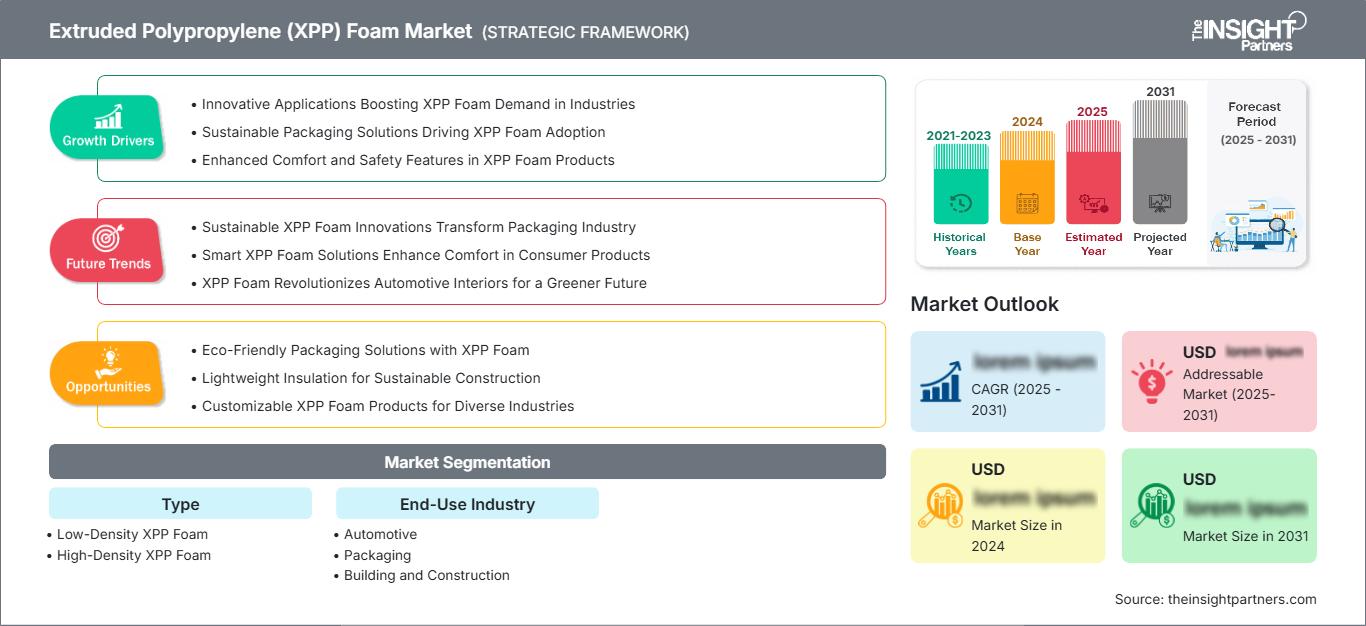
Extruded Polypropylene (XPP) Foam Market: Strategic Insights
Regional Insights
North America Extruded Polypropylene Foam Market
North America is estimated to hold 28–32% share in 2025 and expand at a 5.0–6.0% CAGR through 2034. US dominance in regional consumption is underpinned by automotive components, reusable transport packaging, and the need for lightweight protective packaging. The additional value added by Mexico relates to automotive and packaging channels, whereas that of Canada lies in industrial and construction applications. Regionally, recyclability of polypropylene foams will continue to be preferred by converters as it allows recovery and material simplicity.
As per the Extruded Polypropylene Foam Market, automotive continues to be an important driver due to its weight reduction capability coupled with impact and acoustic or thermal insulation. Returnable packaging systems and durable inserts will also contribute to the demand for polypropylene foams. JSP Corporation, Pregis LLC, Sekisui Voltek, and Sonoco Products Company add to the regional supply and conversion strengths. Regional investments in terms of local capacity building, material qualification and application engineering will ensure continuation of North America's dominance, even as car production and resin prices affect short-term buying patterns.
U.S. Extruded Polypropylene Foam Market
The US is estimated to represent 22–26% of global share in 2025, equivalent to roughly 72–82% of North American demand, and is expected to grow at a 5.0–6.0% CAGR through 2034. Use of products within the automotive industry is still significant, specifically lightweight interior, underbody, thermal, and acoustic parts. Another application which holds significance is packaging, specifically reusable containers and protective inserts for industrial logistics operations.
Advantages associated with the market include presence of well-developed plastics processing infrastructure, in addition to close proximity between resin producers, foam converters, automobile manufacturers, and packaging companies. Some examples include JSP Corporation and Sekisui Voltek who have developed regional capacities while Pregis LLC and Sonoco Products Company cater to protective packaging applications. Requirement of material efficiency and recycling is also gaining importance.
Europe Extruded Polypropylene Foam Market
Europe accounts for an estimated 24–28% share in 2025 and is projected to expand at a 4.5–5.5% CAGR through 2034. Demand in the region comes mainly from Germany because of the presence of its vehicle manufacturing industries as well as the engineering plastic industry. The UK, France, Italy, and Spain provide the demand from packaging, automotive parts, home appliances, and construction materials industries. The regulations in the region favor the design of recyclable materials.
Germany is the leader because of the vehicle manufacturing as well as the advanced polymer processing which leads to high demand for lightweight foams. France and Italy are diversified in their automotive, packaging, and industrial manufacturing. Spain is advantaged by the presence of the automotive and packaging industries, while the UK contributes from logistics, construction, and industrial packaging industries. Borealis AG and NMC SA provide the technology and applications in the region, while Zotefoams plc brings in foam technology expertise.
APAC Extruded Polypropylene Foam Market
APAC is estimated to hold 30–34% share in 2025 and grow at 6.0–7.0% CAGR through 2034, making it the leading regional growth center. The largest consumer is China, followed by Japan, South Korea, India, and Australia. The construction industry, automotive manufacturing, electronic logistics, and packaging conversion help fuel consumption in this region.
China offers heavy manufacturing coupled with growing needs for light packaging and automotive materials. Japan and South Korea focus on precision application and properties of materials, whereas India enjoys advantages from industrialization, automobile manufacturing, and infrastructure development. Australia stands for a relatively smaller construction and packaging market. Investment in manufacturing facilities and recycling of materials is likely to foster adoption.
Middle East & Africa Extruded Polypropylene Foam Market
Middle East and Africa demand is developing from a smaller base, with Saudi Arabia, the UAE, and South Africa representing important markets. The region is estimated to grow at 4.0–5.0% CAGR through 2034 as packaging, construction, logistics, and automotive-related applications expand.
The advantages of Saudi Arabia and the UAE include infrastructure investment, diversification in manufacturing, and petrochemicals, while South Africa has the best converting base in Sub-Saharan Africa. Energy availability and availability of polypropylene raw material can help to make this region economically viable. The demand for the product will focus more on insulation, packaging, and construction materials.
Segmentation Analysis
Type
The Type segment is expected to register a 5.4–6.2% CAGR from 2026 to 2034. Product selection depends primarily on density, stiffness, impact performance, thermal requirements, and processing conditions. The Extruded Polypropylene Foam Market scope is expanding as users move from general-purpose cushioning toward engineered grades tailored to automotive, packaging, and construction requirements.
- Low-Density XPP Foam: Low-density grades emphasize weight reduction, cushioning, and material efficiency. They are particularly relevant for protective packaging and applications where lower mass and flexible energy absorption provide advantages over denser structures.
- High-Density XPP Foam: High-density grades provide greater stiffness, durability, impact resistance, and structural support. Their performance profile makes them important for automotive components, reusable packaging systems, and construction products requiring dimensional stability.
End-Use Industry
The End-Use Industry segment is forecast to expand at a 5.8–6.6% CAGR from 2026 to 2034. Adoption is shaped by lightweighting, protection requirements, durability, and regulatory pressure for recyclable materials. The segment demonstrates how application-specific performance requirements influence formulation, density selection, and converter investment.
- Automotive: Automotive applications use polypropylene foam for lightweight components, impact management, thermal insulation, acoustic functions, and protective structures. The material's low weight and durability support vehicle efficiency and increasingly complex component-design requirements.
- Packaging: Packaging applications emphasize cushioning, reusability, moisture resistance, and material recovery. XPP foam can replace heavier or multi-material protective structures, particularly in returnable transport systems and durable industrial packaging.
- Building and Construction: Construction applications focus on insulation, lightweight panels, protection layers, and durable cores. Polypropylene foam can provide moisture resistance and mechanical stability where long service life and reduced material weight are important.
Opportunity Snapshot
| End-Use Industry | Revenue Contribution (High/Medium/Low) | Trend Tag | Adoption Stage |
|---|---|---|---|
| Automotive | High | Vehicle Lightweighting | Mature |
| Packaging | High | Reusable Transit | Scaling |
| Building and Construction | Medium | Lightweight Panels | Scaling |
Extruded Polypropylene (XPP) Foam Market Growth Drivers and Impact Analysis
Vehicle Lightweighting and Component Efficiency
Automotive manufacturers are under sustained pressure to reduce vehicle mass while preserving safety, comfort, durability, and production efficiency. Polypropylene foam contributes by replacing heavier structures and integrating cushioning, insulation, acoustic, and impact-management functions into lightweight components. This creates opportunities for suppliers that can meet dimensional stability and qualification requirements at consistent densities. Electric vehicles strengthen the rationale because lower structural and component weight can help offset battery mass and improve energy efficiency. The impact extends beyond material substitution: designers increasingly consider foam as a functional component rather than merely a filler. Consequently, suppliers with automotive-grade processing expertise, simulation capabilities, and established relationships with vehicle manufacturers are positioned to capture higher-value applications as platforms undergo redesign.
Expansion of Reusable and Recyclable Protective Packaging
Packaging is shifting toward systems that reduce single-use material consumption while maintaining product protection during repeated transportation cycles. Extruded polypropylene foam is well suited to reusable containers, protective inserts, separators, and returnable transport packaging because it combines resilience, moisture resistance, and low weight. The material can also support mono-material packaging architectures where recovery is easier than for complex laminated structures. This transition is particularly relevant to automotive parts, electronics, industrial components, and high-value equipment moving through closed logistics networks. The commercial impact is greater when packaging owners evaluate total cost over multiple shipment cycles rather than the initial material price. As reverse logistics and reusable packaging systems expand, converters with cleaning, fabrication, and design capabilities can create differentiated solutions and secure longer-term customer relationships.
Construction Demand for Lightweight and Durable Materials
Construction applications are creating opportunities for polymer foams that provide insulation, moisture resistance, dimensional stability, and reduced structural weight. XPP foam can be incorporated into panels, protective layers, insulation systems, and selected building components where durability is required under variable environmental conditions. Its resistance to moisture and chemicals can be useful in applications exposed to demanding operating environments. Infrastructure development in Asia Pacific and the Middle East provides additional demand potential, while European sustainability objectives encourage material efficiency and longer service life. The market impact is strongest where foam can simplify assemblies or reduce transportation and installation costs. Producers that develop construction-specific grades, surface treatments, and compatible bonding systems can improve adoption by addressing the performance requirements that often prevent substitution of conventional materials.
Extruded Polypropylene (XPP) Foam Market Future Trends
Greater Adoption of Mono-Material Foam Solutions
The Extruded Polypropylene Foam Market trends show that future product development is likely to prioritize mono-material structures that simplify recycling and reduce compatibility problems at end of life. Foam manufacturers are expected to optimize polypropylene formulations, surface treatments, and processing methods so that protective or structural components contain fewer incompatible materials. This trend could encourage the replacement of laminated cushioning and mixed-polymer assemblies in packaging and automotive applications. Product designers will increasingly evaluate recyclability alongside density, impact performance, and cost during early development. Suppliers that can provide material traceability and consistent recycled-content options may gain stronger positions with customers facing circularity targets. The resulting competitive landscape should favor integrated development programs combining resin engineering, extrusion expertise, converter design, and end-of-life considerations.
Digital Process Control and Application-Specific Foam Engineering
Manufacturers are likely to increase the use of digital process monitoring to improve foam density, cell uniformity, dimensional consistency, and material utilization. Advanced sensors and data analytics can help processors identify changes in melt conditions and blowing behavior before they affect production quality. At the application level, computer-aided engineering can support more accurate optimization of cushioning, thermal insulation, and structural properties. These capabilities can reduce trial-and-error during product development and shorten qualification cycles for demanding automotive and industrial customers. Over time, the differentiation between commodity foam production and engineered foam solutions should become more pronounced. Companies that combine process automation with application simulation will be better positioned to address complex performance specifications while controlling scrap, energy consumption, and production variability.
Extruded Polypropylene (XPP) Foam Market Opportunities
Regional Conversion Capacity in Asia Pacific
Asia Pacific offers investment potential in localized extrusion, fabrication, and conversion capacity because resin availability is strong and downstream manufacturing continues to expand. Investors can target facilities close to automotive clusters, electronics logistics networks, and packaging converters to reduce transportation costs and shorten customer lead times. India and Southeast Asia offer opportunities for capacity development as manufacturing supply chains diversify, while China, Japan, and South Korea provide established technical ecosystems. A regional strategy should emphasize application engineering rather than resin volume alone. Production lines capable of switching density ranges and producing application-specific sheet or component formats can address multiple customer categories. Partnerships with local converters and OEM suppliers may further accelerate qualification and reduce market-entry barriers.
Integrated Circular Foam Product Platforms
According to the Extruded Polypropylene Foam Market forecast, an opportunity lies in developing integrated platforms that combine recycled feedstock, foam production, component conversion, and recovery pathways. Customers increasingly need evidence that sustainability claims translate into measurable material efficiency and practical end-of-life solutions. Producers can therefore differentiate through closed-loop programs for reusable packaging, automotive components, and industrial protection systems. Such platforms can include take-back arrangements, material identification, reprocessing partnerships, and product redesign services. The opportunity is particularly relevant in regions introducing stronger packaging and circularity requirements. Investment should focus on technologies that maintain consistent foam performance when recycled content is introduced. Companies capable of demonstrating reliable quality across repeated processing cycles can potentially capture premium applications while strengthening customer retention and reducing exposure to virgin-resin price volatility.
Recent Developments
- September 2025: Borealis AG announced an investment of more than EUR 100 million to expand and modernize its polypropylene compounding facilities in Schwechat, Austria. The new line is scheduled to start operations in the second half of 2026 and is intended to increase supply of advanced PP compounds for mobility, consumer products, and infrastructure applications.
- June 2025: Borealis AG announced more than EUR 100 million of investment in a new high-melt-strength polypropylene production line at its Burghausen, Germany facility. Planned for startup in the second half of 2026, the line is expected to triple supply capability for recyclable HMS PP used in lightweight foam solutions.
- April 2025: Borealis AG published technical guidance on polypropylene foam production, highlighting the use of hydrocarbons for very-low-density foams and supercritical carbon dioxide or nitrogen for higher-density structures. The company also outlined the suitability of its high-melt-strength polypropylene grades for chemical foaming processes.
Frequently Asked Questions

- Comprehensive Market Sizing and Forecast Analysis
- Detailed Segmentation Analysis
- In-Depth Market Dynamics Assessment
- Regional and Country-Level Insights
- Competitive Landscape and Company Benchmarking
- Strategic Business Intelligence
Recent Reports
Testimonials

The Insight Partners' SCADA System Market report is comprehensive, with valuable insights on current trends and future forecasts. The team was highly professional, responsive, and supportive throughout. We are very satisfied and highly recommend their services.
RAN KEDEM Partner, Reali Technologies LTDs
I requested a report on a very specific software market and the team produced the report in a few days. The information was very relevant and well presented. I then requested some changes and additions to the report. The team was again very responsive and I got the final report in less than a week.
JEAN-HERVE JENN Chairman, Future Analytica
We worked with The Insight Partners for an important market study and forecast. They gave us clear insights into opportunities and risks, which helped shape our plans. Their research was easy to use and based on solid data. It helped us make smart, confident decisions. We highly recommend them.
PIYUSH NAGPAL Sr. Vice President, High Beam Global
The Insight Partners delivered insightful, well-structured market research with strong domain expertise. Their team was professional and responsive throughout. The user-friendly website made accessing industry reports seamless. We highly recommend them for reliable, high-quality research services
YUKIHIKO ADACHI CEO, Deep Blue, LLC.
This is the first time I have purchased a market report from The Insight Partners.While I was unsure at first, I visited their web site and felt more comfortable to take the risk and purchase a market report.I am completely satisfied with the quality of the report and customer service. I had several questions and comments with the initial report, but after a couple of dialogs over email with their analyst I believe I have a report that I can use as input to our strategic planning process.Thank you so much for taking the extra time and making this a positive experience.I will definitely recommend your service to others and you will be my first call when we need further market data.
JOHN SUZUKI President and Chief Executive Officer, Board Director, BK Technologies
I wish to appreciate your support and the professionalism you displayed in the course of attending to my request for information regarding to infectious disease IVD market in Nigeria. I appreciate your patience, your guidance, and the fact that you were willing to offer a discount, which eventually made it possible for us to close a deal. I look forward to engaging The Insight Partners in the future, all thanks to the impression you have created in me as a result of this first encounter.
DR CHIJIOKE ONYIA MANAGING DIRECTOR, PineCrest Healthcare Ltd.Reason to Buy
- Informed Decision-Making
- Understanding Market Dynamics
- Competitive Analysis
- Identifying Emerging Markets
- Customer Insights
- Market Forecasts
- Risk Mitigation
- Boosting Operational Efficiency
- Strategic Planning
- Investment Justification
- Tracking Industry Innovations
- Aligning with Regulatory Trends





 Get Free Sample for