
Extrusion Billets Market Size, Share & Forecast by 2034
Coverage: by Type (75-280 mm, 280-325 mm); Application (Building and Construction, Transportation, Consumer Durables, Engineered Products), and Geography (North America, Europe, Asia Pacific, and South and Central America)
- Status : Data Released
- Report Code : TIPRE00013046
- Category : Chemicals and Materials
- No. of Pages : 150
- Available Report Formats :


- Last update date : November 02, 2026


2025 Market Size
US$ 5.53 Bn
Base year value
2034 Forecast
US$ 8.39 Bn
Projected by 2034
CAGR 2026-2034
4.76 %
Growth rate
Addressable Market
US$ 63.25 Bn
(2026-2034)
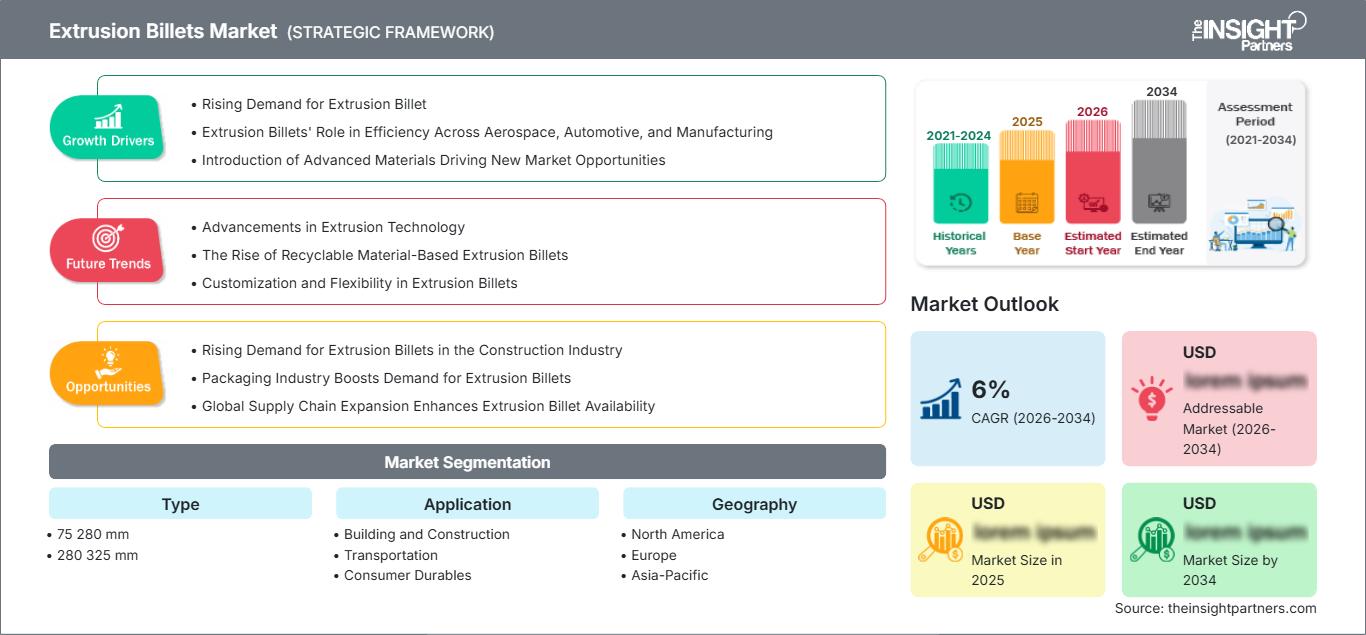
The Extrusion Billets Market size is valued at US$ 5.53 Billion in 2025 and is projected to reach US$ 8.39 Billion by 2034, expanding at a CAGR of 4.76% from 2026 to 2034. The market covers aluminum billets manufactured for downstream extrusion processes, with demand shaped by construction, transportation, consumer durables, and engineered products. Product differentiation increasingly depends on alloy chemistry, billet diameter, recycled content, casting quality, homogenization, surface integrity, and the ability to supply consistent material for automated extrusion operations.
North America is positioned as a substantial regional market, supported by established aluminum extrusion capacity, domestic remelting infrastructure, and demand from construction, transportation, and industrial manufacturing. The region is expected to expand at a modeled CAGR of ~4% through 2034. Supply-chain localization, recycled aluminum availability, and investment in lower-carbon billet production are strengthening regional sourcing. Domestic producers are gaining importance as buyers seek shorter lead times, controlled alloy specifications, and greater resilience against trade and logistics disruptions.
Extrusion Billets Market Assessment and Insights
Regional Outlook
- North America: ~29% of the global Extrusion Billets Market share in 2025 | ~4% CAGR through 2034. Market position: North America maintains a major regional position because established extrusion capacity, recycling infrastructure, construction demand, and transportation applications support recurring billet consumption. Regional sourcing is strengthening as buyers prioritize reliable domestic supply and lower logistics exposure.
- US: ~78% of North American market revenue in 2025 | ~4% CAGR through 2034. Market position: The US represents the principal country market within North America, supported by a broad extrusion manufacturing base serving building systems, transportation, electrical applications, consumer products, and engineered components. Recycled billet production further strengthens the domestic supply.
- Europe: ~27% of the global market in 2025 | ~3% CAGR through 2034. Market position: Europe is a mature extrusion market, with Germany representing the leading country in Europe. Automotive electrification, building renovation, industrial engineering, and circular aluminum initiatives support demand, although subdued construction and industrial activity constrain near-term expansion.
- Asia Pacific: ~37% of the global market in 2025 | ~6% CAGR through 2034. Market position: Asia Pacific is the largest regional market and the fastest-growing region, supported by extensive manufacturing capacity. China leads the region, while India, Japan, South Korea, and Australia contribute through construction, mobility, industrial equipment, and infrastructure demand.
Segment Outlook
- 75-280 mm: ~72% Share in 2025 | ~5% CAGR through 2034. Market position: This diameter category leads because standard extrusion presses serving construction profiles, transportation components, consumer products, and industrial shapes commonly use billets within this range. Broad alloy availability and established handling systems reinforce its commercial importance.
- Transportation: ~21% Share in 2025 | ~6% CAGR through 2034. Market position: Transportation has the highest growth outlook as aluminum supports lightweight vehicle structures, battery-electric vehicle components, rail applications, and commercial transportation systems. Demand is increasingly linked to weight reduction, energy efficiency, corrosion resistance, and material circularity.
Competitive Coverage
Aluminum Bahrain B.S.C. (Alba), Matalco Inc., Norsk Hydro ASA, Praim Srl, Rio Tinto plc, Sandvik AB, Service Center Metals, TRIMET Aluminum SE, Vista Metals Corp., Zalco B.V.
Methodology
The Insight Partners follows Data Collection & Secondary Research, Primary Research, Data Analysis, and Data Triangulation & Final Review to validate market estimates and insights.
Source: The Insight Partners' analysis based on proprietary research, government publications, company annual reports, investor presentations, industry databases, and expert interviews.
The Extrusion Billets Market report shows that extrusion billets have shifted from conventional methods involving production of primary aluminum billet through casting and remelting processes. Manufacturers now increasingly blend primary metal with post-consumer and processing scrap before alloying, filtering, degassing, grain refining, homogenization, ultrasonic testing and precise cutting. These procedures result in better quality consistency with high speed extrusion presses. Monitoring of process using digital equipment is likely to become increasingly important as customers desire repeatable alloy composition and surface finish. Recycled content billet is becoming increasingly relevant due to its potential to lower greenhouse gas emissions while maintaining the properties needed in structural and industrial extrusion applications.
In the future, investments in Extrusion Billets market will be focused towards recycling facilities, regional remelting facilities, energy efficient melting units, specialty alloy development and integrated supply chains. Future growth drivers in emerging demand markets of India and Southeast Asia include industrialization, infrastructural development, automobile production and growing downstream extrusion capacity. In Europe and North America, regulation concerning carbon footprint will drive increased recycled content and traceability. Manufacturers capable of combining consistent metallurgy with recycled content will be able to take advantage of purchasing programs where life cycle performance becomes an increasing factor.
Extrusion Billets Market Report Scope
| Report Attribute | Details |
|---|---|
| Market size in 2025 | US$ 5.53 Billion |
| Market Size by 2034 | US$ 8.39 Billion |
| Global CAGR (2026 - 2034) | 4.76% |
| Historical Data | 2021-2024 |
| Forecast period | 2026-2034 |
Extrusion Billets Market Analysis
Extrusion Billets Demand in the market is dependent on operating rates and the type of extrusion press that is being used. Construction industry uses billets in large quantities for applications like frames, facades, doors, windows, structural sections, and transport. The transportation industry uses alloys that have different characteristics. Consumer durables use billets to produce repeating profiles that are found in machines and appliances. Engineering products require special chemistry of the metal and high-quality billets. Value chain involves alumina, primary aluminum, and scrap that goes through remelting, alloying, casting, homogenizing, cutting, testing, logistics, and extrusion process.
The dynamics of supply of the Extrusion Billets market are influenced by the price of aluminum, availability of scrap, cost of electricity, capacity for casting, regional trade situation, and the ratio of primary and secondary metal. The production of secondary billets is one of the ways of using scrap for the production of extrusion billets, although contamination and sorting can sometimes affect the use of secondary metal. Billets producers that have their own recycling processes can decrease their dependency on third party sources and can enhance traceability. The presence of billet plants in regional areas near extrusion plants can help to reduce costs of transportation and warehousing.
The competitive environment within the Extrusion Billets Market is made up of integrated aluminum producers, specialized remelters, standalone billet producers, and vertically integrated extrusion firms. Norsk Hydro ASA integrates primary aluminum, recycling, billet production, and extrusion in various markets, while Matalco Inc. has made its mark as a leading North American remelter for recycled billets. Rio Tinto plc engages in the market via primary aluminum production and downstream alliances, while TRIMET Aluminum SE is a combination of primary producer, foundry, recycler, and extrusion billet manufacturer. Service Center Metals and Zalco B.V. make the ranks of the specialists, while Vista Metals Corp. specializes in specialty aluminum products.
The Extrusion Billets Market forecast shows that investment trends have been towards low carbon production, automated casting, recycling, alloy formulation, and specification of the billet according to the needs of the buyer. Hence, competitive position can be created more through offering consistent quality products having lower carbon footprint and reliable transportation in the region than by just supplying raw materials. The firms like Aluminum Bahrain B.S.C. (Alba), Praim Srl, along with others operating in the industry play their part in such a market environment where qualification of the buyer, metallurgical consistency, and technical assistance based on specific application play an important role in buying decisions.
● REPORT CUSTOMIZATION
Tailor This Report To Align With Your Specific Business Requirements
This report can be customized to align precisely with your business objectives, scope, and target markets. Customization options include tailored segmentation, geography, competitive analysis, and strategic insights to support informed decision-making.
Customize This Report →WHAT YOU CAN ADJUST
- ● Segmentations
- ● Geography
- ● Competitive Analysis
- ● Language Preferences
Extrusion Billets Market: Strategic Insights
Regional Insights
North America Extrusion Billets Market
North America accounts for ~29% of global revenue in 2025 and is projected to expand at a ~4% CAGR through 2034. The region has an existing aluminum extrusion value chain for building, transportation, industrial applications, electrical components, and consumer goods. The US forms the largest market nationally in the region, while Canada is the source for raw and recycled aluminum. Remelting is becoming more strategic as companies try to have better control over their material supply and delivery lead times.
The supply structure for the region is becoming increasingly reliant on recycled aluminum. Matalco Inc. is a company that specializes in remelting and casting of aluminum across the United States and Canada. Service Center Metals is a company with integrated billet and extrusion capabilities. Hydro is another firm that offers recycling and billet services for automobiles, transportation and building applications. Demand dynamics in the region are uneven across application types, with construction and industrial applications acting as a demand source while commercial transportation and some automobile applications are facing cyclical pressures.
U.S. Extrusion Billets Market
The US represents ~78% of North American revenue in 2025 and is expected to expand at a ~4% CAGR through 2034. The placement is justified by the presence of substantial extrusion capacity, high levels of construction activities, automotive and transportation manufacturing, and diverse industries. Building systems represent a major customer for billets, while transportation industry uses lightweight aluminum parts more frequently. Both primary and secondary billet production contribute to the US market.
Domestic suppliers continue to develop their capability to process post-consumer and industrial scrap to produce extrusion billets. Hydro, Matalco Inc., Service Center Metals, and Vista Metals Corp. can offer their services to different sectors of the downstream market. Secondary production is especially important in case when customers have to have documentation on their environmental performance. The demand for the product will be related to construction investments, automotive and industrial manufacturing, and infrastructure development.
Europe Extrusion Billets Market
Europe represents ~27% of global revenue in 2025 and is expected to grow at a ~3% CAGR through 2034. Germany is the leading country in Europe, supported by its large industrial base, automotive manufacturing ecosystem, engineering capabilities, and established aluminum processing infrastructure. The UK maintains demand across construction, transportation, and industrial products, while France benefits from aerospace, automotive, rail, and building applications. Italy has a broad network of extrusion and fabrication companies, and Spain contributes through construction, transportation, and industrial manufacturing.
European demand is shaped by both mature end-use markets and the transition toward lower-carbon materials. Germany remains important for high-quality industrial and transportation applications, while France has developed recycling and extrusion-billet capabilities serving building and automotive customers. Italy's large downstream processing base supports regular billet requirements, particularly for architectural and industrial profiles. Spain's construction and manufacturing sectors provide additional demand. Across the region, energy costs, industrial utilization, carbon reduction requirements, and recycled-content targets influence producer economics. European billet suppliers are therefore investing in recycling, energy efficiency, alloy development, and process optimization to maintain competitiveness while serving customers with increasingly specific sustainability requirements.
APAC Extrusion Billets Market
Asia Pacific represents ~37% of global revenue in 2025 and is projected to expand at a ~6% CAGR through 2034, making it the largest and fastest-growing regional market. China is the leading country in the Asia Pacific, supported by its extensive aluminum production, extrusion capacity, construction activity, manufacturing base, and infrastructure investment. India is expanding rapidly through construction, transportation, renewable-energy equipment, and industrial manufacturing.
Japan and South Korea contribute through automotive, electronics, machinery, and advanced industrial applications, while Australia provides primary aluminum resources and downstream manufacturing demand. Regional growth is supported by urbanization, industrial localization, vehicle lightweighting, and infrastructure development. Increasing recycling and energy-efficiency initiatives are encouraging producers to expand secondary aluminum capabilities and improve billet quality for higher-value extrusion applications.
Middle East & Africa Extrusion Billets Market
Middle East & Africa is expected to expand at a ~5% CAGR through 2034. Saudi Arabia represents the leading country in the Middle East & Africa region, where evidence supports the strongest combination of aluminum investment, construction activity, industrial diversification, and infrastructure development. The UAE also has an established aluminum processing and extrusion ecosystem, while South Africa supports regional demand through construction, transportation, industrial products, and manufacturing.
The Middle East benefits from comparatively strong access to primary aluminum, energy-intensive processing infrastructure, and large-scale construction programs. Saudi Arabia and the UAE are diversifying downstream metal industries, increasing the potential for domestic billet consumption. South Africa provides an important southern African manufacturing base. Across the rest of MEA, infrastructure modernization, urban development, and industrial projects provide incremental demand, although market development varies considerably by country and project pipeline.
Segmentation Analysis
Type
Type represents a fundamental product classification because billet diameter determines press compatibility, material utilization, handling requirements, and the range of profiles that can be produced. The Type segment is expected to expand at a ~5% CAGR from 2026 to 2034. Standard diameters continue to dominate routine extrusion operations, while larger billets are increasingly relevant for specialized profiles and higher-throughput applications.
- 75-280 mm: This range serves a broad base of conventional extrusion presses and profile applications. Its extensive compatibility with building products, industrial shapes, consumer products, and transportation components supports high recurring demand and established production infrastructure.
- 280–325 mm: Larger-diameter billets are used where higher metal throughput and larger profile dimensions are required. Demand is more application-specific, with opportunities linked to structural profiles, transportation components, industrial equipment, and specialized extrusion presses.
Application
The application represents the downstream demand structure for extrusion billets and is projected to expand at a ~5% CAGR from 2026 to 2034. Building and construction provides a broad recurring consumption base, while transportation has stronger structural momentum from lightweighting and electrification. Consumer durables and engineered products provide additional demand through appliances, machinery, industrial systems, and specialized components.
- Building and Construction: Aluminum profiles are widely used in windows, doors, façades, curtain walls, structural systems, and infrastructure. Demand is influenced by new construction, renovation, energy-efficient buildings, and the replacement of heavier materials with durable lightweight profiles.
- Transportation: Automotive, rail, commercial vehicles, and other mobility applications use aluminum extrusions to reduce weight and support structural efficiency. Electrification increases opportunities for battery housings, crash-management systems, thermal components, and lightweight structural profiles.
- Consumer Durables: Appliances, furniture, electronics-related structures, and household equipment use aluminum profiles where light weight, corrosion resistance, thermal performance, and appearance are important. Demand follows consumer manufacturing activity and product design requirements.
- Engineered Products: Industrial machinery, heat-management systems, electrical equipment, and specialized fabricated products require controlled alloy chemistry and dimensional consistency. This application supports higher-value billet requirements where performance and repeatability outweigh commodity pricing considerations.
Opportunity Snapshot
| Application | Revenue Contribution | Trend Tag | Adoption Stage |
| Building and Construction | High | Green Buildings | Mature |
| Transportation | Medium | Vehicle Lightweighting | Scaling |
| Consumer Durables | Medium | Product Lightweighting | Mature |
| Engineered Products | Low | Precision Profiles | Scaling |
Extrusion Billets Market Growth Drivers and Impact Analysis
Expansion of Recycled Aluminum Billet Production
Recycled aluminum is becoming a central supply strategy because remelting aluminum generally requires substantially less energy than producing primary metal from ore. Billet manufacturers are therefore increasing scrap sorting, remelting, filtration, degassing, and alloy-adjustment capabilities to deliver extrusion-grade secondary material. The commercial impact extends beyond environmental performance. Regional recycling systems can reduce exposure to primary metal shortages, improve raw-material traceability, and shorten supply chains. Producers with access to consistent post-consumer scrap can offer billets with documented recycled content while maintaining specifications demanded by extrusion customers. This creates a competitive distinction between producers that merely sell commodity billet and those capable of integrating scrap sourcing, advanced sorting, metallurgy, certification, and customer-specific alloy management into one supply proposition.
Vehicle Lightweighting and Electrification Increase Aluminum Content
Transportation is creating additional billet demand because aluminum extrusion offers a combination of low density, structural performance, corrosion resistance, and design flexibility. Electric vehicles require lightweight structures to offset battery mass, while rail and commercial transportation manufacturers continue to seek weight savings and durable components. Extruded aluminum is relevant to battery housings, crash structures, thermal-management components, rails, frames, and other engineered systems. This expands the importance of billet consistency because transportation applications can require controlled mechanical properties, dimensional stability, and surface quality. As vehicle platforms become more standardized around aluminum-intensive architectures, billet suppliers can benefit from long-term qualification programs and higher-volume contracts. The impact is strongest for producers capable of meeting automotive and transportation quality requirements while providing competitive recycled-content options.
Regional Supply-Chain Localization Strengthens Billet Manufacturing
Aluminum billet supply is becoming more regional as extrusion customers seek dependable delivery, shorter lead times, and reduced exposure to cross-border disruption. Local remelting also allows producers to process regionally available scrap and tailor alloy chemistry to nearby extrusion customers. North America demonstrates this model through a growing network of billet and recycling facilities, while Europe continues to integrate recycling with established extrusion clusters. Asia Pacific combines large-scale primary aluminum availability with rapidly expanding downstream manufacturing. Localization changes competitive priorities because buyers increasingly evaluate supply security alongside price, alloy range, and quality. For billet producers, proximity to extrusion presses can improve inventory responsiveness and reduce logistics costs. It can further support closed-loop scrap arrangements in which production scrap returns to the same regional supply system.
Extrusion Billets Market Future Trends
Digital Traceability Will Connect Scrap, Billet, and Extrusion Data
The Extrusion Billets Market trends indicate that digital traceability is likely to become more important as customers require greater visibility into alloy composition, recycled content, carbon intensity, and material origin. Future billet production systems can integrate scrap identification, furnace records, alloy additions, casting parameters, homogenization conditions, inspection results, and shipment data into a traceable product history. This development can improve quality control while reducing the administrative burden associated with sustainability declarations. For transportation and engineered applications, digital records can strengthen supplier qualification by linking billet chemistry and processing conditions to downstream performance. For construction customers, traceable recycled content can support procurement and environmental reporting. The trend favors producers that combine automated production controls with data infrastructure rather than treating traceability as a separate documentation activity.
Specialized Low-Carbon Alloys Will Broaden Premium Billet Applications
The market is likely to move toward a broader portfolio of low-carbon and application-specific billet grades. Producers are developing methods to incorporate higher proportions of recycled metal while controlling impurities and maintaining extrusion performance. Alloy innovation can reduce extrusion pressure, improve surface quality, increase productivity, or enable more complex profiles, creating value beyond the underlying aluminum content. Transportation and engineered products are particularly suited to this trend because buyers can justify specialized materials when performance improvements affect total manufacturing economics. Construction customers are increasingly interested in low-carbon materials for structural and architectural profiles. As carbon accounting becomes more integrated into purchasing, billet specifications are expected to include both metallurgical characteristics and environmental attributes.
Extrusion Billets Market Opportunities
Investment in Regional Recycling and Remelting Hubs
Investment opportunities are emerging around recycling plants located close to major extrusion clusters. A regional hub can collect post-consumer and industrial scrap, sort alloys, remelt material, and supply homogenized billet to nearby customers. This structure reduces transport requirements and can improve raw-material security while creating a direct route for closed-loop material recovery. Investors and producers can target regions with large concentrations of extrusion presses, strong construction or automotive manufacturing, and established scrap collection networks. The commercial opportunity is particularly relevant where customers have explicit recycled-content requirements but lack sufficient internal remelting capacity. Integrating billet casting with scrap preparation can further improve economics by controlling feedstock quality and reducing dependence on imported primary aluminum.
Customer-Specific Billet Development for High-Value Extrusion Applications
A second opportunity lies in developing application-specific billets rather than competing only on standard alloy availability. Transportation, aerospace-related products, industrial equipment, and complex building systems can require tighter chemistry, controlled microstructure, superior surface characteristics, or enhanced extrusion productivity. Billet manufacturers can work directly with extrusion companies to optimize alloy composition, homogenization cycles, casting parameters, and billet dimensions. Such collaboration can create longer qualification cycles and stronger customer retention because the material becomes integrated into a customer's process specifications. Producers can further combine customized metallurgy with recycled content and carbon documentation, creating differentiated offerings for customers with sustainability and performance targets. This approach supports higher-value applications while reducing reliance on purely price-driven commodity competition.
Recent Developments
- August 2026: Rockwell Automation, Inc. (NYSE: ROK), the world's largest company dedicated to industrial automation and digital transformation, announced that Indinvest LT, one of Italy's leading manufacturers of aluminum billets and extrusions, is working with Rockwell and H.S. Automation to strengthen the cybersecurity of its operational technology (OT) environment through a comprehensive cybersecurity risk assessment.
- December 2025: Remal Alcast Pvt. Ltd. commenced operations at its new integrated aluminum billet casthouse under the brand Remal at Vile Bhagad, Maharashtra, India. Backed by the Star Group, the facility strengthens India's aluminum manufacturing ecosystem with a strong focus on quality, sustainability, and advanced process capability.
Frequently Asked Questions

- Comprehensive Market Sizing and Forecast Analysis
- Detailed Segmentation Analysis
- In-Depth Market Dynamics Assessment
- Regional and Country-Level Insights
- Competitive Landscape and Company Benchmarking
- Strategic Business Intelligence
Recent Reports
Testimonials

The Insight Partners provided valuable market intelligence that supported our global go-to-market strategy. Their team was professional, responsive, and attentive to our feedback, providing thoughtful analysis and helpful methodological clarifications throughout the project.
Junmo Kim Chief Financial Officer (CFO), Enertech Co., Ltd.
The Insight Partners' SCADA System Market report is comprehensive, with valuable insights on current trends and future forecasts. The team was highly professional, responsive, and supportive throughout. We are very satisfied and highly recommend their services.
RAN KEDEM Partner, Reali Technologies LTDs
I requested a report on a very specific software market and the team produced the report in a few days. The information was very relevant and well presented. I then requested some changes and additions to the report. The team was again very responsive and I got the final report in less than a week.
JEAN-HERVE JENN Chairman, Future Analytica
We worked with The Insight Partners for an important market study and forecast. They gave us clear insights into opportunities and risks, which helped shape our plans. Their research was easy to use and based on solid data. It helped us make smart, confident decisions. We highly recommend them.
PIYUSH NAGPAL Sr. Vice President, High Beam Global
The Insight Partners delivered insightful, well-structured market research with strong domain expertise. Their team was professional and responsive throughout. The user-friendly website made accessing industry reports seamless. We highly recommend them for reliable, high-quality research services
YUKIHIKO ADACHI CEO, Deep Blue, LLC.
This is the first time I have purchased a market report from The Insight Partners.While I was unsure at first, I visited their web site and felt more comfortable to take the risk and purchase a market report.I am completely satisfied with the quality of the report and customer service. I had several questions and comments with the initial report, but after a couple of dialogs over email with their analyst I believe I have a report that I can use as input to our strategic planning process.Thank you so much for taking the extra time and making this a positive experience.I will definitely recommend your service to others and you will be my first call when we need further market data.
JOHN SUZUKI President and Chief Executive Officer, Board Director, BK Technologies
I wish to appreciate your support and the professionalism you displayed in the course of attending to my request for information regarding to infectious disease IVD market in Nigeria. I appreciate your patience, your guidance, and the fact that you were willing to offer a discount, which eventually made it possible for us to close a deal. I look forward to engaging The Insight Partners in the future, all thanks to the impression you have created in me as a result of this first encounter.
DR CHIJIOKE ONYIA MANAGING DIRECTOR, PineCrest Healthcare Ltd.Reason to Buy
- Informed Decision-Making
- Understanding Market Dynamics
- Competitive Analysis
- Identifying Emerging Markets
- Customer Insights
- Market Forecasts
- Risk Mitigation
- Boosting Operational Efficiency
- Strategic Planning
- Investment Justification
- Tracking Industry Innovations
- Aligning with Regulatory Trends





 Get Free Sample for