
Extrusion Blow Moulding Market Demand, Size & Forecast by 2034
Coverage: By Type (PET, PVC, Polystyrene, Polyethylene, Acrylonitrile, Polypropylene, Others); Application (Medical, Building and construction, Automotive and transport, Consumables and electronics, Packaging, Others), and Geography (North America, Europe, Asia Pacific, and South and Central America)
- Status : Data Released
- Report Code : TIPRE00016521
- Category : Chemicals and Materials
- No. of Pages : 150
- Available Report Formats :


- Last update date : September 18, 2026


2025 Market Size
US$ 5.29 Bn
Base year value
2034 Forecast
US$ 7.56 Bn
Projected by 2034
CAGR 2026-2034
4.05 %
Growth rate
Addressable Market
US$ 58.37 Bn
(2026-2034)
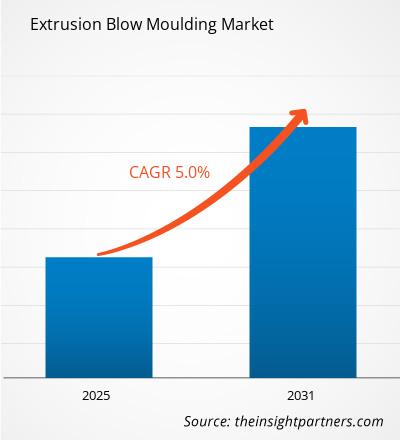
The Extrusion Blow Moulding Market is valued at US$ 5.29 Billion in 2025 and is projected to reach US$ 7.56 Billion by 2034, registering a CAGR of 4.05% during 2026–2034. The market includes the process of conversion of thermoplastics into hollow forms through the means of continuous parison extrusion and mold inflation in various applications like packaging, medical, construction, automotive, transportation, consumer, and electronics where lightweight construction, durability, chemical resistance, and scalable production are vital buying considerations.
North America is set to see consistent growth driven by packaging replacement needs, healthcare products manufacturing, and lightweighting in automobiles. The regional Extrusion Blow Moulding Market Size is expected to grow at a CAGR of 3.8%-4.3% from 2026 to 2034. The increasing adoption of recyclable polyethylene varieties, local manufacturing, and automated molding machines will drive investments in high-efficiency machinery and tooling.
Extrusion Blow Moulding Market Assessment and Insights
- North America: North America is estimated to account for 24–28% share in 2025, expanding at a 3.8–4.3% CAGR between 2026–2034. Packaging, healthcare, industrial containers, and lightweight automotive components support regional demand.
- US: The US represents 68–72% of North American demand in 2025 and is projected to grow at a 3.7–4.2% CAGR during 2026–2034, supported by packaging conversion and domestic manufacturing.
- Europe: Europe is estimated at 19–23% share in 2025, growing at a 3.2–3.8% CAGR during 2026–2034. Germany, Italy, France, the UK, and Spain remain important manufacturing and conversion centers.
- Asia Pacific: Asia Pacific is estimated at 40–44% of the Extrusion Blow Moulding Market share in 2025 and is projected to register a 4.8–5.4% CAGR through 2034. China, Japan, South Korea, and India provide the strongest industrial base.
- Largest Segment: Packaging is estimated at a 42–46% market share in 2025, with a 4.2–4.6% CAGR during 2026–2034, supported by bottles, containers, household products, and specialty packs.
- High Growth Segment: Medical is estimated at an 8–11% share in 2025 and a 5.0–5.5% CAGR during 2026–2034, reflecting healthcare packaging and specialized hollow components.
- Key companies analyzed in detail: Inpress Plastics Ltd, LyondellBasell Industries N.V., Magna International Inc., Berry Global Group, Inc., Rutland Plastics Ltd, Agri-Industrial Plastics Co., The Dow Chemical Company, SABIC, Comar LLC, The Plastic Forming Company, Inc.
Source: The Insight Partners' analysis based on proprietary research, government publications, company annual reports, investor presentations, industry databases, and expert interviews.
Production economics trends are: automation of parison control, multilayering, light weighting, and process control. Resin material selection considerations include: melt strength, stiffness, environment stress crack resistance, barriers, and recycle content. Polyethylene is still relevant as a resin material in container and industrial products, while polyethylene terephthalate and polypropylene have potential for new processes and applications development. Blow molding technology accounted for 57.6% of total rigid plastic packaging production in 2025, which reflects the significance of processes used in production of hollow products.
The investments in the upcoming years would be directed towards machinery for processing recycled and biocircular raw materials without impacting dimensional stability. Asia-Pacific region will have an advantage due to the integration of polymer supply chains and converter clusters. Meanwhile, Europe will face more pressure on energy efficiency and circular materials usage. Plastic products in Europe had only 15.4% recycled content in 2024.
Extrusion Blow Moulding Market Report Scope
| Report Attribute | Details |
|---|---|
| Market size in 2025 | US$ 5.29 Billion |
| Market Size by 2034 | US$ 7.56 Billion |
| Global CAGR (2026 - 2034) | 4.05% |
| Historical Data | 2021-2024 |
| Forecast period | 2026-2034 |
Extrusion Blow Moulding Market Analysis
Packaging replacement, healthcare expenditure, industrial containers needs, and automobiles light-weighting initiatives will determine demand growth. Hence, growth of the Extrusion Blow Moulding Market will depend on not only resins supply but also conversion economics. Value Chain involves resin producers, compounders, mould designers, machinery producers, blow molders, contract manufacturers, end-users and recyclers. In procurement, cycle times, scrap recovery, mould efficiency, energy use and recycled feedstocks compatibility become ever more relevant.
Supply conditions are still strongly tied to polyethylene, polypropylene, PET, PVC and specialized resins prices. Integrated producers can offer better specification stability of their resins, while converters are increasingly negotiating resin grades based on melt strength and processability. Scrap recovery can help minimize materials loss, but multilayered materials and contamination limit recycling efficiency. Regulatory pressures, hence, are driving manufactures towards simpler constructions, traceability of recycled content and recyclability in terms of mechanical performance after multiple cycles.
According to the Extrusion Blow Moulding Market Report, positioning includes expertise in polymers, tooling expertise, geographical proximity, and application engineering. LyondellBasell Industries N.V., The Dow Chemical Company, and SABIC have very robust competitiveness from resin product lines and technical assistance, while Berry Global Group, Inc. has expertise in packaging and molding processes. Magna International Inc. has expertise in automotive engineering, while Agri-Industrial Plastics Co., Rutland Plastics Ltd, Inpress Plastics Ltd, Comar LLC, and The Plastic Forming Company, Inc. are focusing on specialty conversion services and customer specific manufacturing.
The investments in the firm can be made with the efficient use of the raw materials, adaptable machinery, process automation, and circularity. The merger of Berry Global Group, Inc. and Amcor took place in April 2025 and has resulted in the creation of a bigger platform of packaging with advanced materials science and manufacturing. This is the consolidation strategy taking place in connection with the integrated packaging capabilities. At the same time, Dow and SABIC have concentrated on recyclable and recycled polymers and provided the converters with different options to meet the sustainability needs of their customers staying inside blow molding.
● REPORT CUSTOMIZATION
Tailor This Report To Align With Your Specific Business Requirements
This report can be customized to align precisely with your business objectives, scope, and target markets. Customization options include tailored segmentation, geography, competitive analysis, and strategic insights to support informed decision-making.
Customize This Report →WHAT YOU CAN ADJUST
- ● Segmentations
- ● Geography
- ● Competitive Analysis
- ● Language Preferences
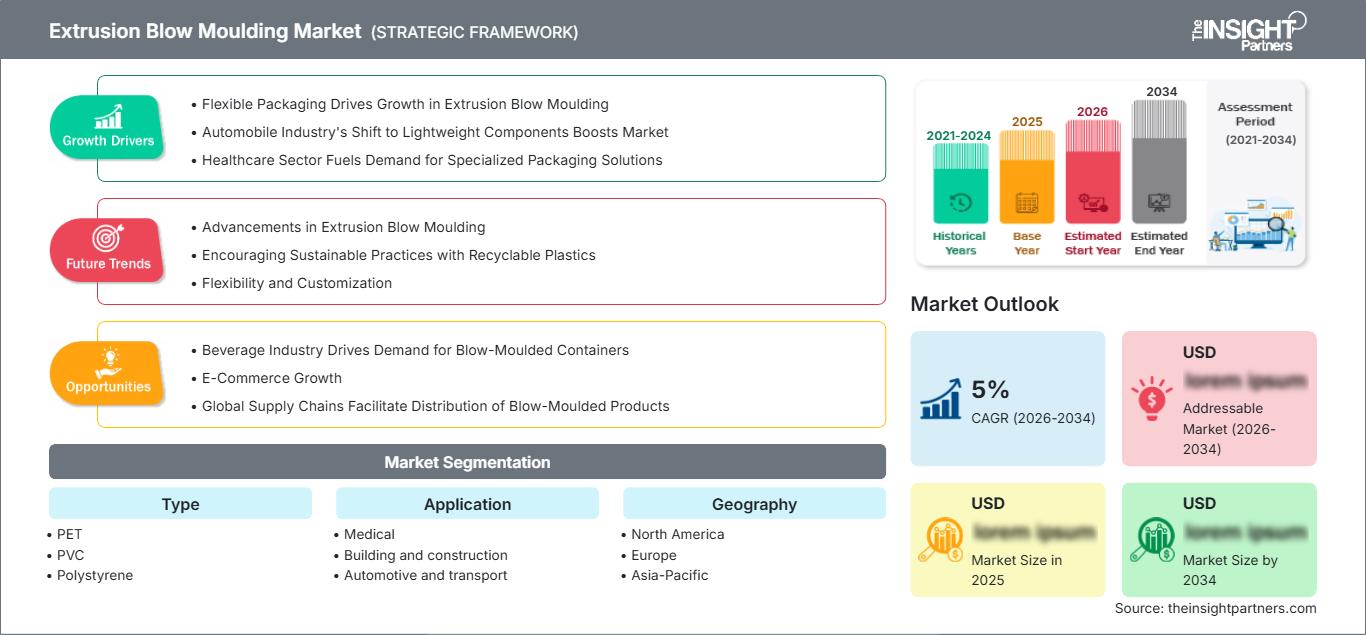
Extrusion Blow Moulding Market: Strategic Insights
Regional Insights
North America Extrusion Blow Moulding Market
The Extrusion Blow Moulding Market share of North America is forecasted at 24–28% in 2025, and CAGR growth is forecasted at 3.8–4.3% in 2034. The United States represents the majority of demand in the region, whereas Canada contributes to special packaging, industrial, and automotive applications. Converter capacity utilization rates are driven by efficient container production, healthcare packaging, and industrial products resistant to chemicals.
Regional consumers are becoming increasingly concerned about domestic supply security, reduction in tooling times, and equipment able to use recycled polyethylene. There is potential for larger hollow and fluid management products due to automotive lightweighting. The need for regulations concerning fuel containment and emissions can result in multilayer structures in certain applications, whereas package users prefer recyclable structures and downgauging.
U.S. Extrusion Blow Moulding Market
The US is forecast to account for 68–72% of North American demand by 2025 and is forecast to grow at a CAGR of 3.7–4.2%. Demand is split into packaging, medical containers, industrial goods, and automobile parts. Local resin supply enables the manufacture of large quantities of plastic, while specialty converters cater to niche applications.
Firms such as Berry Global Group, Inc., Magna International Inc., Agri-Industrial Plastics Co., and The Plastic Forming Company, Inc. demonstrate the scope of local capabilities in application. Packaging is still the major volume user, but in addition, the medical and automotive segments are focusing on accurate dimensions, barrier qualities, light-weighting, and compliance requirements.
Europe Extrusion Blow Moulding Market
Europe is estimated to hold a share of 19–23% in 2025 and is forecast to record a 3.2–3.8% CAGR. Germany continues to be the dominant player driven by a robust ecosystem for plastic processing, followed by Italy, France, the UK, and Spain. Increasing regulatory pressures are fostering increased material efficiency and recyclability.
The UK and Germany still maintain great abilities in converters and machines, with Germany maintaining an even better industrial base. France and Italy gain strength in packaging, consumer goods, and industrial uses, while Spain gets its strength from food/beverage, household, and automotive industries. The contribution of European plastic production to world plastic production in 2024 was 12%, which was down from 22% in 2006 due to stiff competition in Europe.
APAC Extrusion Blow Moulding Market
The APAC region holds an estimated share of 40-44% in 2025, and is projected to grow at a CAGR of 4.8-5.4%. The dominant driver of demand within the region is China, followed by Japan, South Korea, India, and Australia, which offer manufacturing facilities for converters.
China offers size along with demand for packaging, Japan and South Korea focus on precision and technology in materials. India has gained from growth in packaging, healthcare, and automotive manufacturing, whereas Australia is small and application oriented. Regional investments have been increasingly directed towards energy efficient machinery, material recovery process, and quality inspection machines.
Middle East & Africa Extrusion Blow Moulding Market
Middle East and Africa is expected to expand at a 3.5–4.2% CAGR. Saudi Arabia leads regional activity, followed by the UAE and South Africa, while the rest of MEA remains fragmented. Integrated petrochemical production provides a feedstock advantage for regional converters.
Polymer availability and diversification of industry are advantageous to Saudi Arabia, while the UAE acts as a center for logistics and conversion. South Africa has already developed facilities for packaging as well as manufacturing of consumer products. Development of infrastructure and availability of energy for domestic processing further increases the demand for containers and other products. Usage of recycled materials is not yet so much developed.
Segmentation Analysis
Type
The Type segment in the Extrusion Blow Moulding Market is projected to expand at a 3.8–4.3% CAGR during 2026–2034. Material selection determines melt strength, cycle behavior, impact resistance, chemical compatibility, transparency, and recyclability. Polyethylene remains central to large and small hollow products, while PET and polypropylene provide opportunities where appearance, stiffness, or barrier performance is important.
- PET: PET supports applications requiring clarity, stiffness, and strong appearance characteristics. Its established recycling infrastructure and beverage packaging presence maintain strategic relevance, although processing requirements can favor alternative technologies for selected container formats.
- PVC: PVC remains relevant where chemical resistance, durability, and cost effectiveness are prioritized. Demand is concentrated in selected industrial and construction-related products, with formulation and regulatory considerations influencing material selection.
- Polystyrene: Polystyrene serves specialized applications where rigidity and dimensional stability are required. Its role is comparatively narrow because sustainability requirements and substitution pressures increasingly influence packaging material decisions.
- Polyethylene: Polyethylene remains the principal material family for extrusion blow molding because its toughness, chemical resistance, processability, and environmental stress-crack resistance support containers, tanks, and industrial components.
- Acrylonitrile: Acrylonitrile-based materials occupy specialized applications requiring particular surface, rigidity, or chemical-performance characteristics. Their adoption is driven by engineered-product requirements rather than broad commodity packaging volumes.
- Polypropylene: Polypropylene offers a pathway toward lightweight, rigid, and chemically resistant hollow products. Improved grades and processing technologies are expanding its suitability for selected packaging and consumer applications.
Application
The Application segment is forecast to grow at a 4.2–4.7% CAGR through 2034. Packaging provides the largest demand base, while medical applications are developing rapidly as healthcare manufacturers require consistent, lightweight, chemically resistant, and regulation-compliant hollow products. The segment also benefits from automotive lightweighting and durable industrial component requirements.
- Medical: Medical applications require controlled processing, material purity, dimensional consistency, and dependable supply. Bottles, containers, equipment housings, and specialized components create opportunities for converters capable of meeting stringent quality requirements.
- Building and construction: Construction applications use hollow plastic products where corrosion resistance, low weight, durability, and installation efficiency provide advantages. Demand includes selected containers, ducts, protective components, and specialized construction products.
- Automotive and transport: Automotive applications favor lightweight hollow components that reduce vehicle mass while maintaining structural and chemical performance. Fuel systems, reservoirs, ducts, and other engineered parts create opportunities for multilayer and precision molding.
- Consumables and electronics: Consumer and electronics applications require attractive surfaces, dimensional stability, impact resistance, and functional integration. Cases, housings, storage products, and household components support specialized production requirements.
- Packaging: Packaging is the dominant application because extrusion blow molding efficiently produces bottles, containers, jerry cans, and household packs. Brand owners increasingly seek lightweight designs, recycled content, and efficient material utilization.
Opportunity Snapshot
| Application | Revenue Contribution (High/Medium/Low) | Trend Tag | Adoption Stage |
|---|---|---|---|
| Medical | Medium | Sterile Packaging | Scaling |
| Building and construction | Medium | Durable Components | Mature |
| Automotive and transport | Medium | Lightweight Parts | Scaling |
| Consumables and electronics | Medium | Protective Housings | Scaling |
| Packaging | High | Recyclable Containers | Mature |
Extrusion Blow Moulding Market Growth Drivers and Impact Analysis
Packaging lightweighting and circular-material requirements
Packaging converters are under simultaneous pressure to lower material consumption and increase recycled content without compromising container strength. This combination favors extrusion blow molding because process parameters can be adjusted to optimize wall distribution, while polyethylene grades can provide high toughness at reduced weight. The commercial impact is strongest in household chemicals, personal care, industrial packaging, and selected food applications. Material suppliers are responding with grades designed for blow molding that balance stiffness, environmental stress-crack resistance, and processability. SABIC, for example, maintains HDPE grades specifically engineered for small bottles, larger containers, healthcare packaging, and industrial applications. Such specialization can improve converter productivity and broaden sustainable packaging options.
Expansion of lightweight plastic components in transportation
Vehicle manufacturers increasingly use plastics and composites to reduce mass while preserving functionality, corrosion resistance, and design flexibility. This creates opportunities for hollow components that can consolidate parts, reduce assembly requirements, and accommodate complex geometries. Extrusion blow molding is particularly relevant where fluid management, reservoirs, ducts, and protective structures require controlled wall thickness and chemical resistance. Automotive demand also encourages multilayer constructions when barrier performance is important. Magna International Inc. highlighted in 2025 that material science and lightweight composite development are increasingly important to the future of vehicle design, including efforts to improve sustainability and efficiency. The resulting design requirements should support specialized molding investments rather than only commodity-volume expansion.
Healthcare and specialized container manufacturing
Healthcare manufacturing creates an attractive demand pool because packaging and equipment components must meet demanding requirements for purity, dimensional accuracy, chemical resistance, and repeatability. As healthcare consumption expands, suppliers increasingly seek local and regional manufacturing partners capable of validating processes and maintaining consistent material specifications. Blow molding can support bottles, containers, diagnostic accessories, and selected equipment components while enabling efficient production of hollow geometries. SABIC offers dedicated HDPE grades for healthcare packaging, including materials designed for blow-molded bottles and cans with regulatory compliance characteristics. The opportunity therefore extends beyond volume growth to qualification-driven supplier relationships, specialized tooling, controlled production environments, and longer-term contracts with medical product manufacturers.
Extrusion Blow Moulding Market Future Trends
Integration of recycled polymers into high-performance blow molding
In the Extrusion Blow Moulding Market Trends, recycled-content integration is likely to become a standard design parameter rather than a niche sustainability feature. Material suppliers are developing post-consumer recycled polyethylene with controlled stiffness, toughness, and processability to reduce performance gaps versus virgin grades. This will encourage converters to redesign parison structures, optimize melt temperatures, and improve contamination control. Digital process monitoring can help maintain consistency when feedstock variability increases. Dow, for example, lists a PCR HDPE resin specifically designed for packaging and blow molding, with processability and mechanical-performance characteristics targeted at rigid applications. As recycling targets tighten, converter competitiveness will increasingly depend on the ability to process recycled content reliably while preserving product quality.
Digitalized molding and adaptive production systems
Equipment manufacturers and converters are expected to increase use of sensors, machine vision, predictive maintenance, and closed-loop process controls. These systems can identify parison variation, wall-thickness deviations, temperature instability, and mold defects earlier than conventional inspection methods. Digital production records can also improve traceability for medical and regulated packaging applications. Adaptive controls should become especially valuable when recycled resins are introduced because variations in melt behavior can affect cycle stability. Over time, digitalization may shift purchasing decisions from machine capacity alone toward measurable output quality, energy consumption, scrap rates, and uptime. Suppliers capable of integrating data analytics with extrusion, mold handling, trimming, and inspection should gain stronger positions in high-value manufacturing programs.
Extrusion Blow Moulding Market Opportunities
Regional production of recyclable industrial containers
Investors can target regional production platforms for recyclable industrial containers, particularly in markets where chemical, agricultural, lubricant, and household-product manufacturers currently depend on long-distance supply chains. Localized blow molding reduces transport requirements and can support customized container sizes, labeling, and delivery schedules. The strongest opportunity in the Extrusion Blow Moulding Market Forecast are likely to emerge near polymer production centers and large industrial clusters, where resin availability and logistics can improve economics. Saudi Arabia, the UAE, India, and selected Southeast Asian markets offer potential because polymer availability intersects with expanding manufacturing activity. A disciplined investment strategy should prioritize flexible equipment, recycled-content capability, short mold-change times, and designs that accommodate several container families without requiring extensive capital duplication.
Specialized medical and diagnostic packaging platforms
Medical and diagnostic packaging offers an opportunity to build higher-value production capabilities around validated processes rather than commodity volume. Investors can focus on clean manufacturing environments, traceable resin sourcing, automated inspection, and tooling designed for repeatable dimensional performance. The commercial advantage comes from qualification barriers and customer integration, which can create longer supplier relationships than standard consumer packaging. Product development teams should prioritize containers and components where chemical resistance, impact performance, and controlled geometry are important. Partnerships with healthcare manufacturers can further reduce development risk by aligning mold design, material selection, sterilization compatibility, and regulatory documentation from the beginning. Such platforms can provide differentiated margins while broadening the application base beyond conventional bottles and containers.
Recent Developments
- September 2025: The Dow Chemical Company — Dow introduced DOWSIL 5-1050 Polymer Processing Aid for blown and stretch film applications. The technology was developed as an alternative to fluoropolymer-based processing aids and targets processing efficiency while addressing environmental and regulatory pressures affecting plastic film manufacturing.
- April 2025: Amcor plc — Amcor completed its combination with Berry Global Group, Inc., acquiring 100% of Berry’s equity in a transaction valued at approximately US$10.4 billion. The combination expanded the combined company’s packaging scale and material science capabilities, strengthening its ability to serve consumer and healthcare packaging customers globally.
Frequently Asked Questions

- Comprehensive Market Sizing and Forecast Analysis
- Detailed Segmentation Analysis
- In-Depth Market Dynamics Assessment
- Regional and Country-Level Insights
- Competitive Landscape and Company Benchmarking
- Strategic Business Intelligence
Recent Reports
Testimonials

The Insight Partners' SCADA System Market report is comprehensive, with valuable insights on current trends and future forecasts. The team was highly professional, responsive, and supportive throughout. We are very satisfied and highly recommend their services.
RAN KEDEM Partner, Reali Technologies LTDs
I requested a report on a very specific software market and the team produced the report in a few days. The information was very relevant and well presented. I then requested some changes and additions to the report. The team was again very responsive and I got the final report in less than a week.
JEAN-HERVE JENN Chairman, Future Analytica
We worked with The Insight Partners for an important market study and forecast. They gave us clear insights into opportunities and risks, which helped shape our plans. Their research was easy to use and based on solid data. It helped us make smart, confident decisions. We highly recommend them.
PIYUSH NAGPAL Sr. Vice President, High Beam Global
The Insight Partners delivered insightful, well-structured market research with strong domain expertise. Their team was professional and responsive throughout. The user-friendly website made accessing industry reports seamless. We highly recommend them for reliable, high-quality research services
YUKIHIKO ADACHI CEO, Deep Blue, LLC.
This is the first time I have purchased a market report from The Insight Partners.While I was unsure at first, I visited their web site and felt more comfortable to take the risk and purchase a market report.I am completely satisfied with the quality of the report and customer service. I had several questions and comments with the initial report, but after a couple of dialogs over email with their analyst I believe I have a report that I can use as input to our strategic planning process.Thank you so much for taking the extra time and making this a positive experience.I will definitely recommend your service to others and you will be my first call when we need further market data.
JOHN SUZUKI President and Chief Executive Officer, Board Director, BK Technologies
I wish to appreciate your support and the professionalism you displayed in the course of attending to my request for information regarding to infectious disease IVD market in Nigeria. I appreciate your patience, your guidance, and the fact that you were willing to offer a discount, which eventually made it possible for us to close a deal. I look forward to engaging The Insight Partners in the future, all thanks to the impression you have created in me as a result of this first encounter.
DR CHIJIOKE ONYIA MANAGING DIRECTOR, PineCrest Healthcare Ltd.Reason to Buy
- Informed Decision-Making
- Understanding Market Dynamics
- Competitive Analysis
- Identifying Emerging Markets
- Customer Insights
- Market Forecasts
- Risk Mitigation
- Boosting Operational Efficiency
- Strategic Planning
- Investment Justification
- Tracking Industry Innovations
- Aligning with Regulatory Trends





 Get Free Sample for