
Fabric Filters Market Growth, Trends & Forecast by 2034
Coverage: by Type (Liquid Filter Media, Air Filter Media); End-Use Industry (Food and Beverage, Metal and Mining, Chemical, Pharmaceutical, Power Generation, Others) , and Geography (North America, Europe, Asia Pacific, and South and Central America)
- Status : Data Released
- Report Code : TIPRE00006682
- Category : Chemicals and Materials
- No. of Pages : 150
- Available Report Formats :


- Last update date : September 28, 2026


2025 Market Size
US$ 13.65 Bn
Base year value
2034 Forecast
US$ 18.71 Bn
Projected by 2034
CAGR 2026-2034
3.57 %
Growth rate
Addressable Market
US$ 147.00 Bn
(2026-2034)
The Fabric Filters Market is valued at US$ 13.65 Billion in 2025 and is projected to reach US$ 18.71 Billion by 2034, expanding at a CAGR of 3.57% during 2026–2034. The factors that drive the market’s growth include the use of particulate control systems in industries, stringent regulations related to the workplace and environment, replacement of old collection systems, and application of engineered media in the filtration of air and liquids.
North America is seen to be structurally significant in terms of market demand, backed by industrial emission controls, replacement needs, and investments in energy-efficient dust collection technology. The Fabric Filters Market size in North America is forecast to grow at a rate of 3.4–4.0% CAGR until 2034.
Fabric Filters Market Assessment and Insights
- North America represents a mature industrial filtration base, supported by regulatory compliance, replacement demand, and modernization of manufacturing assets. Its share is estimated at 24–28% in 2025, with a CAGR of 3.4–4.0% between 2026–2034.
- US accounts for the majority of North American demand, reflecting its large manufacturing, power, chemical, pharmaceutical, and food-processing base. It represents 74–78% of North America in 2025, growing at a CAGR of 3.5–4.1% during 2026–2034.
- Europe maintains a substantial installed base, with Germany, France, Italy, Spain, and the UK supporting demand through industrial decarbonization and emissions-control investments. Its share is estimated at 23–27% in 2025, with a CAGR of 3.0–3.6% through 2034.
- Asia Pacific is the largest regional market, led by China, India, Japan, and South Korea, where industrialization and air-quality programs support adoption. The region represents 34–38% in 2025, expanding at a CAGR of 4.0–4.8% during 2026–2034.
- Largest Segment is air filter media, accounting for an estimated 68–72% market share in 2025 and advancing at a CAGR of 3.7–4.2% during 2026–2034.
- High Growth Segment is pharmaceutical end use, estimated at 10–14% market share in 2025 and projected to grow at a CAGR of 4.5–5.2% during 2026–2034.
- Key companies analyzed in detail: 3M Company, American Fabric Filter, Autotech Nonwovens Pvt Ltd., Berry Global Inc., Donaldson Company, Inc., Eagle Nonwovens Inc., Irema Ireland, MANN+HUMMEL GmbH, Norafin Industries GmbH, Nordic Air Filtration, Camfil AB, and Babcock & Wilcox Enterprises, Inc.
Source: The Insight Partners' analysis based on proprietary research, government publications, company annual reports, investor presentations, industry databases, and expert interviews.
The Fabric Filters Market has moved away from the traditional woven media in fabric collection bags to become non-woven, membrane laminate, fine fiber, and chemical resistant fabrics. Cleaning by pulse-jet methods, better surface loadings, and permeability have become key factors influencing lifecycle performance. The US Environmental Protection Agency says that the fabric filters have collection efficiency of more than 99%, while cleaning design influences the pressure drop management.
Future demands will be related to the modernization of industry in the Asia-Pacific region and replacements through investments in North America and Europe. Companies are currently emphasizing on the importance of developing a low pressure drop, long-lasting, PFAS-free media, recycling, and technology-based monitoring. In 2025, MANN+HUMMEL made some comments regarding their achievements in fabric media and systems engineering.
Fabric Filters Market Report Scope
| Report Attribute | Details |
|---|---|
| Market size in 2025 | US$ 13.65 Billion |
| Market Size by 2034 | US$ 18.71 Billion |
| Global CAGR (2026 - 2034) | 3.57% |
| Historical Data | 2021-2024 |
| Forecast period | 2026-2034 |
Fabric Filters Market Analysis
Industrial application requires processes which result in the formation of dust, aerosols, suspension of solids, or polluted air streams. For industries like power production, mining, metals, chemicals, food processing, and pharmaceuticals, particulate separation is very important for occupational safety, machine safety, product safety, and environmental safety. The value chain spans the entire process starting from artificial or natural fiber, modifying resins and membranes, non-woven production, fabric finishing, filter bag production, and equipment assembly.
Fabric Filters Market Report is a combination of equipment driven demand and periodic aftermarket component demand. Media selection depends on the temperature, particle loading, chemical resistance, moisture resistance, permeability, and cleaning mechanism. Providers with application engineering expertise can distinguish themselves based on media customization rather than fabric commodity prices. For example, Autotech Nonwovens provides needle-punched media for both dry and liquid filtration applications using media such as polyester, polypropylene, acrylic, PPS, PTFE, and Polyimide.
Competition exists among diversified filtration firms, specialty fabric firms, and integrated dust-collector suppliers. While Donaldson stresses custom media and filtration system integration, MANN+HUMMEL offers an integration of media design and air-filtration systems as a whole solution. Camfil continues to hold a dominant position in air-pollution control applications for the industry, whereas specialty manufacturers compete on customization, variety of materials, and faster delivery schedules.
Capital is increasingly being invested in more efficient media, automatic cleaning, monitoring technologies, and less harmful materials. M&A remains relevant since portfolio of filters ensures ongoing revenues from replacements and allows entering Fabric Filters Market. Donaldson's deal with Facet until 2026, which cost about $820 million, proves the significance of diversification of filtration product lines for industrial applications.
● REPORT CUSTOMIZATION
Tailor This Report To Align With Your Specific Business Requirements
This report can be customized to align precisely with your business objectives, scope, and target markets. Customization options include tailored segmentation, geography, competitive analysis, and strategic insights to support informed decision-making.
Customize This Report →WHAT YOU CAN ADJUST
- ● Segmentations
- ● Geography
- ● Competitive Analysis
- ● Language Preferences
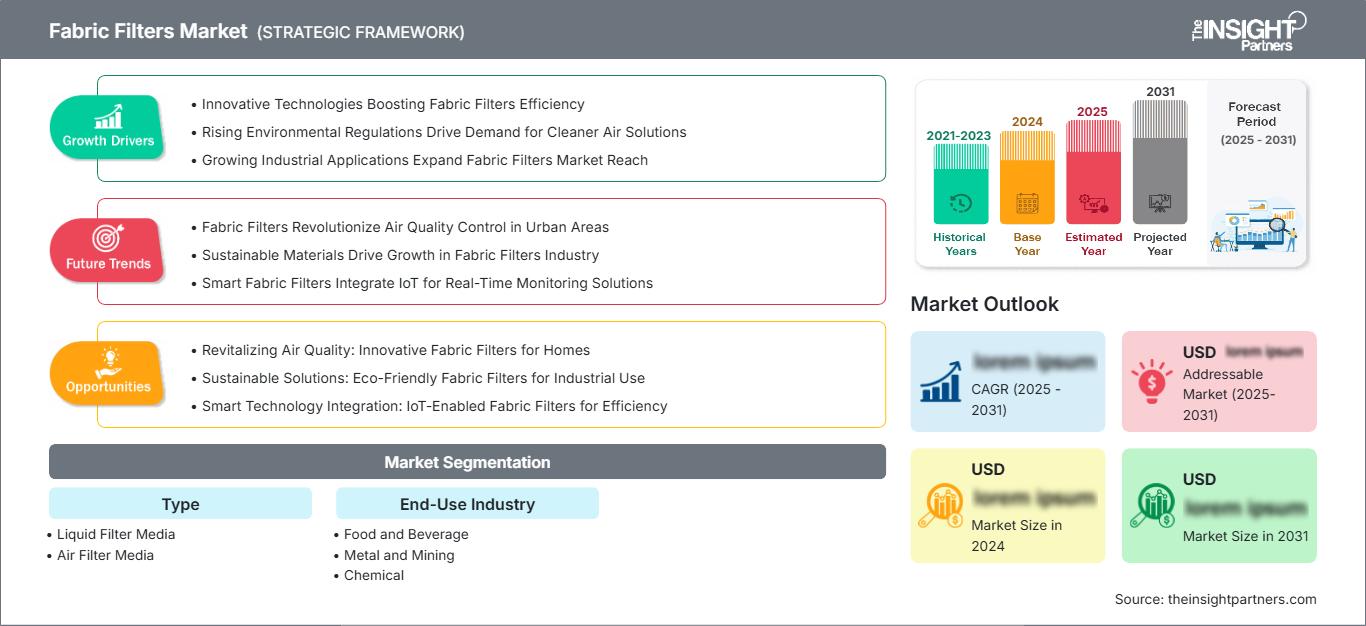
Fabric Filters Market: Strategic Insights
Regional Insights
North America Fabric Filters Market
The Fabric Filters Market share of North America's demand in 2025 is expected to be between 24% and 28%, with a CAGR of 3.4% and 4.0% until 2034. The presence of an advanced industrial base provides a robust replacement market, while emissions control regulations ensure ongoing use in power generation, metals, chemicals, food processing, and manufacturing. In North America, US industrial applications will be the primary drivers, whereas Canada will rely on its mining and resource industry segment.
Replacement cycles increasingly favor engineered media that offer low pressure drop and infrequent maintenance needs. Bags made from fine fibers, membrane treatments, and those designed for particular applications allow for extended service life where dust loading or particle sizes are challenging. Local manufacturers get the advantage of aftermarket opportunities since filter media need to be replaced regularly even though collection equipment stays in operation. Higher energy costs make the case more compelling for low resistance media.
U.S. Fabric Filters Market
The USA accounts for 74–78% of North America demand by 2025 and will experience growth in the range of 3.5–4.1% until 2034. The US status is due to the high level of industrial activity, particulate control regulations, and large installed base in the fields of power generation, chemical, food processing, pharmaceutical, metallurgy, and mining industries. Public environmental requirements constitute an important structural driver of demand.
Donaldson, American Fabric Filter, Camfil, and other manufacturers possess substantial application exposure within industrial dust collectors. Modern trends in demand include the increasing demand for compact collectors, specialized filters, nanofiber media, and monitoring systems. Applications in the pharmaceutical and food sectors put extra focus on contamination control and performance validation. Applications in the mining and metalworking sectors still require tough media, able to deal with abrasive dust and high particulate load.
Europe Fabric Filters Market
Europe accounts for about 23–27% of total global demand in 2025 and is expected to grow at a rate of 3.0–3.6% until 2034. Germany continues to dominate the top spot for national demand, buoyed by highly developed manufacturing, chemical, metals, pharmaceutical, and environmental engineering industries. The UK, France, Italy, and Spain contribute further demand through their industrial processing, food manufacturing, energy infrastructure, and particulate control equipment modernization.
The sophistication of the filtration supply chain and advanced industrial environmental standards in Germany make the country well-situated for high demand. France and Italy have a diversified range of process and food manufacturing demands, while Spain has its cement, metals, and energy sectors, which meet its industrial dust control demands. In addition, the UK brings its share through pharmaceuticals, food processing, chemicals, and industrial replacement. The buying behavior of European countries will increasingly be shaped by considerations such as lifecycle performance, energy use, recycling rates, and filters based on certain materials that are restricted.
APAC Fabric Filters Market
The APAC region represents an approximate 34–38% share in 2025 and will register growth of 4.0–4.8% up to 2034. In terms of regional consumption, China leads, followed by Japan, South Korea, India, and Australia. Application includes industry expansion, mining, metalworking, chemical processing, power generation, and food processing applications, whereas regional environmental policies increase particulate control specifications.
China's mass manufacturing offers the biggest consuming area, while India uses its industrial development along with air quality investments. The Japanese and Korean markets concentrate on filtering efficiency and reliability in advanced and process manufacturing, while the Australian market depends on mining and mineral processing operations. The manufacturers in the region find themselves competing through local manufacturing, customization, and low-cost nonwoven filter media, while the international competitors concentrate on engineering and distribution services.
Middle East & Africa Fabric Filters Market
Middle East and Africa demand is supported by energy-intensive industries, mining, cement, metals, chemicals, and infrastructure development. Saudi Arabia leads regional activity, followed by the UAE and South Africa. The region is estimated to grow at 3.0–3.8% through 2034 as industrial projects incorporate particulate-control equipment and replacement media.
The two countries of Saudi Arabia and the UAE benefit from investments in refining, petrochemicals, power and infrastructure while South Africa gives high demands for mining and metals. Rest of MEA operations have been majorly found in cement, minerals processing, power and industrial applications. Hot environments with abrasive dust and harsh working conditions make it favorable for tough filter media.
Segmentation Analysis
Type
Type segmentation comprises liquid filter media and air filter media. Air filtration remains the larger category because industrial dust collection represents a broad installed application base across power, metals, mining, chemicals, food processing, and pharmaceuticals. The type segment is expected to grow at a CAGR of 3.5–4.0% during 2026–2034, with performance increasingly determined by permeability, particle capture, cleaning behavior, and chemical resistance.
- Liquid Filter Media serve process-fluid, beverage, pharmaceutical, chemical, and water-related filtration requirements. Demand is shaped by purity specifications, contamination control, media compatibility, and the need for dependable separation during continuous processing operations.
- Air Filter Media represent the dominant application base because industrial facilities require particulate capture across dust-generating operations. Product selection increasingly emphasizes fine-particle efficiency, low pressure drop, durability, and compatibility with automated cleaning systems.
End-Use Industry
End-use demand spans food and beverage, metal and mining, chemical, pharmaceutical, and power generation. The segment is expected to advance at a CAGR of 3.6–4.2% during 2026–2034. Application requirements differ significantly by dust characteristics, operating temperature, regulatory exposure, product sensitivity, and process continuity, making technical media selection central to purchasing decisions.
- Food and Beverage users prioritize hygienic filtration, product protection, and reliable separation in processing environments. Demand is supported by beverage clarification, ingredient handling, grain processing, and dust control around dry materials.
- Metal and Mining operations require robust media for abrasive dust, high loading, crushing, grinding, smelting, and material handling. Durability, pulse-cleaning performance, and resistance to challenging particulates are central procurement criteria.
- Chemical facilities require media with controlled permeability and chemical resistance across diverse process conditions. Customized polymers, coatings, and membrane treatments can improve reliability where corrosive or reactive contaminants challenge conventional fabrics.
- Pharmaceutical facilities emphasize contamination containment, product recovery, validated filtration performance, and clean manufacturing conditions. High-value powders and stringent process controls support demand for specialized media and engineered collection systems.
- Power Generation remains a major application because combustion and material-handling processes generate significant particulate loads. Fabric filtration supports emissions control while replacement demand is influenced by operating hours, fuel characteristics, temperature, and maintenance cycles.
Opportunity Snapshot
| End-Use Industry | Revenue Contribution | Trend Tag | Adoption Stage |
| Food and Beverage | Medium | Hygienic Processing | Mature |
| Metal and Mining | High | Abrasive Dust | Mature |
| Chemical | High | Chemical Resistance | Scaling |
| Pharmaceutical | Medium | Containment Control | Scaling |
| Power Generation | High | Emission Control | Mature |
Fabric Filters Market Growth Drivers and Impact Analysis
Stricter particulate-emission and workplace-control requirements
Regulatory pressure is reinforcing investment in particulate-control systems across industrial facilities. Fabric filtration remains attractive where operators require high collection efficiency for fine particles and dependable compliance performance. The EPA identifies fabric filters as established control devices and notes that collection can exceed 99% under appropriate operating conditions. As regulators and plant operators focus on worker exposure, fugitive dust, and stack emissions, older systems increasingly require replacement, retrofit, or media upgrades. The commercial effect extends beyond new equipment because existing baghouses require recurring media replacement. Suppliers able to demonstrate stable pressure drop, cleaning efficiency, and service life can capture higher-value contracts. This driver particularly benefits metals, mining, chemicals, power generation, and food-processing facilities with persistent particulate loads.
Industrial modernization and demand for lower operating costs
Manufacturers are increasingly evaluating filtration equipment through total cost of ownership rather than initial purchase price. Lower pressure drop can reduce fan energy requirements, while improved cleaning characteristics can extend media life and reduce maintenance interruptions. Donaldson's filtration technologies illustrate this shift through designs intended to improve airflow management, cleaning performance, footprint, and filter utilization. The impact is strongest in continuous-process industries where filtration operates for long production cycles. Plants with constrained floor space are also favoring compact systems and higher-capacity media. As industrial operators modernize equipment, replacement projects can become opportunities for premium media suppliers to displace conventional fabrics. The resulting demand favors engineering-led differentiation, performance guarantees, application testing, and replacement programs rather than purely price-based competition.
Expansion of specialized processing and contamination-sensitive industries
Pharmaceutical, food, specialty chemical, and advanced manufacturing operations increasingly require filtration solutions tailored to contamination, hygiene, and material compatibility requirements. These applications can command higher technical specifications because filter performance directly affects product quality, process reliability, and worker protection. Pharmaceutical manufacturers, for example, may require controlled dust collection around weighing, compression, granulation, coating, and packaging operations. Donaldson's pharmaceutical portfolio illustrates the increasing use of application-specific collectors and media across these processes. The Fabric Filters Market impact extends to specialty nonwovens, membrane laminates, and chemically resistant fibers. Suppliers that can provide traceability, consistent media properties, and application engineering are positioned to gain share as regulated industries expand production capacity and modernize contamination-control infrastructure.
Fabric Filters Market Future Trends
Advanced media engineering and PFAS-conscious product development
Future Fabric Filters Market Trends is likely to emphasize engineered fiber structures, surface treatments, membrane laminates, and lower-impact chemistries. Manufacturers are progressively balancing filtration efficiency against pressure drop, service life, recyclability, and regulatory exposure. MANN+HUMMEL's transition toward intentionally added PFAS-free wet-laid media indicates how material chemistry is becoming a strategic design consideration rather than a compliance afterthought. Similar development efforts can encourage broader adoption of recycled fibers, bio-derived inputs, and optimized nonwoven architectures. Over time, procurement specifications are likely to incorporate lifecycle indicators alongside capture performance. This change can increase qualification requirements for suppliers while creating differentiation for companies with proprietary materials, testing capabilities, environmental documentation, and consistent manufacturing quality across multiple production locations.
Connected filtration and predictive replacement models
Digital monitoring is expected to move from optional equipment functionality toward a more integrated part of industrial filtration management. Sensors can track pressure differential, airflow, cleaning cycles, operating hours, and abnormal conditions, allowing maintenance teams to identify deterioration before production is affected. Donaldson's iCue connected filtration technology demonstrates how performance information can be integrated into monitoring and compliance workflows. Future systems can combine operating data with historical replacement records to estimate remaining media life and optimize service schedules. Such capabilities could reduce unnecessary replacements while limiting failures caused by delayed maintenance. Suppliers may increasingly bundle media, monitoring, service contracts, and analytics, shifting competitive positioning from individual filter sales toward recurring performance-management relationships.
Fabric Filters Market Opportunities
Localized high-performance media manufacturing
A major opportunity exists in developing regional manufacturing capacity for high-performance filter media close to industrial demand centers. Localized production can shorten lead times, reduce logistics exposure, and allow suppliers to customize fabrics for temperature, chemical resistance, particle loading, and cleaning requirements. Asia Pacific offers particularly attractive potential because of its large industrial base and expanding filtration demand. India can serve as a manufacturing and export platform because of its established textile and nonwoven capabilities, while China offers scale and proximity to major industrial customers. European and North American suppliers can complement regional production through specialty media, testing, and application engineering. Investment priorities should include needlepunched lines, membrane lamination, precision finishing, laboratory testing, and automated quality control to support technically differentiated products.
Aftermarket services and application-specific replacement programs
The recurring replacement nature of filter media creates an opportunity to develop structured aftermarket programs around inspection, performance testing, inventory planning, and scheduled replacement. Customers with large baghouse fleets can benefit from standardized media specifications combined with site-specific recommendations based on dust characteristics and operating conditions. Suppliers can use service contracts to improve customer retention while gaining data on filter life and failure modes. Digital pressure-drop monitoring can further support predictive replacement and inventory management. The opportunity in the Fabric Filters Market Forecast is particularly relevant in mining, metals, chemicals, food processing, and power generation, where unplanned filtration failures can disrupt production. Companies that combine replacement media with technical audits and maintenance support can build recurring revenue streams and differentiate themselves from low-cost fabric suppliers.
Recent Developments
- February 2026: Donaldson Company, Inc. announced an agreement to acquire Filtration Group's Facet Filtration business for approximately US$820 million. The transaction is intended to broaden Donaldson's fuel and fluid filtration portfolio and strengthen exposure to aerospace, defense, power generation, and other durable filtration applications. The acquisition also adds a substantial installed base and recurring consumables exposure.
- May 2026: MANN+HUMMEL announced the launch of a Global Technology & Innovation Center in Tumkur, Karnataka, reinforcing its global technology and growth strategy. The facility expands the company's innovation infrastructure in India and supports development activities associated with its broader filtration portfolio. The company has simultaneously increased focus on sustainable filtration, energy efficiency, and system-based solutions across its Life Sciences & Environment business.
Frequently Asked Questions

- Comprehensive Market Sizing and Forecast Analysis
- Detailed Segmentation Analysis
- In-Depth Market Dynamics Assessment
- Regional and Country-Level Insights
- Competitive Landscape and Company Benchmarking
- Strategic Business Intelligence
Recent Reports
Testimonials

The Insight Partners' SCADA System Market report is comprehensive, with valuable insights on current trends and future forecasts. The team was highly professional, responsive, and supportive throughout. We are very satisfied and highly recommend their services.
RAN KEDEM Partner, Reali Technologies LTDs
I requested a report on a very specific software market and the team produced the report in a few days. The information was very relevant and well presented. I then requested some changes and additions to the report. The team was again very responsive and I got the final report in less than a week.
JEAN-HERVE JENN Chairman, Future Analytica
We worked with The Insight Partners for an important market study and forecast. They gave us clear insights into opportunities and risks, which helped shape our plans. Their research was easy to use and based on solid data. It helped us make smart, confident decisions. We highly recommend them.
PIYUSH NAGPAL Sr. Vice President, High Beam Global
The Insight Partners delivered insightful, well-structured market research with strong domain expertise. Their team was professional and responsive throughout. The user-friendly website made accessing industry reports seamless. We highly recommend them for reliable, high-quality research services
YUKIHIKO ADACHI CEO, Deep Blue, LLC.
This is the first time I have purchased a market report from The Insight Partners.While I was unsure at first, I visited their web site and felt more comfortable to take the risk and purchase a market report.I am completely satisfied with the quality of the report and customer service. I had several questions and comments with the initial report, but after a couple of dialogs over email with their analyst I believe I have a report that I can use as input to our strategic planning process.Thank you so much for taking the extra time and making this a positive experience.I will definitely recommend your service to others and you will be my first call when we need further market data.
JOHN SUZUKI President and Chief Executive Officer, Board Director, BK Technologies
I wish to appreciate your support and the professionalism you displayed in the course of attending to my request for information regarding to infectious disease IVD market in Nigeria. I appreciate your patience, your guidance, and the fact that you were willing to offer a discount, which eventually made it possible for us to close a deal. I look forward to engaging The Insight Partners in the future, all thanks to the impression you have created in me as a result of this first encounter.
DR CHIJIOKE ONYIA MANAGING DIRECTOR, PineCrest Healthcare Ltd.Reason to Buy
- Informed Decision-Making
- Understanding Market Dynamics
- Competitive Analysis
- Identifying Emerging Markets
- Customer Insights
- Market Forecasts
- Risk Mitigation
- Boosting Operational Efficiency
- Strategic Planning
- Investment Justification
- Tracking Industry Innovations
- Aligning with Regulatory Trends





 Get Free Sample for