
Fast Food Packaging Market Share, Trends & Demand Outlook 2034
Coverage: By Packaging Type (Paper and Paperboard Packaging, Plastic Packaging, Metal Packaging, and Others), Product Type (Boxes and Containers, Wraps and Films, Cups and Lids, Trays and Plates, Pouches and Bags, and Others), Application (Quick Service Restaurants, Street Food and Food Trucks, Food Delivery Services, Institutional Catering, and Others), and Geography (North America, Europe, Asia Pacific, the Middle East and Africa, and South and Central America)
- Status : Data Released
- Report Code : TIPRE00044100
- Category : Chemicals and Materials
- No. of Pages : 369
- Available Report Formats :


- Last update date : November 05, 2026


2025 Market Size
US$ 122.06 Bn
Base year value
2034 Forecast
US$ 196.25 Bn
Projected by 2034
CAGR 2026-2034
5.4 %
Growth rate
Addressable Market
US$ 1,442.17 Bn
(2026-2034)
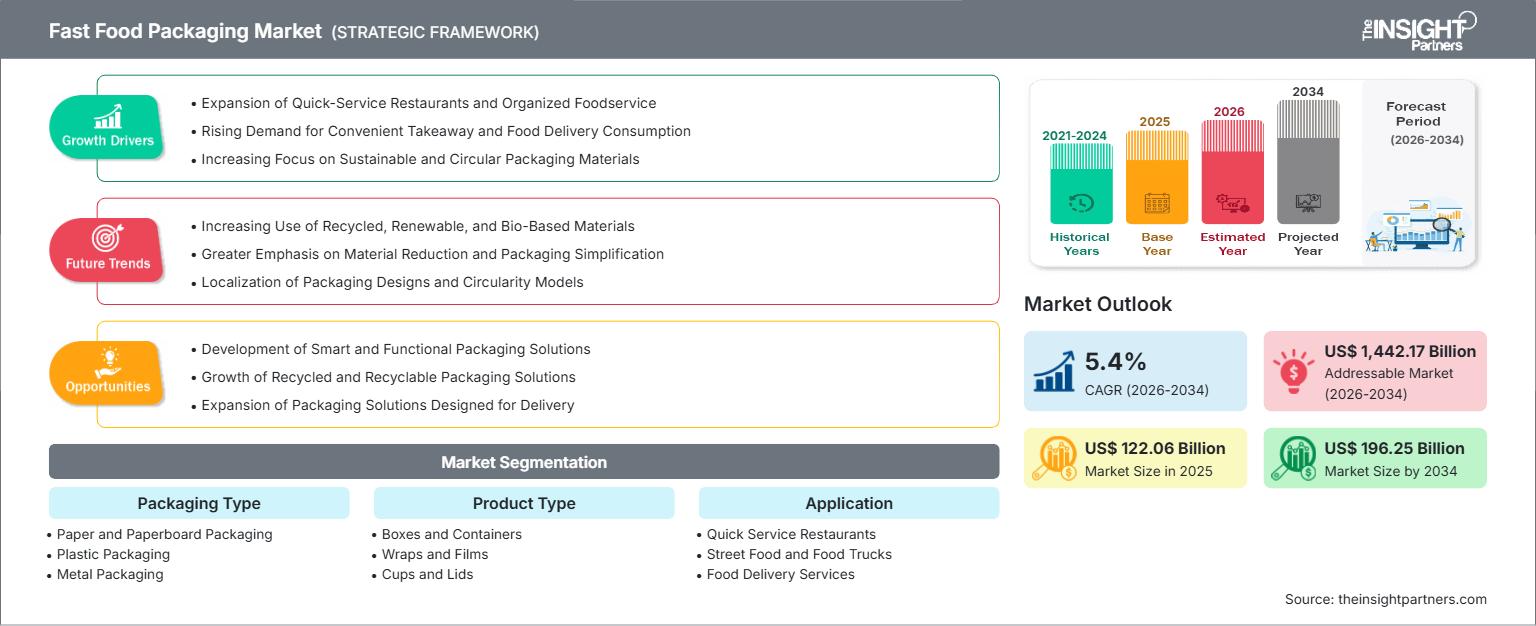
The Fast Food Packaging Market was valued at US$ 122.06 billion in 2025 and is projected to reach US$ 196.25 billion by 2034, registering a CAGR of 5.40% during 2026–2034. Market expansion is supported by the increasing consumption of takeaway meals, the growth of quick service restaurants, the expansion of online food delivery, and demand for packaging that preserves food quality during transportation. Material innovation, packaging customization, operational efficiency, and sustainability requirements are also influencing purchasing decisions across the global foodservice industry.
North America remains an important market for fast food packaging, supported by established quick service restaurant networks, widespread drive-through services, strong takeaway consumption, and mature food distribution infrastructure. The region's Fast Food Packaging Market size is ~5% CAGR through 2034. Restaurant chains require consistent packaging specifications across locations, while delivery platforms increase the need for secure containers, dependable closures, and packaging that withstands transportation. Investments in recyclable materials, lightweight designs, and customized foodservice products are also shaping supplier strategies as restaurant operators balance cost control, customer experience, and environmental objectives.
Fast Food Packaging Market Assessment and Insights
Regional Outlook
- North America: ~32% of the global market in 2025 | ~5% CAGR through 2034. Market position: North America is the largest regional market in this modeled assessment. Established restaurant chains, high takeaway activity, developed packaging supply networks, and demand for standardized foodservice products support its position.
- US: ~75% of North American market revenue in 2025 | ~5% CAGR through 2034. Market position: The United States anchors regional demand through extensive limited-service restaurant operations, drive-through consumption, and established food delivery channels. Its large commercial foodservice ecosystem supports recurring demand for beverage cups, lids, containers, and transport packaging.
- Europe: ~25% of the global market in 2025 | ~5% CAGR through 2034. Market position: Europe is a mature market with established restaurant networks and a strong emphasis on packaging compliance, recycling, and material efficiency. The UK, Germany, France, Italy, and Spain represent important national markets.
- Asia Pacific: ~30% of the global market in 2025 | ~7% CAGR through 2034. Market position: Asia Pacific is the fastest-growing region in this modeled assessment. Expanding urban foodservice, growing online meal ordering, restaurant-chain development, and rising demand for convenient meals support regional expansion, particularly in China and India.
Segment Outlook
- Plastic Packaging: ~42% share in 2025 | ~5% CAGR through 2034. Market position: Plastic packaging leads the packaging type segment because of its versatility, moisture resistance, lightweight construction, and suitability for high-volume beverage and prepared-food applications.
- Cups and Lids: ~24% share in 2025 | ~6% CAGR through 2034. Market position: Cups and lids benefit from recurring demand across beverage service, takeaway outlets, and quick service restaurants. Growth is supported by portable beverage consumption, delivery requirements, and innovation in reusable and recyclable formats.
Competitive Coverage
Huhtamaki Oyj, Duni AB, Graphic Packaging Holding Co, Novolex Holdings LLC, Dart Container Corp, Sealed Air Corp, Sabert Corp, Genpak LLC, Berry Global Group, Inc, Smurfit Westrock plc, Amcor plc, Anchor Packaging LLC, Winpak Ltd, Mondi plc, Stora Enso Oyj, ProAmpac
Methodology
The Insight Partners follows Data Collection & Secondary Research, Primary Research, Data Analysis, and Data Triangulation & Final Review to validate market estimates and insights.
Source: The Insight Partners' analysis based on proprietary research, government publications, company annual reports, investor presentations, industry databases, and expert interviews.
Restaurant packaging has transformed itself from simple packaging and disposable food serving utensils to become a part of restaurant logistics, display, and overall consumer experience. Restaurant format evolution, the growth of takeaway services, and the use of online ordering systems have raised the stakes regarding packaging effectiveness after sales. Material attributes, sealing strength, print quality, stackability, and handling have become key elements of competition among producers. Plastic is still widely employed due to its versatile performance capabilities, but fiber packaging and better materials continue to offer options to restaurants that are looking for alternatives in particular applications.
Until 2034, there will be a need for investments in packaging that will combine food protection with reduced material consumption and recycling capabilities, as well as compatibility with the work of commercial food service companies. There are new markets that will provide the chance for such investments as a result of the growing number of restaurants and delivery services, but local affordability, waste management infrastructure, and material availability will have an impact on the acceptance of innovations. Legislative shifts related to packaging waste and single-use products might speed up the process of product redesign, especially in Europe and certain countries.
Fast Food Packaging Market Report Scope
| Report Attribute | Details |
|---|---|
| Market size in 2025 | US$ 122.06 Billion |
| Market Size by 2034 | US$ 196.25 Billion |
| Global CAGR (2026 - 2034) | 5.4% |
| Historical Data | 2021-2024 |
| Forecast period | 2026-2034 |
Fast Food Packaging Market Analysis
The growth in the Fast Food Packaging Market can be attributed to the volume of transactions and the rising importance of takeaways and deliveries in the restaurant industry. Demand for packaging arises when meals, drinks, and side orders have to be packaged, safeguarded, moved around, and delivered. QSRs are key since they involve standardized menus and efficient order processing systems that produce repeat demand for packaging in uniform ways. The need for deliveries leads to a need for anti-spill, closure, partitioning, and handling resistant packaging solutions. The above considerations determine the nature of packaging and present opportunities to offer coordinated product packages rather than standalone packaging solutions.
The value chain consists of producers of the raw materials, resin providers and paper providers, converters, printers, formers, distributors, buying agents from restaurants, and food service firms. The price of resins, availability of pulp, cost of energy, cost of transportation, and conversion efficiency affect the margins for the suppliers as well as the prices that the customers pay. While the big chains may emphasize specifications, dependability of supplies, and size of purchases, small restaurants may emphasize cost and availability of supplies.
The industry has competition between diversified packaging companies and those that specialize in the food service and takeout applications. Huhtamaki Oyj and Duni AB specialize in food service offerings, whereas Graphic Packaging Holding Co and Smurfit Westrock plc provide paper packaging solutions. Foodservice packaging solutions for diverse needs include Novolex Holdings LLC, Dart Container Corp, Genpak LLC, Sabert Corp, and Anchor Packaging LLC. Amcor plc, Berry Global Group, Inc, Sealed Air Corp, Winpak Ltd, Mondi plc, Stora Enso Oyj, and ProAmpac compete on the basis of materials technology and packaging formats.
The priorities for investment will be capacity utilization, new product innovation, automation of production processes, improved barrier properties, and packaging that is compatible with advanced systems of waste collection and recycling. The position in the market is contingent upon the ability to fulfill customer needs cost-effectively in volume without sacrificing price and performance. Cooperation with fast-food restaurant chains in testing packaging under realistic conditions is another priority for suppliers. Both acquisitions and R&D may enable the firms to adapt to changing regulations and consumer demands.
● REPORT CUSTOMIZATION
Tailor This Report To Align With Your Specific Business Requirements
This report can be customized to align precisely with your business objectives, scope, and target markets. Customization options include tailored segmentation, geography, competitive analysis, and strategic insights to support informed decision-making.
Customize This Report →WHAT YOU CAN ADJUST
- ● Segmentations
- ● Geography
- ● Competitive Analysis
- ● Language Preferences
Fast Food Packaging Market: Strategic Insights
Regional Insights
North America fast food packaging market
North America forms the largest regional Fast Food Packaging Market Share for this forecasted analysis and holds a share of nearly 32% in 2025 along with a growth rate of nearly 5% up to 2034. Quick service restaurants in this region, well-established distribution channels, and high demand for takeaway meals ensure repeated demand for packaging material. The US forms the major market for consumption while Canada forms a part through the activities related to restaurants, institutional foodservices, and convenient meal packages. Mexico is also considered as a viable market with development of organized foodservices and delivery channels.
Restaurants in this region are now focusing on packaging material considering the aspects of cost, food safety, transportability, and environment compliances together. According to the report of US Department of Agriculture, the food-away-from-home expenditure for the year 2024 has reached up to $1.27 trillion in the US. This measure includes a larger scope of food services compared to fast food, and hence, forms a demand measurement instead of a revenue measure for the packaging material. The packaging material vendors can leverage on this large demand base to design customer specific products and logistics agreements.
U.S. fast food packaging market
The United States makes up about ~75% share of fast food packaging market share within North America in 2025, expected to grow at a CAGR of ~5% until 2034. The country’s dominance stems from its considerable limited-service restaurants industry, developed drive-through facilities, and extensive delivery and takeaway offerings. Chain restaurants need packaging specifications which have to be consistent in geographically distributed locations, generating the need for suppliers with reliable manufacturing, distribution, and quality control processes. Beverage services and prepared meals represent ongoing sources of packaging purchases.
The competition has shifted to service performance of the packaging. Amcor plc provides rigid and flexible packaging services, whereas Graphic Packaging Holding Co produces paperboard packaging formats for food service and beverages. Novolex Holdings LLC and Dart Container Corp manufacture food service packaging products. Leak-proofing, temperature control, stacking capabilities, branding and disposal ease are evaluated by operators together with cost. Food away from home spending in the US grew to US$ 1.27 trillion in 2024, demonstrating the extent of the commercial foodservice channel, however not suggesting all of them are fast food related.
Europe fast food packaging market
Europe comprises about 25% of worldwide fast food packaging revenue in 2025 and is expected to grow at a CAGR of around 5% up to 2034. Market trends are characterized by well-established restaurants, developed packaging conversion infrastructure, as well as recyclability and materials' efficiency considerations. Germany is considered the largest country in Europe according to this regional model, thanks to the strong manufacturing base and well-established food and packaging industries. The UK and France are also significant markets due to the development of restaurant infrastructure and takeaway culture, as well as developed retail and foodservice chains.
The manufacturing system in Germany leads to the creation of demand for new types of packaging, and in the British market, there are opportunities for creating packaging for takeaway drinks, ready-to-eat meals, and deliveries. There are established foodservice demands and packaging and environmental regulations in France. The contribution of Italy and Spain comes from the use of the restaurant, café, tourism and street food concepts where packaging will need to cover the diversity of menu and seasonality.
Regulatory changes are affecting the specification for purchases. The Packaging and Packaging Waste Directive from the European Union is putting more emphasis on recyclability, waste management, and packaging design. The commercial implications vary for each application because the grease resistance, moisture barrier, food safety and protection requirements remain important. The opportunity for the suppliers is to show the performance of the material and to help the customers to adjust packaging specifications. Adoption of the alternatives will be affected by collection and processing facilities as well as compatibility with restaurant operations.
APAC fast food packaging market
Asia Pacific accounts for an estimated ~30% of global fast food packaging revenue in 2025 and is projected to record a CAGR of ~7% through 2034, making it the fastest-growing region in this assessment. China is the leading country in Asia Pacific in the modeled regional assessment, supported by its extensive manufacturing ecosystem, large urban consumer base, and established food delivery activity. India provides additional growth potential as organized quick service restaurants expand into new cities and delivery services reach more consumers. Japan and South Korea have established convenience-food and restaurant markets, while Australia contributes through developed takeaway and café channels.
Regional growth is characterized not only by increasing demand in foodservice packaging, but also by the need to have packaging that is adaptable to local conditions. It is advantageous for manufacturers to be located near the converters, resin, paper suppliers and large restaurant clients. Waste management policies and packaging recovery are also having an impact on material choices, even though regulatory measures vary in each country. Suppliers should consider competing prices, functionality for food contact, durability during transport and local facilities for recovery.
Middle East & Africa fast food packaging market
The Middle East and Africa region is projected to register a CAGR of ~6% through 2034. Saudi Arabia and the United Arab Emirates represent important Middle Eastern markets because of established urban foodservice activity, tourism, hospitality investment, and demand for convenient meals. South Africa provides an important market in the African region through organized restaurant operations and developed retail and distribution infrastructure. Saudi Arabia is identified as the leading country in the Middle East & Africa in this modeled assessment, reflecting its substantial foodservice investment and expanding hospitality ecosystem.
The factors affecting packaging costs in the area include energy availability, raw materials imports, transport infrastructure, and converting facilities. In the Gulf markets, the warm weather makes the stability of the package, its ability to remain sealed, and protection during transportation critical factors. In South Africa and other markets on the continent, cost, distribution capability, and availability of materials are crucial procurement considerations. The Rest of MEA encompasses varied markets with differing regulatory environments and recovery infrastructures. Packaging suppliers able to adjust their products and supplies according to local requirements may have opportunities as restaurants grow their networks.
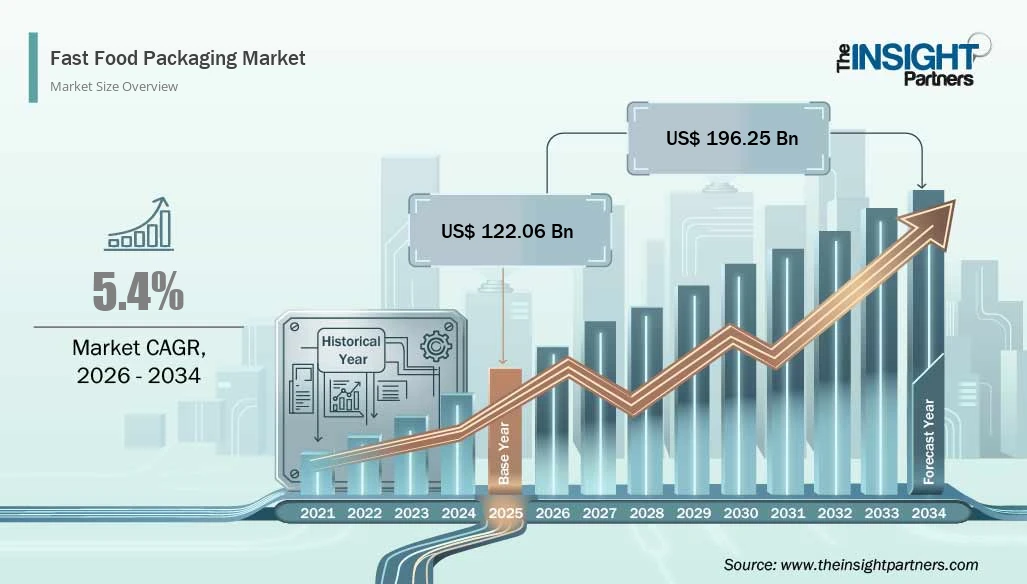
Segmentation Analysis
Packaging Type
Packaging type influences procurement cost, food protection, operational efficiency, and environmental performance across foodservice operations. Plastic packaging holds the largest position in the category because it provides functional flexibility and can be produced in formats suited to different foods and beverages. The segment's modeled outlook reflects continued demand from high-volume restaurant operations alongside gradual material substitution where alternatives meet technical and economic requirements. Within this category, paper and paperboard packaging is expected to benefit from material redesign and circularity initiatives, with a modeled sub-segment CAGR of ~6% through 2034.
- Paper and Paperboard Packaging: Used for food cartons, beverage cups, bags, and selected takeaway containers, paper-based packaging supports printing, branding, and fiber recovery where appropriate infrastructure exists. Barrier treatments remain important for managing grease, moisture, and hot food.
- Plastic Packaging: This category serves applications requiring lightweight construction, moisture resistance, durability, and flexible design. Its established processing infrastructure supports high-volume supply, although recyclability, material use, and compliance requirements influence product development.
- Metal Packaging: Metal formats serve selected foodservice requirements where strength, rigidity, or specific barrier properties are important. Their role depends on application suitability and cost, as many fast food products favor lighter and more easily handled formats.
- Others: Other materials and specialized combinations serve niche requirements where conventional formats do not provide the required performance. Adoption depends on food-contact suitability, commercial availability, disposal conditions, and compatibility with existing restaurant workflows.
Product Type
Product type determines how packaging supports portioning, serving, transport, and food presentation. Demand is shaped by menu composition, beverage sales, order volumes, and the operating procedures of foodservice customers. Cups and lids hold the largest position because they serve recurring beverage transactions and require reliable compatibility between components. The category's modeled outlook reflects takeaway beverage consumption and continued demand for improved closure and material performance. Within the product type segment, cups and lids are projected to register a CAGR of ~6% through 2034.
- Boxes and Containers: These products accommodate burgers, combination meals, fried foods, and other prepared items. Structural integrity, heat tolerance, compartment design, and stacking performance influence their suitability for takeaway and delivery orders.
- Wraps and Films: Wraps and films provide flexible coverage for sandwiches, burgers, and other menu items. Their value lies in compact storage, efficient wrapping, and the ability to help retain product condition during short handling and transport periods.
- Cups and Lids: These formats support hot and cold beverages across restaurants, cafés, and takeaway outlets. Lid fit, drinking convenience, leak prevention, insulation, and compatibility with filling equipment are important purchasing considerations.
- Trays and Plates: Trays and plates facilitate serving, portion separation, and food presentation. They are relevant to dine-in, takeaway, catering, and selected delivery applications where stability and ease of handling influence customer experience.
- Pouches and Bags: Pouches and bags support portable food items, snacks, side dishes, and order consolidation. Their lightweight construction and storage efficiency make them useful where space, speed of service, and carrying convenience matter.
- Others: Other product formats address specialized serving and handling needs that do not fit the main categories. Demand depends on menu innovation, customer-specific specifications, and compatibility with food preparation and distribution processes.
Application
The application segment reflects the diverse requirements of commercial foodservice operators, including packaging durability, portion control, food protection, portability, and cost efficiency. Quick service restaurants represent the leading application because standardized menus and high transaction volumes generate recurring packaging requirements. Demand is also supported by the expansion of takeaway ordering, delivery platforms, and organized foodservice operations. Packaging suppliers must accommodate different handling conditions and procurement priorities across applications. Quick service restaurants are projected to register a modeled CAGR of ~6% through 2034, supported by restaurant network expansion and continued demand for convenient meal formats.
- Quick Service Restaurants: These establishments require standardized packaging for burgers, sandwiches, fries, beverages, and combination meals. Consistent product quality, efficient order assembly, branding, and dependable bulk supply influence procurement decisions across restaurant chains.
- Street Food and Food Trucks: These businesses prioritize portable, lightweight, and affordable packaging suited to rapid service and compact operating environments. Product selection depends on menu variety, ease of handling, storage constraints, and customer convenience.
- Food Delivery Services: Delivery-oriented packaging must protect food during transportation and reduce leakage, spillage, and damage. Secure closures, compartmentalized designs, and compatibility with delivery bags help maintain food presentation and customer satisfaction.
- Institutional Catering: Institutional catering requires packaging suitable for portioning, meal distribution, organized foodservice, and bulk handling. Purchasing decisions emphasize food hygiene, operational consistency, storage efficiency, and compatibility with institutional service procedures.
- Others: Other applications include specialized foodservice operations and prepared-food businesses with distinct packaging requirements. Demand varies according to service formats, food characteristics, customer expectations, and the availability of suitable packaging solutions.
Opportunity Snapshot
| Application | Revenue Contribution | Trend Tag | Adoption Stage |
| Quick Service Restaurants | High | Standardized Packaging | Mature |
| Street Food and Food Trucks | Medium | Portable Formats | Scaling |
| Food Delivery Services | High | Transit Protection | Scaling |
| Institutional Catering | Medium | Portion Control | Mature |
| Others | Low | Specialized Service | Emerging |
Fast Food Packaging Market Growth Drivers and Impact Analysis
Expansion of Quick Service Restaurant Networks
The expansion of quick service restaurant networks supports recurring demand for packaging designed around standardized menus, predictable portion sizes, and rapid order fulfillment. Multi-location operators require consistent specifications, dependable delivery schedules, and products that can be integrated into established preparation routines. These requirements favor manufacturers capable of supplying large volumes while maintaining quality across production batches. New restaurant openings also create demand for coordinated packaging procurement, including food containers, beverage-serving products, bags, and protective inserts. For packaging suppliers, growth in restaurant networks can improve capacity utilization and support longer-term supply relationships. However, competitive tenders and centralized procurement place pressure on pricing, making manufacturing efficiency and product consistency important differentiators. Suppliers that can meet volume commitments while accommodating local menu variations are better positioned to serve expanding restaurant groups.
Increasing Dependence on Takeaway and Delivery Channels
Takeaway and delivery operations increase the importance of packaging as a protective layer between food preparation and consumption. Unlike meals served immediately at a table, transported orders can experience temperature changes, movement, stacking, and repeated handling. Packaging failure may result in leakage, damaged presentation, customer complaints, and replacement costs. Restaurant operators consequently assess container strength, closure reliability, compartment separation, and suitability for different menu items. Food delivery services also require practical bagging systems and packaging that supports accurate order assembly. These requirements create opportunities for suppliers to develop application-specific formats and test packaging under representative transport conditions. Commercial success depends on delivering sufficient protection without adding unnecessary material or cost. Effective packaging can therefore contribute to service reliability and customer retention, rather than functioning solely as a disposable serving item.
Material Cost Management and Operational Standardization
Packaging expenditure is a recurring operating cost for restaurants, making material efficiency and supply reliability central to purchasing decisions. Changes in resin, pulp, energy, conversion, and transportation costs can affect supplier pricing and restaurant margins. Operators often seek formats that stack efficiently, fit storage areas, work with existing dispensing equipment, and reduce assembly time during busy service periods. Standardized packaging specifications can simplify purchasing across locations and reduce the complexity of inventory management. Manufacturers respond through production optimization, material reduction, process automation, and coordinated product portfolios. These improvements can reduce waste and support more predictable supply, although excessively lightweight designs must still meet food protection and handling requirements. Suppliers that demonstrate measurable operational value alongside competitive pricing can strengthen customer relationships and improve their position in contract-based procurement.
Fast Food Packaging Market Future Trends
Recyclability-Centered Design and Material Simplification
The Fast Food Packaging Market trends are increasingly shaped by the need to reconcile food protection with recyclability and changing packaging regulations. Manufacturers are likely to place greater emphasis on material structures that are easier to identify, separate, and process through suitable recovery systems. This may encourage the development of mono-material flexible packaging, fiber-based formats with functional barriers, and products designed to reduce unnecessary components. The transition is technically demanding because grease, moisture, heat, and leakage resistance remain essential in foodservice applications. Packaging designers must evaluate the entire product system, including coatings, inks, adhesives, closures, and available collection infrastructure. Restaurant chains may increasingly assess suppliers against material specifications and recovery compatibility, while converters will need to demonstrate that redesigned products retain acceptable performance and commercial viability.
Packaging Performance Testing and Data-Enabled Specification
Packaging development is likely to become more closely connected with structured performance testing and digital product specifications. Restaurant operators managing broad delivery networks need packaging that performs consistently across different menu items, transport conditions, and preparation environments. Manufacturers can use standardized testing to assess compression strength, leakage, thermal performance, closure integrity, and compatibility with food types. Digital specification management can help purchasing teams compare products, maintain approved supplier lists, and track changes in materials or manufacturing processes. Better coordination between packaging designers, restaurant operations teams, and delivery partners may reduce product failures and unnecessary redesign. As customers demand evidence of both functional performance and environmental attributes, suppliers with reliable technical documentation and repeatable quality-control processes may gain a competitive advantage in procurement decisions.
Fast Food Packaging Market Opportunities
Developing Application-Specific Sustainable Packaging Portfolios
Packaging suppliers have an opportunity to expand portfolios that address customer sustainability requirements without sacrificing food protection or operational efficiency. Investment can focus on fiber-based formats, recyclable designs, improved barrier systems, and reusable solutions where collection and return logistics are practical. The strongest commercial opportunities are likely to emerge where redesigned packaging can meet existing filling, stacking, storage, and serving requirements with minimal operational disruption. Manufacturers should evaluate product economics alongside local waste-management infrastructure and customer procurement priorities. Collaboration with restaurant chains can help validate new formats before broader commercialization. A disciplined approach to testing, production scale-up, and customer education can reduce adoption barriers. These initiatives also create opportunities to differentiate products through documented performance, material transparency, and compatibility with relevant recovery systems.
Expanding Manufacturing and Distribution in Emerging Foodservice Markets
Asia Pacific and selected Middle Eastern markets provide opportunities for manufacturers to establish local converting capacity, strengthen distribution partnerships, and customize products for regional foodservice requirements. Investment decisions should account for restaurant expansion, raw material access, import dependence, logistics costs, and the capabilities of local suppliers. Regional production can reduce delivery lead times and help customers manage inventory, particularly where high-volume operators need consistent packaging availability. Suppliers can also develop product portfolios that accommodate local menu preferences, climate conditions, and price sensitivity. The commercial opportunity is not limited to new factories; partnerships with converters, distributors, and restaurant procurement teams may provide lower-risk routes to market. The Fast Food Packaging Market Forecasts depend partly on how effectively suppliers translate expanding foodservice demand into viable local manufacturing and distribution models.
Recent Developments
- October 2026: Novolex Holdings LLC announced the opening of an Applied Innovation Center in Roanoke, Texas. The facility is designed to help customers evaluate packaging options under realistic operating conditions, bringing product testing and technical guidance closer to foodservice and other packaging applications. The development highlights the importance of performance validation as customers balance material selection, cost, and sustainability requirements.
- October 2025: Graphic Packaging Holding Co received the QSR/FPI Foodservice Packaging Awards' Innovation in Convenience recognition for a two-cell drink insert developed for American Dairy Queen Corporation. The paperboard insert is designed to stabilize beverage cups during transport, improve order handling, and support curbside recyclability. The format also ships flat and is designed for quick assembly, addressing space efficiency and workflow requirements in high-volume foodservice operations.
Frequently Asked Questions

- Comprehensive Market Sizing and Forecast Analysis
- Detailed Segmentation Analysis
- In-Depth Market Dynamics Assessment
- Regional and Country-Level Insights
- Competitive Landscape and Company Benchmarking
- Strategic Business Intelligence
Recent Reports
Testimonials

The Insight Partners provided valuable market intelligence that supported our global go-to-market strategy. Their team was professional, responsive, and attentive to our feedback, providing thoughtful analysis and helpful methodological clarifications throughout the project.
Junmo Kim Chief Financial Officer (CFO), Enertech Co., Ltd.
The Insight Partners' SCADA System Market report is comprehensive, with valuable insights on current trends and future forecasts. The team was highly professional, responsive, and supportive throughout. We are very satisfied and highly recommend their services.
RAN KEDEM Partner, Reali Technologies LTDs
I requested a report on a very specific software market and the team produced the report in a few days. The information was very relevant and well presented. I then requested some changes and additions to the report. The team was again very responsive and I got the final report in less than a week.
JEAN-HERVE JENN Chairman, Future Analytica
We worked with The Insight Partners for an important market study and forecast. They gave us clear insights into opportunities and risks, which helped shape our plans. Their research was easy to use and based on solid data. It helped us make smart, confident decisions. We highly recommend them.
PIYUSH NAGPAL Sr. Vice President, High Beam Global
The Insight Partners delivered insightful, well-structured market research with strong domain expertise. Their team was professional and responsive throughout. The user-friendly website made accessing industry reports seamless. We highly recommend them for reliable, high-quality research services
YUKIHIKO ADACHI CEO, Deep Blue, LLC.
This is the first time I have purchased a market report from The Insight Partners.While I was unsure at first, I visited their web site and felt more comfortable to take the risk and purchase a market report.I am completely satisfied with the quality of the report and customer service. I had several questions and comments with the initial report, but after a couple of dialogs over email with their analyst I believe I have a report that I can use as input to our strategic planning process.Thank you so much for taking the extra time and making this a positive experience.I will definitely recommend your service to others and you will be my first call when we need further market data.
JOHN SUZUKI President and Chief Executive Officer, Board Director, BK Technologies
I wish to appreciate your support and the professionalism you displayed in the course of attending to my request for information regarding to infectious disease IVD market in Nigeria. I appreciate your patience, your guidance, and the fact that you were willing to offer a discount, which eventually made it possible for us to close a deal. I look forward to engaging The Insight Partners in the future, all thanks to the impression you have created in me as a result of this first encounter.
DR CHIJIOKE ONYIA MANAGING DIRECTOR, PineCrest Healthcare Ltd.Reason to Buy
- Informed Decision-Making
- Understanding Market Dynamics
- Competitive Analysis
- Identifying Emerging Markets
- Customer Insights
- Market Forecasts
- Risk Mitigation
- Boosting Operational Efficiency
- Strategic Planning
- Investment Justification
- Tracking Industry Innovations
- Aligning with Regulatory Trends





 Get Free Sample for