
Flame Retardants for Aerospace Plastics Market Growth, Size & Forecast by 2034
Coverage: by Product (Aluminum Hydroxide, Phosphorous); Application (Polyolefins, Epoxy Resin, UPE, PVC), and Geography (North America, Europe, Asia Pacific, and South and Central America)
- Status : Data Released
- Report Code : TIPRE00013379
- Category : Chemicals and Materials
- No. of Pages : 150
- Available Report Formats :


- Last update date : October 30, 2026


2025 Market Size
US$ 36.09 Mn
Base year value
2034 Forecast
US$ 67.42 Mn
Projected by 2034
CAGR 2026-2034
7.19 %
Growth rate
Addressable Market
US$ 467.04 Mn
(2026-2034)
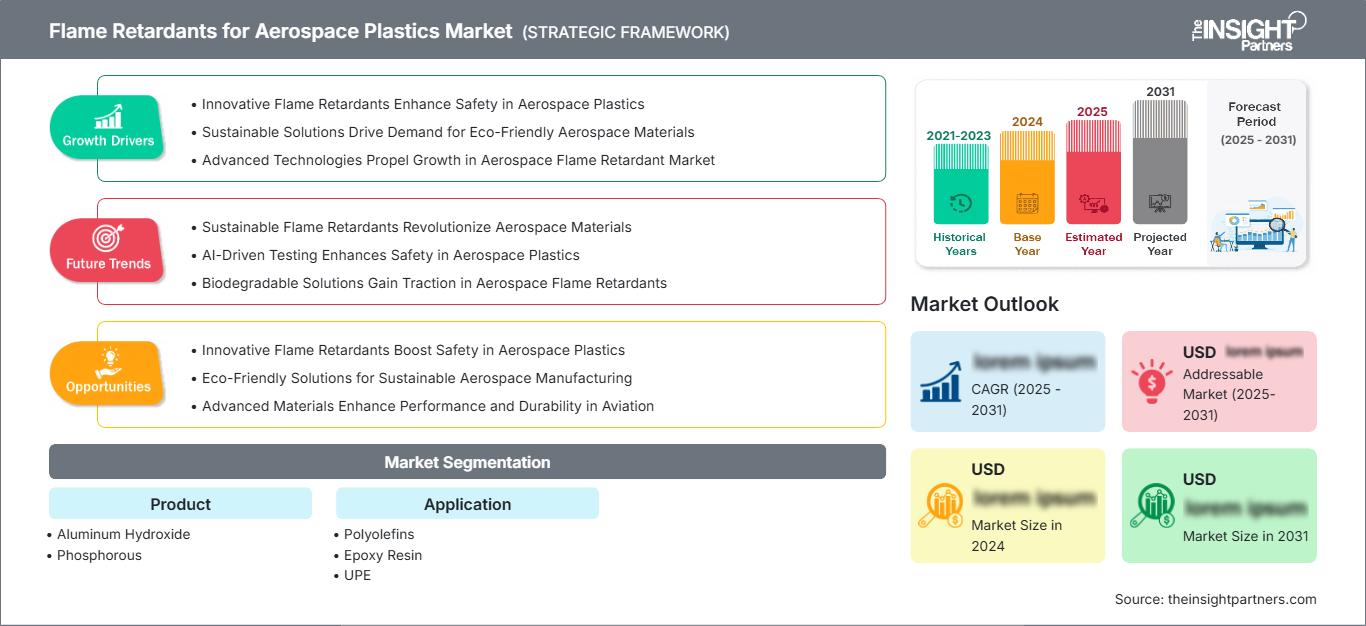
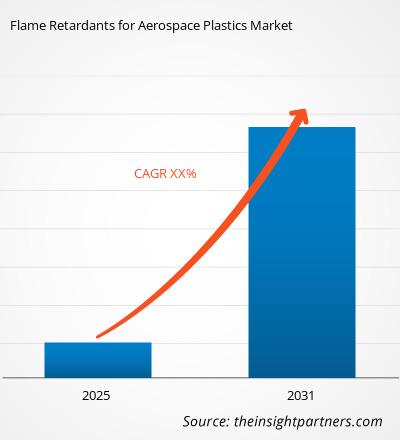
The Flame retardants for aerospace plastics market was valued at US$ 36.09 Million in 2025 and is projected to reach US$ 67.42 Million by 2034, expanding at a CAGR of 7.19% from 2026 to 2034. The market covers flame-retardant materials used in aerospace plastic systems, with the supplied scope segmented by Product into Aluminum Hydroxide and Phosphorous, and by Application into Polyolefins, Epoxy Resin, UPE, and PVC.
North America remains an important demand center because aerospace-grade plastics require stringent fire, smoke, and material-performance characteristics. The regional flame retardants for aerospace plastics market size is estimated to expand at a CAGR of ~6% through 2034, supported by aircraft production, aftermarket cabin refurbishment, and continued qualification of lightweight polymeric components for aerospace applications.
Flame Retardants for Aerospace Plastics Market Assessment and Insights
Regional Outlook
- North America: ~31% of the global market in 2025 | ~6% CAGR through 2034. Market position: North America represents a major aerospace materials market, supported by established aircraft manufacturing, extensive MRO activity, stringent certification requirements, and continued use of engineered plastics in cabin, electrical, insulation, and structural-adjacent applications.
- US: ~86% of North American market revenue in 2025 | ~6% CAGR through 2034. Market position: The US accounts for most North American demand because of its large aerospace manufacturing and MRO ecosystem. Material qualification, aircraft interiors, electrical components, and lightweight polymer substitution sustain demand for compliant flame-retardant formulations.
- Europe: ~34% of the global market in 2025 | ~6% CAGR through 2034. Market position: Europe has a mature aerospace materials ecosystem led by France and Germany, with the UK, Italy, and Spain contributing through aircraft manufacturing, component production, interiors, and maintenance activities. Regulatory emphasis supports qualified low-smoke formulations.
- Asia Pacific: ~29% of the global market in 2025 | ~9% CAGR through 2034. Market position: Asia Pacific is the fastest-growing region, supported by expanding commercial aviation, aerospace manufacturing localization, and rising polymer consumption. China leads the regional market, while Japan, South Korea, India, and Australia contribute through aircraft production and component supply chains.
Segment Outlook
- Aluminum Hydroxide: ~58% Share in 2025 | ~6% CAGR through 2034. Market position: Aluminum Hydroxide leads because it combines halogen-free flame retardancy, smoke suppression, relatively established processing routes, and compatibility with selected thermoset and thermoplastic systems. Its established supply base supports use where formulation economics and fire performance must be balanced.
- Phosphorous: ~42% Share in 2025 | ~9% CAGR through 2034. Market position: Phosphorous-based systems have a higher growth trajectory as formulators seek efficient flame retardancy at lower additive loading and greater compatibility with high-performance polymers. Their ability to support compact, lightweight components strengthens adoption in demanding aerospace applications.
Competitive Coverage
Albemarle, BASF, Clariant Corporation, DIC Corporation, Huber Advanced Materials, Italmatch Chemicals, LANXESS, Nabaltec AG, RTP Company, Solvay
Methodology
The Insight Partners follows Data Collection & Secondary Research, Primary Research, Data Analysis, and Data Triangulation & Final Review to validate market estimates and insights.
Source: The Insight Partners' analysis based on proprietary research, government publications, company annual reports, investor presentations, industry databases, and expert interviews.
There has been a continuous move from aerospace plastics towards lightweight engineering polymers, thermoset, composite, film, foam, and resin types that may help to reduce the weight of components while maintaining their thermal, mechanical, electrical, and chemical properties. This has made it necessary for additive packages, which provide fire retardancy without significantly affecting processability and weight of components, to become an essential part of the market. Hence, the flame retardants for aerospace plastics market represents the balance between qualification requirements of aircrafts and the economic aspects of polymer formulation.
In the future, the demand is predicted to grow due to the growth in aircraft production in Asia Pacific regions and geographical diversification of aerospace supply chains. It is expected that qualification of new polymer grades will still be the main business challenge, and regulation will drive the suppliers to develop low emission and halogen-free solutions. Thus, it is likely that there will be higher investments in formulation, application, certification, and local technical support. The suppliers who possess a wide compatibility with polymers and can work with aerospace qualification programs will be able to benefit from the opportunities created by aircraft production and interior modernization.
Flame Retardants for Aerospace Plastics Market Report Scope
| Report Attribute | Details |
|---|---|
| Market size in 2025 | US$ 36.09 Million |
| Market Size by 2034 | US$ 67.42 Million |
| Global CAGR (2026 - 2034) | 7.19% |
| Historical Data | 2021-2024 |
| Forecast period | 2026-2034 |
Flame Retardants for Aerospace Plastics Market Analysis
A relationship between the demand structure and the aerospace application of plastics for cabin interiors, electrical and electronic parts, insulating materials, ducts, panels, fittings, and other applications where low weight must be combined with stringent fire performance requirements exists. In aerospace certification there is a focus on flame spread, heat release, and smoke properties than in most conventional plastic applications. Additive selection is therefore a formulation issue and not a commodity decision. Consequently, demand is skewed towards grades that can meet desired specifications without being heavily loaded and losing mechanical properties.
The supply chain consists of aluminum hydroxide and phosphorus chemicals, additives and specialty chemicals manufacturers, plastic compounders, resin producers, component makers, aircraft providers, and the aircraft OEM qualification programs. Factors that determine the supply dynamics include the availability of chemicals feedstocks, specialty production capacity, technical support, and qualification continuity. The market therefore faces minimal exposure to volume-based competition than the general purpose flame retardant plastics market. It is essential to note that changes in additive chemistry will need validation for qualification in aerospace materials system.
As per the flame retardants for aerospace plastics market report, competition exists across the global specialty chemical firms as well as specialist flame-retardants firms. Albemarle offers know-how for polymeric flame retardant technologies, whereas Clariant Corporation and LANXESS are players in a wide range of phosphorus additives and other types. Huber Advanced Materials and Nabaltec AG offer aluminum hydroxide technologies, and Italmatch Chemicals offers significant know-how for phosphorus chemistries. BASF and DIC Corporation are engaged through engineering polymers and compounding know-how, while RTP Company offers custom flame retardant compounds. Solvay plays through high performance aerospace polymers and technology developments.
Investments are being made increasingly into efficiency of formulations, halogen free technologies, localization of productions, and technical qualifications. Positioning of suppliers is thus affected not only by production capacities. Being closer to aerospace compounders, having contacts with component manufacturers, having access to formulation laboratories and certification assistance, may help improve the customer base retention. The investments into capacity building for flame retardants production of Clariant Corporation and the portfolio development of LANXESS are good examples of sustainable and technically differentiated additive systems which are currently developed in the industry.
● REPORT CUSTOMIZATION
Tailor This Report To Align With Your Specific Business Requirements
This report can be customized to align precisely with your business objectives, scope, and target markets. Customization options include tailored segmentation, geography, competitive analysis, and strategic insights to support informed decision-making.
Customize This Report →WHAT YOU CAN ADJUST
- ● Segmentations
- ● Geography
- ● Competitive Analysis
- ● Language Preferences
Flame Retardants for Aerospace Plastics Market: Strategic Insights
Regional Insights
North America Flame retardants for aerospace plastics market
In 2025, North America had ~31% Flame retardants for aerospace plastics market share, which is predicted to grow at a CAGR of ~6% till 2034. North America enjoys a favorable environment in terms of presence of aircraft manufacturing industry, aerospace tier suppliers, MRO facilities, and advanced system of polymer qualification. US serves as the primary demand center, whereas Canada plays its part through aerospace manufacturing and special component manufacturing.
North American market is influenced by stringent fire performance properties requirement for aircraft interior and components. There is an increasing need for material suppliers to deliver consistent properties in terms of flame, smoke, and toxicity performance along with mechanical and processability properties. RTP Company offers flame retardant plastics catering to the needs of low heat, smoke, and flame spread applications such as aerospace applications. Halogen free aluminum hydroxide solutions for demanding polymer and composite applications are provided by Huber Advanced Materials.
U.S. Flame retardants for aerospace plastics market
The United States accounted for ~86% of the North American revenues in 2025, and its market is projected to expand at a CAGR of ~6% through 2034. The dominance of the US market can be attributed to the presence of aircraft OEMs, aerospace component manufacturers, MRO services companies, and specialized materials vendors. Applications range from interior fittings, electrical installations, insulators, ducts, structural-adjacent polymer parts, and specialist engineered plastics.
The choice of aerospace materials in the United States is heavily impacted by certifications and qualifications. The US-based companies like Albemarle, RTP Company, Huber Advanced Materials, and Solvay operate in adjacent flame retardant or high performance polymers ecosystems. The mix of applications is increasingly widening due to substitution of some metal or traditional systems by lightweight polymer systems.
Europe Flame retardants for aerospace plastics market
Europe represented ~34% of the global market in 2025 and is estimated to expand at a CAGR of ~6% through 2034. France is the leading country in Europe because of its extensive aerospace manufacturing ecosystem and concentration of aircraft, engine, systems, and component activity. Germany is another major center, supported by aerospace manufacturing, engineering, and specialty chemical capabilities. The UK contributes through aircraft systems, engines, components, and MRO, while Italy and Spain maintain important aerospace production and supplier networks.
There is considerable importance to material compliance, smoke performance, environmental aspects, and supply chain traceability within the European market. This creates a conducive environment for the development of halogen-free and phosphorus-based materials together with aluminum hydroxide materials. Halogen-free flame retardants and aluminum hydroxide are produced by companies such as Clariant Corporation and LANXESS respectively. Meanwhile, Italmatch Chemicals has experience with phosphorus-based flame retardants. Market growth in this case will be driven by aircraft production and regulations in the wider European chemical industry.
Competition in the European market will revolve around formulating more efficient products that are environmentally sustainable and backed by adequate technical documents. In addition, there is constant replacement and refurbishing need in the matured aircraft industry in Europe. This creates a foundation for the flame retardants for aerospace plastics market despite the varying cycles of aircraft production.
APAC Flame retardants for aerospace plastics market
Asia-Pacific held around 29% share of the global market in 2025 and is expected to register a CAGR of about 9% during 2026-2034, which makes it the most rapidly growing region. China leads the Asia-Pacific region, driven by the growing aviation ecosystem, industrial manufacturing industry, and aerospace localization. Japan and South Korea contribute via advanced manufacturing and specialty materials whereas India is benefitted by the growing commercial aviation and aerospace manufacturing activities. Australia is still relevant through aerospace services and special applications.
Drivers behind regional growth include expansion of aircraft fleet size, component manufacturing localization, and growing demand for lightweight engineering plastics. The combination of domestic aerospace investment and global supply chain participation is likely to drive material qualification and technical capabilities at local level. Suppliers who can offer consistently performing flame retardant performance and application engineering can capitalize on the growing regional ecosystem.
Middle East & Africa Flame retardants for aerospace plastics market
The Middle East & Africa market is estimated to expand at a CAGR of ~7% through 2034. Saudi Arabia and the UAE represent important demand centers in the Middle East because of aviation infrastructure investment, airline fleet development, airport expansion, and aerospace services. South Africa provides a comparatively established aerospace and defense manufacturing base, while the rest of MEA contributes through aviation infrastructure, maintenance, and emerging component activity.
The region's demand is closely connected to aircraft fleet modernization, MRO expansion, airport infrastructure, and the increasing importance of localized aerospace services. Flame-retardant plastics can benefit from interior refurbishment and component replacement cycles where lightweight materials must comply with aviation safety requirements. Supplier participation is likely to remain concentrated around international chemical companies and regional distributors with technical support capabilities.
Segmentation Analysis
Product
Product segment in the Flame retardants for aerospace plastics market represents the chemical technology dimension of the market, with Aluminum Hydroxide and Phosphorous forming the supplied product categories. The Product segment is estimated to grow at a CAGR of ~7% from 2026 to 2034. Adoption depends on polymer compatibility, required flame performance, smoke behavior, loading efficiency, processing temperature, environmental requirements, and the qualification status of individual formulations. Aerospace applications generally favor technically validated grades over simple low-cost substitution.
- Aluminum Hydroxide: Aluminum Hydroxide occupies a substantial position where halogen-free flame retardancy and smoke suppression are important. Its established technology base, relatively predictable behavior, and availability in differentiated particle-size grades support incorporation into selected thermoset and polymer systems used for demanding applications.
- Phosphorous: Phosphorous technologies are increasingly important for high-performance plastics where efficient flame retardancy and lower additive loading can preserve mechanical and processing properties. Their strategic importance rises as aerospace designers seek lightweight components and suppliers develop halogen-free systems compatible with advanced engineering polymers.
Application
Application segment in the Flame retardants for aerospace plastics market covers Polyolefins, Epoxy Resin, UPE, and PVC. The Application segment is estimated to expand at a CAGR of ~7% from 2026 to 2034. Demand differs according to polymer chemistry, processing temperature, component geometry, certification requirements, and the required balance between fire resistance and mechanical performance. Application-specific formulation expertise remains important because the same additive does not provide identical results across polymer systems.
- Polyolefins: Polyolefins provide lightweight and versatile polymer platforms, making flame-retardant formulations relevant for selected aerospace interiors, insulation-related components, and engineered applications. Adoption depends on achieving required fire performance while retaining processing efficiency, mechanical properties, and acceptable additive loading.
- Epoxy Resin: Epoxy systems are strategically important for aerospace composites, adhesives, coatings, and structural-adjacent applications. Flame-retardant technologies must preserve resin performance and composite integrity while meeting demanding fire requirements, creating opportunities for phosphorus-based and synergistic systems with strong compatibility.
- UPE: Unsaturated polyester resin supports selected composite and molded applications where cost, processability, and fire performance must be balanced. Flame retardants that maintain resin flow, cure behavior, surface quality, and mechanical characteristics are particularly relevant to aerospace component manufacturers.
- PVC: PVC remains relevant for selected aerospace cables, coverings, insulation-related products, and specialized flexible applications. Flame-retardant selection emphasizes smoke behavior, flexibility, thermal stability, and processing compatibility, with phosphorus-based technologies offering opportunities where halogen-free or lower-emission formulations are prioritized.
Opportunity Snapshot
| Application | Revenue Contribution | Trend Tag | Adoption Stage |
|---|---|---|---|
| Polyolefins | High | Lightweight Plastics | Scaling |
| Epoxy Resin | High | Composite Integration | Mature |
| UPE | Medium | Composite Molding | Scaling |
| PVC | Medium | Cable Safety | Mature |
Flame Retardants for Aerospace Plastics Market Growth Drivers and Impact Analysis
Expansion of Commercial Aircraft Production and Fleet Replacement
Increasing aircraft production and replacement of older aircraft create a direct downstream requirement for qualified lightweight materials. Aircraft manufacturers continue to pursue weight reduction because lower component mass can support fuel and operating-efficiency objectives. Plastics are therefore used across an expanding set of interior, electrical, insulation, ducting, and equipment applications, but these materials must meet stringent fire-performance requirements. The resulting demand is not simply proportional to polymer consumption because each new material system requires an appropriate fire-safety strategy. As aircraft programs increase production rates, qualified flame-retardant formulations can gain recurring demand from both original equipment and replacement channels. The effect is particularly relevant for compounders and additive suppliers capable of maintaining consistent quality across long aerospace qualification cycles.
Stringent Fire, Smoke, and Toxicity Requirements for Cabin Materials
Aerospace certification requirements create a structural demand mechanism for flame-retardant technologies. Aircraft cabin materials are subject to prescribed flammability testing, while selected interior components must also satisfy heat-release and smoke-emission requirements. This raises the technical threshold for plastic formulations and limits the applicability of unqualified commodity additives. Suppliers therefore compete on the ability to deliver a complete performance profile rather than only flame resistance. Low smoke, controlled flame propagation, thermal stability, mechanical retention, and compatibility with production processes can determine whether a formulation advances through qualification. The requirement for documented and repeatable performance also increases switching costs after a material has been validated, supporting longer customer relationships for suppliers with established aerospace-grade technologies.
Transition Toward Lightweight and Halogen-Free Material Systems
The movement toward lightweight materials is creating demand for flame-retardant technologies that do not undermine the advantages of advanced plastics. Aerospace designers increasingly evaluate material systems according to weight, fire performance, smoke generation, environmental profile, processing requirements, and lifecycle considerations together. Halogen-free aluminum hydroxide and phosphorus technologies can address some of these requirements, although the appropriate chemistry depends strongly on the polymer and component design. Suppliers that improve additive efficiency can help compounders reduce loading while retaining required fire performance and mechanical properties. This creates a product-development pathway based on performance optimization rather than simple substitution. The resulting market opportunity extends across new aircraft programs, cabin upgrades, component redesign, and the broader adoption of engineered plastics.
Flame Retardants for Aerospace Plastics Market Future Trends
Higher-Efficiency Flame-Retardant Formulations
Future formulation development is likely to emphasize higher efficiency at lower additive concentrations. Aerospace plastics place unusual importance on weight, dimensional stability, mechanical retention, and long-term durability, so excessive flame-retardant loading can create unacceptable trade-offs. Suppliers are consequently expected to pursue synergistic formulations in which phosphorus compounds, mineral additives, polymer architectures, and processing conditions work together to improve fire performance. Advanced particle engineering for aluminum hydroxide and more thermally stable phosphorus chemistries can also expand compatibility with higher-temperature polymers. This direction could gradually shift competition from broad chemical availability toward application-specific formulation engineering. Compounders and aerospace material developers are likely to place greater value on additives that provide repeatable performance across thin sections and complex component geometries.
Integration of Sustainability Into Aerospace Material Qualification
Sustainability considerations are expected to become increasingly integrated into material selection alongside conventional aerospace performance requirements. Suppliers are developing halogen-free technologies, recycled-content-compatible formulations, and chemistries designed to reduce undesirable emissions while retaining fire protection. However, sustainability claims alone will not determine adoption because aerospace qualification remains performance-driven. Future materials will therefore need to demonstrate an integrated profile covering fire safety, smoke behavior, durability, processability, environmental characteristics, and supply continuity. This flame retardants for aerospace plastics market trend favors suppliers that can support testing and qualification rather than merely provide an additive. Over time, environmental requirements may also influence preferred feedstocks, manufacturing processes, and end-of-life considerations for aerospace plastic components.
Flame Retardants for Aerospace Plastics Market Opportunities
Localized Technical Support in Asia Pacific
Asia Pacific Flame retardants for aerospace plastics market offers an opportunity for suppliers to establish closer technical relationships with aircraft component manufacturers, compounders, and aerospace supply-chain participants. Regional aircraft production and aviation activity are expanding, but material qualification remains technically demanding. Local application laboratories, formulation support, and certification assistance can reduce development friction and improve customer engagement. China, India, Japan, and South Korea each present different combinations of aerospace manufacturing, electronics, specialty plastics, and industrial capabilities, creating scope for localized product strategies. Suppliers can also strengthen resilience by developing regional inventory and technical-service networks rather than relying exclusively on long-distance supply. Investment in these capabilities can support market access where customers increasingly expect rapid formulation assistance and reliable supply.
Premium Flame-Retardant Grades for Advanced Aerospace Polymers
Premium grades designed for high-performance polymers and demanding component geometries add to the Flame retardants for aerospace plastics market forecast. Aerospace designers increasingly use polymers where thermal stability, low moisture absorption, electrical performance, chemical resistance, and mechanical strength are required simultaneously. Flame retardants must therefore operate within narrower formulation windows than in conventional plastics. Development of high-efficiency phosphorus systems, engineered aluminum hydroxide grades, and synergistic additive packages can create differentiated products for these applications. Suppliers can pursue this opportunity through co-development with compounders and aerospace component manufacturers, supported by application testing and qualification data. Such strategies can shift value capture toward specialty formulations with technical barriers rather than standardized flame-retardant commodities.
Recent Developments
- December 2025: Symphony Environmental campaigned that flame-retardant plastic is essential for fire safety. Standard plastic components used by the construction and electronics industries are a major factor in the rapid spread of fires in residential and commercial buildings. D2p flame-retardant technology is key to reducing the threat of fire and meeting safety-compliance, which will go on to stop billions in property damage and tragic loss of life.
- August 2025: There is growing concern about the environmental impact generated by key industrial sectors, especially in areas such as construction and mobility, where achieving materials with good mechanical performance, lighter weight, and greater fire resistance plays a crucial role. In this context, AIMPLAS, the Plastics Technology Centre, worked on two projects funded by the Valencian Institute for Competitiveness and Innovation (IVACE+i), with support from the European Regional Development Fund (ERDF), to sustainably develop new flame-retardant coatings and composite materials that enhance safety in homes and transportation.
Frequently Asked Questions

- Comprehensive Market Sizing and Forecast Analysis
- Detailed Segmentation Analysis
- In-Depth Market Dynamics Assessment
- Regional and Country-Level Insights
- Competitive Landscape and Company Benchmarking
- Strategic Business Intelligence
Recent Reports
Testimonials

The Insight Partners provided valuable market intelligence that supported our global go-to-market strategy. Their team was professional, responsive, and attentive to our feedback, providing thoughtful analysis and helpful methodological clarifications throughout the project.
Junmo Kim Chief Financial Officer (CFO), Enertech Co., Ltd.
The Insight Partners' SCADA System Market report is comprehensive, with valuable insights on current trends and future forecasts. The team was highly professional, responsive, and supportive throughout. We are very satisfied and highly recommend their services.
RAN KEDEM Partner, Reali Technologies LTDs
I requested a report on a very specific software market and the team produced the report in a few days. The information was very relevant and well presented. I then requested some changes and additions to the report. The team was again very responsive and I got the final report in less than a week.
JEAN-HERVE JENN Chairman, Future Analytica
We worked with The Insight Partners for an important market study and forecast. They gave us clear insights into opportunities and risks, which helped shape our plans. Their research was easy to use and based on solid data. It helped us make smart, confident decisions. We highly recommend them.
PIYUSH NAGPAL Sr. Vice President, High Beam Global
The Insight Partners delivered insightful, well-structured market research with strong domain expertise. Their team was professional and responsive throughout. The user-friendly website made accessing industry reports seamless. We highly recommend them for reliable, high-quality research services
YUKIHIKO ADACHI CEO, Deep Blue, LLC.
This is the first time I have purchased a market report from The Insight Partners.While I was unsure at first, I visited their web site and felt more comfortable to take the risk and purchase a market report.I am completely satisfied with the quality of the report and customer service. I had several questions and comments with the initial report, but after a couple of dialogs over email with their analyst I believe I have a report that I can use as input to our strategic planning process.Thank you so much for taking the extra time and making this a positive experience.I will definitely recommend your service to others and you will be my first call when we need further market data.
JOHN SUZUKI President and Chief Executive Officer, Board Director, BK Technologies
I wish to appreciate your support and the professionalism you displayed in the course of attending to my request for information regarding to infectious disease IVD market in Nigeria. I appreciate your patience, your guidance, and the fact that you were willing to offer a discount, which eventually made it possible for us to close a deal. I look forward to engaging The Insight Partners in the future, all thanks to the impression you have created in me as a result of this first encounter.
DR CHIJIOKE ONYIA MANAGING DIRECTOR, PineCrest Healthcare Ltd.Reason to Buy
- Informed Decision-Making
- Understanding Market Dynamics
- Competitive Analysis
- Identifying Emerging Markets
- Customer Insights
- Market Forecasts
- Risk Mitigation
- Boosting Operational Efficiency
- Strategic Planning
- Investment Justification
- Tracking Industry Innovations
- Aligning with Regulatory Trends





 Get Free Sample for