
Gesture Recognition For Smart TV Market Size, Share & Forecast by 2034
Gesture Recognition For Smart TV Market Size and Forecasts (2021–2034), Global and Regional Share, Trends, and Growth Opportunity Analysis Report Coverage : By Software (2D & 3D Image Sensor), Hardware(Image Sensor, IR Proximity Sensor, IR Temperature Sensor, Light Sensors, & Semiconductor ICS)
- Status : Data Released
- Report Code : TIPRE00039441
- Category : Electronics and Semiconductor
- No. of Pages : 150
- Available Report Formats :


- Last update date : August 17, 2026


2025 Market Size
US$ 927.87 Mn
Base year value
2034 Forecast
US$ 10,678.08 Mn
Projected by 2034
CAGR 2026-2034
31.19 %
Growth rate
Addressable Market
US$ 41,021.30 Mn
(2026-2034)
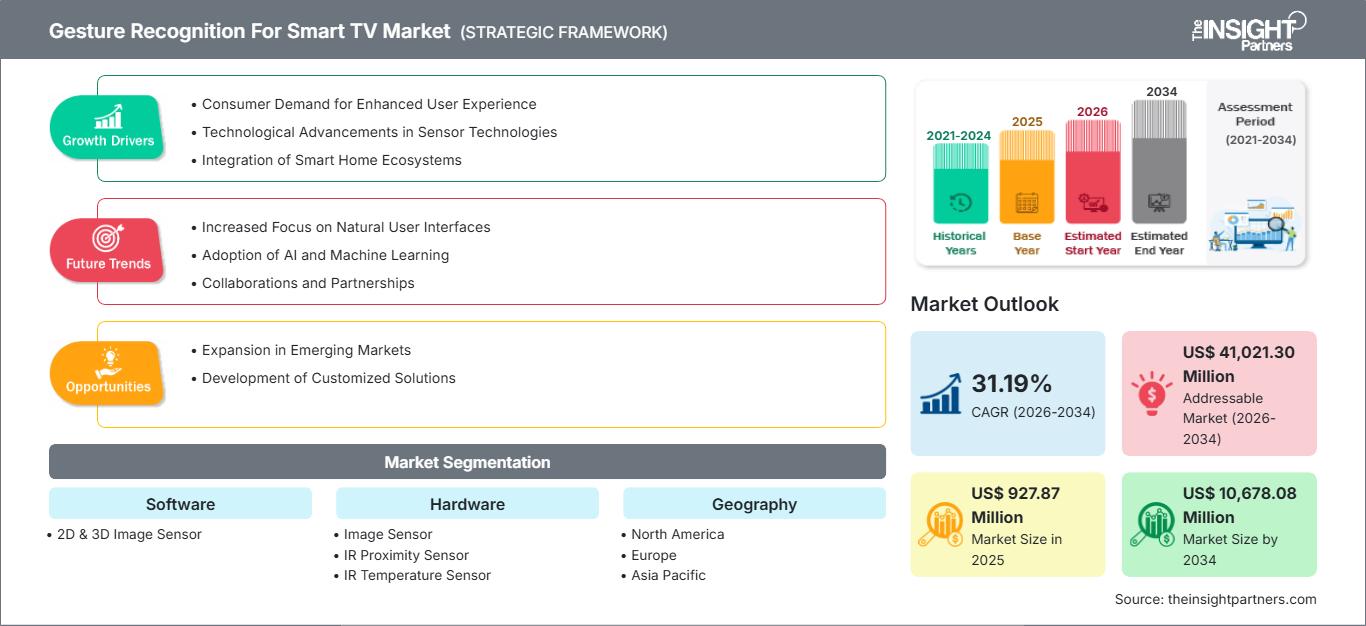
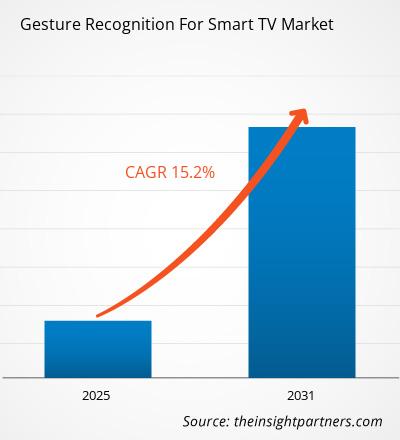
The Gesture Recognition for Smart TV Market was valued at US$ 927.87 Million in 2025 and is projected to reach US$ 10,678.08 Million by 2034, registering a compound annual growth rate (CAGR) of 3.19% from 2026 to 2034. This growth trajectory reflects the increasing integration of gesture-based control interfaces in next-generation smart television systems. The market benefits from advancements in 3D image sensing, infrared proximity detection, and artificial intelligence algorithms that enable intuitive, touchless user interactions with television displays.
North America is estimated to account for approximately 24–28% of the global Gesture Recognition for Smart TV Market size in 2025, growing at a CAGR of 2–4% over the forecast period. The region's market position is supported by high smart TV penetration rates, early adoption of advanced user interface technologies, and substantial investments in AI-powered consumer electronics. The United States leads regional demand, with major technology companies and consumer electronics manufacturers driving innovation in gesture control solutions.
Gesture Recognition For Smart TV Market Assessment and Insights
- North America: North America holds a significant share of 24–28% in the mMarket in 2025, driven by high smart TV adoption and consumer demand for intuitive interfaces. The region is projected to grow at a CAGR of 2–4% from 2026 to 2034.
- US: The US accounts for approximately 80–85% of the North American Market in 2025, growing at a CAGR of 2–4% through 2034, driven by technology innovation and early adoption of AI-powered TV interfaces.
- Europe: Europe holds a market share of 20–24% in 2025, with Germany, the UK, and France leading adoption. The region is projected to grow at a CAGR of 3–5% from 2026 to 2034, supported by strong consumer electronics sectors and smart home adoption.
- Asia Pacific: Asia Pacific dominates the global Market with a share of 42–46% in 2025, growing at a CAGR of 4–6% through 2034. China, Japan, South Korea, and India are leading the regional expansion, driven by massive smart TV production and consumer demand.
- Largest Segment (Hardware): Hardware represents the largest component segment in 2025 with a market share of 55–60%, driven by demand for image sensors, IR proximity sensors, and semiconductor ICs essential for gesture detection.
- High Growth Segment (Software): Software is the fastest-growing component segment in 2025 with a market share of 40–45%, projected to grow at a CAGR of 4–6% through 2034, driven by AI algorithm development and 2D/3D image processing advancements.
- Key companies analyzed in detail: Eyesight Technologies Ltd., Leap Motion, Inc., LG Electronics Inc., Panasonic Holdings Corporation, PointGrab Ltd., Samsung Electronics Co., Ltd., SoftKinetic SA, Sony Group Corporation, Tesna Inc., Texas Instruments Incorporated.
Source: The Insight Partners' analysis based on proprietary research, government publications, company annual reports, investor presentations, industry databases, and expert interviews.
The Gesture Recognition for Smart TV Market has come a long way from being an experimental form of basic motion detection technology to becoming highly advanced artificial intelligence based interaction platforms. Technical developments in time-of-flight sensors, stereo vision cameras, and deep learning algorithms have allowed accurate and quick interpretation of complex hand gestures and movements. In addition, the incorporation of dedicated neural processing units in smart TV processors has increased the speed of gesture processing, minimizing reliance on cloud-based computing. At the same time, the creation of universal gesture recognition standards and platforms has contributed to easier implementation for various smart TVs and operating systems.
In the future, the market gowth is expected to continue steadily as a result of the emergence of new applications in the areas of gaming, virtual fitness and smart home devices control. As for platforms, AI enabled televisions equipped with cameras and sensors provide a natural environment for integrating the gesture recognition into the television sets. Regulations that support accessibility and inclusiveness have driven manufacturers to introduce touchless control technologies.
Gesture Recognition For Smart TV Market Report Scope
| Report Attribute | Details |
|---|---|
| Market size in 2025 | US$ 927.87 Million |
| Market Size by 2034 | US$ 10,678.08 Million |
| Global CAGR (2026 - 2034) | 31.19% |
| Historical Data | 2021-2024 |
| Forecast period | 2026-2034 |
Gesture Recognition For Smart TV Market Analysis
The market growth is fueled by several demand factors that are interrelated with one another and drive the market’s development in one direction. The rising trend towards touchless interfaces has turned gesture recognition into one of the main points of differentiation in the highly competitive smart TV industry. Smart TV producers include gesture control technologies into their products to enable users to operate with hand movements such as changing channels, volume adjustment, and menu navigation. The rise of AI-based smart TVs that utilize computer vision and machine learning to provide personalized video recommendation services creates additional opportunity for gesture recognition technology implementation. The gaming and fitness industries are promising areas where gesture-controlled content becomes popular among health-conscious individuals and casual game players.
The competitive environment within the Gesture Recognition for Smart TV Market Report consists of established consumer electronic companies, gesture recognition software solution providers, and semiconductor companies. Consumer electronics companies, including Samsung Electronics Co., Ltd., LG Electronics Inc., and Sony Group Corporation, provide expertise in the design of smart TVs, integration of sensors, and development of AI algorithms. Partnerships and acquisitions are becoming prevalent in order to incorporate gesture recognition technologies into complete smart TV solutions. Increasing levels of investments demonstrate optimism about the future growth prospects in the industry, and established firms are increasing their research & development spending on computer vision and machine learning in relation to gesture recognition.
● REPORT CUSTOMIZATION
Tailor This Report To Align With Your Specific Business Requirements
This report can be customized to align precisely with your business objectives, scope, and target markets. Customization options include tailored segmentation, geography, competitive analysis, and strategic insights to support informed decision-making.
Customize This Report →WHAT YOU CAN ADJUST
- ● Segmentations
- ● Geography
- ● Competitive Analysis
- ● Language Preferences
Gesture Recognition For Smart TV Market: Strategic Insights
Regional Insights
North America Gesture Recognition for Smart TV Market
North America constitutes a substantial segment in the world’s Gesture Recognition for Smart TV Market Share and is valued at around 24-28% in 2025, while its growth rate is forecasted at a CAGR of 2-4% for 2026-2034. The US constitutes the main driving force behind the demand in this region due to the high level of penetration of smart TVs, high expenditure on consumer electronics, and the innovative environment of technology development. North America has a developed market of consumer electronics and early introduction of AI features and advanced user interfaces in TVs. In this case, the gaming and fitness segments of the demand demonstrate a high level of development since interactive content controlled by gestures becomes popular among younger audiences.
U.S. Gesture Recognition for Smart TV Market
Market share of the U.S. Market is estimated to be around 80%-85% of the North America regional share in 2025, and it is expected to register a CAGR of 2%-4% from 2025 to 2034. This can be attributed to the presence of top consumer electronics manufacturers, technology innovators, and content producers. Gaming, fitness, and smart homes are some of the application areas with high growth potential due to the ability of gesture recognition technologies to interact with several other devices. The government's inclination towards innovation and digital accessibility has been instrumental in providing a conducive environment for research & development activities.
Europe Gesture Recognition for Smart TV Market
Europe represents a 20–24% market share of the market in 2025 with a compound annual growth rate of 3–5% from 2026 to 2034. Germany is the largest market in Europe due to the presence of an advanced consumer electronics industry and innovation in technology. The UK is the second-largest market in Europe with major developments in smart home technologies and digital entertainment. France makes contributions to the market through its media and entertainment industries. Italy and Spain are emerging markets in Europe owing to the growing use of smart TVs and increased consumer demands for advanced interfaces.
APAC Gesture Recognition for Smart TV Market
The APAC region holds the biggest market share with 42–46% in 2025, with a CAGR of 4–6% up to 2034, which makes this region the fastest-growing regional market. China is the leader in the regional market, owing to its status as the biggest producer and consumer of smart TVs worldwide. Japan makes its contribution due to the developed consumer electronics and robotics industry there. South Korea contributes due to innovations in technologies of TVs and their interface. India is the market that is developing quickly due to the increased popularity of smart TVs and disposable income of consumers there. Australia has its market due to the high penetration rate of smart TVs and advanced requirements of consumers there.
Middle East & Africa Gesture Recognition for Smart TV Market
Gesture recognition technology is expected to become a growing market in the Middle East and Africa region, where adoption in the region is led by the countries of Saudi Arabia and UAE via smart city projects and digital transformation strategies. South Africa will be responsible for demand from the consumer electronics industry, and the rest of MEA region will exhibit promising growth in hospitality and commercial sectors. Growth in the region is expected at a rate of 3%-5% CAGR during 2026-2034 due to investment in digital infrastructure, smart homes, and consumers' expenditure on entertainment technology.
Segmentation Analysis
Software
The Software segment encompasses 2D and 3D image sensor software solutions, with the overall segment projected to grow at a CAGR of 4–6% from 2026 to 2034. Software selection significantly influences gesture recognition accuracy, responsiveness, and feature set. The industry is witnessing growing demand for advanced AI-powered software capable of interpreting complex gestures and adapting to different environmental conditions.
- 2D & 3D Image Sensor: 2D and 3D image sensor software enables gesture recognition through camera-based systems that capture and interpret hand and body movements. This software is widely deployed in smart TVs for navigation, gaming, and interactive content.
Hardware
The Hardware segment includes Image Sensors, IR Proximity Sensors, IR Temperature Sensors, Light Sensors, and Semiconductor ICs, with the overall segment projected to grow at a CAGR of 3–5% from 2026 to 2034. Hardware selection significantly influences gesture recognition system performance, reliability, and cost.
- Image Sensor: Image sensors capture visual data for gesture recognition systems, enabling 2D and 3D gesture detection. These sensors are essential components in camera-based gesture recognition solutions for smart TVs.
- IR Proximity Sensor: IR proximity sensors detect the presence and proximity of users, enabling wake-on-approach and power-saving features in smart TVs. These sensors enhance user experience through intelligent power management.
- IR Temperature Sensor: IR temperature sensors enable gesture recognition through thermal detection, providing reliable operation in low-light conditions. These sensors complement vision-based systems for enhanced robustness.
- Light Sensors: Light sensors optimize gesture recognition performance by adjusting camera settings based on ambient lighting conditions. These sensors ensure consistent gesture detection across different viewing environments.
- Semiconductor ICs: Semiconductor ICs process gesture recognition algorithms and sensor data, enabling real-time gesture interpretation. These ICs are critical for on-device processing and low-latency gesture response.
Opportunity Snapshot
| Component | Revenue Contribution | Trend Tag | Adoption Stage |
|---|---|---|---|
| Software | High | AI Vision | Scaling |
| Hardware | High | Sensor Fusion | Mature |
Gesture Recognition For Smart TV Market Growth Drivers and Impact Analysis
Consumer Demand for Intuitive Touchless Interfaces
The growing consumer preference for intuitive, touchless interfaces represents a primary growth driver for the market. Modern consumers increasingly expect seamless, natural interaction methods that eliminate the need for physical remote controls. Gesture recognition technology addresses this demand by enabling users to control their smart TVs through simple hand movements, enhancing convenience and accessibility. The technology is particularly appealing in multi-user households where remote controls are frequently misplaced or in shared living spaces where hygiene concerns drive demand for touchless operation. The global smart TV market, with shipments exceeding 200 million units annually, provides a substantial installed base for gesture recognition adoption.
AI and Machine Learning Advancements in Computer Vision
The rapid advancement of artificial intelligence and machine learning in computer vision is accelerating gesture recognition capabilities and expanding addressable applications. Deep learning algorithms enable more accurate gesture interpretation, improved robustness to varying lighting conditions, and recognition of complex gesture sequences. AI-powered gesture recognition systems can learn user preferences and adapt to individual gesture styles, enhancing personalization and user satisfaction. The integration of dedicated neural processing units in smart TV chipsets enables on-device AI processing, reducing latency and improving privacy by keeping gesture data local.
Gaming and Interactive Content Expansion
The expanding market for gaming and interactive content on smart TVs is creating substantial demand for gesture recognition technology. Gesture-controlled gaming enables immersive, controller-free experiences that appeal to casual gamers and families. Fitness applications leveraging gesture recognition allow users to participate in interactive workout sessions with real-time movement tracking and feedback. The global gaming market, projected to reach over USD 250 billion by 2025, represents a significant opportunity for gesture recognition integration in smart TVs.
Gesture Recognition For Smart TV Market Future Trends
Integration of Multimodal Sensing for Enhanced Accuracy
The Gesture Recognition for Smart TV Market Trend is witnessing increasing integration of multimodal sensing approaches combining cameras, infrared sensors, and radar technologies for enhanced gesture recognition accuracy and robustness. Multimodal systems can operate effectively across diverse lighting conditions and recognize a broader range of gestures. This trend is driving development of sensor fusion algorithms and integrated sensor modules optimized for TV applications. Manufacturers are investing in advanced sensor technologies and software platforms to deliver superior gesture recognition performance.
Expansion of Gesture Recognition into Smart Home Ecosystems
The industry is experiencing a trend toward expansion of gesture recognition beyond TV control into broader smart home ecosystem integration. Gesture recognition capabilities in smart TVs can extend to control of connected lighting, thermostats, and appliances, enabling unified gesture-based home automation. This trend is particularly pronounced in smart home platforms where TVs serve as central hubs for home control. Manufacturers are developing gesture recognition systems that can differentiate between TV control gestures and home automation commands.
Gesture Recognition For Smart TV Market Opportunities
Expansion into Emerging Markets with Growing Smart TV Adoption
The rapid growth of smart TV adoption in emerging economies presents substantial opportunities for gesture recognition technology providers. Countries in Asia Pacific, Latin America, and Eastern Europe are experiencing increasing consumer electronics spending and rising demand for advanced TV features. Gesture recognition manufacturers can capitalize on this trend by developing cost-optimized solutions for price-sensitive markets, establishing local partnerships, and adapting software for regional gesture preferences. The growing middle class in China, India, and Southeast Asia represents significant addressable market potential for gesture-enabled smart TVs.
Development of Specialized Gesture Solutions for Accessibility Applications
The growing focus on digital accessibility and inclusive design presents opportunities for Gesture Recognition for Smart TV Market Forecast to develop specialized solutions for users with disabilities. Gesture control can enable TV operation for individuals with limited mobility who cannot use traditional remote controls. Manufacturers can differentiate through accessibility-focused features, simplified gesture sets, and integration with assistive technologies. Regulatory requirements for digital accessibility in North America and Europe are driving demand for inclusive TV interfaces, creating opportunities for gesture recognition solutions tailored to accessibility applications.
Recent Developments
- May 2026: Nuvoton Technology Corporation launched the NuMaker-GestureAI-M55M1 module, integrating AI processing and vision capabilities to simplify gesture control development. The platform combines the NuMicro M55M1 microcontroller with an Arm Cortex-M55 core and Ethos-U55 NPU, targeting smart homes, industrial controls, touchless systems, and
- June 2026: Prehension launched its gesture recognition SDK for XR developers at AWE USA 2026. The SDK uses temporal classification to recognize dynamic hand movements such as swipes, waves, and pushes, enabling developers to create more natural XR interactions through on-device gesture
- November 2025: Neuranics announced its 8-channel MiMiG magnetic sensing wristband prototype for CES 2026, demonstrating gesture recognition through magnetomyography technology. The wristband uses TMR-based sensors to capture muscle-generated magnetic signals for applications in XR, wearable technology, digital health, and human-machine interaction.
Frequently Asked Questions

- Comprehensive Market Sizing and Forecast Analysis
- Detailed Segmentation Analysis
- In-Depth Market Dynamics Assessment
- Regional and Country-Level Insights
- Competitive Landscape and Company Benchmarking
- Strategic Business Intelligence
Recent Reports
Testimonials

The Insight Partners' SCADA System Market report is comprehensive, with valuable insights on current trends and future forecasts. The team was highly professional, responsive, and supportive throughout. We are very satisfied and highly recommend their services.
RAN KEDEM Partner, Reali Technologies LTDs
I requested a report on a very specific software market and the team produced the report in a few days. The information was very relevant and well presented. I then requested some changes and additions to the report. The team was again very responsive and I got the final report in less than a week.
JEAN-HERVE JENN Chairman, Future Analytica
We worked with The Insight Partners for an important market study and forecast. They gave us clear insights into opportunities and risks, which helped shape our plans. Their research was easy to use and based on solid data. It helped us make smart, confident decisions. We highly recommend them.
PIYUSH NAGPAL Sr. Vice President, High Beam Global
The Insight Partners delivered insightful, well-structured market research with strong domain expertise. Their team was professional and responsive throughout. The user-friendly website made accessing industry reports seamless. We highly recommend them for reliable, high-quality research services
YUKIHIKO ADACHI CEO, Deep Blue, LLC.
This is the first time I have purchased a market report from The Insight Partners.While I was unsure at first, I visited their web site and felt more comfortable to take the risk and purchase a market report.I am completely satisfied with the quality of the report and customer service. I had several questions and comments with the initial report, but after a couple of dialogs over email with their analyst I believe I have a report that I can use as input to our strategic planning process.Thank you so much for taking the extra time and making this a positive experience.I will definitely recommend your service to others and you will be my first call when we need further market data.
JOHN SUZUKI President and Chief Executive Officer, Board Director, BK Technologies
I wish to appreciate your support and the professionalism you displayed in the course of attending to my request for information regarding to infectious disease IVD market in Nigeria. I appreciate your patience, your guidance, and the fact that you were willing to offer a discount, which eventually made it possible for us to close a deal. I look forward to engaging The Insight Partners in the future, all thanks to the impression you have created in me as a result of this first encounter.
DR CHIJIOKE ONYIA MANAGING DIRECTOR, PineCrest Healthcare Ltd.Reason to Buy
- Informed Decision-Making
- Understanding Market Dynamics
- Competitive Analysis
- Identifying Emerging Markets
- Customer Insights
- Market Forecasts
- Risk Mitigation
- Boosting Operational Efficiency
- Strategic Planning
- Investment Justification
- Tracking Industry Innovations
- Aligning with Regulatory Trends





 Get Free Sample for