
Glass Fiber Reinforced Plastic (GFRP) Composite Material Market Trends, Share & Demand by 2034
Coverage: By Product (S- glass, C-glass, E-glass, Other glass); Manufacturing Processes (Sheet molding process, Bulk molding process, Continuous processing, Spray- up process, Resin transfer molding process, Other processes), and Geography (North America, Europe, Asia Pacific, and South and Central America)
- Status : Data Released
- Report Code : TIPRE00016179
- Category : Chemicals and Materials
- No. of Pages : 150
- Available Report Formats :


- Last update date : July 15, 2026


2025 Market Size
US$ 22.05 Bn
Base year value
2034 Forecast
US$ 46.23 Bn
Projected by 2034
CAGR 2026-2034
8.57 %
Growth rate
Addressable Market
US$ 306.16 Bn
(2026-2034)
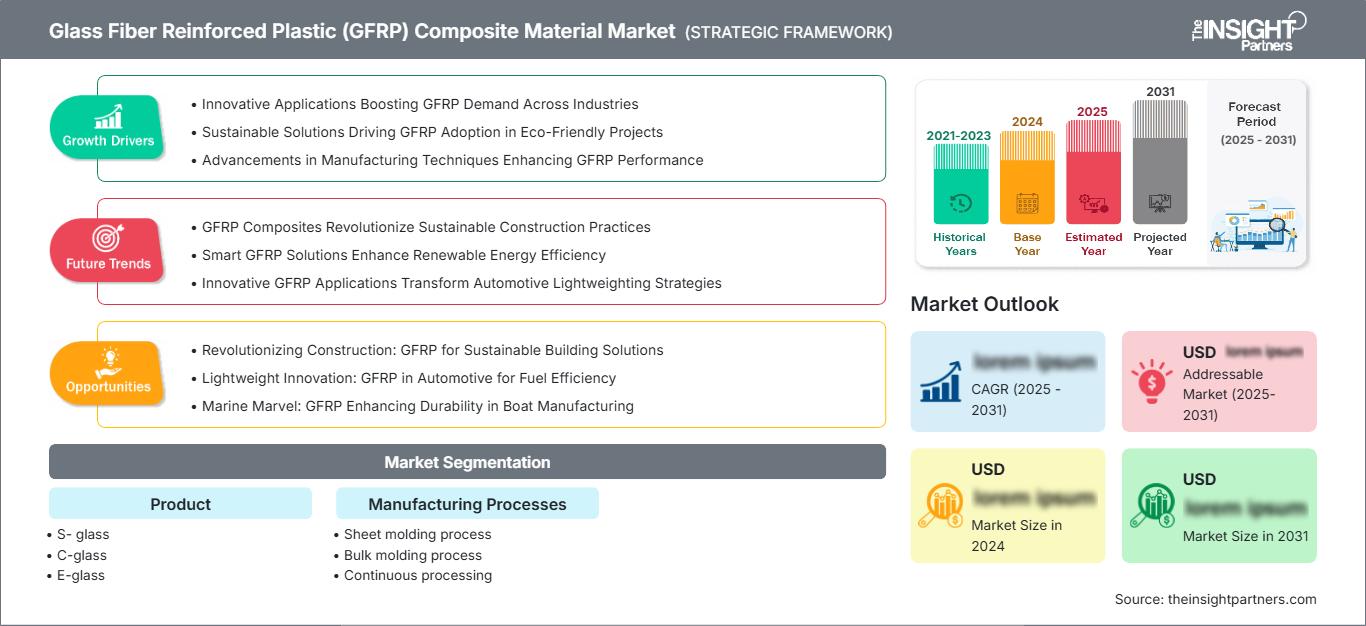
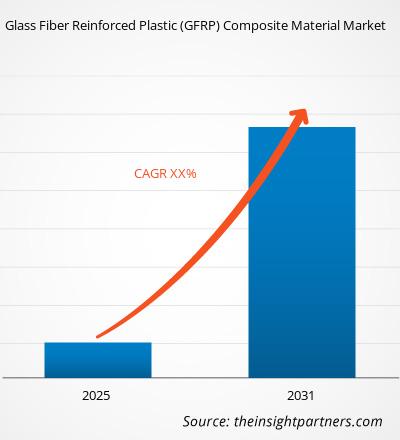
The glass fiber reinforced plastic composite material market size was valued at US$ 22.05 Billion in 2025 and is projected to reach US$ 46.23 Billion by 2034, expanding at a CAGR of 8.57% during 2026–2034. Rising adoption of lightweight composite materials across transportation, construction, renewable energy, marine, and industrial manufacturing continues to strengthen long-term demand. Continuous material innovation, improved production efficiency, and expanding end-use applications are expected to support sustained market expansion throughout the forecast period.
Across North America, increasing investments in advanced manufacturing, renewable energy infrastructure, and lightweight mobility solutions continue to support stable demand for glass fiber reinforced plastic composites. The glass fiber reinforced plastic composite material market size is expected to expand steadily in the region at an estimated CAGR of 7.8–8.3% between 2026 and 2034. Growth is reinforced by modernization of transportation infrastructure, expanding wind energy installations, and greater utilization of corrosion-resistant composite materials in industrial facilities.
Glass Fiber Reinforced Plastic (GFRP) Composite Material Market Assessment and Insights
- North America: Supported by mature aerospace, transportation, and wind energy industries, North America accounted for an estimated 28–32% of the glass fiber reinforced plastic composite material market share in 2025 and is anticipated to register a CAGR of 7.8–8.3% during 2026–2034. Investments in lightweight structural materials and infrastructure modernization continue to strengthen regional demand.
- US: The United States represented approximately 76–80% of the North American market in 2025 and is forecast to grow at a CAGR of 7.9–8.4% during 2026–2034, supported by transportation electrification, industrial modernization, and renewable energy investments.
- Europe: Europe held an estimated 24–28% share in 2025 and is projected to expand at a CAGR of 7.4–7.9% during 2026–2034. Germany, France, Italy, the UK, and Spain remain leading manufacturing hubs owing to strong automotive, construction, and wind energy sectors.
- Asia Pacific: Asia Pacific accounted for approximately 34–38% share in 2025 and is expected to record the fastest expansion with a CAGR of 9.2–9.7% during 2026–2034. China, Japan, India, and South Korea continue to increase composite manufacturing capacity and industrial consumption.
- Largest Segment: E-glass dominated the market with an estimated 54–58% market share in 2025 and is projected to grow at a CAGR of 8.2–8.7% during 2026–2034, driven by its cost efficiency, excellent mechanical performance, and broad industrial applications.
- High Growth Segment: Resin transfer molding process accounted for approximately 16–20% market share in 2025 and is anticipated to register a CAGR of 9.5–10.0% during 2026–2034, supported by increasing production of lightweight, high-performance composite components.
- Key companies analyzed in detail: The Fibreglass Company, AGY Holding Corp., Changzhou Pengyu FRP Pressure Vessel Co., Ltd., Delkom Group, Gurit Holding AG, Jushi Co., Ltd., Nitto Boseki Co., Ltd., PPG Industries, Inc., Saint-Gobain Vetrotex, Taiwan Glass Industry Corporation.
Source: The Insight Partners' analysis based on proprietary research, government publications, company annual reports, investor presentations, industry databases, and expert interviews.
Material engineering innovations have significantly reshaped the glass fiber reinforced plastic composite material market over the past decade through enhanced fiber formulations, automated molding technologies, and improved resin systems. Manufacturers are increasingly integrating digital process monitoring and precision manufacturing techniques to improve product consistency while reducing production waste. Simultaneously, expanding applications across wind energy, automotive structures, marine vessels, electrical insulation, and civil infrastructure continue to diversify demand and strengthen production capacities worldwide.
Looking ahead, emerging manufacturing hubs in Southeast Asia, the Middle East, and Eastern Europe are expected to attract fresh investments in composite processing facilities. Sustainability regulations encouraging lightweight construction materials, greater renewable energy deployment, and recycling initiatives are expected to create favorable long-term opportunities. Continuous investments in advanced processing technologies, localized supply chains, and high-performance material development are anticipated to reinforce the market's competitive landscape during the forecast period.
Glass Fiber Reinforced Plastic (GFRP) Composite Material Market Report Scope
| Report Attribute | Details |
|---|---|
| Market size in 2025 | US$ 22.05 Billion |
| Market Size by 2034 | US$ 46.23 Billion |
| Global CAGR (2026 - 2034) | 8.57% |
| Historical Data | 2021-2024 |
| Forecast period | 2026-2034 |
Glass Fiber Reinforced Plastic (GFRP) Composite Material Market Analysis
An accelerated adoption of glass fiber reinforced plastic composite materials by an array of industries-thanks to the increased industrial preference for light weight, anti-corrosive, and high-strength engineering materials. The automotive industry is continuously adopting such composite materials as an alternative for conventional metals to boost the performance of their automobiles and also fuel efficiency. Similarly, wind energy sector is utilizing high-tech glass fiber composites to enhance bigger and resilient wind turbine blades. Additional drivers include, but not limited to the expansion of building projects and increased electrical infrastructure upgrade along with investments in water treatment plants across different parts of the world.
With the value chain continually expanding its reach through greater cooperation among raw material providers, glass fiber producers, resin producers, composite fabricators and the manufacturers of the final products. More manufacturers are becoming vertically integrated to set up local production bases and adopt digital technologies, that in turn help to minimize operation costs while providing better supply reliability. In addition, the recent advancements made in terms of compatibility between thermosetting and thermoplastic resins have enhanced the adaptability to varied applications across sectors.
A growth in intensity among the companies involved in the global glass fiber reinforced plastic composite materials market analysis have been observed with their respective emphasis on facility enlargement, product specification difference and technological partnerships. The glass fiber reinforced plastic composite material market report highlights key players including Jushi Co., Ltd., Gurit Holding AG, PPG Industries, Inc., AGY Holding Corp., Saint-Gobain Vetrotex, and Nitto Boseki Co., Ltd. which maintain investment on novelty regarding speciality glass fibers, eco-friendly production procedures and customizable composite solutions for fortified presence around the globe. Regional vendors are also ramping up their exports by increasing the production capabilities and strategic pacts.
Significant capital investments are targeted toward modern automated production machinery, advanced resin transfer molding technologies and environmentally friendly procedures which are capable of reducing material wastage and consumption of energy. Industry leaders are intensifying their R&D efforts to develop new recyclable composite systems and future generation reinforcing agents that can effectively serve the transportation industry, green power production, electrical hardware manufacturing, and infrastructure for various industries. Such initiatives taken to enhance supply chain resilience along with long term commercialization prospects of robust composite solutions have been projected for the time to come.
● REPORT CUSTOMIZATION
Tailor This Report To Align With Your Specific Business Requirements
This report can be customized to align precisely with your business objectives, scope, and target markets. Customization options include tailored segmentation, geography, competitive analysis, and strategic insights to support informed decision-making.
Customize This Report →WHAT YOU CAN ADJUST
- ● Segmentations
- ● Geography
- ● Competitive Analysis
- ● Language Preferences
Glass Fiber Reinforced Plastic (GFRP) Composite Material Market: Strategic Insights
Regional Insights
North America Glass Fiber Reinforced Plastic Composite Material Market
North America accounted for an estimated 28–32% share of the global market in 2025 and is projected to expand at a CAGR of 7.8–8.3% during 2026–2034. Strong demand from aerospace, wind energy, transportation, marine, and civil infrastructure applications continues to support regional consumption. Increasing replacement of conventional metals with lightweight composites, combined with investments in resilient infrastructure and renewable energy projects, strengthens long-term market prospects. The glass fiber reinforced plastic composite material market share remains significant because of well-established manufacturing capabilities and advanced research ecosystems.
Manufacturers across the region continue investing in automated molding technologies, digital quality monitoring, and sustainable resin systems to improve operational efficiency. Government support for domestic manufacturing, modernization of electrical transmission infrastructure, and expansion of offshore and onshore wind projects are expected to sustain demand. Rising adoption of corrosion-resistant composite materials in wastewater treatment facilities, bridges, and industrial processing equipment further contributes to steady regional growth throughout the forecast period.
U.S. Glass Fiber Reinforced Plastic Composite Material Market
The United States represented approximately 76–80% of the North American market in 2025 and is expected to register a CAGR of 7.9–8.4% during 2026–2034. Strong domestic production capacity, advanced composite manufacturing technologies, and continuous innovation across automotive, aerospace, defense, and renewable energy industries reinforce national market leadership. Demand for lightweight structural materials continues to increase alongside expanding electric vehicle production and modernization of industrial infrastructure.
Leading manufacturers maintain significant production, research, and engineering operations across the country, supporting continuous product innovation and supply chain resilience. Wind turbine blade manufacturing, utility infrastructure upgrades, and industrial storage applications continue creating new demand for glass fiber reinforced composites. Federal investment programs supporting clean energy, transportation modernization, and domestic manufacturing are expected to further strengthen long-term industry expansion across the United States.
Europe Glass Fiber Reinforced Plastic Composite Material Market
Europe captured an estimated 24–28% share in 2025 and is anticipated to grow at a CAGR of 7.4–7.9% during 2026–2034. Germany remains the leading regional market owing to its strong automotive manufacturing base, industrial engineering expertise, and growing utilization of composite materials in renewable energy equipment. The United Kingdom continues expanding composite applications across aerospace, marine, and infrastructure projects, supported by sustained investments in advanced manufacturing technologies.
France, Italy, and Spain collectively contribute substantial demand through transportation equipment, construction materials, industrial machinery, and wind energy installations. France emphasizes aerospace-grade composite development, while Italy supports growing demand from marine and industrial equipment manufacturers. Spain continues investing in renewable energy capacity, encouraging wider adoption of glass fiber reinforced composite materials for wind turbine components and utility infrastructure. Increasing sustainability regulations across Europe are also encouraging manufacturers to improve production efficiency and material recyclability.
APAC Glass Fiber Reinforced Plastic Composite Material Market
Asia Pacific accounted for approximately 34–38% of the global glass fiber reinforced plastic composite material market forecast in 2025 and is projected to record the highest CAGR of 9.2–9.7% during 2026–2034. China leads regional production and consumption owing to its extensive manufacturing ecosystem, followed by Japan, South Korea, and India, which continue expanding high-value composite manufacturing across transportation, electrical equipment, and industrial sectors.
Government initiatives promoting advanced manufacturing, renewable energy deployment, and industrial modernization continue encouraging investments in composite production facilities. Australia also contributes through growing wind energy installations and infrastructure development, supporting wider regional adoption of high-performance glass fiber reinforced plastic composite materials.
Middle East & Africa Glass Fiber Reinforced Plastic Composite Material Market
The Middle East & Africa market is anticipated to expand at a CAGR of 7.0–7.5% during 2026–2034. Saudi Arabia and the United Arab Emirates continue investing in industrial diversification, desalination infrastructure, and renewable energy projects, increasing the utilization of corrosion-resistant composite materials. South Africa remains an important market supported by mining, utility, and industrial infrastructure applications.
Large-scale infrastructure investments and water management projects continue encouraging demand for durable composite products across the region. Expansion of oil and gas processing facilities, utility networks, and industrial construction is expected to sustain long-term opportunities, while localized manufacturing initiatives gradually strengthen regional supply capabilities.
Segmentation Analysis
Product
The Product segment represents the core of the market, supported by continuous improvements in fiber strength, durability, chemical resistance, and manufacturing efficiency. The glass fiber reinforced plastic composite material market trends continues to broaden as manufacturers develop specialized glass fibers for demanding industrial, transportation, construction, and renewable energy applications. The segment is projected to expand at a CAGR of 8.3–8.8% during 2026–2034, reflecting growing adoption across both mature and emerging industries.
- E-glass – The most widely utilized product category due to its balanced mechanical properties, electrical insulation performance, corrosion resistance, and cost-effectiveness. It remains the preferred reinforcement material across transportation, construction, electrical equipment, marine, and wind energy applications.
- S-glass – Preferred for high-performance structural applications requiring superior tensile strength, impact resistance, and fatigue performance. Demand is primarily driven by aerospace, defense, sporting goods, and advanced industrial components where lightweight strength is critical.
- C-glass – Primarily utilized where exceptional chemical and corrosion resistance is required. It serves industrial equipment, chemical processing facilities, storage tanks, pipelines, and wastewater treatment infrastructure requiring extended operational durability.
Manufacturing Processes
The Manufacturing Processes segment in the glass fiber reinforced plastic composite material market continues to evolve with greater automation, improved production efficiency, and increasing demand for precision-engineered composite components. Manufacturers are adopting advanced molding technologies to enhance dimensional accuracy, reduce material waste, and improve production consistency. The segment is expected to register a CAGR of 8.8–9.3% during 2026–2034, supported by rising investments in scalable composite manufacturing technologies.
- Sheet molding process – Widely adopted for producing complex automotive panels, electrical housings, and industrial components with high dimensional consistency, efficient production rates, and reliable mechanical performance suitable for medium- to high-volume manufacturing.
- Bulk molding process – Favored for manufacturing durable electrical components, automotive parts, and industrial equipment requiring excellent moldability, high production efficiency, and consistent structural integrity across complex component geometries.
- Continuous processing – Supports large-scale production of uniform composite profiles, pipes, structural sections, and construction materials through highly automated manufacturing systems that improve productivity while minimizing material variation.
- Spray-up process – Commonly applied in marine products, storage tanks, recreational equipment, and customized industrial components where flexible production, relatively low tooling investment, and large-part fabrication are required.
- Resin transfer molding process – Increasingly selected for manufacturing lightweight, high-strength composite structures with excellent surface finish, precise fiber placement, and reduced emissions, particularly across automotive, aerospace, and renewable energy applications.
Opportunity Snapshot
| Segment Name | Revenue Contribution | Trend Tag | Adoption Stage |
| S-glass | Medium | Aerospace Parts | Scaling |
| C-glass | Medium | Chemical Resistance | Mature |
| E-glass | High | Wind Blades | Mature |
| Sheet molding process | High | Lightweight Panels | Mature |
| Bulk molding process | Medium | Electrical Components | Mature |
| Continuous processing | High | Pultrusion Lines | Scaling |
| Spray-up process | Medium | Marine Structures | Mature |
| Resin transfer molding process | High | Precision Molding | Scaling |
Glass Fiber Reinforced Plastic (GFRP) Composite Material Market Growth Drivers and Impact Analysis
Expansion of Wind Energy Capacity Drives Composite Material Consumption
Investment in global renewable infrastructure has fueled demand for lightweight and robust composite materials especially for longer service life, fatigue resistance wind turbine blades where GFRP composite are considered as cost-effective, mechanical strong, corrosion resistant and light-weighted material as the reinforcement for onshore and offshore applications. Growing national commitments to carbon neutrality, renewable electricity generation and modernizing the electric grids is motivating manufacturers to extend the capacities. Enhanced blade design, size, localized ecosystem support the usage and is expected to continue supporting global GFRP composite suppliers with consistent purchasing volume and long-term agreements across major Wind energy consumers regions Asia Pacific, Europe, and North America.
Growing Adoption of Lightweight Materials Across Transportation Industries
Vehicle and machine manufacturers – from automotive and rail to commercial, aerospace, and marine – are opting for glass fiber reinforced composites as a replacement for conventional metals in response to a growing need for lighter and stronger parts with greater operational life and better fuel efficiency. The lighter weight of composite structures reduces the overall mass of the vehicle, enabling vehicle and machine manufacturers to comply with increasing environmental legislation and emissions standards around the globe, without compromising on mechanical properties and the high corrosion resistance of glass fibers. The transportation sector is also seeing a rise in composite applications due to the global trend toward electrification, as lighter vehicle components can enhance battery efficiency and increase driving range. The ongoing investment in the manufacturing processes by OEMs in automated molding techniques and short cycle times, along with recyclable composite materials, is helping to meet current glass fiber reinforced plastic composite material market trends, which are extending the possible applications of composite components, such as battery components, internal body components, chassis structures and even industrial transport equipment.
Infrastructure Modernization and Industrial Investment Support Long-Term Demand
Continued construction projects and investments in urbanisation and infrastructure for governments and developing nations worldwide for better long-term durability and the use of corrosion-resistant materials in bridges, water treatment plants, storage tanks, pipelines and utility infrastructure are contributing to a steady rise in the demand for advanced composite materials such as glass fiber reinforced plastic. In the water treatment plants, in industrial and municipal projects in marine conditions it finds an ideal place as the material provides durability when used in highly corrosive environment. Furthermore, ongoing investments in manufacturing technology, local production facilities and the sustainable building material industry will boost long term market growth, and simultaneously address supply chain resilience and product accessibility in multiple industries.
Glass Fiber Reinforced Plastic (GFRP) Composite Material Market Future Trends
Digital Manufacturing and Smart Composite Production
Composites manufacturing plants, manufacturers are increasingly adopting a blend of artificial intelligence, robotics, automation, and digital monitoring into composites manufacturing processes to increase production accuracy and efficiency. Manufacturers adopting automated quality inspection systems and the need for predictive maintenance are major drivers in glass fibre reinforced plastic composites material market growth trends with producers looking at technologies that enable process real time optimisation reducing process scrap while ensuring product quality consistency. The smart factory trend allows manufacturers the flexibility to accommodate custom composites components and the possibility of significantly reduced operation costs. Faster production cycles due to these technologies allow faster growth while boosting global competitiveness with higher quality production standards across all transportation sectors, renewable energy, building, construction and various industrial manufacturing sectors.
Growing Focus on Sustainable Composite Materials
In addition, sustainability goals also motivate manufacturers to build recyclability in their resin systems, achieve lower production emissions, and practice environmentally responsible manufacturing techniques. Manufacturers still place an emphasis on increasing resource efficiency and better utilization of waste streams, along with improving energy management in their composite production facilities. Efforts towards achieving a circular economy, increasingly tight environmental regulations and growing customer requirements for sustainability-friendly engineering materials are a significant stimulus for innovation along the value chain. Sustained collaboration between material producers, converters, and research institutes can foster innovations in recycling processes and lead to commercial utilization of future composite products.
Glass Fiber Reinforced Plastic (GFRP) Composite Material Market Opportunities
Expansion into Emerging Manufacturing Economies
Rapid industrialization across Southeast Asia, the Middle East, Latin America, and parts of Eastern Europe presents significant investment opportunities for composite manufacturers. Glass fiber reinforced plastic composite material market forecast indicate that expanding industrial infrastructure, renewable energy deployment, automotive production, and construction activities will continue generating new demand for advanced composite materials. Companies establishing regional manufacturing facilities, technical support centers, and localized supply chains are expected to strengthen customer responsiveness while reducing logistics costs. Strategic partnerships with domestic manufacturers, technology providers, and engineering firms can further accelerate market penetration and improve long-term competitiveness in high-growth economies.
Development of High-Performance Composite Solutions
Growing demand for advanced engineering materials across aerospace, defense, electric vehicles, marine equipment, and industrial machinery continues creating opportunities for manufacturers specializing in premium composite solutions. Investments in specialty glass fibers, advanced resin systems, precision molding technologies, and lightweight structural components are expected to deliver strong commercial potential. Companies capable of offering customized materials with improved mechanical performance, durability, thermal stability, and sustainability characteristics are likely to secure long-term contracts across high-value industrial applications. Continuous research and development activities will remain essential for maintaining technological differentiation and expanding future revenue streams.
Recent Developments
- March 2026: Gurit Holding AG announced a two-year supply contract for its glass pultruded blade root reinforcement solution with a leading wind turbine manufacturer in the Asia-Pacific region.
- February 2026: Gurit Holding AG announced the expansion of its U.S. operations to support increasing demand from the subsea industry. The investment enhances regional manufacturing capabilities, improves customer responsiveness, and reinforces the company's strategy of expanding advanced composite material production for industrial and marine applications.
Frequently Asked Questions

- Comprehensive Market Sizing and Forecast Analysis
- Detailed Segmentation Analysis
- In-Depth Market Dynamics Assessment
- Regional and Country-Level Insights
- Competitive Landscape and Company Benchmarking
- Strategic Business Intelligence
Recent Reports
Testimonials

The Insight Partners' SCADA System Market report is comprehensive, with valuable insights on current trends and future forecasts. The team was highly professional, responsive, and supportive throughout. We are very satisfied and highly recommend their services.
RAN KEDEM Partner, Reali Technologies LTDs
I requested a report on a very specific software market and the team produced the report in a few days. The information was very relevant and well presented. I then requested some changes and additions to the report. The team was again very responsive and I got the final report in less than a week.
JEAN-HERVE JENN Chairman, Future Analytica
We worked with The Insight Partners for an important market study and forecast. They gave us clear insights into opportunities and risks, which helped shape our plans. Their research was easy to use and based on solid data. It helped us make smart, confident decisions. We highly recommend them.
PIYUSH NAGPAL Sr. Vice President, High Beam Global
The Insight Partners delivered insightful, well-structured market research with strong domain expertise. Their team was professional and responsive throughout. The user-friendly website made accessing industry reports seamless. We highly recommend them for reliable, high-quality research services
YUKIHIKO ADACHI CEO, Deep Blue, LLC.
This is the first time I have purchased a market report from The Insight Partners.While I was unsure at first, I visited their web site and felt more comfortable to take the risk and purchase a market report.I am completely satisfied with the quality of the report and customer service. I had several questions and comments with the initial report, but after a couple of dialogs over email with their analyst I believe I have a report that I can use as input to our strategic planning process.Thank you so much for taking the extra time and making this a positive experience.I will definitely recommend your service to others and you will be my first call when we need further market data.
JOHN SUZUKI President and Chief Executive Officer, Board Director, BK Technologies
I wish to appreciate your support and the professionalism you displayed in the course of attending to my request for information regarding to infectious disease IVD market in Nigeria. I appreciate your patience, your guidance, and the fact that you were willing to offer a discount, which eventually made it possible for us to close a deal. I look forward to engaging The Insight Partners in the future, all thanks to the impression you have created in me as a result of this first encounter.
DR CHIJIOKE ONYIA MANAGING DIRECTOR, PineCrest Healthcare Ltd.Reason to Buy
- Informed Decision-Making
- Understanding Market Dynamics
- Competitive Analysis
- Identifying Emerging Markets
- Customer Insights
- Market Forecasts
- Risk Mitigation
- Boosting Operational Efficiency
- Strategic Planning
- Investment Justification
- Tracking Industry Innovations
- Aligning with Regulatory Trends





 Get Free Sample for