
Glass Insulators Market Demand, Size & Forecast by 2034
Coverage: By Product Type (Suspension Glass Insulators, Pin Glass Insulators); Application (Distribution and Railway Applications, HVDC Applications, HVAC Applications) , and Geography (North America, Europe, Asia Pacific, and South and Central America)
- Status : Data Released
- Report Code : TIPRE00027570
- Category : Electronics and Semiconductor
- No. of Pages : 150
- Available Report Formats :


- Last update date : September 17, 2026


2025 Market Size
US$ 222.85 Mn
Base year value
2034 Forecast
US$ 308.04 Mn
Projected by 2034
CAGR 2026-2034
3.66 %
Growth rate
Addressable Market
US$ 2,410.90 Mn
(2026-2034)
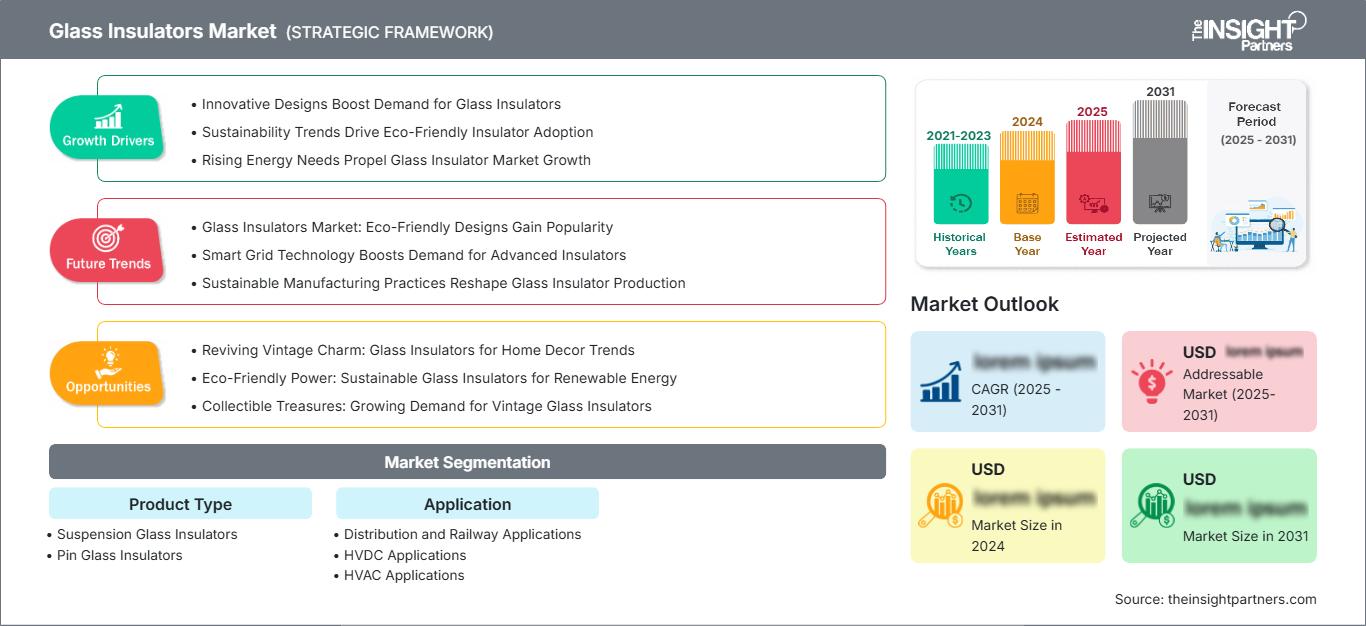
The Glass Insulators Market is projected to expand from US$ 222.85 Million in 2025 to US$ 308.04 Million by 2034, registering a CAGR of 3.66% during 2026–2034. Demand is being shaped by transmission and distribution network expansion, replacement of aging overhead infrastructure, renewable-energy integration, and continued deployment of high-voltage and ultra-high-voltage lines. Suspension products remain central to transmission applications, while specialized designs support increasingly demanding climatic and electrical operating conditions.
North America is expected to record an estimated CAGR of 4.0–4.5% through 2034, supported by grid modernization, resilience spending, and replacement of aging transmission assets. The Glass Insulators Market size outlook in the region is reinforced by utility investment in long-distance transmission, data-center-related load growth, and increasing requirements for reliable infrastructure capable of integrating new generation resources while maintaining system stability.
Glass Insulators Market Assessment and Insights
- North America: The region is estimated to hold a 24–28% Glass Insulators Market share in 2025 and grow at a CAGR of 4.0–4.5% between 2026–2034, supported by transmission replacement, grid resilience programs, and renewable interconnection requirements.
- US: The US is estimated to represent 68–72% of North America’s 2025 share, with a CAGR of 4.0–4.5% through 2034, driven by transmission expansion and utility modernization.
- Europe: Europe is estimated at a 27–31% share in 2025, growing at 3.3–3.8% during 2026–2034. Germany, France, Italy, Spain, and the UK support demand through aging-grid replacement and renewable interconnection.
- Asia Pacific: Asia Pacific is estimated at a 34–38% share in 2025 and a 4.2–4.8% CAGR through 2034, led by China, India, Japan, South Korea, and Australia through grid expansion and UHV investment.
- Largest Segment: Suspension Glass Insulators are estimated to command a 72–76% market share in 2025, expanding at a CAGR of 3.4–3.8% as transmission projects favor mechanically robust string configurations.
- High Growth Segment: HVDC Applications are estimated to represent a 10–14% market share in 2025 and expand at 5.0–5.6% through 2034 as long-distance renewable power transfer increases.
- Key companies analyzed in detail: Seves Group, MacLean Power Systems, Global Insulators Group, Incap Limited, ZX Insulators, Hubbell, GAMMA Insulators, JSC U.M.E.K, Shandong Ruitai Glass Insulator Co., Ltd., Nanjing Electric International Co., Ltd.
Source: The Insight Partners' analysis based on proprietary research, government publications, company annual reports, investor presentations, industry databases, and expert interviews.
Qualification in the product portfolio has been made easier due to the development in the processes associated with toughened glass, thermal tempering, cementing, metal parts, and contamination resistant profile development. In addition to this, manufacturers are increasingly emphasizing consistent mechanical strength, detectability of failure, and capability for handling extreme transmission conditions. Newer standards are also placing emphasis on testing, including impulse tests, residual strength tests, impact test, and resistance to radio interference.
Going forward, qualification in combination with supply and local technical support capabilities will become an increasing procurement priority. Development of grids in developing economies will increase the demand for glass suspension strings, while in developed economies replacement and upgrade needs will dominate. Reliability considerations, integration of renewable energy sources, and network resilience should drive the need for products with consistent field performance and traceability of manufacturing and testing.
Glass Insulators Market Report Scope
| Report Attribute | Details |
|---|---|
| Market size in 2025 | US$ 222.85 Million |
| Market Size by 2034 | US$ 308.04 Million |
| Global CAGR (2026 - 2034) | 3.66% |
| Historical Data | 2021-2024 |
| Forecast period | 2026-2034 |
Glass Insulators Market Analysis
Grid expansion is the leading driver, thus making Glass Insulators Market development strongly associated with the development of new transmission lines, upgrades in distribution, railway electrification, and equipment replacement. Value chain starts from specialty glass and metallic components providers, followed by batching, melting, forming, thermal toughening, assembling, testing, packing and qualification by utilities. Demand drivers include the level of pollution, voltage class, mechanical loads, and line configuration.
In supply, there is increasing dependence on furnace efficiency, automation, power prices, transportation logistics, and access to high-quality steel and cementing material. Producers having the vertical integration will be able to control better dimensional accuracy and mechanical properties, whereas exporters will need to take care about certifications and specific demands of utilities. Large-scale transmission programs may create peak purchasing seasons, which will make scheduling and inventories management an important part of logistics to deliver reliably but without overinvesting working capital.
Glass Insulators Market competitive structure analysis shows a fragmented market that includes well-established multinational producers, specialized producers, and big Asian producers. Seves Group, MacLean Power Systems, Global Insulators Group, Incap Limited, and Hubbell compete in the market through wide portfolio, qualification and geographical presence. Nanjing Electric International Co., Ltd. and Shandong Ruitai Glass Insulator Co., Ltd. focus on production size, export capabilities and production efficiency, whereas GAMMA Insulators and JSC U.M.E.K represent alternative choices.
Increasing investments are targeted at furnace renovation, automated forming, inspections, energy efficiency and flexible capacity. Modernization of Nanjing Electric production demonstrates the significance of automation, whereas MacLean Power Systems pays attention to the manufacturing quality and performance of their products. Specialized producers of ZX Insulators and others have possibilities to strengthen their positions using short lead times, customization of profiles and certification services together with economic lifecycle considerations.
● REPORT CUSTOMIZATION
Tailor This Report To Align With Your Specific Business Requirements
This report can be customized to align precisely with your business objectives, scope, and target markets. Customization options include tailored segmentation, geography, competitive analysis, and strategic insights to support informed decision-making.
Customize This Report →WHAT YOU CAN ADJUST
- ● Segmentations
- ● Geography
- ● Competitive Analysis
- ● Language Preferences
Glass Insulators Market: Strategic Insights
Regional Insights
North America Glass Insulators Market
North America is estimated to account for 24–28% of 2025 demand and expand at a CAGR of 4.0–4.5% through 2034. The regional requirement is associated with aged transmission infrastructure, electricity demands, renewables' connection, and resilience initiatives. The focus of utility companies on their expenses is now shifting towards long-range transmission systems and replacement of equipment nearing the end of its service life.
The USA accounts for the major portion of regional procurements, whereas Canada and Mexico are involved in the process via reinforcement and renewables' integration. Glass suspension insulators still have applications wherever utilities require high mechanical strength and visual fault detection capabilities. Supply assurance, experience in qualifying products, and compatibility of insulators with line accessories will thus be taken into account by purchasers.
U.S. Glass Insulators Market
The U.S. represents an estimated 68–72% of North America’s 2025 market and is projected to grow at a CAGR of 4.0–4.5%. Demand is driven by transmission modernization, resilience development, electrification, and increased load growth due to data centers and industry manufacturing. Procurement activities are conducted by utility companies that prefer quality products that adhere to the ANSI standards.
The key players in this market include Hubbell and MacLean Power Systems for their respective domestic markets, along with foreign suppliers operating through distribution networks. The use of the product involves transmission, sub-transmission, distribution, and selected rail applications. The issue of replacement becomes increasingly important due to the fact that utilities have to ensure reliability developments and outage limitations.
Europe Glass Insulators Market
Europe is estimated to hold 27–31% of 2025 demand and grow at 3.3–3.8% through 2034, with Germany the leading national market. The UK, Germany, France, Italy, and Spain collectively provide a broad base of transmission replacement, railway electrification, and renewable-grid reinforcement.
Offshore wind connectivity and grid reinforcement affect the UK. Germany has grid reinforcement needs associated with renewable energy sources and north-south transfers. France has nuclear-focused electricity generation along with interconnections and renewables. In the case of Italy, there are grid reinforcement needs in the south where there is considerable renewable energy. Spain has continued grid developments for solar and wind energy integration. For all these markets, qualification, environmental sustainability, and conformity with European standards of IEC continue to be critical purchase factors.
APAC Glass Insulators Market
APAC is estimated to represent 34–38% of 2025 demand and grow at 4.2–4.8% through 2034, making it the leading regional market. China leads, followed by India, Japan, South Korea, and Australia. Large transmission corridors and renewable integration underpin procurement.
China’s UHV expansion and India’s planned transmission additions create substantial requirements for suspension strings. Japan and South Korea emphasize reliability and replacement, while Australia requires products suited to long-distance networks and harsh environmental conditions. Industrial expansion, renewable-energy policies, and grid investment provide a durable demand base across the region.
Middle East & Africa Glass Insulators Market
Middle East and Africa demand is projected to grow at a CAGR of 3.8–4.4% through 2034, with Saudi Arabia leading regional requirements. UAE investment in infrastructure and South Africa’s grid reinforcement add demand, while the rest of MEA remains tied to transmission access and generation projects.
Energy diversification, interconnection, and infrastructure development are increasing the need for reliable overhead-line components. Saudi Arabia and UAE emphasize large-scale generation and network development, whereas South Africa requires reinforcement of constrained transmission corridors. Buyers across MEA increasingly consider pollution performance, heat exposure, corrosion protection, and availability of replacement units when evaluating glass-insulator specifications.
Segmentation Analysis
Product Type
Product Type is projected to expand at a CAGR of 3.4–4.1% during 2026–2034. The segment reflects established demand for suspension and pin configurations across different voltage classes and line architectures. The Glass Insulators Market scope increasingly favors products combining mechanical reliability, predictable electrical performance, pollution resistance, and compatibility with existing hardware.
- Suspension Glass Insulators: These products occupy the principal transmission position because multiple units can be assembled into strings for higher voltage levels. Demand remains closely connected with long-distance transmission construction, refurbishment, and severe environmental conditions.
- Pin Glass Insulators: Pin configurations remain important in distribution networks and selected lower-voltage overhead applications. Their strategic relevance comes from straightforward installation, established utility designs, and continued replacement requirements across mature distribution systems.
Application
Application is projected to register a CAGR of 3.9–4.4% through 2034. The segment benefits from simultaneous investment in distribution networks, railway electrification, HVAC transmission, and HVDC corridors. The Glass Insulators Market scope is increasingly influenced by renewable integration, interregional electricity transfers, and the need to extend existing network reliability.
- Distribution and Railway Applications: These applications provide recurring replacement demand across utility distribution and railway electrification. Procurement emphasizes standardized dimensions, mechanical reliability, pollution performance, and compatibility with installed infrastructure.
- HVDC Applications: HVDC projects require highly reliable insulation systems for long-distance bulk power transfer. Demand is strategically important where renewable generation is remote from load centers and interregional transmission capacity must increase.
- HVAC Applications: HVAC remains a major application across conventional transmission and distribution networks. Demand is supported by grid reinforcement, replacement of aging strings, renewable interconnection, and expansion of high-voltage corridors.
Opportunity Snapshot
| Application | Revenue Contribution | Trend Tag | Adoption Stage |
|---|---|---|---|
| Distribution and Railway Applications | High | Grid Renewal | Mature |
| HVDC Applications | Medium | UHV Expansion | Scaling |
| HVAC Applications | High | Line Reinforcement | Mature |
Glass Insulators Market Growth Drivers and Impact Analysis
Expansion of high-voltage transmission infrastructure
Capacity growth will bring about an increased demand for mechanically durable insulators that can handle high voltage classes and long distances. According to the IEA, there will be significant expansion and upgrading of global grid networks until 2040, further underscoring the structural significance of components used in transmission networks. As far as glass insulator manufacturers are concerned, the outcome will be larger order backlogs, qualification possibilities, and the significance of scalable manufacturing processes. In addition, utilities will seek standardized products that can fit into existing towers, cables, and fittings. Commercial success will be seen particularly in case of suspension types of insulators because such insulators can be put together as strings based on the voltage and mechanical considerations.
Renewable integration and long-distance power transfer
Renewable generation is increasingly located far from major consumption centers, creating requirements for transmission corridors capable of moving electricity across substantial distances. China, India, Europe, Australia, and North America are expanding networks to connect generation zones with industrial and population centers. Glass insulation benefits where utilities prioritize visible failure detection, mechanical strength, and long service performance in overhead applications. HVDC development adds another layer of opportunity because long-distance direct-current links require carefully engineered insulation systems. The market impact extends beyond new construction, as utilities must also reinforce existing corridors to accommodate changing power flows. Suppliers that provide pollution-resistant profiles, high mechanical ratings, and application-specific designs can improve their relevance in projects where environmental exposure and system reliability influence equipment selection.
Replacement of aging overhead-line assets
Aging infrastructure is becoming a decisive procurement factor in developed electricity systems. Europe reports that a substantial portion of distribution networks is more than four decades old, while North American utilities continue investing in reliability and resilience. Replacement programs create recurring demand independent of new generation additions because insulator strings, fittings, and associated hardware must maintain electrical and mechanical performance throughout extended operating periods. Glass products can benefit from their visible failure characteristics, allowing maintenance teams to identify damaged units during inspections. The commercial effect is a shift toward lifecycle-based purchasing rather than lowest initial price. Manufacturers able to document mechanical consistency, environmental resistance, testing performance, and compatibility with legacy hardware can gain repeat orders from utilities undertaking phased refurbishment programs.
Glass Insulators Market Future Trends
Advanced inspection and condition-based maintenance
Future Glass Insulators Market trends will increasingly connect product design with digital inspection practices. Utilities are adopting drones, high-resolution imaging, thermal assessment, and structured asset databases to identify defects before failures affect service continuity. Glass units are particularly compatible with visual inspection because punctured or fractured components can be detected more readily than concealed degradation mechanisms. Manufacturers may respond by improving surface consistency, developing clearer identification systems, and supplying digital product records linked to manufacturing batches. Condition-based maintenance can also change procurement specifications by placing greater emphasis on inspectability and predictable failure modes. Over time, utility engineering teams may evaluate insulators as part of integrated asset-management systems rather than isolated hardware purchases, encouraging suppliers to provide documentation, traceability, installation guidance, and testing data alongside physical products.
Lower-carbon manufacturing and process automation
Glass-insulator production is energy intensive because manufacturing requires controlled melting, forming, and thermal treatment. Future suppliers are therefore likely to prioritize furnace efficiency, automated material handling, optimized heating cycles, waste reduction, and improved process monitoring. Automation can also improve dimensional consistency and reduce variability between production batches, which is valuable when utility qualification programs demand repeatable mechanical and electrical characteristics. Manufacturers operating older facilities may face increasing pressure to modernize equipment as energy costs and environmental expectations influence total production economics. The result could be a gradual shift toward digitally monitored furnaces, automated inspection, and higher process control. These changes should improve yield and product consistency while helping producers manage operating costs without relying solely on higher selling prices.
Glass Insulators Market Opportunities
Regional manufacturing for transmission expansion
Regional manufacturing represents an attractive opportunity where governments and utilities seek greater supply-chain resilience for critical grid components. India, Southeast Asia, the Middle East, and selected Latin American markets offer potential for localized production, assembly, testing, or inventory hubs. Investors can target facilities near transmission-development clusters to reduce freight exposure and improve response times for utility projects. Glass Insulators Market Forecasts can benefit from a procurement environment increasingly focused on delivery certainty, qualification continuity, and local technical support. Partnerships between established manufacturers and regional engineering groups could provide a practical entry route without duplicating every upstream capability. The strongest business cases are likely to combine local finishing or warehousing with centralized specialty-glass production, allowing manufacturers to preserve process efficiency while adapting products to regional standards and environmental conditions.
High-performance products for HVDC and severe environments
Investment opportunities are emerging around products designed for high-voltage direct-current corridors and locations with severe pollution, salt exposure, dust, or temperature variation. Such projects require careful control of creepage distance, mechanical loading, electrical performance, and profile geometry. Suppliers can differentiate through application engineering rather than basic component supply, offering configurations matched to local contamination severity and line design. Research programs focused on glass-insulator fracture behavior and surface coatings also create pathways for incremental product improvement. Manufacturers can prioritize dedicated testing, profile optimization, and field-service capabilities to support premium procurement requirements. This strategy may be particularly relevant in countries building long transmission corridors from renewable-resource regions, where reliability consequences of component failure are significant and utilities increasingly evaluate equipment based on total lifecycle performance.
Recent Developments
- May 2026: AGC launched a new production line for FINEO vacuum insulating glass, expanding manufacturing capacity for its high-performance glazing solution in Europe. FINEO uses a vacuum layer of approximately 0.1 mm between two glass panes to deliver thermal insulation comparable to triple glazing while maintaining a much thinner and lighter profile, making it particularly suitable for building renovation and applications where existing window frames must be retained. The new production capacity supports growing demand for high-performance, energy-efficient glazing as Europe accelerates building renovation and decarbonization.
- September 2025: Saint-Gobain Glass partnered with LuxWall to bring INSIO®, a next-generation vacuum glazing solution incorporating LuxWall’s transparent insulation technology, to the European market. The collaboration combines Saint-Gobain Glass’s global scale and expertise in building glass with LuxWall’s Enthermal technology to reduce heat transfer through windows and façades while maintaining daylight and design flexibility.
- June 2025: SORG continued its long-standing partnership with Nanjing Electric Technology Group Co., Ltd., which selected SORG to supply a third furnace to support increased production capacity for glass insulators. The new furnace is a fully electric SORG VSM melter with a 21 m² melting surface, supplied with SORG engineering and technology along with a rotating crown, transformers, top electrode system, STF forehearth with stirrer unit and Conti-Drain system.
Frequently Asked Questions

- Comprehensive Market Sizing and Forecast Analysis
- Detailed Segmentation Analysis
- In-Depth Market Dynamics Assessment
- Regional and Country-Level Insights
- Competitive Landscape and Company Benchmarking
- Strategic Business Intelligence
Recent Reports
Testimonials

The Insight Partners' SCADA System Market report is comprehensive, with valuable insights on current trends and future forecasts. The team was highly professional, responsive, and supportive throughout. We are very satisfied and highly recommend their services.
RAN KEDEM Partner, Reali Technologies LTDs
I requested a report on a very specific software market and the team produced the report in a few days. The information was very relevant and well presented. I then requested some changes and additions to the report. The team was again very responsive and I got the final report in less than a week.
JEAN-HERVE JENN Chairman, Future Analytica
We worked with The Insight Partners for an important market study and forecast. They gave us clear insights into opportunities and risks, which helped shape our plans. Their research was easy to use and based on solid data. It helped us make smart, confident decisions. We highly recommend them.
PIYUSH NAGPAL Sr. Vice President, High Beam Global
The Insight Partners delivered insightful, well-structured market research with strong domain expertise. Their team was professional and responsive throughout. The user-friendly website made accessing industry reports seamless. We highly recommend them for reliable, high-quality research services
YUKIHIKO ADACHI CEO, Deep Blue, LLC.
This is the first time I have purchased a market report from The Insight Partners.While I was unsure at first, I visited their web site and felt more comfortable to take the risk and purchase a market report.I am completely satisfied with the quality of the report and customer service. I had several questions and comments with the initial report, but after a couple of dialogs over email with their analyst I believe I have a report that I can use as input to our strategic planning process.Thank you so much for taking the extra time and making this a positive experience.I will definitely recommend your service to others and you will be my first call when we need further market data.
JOHN SUZUKI President and Chief Executive Officer, Board Director, BK Technologies
I wish to appreciate your support and the professionalism you displayed in the course of attending to my request for information regarding to infectious disease IVD market in Nigeria. I appreciate your patience, your guidance, and the fact that you were willing to offer a discount, which eventually made it possible for us to close a deal. I look forward to engaging The Insight Partners in the future, all thanks to the impression you have created in me as a result of this first encounter.
DR CHIJIOKE ONYIA MANAGING DIRECTOR, PineCrest Healthcare Ltd.Reason to Buy
- Informed Decision-Making
- Understanding Market Dynamics
- Competitive Analysis
- Identifying Emerging Markets
- Customer Insights
- Market Forecasts
- Risk Mitigation
- Boosting Operational Efficiency
- Strategic Planning
- Investment Justification
- Tracking Industry Innovations
- Aligning with Regulatory Trends





 Get Free Sample for