
GPS Watches Market Demand, Size & Forecast by 2034
Coverage: By Type (GPS Heart Rate Watches, GPS Step Counting Watches); Application (Training, Running, Hiking); End Use (Fitness & Sports, Outdoor Activities, Military & Defense); Distribution Channel (Online, Offline); and Geography (North America, Europe, Asia Pacific, and South and Central America)
- Status : Data Released
- Report Code : TIPRE00014959
- Category : Electronics and Semiconductor
- No. of Pages : 150
- Available Report Formats :


- Last update date : September 10, 2026


2025 Market Size
US$ 5.06 Bn
Base year value
2034 Forecast
US$ 11.33 Bn
Projected by 2034
CAGR 2026-2034
9.36 %
Growth rate
Addressable Market
US$ 73.15 Bn
(2026-2034)
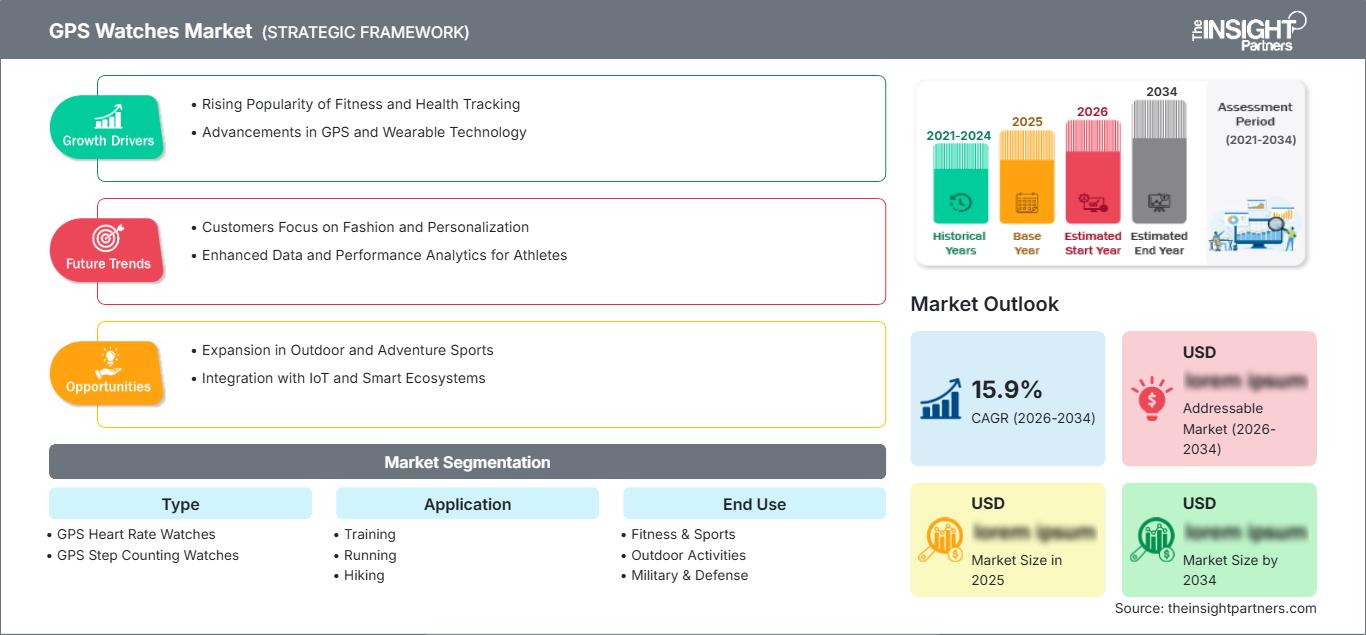
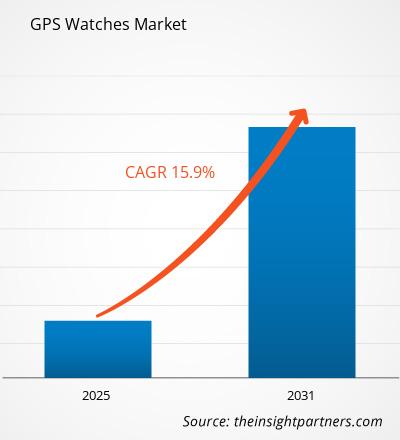
The GPS Watches Market size is expanding from US$ 5.06 Billion in 2025 to US$ 11.33 Billion by 2034, reflecting a CAGR of 9.36% during 2026–2034. Growth is supported by broader adoption of location-enabled wearables, improving biometric sensors, longer battery performance, and integration with digital fitness ecosystems. Product development is increasingly focused on training intelligence, navigation accuracy, recovery metrics, health monitoring, and connected outdoor applications.
In North America, the GPS Watches Market is expected to advance at an estimated 8.1–8.7% CAGR between 2026 and 2034. Structural growth is supported by high sports participation, established wearable ecosystems, premium device adoption, and increasing consumer interest in continuous health and performance monitoring. Demand is also reinforced by outdoor recreation and connected fitness services.
GPS Watches Market Assessment and Insights
- North America: North America is estimated to account for a 31–35% GPS Watches Market share in 2025 and expand at a 8.1–8.7% CAGR between 2026–2034, supported by premium wearable adoption, organized sports, outdoor recreation, and established digital fitness ecosystems.
- US: The US represents approximately 74–78% of North American demand in 2025 and is projected to grow at a 8.0–8.6% CAGR between 2026–2034, led by fitness tracking, running, and connected health applications.
- Europe: Europe is estimated at a 27–31% share in 2025, growing at a 8.7–9.3% CAGR between 2026–2034. Germany, the UK, France, Italy, and Spain provide a broad base across running, cycling, hiking, and outdoor recreation.
- Asia Pacific: Asia Pacific is estimated to hold a 29–33% share in 2025 and grow at a 10.2–11.0% CAGR between 2026–2034. China, Japan, South Korea, India, and Australia are key demand centers.
- Largest Segment: GPS Heart Rate Watches hold an estimated 62–66% market share in 2025 and are projected to grow at a 9.0–9.6% CAGR between 2026–2034.
- High Growth Segment: Hiking represents an estimated 20–24% market share in 2025 and is expected to expand at an 11.0–12.0% CAGR between 2026–2034, supported by navigation and outdoor safety functions.
- Key companies analyzed in detail: Apple Inc., Timex.com, Inc., Garmin Ltd., COROS Wearables Inc., Samsung Electronics Co., Ltd., SoleusRunning, Fitbit, Lenovo Group, Fossil Group, Inc., Polar.
Source: The Insight Partners' analysis based on proprietary research, government publications, company annual reports, investor presentations, industry databases, and expert interviews.
The industry’s product spectrum has moved on from mere location services to integrated performance platforms that incorporate GPS functionality along with optical heartbeat measurement, altitude determination, sleep analysis, recovery parameters, and smartphone integration. Differentiation is happening on the basis of sensor accuracy, battery management systems, display technology, software capabilities, and unique training algorithms. The industry continues to depend on semiconductors, GPS hardware, optical sensors, displays, batteries, and miniaturization technology.
In the future, the usage of products should expand into new Asian markets as well as outdoor specialties. Increasing phone ownership, growing numbers in sports activities, and declining prices could help drive unit sales, while premium products would compete on health insights and training customization. Health-specific functions of wearable devices might receive regulatory scrutiny in developed countries.
GPS Watches Market Report Scope
| Report Attribute | Details |
|---|---|
| Market size in 2025 | US$ 5.06 Billion |
| Market Size by 2034 | US$ 11.33 Billion |
| Global CAGR (2026 - 2034) | 9.36% |
| Historical Data | 2021-2024 |
| Forecast period | 2026-2034 |
GPS Watches Market Analysis
The demand for watches will shift towards customers seeking accurate performance measures versus basic performance records. Hence, GPS Watches Market expansion will be driven by the activities of running, hiking, cycling, endurance training, and multisport involvement, in which case precise navigation and physiological feedback become important features. The ecosystem consists of GNSS chips, optical sensors, displays, batteries, operation systems, mobile applications, cloud platforms, distribution channels, and subscription service providers.
In the value chain of the GPS Watches Market, suppliers of components affect accuracy, energy consumption, and miniaturization of devices, whereas original equipment manufacturers are responsible for defining the architecture of products and their software uniqueness. High-end watches need better hardware-software combination since it is the battery life, positioning performance, sensor accuracy, and display responsiveness that make the product valuable altogether. At the same time, the manufacturers balance innovative features with high cost of components and supply chain sensitivity.
Competition becomes defined by the depth of ecosystems, specialization in training solutions, and differentiation of the hardware. The analysis of GPS Watches Market reveals that Apple Inc. highlights health and integration into a single device, Garmin Ltd. puts a lot of emphasis on sport activities and outdoor performance, COROS Wearables Inc. aims at endurance athletes via training functionalities, Samsung Electronics Co., Ltd. competes in connected device integration, and Polar has a specialist positioning.
In the GPS Watches Market trends, there is a trend in investments in sensor fusion, software intelligence, battery efficiency, satellite communications, and personal coaching. Timex.com, Inc., SoleusRunning, Fitbit, Lenovo Group, and Fossil Group, Inc. address various consumer segments, whereas Garmin and Apple build their premium products. There is an expectation that competitive intensity will grow as vendors use proprietary data, wearable operation systems, health platforms, and subscription services to retain their customers.
● REPORT CUSTOMIZATION
Tailor This Report To Align With Your Specific Business Requirements
This report can be customized to align precisely with your business objectives, scope, and target markets. Customization options include tailored segmentation, geography, competitive analysis, and strategic insights to support informed decision-making.
Customize This Report →WHAT YOU CAN ADJUST
- ● Segmentations
- ● Geography
- ● Competitive Analysis
- ● Language Preferences
GPS Watches Market: Strategic Insights
Regional Insights
North America GPS Watches Market
North America is estimated to represent a 31–35% share in 2025, with a projected 8.1–8.7% CAGR through 2034. The geographical area can capitalize on the high penetrations of wearables, running communities, outdoors activities, and consumer adoption of connected health products. The US is the primary market for the company, while Canada will provide additional demand through their hiking, winter, biking, and fitness activities.
Purchase behavior within the geographical area tends towards purchasing premium devices that include proper location tracking capabilities, long battery life, advanced heart rate measurement, and smartphone integration. Garmin Ltd and Apple Inc have good relevance within sports and life style markets, whereas Samsung Electronics Co., Ltd caters to broader connected device consumers.
U.S. GPS Watches Market
The US accounts for approximately 74–78% of North American GPS Watches Market in 2025 and is expected to expand at an 8.0–8.6% CAGR through 2034. Running, fitness, hiking, and endurance activities continue to be common areas of application, while advanced health tracking capabilities become more relevant to replacement. Well-established distribution channels serve as a way of making specialized equipment available to many customers.
Apple Inc., Garmin Ltd., Fitbit, and Samsung Electronics Co., Ltd. have high product recognition across consumer markets, while specialized brands focus on performance-oriented customers. Device choice is influenced by considerations of battery life, navigation precision, analysis of training process, recovery parameters, and compatibility with smartphones. Military and defense-related applications still belong to more specialized spheres, where rugged devices are appreciated for their navigational and endurance qualities.
Europe GPS Watches Market
Europe is estimated to hold a 27–31% GPS Watches Market in 2025 and is projected to grow at an 8.7–9.3% CAGR through 2034. UK and Germany emerge as the key markets, aided by a developed culture of fitness, buying capacity, engagement in outdoor activities, and requirement for quality wearable products.
UK offers a well-developed environment of running and fitness, wherein demand ranges from training, preparing for marathons, hiking to overall wellness. Customers today compare batteries life span, heart rate tracking, map functionality, and the device's compatibility with existing mobile ecosystems. E-commerce websites help in comparing the product, while sports goods stores continue to be important for quality products.
Germany can be considered one of the major markets that are influenced by biking, trekking, running, and sport participation. Consumers tend to place special emphasis on durability, quality of engineering, navigation capabilities, and efficiency of batteries. Other major markets are provided by France, Italy, and Spain through running, outdoor activities for tourists, recreational trekking, and fitness participation. Germany is the leader among the European markets considered.
APAC GPS Watches Market
APAC is estimated to account for 29–33% of 2025 demand and is projected to grow at a 10.2–11.0% CAGR. China is at the top of the regional market, trailed by Japan, South Korea, India, and Australia, all supported by growing participation in exercise and the adoption of connected devices.
China gets support from domestic wearables and strong technology adoption. Japan stresses health, accuracy, and outdoors use. South Korea combines sports usage and mobile phone technology. India offers considerable long-term prospects, despite current pressure on its smartwatch market. Australia derives support from its outdoor activity, especially hiking.
Middle East & Africa GPS Watches Market
Middle East and Africa demand remains smaller but is projected to grow at an 8.5–9.5% CAGR through 2034. The key Gulf countries that have been considered for market assessment are Saudi Arabia and the UAE, while the key country in Africa to consider is South Africa. Sports activity, tourism, outdoor leisure activities, and premium consumer electronics drive the adoption.
Saudi Arabia and the UAE will have access to sports infrastructure, tourism, and active lifestyle marketing campaigns. South Africa will contribute through sports such as running, hiking, and endurance. RoMEA will be fragmented, and the adoption will happen only in affluent urban markets. GPS is critical in this region as it helps in navigation and location.
Segmentation Analysis
Type
The Type segment is projected to expand at an 8.8–9.5% CAGR between 2026–2034. The GPS Watches Market scope increasingly favors devices that combine positioning with physiological measurements, making heart-rate functionality central to training, wellness, and performance applications. Step-counting products retain relevance among general fitness users and price-sensitive consumers seeking straightforward activity monitoring.
- GPS Heart Rate Watches: These products occupy the premium and performance-oriented portion of demand by combining positioning with continuous physiological measurement. Their strategic importance is increasing as runners and athletes seek integrated training feedback.
- GPS Step Counting Watches: These devices address consumers prioritizing everyday activity monitoring, walking, and accessible fitness tracking. Their simpler functionality supports broader adoption where affordability and ease of use influence purchasing decisions.
Application
The Application segment is expected to grow at a 9.8–10.6% CAGR through 2034. Training, running, and hiking require increasingly specialized location and performance information, supporting demand for products that combine route mapping, pace analysis, physiological data, and recovery insights. Application-specific software is becoming an important differentiator between general-purpose and specialist devices.
- Training: Training applications emphasize structured workouts, recovery indicators, performance history, and personalized recommendations. They are strategically important because recurring training use encourages users to remain within connected software ecosystems.
- Running: Running remains a core application, supported by route tracking, pace measurement, heart-rate monitoring, and performance analytics. Specialist runners increasingly value advanced metrics that support structured preparation and race optimization.
- Hiking: Hiking benefits from route navigation, elevation tracking, long battery life, weather information, and location awareness. These capabilities increase product relevance for outdoor users operating away from reliable cellular connectivity.
End Use
The End Use segment is projected to register a 9.1–9.8% CAGR from 2026–2034. Fitness and sports remain the principal demand base, while outdoor activities support premium navigation functionality. Military and defense users form a specialized segment where ruggedness, battery endurance, positioning reliability, and operational functionality are more important than consumer-oriented design.
- Fitness & Sports: This category represents the broadest consumer base, covering gym users, runners, athletes, and recreational participants. Demand centers on health metrics, training analysis, workout tracking, and ecosystem connectivity.
- Outdoor Activities: Outdoor users prioritize navigation, elevation, route planning, battery longevity, weather information, and durability. These requirements support higher-value products designed for hiking, trekking, trail running, and adventure activities.
- Military & Defense: Specialized users require rugged construction, reliable positioning, extended endurance, and operational resilience. Procurement decisions emphasize mission utility, durability, interoperability, and security rather than lifestyle features.
Distribution Channel
Distribution Channel is expected to grow at a 10.0–10.8% CAGR during 2026–2034. Online retail is gaining strategic importance through broader assortment, direct-to-consumer models, subscription bundling, and detailed product comparisons. Offline channels remain important for premium purchases requiring physical demonstrations, fitting, specialist advice, and immediate product availability.
- Online: Online channels provide extensive product selection, transparent comparison, direct manufacturer access, and convenient purchasing. Their strategic importance is rising as consumers become more familiar with specifications and specialist wearable categories.
- Offline: Physical channels remain relevant for premium watches, sporting-goods purchases, and consumers seeking product demonstrations. Specialist retailers can provide application-specific guidance, fitting support, and immediate after-sales interaction.
Opportunity Snapshot
| Application | Revenue Contribution (High/Medium/Low) | Trend Tag | Adoption Stage |
|---|---|---|---|
| Training | High | Adaptive Training | Scaling |
| Running | High | Race Analytics | Mature |
| Hiking | Medium | Trail Navigation | Scaling |
GPS Watches Market Growth Drivers and Impact Analysis
Rising demand for continuous performance and health measurement
Customers now demand actionable insights from wearable technology and not merely numerical activity readings. Continuous heart rate monitoring, sleep metrics, recovery metrics, training loads, and routes have become key factors when making decisions about fitness. The integration of these features enhances the appeal of GPS-powered devices since geographic location adds context to physiological data, especially while running, hiking, cycling, or during workouts. This enables vendors to differentiate through their algorithms and software offerings instead of relying solely on their hardware. The business implications are far-reaching since they involve sensors, cloud, mobile apps, and subscription services. Increased expectations about the range of features to be provided by the device make customers more likely to replace old devices without such sophisticated analytical functions.
Expansion of outdoor recreation and endurance sports participation
Outdoor recreation is putting pressure on manufacturers to develop wearable devices that work efficiently outside the typical city environment used by traditional fitness enthusiasts. Outdoor activities such as hiking, trail running, trekking, and other endurance sports demand precise positioning and elevation data, routing information, weather information, and battery longevity. Such demands make GPS watches more suitable than activity trackers since navigation is now an integral part of the product rather than an optional one. It especially applies to high-end devices, which people are ready to pay more money for due to robust construction, ability to map, satellite connection, and battery life control technologies. As a result, companies are now making efforts to create rugged and specialized watches for certain types of sports and navigate outdoors.
Integration of AI-enabled coaching and personalized fitness ecosystems
Wearable technology is transforming the way data on wearable devices gets turned into actionable advice. Rather than simply displaying data points in isolation, more advanced platforms are analyzing a person’s history with exercise, recovery, sleep, and body reactions in order to create customized training suggestions. This could lead to greater adoption of wearables, since customers will be provided with tailored recommendations based on their actions rather than fixed dashboards. From the point of view of manufacturers, artificial intelligence opens up possibilities to develop ongoing software relationships on top of hardware sales through premium coaching and personalized training programs. The quality of the data becomes more important, along with the quality of sensors, privacy management, and algorithm verification. In terms of competition, the differentiation moves from sensors to analytics.
GPS Watches Market Future Trends
AI-driven adaptive coaching and multimodal training intelligence
GPS Watches Market trends are moving toward adaptive coaching systems that continuously interpret location, heart-rate, sleep, recovery, and training-load information. In the future, recommendations of wearable technology are going to be more personalized and adapt not only to performance but also to environment and fatigue levels, instead of depending upon static training programs. Moreover, AI is going to help users interpret the complex data into actions like changing intensity or resting time. This ability is going to blur the line between a wearables product and a virtual trainer. Wearable vendors are going to focus on developing proprietary algorithms, advanced sensor fusion technologies, and software ecosystems that keep users after purchase of their hardware. The most successful wearables in the market will put an emphasis on transparent recommendations, privacy, and interoperability.
Satellite connectivity and advanced navigation beyond conventional GNSS
Future products are likely to expand from GPS positioning toward broader satellite-enabled communication and navigation capabilities. This development can improve utility in remote environments where cellular networks are unavailable, particularly for hikers, expedition users, endurance athletes, and specialized operational customers. Satellite messaging, emergency location sharing, improved multi-band positioning, and more efficient signal processing may become increasingly differentiated features. Manufacturers will also seek to reduce the energy burden associated with continuous satellite connectivity through better chip architectures and adaptive power management. The commercial opportunity extends beyond navigation because safety features can increase perceived product value among outdoor consumers. As connectivity becomes more integrated, product design will increasingly balance antenna performance, battery capacity, device size, subscription economics, and regional satellite-service availability.
GPS Watches Market Opportunities
Premium outdoor platforms combining navigation, safety, and endurance
Manufacturers can pursue premium opportunities by combining navigation, safety, battery endurance, environmental sensing, and advanced fitness analytics in a single outdoor platform. Such products can target hikers, trail runners, expedition users, adventure travelers, and specialized professionals whose requirements extend beyond conventional fitness tracking. GPS Watches Market Forecasts can support investment decisions by evaluating regional outdoor participation, premium wearable penetration, and channel economics together rather than treating these factors independently. Strategic development should emphasize low-power positioning, offline maps, satellite communication, durable materials, and emergency functions. Partnerships with outdoor-content providers, insurance platforms, tourism operators, and digital coaching services could broaden revenue streams. The opportunity is strongest where users value reliability and safety enough to support premium pricing and recurring service relationships.
Enterprise and defense-oriented wearable applications
An emerging opportunity exists in specialized enterprise, public-safety, and defense applications requiring rugged positioning, biometric monitoring, and operational communication. These customers can value reliability and endurance more heavily than consumer aesthetics, creating differentiated procurement criteria and potentially longer product lifecycles. Suppliers should evaluate secure data handling, device management, interoperability, ruggedization, and offline functionality when developing enterprise offerings. The opportunity also extends to industrial workforce applications where location awareness and worker-safety monitoring can complement existing communication systems. Commercial strategies should prioritize pilot deployments, institutional procurement relationships, and application-specific software rather than relying exclusively on consumer retail. Vendors with established hardware engineering and secure software capabilities may be able to leverage existing technologies into specialized markets without redesigning the entire device architecture.
Recent Developments
- February 2026: Garmin Ltd. reported record fourth-quarter and full-year 2025 results, with fourth-quarter consolidated revenue reaching US$2.12 billion, up 17% year over year. The company also announced a new US$500 million share repurchase authorization. The results demonstrate continued financial momentum across Garmin’s diversified portfolio, including fitness, outdoor, and wearable products.
- December 2025: Apple Inc. made hypertension notifications available on Apple Watch in India. The feature uses optical heart-sensor data to identify patterns associated with possible chronic high blood pressure and directs users toward confirmatory measurement with a blood-pressure cuff. The development expands the role of wearable devices from fitness tracking toward broader health-monitoring applications.
- May 2025: Garmin Ltd. introduced the Forerunner 570 and Forerunner 970 GPS running and triathlon smartwatches, adding advanced training tools, recovery insights, personalized workouts, and new performance metrics. The Forerunner 970 also incorporated an LED flashlight and additional running analytics. The launch reinforced Garmin’s positioning around specialized endurance training and performance-oriented wearable functionality.
Frequently Asked Questions

- Comprehensive Market Sizing and Forecast Analysis
- Detailed Segmentation Analysis
- In-Depth Market Dynamics Assessment
- Regional and Country-Level Insights
- Competitive Landscape and Company Benchmarking
- Strategic Business Intelligence
Recent Reports
Testimonials

The Insight Partners' SCADA System Market report is comprehensive, with valuable insights on current trends and future forecasts. The team was highly professional, responsive, and supportive throughout. We are very satisfied and highly recommend their services.
RAN KEDEM Partner, Reali Technologies LTDs
I requested a report on a very specific software market and the team produced the report in a few days. The information was very relevant and well presented. I then requested some changes and additions to the report. The team was again very responsive and I got the final report in less than a week.
JEAN-HERVE JENN Chairman, Future Analytica
We worked with The Insight Partners for an important market study and forecast. They gave us clear insights into opportunities and risks, which helped shape our plans. Their research was easy to use and based on solid data. It helped us make smart, confident decisions. We highly recommend them.
PIYUSH NAGPAL Sr. Vice President, High Beam Global
The Insight Partners delivered insightful, well-structured market research with strong domain expertise. Their team was professional and responsive throughout. The user-friendly website made accessing industry reports seamless. We highly recommend them for reliable, high-quality research services
YUKIHIKO ADACHI CEO, Deep Blue, LLC.
This is the first time I have purchased a market report from The Insight Partners.While I was unsure at first, I visited their web site and felt more comfortable to take the risk and purchase a market report.I am completely satisfied with the quality of the report and customer service. I had several questions and comments with the initial report, but after a couple of dialogs over email with their analyst I believe I have a report that I can use as input to our strategic planning process.Thank you so much for taking the extra time and making this a positive experience.I will definitely recommend your service to others and you will be my first call when we need further market data.
JOHN SUZUKI President and Chief Executive Officer, Board Director, BK Technologies
I wish to appreciate your support and the professionalism you displayed in the course of attending to my request for information regarding to infectious disease IVD market in Nigeria. I appreciate your patience, your guidance, and the fact that you were willing to offer a discount, which eventually made it possible for us to close a deal. I look forward to engaging The Insight Partners in the future, all thanks to the impression you have created in me as a result of this first encounter.
DR CHIJIOKE ONYIA MANAGING DIRECTOR, PineCrest Healthcare Ltd.Reason to Buy
- Informed Decision-Making
- Understanding Market Dynamics
- Competitive Analysis
- Identifying Emerging Markets
- Customer Insights
- Market Forecasts
- Risk Mitigation
- Boosting Operational Efficiency
- Strategic Planning
- Investment Justification
- Tracking Industry Innovations
- Aligning with Regulatory Trends





 Get Free Sample for