
Heat Treated Steel Plates Market Growth, Size & Forecast by 2034
Coverage: by Steel Type (Carbon Steel, Alloy Steel, Stainless Steel); Treatment (Quenching and Tempering, Normalizing, Spheroidizing, Stress Relieving, Others); Application (Construction, Energy and Power, Industrial Machinery, Automotive and Defense Vehicles, Shipbuilding, Others) , and Geography (North America, Europe, Asia Pacific, and South and Central America)
- Status : Data Released
- Report Code : TIPRE00009225
- Category : Chemicals and Materials
- No. of Pages : 150
- Available Report Formats :


- Last update date : August 10, 2026


2025 Market Size
US$ 8.14 Bn
Base year value
2034 Forecast
US$ 12.55 Bn
Projected by 2034
CAGR 2026-2034
4.93 %
Growth rate
Addressable Market
US$ 93.91 Bn
(2026-2034)
The heat treated steel plates market was valued at US$ 8.14 Billion in 2025 and is projected to reach US$ 12.55 Billion by 2034, expanding at a CAGR of 4.93% during 2026–2034. The market benefits from sustained demand across infrastructure development, industrial machinery manufacturing, energy projects, defense equipment production, and shipbuilding activities. Heat treatment processes enhance toughness, hardness, fatigue resistance, and structural integrity, making treated steel plates essential for applications operating under high stress and harsh environmental conditions.
Across North America, replacement of aging infrastructure, expansion of renewable energy facilities, and increasing investments in defense modernization continue to support demand. The heat treated steel plates market size in the region is influenced by strong procurement from construction contractors, heavy equipment manufacturers, and energy operators. Industrial reshoring initiatives and government-backed infrastructure spending programs are expected to support regional growth at a CAGR ranging between 4.2% and 4.8% through 2034.
Heat Treated Steel Plates Market Assessment and Insights
- North America: Accounted for 26–28% share in 2025 and is projected to expand at a CAGR of 4.2–4.8% during 2026–2034. Infrastructure rehabilitation, defense procurement programs, and energy sector investments continue to support steady demand for high-strength heat-treated plate products.
- US: Represented 78–82% of North American demand in 2025 and is anticipated to register a CAGR of 4.3–4.9% during 2026–2034. Growth is supported by heavy machinery production, bridge replacement projects, and defense vehicle manufacturing.
- Europe: Held a 24–26% share in 2025 and is forecast to grow at a CAGR of 4.0–4.6% during 2026–2034. Germany, Italy, France, and the UK remain leading consumers owing to industrial engineering, shipbuilding, and energy infrastructure investments.
- Asia Pacific: Captured 38–42% share in 2025 and is expected to record a CAGR of 5.3–5.9% during 2026–2034. China, Japan, South Korea, and India drive consumption through industrial expansion, manufacturing investments, and large-scale infrastructure projects.
- Largest Segment: Carbon Steel accounted for 48–52% market share in 2025 and is projected to grow at a CAGR of 4.5–5.0% during 2026–2034. Cost efficiency, weldability, and widespread use in construction and industrial equipment support segment leadership.
- High Growth Segment: Energy and Power represented 18–22% market share in 2025 and is expected to expand at a CAGR of 5.8–6.4% during 2026–2034. Renewable energy projects, transmission infrastructure, and power generation investments continue to increase demand.
- Key companies analyzed in detail: ArcelorMittal S.A., China Baowu Steel Group Corporation Limited, JFE Holdings, Inc., Nippon Steel Corporation, Novolipetsk Steel Public Joint Stock Company, Outokumpu Oyj, POSCO Holdings Inc., Tata Steel Limited, thyssenkrupp AG, VÍTKOVICE STEEL, a.s.
Source: The Insight Partners' analysis based on proprietary research, government publications, company annual reports, investor presentations, industry databases, and expert interviews.
Growing demand for advanced structural materials has reshaped production strategies across the global steel industry. Manufacturers increasingly employ quenching and tempering technologies, automated thermal processing systems, and digital quality monitoring tools to achieve precise metallurgical properties. Rising requirements from defense, construction, heavy equipment, and offshore energy applications have encouraged producers to expand high-strength plate portfolios. Simultaneously, steelmakers continue optimizing production efficiency through energy-saving heat-treatment technologies and process automation, supporting improved product consistency and operational performance.
Looking ahead, investment activity is expected to accelerate in emerging manufacturing hubs across Southeast Asia, the Middle East, and selected African economies. Infrastructure modernization programs, renewable energy deployment, and industrial diversification strategies are generating new demand centers for engineered steel products. Environmental regulations encouraging longer-lasting structural materials and lifecycle efficiency are further supporting adoption. As industrial users increasingly prioritize durability, safety, and performance, the heat treated steel plates market is expected to experience stable long-term expansion across both developed and developing economies.
Heat Treated Steel Plates Market Report Scope
| Report Attribute | Details |
|---|---|
| Market size in 2025 | US$ 8.14 Billion |
| Market Size by 2034 | US$ 12.55 Billion |
| Global CAGR (2026 - 2034) | 4.93% |
| Historical Data | 2021-2024 |
| Forecast period | 2026-2034 |
Heat Treated Steel Plates Market Analysis
The heat treated steel plates market growth is primarily driven by increasing demand for high-performance steel components capable of withstanding extreme loads, pressure, and environmental conditions. Construction firms require stronger materials for bridges, commercial buildings, and transportation infrastructure, while industrial machinery manufacturers seek enhanced wear resistance and fatigue strength. Demand from shipbuilding and defense sectors further strengthens consumption patterns. Across the value chain, raw steel production, heat-treatment processing, fabrication, distribution, and end-use integration remain closely interconnected. Improvements in furnace efficiency, process control, and metallurgical engineering continue to support the availability of specialized plate grades designed for demanding industrial applications.
Supply dynamics are influenced by steel production capacity, energy costs, raw material availability, and industrial investment cycles. Major producing countries continue expanding advanced plate manufacturing capabilities to address growing requirements from energy, transportation, and heavy engineering sectors. Increased adoption of automated quality-control systems and digital production monitoring is helping manufacturers improve yield rates and reduce production variability. These developments support reliable supply while enabling producers to meet increasingly stringent customer specifications.
The heat treated steel plates market analysis indicates a competitive environment characterized by capacity optimization, product differentiation, and strategic investment in advanced processing technologies. Global producers are increasingly focusing on higher-value plate grades designed for demanding applications such as offshore structures, defense vehicles, industrial equipment, and energy infrastructure. Companies are strengthening regional supply networks and enhancing technical service capabilities to improve customer engagement and project execution.
Industry leaders including ArcelorMittal S.A., China Baowu Steel Group Corporation Limited, Nippon Steel Corporation, POSCO Holdings Inc., Tata Steel Limited, and thyssenkrupp AG continue investing in production modernization and sustainability initiatives. Meanwhile, JFE Holdings, Inc., Outokumpu Oyj, Novolipetsk Steel Public Joint Stock Company, and VÍTKOVICE STEEL, a.s. are expanding specialized product offerings for industrial and infrastructure applications. Strategic partnerships, operational efficiency programs, and investments in advanced heat-treatment facilities are expected to remain central competitive priorities throughout the forecast period.
● REPORT CUSTOMIZATION
Tailor This Report To Align With Your Specific Business Requirements
This report can be customized to align precisely with your business objectives, scope, and target markets. Customization options include tailored segmentation, geography, competitive analysis, and strategic insights to support informed decision-making.
Customize This Report →WHAT YOU CAN ADJUST
- ● Segmentations
- ● Geography
- ● Competitive Analysis
- ● Language Preferences
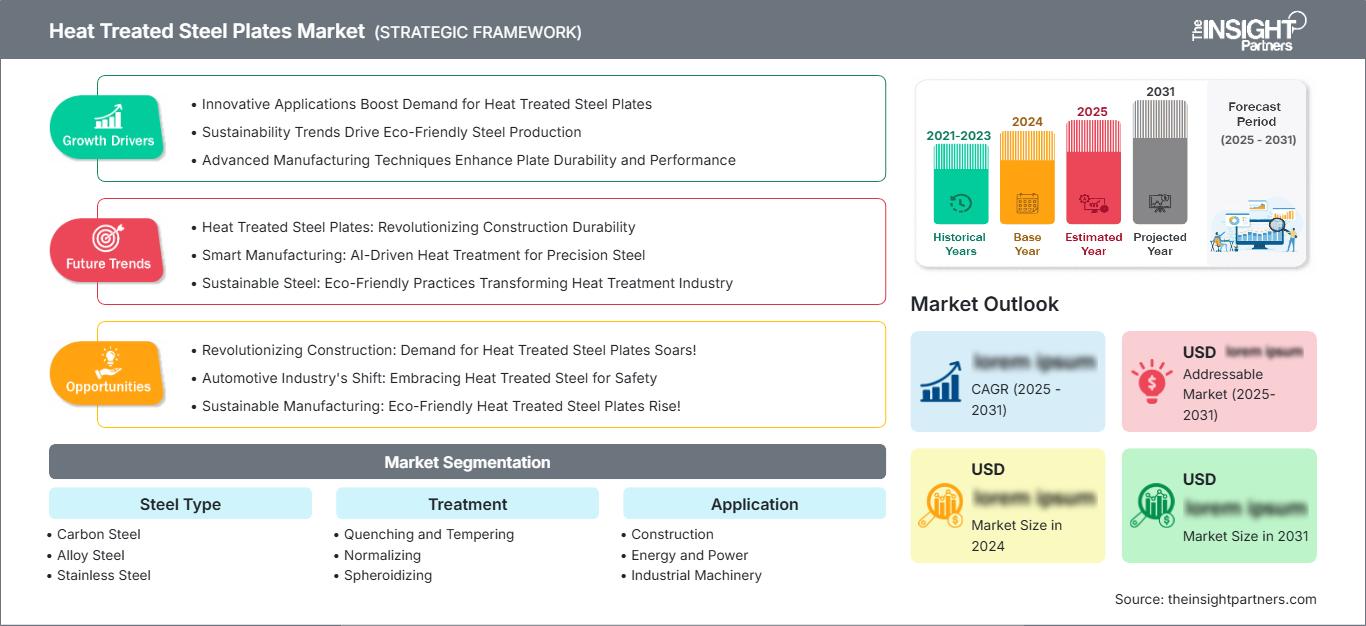
Heat Treated Steel Plates Market: Strategic Insights
Regional Insights
North America Heat Treated Steel Plates Market
North America accounted for 26–28% of the heat treated steel plates market share in 2025 and is anticipated to expand at a CAGR of 4.2–4.8% during 2026–2034. Demand remains supported by infrastructure rehabilitation projects, industrial modernization programs, and defense spending across the region. The replacement of aging bridges, transportation systems, and energy infrastructure continues to generate substantial requirements for high-strength heat-treated steel plates with enhanced durability and fatigue resistance.
Industrial equipment manufacturing and energy sector investments also contribute significantly to regional demand. Growth in renewable energy projects, transmission networks, and heavy machinery production is supporting consumption of specialized plate grades. Steel producers are increasingly investing in advanced processing technologies and operational efficiency improvements to meet evolving customer requirements. The region benefits from a mature industrial ecosystem, established supply chains, and consistent procurement activity from public and private sector infrastructure projects.
U.S. Heat Treated Steel Plates Market
The U.S. represented 78–82% of North American demand in 2025 and is projected to register a CAGR of 4.3–4.9% during 2026–2034. Federal infrastructure funding initiatives, industrial reshoring strategies, and sustained defense procurement programs continue to strengthen domestic demand. High-performance steel plates are increasingly utilized in bridge construction, transportation equipment, military vehicles, and energy infrastructure projects requiring enhanced structural performance.
The country hosts significant operations from major steel producers and downstream fabricators, supporting domestic manufacturing capabilities. Demand from industrial machinery, construction equipment, and utility sectors remains particularly strong. Increased focus on grid modernization, renewable energy deployment, and industrial capacity expansion is expected to create additional opportunities for heat-treated steel plate suppliers. Continued investment in advanced manufacturing technologies further supports market development and product innovation.
Europe Heat Treated Steel Plates Market
Europe held a 24–26% share in 2025 and is forecast to expand at a CAGR of 4.0–4.6% during 2026–2034. Germany remains the leading market due to its extensive industrial manufacturing base, engineering expertise, and machinery production capabilities. The country continues investing in energy transition infrastructure and advanced manufacturing technologies, supporting demand for high-strength steel plate products.
The UK is aided by infrastructure improvements, defense modernization efforts, and offshore energy projects. The combined demand from France, Italy, and Spain stems from transport infrastructure projects, industrial machinery manufacturing, and renewable energy projects. Steel producers in the region are increasingly concerned with producing environmentally friendly steel. This trend helps foster steady growth in the market while making European steel manufacturers more competitive in international markets.
APAC Heat Treated Steel Plates Market
Asia Pacific accounted for 38-42% of the market in 2025 and is projected to register a CAGR of 5.3-5.9% between 2026 and 2034. China holds the largest market share due to its large-scale steel manufacturing, infrastructure investments, and manufacturing industries. Japan and South Korea hold a growing market for their shipbuilding, automotive manufacturing, and heavy engineering sectors.
India and Australia are emerging as vital market drivers, driven by mining investments, industrial growth, and infrastructure development. Government industrial policies, manufacturing, and renewable energy development are contributing to regional demand fundamentals.
Middle East & Africa Heat Treated Steel Plates Market
The Middle East & Africa market is expected to witness a CAGR of 4.8–5.4% in the forecast period 2026-2034. Saudi Arabia is at the forefront of regional growth driven by large-scale infrastructure development, industrial diversification, and energy sector investments. The UAE continues its investments in transportation, logistics, and commercial construction projects that require corrosion-resistant structural steel.
South Africa remains an important market due to mining, industrial processing, and infrastructure operations. In the wider region, power generation plants, petrochemical operations, and transport networks have created opportunities for producers of high-quality heat-treated steel plates.
Segmentation Analysis
Steel Type
The Steel Type Segment is estimated to grow at a 4.8–5.3% CAGR for the forecast period of 2026–2034. The choice of materials is always an important aspect in end-use industries, as mechanical strength, corrosion resistance, weldability, and overall cost determine project feasibility. The Heat Treated Steel Plates Market scope is continually expanding as manufacturers develop innovative material grades that meet increasingly stringent requirements of end-use industries.
- Carbon Steel: Carbon steel remains the most widely used material category due to its favorable cost-performance balance, high strength characteristics, and broad applicability across construction, machinery manufacturing, transportation infrastructure, and structural engineering projects.
- Alloy Steel: Alloy steel plates are increasingly utilized in demanding industrial environments requiring superior hardness, wear resistance, and fatigue performance. Their ability to withstand extreme operating conditions supports adoption across heavy machinery and energy applications.
- Stainless Steel: Stainless steel plates play a strategic role in corrosive environments where durability and reduced maintenance requirements are essential. Demand remains strong across energy, marine, chemical processing, and specialized infrastructure applications.
Treatment
The Treatment category is expected to post a CAGR of 4.9-5.4% during 2026-2034. Heat treatment plays a decisive role in setting the mechanical properties, toughness, hardness, and durability of steel plates. New technologies and automation in heat treatments enhance their quality. Manufacturers now focus on tailoring their treatment techniques to meet application needs, enabling the production of special grades of plates.
- Quenching and Tempering: This treatment method remains highly important for producing plates with enhanced strength and toughness. It is widely used in defense equipment, heavy machinery, mining equipment, and structural applications exposed to severe loading conditions.
- Normalizing: Normalizing improves grain structure uniformity and mechanical reliability, making it suitable for structural fabrication, pressure equipment, and industrial components requiring balanced strength and workability characteristics.
- Spheroidizing: Spheroidizing is primarily employed when improved machinability and formability are required. The process supports downstream manufacturing operations involving precision shaping, machining, and component fabrication.
- Stress Relieving: Stress-relieving treatments help reduce residual stresses generated during fabrication and welding processes. The technique is particularly valuable in large structural components, pressure systems, and industrial machinery applications.
Application
The Application segment market is expected to witness a CAGR of 5.0–5.6% from 2026 to 2034. End-user demand is highly dependent on infrastructure spending, industrial development, the development of the transportation and energy industries, and energy industry growth. The rise in demand for robust materials capable of withstanding harsh conditions is boosting adoption rates. Technological progress in the steel manufacturing industry and a focus on asset durability contribute to the increasing demand.
- Construction: Construction remains a foundational demand center for heat-treated steel plates, supporting bridges, commercial buildings, industrial facilities, transportation infrastructure, and other projects requiring enhanced structural reliability and long service life.
- Energy and Power: Energy and power applications are benefiting from investments in renewable energy facilities, transmission infrastructure, power generation assets, and offshore energy projects requiring durable and high-performance steel materials.
- Industrial Machinery: Industrial machinery manufacturers utilize heat-treated plates to improve equipment durability, wear resistance, and operational performance in demanding manufacturing, mining, and processing environments.
- Automotive and Defense Vehicles: This segment relies on advanced steel grades to achieve strength, safety, impact resistance, and weight optimization objectives across commercial vehicles, military platforms, and specialized transportation equipment.
- Shipbuilding: Shipbuilding applications require steel plates capable of withstanding harsh marine environments, heavy loads, and extended operational cycles, making heat treatment an essential manufacturing process.
Opportunity Snapshot
| Application | Revenue Contribution | Trend Tag | Adoption Stage |
| Construction | High | Bridge Renewal | Mature |
| Energy and Power | High | Grid Expansion | Scaling |
| Industrial Machinery | Medium | Equipment Upgrade | Mature |
| Automotive and Defense Vehicles | Medium | Armor Systems | Scaling |
| Shipbuilding | Medium | Offshore Fleet | Scaling |
Heat Treated Steel Plates Market Growth Drivers and Impact Analysis
Expansion of Global Infrastructure Modernization Programs
Governments across developed and emerging economies continue to allocate substantial capital to transportation, utilities, and public infrastructure upgrades. The aging of bridges, rail transport systems, ports, and industrial plants necessitates materials that can withstand prolonged operation under harsh conditions. Heat-treated steel plates are known for providing increased strength, toughness, and fatigue resistance and are hence ideal for massive engineering works. Public sector projects in North America, Europe, Asia-Pacific, and the Middle East have resulted in a steady stream of business for the construction and engineering sectors. With infrastructure becoming more durable and low-maintenance, there will be increasing demand for such materials. Thus, steel manufacturers' capacity utilization can be efficiently managed through technology investments.
Rising Investments in Energy and Industrial Projects
The global transition toward diversified energy systems is creating significant opportunities for suppliers of engineered steel products. The development of renewable energy installations, transmission grids, offshore structures, energy generation installations, and industrial processing units requires materials that can withstand harsh environmental and mechanical conditions. Heat-treated steel plates have unique performance attributes that ensure reliability and efficiency. At the same time, industrial growth in developing countries results in higher demand for production, mining, and heavy engineering equipment. Such investments boost consumption in many different applications. When project developers look for materials that extend lifespan and enhance safety performance, heat-treated steel products become increasingly important components of such projects.
Growing Demand for High-Performance Defense and Transportation Materials
Defense modernization programs and improvements in the transport industry will lead to increased use of high-strength steel materials worldwide. Military vehicles, armor, transportation equipment, and heavy commercial vehicles all require plate materials that meet specific criteria and requirements. Heat treatment enhances toughness, longevity, and performance, making the material more valuable for critical missions. Incentives such as budget allocation to the defense sector and improvements in infrastructure in key markets will boost demand for products in the coming days. New plate grades will be developed to cater to specific demands in the future. This phenomenon is making the market more competitive and fostering innovation in metallurgy and heat-treating processes.
Heat Treated Steel Plates Market Future Trends
Integration of Digital Process Control and Smart Heat-Treatment Systems
The heat treated steel plates market trends increasingly reflect the adoption of Industry 4.0 technologies across steel production and thermal processing facilities. There is a trend among companies to monitor, predict maintenance needs, and control the furnace using a digital system. The use of digital sensors and process analysis enables enhanced control of the temperature curve and metallurgy, leading to fewer quality discrepancies and production disruptions. In the next 10 years, such smart manufacturing solutions will be seen as a normal element of contemporary heat treatment processes. Such technology will increase productivity and improve traceability, making it easier to comply with growing customer requirements.
Development of Sustainable and Low-Carbon Steel Production Routes
Environmental considerations are becoming increasingly significant in investment decisions across the steel chain. Steelmakers are working to reduce carbon emissions by using renewable energy sources, efficient furnaces, recycling, and the latest technologies. The regulatory environment of Europe, North America, and certain regions of Asia is forcing the industry to adopt low-carbon steelmaking practices. Given that corporate customers prioritize sustainable practices, the demand for steel products with a minimized environmental impact will grow. This trend will create an opportunity for companies that manage to combine sustainability with improved material performance.
Heat Treated Steel Plates Market Opportunities
Expansion of Advanced Energy Infrastructure Projects
As the scale of renewable energy applications emerges and improvements in the power grid occur, there is a definite need for companies producing high-end steel plates. Applications such as wind energy systems, transmission lines, energy storage systems, and offshore energy projects require robust materials that perform well in harsh conditions. According to Heat Treated Steel Plates Market Forecasts, energy sector investments will remain among the top opportunities until 2034. Manufacturers who create specialized plate grades with improved fatigue strength and corrosion resistance will find opportunities as project complexity increases. Strategic partnerships with engineering contractors and energy developers can further strengthen market positioning while supporting long-term revenue diversification across expanding energy infrastructure segments.
Capacity Expansion in Emerging Manufacturing Economies
Initiatives toward industrialization in Southeast Asia, the Middle East, and some African countries are creating an environment conducive to new production investments. The rapid development of infrastructure, transport systems, industrial plants, and engineering projects is driving increased demand for high-quality steel products. Manufacturing firms that develop processing capabilities in these regions or enhance their local distribution networks will be able to achieve greater responsiveness and customer engagement. The possibility goes further than growth in volumes to developing products that meet the needs of the industry in these regions. Companies that manage to align their investment policies with the new manufacturing ecosystems will gain more market share.
Recent Developments
- July 2026: ArcelorMittal, the world's leading integrated steel and mining company, announced results for the three-month and six-month periods ended June 30, 2026.
- January 2026: In 2025, Metinvest Group’s metallurgical enterprises launched production of 11 new types of steel products, despite the difficult conditions of wartime and restrictions in energy and logistics.
- July 2025: thyssenkrupp Steel Europe implemented major strategic investments at the Duisburg location. With the core facilities now completed, Germany's largest steelmaker had modernized and optimized its production network at key interfaces.
Frequently Asked Questions

- Comprehensive Market Sizing and Forecast Analysis
- Detailed Segmentation Analysis
- In-Depth Market Dynamics Assessment
- Regional and Country-Level Insights
- Competitive Landscape and Company Benchmarking
- Strategic Business Intelligence
Recent Reports
Testimonials

The Insight Partners' SCADA System Market report is comprehensive, with valuable insights on current trends and future forecasts. The team was highly professional, responsive, and supportive throughout. We are very satisfied and highly recommend their services.
RAN KEDEM Partner, Reali Technologies LTDs
I requested a report on a very specific software market and the team produced the report in a few days. The information was very relevant and well presented. I then requested some changes and additions to the report. The team was again very responsive and I got the final report in less than a week.
JEAN-HERVE JENN Chairman, Future Analytica
We worked with The Insight Partners for an important market study and forecast. They gave us clear insights into opportunities and risks, which helped shape our plans. Their research was easy to use and based on solid data. It helped us make smart, confident decisions. We highly recommend them.
PIYUSH NAGPAL Sr. Vice President, High Beam Global
The Insight Partners delivered insightful, well-structured market research with strong domain expertise. Their team was professional and responsive throughout. The user-friendly website made accessing industry reports seamless. We highly recommend them for reliable, high-quality research services
YUKIHIKO ADACHI CEO, Deep Blue, LLC.
This is the first time I have purchased a market report from The Insight Partners.While I was unsure at first, I visited their web site and felt more comfortable to take the risk and purchase a market report.I am completely satisfied with the quality of the report and customer service. I had several questions and comments with the initial report, but after a couple of dialogs over email with their analyst I believe I have a report that I can use as input to our strategic planning process.Thank you so much for taking the extra time and making this a positive experience.I will definitely recommend your service to others and you will be my first call when we need further market data.
JOHN SUZUKI President and Chief Executive Officer, Board Director, BK Technologies
I wish to appreciate your support and the professionalism you displayed in the course of attending to my request for information regarding to infectious disease IVD market in Nigeria. I appreciate your patience, your guidance, and the fact that you were willing to offer a discount, which eventually made it possible for us to close a deal. I look forward to engaging The Insight Partners in the future, all thanks to the impression you have created in me as a result of this first encounter.
DR CHIJIOKE ONYIA MANAGING DIRECTOR, PineCrest Healthcare Ltd.Reason to Buy
- Informed Decision-Making
- Understanding Market Dynamics
- Competitive Analysis
- Identifying Emerging Markets
- Customer Insights
- Market Forecasts
- Risk Mitigation
- Boosting Operational Efficiency
- Strategic Planning
- Investment Justification
- Tracking Industry Innovations
- Aligning with Regulatory Trends





 Get Free Sample for