
Hi-Fi System Market Growth, Share & Trends by 2034
Coverage: by System (Speaker & Soundbar, CD Player, DVD Player, Blu-ray Player, Network Media Player, Turntable, Headphone & Earphone), Connectivity Technology ( Wired, Wireless, Bluetooth, Wi-Fi, Airplay), Application (Residential, Automotive, Commercial), and Geography (North America, Europe, Asia Pacific, and South and Central America)
- Status : Data Released
- Report Code : TIPTE100000463
- Category : Electronics and Semiconductor
- No. of Pages : 150
- Available Report Formats :


- Last update date : September 17, 2026


2025 Market Size
US$ 17.92 Bn
Base year value
2034 Forecast
US$ 30.69 Bn
Projected by 2034
CAGR 2026-2034
6.16 %
Growth rate
Addressable Market
US$ 220.06 Bn
(2026-2034)
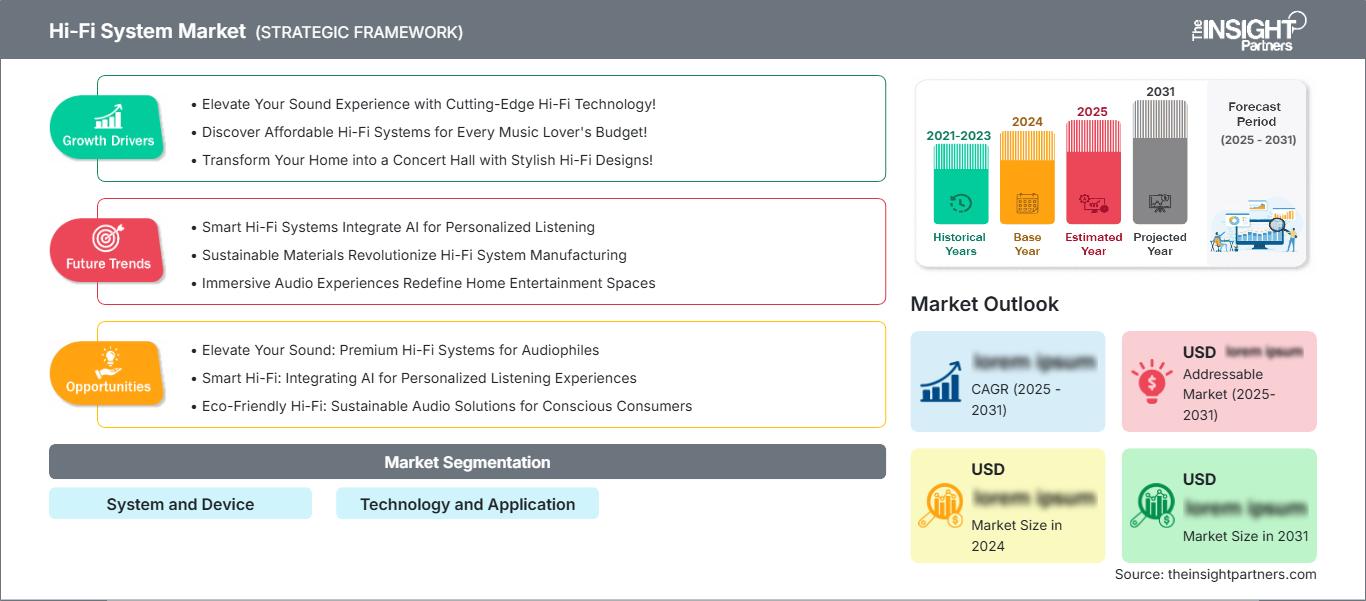
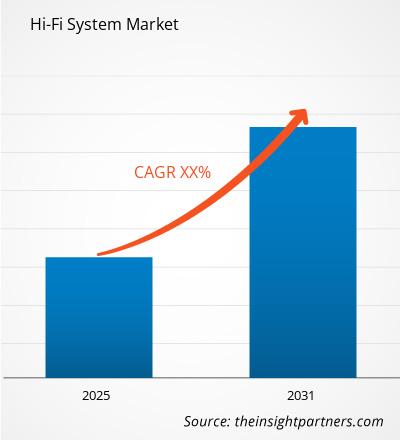
The global Hi-Fi System Market was valued at US$ 17.92 Billion in 2025 and is projected to reach US$ 30.69 Billion by 2034, registering a compound annual growth rate (CAGR) of 6.16% from 2026 to 2034. The market includes a wide range of products that include hi-fi audio equipment that helps in producing accurate sound. The technology used in such products involves the use of audio technologies such as digital signal processing, high-resolution audio codec, and multi-room wireless capability among others.
North America is a major contributor in the global Hi-Fi System market size. This region is expected to generate around 30-34% of the total revenues of the global market in 2025, growing at a CAGR of 5-7%. This growth in the market is attributed to various factors such as the high disposable incomes of consumers, music streaming capabilities, and leading audio companies.
Hi-Fi System Market Assessment and Insights
- North America: North America held a significant share of approximately 30-34% in 2025 and is projected to grow at a CAGR of 5-7% during 2026-2034. The region benefits from high consumer spending on premium audio equipment, strong streaming music adoption, and robust home theater demand.
- US: The United States accounted for approximately 85-90% of the North American Market in 2025 and is expected to grow at a CAGR of 6-8% through 2034. Strong retail infrastructure, high internet penetration, and premium product preferences drive US market growth.
- Europe: Europe represented approximately 25-28% of the global Market in 2025, with a projected CAGR of 5-7% during 2026-2034. Leading countries include Germany, the United Kingdom, and France, where audiophile culture and high-quality engineering traditions sustain steady demand.
- Asia Pacific: Asia Pacific accounted for approximately 35-39% of the global Market in 2025 and is projected to grow at a CAGR of 7-9% during 2026-2034. China, Japan, South Korea, India, and Australia are key contributors, driven by rising disposable incomes, urbanization, and increasing consumer electronics spending.
- Largest Segment: The Speaker & Soundbar segment held the largest market share of approximately 35-40% in 2025 and is projected to grow at a CAGR of 6-8% during 2026-2034. Consumer preference for enhanced audio experiences in home entertainment and streaming media consumption drives this segment's dominance.
- High Growth Segment: The Wireless connectivity segment is the fastest-growing category, with a projected CAGR of 8-10% during 2026-2034. Bluetooth, Wi-Fi, and Airplay adoption in audio devices enable seamless streaming and multi-room audio setups, driving significant growth.
- Key companies analyzed in detail: Sony Corporation, LG Electronics Ltd., Bose Corporation, Harman International Industries Incorporated, Onkyo Corporation, Bowers & Wilkins Group Ltd., Panasonic Corporation, Yamaha Corporation, Samsung Electronics Ltd., Koninklijke Philips N.V.
Source: The Insight Partners' analysis based on proprietary research, government publications, company annual reports, investor presentations, industry databases, and expert interviews.
The Hi-Fi System has experienced a phenomenal change in the past ten years; changing from conventional component-based stereo systems into wireless audio systems which emphasize on user-friendliness and do not affect the quality of the sound. This change has been enabled due to technological advancements in digital audio processing technology, wireless transmission standards and high-resolution streaming service which ensures studio-quality music can be delivered through consumer devices. Manufacturing of these products has seen a shift towards Asia Pacific due to efficient supply chains and low-cost manufacturing operations in the region.
The Western markets, on the other hand, are emphasizing on differentiation in the premium end through acoustic engineering, design and software integration with multiple devices. In the coming years, the market is expected to witness steady growth due to increasing adoption of hi-fi audio solutions in emerging geographies such as Southeast Asia, Latin America and the Middle East. Significant investments in research and development are being made by key players in the market towards spatial audio processing, artificial intelligence and wireless multiroom audio.
Hi-Fi System Market Report Scope
| Report Attribute | Details |
|---|---|
| Market size in 2025 | US$ 17.92 Billion |
| Market Size by 2034 | US$ 30.69 Billion |
| Global CAGR (2026 - 2034) | 6.16% |
| Historical Data | 2021-2024 |
| Forecast period | 2026-2034 |
Hi-Fi System Market Analysis
There are various factors that determine the growth of the market for Hi-Fi systems through their impact on the demand side. With numerous high-resolution audio streaming services providing users with lossless and immersive music, there is a considerable demand for hi-fi equipment that would reproduce sounds with professional audio quality. The streaming services Tidal, Qobuz, and Amazon Music HD report more than 15% annual user growth, signaling the growing interest in high-end audio. These factors push consumers to buy high-end speakers, sound bars, and network media players featuring advanced audio codecs and digital-to-analog converters. The supply chain for Hi-Fi systems is composed of many companies producing components, acoustic engineering firms, software developers, and distribution firms. The key components are mainly produced in Asia Pacific, while system development and branding are still carried out in North America, Europe, and Japan. Companies prefer using vertically integrated supply chains in order to keep quality under control and reduce manufacturing costs.
Competitive dynamics in the Hi-Fi System Market Report involve the combination of traditional consumer electronics manufacturers and audio-specific firms. Sony Corporation dominates the market due to its full audio line-up, which is provided by its capability to create high-quality sound via its skills in digital signal processing and acoustic engineering. Samsung Electronics Ltd. aggressively competes on the basis of its subsidiary – Harman International, which uses JBL and AKG technologies in its audio products. Bose Corporation distinguishes itself by developing proprietary audio technologies and a strong brand reputation for providing sound. Yamaha Corporation is a strong competitor due to its long-standing experience in creating musical instruments and professional audio. Investment trends reveal the increasing importance of development of wireless audio technologies, integration of voice assistants, and software functionalities that allow performing firmware upgrades and improve performance. The positioning of products focuses on the integration of ecosystem, where the company designs Hi-Fi systems that can easily integrate into the smart home platform.
● REPORT CUSTOMIZATION
Tailor This Report To Align With Your Specific Business Requirements
This report can be customized to align precisely with your business objectives, scope, and target markets. Customization options include tailored segmentation, geography, competitive analysis, and strategic insights to support informed decision-making.
Customize This Report →WHAT YOU CAN ADJUST
- ● Segmentations
- ● Geography
- ● Competitive Analysis
- ● Language Preferences
Hi-Fi System Market: Strategic Insights
Regional Insights
North America Hi-Fi System Market
North America stands out as an advanced market for Hi-Fi systems, contributing about 30-34% of worldwide revenue in 2025 and with a forecasted CAGR of 5-7% during the period between 2026 and 2034. The leadership of the market in the region is ensured by high disposable incomes of consumers, adoption of streaming music services, and adoption of high-end audio technology. The US emerges as the core driver of growth in the region due to the consumers' willingness to spend more money on immersive sound experiences. Canada provides supplementary demand for the market in the region on the basis of similar consumer preferences and distribution channels. Competition in the North American market includes several global leaders in the industry such as Bose Corporation, Sony, Samsung, and Yamaha, which hold significant shares through innovative product portfolio and wide distribution channels.
U.S. Hi-Fi System Market
In terms of the North American Hi-Fi System Market share, the United States holds the top position, having nearly 85-90% share of revenue in the year 2025 with an estimated CAGR of 6-8% over 2026-2034. The United States is one of the largest Hi-Fi markets owing to the consumer's demand in the country who are techno-savvy and have access to robust retail and e-commerce channel infrastructure along with corporate headquarters. In the United States market, consumer preference towards products are towards soundbars for Home theater systems, wireless multichannel systems for whole home audio and hi-fi speakers for music streaming purposes. High Resolution Audio formats and immersive technology such as Dolby Atmos and DTS:X requires compatibility with Hi-Fi system, thus increasing their demand in the region. Corporate wellness and insurance tie-ups will emerge as new distribution channel for premium audio solution in the country.
Europe Hi-Fi System Market
Europe contributed around 25-28% towards the Hi-Fi Systems in 2025, with a CAGR forecast of 5-7% from 2026 to 2034. Germany is seen as the biggest single national market in Europe due to engineering excellence, audio quality considerations and higher consumer spending on electronics. The United Kingdom comes second owing to its developed retail environment and adoption of wireless audio systems. Other European markets that make meaningful contributions include France, Italy, and Spain with their music cultures and higher acceptance of hi-fi audio products. European consumers tend to be discriminating, paying particular attention to sound quality, aesthetics, and sustainable features. Environmental regulation within the EU, including energy-efficient standards, affect product development and distribution in this region. Main market players are Sony, Yamaha, Bowers & Wilkins, and Philips while there are specialized local brands targeting the premium market, such as high-performance speakers and turntables.
APAC Hi-Fi System Market
Asia-Pacific was the largest regional market for Hi-Fi systems, contributing around 35-39% of total revenue generated in the year 2025, with a forecasted CAGR of 7-9% during 2026-2034. The region of Asia Pacific holds great significance as the world's largest producer of manufacturing, owing to rapid economic growth and increase in purchasing power, especially due to domestic brands of consumer electronics. Japan and South Korea play an important role due to their high technological advancement in consumer electronics, along with high usage of premium audio systems. Emerging markets for the region include India and Australia due to increased population size of middle class and penetration of smartphones in the respective countries, respectively. The region also enjoys supportive policies for electronic manufacturing industry along with strong supply chain network and government policies to enhance digital connectivity.
Middle East & Africa Hi-Fi System Market
MEA and Africa is another comparatively smaller but emerging market for Hi-Fi devices with a forecasted CAGR of 6-8% between 2026 and 2034. Saudi Arabia and UAE form the major demand generators in the region, backed by high disposable incomes, growth in the retail infrastructure, and the rising demand for premium consumer electronics. South Africa is the leading country in Sub-Saharan Africa due to its relatively advanced retail market structure and rising adoption of wireless audio technology. Development in the energy and infrastructure sector in the region has triggered a rising demand for commercial audio solutions in various applications, including hotels, entertainment, and enterprises. Rest of MEA is another varied category of markets with different adoption scenarios, where the rising penetration of smartphones and digital content consumption play a critical role in driving the adoption of audio devices.
Segmentation Analysis
System
The System encompasses product components and device categories that together constitute complete audio solutions. This segment is projected to grow at a CAGR of approximately 6-8% from 2026 to 2034, driven by continuous innovation across product categories and expanding consumer use cases beyond traditional stereo listening.
- Speaker & Soundbar: Speakers and soundbars represent the largest product category, benefiting from consumer demand for enhanced audio experiences in home entertainment and streaming media consumption. The segment includes standalone speakers, home theater systems, and soundbars with advanced features including Dolby Atmos and wireless connectivity.
- CD Player: CD players maintain a presence in the Hi-Fi market among audiophiles and collectors who value physical media sound quality. Despite declining mainstream adoption, premium CD players with high-quality digital-to-analog converters continue to serve niche markets.
- DVD Player: DVD players serve consumers seeking integrated video and audio playback solutions for home entertainment. The segment has diminished with the rise of streaming services but maintains relevance in specific geographic markets.
- Blu-ray Player: Blu-ray players offer superior audio and video quality for high-definition content consumption. The segment appeals to home theater enthusiasts who prioritize physical media's uncompressed audio and video quality.
- Network Media Player: Network media players enable streaming of high-resolution audio content from online services and local network storage. The segment is growing rapidly as consumers embrace streaming platforms and digital music libraries.
- Turntable: Turntables have experienced a resurgence driven by vinyl record popularity among audiophiles and younger consumers seeking tactile music experiences. Premium turntables with advanced tonearms and cartridge systems represent a growing niche.
- Headphone & Earphone: Headphones and earphones complement Hi-Fi systems for personal listening applications. Premium models featuring high-resolution audio codecs and advanced driver technologies appeal to discerning consumers.
Connectivity Technology
The Connectivity Technology segment categorizes Hi-Fi systems by their connection methods, encompassing wired and wireless solutions. This segment is projected to grow at a CAGR of approximately 6-9% from 2026 to 2034, with wireless technologies exhibiting the strongest growth trajectory.
- Wired: Wired connectivity maintains a presence in professional and high-end consumer audio applications where signal integrity and zero latency are prioritized. Traditional analog and digital connections including RCA, XLR, and optical cables serve audiophile and studio markets.
- Wireless: Wireless connectivity dominates the market, driven by consumer preference for tangle-free convenience, multi-room audio capabilities, and seamless integration with smartphones and streaming services. The sub-segment includes multiple technologies serving diverse use cases.
- Bluetooth: Bluetooth-enabled Hi-Fi systems offer convenient wireless streaming from mobile devices and computers. Advances in Bluetooth codecs including aptX and LDAC enable near-CD-quality wireless audio transmission.
- Wi-Fi: Wi-Fi connectivity enables high-resolution audio streaming, multi-room synchronization, and integration with smart home platforms. The technology supports lossless audio transmission and robust multi-device ecosystems.
- Airplay: Apple's Airplay technology enables seamless streaming from iOS devices and Mac computers to compatible Hi-Fi systems. The technology supports high-resolution audio and multi-room playback capabilities.
Application
The Application segment categorizes Hi-Fi system adoption across residential, automotive, commercial, and other sectors. This segment is projected to grow at a CAGR of approximately 6-8% from 2026 to 2034, with residential applications maintaining the largest share.
- Residential: Residential applications represent the largest end-user segment, encompassing home entertainment, music listening, and multi-room audio systems. Growing consumer spending on home improvement and entertainment drives sustained demand.
- Automotive: Automotive applications include factory-installed and aftermarket Hi-Fi systems for premium sound experiences. Luxury vehicle manufacturers increasingly offer high-end audio systems as differentiating features.
- Commercial: Commercial applications include Hi-Fi systems for hospitality, corporate, retail, and event spaces where high-quality audio is essential for customer experience and communication. Growing investment in commercial AV infrastructure supports segment growth.
Opportunity Snapshot
| Application Segment | Revenue Contribution | Trend Tag | Adoption Stage |
|---|---|---|---|
| Residential | High | Home Audio | Mature |
| Automotive | Medium | In-Car Sound | Scaling |
| Commercial | Medium | Venue Audio | Scaling |
Hi-Fi System Market Growth Drivers and Impact Analysis
High-Resolution Audio Streaming Services Adoption
The rise in availability of hi-res audio streaming platforms has drastically altered the consumer expectations in terms of quality of sound and hence created the need for the Hi-Fi systems for audio replication. The providers of such services in form of lossless and immersive audio have seen significant growth in number of subscribers suggesting a very strong interest from consumers for the higher audio experience. The consumer behavior has been motivated to change their audio hardware from normal consumer electronics to high-end equipment which can deliver all the features of hi-res audio. The manufacturers too have come up with the devices which are compatible with advanced audio codecs, hi-end DACs and wireless audio transfer systems. The increasing availability of hi-res content in various genres and languages has further increased the addressable market size for the streaming services.
Smart Home Integration and Voice Control
The adoption of Hi-Fi technology into smart homes has made it more effective and popular among the current generation of users. Hi-Fi gadgets which allow interaction with Google Assistant, Amazon Alexa, and Apple's Siri are hands-free gadgets, offering customized audio experience and connectivity to smart home systems. The combination of high fidelity and smart homes has increased the target market from audiophiles to mainstream buyers who want sound quality in addition to convenience. Voice-activated multi-room audio gadgets enable users to synchronize music in various rooms as well as control audio settings using voice commands. There have been new distribution networks as a result of smart home phenomenon with manufacturers producing Hi-Fi devices with smart home functionality.
Rising Consumer Spending on Home Entertainment
Consumer spending towards home entertainment has become a key growth factor for the market as people spend on high-quality audio equipment to improve their viewing and listening experience. There has been an increasing trend of making a dedicated space at home for enjoying movies and music with the help of advanced surround sound systems and soundbars. Audio equipment now constitutes a large part of the entertainment budget of consumers owing to the significance of audio quality for movies and music. This phenomenon is very common in the developed regions as people spend more money on entertainment and improvement in homes.
Hi-Fi System Market Future Trends
AI-Powered Adaptive Sound Optimization
Artificial intelligence is increasingly central to delivering personalized audio experiences that adapt to individual user preferences, room acoustics, and listening environments. AI algorithms analyze listening habits, room dimensions, and acoustic characteristics to automatically optimize sound profiles for specific spaces and content types. This trend extends to active noise cancellation and dialogue enhancement features that improve clarity in challenging listening environments. The integration of machine learning enables devices to learn user preferences over time, creating increasingly refined audio experiences that enhance satisfaction and reduce the need for manual adjustments. As AI capabilities continue to advance, Hi-Fi systems are evolving from passive audio playback devices into intelligent platforms that proactively manage the entire listening experience.
Spatial Audio and Immersive Sound Formats
The adoption of spatial audio and immersive sound formats represents a transformative Hi-Fi System Market trend, delivering three-dimensional soundscapes that enhance music, gaming, and cinematic experiences. Technologies including Dolby Atmos, DTS:X, and Sony's 360 Reality Audio create multi-dimensional sound environments that place listeners at the center of the audio experience. Consumer demand for immersive audio is being fueled by streaming platforms offering spatial audio content, gaming consoles supporting immersive sound, and increasing availability of compatible recordings. This trend is driving development of products with advanced multi-driver arrays, upward-firing speakers, and sophisticated processing algorithms that render spatial audio accurately in diverse room configurations. The expansion of spatial audio compatibility across music and entertainment content ensures sustained demand for immersive-capable Hi-Fi systems.
Hi-Fi System Market Opportunities
Premium Wireless Multi-Room Solutions
The development of premium wireless multi-room audio solutions represents a significant growth opportunity for the Market. Consumers increasingly seek whole-home audio systems that deliver consistent sound quality across multiple rooms and spaces. This opportunity extends to integrated home audio solutions that combine wireless convenience with audiophile-grade sound quality, addressing the gap between consumer wireless speakers and traditional high-fidelity component systems. Manufacturers can differentiate through proprietary wireless protocols that ensure synchronization, low latency, and reliable connectivity across large spaces. The integration of room correction technology and adaptive sound optimization enhances multi-room system performance. This segment offers attractive margins and recurring revenue through software updates and content integration.
Automotive Premium Audio Systems Partnership
Partnerships with automotive manufacturers for factory-installed premium audio systems represent an expanding opportunity for Hi-Fi system manufacturers. Luxury vehicle manufacturers increasingly differentiate their models through high-end audio systems from established Hi-Fi brands, creating substantial and recurring revenue streams. The opportunity extends to electric vehicle manufacturers seeking to enhance cabin experiences through superior sound systems that complement quiet powertrains. Manufacturers can leverage their acoustic engineering expertise, brand reputation, and software capabilities to secure automotive partnerships. This segment offers long-term revenue stability and brand exposure through association with premium automotive brands. The Hi-Fi System Market Forecasts indicate sustained growth potential in automotive applications as consumers prioritize in-vehicle entertainment experiences.
Recent Developments
- August 2026: PacBio — the company announced new SPRQ-Nx chemistry and a software update for its Vega sequencing system, increasing HiFi output from 60 Gb to 90 Gb per run while reducing cost per gigabase by about 40%. The update also introduces two- and four-hour sequencing runs, improved methylation analysis, and compliance controls for regulated laboratories.
- May 2026: DALI — the company launched the VEGA, a premium all-in-one wireless sound system combining advanced acoustics, wireless connectivity, intuitive controls, and Danish design for high-quality home audio. The system is expected to become available through selected authorized DALI dealers from September/October 2026.
- June 2026: Bose Corporation — the company acquired Vienna-based StreamUnlimited Engineering GmbH, a provider of software, hardware modules, and engineering services for connected audio and smart-home products. The acquisition strengthens Bose’s Audio Technology business by expanding its ability to bring proprietary audio technologies to third-party devices, streaming platforms, and connected ecosystems.
Frequently Asked Questions

- Comprehensive Market Sizing and Forecast Analysis
- Detailed Segmentation Analysis
- In-Depth Market Dynamics Assessment
- Regional and Country-Level Insights
- Competitive Landscape and Company Benchmarking
- Strategic Business Intelligence
Recent Reports
Testimonials

The Insight Partners' SCADA System Market report is comprehensive, with valuable insights on current trends and future forecasts. The team was highly professional, responsive, and supportive throughout. We are very satisfied and highly recommend their services.
RAN KEDEM Partner, Reali Technologies LTDs
I requested a report on a very specific software market and the team produced the report in a few days. The information was very relevant and well presented. I then requested some changes and additions to the report. The team was again very responsive and I got the final report in less than a week.
JEAN-HERVE JENN Chairman, Future Analytica
We worked with The Insight Partners for an important market study and forecast. They gave us clear insights into opportunities and risks, which helped shape our plans. Their research was easy to use and based on solid data. It helped us make smart, confident decisions. We highly recommend them.
PIYUSH NAGPAL Sr. Vice President, High Beam Global
The Insight Partners delivered insightful, well-structured market research with strong domain expertise. Their team was professional and responsive throughout. The user-friendly website made accessing industry reports seamless. We highly recommend them for reliable, high-quality research services
YUKIHIKO ADACHI CEO, Deep Blue, LLC.
This is the first time I have purchased a market report from The Insight Partners.While I was unsure at first, I visited their web site and felt more comfortable to take the risk and purchase a market report.I am completely satisfied with the quality of the report and customer service. I had several questions and comments with the initial report, but after a couple of dialogs over email with their analyst I believe I have a report that I can use as input to our strategic planning process.Thank you so much for taking the extra time and making this a positive experience.I will definitely recommend your service to others and you will be my first call when we need further market data.
JOHN SUZUKI President and Chief Executive Officer, Board Director, BK Technologies
I wish to appreciate your support and the professionalism you displayed in the course of attending to my request for information regarding to infectious disease IVD market in Nigeria. I appreciate your patience, your guidance, and the fact that you were willing to offer a discount, which eventually made it possible for us to close a deal. I look forward to engaging The Insight Partners in the future, all thanks to the impression you have created in me as a result of this first encounter.
DR CHIJIOKE ONYIA MANAGING DIRECTOR, PineCrest Healthcare Ltd.Reason to Buy
- Informed Decision-Making
- Understanding Market Dynamics
- Competitive Analysis
- Identifying Emerging Markets
- Customer Insights
- Market Forecasts
- Risk Mitigation
- Boosting Operational Efficiency
- Strategic Planning
- Investment Justification
- Tracking Industry Innovations
- Aligning with Regulatory Trends





 Get Free Sample for