
High Security Electronic Locks Market Growth, Trends & Demand by 2034
Coverage: by Component (Hardware, Software and Service); Product Type (Electromagnetic Locks, Electronic Strikes and Electronic Deadbolts and Latches); Authentication Method (Keypad, Security Tokens, Biometrics and RFID) and End-User (Residential, Commercial, Government, Automotive and Industrial), and Geography (North America, Europe, Asia Pacific, and South and Central America)
- Status : Data Released
- Report Code : TIPTE100001345
- Category : Electronics and Semiconductor
- No. of Pages : 150
- Available Report Formats :


- Last update date : September 17, 2026


2025 Market Size
US$ 2.75 Bn
Base year value
2034 Forecast
US$ 4.97 Bn
Projected by 2034
CAGR 2026-2034
6.79 %
Growth rate
Addressable Market
US$ 34.87 Bn
(2026-2034)
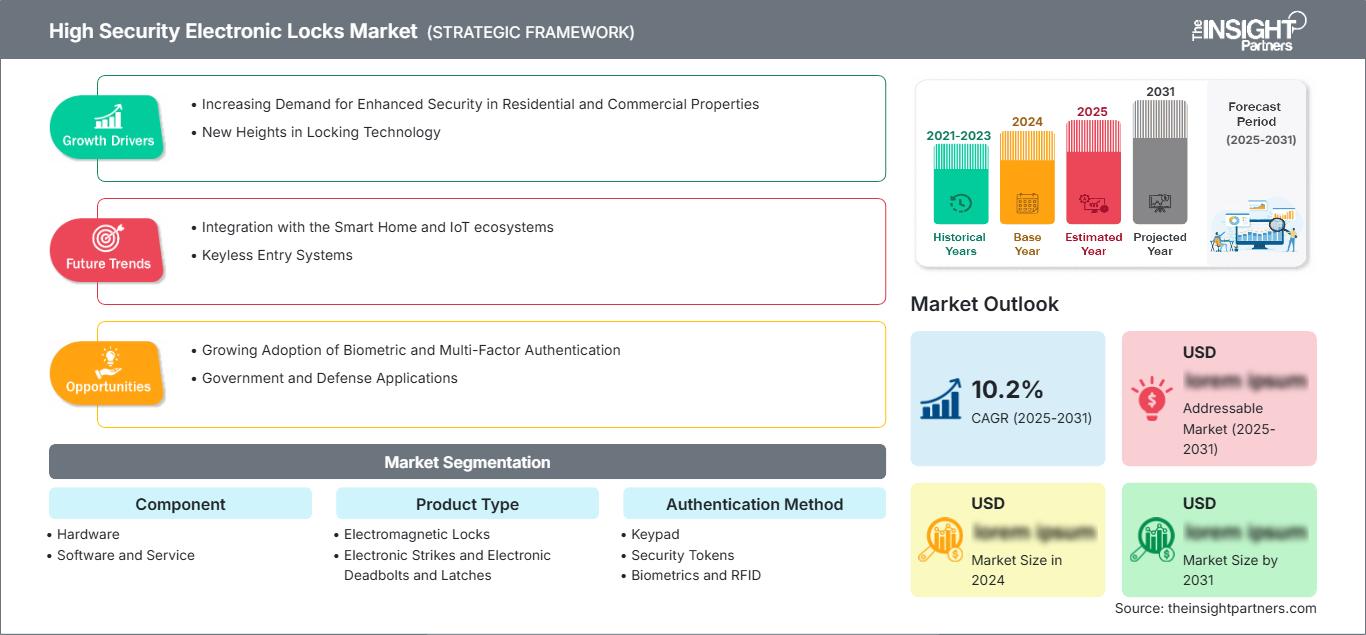
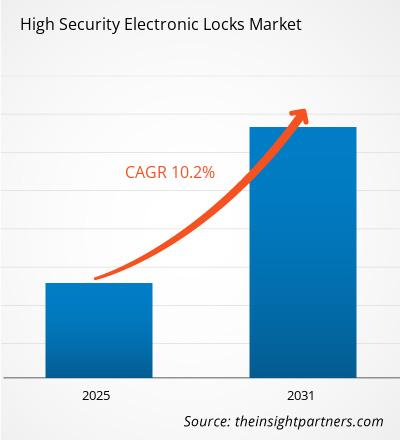
The High Security Electronic Locks Market reached US$ 2.75 Billion in 2025 and is projected to reach US$ 4.97 Billion by 2034, expanding at a CAGR of 6.79% during 2026–2034. The market demonstrates increasing usage of electronic access control in residential, commercial, government, automotive, and industrial applications, driven by higher authentication needs, security infrastructures that are connected, and requirement for credentials that can be remotely managed as well as monitored access events.
The North American High Security Electronic Locks Market Size is projected to have a forecasted CAGR of 6.4–7.2% until 2034, due to upgrading of access infrastructure in commercial applications and growing usage of cloud-based credentials. Multi-family housing, critical buildings, and corporate campuses are key structural demand centers due to the need for security management and control of the credential lifecycles.
High Security Electronic Locks Market Assessment and Insights
- North America: North America represented an estimated 32–36% share in 2025 and is modeled to expand at a 6.4–7.2% CAGR between 2026–2034, supported by commercial modernization, connected access control, and multifamily deployment.
- US: The US accounted for an estimated 78–82% of North American revenue in 2025 and is modeled to grow at a 6.3–7.1% CAGR during 2026–2034, led by enterprise and residential applications.
- Europe: Europe held an estimated 24–28% share in 2025 and is modeled to grow at a 6.1–6.9% CAGR during 2026–2034, with Germany, the UK, France, Italy, and Spain providing diversified demand.
- Asia Pacific: Asia Pacific represented an estimated 25–29% share in 2025 and is modeled to expand at a 7.4–8.3% CAGR during 2026–2034, led by China, Japan, South Korea, India, and Australia.
- Largest Segment: Hardware held an estimated 56–60% market share in 2025 and is modeled to grow at a 6.2–6.9% CAGR during 2026–2034, reflecting continued physical lock deployment.
- High Growth Segment: Software represented an estimated 15–19% market share in 2025 and is modeled to grow at an 8.0–9.0% CAGR during 2026–2034, supported by cloud administration and credential analytics.
- Key companies analyzed in detail: Weiser Lock Corp, dormakaba Holding AG, Godrej & Boyce Manufacturing Company Limited, ASSA ABLOY AB, Shengjiu Group Co., Ltd., Spectrum Brands Holdings, Inc., Honeywell International Inc., Cisco Systems, Inc., Vivint, Inc., Gunnebo AB.
Source: The Insight Partners' analysis based on proprietary research, government publications, company annual reports, investor presentations, industry databases, and expert interviews.
The High Security Electronic Locks Market has transformed from simple electronic cylinder and keypad devices to complex access control ecosystems that use the readers, locks, software, and credential services. Modern manufacturing focuses on the use of wireless connections, small electromechanical devices, biometrics identification, RFID, mobility of credentials, and compatibility. At the same time, there are such trends in manufacturing as cybersecurity protection, better battery life, ease of installation, and ability to operate mechanically.
With regard to future growth, High Security Electronic Locks Market can leverage smart buildings investments, urban residential building projects, digitization of workplaces, and enhanced security infrastructure in infrastructure-oriented countries. With legal attention towards management of access, security, privacy, and traceability, companies have no choice but to transition from fragmented credentials to integrated ones. Implementations in countries like India, Southeast Asia, Gulf states, and Latin America will widen the customer base.
High Security Electronic Locks Market Report Scope
| Report Attribute | Details |
|---|---|
| Market size in 2025 | US$ 2.75 Billion |
| Market Size by 2034 | US$ 4.97 Billion |
| Global CAGR (2026 - 2034) | 6.79% |
| Historical Data | 2021-2024 |
| Forecast period | 2026-2034 |
High Security Electronic Locks Market Analysis
The High Security Electronic Locks Market is being driven by demand for access control, flexible credentials, and visible security through various property types. Companies now demand a system that would provide authorization based on role, time, location, or credential status, and retain audit trail information. The industry consists of lock manufacturers, electronic components manufacturers, authentication technology providers, software providers, installation companies, security integrators, property management companies, and facility operators. The demand is thus moving away from single locks to an access control platform.
The supply chain will depend on reliable motors, solenoids, sensors, controllers, batteries, wireless systems, readers, and software interface. Supply factors include semiconductor availability, electronic component pricing, concentration of manufacturing and regional certifications. Manufacturers who can provide reliability in hardware as well as scalability in software are better positioned to meet enterprise purchasing requirements. Services also play an important role since installation, maintenance, credential migration, and system integration have significant impact on economic performance.
The High Security Electronic Locks Market report mentioned that competition is moving towards becoming more and more platform based and not just purely mechanical. ASSA ABLOY AB and dormakaba Holding AG offer strong access solutions, while Godrej & Boyce Manufacturing Company Limited and Shengjiu Group Co., Ltd. provide regionality and capabilities in specific products. Weiser Lock Corp and Spectrum Brands Holdings, Inc. are players in the residential access space, while Honeywell International Inc., Cisco Systems, Inc., and Vivint, Inc. offer additional security and connectivity features.
The investment focus has shifted towards connected credential, cloud administration, biometric verification, and interoperability capabilities. ASSA ABLOY AB has been continuously expanding its technology and product portfolio, while dormakaba Holding AG has focused on migrating to more advanced wireless and integrated platforms. Competitiveness increasingly relies on software revenues, partnerships and installation ecosystem capability, and an ability to provide solutions for both retrofit and new construction without significant changes to the infrastructure.
● REPORT CUSTOMIZATION
Tailor This Report To Align With Your Specific Business Requirements
This report can be customized to align precisely with your business objectives, scope, and target markets. Customization options include tailored segmentation, geography, competitive analysis, and strategic insights to support informed decision-making.
Customize This Report →WHAT YOU CAN ADJUST
- ● Segmentations
- ● Geography
- ● Competitive Analysis
- ● Language Preferences
High Security Electronic Locks Market: Strategic Insights
Regional Insights
North America High Security Electronic Locks Market
North America is expected to represent 32-36% High Security Electronic Locks Market share in 2025 and exhibit 6.4-7.2% CAGR through 2034. The region enjoys advantages such as developed security architecture of offices, widespread adoption of enterprise solutions, new multifamily buildings, and need for centrally managed credentials. In North America, the US is the main driver of regional revenues whereas Canada adds to its market performance via commercial, institutional, and residential modernization. Customers analyze electronic locks as a part of larger architecture solutions.
There is a structural demand driven by office, health care, education, hospitality, logistics, and infrastructure sectors. Wireless capabilities are especially important where rewiring of existing buildings can be too expensive or inconvenient. Multi-family building managers are implementing remote access to buildings for residents, visitors, contractors, and maintenance personnel. Also, the competition in the region will favor companies with comprehensive solutions in terms of hardware, software, integration, and services.
U.S. High Security Electronic Locks Market
The US was estimated to account for 78-82% of the North American market in 2025 and is projected to grow at a 6.3-7.1% CAGR up to 2034. There are significant demands from commercial buildings, multifamily residential, hospitality, health care facilities, education, and home automation. Adoption of mobile credentials, RFID, biometric validation, and cloud-based management systems will become more common when users need remote validation and audit access logs.
There are active operations from companies like ASSA ABLOY AB, dormakaba Holding AG, Honeywell International Inc., Spectrum Brands Holdings, Inc., Weiser Lock Corp, Cisco Systems, Inc., and Vivint, Inc. The current application trend focuses on easy-to-install wireless locks, building system integration, and automated credentialing. Buyers will be looking more for security aspects, battery management, emergency access, and access control system compatibility during their replacement cycle.
Europe High Security Electronic Locks Market
Europe held an estimated 24–28% share in 2025 and is modeled to grow at a 6.1–6.9% CAGR through 2034. Germany is the leading country by regional industrial depth, while the UK, France, Italy, and Spain contribute through commercial, residential, hospitality, and infrastructure modernization.
UK has multifamily, hospitality, and institutional retrofit opportunities, aided by mobile credential technology to enable flexible operations. Germany offers advanced industrial capabilities along with advanced commercial security needs and requirements for access management systems.
There are opportunities for France, Italy, and Spain in the areas of hotels, offices, residences, and public buildings. Procurement processes in Europe increasingly stress on the need for interoperability, privacy-driven system designs, energy efficiency, and robust hardware components. There is an established architecture of hardware solutions in Europe for access control.
APAC High Security Electronic Locks Market
APAC contributed 25-29% in 2025 and is expected to witness a CAGR of 7.4-8.3% till 2034 and hence is the fastest-growing major region. The leading countries are China, Japan, South Korea, India, and Australia. Demand for smart locks is driven by smart-home technology, urban construction, hotels, and electronic products.
Increased industrial investments and government efforts for digitalization will drive the growth of the market in APAC region. While China benefits from large-scale manufacturing and penetration of smart locks, India sees increased residential and commercial prospects. The Japanese and South Korean regions focus on technological access control, and Australia benefits from commercial security upgrades.
Middle East & Africa High Security Electronic Locks Market
The demand from Middle East and Africa will be projected to grow at a CAGR of 6.8% to 7.6% up until 2034 due to the need for infrastructure development, hospitality, commercial constructions, and security modernization. The leaders in regional use include Saudi Arabia and the UAE, and South Africa continues to be an important player when it comes to commercial and institutional uses.
The energy infrastructure, airports, hotels, multi-use constructions, and government institutions present the need for access control and credential management solutions. Projects in the Gulf countries are becoming more demanding of security systems integration when being built, whereas retrofits are more common in commercial properties already developed.
Segmentation Analysis
Component
Hardware remains the principal component category because every deployment requires physical locking mechanisms, controllers, readers, and supporting electronics. Software is gaining strategic importance in the High Security Electronic Locks Market as organizations move toward centralized credential administration, analytics, and remote management. Services support installation, integration, maintenance, and migration. The component segment is modeled to expand at a 6.1–7.0% CAGR during 2026–2034 as buyers increasingly procure complete access ecosystems.
- Hardware: Hardware maintains the largest market position because electronic locks require dependable physical mechanisms, controllers, sensors, and power systems. Demand is strongest where security upgrades require reliable retrofit compatibility.
- Software: Software is strategically important for centralized authorization, credential management, event monitoring, integrations, and remote administration, particularly across distributed commercial and multifamily properties.
- Service: Services support installation, configuration, maintenance, integration, and lifecycle migration. Demand increases as electronic access deployments become more interconnected and require specialized technical support.
Product Type
Product selection varies according to door configuration, security requirement, installation environment, and integration architecture. Electromagnetic locks are important where rapid access control and holding force are required, while electronic strikes support retrofit applications. Electronic deadbolts and latches are especially relevant to residential, hospitality, and selected commercial installations. The product type segment is modeled to grow at a 6.4–7.2% CAGR during 2026–2034.
- Electromagnetic Locks: These products remain important for controlled-entry applications requiring strong holding performance and integration with access-control systems, particularly in commercial and institutional facilities.
- Electronic Strikes: Electronic strikes support retrofit-friendly deployment across compatible door frames and remain strategically relevant where operators seek electronic authorization without replacing complete mechanical locksets.
- Electronic Deadbolts and Latches: These products are widely applicable to residential and hospitality environments, where compact form factors, credential flexibility, and user convenience influence purchasing decisions.
Authentication Method
Authentication is shifting toward combinations of credentials rather than single methods. Keypads remain practical for low-friction access, while security tokens support controlled environments. Biometrics provide stronger identity association, and RFID remains widely applicable because credentials can be issued, revoked, and managed systematically. The authentication method segment in the High Security Electronic Locks Market is modeled to expand at a 7.0–8.0% CAGR during 2026–2034 as organizations prioritize stronger identity assurance.
- Keypad: Keypads provide straightforward code-based access without physical credentials, making them useful for residential, small commercial, storage, and controlled-service applications.
- Security Tokens: Security tokens support environments requiring credential portability and controlled issuance, particularly where organizations need explicit user authorization and revocation capabilities.
- Biometrics: Biometrics strengthen identity verification by associating access with physical characteristics, supporting higher-security facilities and applications where credential sharing presents an operational concern.
- RFID: RFID remains strategically important because cards and tags can be issued at scale, centrally revoked, and integrated with established access-control infrastructures.
End-User
End-user requirements differ substantially by security exposure, user population, operating model, and regulatory expectations. Commercial and government facilities prioritize centralized administration and auditability, while residential users emphasize convenience and remote access. Automotive and industrial deployments require application-specific durability and integration. The end-user segment in the High Security Electronic Locks Market is modeled to grow at a 6.6–7.5% CAGR during 2026–2034, supported by broadening electronic access adoption.
- Residential: Residential adoption is supported by smart-home integration, mobile access, temporary credentials, and consumer demand for convenient entry management without conventional key dependency.
- Commercial: Commercial facilities emphasize centralized access administration, employee credential management, visitor control, audit trails, and integration with broader building-security platforms.
- Government: Government facilities require controlled identities, restricted zones, auditable events, and robust physical security, creating demand for electronically managed access across offices and infrastructure.
- Automotive: Automotive applications require specialized electronic locking architectures and integration with vehicle security, manufacturing, logistics, and controlled operational environments.
- Industrial: Industrial sites prioritize durability, access zoning, worker authorization, and integration with safety and operational systems across factories, warehouses, utilities, and processing facilities.
Opportunity Snapshot
| End Users | Revenue Contribution (High/Medium/Low) | Trend Tag (MAX 2 words) | Adoption Stage (Emerging/Scaling/Mature) |
| Residential | High | Smart Entry | Scaling |
| Commercial | High | Cloud Access | Mature |
| Government | Medium | Secure Zones | Scaling |
| Automotive | Medium | Vehicle Security | Emerging |
| Industrial | High | Facility Control | Scaling |
High Security Electronic Locks Market Growth Drivers and Impact Analysis
Expansion of Cloud-Managed Access Architectures
Cloud-managed access represents new procurement economics, since now it becomes possible for the administrators to manage credentials, privileges, events, and device status at distributed properties. Thus, there is no need for having different databases and separately installed local systems, since all these functions could be centralized in governance and standardized in access management. This procurement economy model is beneficial for multifamily portfolios, retail chains, offices, hotels, logistics centers, and other facilities. The market effect of such solution does not consist only in gaining income from software sale but also in increasing demand for old-fashioned locks replacing due to lack of ability to administer them remotely, as well as for wireless connectivity, gateways, APIs, and service agreements. Vendors able to provide both stable offline mode and cloud-based synchronization would be able to serve those facilities which have inconsistent connectivity.
Rising Demand for Stronger Identity-Based Authentication
Organizations are moving beyond possession-based credentials as security requirements become more closely linked to individual identity and access accountability. Biometrics, RFID credentials, security tokens, and mobile-based authorization can provide more granular control than conventional keys. The impact is particularly relevant in government, healthcare, industrial, and critical infrastructure settings where access events require stronger traceability. Biometric adoption can also reduce credential-sharing risks, although privacy, enrollment, accuracy, and fallback access requirements influence deployment decisions. RFID remains attractive where large populations need inexpensive, revocable credentials. As authentication technologies become more interoperable, lock manufacturers are increasingly expected to support multiple credential types within common platforms. This encourages investment in readers, controllers, software interfaces, and secure credential-management capabilities rather than focusing exclusively on mechanical lock performance.
Modernization of Aging Physical Access Infrastructure
A substantial opportunity arises when older mechanical or electronically isolated access systems reach replacement cycles. Property owners increasingly seek upgrades that improve security without requiring complete door reconstruction or extensive wiring. Electronic strikes, wireless locksets, retrofit readers, and battery-powered devices can address these requirements while preserving useful elements of existing infrastructure. The resulting demand favors products designed for compatibility across different door types and access platforms. Commercial buildings, educational facilities, hotels, warehouses, and multifamily properties can prioritize phased modernization to control capital expenditure and operational disruption. Vendors that provide migration tools, installation support, and interoperability can therefore capture replacement demand more effectively than suppliers focused only on new construction. This modernization pathway also creates recurring opportunities for maintenance, credential migration, software subscriptions, and system upgrades.
High Security Electronic Locks Market Future Trends
Converged Physical and Digital Identity Platforms
Future deployments are likely to treat physical access as an extension of enterprise identity management rather than a separate security function. Electronic locks will increasingly exchange authorization information with workforce identity systems, visitor platforms, property-management software, and security monitoring tools. This convergence can enable automated onboarding, immediate credential revocation, role-based access, and consistent policies across physical locations. Artificial intelligence may assist anomaly detection by identifying unusual access patterns, although governance and explainability will remain important. Edge processing should also become more capable, allowing locks to continue authenticating users when cloud connectivity is unavailable. The strategic consequence is a shift toward interoperable platforms where lock hardware, authentication technologies, software APIs, and cybersecurity controls are designed as one architecture.
Multi-Modal and Privacy-Aware Authentication
Authentication systems are likely to combine credentials according to risk, location, and user context rather than applying one method universally. A low-risk residential entry may use a mobile credential, while a restricted industrial zone could require RFID plus biometrics. Such adaptive architectures can improve security without imposing excessive friction on routine users. Privacy-aware design will become increasingly important where biometric information is collected, creating demand for local processing, encrypted credential storage, transparent retention policies, and controlled administrative access. Manufacturers may also develop more sophisticated fallback mechanisms that maintain emergency access without undermining primary authentication. These High Security Electronic Locks Market trends can broaden adoption in sensitive environments by addressing the practical concerns that often accompany stronger identity verification.
High Security Electronic Locks Market Opportunities
Retrofitting Distributed Commercial Properties
Distributed property portfolios represent an attractive investment opportunity because many buildings contain inconsistent generations of mechanical and electronic access equipment. Operators can use phased retrofits to standardize credentials while avoiding simultaneous replacement across every location. Wireless locks and electronic strikes can reduce installation complexity, particularly where electrical infrastructure is difficult to modify. Investors and technology providers can prioritize property groups with recurring access-management requirements, including hotels, retail networks, offices, healthcare facilities, and multifamily portfolios. The strongest commercial proposition combines hardware with migration services, centralized administration, analytics, and lifecycle support. Such programs can generate repeat orders as additional sites are upgraded. Vendors with established installer networks and interoperable products are particularly well positioned to capture these multi-location modernization programs.
Integrated Security Solutions in Emerging Infrastructure Markets
Emerging infrastructure in the High Security Electronic Locks Market Forecast provide opportunities to incorporate electronic access during new construction rather than relying on later retrofit programs. Airports, hotels, hospitals, data facilities, government buildings, logistics centers, and mixed-use developments can specify access-control architecture at the design stage. Gulf economies, India, Southeast Asia, and selected African markets offer potential where urbanization and infrastructure investment are creating new secured facilities. Local partnerships can improve procurement access, installation capacity, regulatory alignment, and after-sales support. Suppliers should prioritize products capable of operating across different power and connectivity conditions while supporting multiple authentication methods. Integration with surveillance, visitor management, and building systems can strengthen project value. The opportunity is therefore strongest for vendors able to provide complete, interoperable access architectures rather than standalone locking hardware.
Recent Developments
- December 2025: ASSA ABLOY acquired Sargent and Greenleaf, a US manufacturer of high-security mechanical and electronic locking solutions and safe hardware. The acquisition strengthens ASSA ABLOY’s secure access portfolio and expands its capabilities across commercial, institutional, and high-security applications. Sargent and Greenleaf reported approximately US$45 million in 2024 sales.
- August 2025: August 2025: Allegion plc, through a subsidiary, acquired Brisant Secure Limited, a UK provider of residential security hardware. Brisant offers mechanical and electronic locks and door accessories, including the Ultion range of high-security lock cylinders and key systems. The transaction expanded Allegion’s residential security portfolio and strengthened its presence in the UK market..
- January 2026: RA-Lock Group launched as a unified platform bringing specialized security and access-control brands under a single enterprise structure. The initiative is designed to expand market reach, streamline operations, and provide integrated high-security solutions across North America, combining expertise across locking, hardware, distribution, and related security sAllegion, through a subsidiary, acquired Brisant Secure Limited, a UK provider of residential security hardware. Brisant offers mechanical and electronic loervices.
Frequently Asked Questions

- Comprehensive Market Sizing and Forecast Analysis
- Detailed Segmentation Analysis
- In-Depth Market Dynamics Assessment
- Regional and Country-Level Insights
- Competitive Landscape and Company Benchmarking
- Strategic Business Intelligence
Recent Reports
Testimonials

The Insight Partners provided valuable market intelligence that supported our global go-to-market strategy. Their team was professional, responsive, and attentive to our feedback, providing thoughtful analysis and helpful methodological clarifications throughout the project.
Junmo Kim Chief Financial Officer (CFO), Enertech Co., Ltd.
The Insight Partners' SCADA System Market report is comprehensive, with valuable insights on current trends and future forecasts. The team was highly professional, responsive, and supportive throughout. We are very satisfied and highly recommend their services.
RAN KEDEM Partner, Reali Technologies LTDs
I requested a report on a very specific software market and the team produced the report in a few days. The information was very relevant and well presented. I then requested some changes and additions to the report. The team was again very responsive and I got the final report in less than a week.
JEAN-HERVE JENN Chairman, Future Analytica
We worked with The Insight Partners for an important market study and forecast. They gave us clear insights into opportunities and risks, which helped shape our plans. Their research was easy to use and based on solid data. It helped us make smart, confident decisions. We highly recommend them.
PIYUSH NAGPAL Sr. Vice President, High Beam Global
The Insight Partners delivered insightful, well-structured market research with strong domain expertise. Their team was professional and responsive throughout. The user-friendly website made accessing industry reports seamless. We highly recommend them for reliable, high-quality research services
YUKIHIKO ADACHI CEO, Deep Blue, LLC.
This is the first time I have purchased a market report from The Insight Partners.While I was unsure at first, I visited their web site and felt more comfortable to take the risk and purchase a market report.I am completely satisfied with the quality of the report and customer service. I had several questions and comments with the initial report, but after a couple of dialogs over email with their analyst I believe I have a report that I can use as input to our strategic planning process.Thank you so much for taking the extra time and making this a positive experience.I will definitely recommend your service to others and you will be my first call when we need further market data.
JOHN SUZUKI President and Chief Executive Officer, Board Director, BK Technologies
I wish to appreciate your support and the professionalism you displayed in the course of attending to my request for information regarding to infectious disease IVD market in Nigeria. I appreciate your patience, your guidance, and the fact that you were willing to offer a discount, which eventually made it possible for us to close a deal. I look forward to engaging The Insight Partners in the future, all thanks to the impression you have created in me as a result of this first encounter.
DR CHIJIOKE ONYIA MANAGING DIRECTOR, PineCrest Healthcare Ltd.Reason to Buy
- Informed Decision-Making
- Understanding Market Dynamics
- Competitive Analysis
- Identifying Emerging Markets
- Customer Insights
- Market Forecasts
- Risk Mitigation
- Boosting Operational Efficiency
- Strategic Planning
- Investment Justification
- Tracking Industry Innovations
- Aligning with Regulatory Trends





 Get Free Sample for