
Embedded Security Market Size, Trends & Growth by 2034
Coverage: By Product (Secure Element and Embedded SIM, Trusted Platform Module, Hardware Security Module, Hardware Tokens); Security Type (Authentication and Access Management, Payment, Content Protection); Application (Wearables, Smartphones and Tablets, Automotive, Smart Identity Cards, Industrial, Payment Processing and Cards, Computers) , and Geography (North America, Europe, Asia Pacific, and South and Central America)
- Status : Data Released
- Report Code : TIPRE00021747
- Category : Electronics and Semiconductor
- No. of Pages : 150
- Available Report Formats :


- Last update date : August 06, 2026


2025 Market Size
US$ 9.13 Bn
Base year value
2034 Forecast
US$ 19.26 Bn
Projected by 2034
CAGR 2026-2034
9.78 %
Growth rate
Addressable Market
US$ 134.85 Bn
(2026-2034)
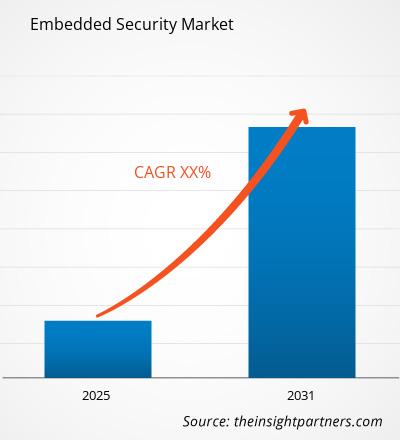
The Embedded Security Market is estimated to grow from US$ 9.13 Billion in 2025 to reach US$ 19.26 Billion by 2034 at a CAGR of 9.78% in 2026-2034. This market is driven by hardware-based roots of trust, secure key storage, secure boot, device authentication, payment credentials, and identity security through connected products, vehicles, industrial machinery, smartphones, tablets, wearables, smart cards, and computer platforms.
The North America Embedded Security Market size is expected to grow at a CAGR of 8.8-9.6% from 2026 to 2034 with drivers such as cybersecurity regulations, connected car architecture, enterprise device security, and healthy semiconductor design ecosystem. U.S. deployment will be fueled by government security guidelines, increased use of cloud-connected endpoints, and greater use of secure elements, TPMs, and hardware security modules in regulated payments, industrial automation, and identity solutions.
Embedded Security Market Assessment and Insights
- North America accounted for 31–34% Embedded Security Market share in 2025 and is growing at a CAGR of 8.8–9.6% during 2026–2034, led by hardware-backed identity, payment security, automotive connectivity, and enterprise endpoint protection.
- US represented 78–82% of North American revenue in 2025 and is growing at a CAGR of 9.0–9.8% during 2026–2034, supported by cloud device fleets and federal security requirements.
- Europe held 24–27% share in 2025 and is growing at a CAGR of 8.5–9.3% during 2026–2034, with Germany, France, the UK, Italy, and Spain leading connected mobility and identity programs.
- Asia Pacific accounted for 32–36% share in 2025 and is growing at a CAGR of 10.4–11.2% during 2026–2034, led by China, Japan, South Korea, India, and Taiwan.
- Largest Segment Secure Element and Embedded SIM held 39–43% market share in 2025 and is growing at a CAGR of 9.2–10.0% during 2026–2034 due to payment, mobile identity, and IoT provisioning.
- High Growth Segment Automotive represented 15–18% market share in 2025 and is growing at a CAGR of 11.4–12.2% during 2026–2034, supported by connected car access, secure ECUs, and software-defined vehicles.
- Key companies analyzed in detail: Infineon Technologies AG; STMicroelectronics N.V.; NXP Semiconductors N.V.; Thales DIS; Texas Instruments Incorporated; Renesas Electronics Corporation; Qualcomm Incorporated; Microchip Technology Incorporated; Samsung Electronics Co., Ltd.; IDEMIA Group.
Source: The Insight Partners' analysis based on proprietary research, government publications, company annual reports, investor presentations, industry databases, and expert interviews.
In terms of security architecture, the trend has shifted from software-based mechanisms to silicon-based protection that provides a foundation of trust prior to the OS booting up. The Embedded Security Market sees a shift in focus from protection to inherent security in the face of the proliferation of connected devices, software complexities in automotive applications, cybersecurity threats in industrial environments, and heightened compliance requirements.
The forward-looking demand for embedded security solutions will grow as manufacturers from new geographies include features such as secure provisioning, identity management, and lifetime protection for their connected devices. Investments are flowing in certified silicon, quantum-resistant capabilities, secure manufacturing processes, and cloud-based key management systems. In addition, the regulatory tailwind offered by the EU Cyber Resilience Act, NIST IoT Guidelines, IEC 62443, ISO/SAE 21434, and Payment Standards will fuel the adoption of embedded security because of the need for security by audit.
Embedded Security Market Report Scope
| Report Attribute | Details |
|---|---|
| Market size in 2025 | US$ 9.13 Billion |
| Market Size by 2034 | US$ 19.26 Billion |
| Global CAGR (2026 - 2034) | 9.78% |
| Historical Data | 2021-2024 |
| Forecast period | 2026-2034 |
Embedded Security Market Analysis
Embedded Security Market growth is attributed to growing connectivity of endpoints, cyber risk exposure, and the requirement to ensure security credentials within hardware instead of applications. IoT devices, payment systems, mobile devices, cars, smart meters, industrial control systems, and smart identity cards have requirements for cryptographic segregation since maliciously altered firmware results in operational, monetary, and private losses at ecosystem level.
The value chain consists of semiconductor manufacturers, secure operating system companies, certification laboratories, original equipment manufacturers, automotive suppliers, payment systems, telecom carriers, cloud identity services, and device makers. The market supply dynamics are influenced by availability of wafer capacity, design library certification, cryptographic engines, secure personalization capabilities, and extended life cycle of security devices.
Embedded Security Market analysis demonstrates a competitive environment dominated by diversified semiconductor and identity security firms. The companies competing within the segment include Infineon Technologies AG, STMicroelectronics N.V., NXP Semiconductors N.V., Texas Instruments Incorporated, Renesas Electronics Corporation, Microchip Technology Incorporated, Qualcomm Incorporated, Samsung Electronics Co., Ltd., Thales DIS, and IDEMIA Group.
Capital is being invested in such areas as firmware protection against quantum attacks, integration of the secure element into digital car keys, introduction of eSIM and integrated SIM, and HSM-protected cloud services. Strategic positions can be established based on Common Criteria and FIPS certification, automotive AEC-Q qualification, developer services, and the capability of combining hardware, firmware, provisioning tools, and life cycle management for regulated customers.
● REPORT CUSTOMIZATION
Tailor This Report To Align With Your Specific Business Requirements
This report can be customized to align precisely with your business objectives, scope, and target markets. Customization options include tailored segmentation, geography, competitive analysis, and strategic insights to support informed decision-making.
Customize This Report →WHAT YOU CAN ADJUST
- ● Segmentations
- ● Geography
- ● Competitive Analysis
- ● Language Preferences
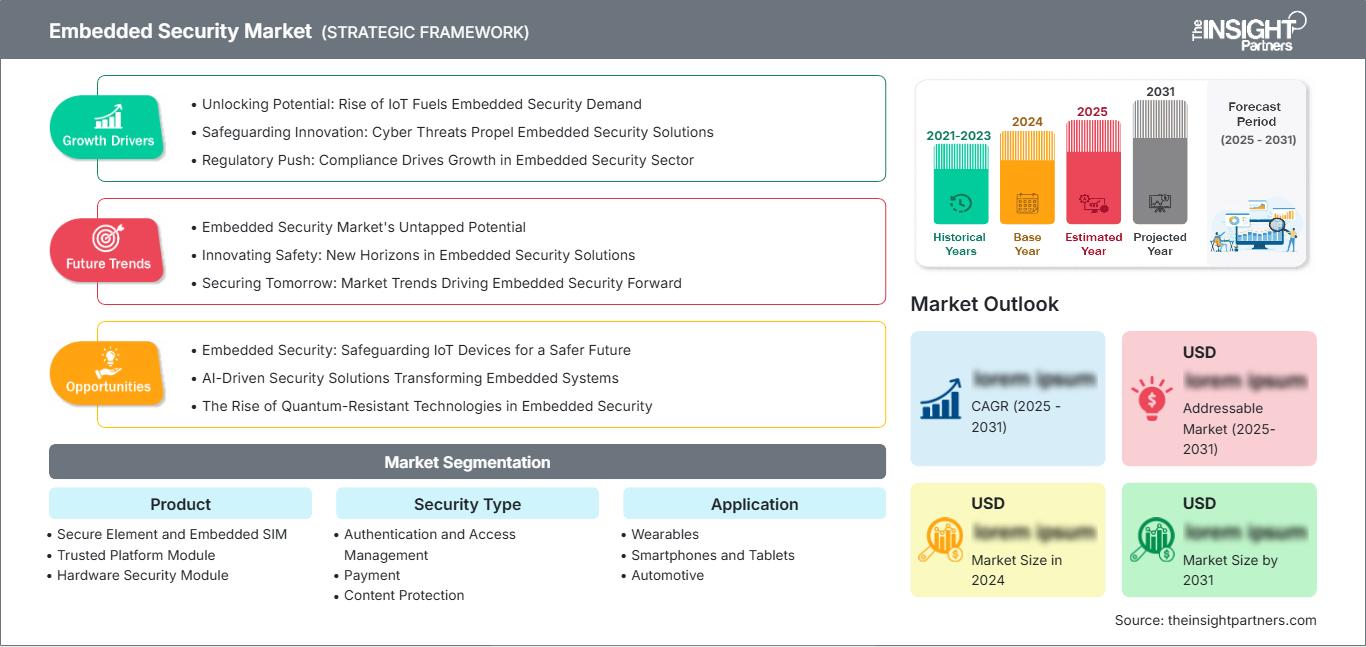
Embedded Security Market: Strategic Insights
Regional Insights
North America Embedded Security Market
North America accounted for 31-34% share of Embedded Security Market in 2025 and is expected to exhibit growth rate of 8.8-9.6% CAGR during 2026-2034. The need is driven by enterprise endpoint security solutions, payment systems, connected medical devices, and automotive cybersecurity initiatives. NIST guidelines for IoT and procurement policies favor hardware-based authentication and update processes.
Security is provided by the chip suppliers, cloud service providers, and equipment OEMs with help of the use of secure elements, TPMs, and HSMs to minimize credential stealing and firmware manipulation. Design efforts in the U.S. are bolstered by industrial automation and payments in Canada. The region continues to be mature, however security by design requirements ensure that replacement cycle continues.
U.S. Embedded Security Market
The United States constitutes 78-82% of the revenue in North America for the year 2025 and will see a CAGR of 9.0-9.8% between 2026 and 2034. The deployment of solutions occurs in payment processing, cloud-connected devices, automobile electronics, identity verification cards, and industrial solutions where firmware integrity and key security is mandatory in the board-level design.
Key companies in this segment include Qualcomm Incorporated, Texas Instruments Incorporated, Microchip Technology Incorporated, as well as substantial operations of NXP Semiconductors N.V., Infineon Technologies AG, and STMicroelectronics N.V. The applications have been shifting towards TPMs in computing, SE for wallet and car, HSMs in enterprise key custody, and tokens for PAM.
Europe Embedded Security Market
Europe had a share of 24-27% in 2025 and is projected to exhibit CAGR of 8.5-9.3% between 2026-2034. Germany dominates due to applications of automotive electronics, industrial automation, and semiconductors in certified security segment. The UK contributes due to fintech and identity applications, whereas France profits due to smart cards, telecom security, and digital identity systems.
Italy and Spain benefit owing to payment terminals, public identities schemes, and connected infrastructure modernization. European demand is influenced by Cyber Resilience Act, NIS2, eIDAS, IEC 62443, and automotive cybersecurity requirements. Infineon Technologies AG, STMicroelectronics N.V., NXP Semiconductors N.V., Thales DIS, and IDEMIA Group form key capabilities in the region.
APAC Embedded Security Market
The Asia Pacific segment had a market share of 32-36% in 2025 and is anticipated to expand at a CAGR of 10.4-11.2% in the period from 2026 to 2034. China dominates in terms of demand for volumes due to smartphones, connected devices, payments, and industrial equipment. Japanese and South Korean players contribute to automotive electronics and secure consumer devices, while India and Australia add demands in the areas of identity, payments, and enterprise security.
The region's importance is linked to its industrial policy, electronics manufacturing, and smart mobility. Secure chips are enabled by Samsung Electronics Co., Ltd., Renesas Electronics Corporation, and Qualcomm Incorporated along with manufacturing partners in the region. Strong growth occurs in regions that require internationally certified connected devices.
Middle East & Africa Embedded Security Market
The Middle East & Africa region is projected to grow at a CAGR of 8.1–8.9% during 2026–2034. Saudi Arabia leads through digital identity, smart city, energy, and infrastructure programs, while the UAE supports payment security and connected services. South Africa and Rest of MEA add banking, telecom, and industrial security demand.
Energy assets, smart grids, and public-sector digitization require hardened authentication for devices operating in dispersed environments. Buyers prioritize HSM-backed key custody, tamper-resistant credentials, and secure lifecycle management. Local implementation partners remain important because cross-border identity, payment, and telecom systems require compliance with national cybersecurity and data-residency expectations.
Segmentation Analysis
Product
Product is projected to grow at a CAGR of 9.4–10.2% during 2026–2034. The Embedded Security Market scope covers hardware roots of trust that protect keys, identities, payment credentials, firmware, and device integrity. Product selection depends on required assurance level, physical attack resistance, memory, interface, certification, lifecycle support, and integration with cloud or manufacturing provisioning systems.
- Secure Element and Embedded SIM lead adoption in smartphones, wearables, vehicles, and IoT devices because they protect credentials, enable remote provisioning, and support payment, identity, and connectivity services.
- Trusted Platform Module demand is strongest in PCs, servers, industrial gateways, and robots where secure boot, measured boot, attestation, and cryptographic key storage are required.
- Hardware Security Module systems protect enterprise, banking, telecom, and cloud keys, providing centralized cryptographic processing for payment authorization, certificate management, and regulated data protection.
- Hardware Tokens remain strategically important for privileged access, workforce authentication, and high-assurance identity where physical possession adds protection against phishing and credential theft.
Security Type
Security Type is forecast to grow at a CAGR of 9.1–9.9% during 2026–2034. Demand is shifting from single-purpose protection toward layered security that combines authentication, payment safeguards, and content protection. Manufacturers prioritize security types based on threat model, regulatory exposure, transaction value, and the consequences of credential leakage or unauthorized access.
- Authentication and Access Management holds broad relevance across enterprise devices, industrial controllers, connected vehicles, smart identity cards, and consumer electronics because every endpoint needs trusted access verification.
- Payment security demand is driven by contactless cards, mobile wallets, payment terminals, wearables, and embedded transaction devices that require certified credential storage and cryptographic transaction processing.
- Content Protection supports smartphones, tablets, computers, media devices, and connected platforms where premium digital content, software licensing, and intellectual property need hardware-backed controls.
Application
Application is expected to grow at a CAGR of 10.0–10.8% during 2026–2034. Application demand reflects where device connectivity, identity, safety, and transaction value intersect. Automotive is the high-growth area, while smartphones, payment cards, and smart identity cards provide large installed bases. Industrial and computing applications add recurring security upgrades.
- Wearables use secure chips for payment credentials, health data, identity functions, and cellular provisioning, making low-power design and remote credential management strategically important.
- Smartphones and Tablets generate high-volume demand through wallets, eSIM, device identity, content protection, biometric authentication, and secure enclave integration across premium and mid-tier devices.
- Automotive adoption is rising as digital keys, secure ECUs, over-the-air updates, connected infotainment, and software-defined vehicle architectures require certified hardware trust anchors.
- Smart Identity Cards rely on tamper-resistant chips for national IDs, employee badges, healthcare cards, and travel credentials where privacy, interoperability, and lifecycle issuance matter.
- Industrial systems use embedded protection for controller authentication, secure firmware, machine access, and operational technology segmentation where downtime and safety risks elevate security requirements.
- Payment Processing and Cards require certified cryptographic execution for contactless transactions, issuer personalization, terminal authentication, and secure key handling across banks and merchants.
- Computers depend on TPMs and secure firmware controls for boot integrity, disk encryption, device attestation, and enterprise endpoint compliance across hybrid work environments.
Opportunity Snapshot
| Application | Revenue Contribution | Trend Tag | Adoption Stage |
| Wearables | Medium | Health Wallets | Scaling |
| Smartphones and Tablets | High | eSIM Wallets | Mature |
| Automotive | High | Digital Keys | Scaling |
| Smart Identity Cards | Medium | Digital ID | Mature |
| Industrial | Medium | Secure OT | Scaling |
| Payment Processing and Cards | High | Contactless Pay | Mature |
| Computers | Medium | TPM Attestation | Mature |
Embedded Security Market Growth Drivers and Impact Analysis
Regulation Makes Hardware Trust a Design Requirement
Cybersecurity guidelines have made embedded security an obligation rather than an optional component. The European Union’s Cyber Resilience Act, NIS2 Directive, IEC 62443, ISO/SAE 21434, payment security standards, and U.S. government IoT guidance mandate better authentication, update security, vulnerability management, and integrity evidence. The market implications are increased demand for secure elements, TPMs, and HSMs which can show cryptographic isolation. Manufacturers who were previously using software-based approaches must use hardware-rooted trust for lowering their risk, passing audits, and staying in regulated markets.
Connected Vehicles Expand Secure Element Deployment
Automotive electronics are moving towards software-definable, connectivity, and credentials-based designs. Digital keys, OTA updates, V2C communication, charging authentication, infotainment transactions, and zonal architectures result in multiple instances where privacy and firmware integrity need protection through the use of private keys. The effect in the market is an increased deployment of automotive-qualified secure elements and TPM-style capabilities that provide attestation and cryptographic processing capabilities. Companies with AEC-Q qualifications, Common Criteria certifications, and car access ecosystems can leverage opportunities that may be locked in design for several years to come.
Payments and Identity Systems Require Tamper Resistance
Contactless transactions, mobile wallets, national IDs, employee credentials, and payment cards depend on tamper-resistant chips because fraud can scale quickly when credentials are exposed. Banks, governments, telecom operators, and device OEMs therefore require secure personalization, protected key storage, and certified transaction processing. The market impact is sustained demand for secure elements, embedded SIMs, HSMs, and hardware tokens. Providers that can support issuance, lifecycle management, remote provisioning, and compliance testing gain advantage because customers want security architectures that remain trustworthy after deployment.
Embedded Security Market Future Trends
Post-Quantum Readiness Enters Embedded Roadmaps
Embedded Security Market trends point toward longer-lifecycle products adopting post-quantum firmware protection before quantum attacks become practical. Vehicles, industrial controllers, medical devices, and infrastructure systems may remain deployed for ten years or more, so vendors are adding upgrade paths, larger memory, and cryptographic agility. Infineon Technologies AG has highlighted TPM approaches for quantum-resilient firmware updates, showing how secure silicon can preserve trust across future algorithm transitions. This trend will favor suppliers that combine certified hardware, update resilience, and ecosystem documentation.
Integrated SIM and Secure Element Convergence Accelerates
Future device designs will increasingly combine cellular provisioning, identity credentials, payment functions, and device attestation inside compact secure hardware. Integrated SIM and secure element convergence reduces board space, simplifies manufacturing, and helps OEMs provision devices remotely across global networks. The trend is especially important for wearables, industrial IoT, smartphones, vehicles, and smart meters. It will reward vendors that can support multiple applets, telecom profiles, security certifications, and lifecycle management while maintaining low power consumption and reliable over-the-air credential updates.
Embedded Security Market Opportunities
Secure Provisioning Services for Connected Device OEMs
Embedded Security Market Forecasts support investment in managed provisioning services that help OEMs inject keys, certificates, eSIM profiles, and device identities during manufacturing or first activation. Many device makers lack in-house security operations, yet customers increasingly ask for traceable identity and secure update capability. Semiconductor vendors, HSM providers, and identity specialists can package chips, personalization, cloud key custody, and compliance documentation. The opportunity is strongest for industrial IoT, smart meters, healthcare devices, and export-oriented consumer electronics where authenticated lifecycle management lowers recall and breach risk.
Automotive Digital Key and Secure Access Platforms
Automakers need scalable security platforms for smartphone access, key fobs, valet permissions, fleet management, and shared mobility. Secure elements can store digital keys, authenticate users, and protect communication between vehicle, mobile device, and cloud systems. Suppliers can invest in reference designs, certification support, and software stacks aligned with Car Connectivity Consortium specifications. The opportunity extends beyond chip sales because OEMs also need provisioning, credential lifecycle tools, testing, and post-sale update support to maintain secure access across vehicle ownership changes.
Recent Developments
- March 2026: Mercury Security, a global leader in open architecture access control hardware, announced the commercial launch of its embedded application environment. With developer onboarding active and partner applications in progress, the platform moves from concept to execution, enabling technology partners and OEMs to build and deploy secure applications directly on Mercury MP Intelligent Controllers equipped with the latest Mercury firmware.
- April 2025: Keysight Technologies, Inc. (NYSE: KEYS) announces the launch of the Next-Generation Embedded Security Testbench, a consolidated and scalable test solution designed to address the increasing complex security testing demands of modern chips and embedded devices. This new solution offers enhanced flexibility, reduces test setup complexities, and improves the reliability and repeatability of critical security evaluations.
- September 2024: AAEON, a leading manufacturer of AI Edge hardware solutions, and The Embedded Kit, a Witekio brand renowned for its innovative embedded systems software products, are thrilled to announce their strategic partnership this week at SIDO Lyon. This collaboration aims to streamline the development process for industrial companies by providing a fully integrated hardware and software bundle.
Frequently Asked Questions

- Comprehensive Market Sizing and Forecast Analysis
- Detailed Segmentation Analysis
- In-Depth Market Dynamics Assessment
- Regional and Country-Level Insights
- Competitive Landscape and Company Benchmarking
- Strategic Business Intelligence
Recent Reports
Testimonials

The Insight Partners' SCADA System Market report is comprehensive, with valuable insights on current trends and future forecasts. The team was highly professional, responsive, and supportive throughout. We are very satisfied and highly recommend their services.
RAN KEDEM Partner, Reali Technologies LTDs
I requested a report on a very specific software market and the team produced the report in a few days. The information was very relevant and well presented. I then requested some changes and additions to the report. The team was again very responsive and I got the final report in less than a week.
JEAN-HERVE JENN Chairman, Future Analytica
We worked with The Insight Partners for an important market study and forecast. They gave us clear insights into opportunities and risks, which helped shape our plans. Their research was easy to use and based on solid data. It helped us make smart, confident decisions. We highly recommend them.
PIYUSH NAGPAL Sr. Vice President, High Beam Global
The Insight Partners delivered insightful, well-structured market research with strong domain expertise. Their team was professional and responsive throughout. The user-friendly website made accessing industry reports seamless. We highly recommend them for reliable, high-quality research services
YUKIHIKO ADACHI CEO, Deep Blue, LLC.
This is the first time I have purchased a market report from The Insight Partners.While I was unsure at first, I visited their web site and felt more comfortable to take the risk and purchase a market report.I am completely satisfied with the quality of the report and customer service. I had several questions and comments with the initial report, but after a couple of dialogs over email with their analyst I believe I have a report that I can use as input to our strategic planning process.Thank you so much for taking the extra time and making this a positive experience.I will definitely recommend your service to others and you will be my first call when we need further market data.
JOHN SUZUKI President and Chief Executive Officer, Board Director, BK Technologies
I wish to appreciate your support and the professionalism you displayed in the course of attending to my request for information regarding to infectious disease IVD market in Nigeria. I appreciate your patience, your guidance, and the fact that you were willing to offer a discount, which eventually made it possible for us to close a deal. I look forward to engaging The Insight Partners in the future, all thanks to the impression you have created in me as a result of this first encounter.
DR CHIJIOKE ONYIA MANAGING DIRECTOR, PineCrest Healthcare Ltd.Reason to Buy
- Informed Decision-Making
- Understanding Market Dynamics
- Competitive Analysis
- Identifying Emerging Markets
- Customer Insights
- Market Forecasts
- Risk Mitigation
- Boosting Operational Efficiency
- Strategic Planning
- Investment Justification
- Tracking Industry Innovations
- Aligning with Regulatory Trends





 Get Free Sample for