
Household Robots Market Size, Trends & Growth by 2034
Coverage: by Offering (Products, Services); Type (Domestic, Entertainment and Leisure); Application (Vacuuming, Lawn Mowing, Companionship, Elderly and H and icap Assistance, Robot Toys and Hobby Systems, Others) , and Geography (North America, Europe, Asia Pacific, and South and Central America)
- Status : Data Released
- Report Code : TIPRE00005959
- Category : Electronics and Semiconductor
- No. of Pages : 150
- Available Report Formats :


- Last update date : September 17, 2026


2025 Market Size
US$ 12.60 Bn
Base year value
2034 Forecast
US$ 45.84 Bn
Projected by 2034
CAGR 2026-2034
15.43 %
Growth rate
Addressable Market
US$ 248.66 Bn
(2026-2034)
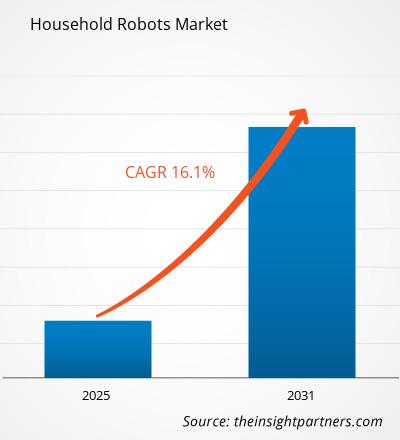
The Household Robots Market is positioned for substantial expansion, reaching US$ 12.60 Billion in 2025 and US$ 45.84 Billion by 2034, representing a CAGR of 15.43% during 2026–2034. The market covers domestic automation robots, entertainment robots, and specialized robots used for cleaning purposes, outdoor maintenance tasks, companionship roles, assistance, and recreation purposes. Growing adoption of artificial intelligence, computer vision, autonomy, connected home solutions, and small form-factor electromechanical systems is expanding the scope of residential robotics from traditional applications such as floor cleaning.
North America continues to be a critical region, with the Household Robots Market expected to record a CAGR of around 14.2–15.2% during 2034. High smart home adoption rate, demand for replacement of cleaning robots, and growing interest in automation technologies is driving the market. North America also has well-established distribution networks for consumer electronics and software products, along with experimentation in companion and assistance robots.
Household Robots Market Assessment and Insights
- North America: North America is estimated to account for 26–30% share in 2025, expanding at a 14.2–15.2% CAGR between 2026–2034, supported by smart-home integration, premium robotic cleaning products, and demand for labor-saving household automation.
- US: The US represents approximately 21–24% share in 2025, with growth of 14.0–15.0% CAGR between 2026–2034, led by robotic vacuum adoption and connected-home ecosystems.
- Europe: Europe holds an estimated 20–23% share in 2025, growing at 13.6–14.6% CAGR between 2026–2034. Germany, the UK, France, Italy, and Spain provide strong demand through smart-home adoption, aging demographics, and household efficiency priorities.
- Asia Pacific: Asia Pacific commands approximately 36–40% share in 2025, advancing at 16.0–17.0% CAGR between 2026–2034. China, Japan, South Korea, and India combine manufacturing depth, robotics expertise, urbanization, and expanding consumer automation.
- Largest Segment: Vacuuming represents an estimated 48–52% market share in 2025, with 14.5–15.5% CAGR between 2026–2034, reflecting established consumer familiarity and recurring replacement demand.
- High Growth Segment: Lawn Mowing is estimated at 7–10% market share in 2025, expanding at 18.0–20.0% CAGR between 2026–2034, supported by autonomous outdoor maintenance.
- Key companies analyzed in detail: Alfred Kärcher SE & Co. KG, Blue Frog Robotics, Deere & Company, Dyson Limited, ECOVACS Robotics Co., Ltd., iRobot Corporation, LG Electronics Inc., Neato Robotics, Inc. (Vorwerk Group), Samsung Electronics Co., Ltd., The LEGO Group (KIRKBI A/S).
Source: The Insight Partners' analysis based on proprietary research, government publications, company annual reports, investor presentations, industry databases, and expert interviews.
The Household Robots Market has moved forward from merely having cleaners to sophisticated robots using sensors, maps, artificial intelligence, and appliances connectivity. Innovation efforts now center on obstacle detection, automatic docking, maintenance, and programming customizations. Moreover, vertical integration along the value chain is increasing, particularly in the manufacturing plants of Asia, where motor, battery, sensor, processor, and body robot parts can be acquired through a connected chain.
Future growth will rely more on regions where labor availability, income levels, urbanization, and demographics make automation economic. Cybersecurity for connected device technology, privacy, battery risks, and consumer data protection will play roles in the design of the products. In addition, investments are moving towards physical artificial intelligence, navigation within homes, and multifunctional robots that interact with appliances.
Household Robots Market Report Scope
| Report Attribute | Details |
|---|---|
| Market size in 2025 | US$ 12.60 Billion |
| Market Size by 2034 | US$ 45.84 Billion |
| Global CAGR (2026 - 2034) | 15.43% |
| Historical Data | 2021-2024 |
| Forecast period | 2026-2034 |
Household Robots Market Analysis
Growth of the Household Robots Market is being driven by the need for automation, labor saving, and convenience for more interconnected homes. The ecosystem includes everything from sensors to processors to motors to batteries to software to navigation systems, cloud platforms, appliance interfaces, retail distribution channels, and after-sales service channels. Cleaning robots currently offer the most extensive commercial foundation because the consumer can easily quantify their worth in terms of saving time vacuuming and mopping.
The competitive landscape is becoming increasingly differentiated through superior navigation capabilities, edge cleaning, obstacle detection, autonomous recharging, autonomous emptying, and multi-functional mopping. Availability of components and decreasing costs of sensors allows for more segmented pricing, with high-end devices relying on better camera, LiDAR, artificial intelligence, and docking capabilities. The Household Robots Market Report thus not only depends on shipments but on rising average prices as well.
Competition has moved from competing based on the effectiveness of individual products to competing based on ownership of entire ecosystems. The company iRobot Corporation promotes the ecosystem and software in its Roomba products while ECOVACS Robotics Co., Ltd. has branched into multiple products that clean the floor, lawns and windows among others. The engineering prowess of Dyson Limited makes the firm unique while LG Electronics Inc. and Samsung Electronics Co., Ltd. combine their robotic products with appliance ecosystems.
Investments become more targeted towards navigation enabled by artificial intelligence, autonomous manipulation, compact actuators, and the ability to interact with the home. Alfred Kärcher SE & Co. KG provides cleaning system technologies, while Blue Frog Robotics is focused on social interaction and companionship. The LEGO Group provides education and entertainment aspect, while Neato Robotics, Inc. (Vorwerk Group) stands for technological development of floor-care robots.
● REPORT CUSTOMIZATION
Tailor This Report To Align With Your Specific Business Requirements
This report can be customized to align precisely with your business objectives, scope, and target markets. Customization options include tailored segmentation, geography, competitive analysis, and strategic insights to support informed decision-making.
Customize This Report →WHAT YOU CAN ADJUST
- ● Segmentations
- ● Geography
- ● Competitive Analysis
- ● Language Preferences
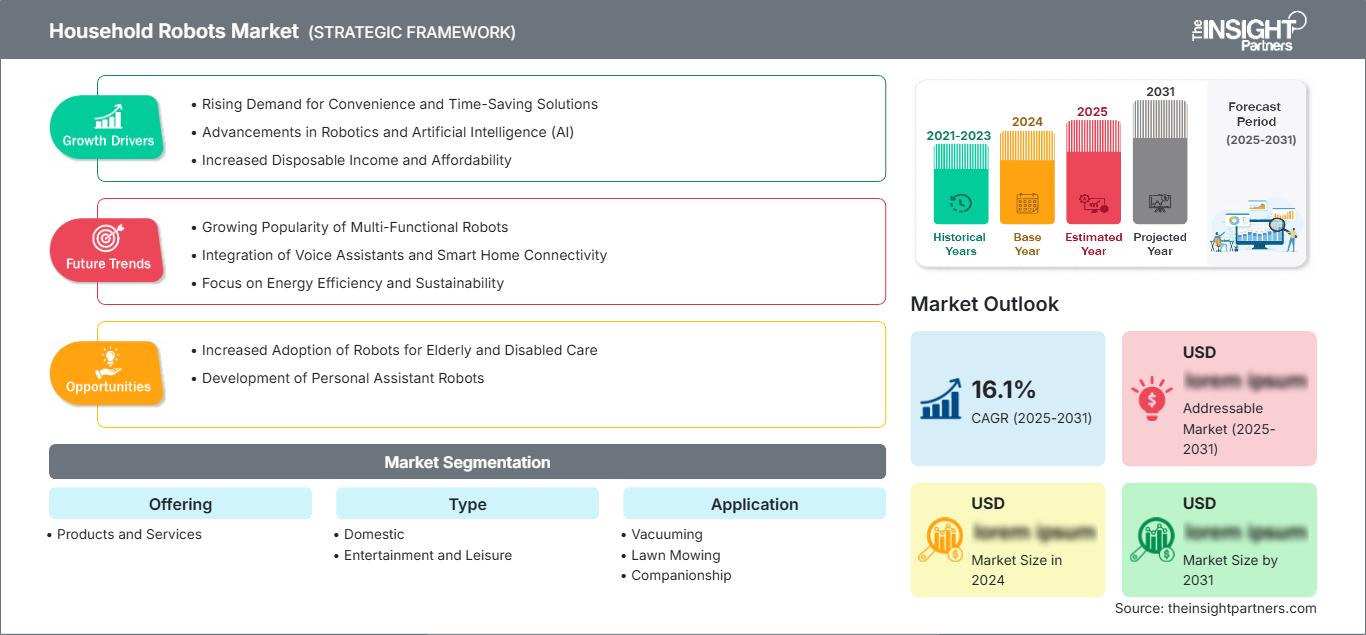
Household Robots Market: Strategic Insights
Regional Insights
North America Household Robots Market
North America is forecast to capture a market share of 26-30%, with the Household Robots Market growing at a CAGR of 14.2-15.2% up to 2034. US accounts for dominant demand in the region, driven by spacious houses, higher disposable incomes, smart home penetration, and awareness about robotic vacuum cleaners among consumers. Canada will be contributing via its high-end appliance use and residential automation.
The regional ecosystem is also shifting towards multi-use machines featuring functionalities for vacuum cleaning, mopping, mapmaking, and self-repair. Increased availability through retail distribution and subscriptions along with connected device platforms is enabling easy access. The demand for automated lawnmowers is another growth area, especially in the suburbs. Privacy, cyber security, battery life, and connectivity are some key buying factors for robots.
U.S. Household Robots Market
The USA comprises about 80-82% of North America's share by 2025, and the Household Robots Market will register a CAGR of 14.0-15.0% up to 2034. International players like iRobot Corporation, Dyson Limited, LG Electronics Inc., Samsung Electronics Co., Ltd. and others have significant presence in both cleaning and smart home segments.
Trends in application areas include development from simple floor vacuum cleaners to autonomous floor mops, lawn cleaners, obstacle sensors, and household control systems. Consumers want hands-free maintenance and remote app controls, but premium clients prefer self-docking stations and better navigation and multi-floors cleaning options. Aging consumers may provide business prospects for assistance and companionship robots, however, these application areas are less commercialized than cleaning solutions.
Europe Household Robots Market
Europe has an estimated 20-23% market share in 2025, growing at a rate of 13.6%-14.6% CAGR with Germany taking the lead for regional demand. The UK population is increasingly embracing intelligent cleaning robots on the back of well-established eCommerce and smart home penetration. Germany has its blend of engineering prowess, appliance quality, and demand for efficient household technology, whereas France sustains steady adoption of premium robotic cleaners.
The other European countries, including Italy and Spain, offer more prospects as urban families embrace the concept of convenience and automated maintenance. The demand from Europe continues to be driven by the efficiency of appliances, product longevity, reparability, data security, and space management in the household. The aging population of Europe also means a case for technologies that offer assistance.
APAC Household Robots Market
APAC market accounts for about 36 to 40 percent in 2025 with growth rate of 16.0 percent – 17.0 percent CAGR; China will be at the helm of affairs. China has been able to capitalize on its extensive infrastructure in robotics manufacturing, Japan has the advantage of automation technology and aging population while South Korea is a combination of leadership in electronics industry and development of smart home.
Australia contributes to increase in demand for lawn and cleaning robots, especially from wealthy families. Regional industrial policies, robotics investments within the region along with electronics chain helps in achieving low costs and rapid innovation.
Middle East & Africa Household Robots Market
The Middle East & Africa presents itself as a small but growing opportunity with Saudi Arabia taking the lead in Gulf region's adoption with the market in this region forecasted to grow at a CAGR of around 12.0–13.0%. The UAE is a leader in smart home adoption while South Africa represents the largest consumer robotics market in sub-Saharan Africa.
Developments of premium residential properties, spill overs from hospitality technology sector, high temperatures and demand for automatic cleaning contribute to adoption in this region. Both Saudi Arabia and UAE present themselves as especially suitable for adoption of connected residential technologies while South Africa as a larger retail presence.
Segmentation Analysis
Offering
Offering divides the market between Products and Services. The segment is increasingly influenced by software, maintenance, cloud connectivity, replacement components, and subscription-based capabilities rather than hardware alone. Products remain the principal revenue source, while services can strengthen customer retention and recurring revenue. The segment is expected to expand at 15.0–16.0% CAGR during 2026–2034, reflecting growing interest in lifecycle support and connected functionality.
- Products: Hardware remains the principal adoption vehicle, encompassing robotic cleaners, lawn systems, entertainment robots, and assistance devices. Product differentiation increasingly depends on autonomy, sensing, battery endurance, and integrated software capabilities.
- Services: Services support installation, maintenance, software-enabled functionality, replacement programs, and customer assistance. Their strategic importance rises as connected robots require continuous updates, diagnostics, and ecosystem management.
Type
Type comprises Domestic, Entertainment and Leisure. Domestic robots currently have the strongest commercial foundation because cleaning and maintenance tasks offer clear utility and measurable time savings. Entertainment and leisure systems address education, companionship, hobbies, and interactive experiences. The segment is projected to grow at 15.2–16.2% CAGR during 2026–2034, as artificial intelligence improves interaction quality and autonomy.
- Domestic: Domestic robots address recurring household activities and remain the largest commercial category. Vacuuming, mopping, lawn maintenance, and emerging assistance functions benefit from measurable convenience and increasingly autonomous operation.
- Entertainment and Leisure: Interactive robots serve recreation, education, companionship, and hobby applications. Adoption depends heavily on affordability, software quality, personalization, and the ability to sustain meaningful user engagement.
Application
Application includes Vacuuming, Lawn Mowing, Companionship, Elderly and H and icap Assistance, Robot Toys and Hobby Systems, Others. The segment is expected to expand at 15.5–16.5% CAGR during 2026–2034, with cleaning applications providing the current commercial base while outdoor and social applications develop faster. The Household Robots Market scope is consequently widening from chore automation toward broader physical assistance.
- Vacuuming: Vacuuming remains the leading application because established consumer awareness, frequent household use, and improving autonomous navigation create a clear value proposition for robotic floor-care systems.
- Lawn Mowing: Lawn mowing is gaining momentum as autonomous navigation, boundary sensing, and obstacle detection improve. Large suburban properties and recurring maintenance requirements make outdoor automation particularly attractive.
- Companionship: Companion robots remain an emerging category, with adoption influenced by conversational AI, emotional interaction, personalization, and household acceptance. Long-term potential depends on reliability and demonstrable user value.
- Elderly and H and icap Assistance: Assistance robots target mobility, reminders, monitoring, and selected household tasks. Their strategic importance is increasing with aging populations, although safety, affordability, privacy, and human oversight remain critical.
- Robot Toys and Hobby Systems: Educational and hobby robots appeal to children, families, and technology enthusiasts. Programmability, interactive features, and learning content can support recurring engagement and differentiate products from conventional toys.
- Others: Other applications provide a flexible pathway for specialized household robotics, allowing manufacturers to address emerging use cases without relying exclusively on established cleaning or entertainment categories.
Opportunity Snapshot
| Application | Revenue Contribution | Trend Tag | Adoption Stage |
|---|---|---|---|
| Vacuuming | High | AI Cleaning | Mature |
| Lawn Mowing | Medium | Auto Mowing | Scaling |
| Companionship | Medium | Social AI | Emerging |
| Elderly and H and icap Assistance | Low | Care Support | Emerging |
| Robot Toys and Hobby Systems | Low | STEM Robotics | Scaling |
| Others | Low | Specialty Tasks | Emerging |
Household Robots Market Growth Drivers and Impact Analysis
Expansion of AI-enabled autonomous navigation
Progress in computer vision, LiDAR, edge computing, and machine learning has enabled improved room mapping, object recognition, path planning, and dynamic obstacle avoidance capabilities in robots. From the point of view of manufacturing companies, better navigation means fewer customer complaints related to the robot’s inability to navigate around obstacles, detect dirty areas, and follow efficient cleaning paths. Artificial intelligence also allows for greater product differentiation since the intelligent software component can be used in conjunction with any hardware upgrade without the need for proportionate hardware improvements. The market implications are significant both in the vacuuming, lawn mowing, and assistance use cases, where autonomy is a critical component of added value. With more powerful processors and cheaper sensors becoming available, advanced navigation capabilities will probably penetrate the mid-tier products segment.
Growing consumer preference for labor-saving home technologies
Household time constraints, urban lifestyles, dual-income families, and growing expectations for convenience are reinforcing demand for automated chores. Cleaning remains particularly attractive because vacuuming and mopping are repetitive, measurable activities that can be delegated without major changes to household routines. The same behavioral pattern supports robotic lawn care, especially where consumers maintain larger outdoor spaces. Manufacturers can therefore expand adoption by demonstrating practical time savings rather than positioning robots solely as advanced technology products. Retailers also benefit because automated systems create opportunities for premium bundles combining robots, docking stations, consumables, and connected appliances. Over time, greater familiarity should reduce the educational burden associated with robotics, allowing emerging applications such as companionship and assistance to build upon an established consumer understanding of autonomous household devices.
Integration with connected-home ecosystems
Robots increasingly operate as components within broader smart-home environments rather than isolated appliances. Integration with mobile applications, voice assistants, sensors, connected appliances, and home platforms can improve scheduling, coordination, and personalization. This creates an important strategic advantage for electronics companies with established ecosystems because robotic functionality can reinforce sales of complementary appliances. The effect is also significant for specialist robotics companies, which must maintain interoperability to remain relevant as consumers consolidate devices around fewer platforms. Connected operation introduces additional requirements for cybersecurity, software updates, data governance, and reliable cloud infrastructure. Companies that address these requirements effectively can strengthen customer retention and generate additional service opportunities. Consequently, ecosystem compatibility is becoming an important purchasing consideration alongside suction power, navigation accuracy, battery capacity, and physical design.
Household Robots Market Future Trends
Multifunctional robots will move beyond single-purpose cleaning
The next phase of the Household Robots Market trends will involve robots combining several household functions within one coordinated platform. Instead of operating only as vacuum cleaners, emerging systems are expected to integrate mopping, object recognition, appliance interaction, security awareness, and selected physical assistance. Advances in embodied AI may allow robots to understand instructions expressed in natural language and translate them into sequences of household actions. This could change purchasing behavior from selecting individual appliances toward evaluating the capabilities of a broader domestic robotic platform. Manufacturers are likely to emphasize modular hardware, software updates, and interoperable components so capabilities can expand after purchase. The strongest products will probably be those that combine dependable routine automation with flexible responses to unusual household conditions, rather than systems that offer numerous features without consistent task completion.
Physical AI will strengthen personalized household assistance
Physical AI is likely to become a major differentiator as robots gain improved perception, reasoning, and contextual awareness. Instead of simply following programmed routes, future systems may learn household routines, identify recurring needs, and coordinate with connected appliances. Samsung’s Ballie initiative illustrates the direction toward conversational and proactive home assistance, while LG CLOiD demonstrates a broader approach involving physical household tasks. The Household Robots Market will therefore increasingly intersect with generative AI, smart appliances, and spatial computing. Successful commercialization will depend on dependable execution, safe movement, privacy protection, and transparent user controls. Companies will need to translate advanced AI into practical household outcomes, because consumers are likely to judge these systems primarily by reliability and convenience rather than by the sophistication of the underlying algorithms.
Household Robots Market Opportunities
Localized robotics platforms for aging populations
Aging demographics create an opportunity to develop robots designed specifically around household independence, safety, reminders, environmental monitoring, and selected assistance tasks. Manufacturers can collaborate with healthcare organizations, insurers, housing providers, and senior-living operators to validate practical use cases before broader consumer deployment. The Household Robots Market Forecasts indicate that assistance applications can become strategically important as populations age and caregiver availability becomes constrained. Investment should prioritize unobtrusive designs, simple interfaces, multilingual interaction, fall-risk awareness, and strong privacy controls rather than excessive mechanical complexity. Commercial models could combine hardware with monitoring or support services, creating recurring revenue while improving maintenance and software continuity. Partnerships with established appliance and telecommunications providers may further reduce deployment barriers by using existing connectivity and service networks.
Premium outdoor automation and robotic maintenance
Autonomous lawn care offers an attractive expansion pathway because outdoor maintenance is repetitive, labor-intensive, and increasingly compatible with robotic navigation. Manufacturers can target premium suburban households through systems that map properties, identify obstacles, manage charging, and operate according to weather and user schedules. Deere & Company provides relevant expertise in autonomous outdoor machinery, creating opportunities to transfer navigation and machine-control capabilities into residential environments. Suppliers should also consider integrated landscaping ecosystems that connect mowing with irrigation, weather data, and garden monitoring. This approach can raise the value of robotic equipment beyond a single maintenance function. Investment priorities should include reliable boundary-free navigation, theft protection, weather resistance, quiet operation, and simple installation, all of which can influence consumer willingness to replace conventional equipment.
Recent Developments
- August 2026: Serve Robotics Inc. (Nasdaq: SERV), a leading autonomous sidewalk delivery company, and Grubhub, a subsidiary of Wonder, a vertically integrated food technology platform built to make great food more accessible, announced a partnership bringing robot delivery to the Grubhub marketplace, beginning in Chicago, Los Angeles and Alexandria. Serve's robot delivery will be available from more than 100 participating Grubhub merchants in Chicago and nearly 200 in Los Angeles, with additional restaurants expected to join the program over time. Every platform that integrates widens the set of restaurants and neighborhoods our robots can serve.
- March 2026: SoftBank Robotics America announced the official launch of a new suite of AI-enabled robots for the commercial cleaning industry. This announcement furthers the future of physical AI solutions for the sector and expands SoftBank Robotics America’s solutions portfolio with advanced technologies designed to deliver increased efficiency and enterprise value in highly dynamic environments.
- January 2026: Qualcomm Technologies, Inc. (NASDAQ: QCOM) introduced a next-generation robotics comprehensive-stack architecture that integrates hardware, software, and compound AI. Qualcomm Technologies also unveiled its latest high performance robotics processor for industrial AMRs and advanced full-size humanoids, the Qualcomm Dragonwing™ IQ10 Series. This is the latest robotics-specific processor which expands the current robotics roadmap for the Company, delivering high performance, energy-efficient “Brain of the Robot” capabilities. Utilizing Qualcomm Technologies’ proven expertise in edge AI, high performance, low-power systems, this innovation transforms prototypes into deployable, intelligent machines.
Frequently Asked Questions

- Comprehensive Market Sizing and Forecast Analysis
- Detailed Segmentation Analysis
- In-Depth Market Dynamics Assessment
- Regional and Country-Level Insights
- Competitive Landscape and Company Benchmarking
- Strategic Business Intelligence
Recent Reports
Testimonials

The Insight Partners' SCADA System Market report is comprehensive, with valuable insights on current trends and future forecasts. The team was highly professional, responsive, and supportive throughout. We are very satisfied and highly recommend their services.
RAN KEDEM Partner, Reali Technologies LTDs
I requested a report on a very specific software market and the team produced the report in a few days. The information was very relevant and well presented. I then requested some changes and additions to the report. The team was again very responsive and I got the final report in less than a week.
JEAN-HERVE JENN Chairman, Future Analytica
We worked with The Insight Partners for an important market study and forecast. They gave us clear insights into opportunities and risks, which helped shape our plans. Their research was easy to use and based on solid data. It helped us make smart, confident decisions. We highly recommend them.
PIYUSH NAGPAL Sr. Vice President, High Beam Global
The Insight Partners delivered insightful, well-structured market research with strong domain expertise. Their team was professional and responsive throughout. The user-friendly website made accessing industry reports seamless. We highly recommend them for reliable, high-quality research services
YUKIHIKO ADACHI CEO, Deep Blue, LLC.
This is the first time I have purchased a market report from The Insight Partners.While I was unsure at first, I visited their web site and felt more comfortable to take the risk and purchase a market report.I am completely satisfied with the quality of the report and customer service. I had several questions and comments with the initial report, but after a couple of dialogs over email with their analyst I believe I have a report that I can use as input to our strategic planning process.Thank you so much for taking the extra time and making this a positive experience.I will definitely recommend your service to others and you will be my first call when we need further market data.
JOHN SUZUKI President and Chief Executive Officer, Board Director, BK Technologies
I wish to appreciate your support and the professionalism you displayed in the course of attending to my request for information regarding to infectious disease IVD market in Nigeria. I appreciate your patience, your guidance, and the fact that you were willing to offer a discount, which eventually made it possible for us to close a deal. I look forward to engaging The Insight Partners in the future, all thanks to the impression you have created in me as a result of this first encounter.
DR CHIJIOKE ONYIA MANAGING DIRECTOR, PineCrest Healthcare Ltd.Reason to Buy
- Informed Decision-Making
- Understanding Market Dynamics
- Competitive Analysis
- Identifying Emerging Markets
- Customer Insights
- Market Forecasts
- Risk Mitigation
- Boosting Operational Efficiency
- Strategic Planning
- Investment Justification
- Tracking Industry Innovations
- Aligning with Regulatory Trends





 Get Free Sample for