
Thermography Building Inspection Market Share, Growth & Demand by 2034
Thermography Building Inspection Market Size and Forecasts (2021–2034), Global and Regional Share, Trends, and Growth Opportunity Analysis Report Coverage : By Service Type (Envelope Inspection, Roof Inspection, Electrical Inspection, Mechanical Inspection); Technology (Infrared Cameras, Thermal Imaging Software, Laser Thermometers); Application (Residential, Commercial, Industrial); Geography (North America, Europe, Asia-Pacific, Middle East & Africa, South and Central America)
- Status : Data Released
- Report Code : TIPRE00039651
- Category : Electronics and Semiconductor
- No. of Pages : 150
- Available Report Formats :


- Last update date : July 15, 2026


2025 Market Size
US$ 1.98 Bn
Base year value
2034 Forecast
US$ 3.75 Bn
Projected by 2034
CAGR 2026-2034
7.35 %
Growth rate
Addressable Market
US$ 25.83 Bn
(2026-2034)
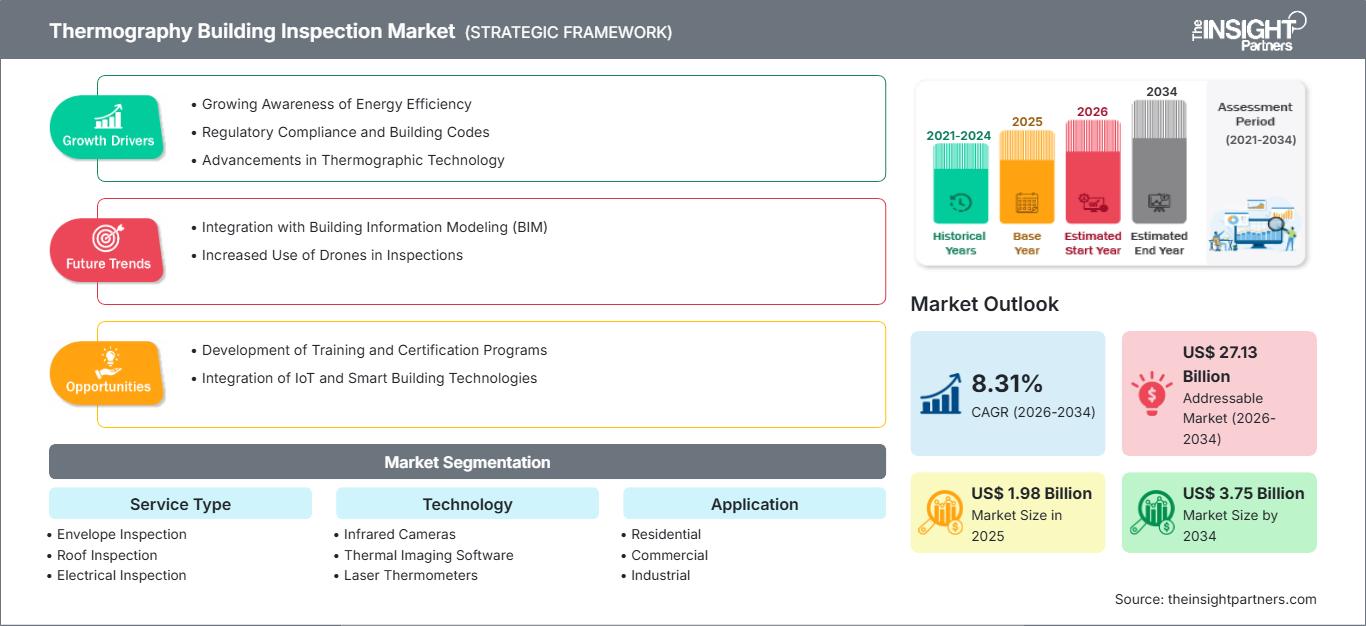
The Thermography Building Inspection market was valued at US$ 1.98 billion in 2025 and is expected to reach US$ 3.75 billion by 2034; it is estimated to record a CAGR of 7.35% during 2026-2034.
Thermography Building Inspection Market Assessment and Insights
- North America accounted for 33–35% share in 2025 and is growing at a CAGR of 7.8–8.4% between 2026–2034, driven by energy audits, NFPA 70B electrical maintenance practices, and building-retrofit spending.
- US represented 78–82% of North America in 2025 and is advancing at a CAGR of 7.9–8.5% between 2026–2034 through facility risk management.
- Europe held 26–28% share in 2025 and is growing at a CAGR of 7.5–8.1% between 2026–2034, led by Germany, the UK, France, Italy, and Spain.
- Asia Pacific captured 24–26% share in 2025 and is expanding at a CAGR of 9.1–9.8% between 2026–2034, led by China, Japan, India, South Korea, and Australia.
- Largest Segment Envelope Inspection held 34–37% Thermography Building Inspection market share in 2025, with a CAGR of 7.7–8.3% during 2026–2034 because insulation and air leakage checks remain routine.
- High Growth Segment Thermal Imaging Software held 18–21% Thermography Building Inspection market share in 2025 and is growing at a CAGR of 9.4–10.1% during 2026–2034.
- Key companies analyzed in detail: Platinum Tools, Inc.; Apex Instruments, Inc.; A. Traffic Ltd.; Honeywell International Inc.; Raytek Corporation; Balkowitsch Enterprises, Inc.; Smart Vision Lights; Testo SE & Co. KGaA; Electronic Heat Technologies; ScanTherm GmbH; Teledyne FLIR LLC.
Source: The Insight Partners' analysis based on proprietary research, government publications, company annual reports, investor presentations, industry databases, and expert interviews.
The technology of digital thermography has shifted from consultant-oriented use to routine use in facilities due to smaller camera sizes, improved software reporting, and route inspections by maintenance crews. The production dynamics in favor of vendors include hardware and analytical providers and service providers through certification of thermographers, rapid reporting, and multi-purpose uses. Thermography Building Inspection has been widely used for energy audit, roof warranty inspection, panel risk assessment, and mechanical reliability programs in one inspection process.
According to the Thermography Building Inspection market forecast, the future adoption is expected from retrofit in mature markets, rapidly rising commercial constructions in Asia Pacific, and infrastructure renewal in the Middle East. There are also the decarbonization ambitions, the reliability problem of the grid, and the demands of the insurance industry creating better budgets for inspections. Those suppliers who provide infrared cameras, software, and instructions about the action taken should have an edge as customers prefer repeatability to single thermal image.
Thermography Building Inspection Market Report Scope
| Report Attribute | Details |
|---|---|
| Market size in 2025 | US$ 1.98 Billion |
| Market Size by 2034 | US$ 3.75 Billion |
| Global CAGR (2026 - 2034) | 7.35% |
| Historical Data | 2021-2024 |
| Forecast period | 2026-2034 |
Thermography Building Inspection Market Analysis
The Thermography Building Inspection market trends indicate growth due to the need for non-destructive methods to detect hidden faults in the facilities. Owners rely on infrared inspections to identify problems such as insulation issues, moisture leaks, hot spots in electrical systems, breaker overloads, heating system imbalances, and issues with the roof membrane before repair costs increase. The value chain consists of camera makers, software providers, certified thermographers, energy auditors, electrical contractors, roof consultants and facility management platforms.
The growing availability of infrared sensors without cooling, cameras embedded in smartphones, and reporting via the cloud reduces the barrier of entering into the Thermography Building Inspection market for the solution. Nevertheless, interpreting skills can be considered a limiting factor due to the special features of thermal images, which depend on emissivity, weather, loads, and materials.
The Thermography Building Inspection analysis identifies a fragmented competitive situation in services and a consolidated one in instruments. Honeywell International Inc. is presented through building automation and predictive diagnostics; Testo SE & Co. KGaA and Teledyne FLIR LLC specialize in thermal cameras and reporting; and Raytek Corporation – in temperature-measuring use cases. Application-specific diagnostics is provided by ScanTherm GmbH and Electronic Heat Technologies.
Investment is going on in sectors like inspection efficiency using software, route planning, and compliance using evidence. These sectors have suppliers like Platinum Tools, Inc., Apex Instruments, Inc., Balkowitsch Enterprises, Inc., Smart Vision Lights, and A. Traffic Ltd., who function with the use of tools, instruments, lights, or inspection technologies. Now, buyers compare suppliers in terms of document speed, calibration, training, and maintenance management integration.
● REPORT CUSTOMIZATION
Tailor This Report To Align With Your Specific Business Requirements
This report can be customized to align precisely with your business objectives, scope, and target markets. Customization options include tailored segmentation, geography, competitive analysis, and strategic insights to support informed decision-making.
Customize This Report →WHAT YOU CAN ADJUST
- ● Segmentations
- ● Geography
- ● Competitive Analysis
- ● Language Preferences
Thermography Building Inspection Market: Strategic Insights
Regional Insights
North America Thermography Building Inspection
The North American region has accounted for 33–35% market share in 2025 and is predicted to achieve a 7.8–8.4% CAGR in 2026–2034. Some of the driving factors behind this trend include the developed energy audit procedures in the region, increasing insurance requirements for electric systems, and growing adoption of thermography in roof asset monitoring. Campus buildings and industrial plants have started shifting their occasional thermographic monitoring processes to an annual maintenance routine.
The need for regular thermographic building inspections is supported by the presence of old facilities, electrification investments, and safety-driven maintenance norms. Thermography Building Inspection Market Share in North America is maintained at high levels due to the opportunity for facility owners to capitalize on these services by saving on downtime, performing retrofitting works, and justifying capital expenditures.
U.S. Thermography Building Inspection Market
The Thermography Building Inspection market in the US accounted for 78–82% of share in North America in 2025 and is projected to advance at a 7.9–8.5% CAGR during 2026–2034. Demand is concentrated in commercial real estate, hospitals, universities, industrial sites, and data centers where electrical load growth increases the value of hot-spot detection and preventive maintenance.
The list of company offerings is wide-ranging, and some of these companies include Honeywell International Inc., Testo SE & Co. KGaA, Teledyne FLIR LLC, Platinum Tools, Inc., and Smart Vision Lights. The application trends in this market involve electrical inspection, roof survey following any weather-related occurrence, and building envelope diagnosis for energy performance projects.
Europe Thermography Building Inspection Market
In 2025, Europe accounted for 26-28%, and it is expected to experience a CAGR of 7.5-8.1% in 2026-2034. Germany dominates owing to industrial activity, high expectations for energy efficiency, and a facility maintenance culture that drives repeat-business requirements. The UK is developing in the areas of commercial retrofit projects and risk assessment of properties.
The uptake in France, Italy, and Spain is increasing due to building renovation incentives and the need to assess heat loss. In Southern Europe, roof and moisture inspection services have been on the increase following extreme weather conditions. Multilingual reporting, evidence standardization, and management of portfolios is enabled by the adoption of Thermal Imaging Software, with Testo SE & Co. KGaA and ScanTherm GmbH driving technology access.
APAC Thermography Building Inspection Market
The Thermography Building Inspection market in APAC region had a share of 24–26% in 2025 and is expected to register a CAGR of 9.1–9.8% over 2026–2034. China is driving demand through industrial parks, skyscrapers, and energy management requirements, whereas Japan and South Korea have prioritized reliability in manufacturing and commercial properties.
India and Australia have increased their use of inspections within real estate, infrastructure, and facilities management. The need for policy-driven efficiency improvements, urban heat mitigation, and increased data center capacity creates scope for envelope, electrical, and mechanical inspections. Having local service providers is essential because the effectiveness of inspections depends on climate, load time, and materials.
Middle East & Africa Thermography Building Inspection Market
The Thermography Building Inspection market in Middle East & Africa region is estimated to experience an 8.6%-9.2% CAGR between 2026-2034. The largest growth will come from Saudi Arabia due to its major infrastructure projects, district developments, and the need for utility load management. The next in line is the UAE, owing to its smart buildings, hotels, and high cooling demand.
Thermography is used in South Africa for its industrial facilities and electrical reliability programs, whereas RoMEA is increasingly employing services in airports, utilities, and commercial buildings. Hot climate requires more attention to HVAC, roof, and façade inspections due to their direct impact on costs.
Segmentation Analysis
Service Type
CAGR for Service Type is projected to be between 8.0% and 8.6% from 2026 to 2034, driven by increased inspection from one-time defect detection to periodic risk management. The Thermography Building Inspection Services offering has become much broader because building envelope, roof, electrical, and mechanical inspections commonly use the same equipment, processes, and personnel.
- Envelope Inspection remains the largest service because air leakage, missing insulation, thermal bridging, and moisture pathways directly affect energy use, comfort, and retrofit prioritization in occupied buildings.
- Roof Inspection is used by property owners, insurers, and roofing contractors to locate trapped moisture, membrane weaknesses, and repair zones without unnecessary invasive sampling across large roof areas.
- Electrical Inspection is gaining strategic importance as higher electrical loads, EV charging, data centers, and industrial automation raise the risk of overheating components and unplanned shutdowns.
- Mechanical Inspection supports HVAC reliability, rotating equipment checks, steam systems, bearings, and process assets where abnormal heat patterns indicate friction, imbalance, blocked flow, or maintenance urgency.
Technology
The technology segment is expected to grow at a CAGR of 8.8–9.4% between 2026 and 2034 due to better precision in inspections, due to high-definition cameras, cloud-based reporting, and image analysis through software. Users are transitioning from standalone tools to connected solutions to reduce manual reporting effort and maintain inspection records.
- Infrared Cameras form the core technology layer, with handheld, rugged, and smartphone-connected models enabling inspectors to capture thermal anomalies across façades, panels, roofs, ceilings, and mechanical rooms.
- Thermal Imaging Software is the high-growth technology because it converts images into structured reports, supports route-based inspections, improves collaboration, and helps buyers compare assets across locations.
- Laser Thermometers remain relevant for quick spot verification, low-cost screening, and field checks, although they do not replace full thermal images for complex building diagnostics.
Application
Application is expected to grow at a 7.9–8.5% CAGR during 2026–2034, supported by diverse use cases across homes, commercial portfolios, and industrial facilities. Residential demand is tied to energy audits and moisture detection, commercial adoption is driven by property management and insurance requirements, and industrial users value thermal inspection for reliability and safety.
- Residential demand is shaped by home energy performance, pre-purchase inspections, insulation checks, roof leakage assessment, and homeowner interest in locating hidden moisture before structural damage develops.
- Commercial facilities use thermography for planned maintenance, tenant comfort, roof warranty validation, electrical risk control, and energy-retrofit decisions across offices, retail, healthcare, education, and hospitality.
- Industrial users prioritize electrical panels, motors, bearings, process equipment, and building envelopes because thermal anomalies can signal downtime risk, safety hazards, or inefficient operating conditions.
Opportunity Snapshot
| Segment Name | Revenue Contribution | Trend Tag | Adoption Stage |
| Residential | Medium | Energy Audit | Scaling |
| Commercial | High | Portfolio Risk | Mature |
| Industrial | High | Asset Reliability | Scaling |
Thermography Building Inspection Market Growth Drivers and Impact Analysis
Energy Codes and Building Retrofit Programs
Building owners are facing increased demands to cut down on energy loss, increase comfort levels, and prove successful retrofit results. Infrared thermography enables the detection of missing insulation, air infiltration, thermal bridging, and moisture intrusion prior to costly corrections being made. This technology is most useful in the context of commercial buildings that have energy costs and occupancy requirements impacting their budget. International Energy Agency analysis indicates that buildings use about 30% of total energy consumption. With tightening building performance codes in many regions, infrared inspection is an effective starting point for envelope upgrades.
Preventive Electrical Maintenance and Safety Compliance
Electric inspection is gaining significance in light of the increase in electric vehicle charging stations, data center loads, heat pumps, automation equipment, and distributed energy systems being installed in buildings. Thermography offers the ability for electricians to identify loose connections, overloads, phase imbalance, and failing equipment when the system is still live and under load. It decreases the chances of having fires, unplanned downtimes, and costly emergency repairs. Electric inspection according to NFPA 70B is also prompting facilities to perform electrical condition assessments.
Connected Cameras and Faster Reporting Workflows
Advancements in hardware technology are reducing the cost and complexity of thermographic scanning, yet gains in efficiency from automation are making a bigger difference. Devices that take pictures, store data in the cloud, categorize assets, and provide reporting templates assist technicians in getting from picture taking to documented reports faster. This is important since large buildings will often require many thermal pictures to be taken on a single route. When reporting is reduced, service providers are able to do more locations, while buyers get better repair plans.
Thermography Building Inspection Market Future Trends
AI-Assisted Thermal Interpretation
Thermography Building Inspection market trends are moving toward assisted interpretation, where software flags temperature anomalies, compares historical images, and suggests inspection priorities for human review. This will not remove the need for certified thermographers because field conditions still influence accuracy. However, AI-supported classification can reduce missed defects and make inspection quality more consistent across teams. The trend is especially relevant for large commercial portfolios, industrial campuses, and public infrastructure owners that need comparable data across many assets. Vendors with strong image libraries, secure cloud platforms, and practical reporting tools should be better positioned as buyers demand standardized evidence.
Thermography as a Building Digital Twin Input
Thermal data is likely to become part of broader building digital twins rather than remaining a separate inspection file. Facility teams can use periodic infrared surveys to enrich asset models with heat-loss zones, recurring electrical hot spots, moisture-prone roof sections, and mechanical efficiency indicators. This trend supports better capital planning because thermal evidence can be linked to asset age, repair history, occupancy, and energy data. Adoption will be gradual, but large campuses and industrial owners have the strongest incentive to connect inspection outputs with computerized maintenance management systems and building automation platforms.
Thermography Building Inspection Market Opportunities
Portfolio-Level Inspection Contracts
Thermography Building Inspection market Forecasts indicate that service providers can create higher-margin opportunities by shifting from single-building assignments to portfolio-level contracts. Real estate owners, retailers, healthcare systems, universities, and industrial groups need consistent methods across many locations. Providers that offer standardized reporting, severity ranking, repair guidance, and annual benchmarking can become embedded in maintenance planning. The opportunity is operational as much as technical: firms must train inspectors, maintain calibration discipline, and deliver comparable reports. Those capabilities support recurring revenue, lower customer acquisition cost, and stronger client retention than one-off defect investigations.
Integration with Energy and Insurance Advisory Services
Inspection firms can expand revenue by bundling thermography with energy advisory, roof consulting, electrical safety reviews, and insurance documentation. Buyers increasingly want evidence that links detected anomalies to cost, risk, and remediation priority. A thermal image alone has limited value unless it supports decisions about repair timing, capital budgets, or claim prevention. Firms that partner with energy engineers, roofing specialists, and electrical contractors can provide a more complete diagnostic service. This opportunity is strongest where building owners face rising utility costs, stricter disclosure rules, or insurer requests for documented preventive maintenance.
Recent Developments
- January 2026: Samsung Electronics announced Smart Home Savings, a new service developed with Hartford Steam Boiler (HSB), Munich Re’s powerhouse for technology-driven risk management services and a leading provider of equipment and appliance insurance. The service can help U.S. consumers lower home insurance premiums by recognizing the protective capabilities of existing Samsung home appliances connected to the SmartThings1 platform.
- September 2025: Teledyne FLIR LLC — FLIR introduced the iXX-Series app-enabled thermal cameras built on its ACE platform for asset condition monitoring and building inspection. The series integrates with FLIR Assetlink software, supports app-guided workflows, and addresses skilled thermographer shortages by making structured inspection data easier to capture and report.
Frequently Asked Questions

- Comprehensive Market Sizing and Forecast Analysis
- Detailed Segmentation Analysis
- In-Depth Market Dynamics Assessment
- Regional and Country-Level Insights
- Competitive Landscape and Company Benchmarking
- Strategic Business Intelligence
Recent Reports
Testimonials

The Insight Partners' SCADA System Market report is comprehensive, with valuable insights on current trends and future forecasts. The team was highly professional, responsive, and supportive throughout. We are very satisfied and highly recommend their services.
RAN KEDEM Partner, Reali Technologies LTDs
I requested a report on a very specific software market and the team produced the report in a few days. The information was very relevant and well presented. I then requested some changes and additions to the report. The team was again very responsive and I got the final report in less than a week.
JEAN-HERVE JENN Chairman, Future Analytica
We worked with The Insight Partners for an important market study and forecast. They gave us clear insights into opportunities and risks, which helped shape our plans. Their research was easy to use and based on solid data. It helped us make smart, confident decisions. We highly recommend them.
PIYUSH NAGPAL Sr. Vice President, High Beam Global
The Insight Partners delivered insightful, well-structured market research with strong domain expertise. Their team was professional and responsive throughout. The user-friendly website made accessing industry reports seamless. We highly recommend them for reliable, high-quality research services
YUKIHIKO ADACHI CEO, Deep Blue, LLC.
This is the first time I have purchased a market report from The Insight Partners.While I was unsure at first, I visited their web site and felt more comfortable to take the risk and purchase a market report.I am completely satisfied with the quality of the report and customer service. I had several questions and comments with the initial report, but after a couple of dialogs over email with their analyst I believe I have a report that I can use as input to our strategic planning process.Thank you so much for taking the extra time and making this a positive experience.I will definitely recommend your service to others and you will be my first call when we need further market data.
JOHN SUZUKI President and Chief Executive Officer, Board Director, BK Technologies
I wish to appreciate your support and the professionalism you displayed in the course of attending to my request for information regarding to infectious disease IVD market in Nigeria. I appreciate your patience, your guidance, and the fact that you were willing to offer a discount, which eventually made it possible for us to close a deal. I look forward to engaging The Insight Partners in the future, all thanks to the impression you have created in me as a result of this first encounter.
DR CHIJIOKE ONYIA MANAGING DIRECTOR, PineCrest Healthcare Ltd.Reason to Buy
- Informed Decision-Making
- Understanding Market Dynamics
- Competitive Analysis
- Identifying Emerging Markets
- Customer Insights
- Market Forecasts
- Risk Mitigation
- Boosting Operational Efficiency
- Strategic Planning
- Investment Justification
- Tracking Industry Innovations
- Aligning with Regulatory Trends





 Get Free Sample for