
Robotics as a Service Market Demand, Trends & Forecast by 2034
Robotics as a Service Market Size and Forecasts (2021–2034), Global and Regional Share, Trends, and Growth Opportunity Analysis Report Coverage : By Type (Professional, Personal); Application (Handling, Assembling and Disassembling, Dispensing, Welding and Soldering, Processing, Others); Industry (Manufacturing, Automotive, Aerospace and Defense, Logistics, Healthcare, Food and Beverage, Media and Entertainment, Retail, and Others)
- Status : Data Released
- Report Code : TIPRE00039607
- Category : Electronics and Semiconductor
- No. of Pages : 150
- Available Report Formats :


- Last update date : September 10, 2026


2025 Market Size
US$ 3.04 Bn
Base year value
2034 Forecast
US$ 12.99 Bn
Projected by 2034
CAGR 2026-2034
17.52 %
Growth rate
Addressable Market
US$ 66.80 Bn
(2026-2034)
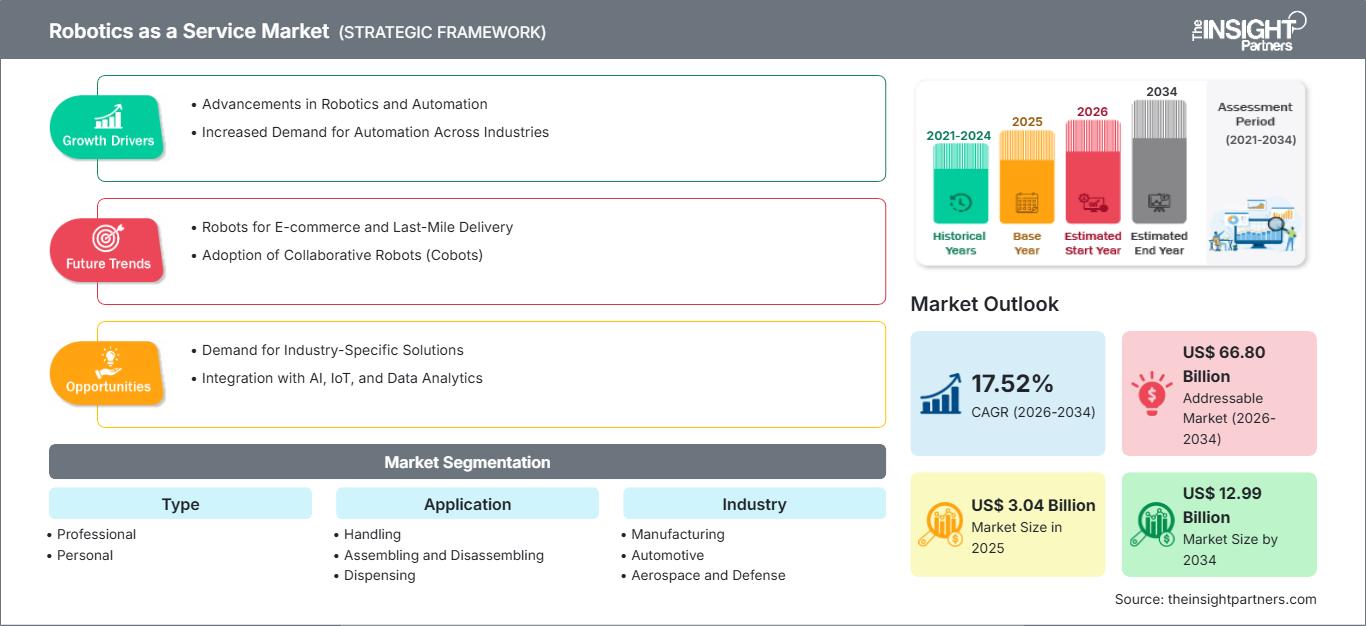
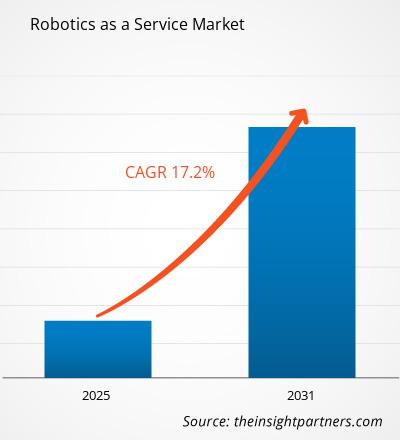
The robotics as a service market reached US$ 3.04 Billion in 2025 and is projected to reach US$ 12.99 Billion by 2034, expanding at a CAGR of 17.52% during 2026–2034. The model is gaining traction as enterprises increasingly shift robotics expenditure from upfront capital purchases toward recurring operating arrangements. Subscription structures can bundle hardware, software, maintenance, analytics, and fleet support, enabling customers to deploy automation with lower initial financial commitments and greater capacity flexibility.
North America is expected to remain a major adoption center, supported by warehouse automation, labor constraints, e-commerce fulfillment, and demand for flexible production. The robotics as a service market size in the region is projected to expand at a 18.0–19.0% CAGR during 2026–2034, with logistics operators and manufacturers increasingly favoring subscription-based deployments that align automation expenditure with operating volumes.
Robotics as a Service Market Assessment and Insights
- North America: North America is estimated to hold a 40–43% share in 2025 and grow at a 18.0–19.0% CAGR between 2026–2034, supported by warehouse automation, labor availability constraints, logistics modernization, and established robotics providers.
- US: The US represents 86–88% of North America's 2025 market and is projected to grow at a 18.2–19.2% CAGR between 2026–2034, led by logistics, manufacturing, healthcare, and retail deployments.
- Europe: Europe is estimated at a 23–25% share in 2025 and is expected to grow at a 17.0–18.0% CAGR between 2026–2034, with Germany, the UK, France, Italy, and Spain supporting industrial and logistics adoption.
- Asia Pacific: Asia Pacific is estimated at a 21–23% share in 2025 and is forecast to expand at a 21.0–22.0% CAGR between 2026–2034, led by China, Japan, South Korea, India, and Australia.
- Largest Segment: Professional robots hold a 69–71% market share in 2025 and are projected to grow at a 17.0–18.0% CAGR during 2026–2034, reflecting enterprise automation requirements.
- High Growth Segment: Service robots within professional and personal deployments represent a 15–18% market share in 2025 and are projected to grow at a 20.0–21.0% CAGR during 2026–2034, supported by expanding commercial applications.
- Key companies analyzed in detail: KUKA AG; Berkshire Grey, Inc.; Locus Robotics; Exotec; Knightscope, Inc.; CYBERDYNE, Inc.; CAJA Robotics; Hirebotics; Cobalt Robotics; Relay Robotics.
Source: The Insight Partners' analysis based on proprietary research, government publications, company annual reports, investor presentations, industry databases, and expert interviews.
This business model has grown from a straightforward robot rental to managed automation platforms that incorporate hardware, fleet management software, integration, maintenance, analytics, and updates. The production and warehousing sectors are recognizing the importance of having scalable capacity since there may be fluctuations in demand on a seasonal basis. Autonomous mobile robots have been quite well-suited for this model, but robotic arms and custom systems are becoming increasingly manageable due to their standard installation and remote monitoring capabilities via software-based optimization.
Future growth will most likely venture outside the logistics industry into sectors such as healthcare, retail, food processing, and small manufacturers. The development of financing models will ensure that such technologies will be adopted by companies that do not have big capital investments in mind. Providers that can demonstrate measurable productivity, predictable service levels, and transparent recurring economics should gain stronger enterprise acceptance, according to the Robotic Lawn Mower Market Report.
Robotics as a Service Market Report Scope
| Report Attribute | Details |
|---|---|
| Market size in 2025 | US$ 3.04 Billion |
| Market Size by 2034 | US$ 12.99 Billion |
| Global CAGR (2026 - 2034) | 17.52% |
| Historical Data | 2021-2024 |
| Forecast period | 2026-2034 |
Robotics as a Service Market Analysis
Demand for robotics as a service market growth is being driven by the need to automate without committing substantial upfront capital. The ecosystem is made up of robot manufacturers, software suppliers, cloud providers, systems integration companies, maintenance services, finance partners, and end-users. Under RaaS agreements, robots, installation, software, customer support, and upgrades could be provided, and clients would be able to view automation as an operational service rather than equipment acquisition. Such a business model is especially favorable for seasonal warehouse operations.
The dynamics of the supply chain have become increasingly platform-based. The companies look for opportunities to reuse hardware, standardize interfaces, control fleets remotely, and provide modular software to decrease the expenses of deployment among multiple customers. The expectations of warehouse and factory managers include fast installation and scalability. As a result, such a business model makes the competition focus not on equipment sales but on uptime, utilization, support, revenue retention, and results.
The competitive robotics as a service market analysis is increasingly shaped by companies with differentiated application expertise. KUKA AG combines industrial robotics with lifecycle services, while Locus Robotics focuses strongly on subscription-based autonomous mobile robot deployments. Berkshire Grey, Inc. addresses AI-enabled warehouse automation, Exotec focuses on goods-to-person systems, and Knightscope, Inc. targets autonomous security applications.
In the Robotic Lawn Mower Market Forecast, investment strategies are moving toward recurring-revenue robotics platforms and application-specific automation. CYBERDYNE, Inc. addresses human-support and rehabilitation technologies, while Hirebotics applies service-oriented robotics to welding. Cobalt Robotics and Relay Robotics concentrate on service applications, and CAJA Robotics develops automation solutions for commercial environments. Strategic positioning increasingly depends on integration capability, fleet intelligence, customer support, and the ability to scale deployments without proportional engineering costs.
● REPORT CUSTOMIZATION
Tailor This Report To Align With Your Specific Business Requirements
This report can be customized to align precisely with your business objectives, scope, and target markets. Customization options include tailored segmentation, geography, competitive analysis, and strategic insights to support informed decision-making.
Customize This Report →WHAT YOU CAN ADJUST
- ● Segmentations
- ● Geography
- ● Competitive Analysis
- ● Language Preferences
Robotics as a Service Market: Strategic Insights
Regional Insights
North America robotics as a service market
North America is estimated to represent a 40–43% of the Robotic Lawn Mower Market share in 2025 and is projected to grow at a 18.0–19.0% CAGR during 2026–2034. While the US drives the regional market demand, Canada and Mexico will make their contribution through logistics, manufacturing, automotive, and food processing robotization. E-commerce logistics and continuous labor shortage drive the region towards the implementation of autonomous mobile robots on the basis of subscriptions as opposed to expensive initial investments.
At that, the region boasts a well-developed technology ecosystem including robotics software developers, cloud computing providers, integrators, and logistics players. The use of the model is more and more connected with the improvement of throughput and capacity management. In addition to retail distribution, healthcare logistics, security, and manufacturing, there is room for growth. Vendors with a well-developed network of local partners will be able to deploy their services faster and retain customers as well.
U.S. robotics as a service Market
The US accounts for 86–88% of North America's 2025 Robotic Lawn Mower Market and is expected to grow at a 18.2–19.2% CAGR during 2026–2034. Locus Robotics, Berkshire Grey, Inc., Knightscope, Inc., Cobalt Robotics, and Relay Robotics all help in developing a varied RaaS landscape in the nation. Both logistics and fulfillment continue to be key use cases, and manufacturing, healthcare, retail, and security are driving greater demands.
Nowadays, more and more clients assess the robotic services not only in terms of hardware but based on the throughput, uptime, labor efficiency, and return on investment measures. Subscription services will allow companies to change capacity according to the order flows. In addition, in the US, there is great venture capital, advanced warehouse automation systems, and widespread usage of cloud-based software.
Europe robotics as a service Market
Europe represents an estimated 23–25% share of the Robotic Lawn Mower Market in 2025 and is projected to expand at a 17.0–18.0% CAGR during 2026–2034. Germany is the leading market, supported by industrial automation and logistics. The UK, France, Italy, and Spain provide additional opportunities through manufacturing, retail, healthcare, and warehouse modernization.
The UK has a strong demand for flexible warehouse automation, logistics services, and commercial robotics, where subscription economics can reduce barriers for operators with changing volumes. Germany benefits from its advanced manufacturing base and extensive industrial robotics ecosystem, creating opportunities for managed automation in production and intralogistics. France, Italy, and Spain add demand through automotive, food, packaging, logistics, hospitality, and healthcare. European buyers increasingly emphasize safety, cybersecurity, interoperability, and predictable lifecycle costs when evaluating service contracts.
APAC robotics as a service Market
Asia Pacific is estimated to hold a 21–23% share of the Robotic Lawn Mower Market in 2025 and is forecast to grow at a 21.0–22.0% CAGR during 2026–2034, making it the fastest-growing major region. China leads, followed by Japan, South Korea, India, and Australia. Manufacturing modernization and logistics automation support regional expansion.
China benefits from large-scale industrial deployment, Japan from sophisticated robotics adoption, and South Korea from electronics and automotive automation. India is expanding warehouse and manufacturing automation, while Australia presents opportunities in logistics, healthcare, mining, and security. Government-supported smart-manufacturing initiatives and rising labor costs should encourage subscription-based deployment, especially where smaller enterprises need flexible access to automation.
Middle East & Africa robotics as a service Market
The Middle East and Africa Robotic Lawn Mower Market is projected to grow at a 16.0–17.0% CAGR during 2026–2034. Saudi Arabia represents the leading opportunity, followed by the UAE and South Africa. Large infrastructure programs, logistics modernization, tourism development, healthcare investment, and industrial diversification provide application opportunities for managed robotic services.
Saudi Arabia and the UAE are developing automated logistics and smart-city infrastructure, while South Africa provides opportunities across retail, mining, healthcare, and industrial operations. The rest of MEA remains fragmented but can benefit from modular service models that reduce initial investment requirements. Security, hospitality, warehouse handling, and inspection applications are particularly relevant where remote management can reduce operational complexity and improve asset utilization.
Segmentation Analysis
Type
The Type segment is projected to grow at a 17.0–18.0% CAGR during 2026–2034, reflecting key Robotic Lawn Mower Market Trends. Professional systems remain dominant because enterprises increasingly deploy robots for structured commercial tasks where productivity and utilization can be measured. Personal robotics remains an emerging opportunity, supported by household assistance, accessibility, and consumer-oriented automation. Service providers can broaden adoption by combining hardware with software, maintenance, and usage-based pricing.
- Professional: Professional robots address enterprise applications requiring measurable productivity, reliability, fleet management, and integration. Their established commercial use cases make them central to subscription models where customers prioritize operational outcomes over ownership.
- Personal: Personal robots serve domestic and individual-use requirements, including assistance, mobility, and household tasks. Lower hardware costs, improved autonomy, and service-based access can gradually expand consumer adoption.
Application
The Application segment is expected to expand at a 18.5–19.5% CAGR during 2026–2034, reflecting key Robotics as a Service Market Trends. Handling remains commercially established, while assembling, dispensing, processing, welding, and related tasks create opportunities as robotics become easier to deploy. RaaS reduces the technical and financial burden associated with application-specific automation and supports incremental scaling.
- Handling: Handling represents a core service application across warehouses, factories, and distribution centers. Demand is supported by repetitive material movement, order fulfillment requirements, labor constraints, and the need for flexible capacity.
- Assembling and Disassembling: Assembling and Disassembling applications benefit from repeatability and programmable motion. Subscription deployment can help manufacturers introduce automation progressively across production cells without purchasing complete robotic infrastructure upfront.
- Dispensing: Dispensing uses robots for controlled application of adhesives, coatings, liquids, and materials. Consistency, reduced waste, and programmable operation support adoption across manufacturing and specialized production environments.
- Welding and Soldering: Welding and Soldering applications require repeatable positioning and process consistency. RaaS can make robotic welding accessible to smaller manufacturers seeking productivity improvements without extensive initial automation investment.
- Processing: Processing includes cutting, finishing, machining, inspection, and related operations. Service models can support application-specific automation where production volumes, staffing, or product mixes make conventional capital procurement difficult.
Industry
The Industry segment is projected to grow at a 17.2–18.2% CAGR during 2026–2034 in the Robotics as a Service Market. Manufacturing and logistics provide substantial commercial demand, while automotive, healthcare, retail, food, aerospace, and media applications broaden the addressable base. Industry-specific service contracts allow providers to package robots, software, support, and performance management around operational requirements.
- Manufacturing: Manufacturing remains a core customer group because robotic services can address assembly, handling, inspection, and production bottlenecks while reducing upfront automation expenditure.
- Automotive: Automotive users apply robotics across assembly, material handling, welding, inspection, and logistics. Subscription models can support flexible deployment as factories adjust production volumes and vehicle platforms.
- Aerospace and Defense: Aerospace and Defense applications require specialized automation for inspection, handling, manufacturing, and security. Service arrangements can spread deployment costs while retaining access to technical support.
- Logistics: Logistics is a leading application environment for AMRs and automated fulfillment. Flexible fleet sizing makes RaaS particularly suitable for seasonal demand, changing order volumes, and distributed warehouse operations.
- Healthcare: Healthcare applications include logistics, delivery, rehabilitation, and facility support. Managed robotics can reduce operational burdens while providing structured maintenance and software support for critical environments.
- Food and Beverage: Food and Beverage operations use robotics for handling, packaging, processing, and repetitive movement. Service contracts can support automation where hygiene, labor availability, and production flexibility are priorities.
- Media and Entertainment: Media and Entertainment can use specialized robots for camera movement, event operations, production support, and interactive experiences. Service access can reduce capital requirements for project-based deployments.
- Retail: Retail applications include inventory movement, fulfillment, security, delivery, and customer-facing services. RaaS enables operators to test and scale robotics while aligning expenditure with store or distribution activity.
Opportunity Snapshot
| Application | Revenue Contribution | Trend Tag | Adoption Stage |
| Handling | High | Warehouse Picking | Mature |
| Assembling and Disassembling | Medium | Cell Automation | Scaling |
| Dispensing | Medium | Precision Dosing | Scaling |
| Welding and Soldering | Medium | Robotic Welding | Scaling |
| Processing | Medium | Robotic Machining | Scaling |
Robotics as a Service Market Growth Drivers and Impact Analysis
Shift from capital ownership toward operating expenditure
The conversion of automation spending from capital expenditure to operating expenditure is a fundamental commercial driver in the Robotics as a Service Market. However, many small manufacturers, retailers, warehouses, and healthcare organizations find it hard to justify such big investments in situations where there is some uncertainty regarding demand or automation needs. Payment through subscription may be spread over the duration of use and may also include maintenance, software, upgrades, and other services. In doing so, procurement becomes not about buying equipment but about achieving certain operational performance. As a result, the provider will need to ensure high asset utilization and take care of technology refresh cycles. Market implications are a wider reach of customers, including those who would not automate due to capital constraints. However, providers will have to ensure high asset utilization and proper contract structuring.
Labor constraints and repetitive-workforce requirements
Persistent shortages of workers for repetitive, physically demanding, or unsociable-hour tasks are encouraging organizations to automate selected workflows in the Robotics as a Service Market. There is a potential for logistics operations, manufacturing processes, food processing, healthcare assistance, and security services to use robots as an augmentation to the human workforce instead of complete automation. In the case of RaaS, it becomes easier as providers can handle all aspects of deploying, maintaining the fleet, and updating software systems while customers can concentrate on their own operations. The biggest benefit of the commercial usage of robots is possible in case of fluctuations in workforce availability or constant training costs due to the turnover rate. There is also a possibility to increase or decrease the number of robots used through subscription according to the seasons.
AI-enabled fleet management and operational intelligence
Advances in artificial intelligence are increasing the value of robotics beyond physical automation in the Robotics as a Service Market. Fleet-management platforms can use operational data to optimize routing, task allocation, utilization, maintenance schedules, and workload distribution. Under RaaS contracts, these capabilities can be updated continuously without requiring customers to purchase new hardware each time software improves. The impact is a gradual shift in competitive differentiation from robot specifications toward system-level performance. Providers can use aggregated operational information to identify bottlenecks and recommend configuration changes, creating additional service value. AI can also support predictive maintenance by identifying abnormal behavior before failures disrupt operations. As fleets become larger and more distributed, intelligent management will become increasingly important for controlling service costs while maintaining agreed-upon uptime and productivity targets.
Robotics as a Service Market Future Trends
RaaS contracts will evolve toward performance-linked pricing
In the next stage of the commercialization process, it is possible that providers will start shifting from subscription-based service fees to fees based on part performance. Providers may include metrics like usage, operation time, completion of tasks, throughput, or availability, according to application needs. These approaches reward the service provider for the performance of the client and help in reducing technology risks in first-time users. It will be necessary to have proper data gathering and clear performance metrics. The providers will also need to know about depreciation, probability of maintenance, software expenses, and customer operations in order to price the contract profitably. The first area where such models will appear will be standardized applications with known outputs.
Multi-robot orchestration will become central to managed fleets
RaaS platforms will evolve to oversee heterogeneous fleets of robots instead of isolated robots. The integration of mobile robots, robotic arms, conveyor systems, inspection devices, and other specialized machines will be common in warehouses and manufacturing facilities, giving rise to a need for orchestration solutions that can coordinate activities across a variety of different types of machines. Such a solution could enhance the efficiency of utilization by distributing activities according to the availability of machine resources and making adjustments to the workflow in case an individual robot needs to recharge or undergo maintenance. Hence, interoperability will become a vital consideration during purchase. Providers that offer solutions that work with various types of hardware could benefit from reducing dependency on customers on dedicated solutions and generating recurring software income.
Robotics as a Service Market Opportunities
SME automation through modular subscription packages
The robotics as a service market Forecasts indicate an opportunity to address small and mid-sized enterprises through standardized packages designed around common workflows. SMEs often lack dedicated robotics engineers, integration teams, and large capital budgets, making fully customized automation difficult to justify. Providers can simplify adoption by offering preconfigured robot cells, deployment services, remote monitoring, training, maintenance, and software under one contract. Packaging should focus on measurable tasks such as pallet movement, machine tending, picking, welding, or inspection rather than broad automation promises. Financing partners can further reduce adoption barriers by aligning payment schedules with expected operating benefits. A scalable SME proposition would expand the addressable customer base while allowing providers to reuse engineering assets, software modules, and support processes across many smaller deployments.
Regional expansion through local integration ecosystems
Expansion into emerging markets creates an opportunity for RaaS providers that can establish local integration and support networks rather than relying solely on direct sales. India, Southeast Asia, the Middle East, and parts of Latin America are developing manufacturing, logistics, healthcare, and infrastructure ecosystems where automation requirements are increasing, but specialized robotics expertise may be unevenly distributed. Local partnerships can provide installation, workforce training, maintenance, and regulatory knowledge while reducing provider operating costs. Service contracts can then package equipment and support into predictable payments suited to customers with limited automation experience. Providers should prioritize standardized hardware and remote diagnostics to control service complexity. Regional ecosystem strategies can also create channel relationships with systems integrators, warehouse operators, industrial distributors, and technology providers.
Frequently Asked Questions

- Comprehensive Market Sizing and Forecast Analysis
- Detailed Segmentation Analysis
- In-Depth Market Dynamics Assessment
- Regional and Country-Level Insights
- Competitive Landscape and Company Benchmarking
- Strategic Business Intelligence
Recent Reports
Testimonials

The Insight Partners provided valuable market intelligence that supported our global go-to-market strategy. Their team was professional, responsive, and attentive to our feedback, providing thoughtful analysis and helpful methodological clarifications throughout the project.
Junmo Kim Chief Financial Officer (CFO), Enertech Co., Ltd.
The Insight Partners' SCADA System Market report is comprehensive, with valuable insights on current trends and future forecasts. The team was highly professional, responsive, and supportive throughout. We are very satisfied and highly recommend their services.
RAN KEDEM Partner, Reali Technologies LTDs
I requested a report on a very specific software market and the team produced the report in a few days. The information was very relevant and well presented. I then requested some changes and additions to the report. The team was again very responsive and I got the final report in less than a week.
JEAN-HERVE JENN Chairman, Future Analytica
We worked with The Insight Partners for an important market study and forecast. They gave us clear insights into opportunities and risks, which helped shape our plans. Their research was easy to use and based on solid data. It helped us make smart, confident decisions. We highly recommend them.
PIYUSH NAGPAL Sr. Vice President, High Beam Global
The Insight Partners delivered insightful, well-structured market research with strong domain expertise. Their team was professional and responsive throughout. The user-friendly website made accessing industry reports seamless. We highly recommend them for reliable, high-quality research services
YUKIHIKO ADACHI CEO, Deep Blue, LLC.
This is the first time I have purchased a market report from The Insight Partners.While I was unsure at first, I visited their web site and felt more comfortable to take the risk and purchase a market report.I am completely satisfied with the quality of the report and customer service. I had several questions and comments with the initial report, but after a couple of dialogs over email with their analyst I believe I have a report that I can use as input to our strategic planning process.Thank you so much for taking the extra time and making this a positive experience.I will definitely recommend your service to others and you will be my first call when we need further market data.
JOHN SUZUKI President and Chief Executive Officer, Board Director, BK Technologies
I wish to appreciate your support and the professionalism you displayed in the course of attending to my request for information regarding to infectious disease IVD market in Nigeria. I appreciate your patience, your guidance, and the fact that you were willing to offer a discount, which eventually made it possible for us to close a deal. I look forward to engaging The Insight Partners in the future, all thanks to the impression you have created in me as a result of this first encounter.
DR CHIJIOKE ONYIA MANAGING DIRECTOR, PineCrest Healthcare Ltd.Reason to Buy
- Informed Decision-Making
- Understanding Market Dynamics
- Competitive Analysis
- Identifying Emerging Markets
- Customer Insights
- Market Forecasts
- Risk Mitigation
- Boosting Operational Efficiency
- Strategic Planning
- Investment Justification
- Tracking Industry Innovations
- Aligning with Regulatory Trends





 Get Free Sample for