
Humanoid Robot Market Trends, Share & Demand by 2034
Coverage: By Component (Hardware, Software); Motion Type (Biped Robot, Wheeled Robot); Application (Education, Research and Space Exploration, Search and Rescue, Personal Assistance and Caregiving, Entertainment, Others); and Geography
- Status : Data Released
- Report Code : TIPTE100001180
- Category : Electronics and Semiconductor
- No. of Pages : 150
- Available Report Formats :


- Last update date : September 17, 2026


2025 Market Size
US$ 3.24 Bn
Base year value
2034 Forecast
US$ 31.87 Bn
Projected by 2034
CAGR 2026-2034
28.92 %
Growth rate
Addressable Market
US$ 127.64 Bn
(2026-2034)
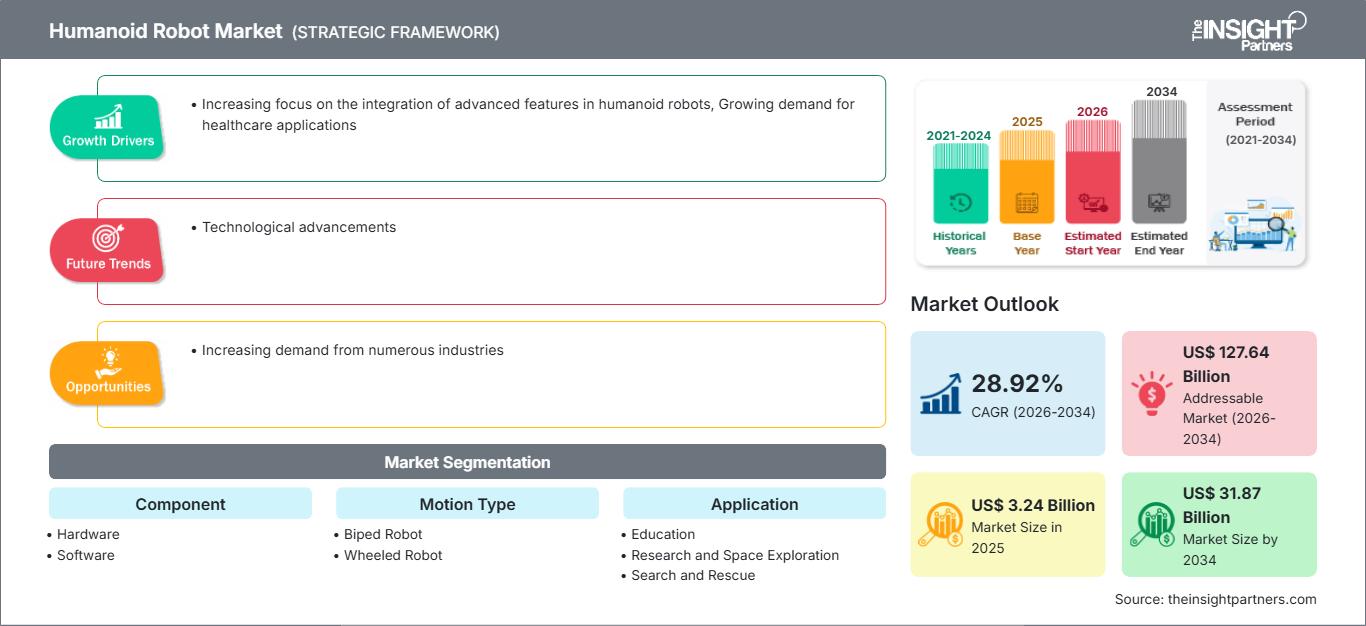
The Humanoid Robot Market reached US$ 3.24 Billion in 2025 and is projected to attain US$ 31.87 Billion by 2034, expanding at a CAGR of 28.92% during 2026–2034. Robotics design has shifted from pre-programmed demonstrations to embodied robotics that integrates vision-language-motion, force sensing, dexterous manipulation, and safer locomotion. Manufacturers are redesigning joint modules, hands, batteries, compute boards, and heatsinks for manufacturing feasibility and not lab functionality. ThMarket covers human-like robotic platforms that are able to move through constructed environments, manipulate objects, interact with humans, and complete repeatable or dangerous tasks in the areas of education, research, and space exploration, search and rescue, assistance and caregiving, and entertainment.
The Humanoid Robot Market size in North America is expected to grow with a modelled CAGR of 27.5-30.5% till 2034. Such growth is driven by the presence of artificial intelligence investments, increasing number of pilots in industrial and institutional settings, developed sensors and semiconductors, cloud platform providers, and robotics integration service providers ecosystems. The limitations in the workforce for caring, logistics, educational, and risky operation services also drives demand. Hardware development is challenging because actuators, reducers, tactile sensors, and lightweight construction have to work properly as a whole system. Software development becomes more data-driven as tele-operation, simulation, and fleet learning reduce training for each new task.
Humanoid Robot Market Assessment and Insights
- North America: The region held a modelled 36–38% share in 2025 and may grow at 27.5–30.5% CAGR during 2026–2034, supported by AI capital, institutional pilots, and advanced component supply.
- US: The country represented 86–88% of North American demand in 2025 and is projected to expand at 28.0–31.0% CAGR during 2026–2034.
- Europe: Europe accounted for a modelled 23–25% share in 2025 and should rise at 25.0–28.0% CAGR through 2034, led by Germany, the UK, France, Italy, and Spain.
- Asia Pacific: Asia Pacific captured a modelled 30–32% share in 2025 and is forecast to grow at 31.0–34.0% CAGR through 2034, led by China, Japan, South Korea, and India.
- Largest Segment: Hardware held a modelled 64–66% market share in 2025 and is expected to record a 26.0–29.0% CAGR during 2026–2034.
- High Growth Segment: Personal Assistance and Caregiving represented a modelled 19–21% share in 2025 and is projected to grow at 32.0–35.0% CAGR during 2026–2034.
- Key companies analyzed in detail: Hanson Robotics Limited, Honda Motor Co., Ltd., PAL Robotics, UBTECH Robotics Corp Ltd., Kawada Robotics Corporation, SoftBank Robotics Group Corp., Promobot LLC, Invento Robotics Private Limited, Toyota Motor Corporation, and Shenzhen Qihan Technology Co., Ltd.
Source: The Insight Partners' analysis based on proprietary research, government publications, company annual reports, investor presentations, industry databases, and expert interviews.
The field of robotics technology is shifting from demonstration using pre-programmed machines to that of embodied robotics involving vision language motion, force sensing, dexterous manipulation, and safe mobility. Robot manufacturers are redesigning joint modules, hands, battery packs, computing board, and heat sinks with the aim of ensuring manufacturability and not just working in the lab. Hardware development is complex because actuators, reducers, tactile sensors, and lightweight materials have to work together as one system. Software development is becoming increasingly data-oriented through tele-operation, simulation, and fleet learning, reducing the number of training sessions needed per task.
Until 2034, commercialization would expand from research centers and pilot projects into deployment within care facilities, educational establishments, visitor experiences, emergency and remote operations. The countries with advanced robotics programs include China, Japan, South Korea, India, and Gulf countries whereas North America and Europe remain popular destinations for investments into AI and hardware development. The safety and cybersecurity requirements, as well as procurement standards, would support robots with verifiable behavior, maintenance, security updates, and uptime metrics.
Humanoid Robot Market Report Scope
| Report Attribute | Details |
|---|---|
| Market size in 2025 | US$ 3.24 Billion |
| Market Size by 2034 | US$ 31.87 Billion |
| Global CAGR (2026 - 2034) | 28.92% |
| Historical Data | 2021-2024 |
| Forecast period | 2026-2034 |
Humanoid Robot Market Analysis
Humanoid Robot Market Growth is determined by the necessity of automating operations in the environment which was initially created for humans. The market is attractive to schools, labs, public places, care centers, and emergency services due to the ability of the robots to perform their functions using stairs, doors, tools, and other equipment, without any additional installation. The chain includes actuators manufacturers, sensors developers, batteries developers, AI creators, robot manufacturers, system integrators, training providers, and maintenance providers.
The economics of supply depends on reducing joint module price while enhancing runtime, carrying capacity, resilience, and field maintainability. Hardware limitation comes from the necessity to create precise reducers, powerful motors, touch-sensing hands, and light-weighted structure. Availability of the software is increasing because of simulations and foundation models, but its efficient application still needs task-specific data, safety valition, and integration with facility systems. Fleet feedback increasingly becomes a competitive asset.
The humanoid robot market report shows a highly fragmented structure, involving traditional automotive companies, robotic manufacturers, and human interactions companies. Honda Motor Co., Ltd., Toyota Motor Corporation, and Kawada Robotics Corporation offer engineering expertise, while PAL Robotics, UBTECH Robotics Corp Ltd., and SoftBank Robotics Group Corp. focus on deployable service robots and research robots. The competition will become more focused on autonomous technology, certified human interaction, data management, and network effects.
Communication is the key to using the robot technology and is covered by Hanson Robotics Limited, Promobot LLC, Invento Robotics Private Limited, and Shenzhen Qihan Technology Co., Ltd. The trend in investments goes towards vertically integrated products, mass production, and ongoing software or services fees. Vendors which are able to prove the economics of task performance and operate systems locally should turn demonstrations into business deals.
● REPORT CUSTOMIZATION
Tailor This Report To Align With Your Specific Business Requirements
This report can be customized to align precisely with your business objectives, scope, and target markets. Customization options include tailored segmentation, geography, competitive analysis, and strategic insights to support informed decision-making.
Customize This Report →WHAT YOU CAN ADJUST
- ● Segmentations
- ● Geography
- ● Competitive Analysis
- ● Language Preferences
Humanoid Robot Market: Strategic Insights
Regional Insights
North America Humanoid Robot Market
The North America Humanoid Robot market Share in 2025 was estimated to be 36-38%, and the region will witness a growth of 27.5-30.5% during 2026-2034. Deep capital in AI, sophisticated access to semiconductors, as well as universities with robotics curricula allow for fast experimentation. Education institutions, researchers, healthcare providers, public organizations, and agencies for emergency response serve as unique buyers that can help vendors experiment with various architectures, be it biped or wheeled robots.
Success is achieved not through impressive demonstration, but by showing reliability, safety, and efficiency. Perceptions and language capabilities of the region's cloud service providers and AI developers, as well as assistance of contract manufacturers and systems integrators, will help to overcome a gap between pilots and implementation. Canada adds research and healthcare innovation; Mexico adds manufacturing and downstream integration. Procurement will include more requirements in terms of cybersecurity, remote diagnostics, incident response, and lifecycle services.
U.S. Humanoid Robot Market
The United States modeled 86–88% of North American demand in 2025 and is expected to increase at a CAGR of 28.0–31.0% between 2026 and 2034. Research universities, technology firms, hospitals, entertainment facilities, and government laboratories have provided an unusually wide base of pilots. Demand is oriented towards platforms that allow for natural language communication, manipulation, teleoperation, and autonomy with buyers increasingly comparing the total costs and frequency of intervention.
Robot models designed by Hanson Robotics Limited, Promobot LLC, as well as other important Asian firms, get coverage due to scientific research, exhibitions, implementation in education and services; however, domestic artificial intelligence and component ecosystem affect the choice of platforms. Universities conduct studies on cognition, locomotion and human-robot interaction; museums and stores express interest in interaction capabilities; nursing companies explore guidance functions. Scientific grants from government agencies and safety standards promote innovation; however, liability issues, privacy, maintenance staff availability and deployment reliability are essential purchasing factors.
Europe Humanoid Robot Market
Europe was estimated to contribute a modelled 23-25% share in 2025 and is expected to grow at 25.0-28.0% CAGR over 2026-2034, with Germany leading the way. Europe has the combination of collaborative robots expertise, university research, automotive engineering, and human-friendly regulation. The UK offers AI and robotics research and service pilots, and Germany specializes in advanced manufacturing, precision engineering, and safety engineering which can be useful for repeatable humanoid robot production.
France can contribute public research, aerospace industry, medical applications, and social robotics; Italy has mechatronics and elderly care pilot programs; Spain has the base for PAL Robotics and also research clusters. EU funding and the same platform create transferable robotics software, but at the same time, the commercialization will have to meet certain requirements concerning safety of machinery, artificial intelligence legislation, privacy, and security. This adds additional expenses due to the qualification, but creates an advantage for vendors having transparent systems and risk management via updates.
APAC Humanoid Robot Market
Modelled shares in Asia Pacific amounted to 30-32% in 2025, with forecasted growth rates of 31.0-34.0% CAGR through 2026-2034 driven by China. High density of electronics supply chain, actuators, batteries, contract manufacturing helps to reduce iterations and allows for aggressive pricing.
Japan provides accurate mechatronics and care robotics technology, South Korea combines electronics, artificial intelligence and robotics initiatives; India specializes in educational, research, and services application; Australia specializes in remote operations and rescue robotics research. Government manufacturing support, aged population, public demonstration would help in developing the technology, whereas local safety and export rules would help to expand globally.
Middle East & Africa Humanoid Robot Market
The Middle East & Africa is expected to grow at 24.0%–27.0% CAGR from 2026 to 2034, with UAE being the leader. Airports, exhibitions, government service centers, education projects, and smart cities provide obvious use cases, whereas risk-intensive infrastructure and energy projects represent longer-term ones.
Robotics is supported by Saudi Arabia through economic diversification and infrastructure development, by UAE through investment, tourism, and testing technologies, by South Africa through mining and education, and by universities there. The Rest of MEA sees robot adoption on a per-project basis. Heat resistance, dust resistance, multilingual user interface, remote servicing, and connectivity are key purchasing criteria.
Segmentation Analysis
Component
Component is projected to register a modelled 28.0–31.0% CAGR during 2026–2034. The Humanoid Robot Market scope covers integrated mechanical, electrical, sensing, computing, and software systems whose value shifts as production scales. Hardware commands current revenue because actuators, hands, batteries, frames, and sensors remain expensive, while software gains strategic importance through fleet learning, simulation, autonomy, and recurring upgrades.
- Hardware: Hardware holds the leading position because precision actuators, reducers, dexterous hands, cameras, force sensors, batteries, and structural materials determine payload, movement quality, runtime, durability, and unit economics.
- Software: Software demand is scaling as perception, planning, language, simulation, teleoperation, and fleet analytics convert general platforms into application-ready systems and create recurring revenue beyond initial equipment sales.
Motion Type
Motion Type is expected to expand at a modelled 29.0–32.0% CAGR during 2026–2034. Biped platforms address stairs, uneven surfaces, and human-scale workspaces, but require sophisticated balance and consume more energy. Wheeled robots offer longer runtime, simpler control, and lower fall risk in hospitals, schools, laboratories, and reception areas. Buyers select mobility according to terrain, payload, safety, serviceability, and cost.
- Biped Robot: Biped robots are strategically important for stairs, narrow passages, and tool use in human-designed environments, supporting research, rescue, and complex assistance despite higher control and energy requirements.
- Wheeled Robot: Wheeled robots achieve strong near-term adoption in structured indoor settings because stable mobility, longer battery life, higher payload efficiency, and simpler maintenance improve deployment economics and operational reliability.
Application
Application demand is projected to grow at a modelled 29.5–32.5% CAGR during 2026–2034. Education and research create early installed bases, while entertainment supports visible interaction-led deployments. Search and rescue requires rugged mobility and teleoperation. Personal assistance and caregiving offers the strongest long-term expansion, but adoption depends on proven safety, privacy, dependable manipulation, clinician or caregiver integration, and affordable lifecycle service.
- Education: Universities, technical institutes, and schools use humanoids for coding, artificial intelligence, mechatronics, and human-robot interaction, creating repeat purchases of programmable platforms supported by curriculum, training, and developer communities.
- Research and Space Exploration: Laboratories and space agencies value modular platforms for locomotion, manipulation, telepresence, and autonomous decision research, making this segment central to technology validation and high-complexity mission preparation.
- Search and Rescue: Emergency organizations require robots capable of remote inspection, debris navigation, hazardous-material sensing, and tool handling, with strategic value determined by ruggedness, communications resilience, and operator control.
- Personal Assistance and Caregiving: Aging populations and caregiver shortages create significant potential for mobility guidance, reminders, monitoring, and object handling, although trust, safety certification, privacy, and service affordability govern adoption.
- Entertainment: Theme parks, exhibitions, museums, studios, and brand venues adopt expressive humanoids for performances and interactive storytelling, prioritizing appearance, speech, repeatable movement, audience safety, and rapid content updates.
Opportunity Snapshot
| Application | Revenue Contribution | Trend Tag | Adoption Stage |
| Education | Medium | AI Curriculum | Scaling |
| Research and Space Exploration | High | Mission Autonomy | Scaling |
| Search and Rescue | Low | Hazard Teleoperation | Emerging |
| Personal Assistance and Caregiving | High | Care Support | Emerging |
| Entertainment | Medium | Interactive Performance | Mature |
Humanoid Robot Market Growth Drivers and Impact Analysis
Embodied AI Improves Task Learning and Adaptability
Vision-language-action models, simulation, and learning from demonstration are reducing the amount of task-specific programming required for humanoid systems. Robots can increasingly interpret spoken instructions, recognize objects, plan movements, and improve through fleet data. This expands addressable use cases from scripted presentations toward variable tasks in laboratories, classrooms, care settings, and emergency operations. The commercial impact extends across cloud compute, edge processors, cameras, force sensors, teleoperation tools, and data-management platforms. However, buyers still require bounded behavior, explainable failure modes, and human override. Vendors that combine versatile models with application-specific safety layers can shorten integration cycles, reuse skills across customers, and build recurring software revenue without redesigning the complete machine for each assignment.
Labor and Care Constraints Expand Automation Demand
Aging populations, caregiver shortages, and difficulty staffing repetitive or hazardous work create sustained interest in robots that can operate within human spaces. Humanoids can potentially deliver supplies, guide users, perform routine inspections, support therapy, and handle selected objects without rebuilding facilities. Market impact will emerge first in structured workflows where task boundaries and escalation paths are clear. Care applications demand exceptional reliability, privacy protection, gentle manipulation, and integration with clinical or social-care teams. Search and rescue adds ruggedness, communications, and remote-operation requirements. Providers that quantify avoided injury, reduced walking time, increased service coverage, or faster response can establish credible purchasing cases and move procurement beyond innovation budgets.
Component Scale Lowers Platform Cost and Service Risk
Humanoid systems use components already benefiting from scale in electric vehicles, smartphones, drones, industrial automation, and AI computing. Higher-volume motors, batteries, cameras, processors, and power electronics can lower input cost, while modular joint assemblies simplify production and repair. The impact is not limited to purchase price: replaceable modules, remote diagnostics, and predictive maintenance can reduce downtime and spare-parts inventory. Chinese manufacturing depth accelerates cost compression, while Japanese, Korean, European, and North American suppliers compete on precision, reliability, and safety. As standard interfaces emerge, manufacturers can dual-source selected parts and shorten product cycles. Suppliers that design for maintainability and publish service metrics will gain an advantage in institutional procurements demanding predictable lifecycle cost.
Humanoid Robot Market Future Trends
General Skills Shift Toward Verified Skill Libraries
Humanoid Robot Market trends will increasingly center on reusable skill libraries that are trained broadly, then constrained for individual workplaces. Vendors will package navigation, grasping, handover, dialogue, and recovery behaviors as validated modules rather than open-ended autonomy. Customers will select approved skills, define restricted zones, and monitor fleet performance through digital twins. This approach can reduce integration effort while preserving accountability. Competitive advantage will depend on the breadth of verified behaviors, transfer across robot models, and quality of incident data. Independent testing and version-controlled updates should become standard procurement requirements as deployments expand around students, patients, visitors, and emergency personnel.
Wheeled and Biped Platforms Converge Around Modular Bodies
Future products will separate upper-body intelligence and manipulation from interchangeable mobility bases. A common torso, perception stack, and hand system may operate on wheels for hospitals or schools, then pair with biped legs for stairs, rubble, or irregular terrain. Modular architecture improves component reuse, simplifies maintenance training, and lets buyers match cost to environment. It also creates opportunities for common software and accessories across product families. Engineering challenges include center-of-gravity changes, calibration, power interfaces, and safety recertification. Vendors that manage these transitions reliably can serve more applications while avoiding entirely separate platforms for every motion requirement.
Humanoid Robot Market Opportunities
Create Managed Humanoid Services for Care and Education
Service providers can reduce adoption barriers by combining robots, deployment design, staff training, connectivity, maintenance, and outcome reporting under multiyear contracts. Humanoid Robot Market Forecasts support phased entry in care facilities and educational institutions where budgets are constrained and internal robotics expertise is limited. Providers should begin with bounded tasks such as guided exercises, supply delivery, classroom demonstrations, reception, and telepresence. Contract pricing can link fees to uptime, completed tasks, or supported users. Partnerships with caregivers, educators, insurers, and local integrators will strengthen workflow fit. Data governance, accessibility, multilingual interfaces, and rapid on-site support should be established before expansion across multiple facilities.
Build Rugged Teleoperated Systems for Emergency Missions
Manufacturers and integrators can target fire services, civil defense, utilities, mines, and disaster-response agencies with humanoids designed for inspection and intervention in hazardous environments. Initial systems should prioritize dependable teleoperation, communications redundancy, thermal protection, dust and water resistance, and tool compatibility before pursuing full autonomy. Buyers need scenario-based testing, transport cases, rapid battery exchange, and clear field-repair procedures. Funding models can combine government grants, infrastructure operators, and emergency agencies around shared regional fleets. Training simulators and recurring exercises will improve operator readiness. Suppliers that document mission performance and post-incident learning can establish procurement credibility in this safety-critical segment.
Recent Developments
- August 2026: LG Electronics has announced that it is developing a next-generation bipedal humanoid robot based on NVIDIA's Isaac GR00T, an open foundation model designed for humanoid robots. LG plans to publicly unveil the new robot in the first quarter of 2027. The announcement marks a move from LG's earlier demonstrations of its CLOiD home robot toward a new generation of humanoid robotics. LG says the collaboration with NVIDIA is moving beyond strategic planning into actual development and implementation.
- November 2025: Agile Robots has launched Agile ONE, its first humanoid robot, specifically designed for use in industrial environments. The robot is intended to work safely alongside human employees and other robotic systems, bringing AI-driven physical intelligence to manufacturing and industrial operations.
- July 2026: BYD has confirmed plans to unveil its first humanoid robot in August 2026, marking another major step in the company's expansion beyond electric vehicles and battery technology. The announcement was reported after BYD confirmed the plan to China Securities Journal. The move makes BYD the latest major Chinese automaker to enter the rapidly developing humanoid robotics market. Other automotive companies in China, including Chery, Changan Automobile, GAC Group and XPeng, are also developing humanoid robots.
Frequently Asked Questions

- Comprehensive Market Sizing and Forecast Analysis
- Detailed Segmentation Analysis
- In-Depth Market Dynamics Assessment
- Regional and Country-Level Insights
- Competitive Landscape and Company Benchmarking
- Strategic Business Intelligence
Recent Reports
Testimonials

The Insight Partners' SCADA System Market report is comprehensive, with valuable insights on current trends and future forecasts. The team was highly professional, responsive, and supportive throughout. We are very satisfied and highly recommend their services.
RAN KEDEM Partner, Reali Technologies LTDs
I requested a report on a very specific software market and the team produced the report in a few days. The information was very relevant and well presented. I then requested some changes and additions to the report. The team was again very responsive and I got the final report in less than a week.
JEAN-HERVE JENN Chairman, Future Analytica
We worked with The Insight Partners for an important market study and forecast. They gave us clear insights into opportunities and risks, which helped shape our plans. Their research was easy to use and based on solid data. It helped us make smart, confident decisions. We highly recommend them.
PIYUSH NAGPAL Sr. Vice President, High Beam Global
The Insight Partners delivered insightful, well-structured market research with strong domain expertise. Their team was professional and responsive throughout. The user-friendly website made accessing industry reports seamless. We highly recommend them for reliable, high-quality research services
YUKIHIKO ADACHI CEO, Deep Blue, LLC.
This is the first time I have purchased a market report from The Insight Partners.While I was unsure at first, I visited their web site and felt more comfortable to take the risk and purchase a market report.I am completely satisfied with the quality of the report and customer service. I had several questions and comments with the initial report, but after a couple of dialogs over email with their analyst I believe I have a report that I can use as input to our strategic planning process.Thank you so much for taking the extra time and making this a positive experience.I will definitely recommend your service to others and you will be my first call when we need further market data.
JOHN SUZUKI President and Chief Executive Officer, Board Director, BK Technologies
I wish to appreciate your support and the professionalism you displayed in the course of attending to my request for information regarding to infectious disease IVD market in Nigeria. I appreciate your patience, your guidance, and the fact that you were willing to offer a discount, which eventually made it possible for us to close a deal. I look forward to engaging The Insight Partners in the future, all thanks to the impression you have created in me as a result of this first encounter.
DR CHIJIOKE ONYIA MANAGING DIRECTOR, PineCrest Healthcare Ltd.Reason to Buy
- Informed Decision-Making
- Understanding Market Dynamics
- Competitive Analysis
- Identifying Emerging Markets
- Customer Insights
- Market Forecasts
- Risk Mitigation
- Boosting Operational Efficiency
- Strategic Planning
- Investment Justification
- Tracking Industry Innovations
- Aligning with Regulatory Trends





 Get Free Sample for