
Hybrid Printing Market Growth, Demand & Size by 2034
Hybrid Printing Market Size and Forecasts (2021 - 2034), Global and Regional Share, Trends, and Growth Opportunity Analysis Report Coverage : By Technology (UV Inkjet Printing, Water Based Printing, Solvent Printing, LED Curable, Dye Sublimation), Substrate (Textile & Fabric, Paper, Glass, Plastic, Metal), Application (Promotional Material, Packaging Printing, Label Printing, Others), End-use Industry (Pharmaceutical, Textile & Apparel, Cosmetics, Food & Beverage, Retail, Electronics, Others)
- Status : Data Released
- Report Code : TIPRE00039460
- Category : Electronics and Semiconductor
- No. of Pages : 150
- Available Report Formats :


- Last update date : September 17, 2026


2025 Market Size
US$ 6.91 Bn
Base year value
2034 Forecast
US$ 21.89 Bn
Projected by 2034
CAGR 2026-2034
13.67 %
Growth rate
Addressable Market
US$ 124.58 Bn
(2026-2034)
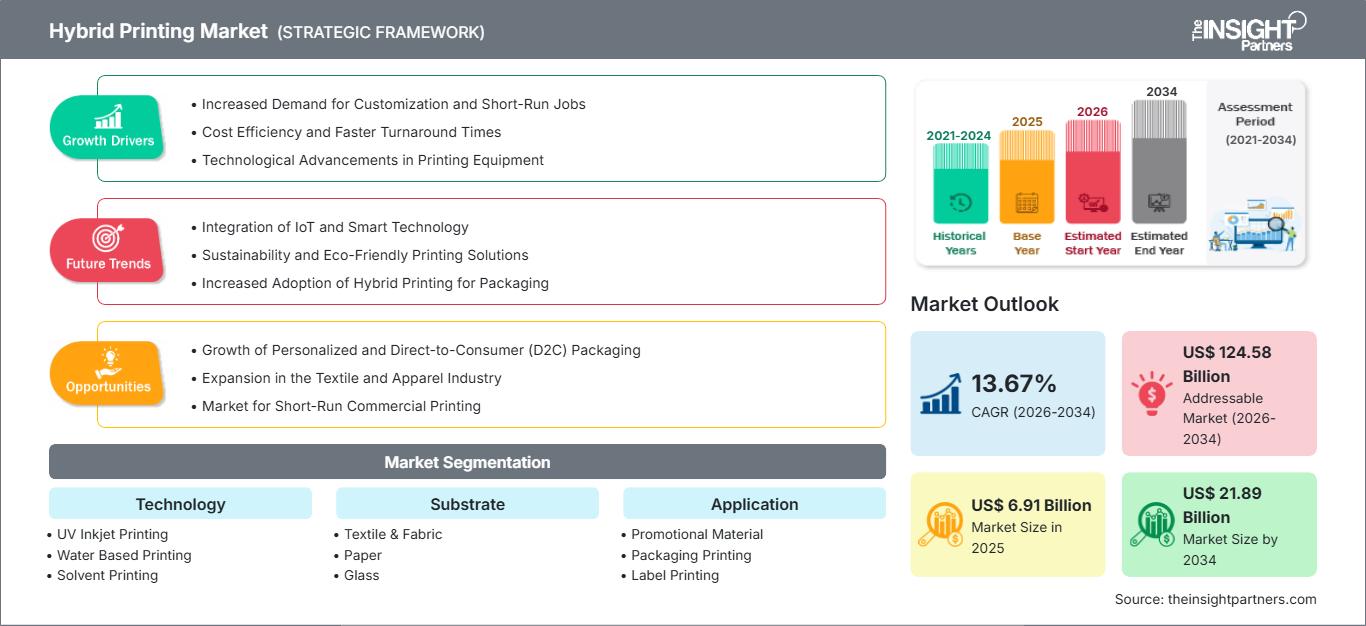
The Hybrid Printing Market is valued at US$ 6.91 Billion in 2025 and is projected to reach US$ 21.89 Billion by 2034, expanding at a CAGR of 13.67% from 2026 to 2034. Hybrid printing involves using a combination of digital and traditional printing technologies in an attempt to cope with shorter press runs, personalization, wide range of substrates, and fast production cycles.
North America will continue being one of the key regions of technology adoption driven by packaging personalization, automation and replacement of legacy printing equipment. Factors influencing the Hybrid Printing Market size include requirements of shortened production cycles, variable data and digital finishing integration. Investment into high-speed inkjet printers, UV curable technologies, workflow software and substrate-friendly printing systems will help to drive regional market growth.
Hybrid Printing Market Assessment and Insights
- North America: North America is estimated to account for 28–32% share in 2025 and is projected to grow at a CAGR of 11.0–12.5% between 2026–2034, supported by packaging personalization, automated workflows, and industrial digital-printing investments.
- US: The US represents approximately 72–76% share of North America in 2025 and is expected to expand at a CAGR of 11.2–12.7% between 2026–2034, led by packaging, labels, and commercial printing.
- Europe: Europe is estimated at 25–29% share in 2025, with a CAGR of 12.2–13.5% between 2026–2034. Germany, the UK, France, Italy, and Spain support demand through advanced packaging, sustainability requirements, and digital production modernization.
- Asia Pacific: Asia Pacific is expected to hold 31–35% share in 2025 and grow at a CAGR of 15.0–16.5% between 2026–2034, led by China, Japan, South Korea, and India, where packaging and textile production are expanding.
- Largest Segment: Packaging Printing is estimated to hold 35–39% market share in 2025, with a CAGR of 14.2–15.4% between 2026–2034, reflecting customization and shorter production runs.
- High Growth Segment: LED Curable is estimated at 14–18% market share in 2025, expanding at a CAGR of 16.0–17.5% between 2026–2034, driven by energy-efficient curing and substrate versatility.
- Key companies analyzed in detail: FUJIFILM Holdings Corporation, HP Development Company, L.P., Ricoh Company, Ltd., Konica Minolta, Inc., Bobst Group SA, Seiko Epson Corporation, Koenig & Bauer AG, Heidelberger Druckmaschinen AG, Kento Digital Printing, and Floraprinter.
Source: The Insight Partners' analysis based on proprietary research, government publications, company annual reports, investor presentations, industry databases, and expert interviews.
This is leading to the shift in the printing ecosystem from siloed analog and digital printing methods to integrated production lines that feature presses, workflow software, variable data, finishing machinery, and quality control automation systems. The development of high speed inkjet technology, UV curable inks, media handling systems, and color management technology will help narrow the performance gap between digital and conventional printing processes. This will lead to an increased use of hybrid setups that can print on a mixed volume basis without having to replace any existing machinery.
Over the forecast period, adoption will take place in new manufacturing hubs of Asia, Latin American converters, as well as select Middle Eastern markets. Investments will be geared towards flexible packaging, label printing, textile customization, and specialty substrates. In addition, environmental considerations will also play a key role in equipment choices.
Hybrid Printing Market Report Scope
| Report Attribute | Details |
|---|---|
| Market size in 2025 | US$ 6.91 Billion |
| Market Size by 2034 | US$ 21.89 Billion |
| Global CAGR (2026 - 2034) | 13.67% |
| Historical Data | 2021-2024 |
| Forecast period | 2026-2034 |
Hybrid Printing Market Analysis
The demand side is being influenced by the shift towards shorter runs, customization, fast artwork changeovers, and increased SKU launches. The development of the hybrid printing market is therefore directly related to converters’ efforts to bring together the digital advantages of variable data printing with the economic benefits of analog printing technologies. The industry’s value chain consists of printing press makers, printhead providers, ink formulators, substrate producers, workflow software providers, converters, finishers, and brand owners.
On the supply side, technological factors become increasingly dominant as printing equipment makers develop solutions for ink delivery, color management, curing, inspections, and workflow automation. Inkjet printheads and inks are among the key technology elements since performance must be compatible with substrates and finishing. Equipment makers compete increasingly on basis of efficiency, media adaptability, automation, and cost of ownership.
The analysis of the Hybrid Printing Market Report describes a competitive landscape that includes diversified printing equipment manufacturers as well as niche digital printing manufacturers. FUJIFILM Holdings Corporation and HP Development Company, L.P. focus on digital production solutions, and Ricoh Company, Ltd. specializes in inkjet technology. Konica Minolta, Inc. and Seiko Epson Corporation compete with imaging, inkjet, automation, and application-specific technology.
Bobst Group SA, Koenig & Bauer AG, and Heidelberger Druckmaschinen AG from Europe maintain leadership in conventional production technology but expand their digital and integrated workflow offerings. Kento Digital Printing and Floraprinter are providing additional niche offerings. Competitive advantage is increasingly determined by interoperability of the equipment, application development, consumables, service networks, and ability to integrate digital process into conventional production line.
Investments are made in high-speed digital engines, automated inspection, cloud-integrated workflow solutions, and specialty inks. The manufacturers are developing application-specific solutions for packaging, textiles, label, and decorative printing. Such solutions help minimize the time of setup and production costs, as well as allow keeping the existing analog assets. Partnerships with converters, substrates, and software developers are becoming essential to verify complete production ecosystem.
● REPORT CUSTOMIZATION
Tailor This Report To Align With Your Specific Business Requirements
This report can be customized to align precisely with your business objectives, scope, and target markets. Customization options include tailored segmentation, geography, competitive analysis, and strategic insights to support informed decision-making.
Customize This Report →WHAT YOU CAN ADJUST
- ● Segmentations
- ● Geography
- ● Competitive Analysis
- ● Language Preferences
Hybrid Printing Market: Strategic Insights
Regional Insights
North America Hybrid Printing Market
North America Hybrid Printing Market share is expected to be 28% - 32% in 2025, backed by mature commercial printing solutions and high demand for personalized packaging, labels, promotions, and short runs. Growth rate of the region is forecasted to be at 11.0% - 12.5% CAGR during 2025 - 2034. US converters comprise the biggest demand of the region, and Canada drives adoption in packaging, specialty and industrial printing applications.
The region's customers seek workflow automation, variable data printing, fast changeovers and machines that can print on different substrates. Hybrid machines enable existing printers to maintain their profitable analog solutions as well as adding digital technology for custom jobs. Relevant portfolio of technology is available in HP Development Company, L.P., FUJIFILM Holdings Corporation, Ricoh Company, Ltd., and Konica Minolta, Inc.
U.S. Hybrid Printing Market
The United States is forecasted to constitute 72-76% of the total demand for the continent in 2025 and is projected to grow with a CAGR of 11.2-12.7% until 2034. Some of the adopters are packaging converters, commercial printers, label manufacturers, and promotional material providers. The driving forces behind demand include e-commerce, personalized products, frequent modifications in artwork, and complex SKUs.
Major vendors have excellent customer service and networks throughout the nation. Industrial digital presses from HP Development Company, L.P. are used for labels and packaging applications, whereas Ricoh Company, Ltd. and FUJIFILM Holdings Corporation provide solutions for commercial and production printing. The hybrid approach is highly applicable when converters need to incorporate digital personalization along with analog operations, thus modernizing without replacing all equipment.
Europe Hybrid Printing Market
It accounts for 25–29% of the market in 2025 and is expected to grow at a CAGR of 12.2–13.5%, with Germany being the biggest national market. Europe enjoys high-level printing machine manufacturing industry, advanced packaging converters, and strong environment regulations. The EU Packaging and Packaging Waste Regulation was adopted in 2025 and came into effect since August 2026, which led to the growing importance of recyclable and sustainable packaging manufacture.
The UK and Germany continue to be centers of technology development. The UK has a developed commercial and packaging printing industry; Germany has a developed machinery manufacturing industry along with large converters and industrial printing industry. France, Italy, and Spain contribute to the demand through packaging, labels, textiles, food, cosmetics, and retail application markets. European customers consider waste minimization, compatibility with substrates, curing performance, and production process automation in purchasing equipment.
APAC Hybrid Printing Market
APAC is forecast to be 31-35% market share by 2025 and will record a CAGR of 15.0-16.5% and become the fastest-growing region. China emerges as the largest demand base driven by packaging & manufacturing scale. Japan and South Korea will bring in technology advancement in the form of printing. India and Australia will bring commercial & packaging opportunities.
The rise in industrialization, textile production, packaging in e-commerce, and print infrastructure development will drive investments in production prints. Short run flexibility and customization with volume efficiency will become more crucial for regional converters. India becomes an important market for investments in production-print and will have suppliers showcasing digital print platforms for commercial, packaging & on-demand markets.
Middle East & Africa Hybrid Printing Market
Middle East and Africa is expected to record a CAGR of 13.0–14.5% through 2034, with Saudi Arabia and the UAE leading regional investment. Packaging modernization, retail expansion, food production, and diversification initiatives are creating opportunities for digital and hybrid equipment. South Africa remains an important industrial printing center serving packaging, labels, commercial applications, and regional exports.
The Middle East and Africa: Both Saudi Arabia and UAE enjoy benefits from infrastructure investments, as well as manufacturing, while South Africa supplies an already developed print conversion environment. The rest of the Middle East and Africa’s print conversion requirements are rather diverse but offer good prospects for upgrading equipment in line with automatic production.

Segmentation Analysis
Technology
Technology remains a central competitive dimension because ink chemistry, curing mechanisms, printhead architecture, and substrate compatibility determine production economics. The segment is projected to expand at a CAGR of 13.2–14.4% from 2026–2034. The Hybrid Printing Market scope increasingly encompasses systems capable of integrating multiple technologies within connected workflows.
- UV Inkjet Printing: Supports durable, high-resolution output across rigid and flexible substrates. Demand is strongest where rapid curing, image quality, and direct printing capabilities justify premium equipment investment.
- Water Based Printing: Gains relevance in packaging and applications requiring lower-emission ink systems. Its strategic importance increases where recyclability, food-contact requirements, and substrate compatibility influence equipment decisions.
- Solvent Printing: Remains relevant for durable outdoor graphics and selected flexible applications. Printers value adhesion and weather resistance, although environmental considerations increasingly encourage migration toward alternative formulations.
- LED Curable: Provides rapid curing, lower thermal impact, and compatibility with diverse media. Adoption is increasing in applications requiring energy efficiency, fast turnaround, and durable specialty printing.
- Dye Sublimation: Supports textile and fabric applications requiring vivid colors and customized designs. Its importance is linked with sportswear, fashion, home décor, signage, and short-run personalized textile production.
Substrate
Substrate selection strongly affects ink adhesion, curing, drying, color performance, and finishing requirements. The segment is expected to expand at a CAGR of 12.9–14.1% from 2026–2034. Greater substrate diversity encourages printers to invest in adaptable systems and application-specific consumables.
- Textile & Fabric: Supports customized apparel, décor, signage, and fashion production. Digital compatibility enables shorter runs, variable designs, and localized manufacturing while reducing dependence on traditional screen-printing setups.
- Paper: Remains a core medium across commercial, publishing, promotional, and packaging applications. Hybrid systems improve flexibility by combining variable-data capabilities with efficient high-volume paper production.
- Glass: Requires specialized ink adhesion and curing performance. Adoption is concentrated in decorative, architectural, beverage, and specialty applications where customization can increase product differentiation.
- Plastic: Supports labels, flexible packaging, containers, and direct-to-object applications. Demand depends heavily on ink adhesion, durability, curing, and compliance with packaging requirements.
Application
Application is projected to expand at a CAGR of 14.1–15.3% from 2026–2034, reflecting the growing importance of customization and production flexibility. Hybrid configurations allow converters to balance long-run economics with digital personalization and rapid artwork changes. This supports the Hybrid Printing Market Forecasts across packaging and commercial applications.
- Promotional Material: Digital customization enables targeted campaigns, localized graphics, personalized merchandise, and short production cycles. Hybrid production can preserve conventional economics while adding variable-data capabilities.
- Packaging Printing: Represents the largest application, supported by SKU proliferation, personalization, shorter runs, and faster product launches. Digital integration is particularly valuable for cartons, flexible packaging, corrugated products, and specialty formats.
- Label Printing: Benefits from variable data, versioning, serialization, and rapid artwork changes. Hybrid platforms support converters serving food, beverage, pharmaceutical, cosmetics, and consumer-product manufacturers.
End-use Industry
End-use Industry demand is projected to grow at a CAGR of 13.5–14.8% from 2026–2034. Industry-specific requirements determine substrate compatibility, regulatory constraints, print durability, and customization intensity. Packaging-intensive industries are likely to remain major adopters, while textile and electronics applications create specialized opportunities.
- Pharmaceutical: Requires accurate variable information, traceability, compliant packaging, and high-quality labels. Digital capabilities support smaller batches and frequent artwork or regulatory changes.
- Textile & Apparel: Benefits from customized designs, shorter fashion cycles, localized production, and on-demand manufacturing. Dye sublimation and inkjet technologies are especially relevant.
- Cosmetics: Packaging differentiation and frequent product launches encourage customized cartons, labels, and decorative applications, creating demand for flexible short-run printing.
- Food & Beverage: Large SKU portfolios and seasonal campaigns create demand for variable packaging and labels. Production systems must balance speed, quality, compliance, and substrate performance.
- Retail: Personalized promotional materials, point-of-sale graphics, packaging, and localized campaigns support adoption. Hybrid systems help retailers respond quickly to changing product and marketing requirements.
- Electronics: Requires precise decorative and functional printing on specialized substrates. Hybrid processes can support customization and controlled production volumes for components and finished products.
Opportunity Snapshot
| Application | Revenue Contribution | Trend Tag | Adoption Stage |
|---|---|---|---|
| Promotional Material | Medium | Variable Data | Scaling |
| Packaging Printing | High | Short Runs | Scaling |
| Label Printing | High | Smart Labels | Mature |
Hybrid Printing Market Growth Drivers and Impact Analysis
Shorter production runs and increasing SKU complexity
Brand owners are becoming increasingly demanding for different variants of their products, regional designs, special edition products, and customized packaging options. This makes the traditional long-term production runs far less attractive and makes the use of equipment that can make quick changeovers much more valuable. In response to this, hybrid presses offer a solution that combines production efficiency in the traditional way with the ability to handle digital variable data. This allows for better utilization of existing equipment as well as printers being able to handle smaller print orders. Packaging converters will also be able to adapt more rapidly to new seasons and new products. The fourth driver in the Hybrid Printing Market promotes the purchase of equipment and workflow automation as well as investment in color management technologies. This driver makes it advantageous for suppliers to create equipment that handles various types of substrates and inks with minimal human intervention.
Expansion of customized and sustainable packaging
Packaging demand is increasingly influenced by personalization, product differentiation, shorter supply chains, and environmental requirements. Hybrid printing enables converters to produce multiple versions without maintaining separate conventional plates or extensive setup cycles. This can reduce waste associated with obsolete inventory and support more responsive production planning. Sustainability requirements are also changing equipment-selection criteria. The European Union's Packaging and Packaging Waste Regulation establishes stronger recyclability and resource-efficiency requirements, increasing pressure on packaging producers to evaluate materials, inks, coatings, and production processes together. Consequently, hybrid platforms with efficient curing, accurate ink deposition, and substrate flexibility can gain preference where converters need both productivity and environmental performance.
Automation and integrated print production workflows
Automation is becoming a core investment priority as printers face labor shortages, rising operating complexity, and tighter delivery schedules. Automated prepress, job scheduling, color control, inspection, and finishing can reduce manual intervention and improve consistency across production runs. Hybrid environments particularly benefit because multiple printing technologies must be coordinated within one workflow. Digital connectivity allows production data to move between design, press, quality control, and finishing stages. This supports real-time monitoring and reduces errors during frequent job changes in the Hybrid Printing Market. Equipment manufacturers are therefore integrating software and hardware rather than competing solely on press specifications. The impact extends beyond productivity because connected workflows improve visibility into job costs, material utilization, downtime, and equipment performance. Such capabilities strengthen the economic case for hybrid production among medium-sized converters and commercial printers.
Hybrid Printing Market Future Trends
AI-enabled production optimization and adaptive print control
AI-enabled systems are likely to become more important as hybrid presses manage increasingly complex combinations of substrates, inks, images, and production schedules. Future platforms may use machine-learning models to optimize color density, drying parameters, printhead performance, registration, and maintenance intervals. Automated inspection could identify defects during production and trigger corrective adjustments without stopping the press. Workflow software will increasingly connect demand forecasting with job sequencing, helping printers consolidate similar substrates and reduce setup requirements. These developments could improve asset utilization and reduce material waste while allowing smaller production teams to manage higher job diversity. Hybrid Printing Market trends are therefore expected to move beyond equipment integration toward autonomous production environments where printing, quality assurance, and scheduling operate through connected control layers.
Growth of digitally integrated packaging production
Packaging converters are expected to increasingly integrate digital print engines with conventional presses, coating, laminating, cutting, and finishing equipment. The objective will be to create continuous workflows rather than isolated digital production islands. Faster inkjet engines, improved drying, and better substrate handling should expand digital participation in applications previously dominated by conventional processes. The transition is particularly relevant to corrugated, flexible packaging, cartons, and labels where customization and SKU proliferation are increasing. European packaging rules may further reinforce this shift by encouraging recyclable designs and more efficient resource use. The combination of variable-data printing, automated inspection, and connected finishing should make hybrid production increasingly viable for medium-volume applications where traditional economics and digital flexibility need to coexist.
Hybrid Printing Market Opportunities
Developing integrated packaging platforms for emerging converters
Equipment suppliers can target emerging packaging markets by offering modular platforms that combine digital print engines with conventional presses and finishing equipment. Such systems reduce the financial barrier associated with complete production-line replacement and allow converters to expand digital capacity incrementally. Vendors can strengthen adoption through application testing, substrate libraries, workflow integration, operator training, and managed service models. India, Southeast Asia, Latin America, and selected Middle Eastern markets offer opportunities where packaging volumes are expanding while production infrastructure remains mixed. Suppliers should prioritize compact equipment, flexible media handling, energy-efficient curing, and remote diagnostics. Hybrid Printing Market Forecasts indicate that investment opportunities will increasingly arise from solutions that integrate hardware, software, consumables, and technical services rather than equipment alone.
Building specialty printing solutions for high-value substrates
Specialty substrates provide an attractive opportunity because they generally command higher margins and require application-specific expertise. Glass, plastics, textiles, metals, and decorative materials can support customized products where digital flexibility creates clear commercial value. Vendors can develop differentiated systems around adhesion, curing, color management, surface treatment, and automated inspection. Partnerships with substrate producers and ink formulators can accelerate validation and reduce implementation risk for converters. Applications in cosmetics, electronics, premium food packaging, apparel, décor, and promotional products can provide diversified revenue streams. Suppliers should also develop configurable platforms that support multiple ink technologies, enabling customers to address changing application requirements without purchasing entirely new equipment. This approach can increase customer lifetime value while strengthening technology lock-in through inks, software, and service relationships.
Recent Developments
- June 2026: FUJIFILM Holdings Corporation expanded its Indian production-print presence by opening the Revoria Experience Center in Faridabad and launching the AI-driven Revoria Press PC2120. The facility supports media validation, high-value printing, operator development, and application testing, while the new press adds expanded color capabilities and automation for commercial and specialty productionMarch 2026: HP Development Company, L.P. announced a strategic agreement with Shutterfly involving deployment of 35 HP Indigo 120K digital presses. The agreement expands industrial-scale digital production and demonstrates increasing use of automated digital presses for personalized, high-volume manufacturing. The first phase is scheduled for 2026, reinforcing HP's focus on scalable digital production.
- March 2026: Ricoh Company, Ltd. announced a strategic partnership with LogoJET to expand direct-to-object UV printing capabilities. Ricoh is adding LogoJET printers to its broader graphic communications portfolio covering hardware, software, workflow, and services. The move strengthens its position in on-demand customization across commercial and in-plant environments and broadens its exposure to specialized UV printing applications.
Frequently Asked Questions

- Comprehensive Market Sizing and Forecast Analysis
- Detailed Segmentation Analysis
- In-Depth Market Dynamics Assessment
- Regional and Country-Level Insights
- Competitive Landscape and Company Benchmarking
- Strategic Business Intelligence
Recent Reports
Testimonials

The Insight Partners provided valuable market intelligence that supported our global go-to-market strategy. Their team was professional, responsive, and attentive to our feedback, providing thoughtful analysis and helpful methodological clarifications throughout the project.
Junmo Kim Chief Financial Officer (CFO), Enertech Co., Ltd.
The Insight Partners' SCADA System Market report is comprehensive, with valuable insights on current trends and future forecasts. The team was highly professional, responsive, and supportive throughout. We are very satisfied and highly recommend their services.
RAN KEDEM Partner, Reali Technologies LTDs
I requested a report on a very specific software market and the team produced the report in a few days. The information was very relevant and well presented. I then requested some changes and additions to the report. The team was again very responsive and I got the final report in less than a week.
JEAN-HERVE JENN Chairman, Future Analytica
We worked with The Insight Partners for an important market study and forecast. They gave us clear insights into opportunities and risks, which helped shape our plans. Their research was easy to use and based on solid data. It helped us make smart, confident decisions. We highly recommend them.
PIYUSH NAGPAL Sr. Vice President, High Beam Global
The Insight Partners delivered insightful, well-structured market research with strong domain expertise. Their team was professional and responsive throughout. The user-friendly website made accessing industry reports seamless. We highly recommend them for reliable, high-quality research services
YUKIHIKO ADACHI CEO, Deep Blue, LLC.
This is the first time I have purchased a market report from The Insight Partners.While I was unsure at first, I visited their web site and felt more comfortable to take the risk and purchase a market report.I am completely satisfied with the quality of the report and customer service. I had several questions and comments with the initial report, but after a couple of dialogs over email with their analyst I believe I have a report that I can use as input to our strategic planning process.Thank you so much for taking the extra time and making this a positive experience.I will definitely recommend your service to others and you will be my first call when we need further market data.
JOHN SUZUKI President and Chief Executive Officer, Board Director, BK Technologies
I wish to appreciate your support and the professionalism you displayed in the course of attending to my request for information regarding to infectious disease IVD market in Nigeria. I appreciate your patience, your guidance, and the fact that you were willing to offer a discount, which eventually made it possible for us to close a deal. I look forward to engaging The Insight Partners in the future, all thanks to the impression you have created in me as a result of this first encounter.
DR CHIJIOKE ONYIA MANAGING DIRECTOR, PineCrest Healthcare Ltd.Reason to Buy
- Informed Decision-Making
- Understanding Market Dynamics
- Competitive Analysis
- Identifying Emerging Markets
- Customer Insights
- Market Forecasts
- Risk Mitigation
- Boosting Operational Efficiency
- Strategic Planning
- Investment Justification
- Tracking Industry Innovations
- Aligning with Regulatory Trends





 Get Free Sample for