
Industrial Brakes Market Developments and Forecast by 2034
Coverage: By Type (Mechanically Applied Brakes, Hydraulically Applied Brakes, Pneumatically Applied Brakes, Electrically Applied Brakes, and Others), Application (Holding Brakes, Dynamic and Emergency Brakes, and Tension Brakes), and Industry Vertical (Manufacturing, Metal and Mining, Construction, Power Generation, Marine and Shipping, and Others) and Geography
- Status : Data Released
- Report Code : TIPRE00007789
- Category : Manufacturing and Construction
- No. of Pages : 150
- Available Report Formats :


- Last update date : August 28, 2026


2025 Market Size
US$ 1.46 Bn
Base year value
2034 Forecast
US$ 2.44 Bn
Projected by 2034
CAGR 2026-2034
5.9 %
Growth rate
Addressable Market
US$ 17.69 Bn
(2026-2034)
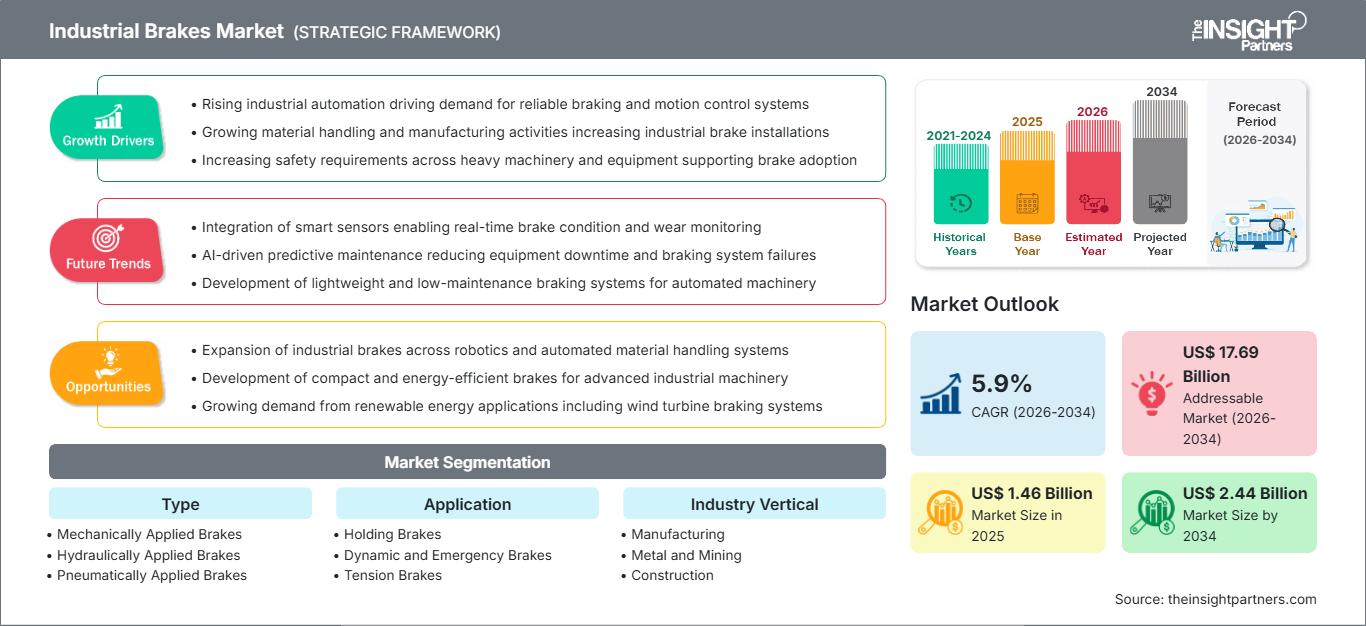
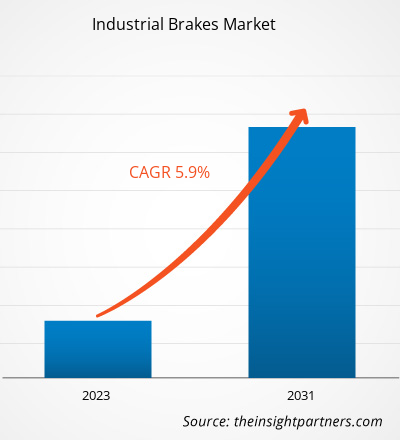
The industrial brakes market is projected to expand from US$ 1.46 Billion in 2025 to US$ 2.44 Billion by 2034, registering a CAGR of 5.9% during 2026–2034. Demand reflects the essential role of braking assemblies in holding, controlled deceleration, emergency stopping, and tension management across manufacturing, metal and mining, construction, power generation, marine, and shipping equipment operating under increasingly automated and safety-critical conditions.
North America remains a technically mature demand center, with the industrial brakes market size supported by replacement cycles, automation investment, and stricter machine-safety practices. A modelled 4.8–5.4% regional CAGR is consistent with expanding warehouse automation, port modernization, and the installed base of cranes, conveyors, hoists, and process machinery. Buyers increasingly prioritize fail-safe architecture, condition monitoring, corrosion resistance, and serviceability over initial component cost.
Industrial Brakes Market Assessment and Insights
- North America accounted for a modelled 31–34% share in 2025 and is expected to grow at 4.8–5.4% during 2026–2034, supported by automation retrofits, port investment, and safety-led replacement demand.
- US represented 76–79% of North American revenue in 2025 and is projected to advance at 4.9–5.5%, reflecting extensive installed machinery and warehouse automation.
- Europe held a modelled 27–30% share in 2025 and should expand at 4.6–5.2%, led by Germany, the UK, France, Italy, and Spain through machinery modernization.
- Asia Pacific captured a modelled 29–32% share in 2025 and is forecast to grow at 6.8–7.4%, led by China, Japan, India, and South Korea.
- Largest Segment Mechanically Applied Brakes held a modelled 34–38% market share in 2025 and should register 4.7–5.3% CAGR through 2034.
- High Growth Segment Electrically Applied Brakes accounted for a modelled 20–24% share in 2025 and should achieve 7.2–7.8% CAGR through 2034.
- Key companies analyzed in detail: Akebono Brake Industry Co., Ltd., Regal Rexnord Corporation, AMETEK, Inc., Aplicaciones Nuevas Tecnologías ANTEC, S.A.U., Dellner Bubenzer Germany GmbH, The Hilliard Corporation, Kobelt Manufacturing Co. Ltd., KOR-PAK Corporation, RINGSPANN GmbH, and Tolomatic, Inc.
Source: The Insight Partners' analysis based on proprietary research, government publications, company annual reports, investor presentations, industry databases, and expert interviews.
The industrial brakes market trends have transitioned from individual mechanical braking elements to sophisticated motion control subsystems integrating actuation, friction products, controls, and diagnostic functions. Electrification trends are decreasing hydraulic fluid connections in cleaner production cells, whereas spring-applied and power-released designs will continue to be crucial for fail-safe functions. Manufacturing trends are increasingly demanding modules, interface standardization, wearable component exchange, and local service stock levels. As such, validation of torque, heat dissipation, ingress protection, and functional safety on application-specific duty cycles become the main success criteria in the industrial brakes market.
The industrial brakes market forecast indicates that investments are expected to extend across manufacturing belts in Asia, ports in the Middle East, mining facilities in Africa, and power generation in renewables. The increased cost of failure due to automation in machine building will push for earlier brake specification in the system design process. Worker protection, crane safety, and equipment availability regulations will provide opportunities for replacement, while digital maintenance platforms will generate additional revenues for sensors, retrofitting, inspections, and authorized spares.
Industrial Brakes Market Report Scope
| Report Attribute | Details |
|---|---|
| Market size in 2025 | US$ 1.46 Billion |
| Market Size by 2034 | US$ 2.44 Billion |
| Global CAGR (2026 - 2034) | 5.9% |
| Historical Data | 2021-2024 |
| Forecast period | 2026-2034 |
Industrial Brakes Market Analysis
Growth of the industrial brakes industry can be attributed to increased utilization of machines, automation, and shortened stopping distances. The demand starts from OEMs and retrofit integrators before reaching friction material makers, casting and machining providers, actuators providers, control suppliers, distributors, and service providers. Metals like steel and aluminum, elastomers, electronics, and machined parts define risk exposure.
Sourcing reliability will come from dual sources, regional inventory and interchangeable wear parts. The customers consider overall lifecycle costs based on the frequency of inspections, pad changeout time, energy consumption, and downtime. Electro-activated parts become popular when cleanliness and precision are important, but hydraulic and pneumatic parts still have benefits in applications requiring high force or harsh environments.
Industrial brakes market analysis suggests that competition in the market is fragmented and defined by application know-how, not size only. Regal Rexnord Corporation offers a variety of different brake products along with power transmission products, while Dellner Bubenzer Germany GmbH specializes in heavy duty crane, mining, marine and wind applications. RINGSPANN GmbH, Tolomatic, Inc., and The Hilliard Corporation operate via engineered diversity and channel coverage.
Strategy definition is based on local engineering, certification testing, after-sales support and digital capabilities. Akebono Brake Industry Co., Ltd. provides friction and braking know-how, AMETEK, Inc. provides special motion control capabilities, Aplicaciones Nuevas Tecnologías ANTEC, S.A.U., Kobelt Manufacturing Co. Ltd. and KOR-PAK Corporation cover specific industrial segments. Capital is shifting towards sensors, corrosion resistant solutions and configurable platforms that reduce customisation process duration.
● REPORT CUSTOMIZATION
Tailor This Report To Align With Your Specific Business Requirements
This report can be customized to align precisely with your business objectives, scope, and target markets. Customization options include tailored segmentation, geography, competitive analysis, and strategic insights to support informed decision-making.
Customize This Report →WHAT YOU CAN ADJUST
- ● Segmentations
- ● Geography
- ● Competitive Analysis
- ● Language Preferences
Industrial Brakes Market: Strategic Insights
Regional Insights
North America industrial brakes market
North America represented a modelled 31–34% of the global industrial brakes market share in 2025 and is expected to register 4.8–5.4% CAGR through 2034. The area enjoys the presence of an extensive base of crane, hoist, conveyor, metals handling, and automatic assembly line equipment. The replacement market is relatively resilient due to the need to replace safety-sensitive brakes that cannot be delayed any further once wear considerations, inspections, or duty cycle changes necessitate action.
The buying process will put emphasis on traceability, availability of certified components, and after-sales service support. Electro-mechanically actuated holding brakes can take advantage of servo-mechanisms, while hydraulic calipers continue to be vital for high torque cranes, mining applications, and wind power installations. Domestic production inducements can help drive capital equipment purchases; however, the area is subject to tariffs and metals price volatility which could impact component economics.
U.S. Industrial Brakes Market
The US accounted for a modelled 76–79% of North American revenue in 2025 and should grow at 4.9–5.5% CAGR. Its density of automation facilities, metal-working facilities, construction machinery, ports, and power generation facilities ensures demand for services within holding, dynamic, and emergency capacity. Electronically operated brakes are becoming common in robotics and servos, while hydraulically operated brakes continue to have application in large rotors and heavy lifting applications.
Companies offer products within diverse industrial applications and niche markets. Regal Rexnord Corporation, AMETEK, Inc., The Hilliard Corporation, KOR-PAK Corporation, and Tolomatic, Inc. operate domestically with design, distribution, or manufacturing expertise. Applications include the use of spring-set brakes that ensure a fail-safe position and remote wear indication, as well as braking solutions bundled with drives and controls. Robust economics in the after market drive suppliers to bundle equipment with maintenance services.
Europe Industrial Brakes Market
Europe held a modelled 27–30% share in 2025 and is projected to expand at 4.6–5.2% CAGR. Germany is dominant in machinery, metals, logistics automation, and wind-equipment usage, thanks to the strict engineering requirements and extensive network of suppliers. The UK makes its contribution to the maritime, port infrastructure, materials handling and renewable energy sectors; the former ones include refurbishing and service operations that ensure repetitive orders for brakes. In addition to the aerospace sector-related precision engineering, France boasts port and industry modernization projects.
Italy and Spain contribute to the demand for machine tools, cranes, construction machines, steel production and logistics centers. The European market is characterized by the preference for low-maintenance products, proven functional safety and energy-saving actuations. The companies like Dellner Bubenzer Germany GmbH and RINGSPANN GmbH enjoy being in close proximity to the industrial consumers. The trend toward electrification is gradually emerging, yet hydraulic and pneumatic solutions have strong positions.
APAC Industrial Brakes Market
Asia Pacific captured a modelled 29–32% share in 2025 and should record 6.8–7.4% CAGR. China drives regional demand through machinery manufacturing, metals, port activities, mining equipment, and factory automation. Japan and South Korea focus on precision machinery, robotics, ship building, and highly specified components.
Manufacturing and infrastructure spending by India expands opportunities in cranes, conveyors, construction equipment, and power equipment, whereas Australia provides support to mining and bulk handling demand. Domestic manufacturing and renewables deployment drive policy support for equipment localization. Competition is intense, therefore application engineering, quality, accessibility, and localization become key differentiators.
Middle East & Africa Industrial Brakes Market
Middle East and Africa is expected to expand at 5.7–6.3% CAGR, led by Saudi Arabia as industrial diversification and large infrastructure programs increase demand for cranes, conveyors, construction machinery, and port equipment. The UAE contributes logistics, marine, and offshore applications with high service expectations.
South Africa anchors mining, metals, and bulk-handling requirements, while the rest of MEA offers selective opportunities tied to mineral extraction, power investment, and terminal upgrades. Harsh environments favor corrosion protection, sealed actuation, thermal capacity, and robust spares support. Local partners remain important for commissioning, inspection, and emergency service.
Segmentation Analysis
Type
The industrial brakes market scope by type spans mechanically, hydraulically, pneumatically, and electrically applied designs, with a modelled overall type-segment CAGR of 5.6–6.2% during 2026–2034. Selection depends on torque, response, utilities, cleanliness, maintenance skill, and fail-safe requirements. Mechanically applied brakes lead established installations, while electrically applied brakes grow fastest as automation, servo systems, and connected diagnostics reshape equipment architectures.
- Mechanically Applied Brakes remain important in cost-sensitive, straightforward holding and stopping duties, offering direct actuation, limited utility dependence, and familiar maintenance across general machinery and mobile industrial equipment.
- Hydraulically Applied Brakes deliver high force density for cranes, mining systems, wind equipment, and heavy rotating machinery, especially where compact packages must manage substantial torque and thermal loads.
- Pneumatically Applied Brakes suit plants with established compressed-air infrastructure, supporting rapid cycling and clean operation in converting, packaging, tension-control, and selected material-handling applications.
- Electrically Applied Brakes gain strategic relevance in automated machinery because they simplify control integration, reduce fluid handling, and enable precise engagement, diagnostics, and coordination with drives.
Application
Application demand should advance at a modelled 5.5–6.1% CAGR during 2026–2034. Holding brakes benefit from automation and vertical-axis safety, dynamic and emergency brakes address controlled stopping under abnormal events, and tension brakes support continuous-web processes. Specification increasingly separates normal service, parking, emergency, and fail-safe functions to avoid oversizing while preserving predictable response across defined duty cycles.
- Holding Brakes secure stationary loads in cranes, hoists, elevators, robots, and servo axes, making predictable engagement and power-off safety central to equipment certification and operator protection.
- Dynamic and Emergency Brakes absorb kinetic energy during routine deceleration or abnormal events, requiring careful thermal sizing, response validation, and redundancy in high-consequence machinery.
- Tension Brakes regulate unwind and web tension in paper, wire, textile, film, and converting lines, where smooth torque control directly affects product quality and throughput.
Industry Vertical
Industry-vertical demand is projected to rise at a modelled 5.7–6.3% CAGR during 2026–2034. Manufacturing provides broad recurring volume, while metal and mining require rugged high-torque systems. Construction, power generation, and marine users emphasize weather resistance, certification, and field service. Across verticals, procurement is shifting from standalone components toward packaged braking solutions matched to equipment controls, environmental exposure, and maintenance regimes.
- Manufacturing represents the broadest installed base, spanning automation, machine tools, conveyors, packaging, and robotics, with replacement demand reinforced by utilization, safety audits, and line modernization.
- Metal and Mining requires high-torque, contamination-resistant systems for mills, winders, conveyors, stackers, and crushers, where brake reliability protects personnel and prevents costly production interruptions.
- Construction demand follows cranes, hoists, winches, and heavy equipment, emphasizing compact packaging, rugged materials, predictable holding force, and straightforward inspection in changing jobsite conditions.
- Power Generation uses braking systems in wind turbines, material handling, maintenance equipment, and rotating assets, with lifecycle support and environmental durability influencing long-term supplier selection.
- Marine and Shipping prioritizes corrosion resistance, certification, and dependable service for propulsion, deck machinery, port cranes, and cargo-handling systems exposed to saltwater and variable loading.
Opportunity Snapshot
| Application | Revenue Contribution | Trend Tag | Adoption Stage |
| Holding Brakes | High | Fail-Safe Axes | Mature |
| Dynamic and Emergency Brakes | High | Controlled Stop | Scaling |
| Tension Brakes | Medium | Web Precision | Mature |
Industrial Brakes Market Growth Drivers and Impact Analysis
Automation Raises the Cost of Uncontrolled Motion
High-speed production operations with reduced number of manual interventions have a greater operational effect from the unintended motion. Brakes play a vital role in vertical axis machines, robot cells, conveyers, storage units, and machine tools where in case of power failure, a stable condition should be guaranteed. Market effects are not confined to new machines as old machines need new brakes, controllers, and monitoring systems compatible with contemporary automation systems. Suppliers will profit from providing sufficient margin of torque, zero backlash capability, fast response, and compatible interfaces. End users can reduce their risk of injuries, product damage, and time for fault recovery.
Infrastructure Modernization Expands Heavy-Duty Demand
Ports, mines, power plants, and construction sites rely on cranes, winches, conveyor belts, stacker reclaims, and rotating equipment that need brakes that function reliably under heavy loads and adverse environments. Modernization drives generate opportunities not only for new brake system installations but also for those to revitalize existing assets. A selective brake upgrade can help increase performance, corrosion resistance, and maintainability without having to replace the whole equipment. This makes particular sense for container cranes and mining winding drums that have decades of operational life ahead of them. Companies providing site surveys, engineering modifications, installation services, and spare parts support will earn ongoing profits and help operators minimize equipment downtime.
Safety Compliance Sustains Replacement Cycles
The operators of industry have to show that the critical machinery is still safe for operation, which means that inspection results, wear limits, and maintenance are important factors for purchase. Brakes that work with hoisting machines, presses, cranes, and passenger-carrying machinery have to be repaired or replaced regardless of how poor the capital spending cycle may be. It will also promote compliance with the separation of servicing and emergencies, redundancy, and power-off fail-safe. Commercially, it means that the manufacturers will profit if they provide documentation of tests, application engineering, traceability of parts, and service partners.
Industrial Brakes Market Future Trends
Connected Brakes Become Maintainable Data Sources
The future trends in industrial brakes will be revolving around the sensors which will monitor brake wear, brake release, temperature, pressure, stroke, and cycles of operation. In the coming years, these inputs will serve to guide the machine controller and maintenance platform so that condition-based maintenance can be done instead of scheduling maintenance. The implementation will start with high-risk cranes, wind power installations, automated storage, and mining machinery, where downtime means a loss of revenue. The integrity of data and ruggedness of the device would be important rather than just the technology behind the sensor.
Electrification Reshapes Actuation Architectures
Electrically applied and electrically released brakes will gain where manufacturers seek cleaner machines, simpler installation, precise timing, and direct coordination with drives. The transition will be selective rather than universal because hydraulic systems retain high-force advantages and pneumatic systems remain economical in air-equipped plants. Future designs should use modular coils, low-power holding states, integrated rectification, and configurable feedback. Growth will be strongest in robotics, packaging, machine tools, automated logistics, and compact mobile equipment. Successful products must manage heat, voltage variation, ingress protection, and safe release behavior while offering familiar mechanical service procedures to maintenance teams.
Industrial Brakes Market Opportunities
Retrofit Packages for Aging Critical Assets
Aging cranes, hoists, conveyors, winders, and marine systems create an investable retrofit opportunity because replacing complete assets is often uneconomic. Suppliers can standardize assessment templates, adapter hardware, upgraded thrusters, corrosion-resistant components, and digital status monitoring while preserving compatible structures. The strongest business models combine engineering surveys, installation, commissioning, training, and multi-year service agreements. Regional hubs can shorten emergency response and stock application-specific wear parts. Target customers include ports, steel plants, mines, utilities, and ship operators with long-lived equipment. Clear payback should be demonstrated through avoided downtime, reduced maintenance hours, extended asset life, and improved safety documentation.
Localized Engineering in Fast-Industrializing Regions
Asia, the Middle East, and Africa offer expansion opportunities where new factories, mines, ports, and infrastructure assets require brakes adapted to local duty cycles and service conditions. Investment should prioritize application engineers, qualified assembly partners, test capability, and spare-parts inventory rather than sales offices alone. Localized sourcing can reduce lead times and currency exposure, but quality governance must remain centralized. Partnerships with crane builders, system integrators, and maintenance contractors can accelerate specification access. Product platforms should accommodate tropical humidity, dust, salt, heat, and inconsistent utilities. Winning suppliers will balance global certification with responsive customization and transparent lifecycle costs.
Recent Developments
- October 2025: Akebono Brake Industry Co., Ltd. announced a broad brake-technology exhibition for Japan Mobility Show 2025, including industrial machinery, railway, motorcycle, and automotive solutions. The display featured a forklift drum brake and an N700S Shinkansen disc brake alongside newer electric and motorsport systems, demonstrating cross-application engineering and friction expertise.
- August 2025: Dellner Bubenzer Germany GmbH detailed an ongoing Benelux mid-life overhaul covering 10 quay cranes and 3 barge quay cranes. The program includes BUEL H thrusters, servicing of SB 28 and SB 8.1 disc brakes, protective coatings, and coupling upgrades, with completion scheduled for 2026 to improve reliability and lifecycle economics.
Frequently Asked Questions

- Comprehensive Market Sizing and Forecast Analysis
- Detailed Segmentation Analysis
- In-Depth Market Dynamics Assessment
- Regional and Country-Level Insights
- Competitive Landscape and Company Benchmarking
- Strategic Business Intelligence
Recent Reports
Testimonials

The Insight Partners' SCADA System Market report is comprehensive, with valuable insights on current trends and future forecasts. The team was highly professional, responsive, and supportive throughout. We are very satisfied and highly recommend their services.
RAN KEDEM Partner, Reali Technologies LTDs
I requested a report on a very specific software market and the team produced the report in a few days. The information was very relevant and well presented. I then requested some changes and additions to the report. The team was again very responsive and I got the final report in less than a week.
JEAN-HERVE JENN Chairman, Future Analytica
We worked with The Insight Partners for an important market study and forecast. They gave us clear insights into opportunities and risks, which helped shape our plans. Their research was easy to use and based on solid data. It helped us make smart, confident decisions. We highly recommend them.
PIYUSH NAGPAL Sr. Vice President, High Beam Global
The Insight Partners delivered insightful, well-structured market research with strong domain expertise. Their team was professional and responsive throughout. The user-friendly website made accessing industry reports seamless. We highly recommend them for reliable, high-quality research services
YUKIHIKO ADACHI CEO, Deep Blue, LLC.
This is the first time I have purchased a market report from The Insight Partners.While I was unsure at first, I visited their web site and felt more comfortable to take the risk and purchase a market report.I am completely satisfied with the quality of the report and customer service. I had several questions and comments with the initial report, but after a couple of dialogs over email with their analyst I believe I have a report that I can use as input to our strategic planning process.Thank you so much for taking the extra time and making this a positive experience.I will definitely recommend your service to others and you will be my first call when we need further market data.
JOHN SUZUKI President and Chief Executive Officer, Board Director, BK Technologies
I wish to appreciate your support and the professionalism you displayed in the course of attending to my request for information regarding to infectious disease IVD market in Nigeria. I appreciate your patience, your guidance, and the fact that you were willing to offer a discount, which eventually made it possible for us to close a deal. I look forward to engaging The Insight Partners in the future, all thanks to the impression you have created in me as a result of this first encounter.
DR CHIJIOKE ONYIA MANAGING DIRECTOR, PineCrest Healthcare Ltd.Reason to Buy
- Informed Decision-Making
- Understanding Market Dynamics
- Competitive Analysis
- Identifying Emerging Markets
- Customer Insights
- Market Forecasts
- Risk Mitigation
- Boosting Operational Efficiency
- Strategic Planning
- Investment Justification
- Tracking Industry Innovations
- Aligning with Regulatory Trends





 Get Free Sample for