
Industrial Foam Market Share, Demand & Growth by 2034
Industrial Foam Market Size and Forecasts (2021 - 2034), Global and Regional Share, Trends, and Growth Opportunity Analysis Report Coverage : by Material (Polyurethane, Polystyrene, Polyethylene, Polypropylene, Polyvinyl Chloride); Foam Type (Rigid and Flexible); End-Use Industry (Construction, Automotive, Aerospace, Medical, Electrical & Electronics); and Geography (North America, Europe, Asia Pacific, and South and Central America)
- Status : Data Released
- Report Code : TIPRE00040314
- Category : Chemicals and Materials
- No. of Pages : 150
- Available Report Formats :


- Last update date : August 28, 2026


2025 Market Size
US$ 144.44 Bn
Base year value
2034 Forecast
US$ 189.14 Bn
Projected by 2034
CAGR 2026-2034
3.04 %
Growth rate
Addressable Market
US$ 1,514.46 Bn
(2026-2034)
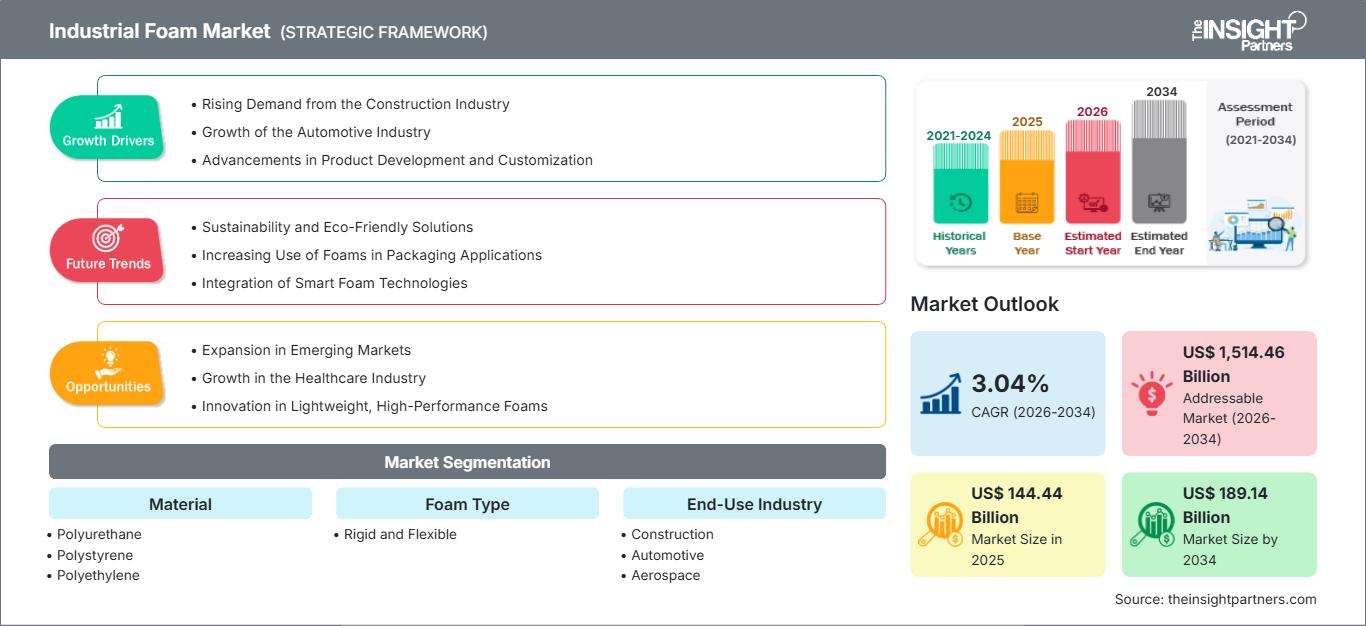
The Industrial Foam Market was valued at US$ 144.44 Billion in 2025 and is projected to reach US$ 189.14 Billion by 2034, registering a CAGR of 3.04% during 2026–2034. This market will be powered by the increasing use of polymeric foam in applications like insulation, cushioning, light weight goods, heat control, packaging, and industries.
North America is expected to remain an important consumer market with a CAGR of 2.7 to 3.2% during 2026 to 2034. Regulations related to energy efficiency and the need for substitutes in the automobile, aerospace, medical, and electrical industries provide natural strengths. The industrial foam market size in North America will be affected by investments in modern manufacturing facilities, insulation, and low emission, recyclable, and bio-based foam.
Industrial Foam Market Assessment and Insights
- North America: The region accounted for an estimated 29–33% share in 2025 and is expected to expand at a 2.7–3.2% CAGR between 2026–2034, supported by insulation retrofits, advanced manufacturing, automotive production, and demand for specialized foam systems.
- US: The country represented approximately 78–82% of North American demand in 2025 and is projected to grow at a 2.8–3.3% CAGR between 2026–2034, supported by construction, transportation, healthcare, and electronics applications.
- Europe: Europe held an estimated 24–28% share in 2025 and is anticipated to record a 2.5–3.0% CAGR between 2026–2034. Germany, the UK, France, Italy, and Spain remain important markets due to industrial production and energy-efficiency investments.
- Asia Pacific: Asia Pacific represented approximately 34–38% of the market in 2025 and is projected to grow at a 3.5–4.1% CAGR between 2026–2034. China, Japan, South Korea, and India lead demand through manufacturing, construction, automotive, and electronics production.
- Largest Segment: Polyurethane represented the largest material segment, accounting for an estimated 39–43% market share in 2025 and expanding at a 3.0–3.5% CAGR during 2026–2034, supported by versatility across insulation, cushioning, transportation, and industrial applications.
- High Growth Segment: Electrical & Electronics accounted for an estimated 10–14% market share in 2025 and is projected to grow at a 4.0–4.6% CAGR during 2026–2034, supported by electronics manufacturing and thermal-management requirements.
- Key companies analyzed in detail: Huntsman International LLC, Covestro AG, BASF SE, General Plastics Manufacturing Company, JSP International Group Limited, Ramfoam Limited, Abriso-Jiffy NV, Dow Inc., Recticel NV/SA, Rogers Corporation.
Source: The Insight Partners' analysis based on proprietary research, government publications, company annual reports, investor presentations, industry databases, and expert interviews.
Foam manufacturers have moved beyond standard commodity manufacturing to engineered applications which offer controlled density, mechanical properties, flame retardance, thermal insulation and sound deadening. There is also an ongoing trend towards efficient formulations, raw materials, automation and recycling. While raw material sources change, polyurethane remains the primary component in the industrial foam manufacturing industry due to its flexible chemistry for flexible and rigid uses. Meanwhile, other plastic resins such as polyethylene, polystyrene, polypropylene, and polyvinyl chloride will continue to serve their specific functions.
Going forward, production capacity expansions and technology investments will focus on the Asia Pacific region, some manufacturing regions in the Middle East, and specialized industrial foam applications in advanced economies. Regulations concerning energy efficiency, product safety, and recycling will prompt manufacturers to invest in new formulas and recycling facilities. Going forward, opportunities will become increasingly dependent on the ability of producers to leverage their size with application knowledge and supply capability.
Industrial Foam Market Report Scope
| Report Attribute | Details |
|---|---|
| Market size in 2025 | US$ 144.44 Billion |
| Market Size by 2034 | US$ 189.14 Billion |
| Global CAGR (2026 - 2034) | 3.04% |
| Historical Data | 2021-2024 |
| Forecast period | 2026-2034 |
Industrial Foam Market Analysis
The demand for foam materials that are light-weight and highly performing is met by industries like construction, transport, healthcare, electricals and industrial machinery. The growth of the market in question is now increasingly driven by insulation needs, vehicle light weighting, equipment protection and management of thermal or acoustic issues. The supply is influenced by the availability of polymers and specialty chemicals upstream, and by the conversion process downstream. Value creation goes beyond polymer production into formulations, foaming, cutting, molding, lamination, manufacture and specialized assembly. Integrated manufacturers enjoy the advantages of formulation and wide distribution, whereas specialists rely on customizing and rapid reaction times. Construction insulation offers a stable base demand, whereas the automotive, aerospace, medical and electronics industries demand precise tolerance.
According to the industrial foam market report, the industry exhibits a competitive landscape with multinational chemical companies and specialist foam manufacturers and converters forming competition. The players such as Covestro AG, BASF SE, Dow Inc., and Huntsman International LLC exhibit capability in terms of materials and formulations, whereas Rogers Corporation and General Plastics Manufacturing Company provide higher-end solutions. Recticel NV/SA, Abriso-Jiffy NV, JSP International Group Limited, and Ramfoam Limited provide competition with insulation, protective, fabrication, and application-specific foams.
Increasing investments in efficient manufacturing, less carbon feedstocks, recycling methods, and environmentally-friendly products have been witnessed in the recent past. Moreover, strategic positioning in the application-specific solutions has also become an important part of the industry because the need for qualification, testing, and consistent supply becomes more important. Instead of competing just in terms of polymer volume, the competitors have now started competing in engineering and processing solutions as well.
● REPORT CUSTOMIZATION
Tailor This Report To Align With Your Specific Business Requirements
This report can be customized to align precisely with your business objectives, scope, and target markets. Customization options include tailored segmentation, geography, competitive analysis, and strategic insights to support informed decision-making.
Customize This Report →WHAT YOU CAN ADJUST
- ● Segmentations
- ● Geography
- ● Competitive Analysis
- ● Language Preferences
Industrial Foam Market: Strategic Insights
Regional Insights
North America Industrial Foam Market
The region’s market held an approximate 29-33% of the industrial foam market share in 2025 and was estimated to witness growth at a 2.7-3.2% CAGR between 2026 and 2034. Building renovations, insulation systems, automobile manufacturing, healthcare production activities, and industrial protection uses drive regional consumption. The US is the largest producer and consumer of industrial foam, with support from robust chemical industry infrastructure and converting capabilities.
Increasingly, manufacturers are emphasizing energy-efficient insulation solutions, recyclable materials, and application-specific material solutions in this region. Regulations regarding building performance standards and chemical management are driving continuous formulation innovations. Canada and Mexico make contributions in terms of construction industry and automotive industry chains. However, the US remains the primary innovation and consumption hub. Growth is likely to be modest but resilient, driven by replacement activities and new industrial investments.
U.S. Industrial Foam Market
The U.S. accounted for around 78–82% of North American demand in 2025 and is anticipated to achieve 2.8–3.3% CAGR between 2026 and 2034. The U.S. features a significant combination of construction, automotive, aerospace, medical, and electrical manufacturing industries along with polymer processing facilities. Huntsman International LLC, Dow Inc., General Plastics Manufacturing Company, and Rogers Corporation make up part of the varied supply chain, ranging from commodity through high-performance materials.
The need for foams is increasingly dependent upon the ability to manage heat, reduce weight in assemblies, resist impacts, and provide insulation. Specialized grades in the aerospace and medical fields offer the chance to utilize material having carefully controlled physical characteristics. A considerable volume of foam is sold in the construction industry, particularly rigid insulating systems. Manufacturing capacity and electronic goods are areas that can contribute to demand for technically developed foams.
Europe Industrial Foam Market
Europe constituted about 24-28% of the market in 2025 and is predicted to grow at a 2.5-3.0% CAGR between 2026 and 2034. Germany continues to be the dominant country because of its automotive, machinery, chemical, and construction industries. Factors that affect the European industrial foam market include energy efficiency considerations, chemical regulations, and rising interest in recycling or less environmentally damaging material systems.
The UK boosts demand through construction renovation, aerospace, medical, and technical converting processes. Its established industrial sector encourages the use of customized flexible and rigid foam solutions, with insulation renewal providing opportunities for replacement purchases. Germany takes advantage of robust production of automobiles and machinery, which makes it the biggest domestic market in the region. France, Italy, and Spain contribute through construction, transportation, furniture-related manufacturing, and industrial processes, with demand in countries affected by renovation.
APAC Industrial Foam Market
The Asia Pacific region held an approximated 34–38% market share in 2025, and it is projected to exhibit a 3.5–4.1% CAGR throughout 2026–2034. The country of China has been the market leader owing to its presence in the construction, automotive, appliances, electronics, and polymer processing industries.
India is forecasted to see growth owing to increasing manufacturing and infrastructure activities, whereas the country of Australia is going to witness stable demand from the construction and industrial sectors. Policies on energy efficiency, manufacturing initiatives, and electronics investments are driving regional growth.
Middle East & Africa Industrial Foam Market
The Middle East & Africa is projected to expand at a 3.2–3.8% CAGR during 2026–2034, supported by construction, energy infrastructure, industrial development, and growing local manufacturing. Saudi Arabia is the leading regional market, with the UAE also benefiting from commercial construction, logistics, and industrial investment.
South Africa continues to be an important manufacturing country in Africa, whereas other markets rely more on development of their infrastructures and urbanization. The demand for insulation comes as a result of the need for energy efficiency and temperature regulation. Investment in the diversification of industries in Gulf countries may boost the demand for locally made foam.
Segmentation Analysis
Material
Material selection determines density, thermal performance, flexibility, chemical resistance, processing economics, and recyclability. This segment is expected to grow at a 3.0–3.6% CAGR during 2026–2034 as producers balance established petrochemical-based formulations with lower-impact alternatives. The industrial foam market scope spans both high-volume insulation and cushioning products and specialized engineered materials, creating differentiated demand patterns across polymer families and end-use environments.
- Polyurethane: The largest material family, polyurethane supports rigid insulation and flexible cushioning applications. Its formulation flexibility allows producers to tailor density, resilience, thermal performance, and mechanical characteristics for diverse industrial requirements.
- Polystyrene: Polystyrene remains strategically important in insulation, packaging, and protective applications because of its low density and processing efficiency, although environmental requirements increasingly influence product design and recovery practices.
- Polyethylene: Polyethylene foam is widely used where moisture resistance, cushioning, buoyancy, and impact protection are required. Demand is supported by packaging, construction, transportation, and fabricated industrial components requiring durable closed-cell structures.
- Polypropylene: Polypropylene foam serves lightweight automotive, packaging, and technical applications. Its favorable stiffness-to-weight characteristics and potential recyclability support adoption where manufacturers seek material efficiency and repeatable processing performance.
- Polyvinyl Chloride: Polyvinyl chloride foam remains relevant for applications requiring chemical resistance, dimensional stability, and structural support. It is used selectively in transportation, construction, and industrial products where performance requirements justify specialized formulations.
Foam Type
Foam architecture separates applications requiring structural strength and thermal insulation from those needing cushioning, resilience, and vibration control. The segment is projected to expand at a 2.9–3.5% CAGR during 2026–2034. Rigid products remain important in construction and industrial insulation, whereas flexible products benefit from transportation, protective, comfort, and equipment applications. Material substitution will depend on performance requirements and end-of-life considerations.
- Rigid: Rigid foam demand is concentrated in insulation and structural applications where thermal efficiency, compressive strength, and dimensional stability are essential. Construction activity and energy-performance standards remain important adoption factors.
- Flexible: Flexible foam supports cushioning, seating, packaging, vibration management, and protective applications. Its adaptability and comfort characteristics sustain broad industrial use, particularly across automotive, furniture-related, and technical fabricated products.
End-Use Industry
End-use diversification provides the industrial foam market with exposure to both cyclical capital spending and recurring replacement demand. This segment is expected to grow at a 3.1–3.8% CAGR during 2026–2034. Construction remains the broadest consumption base, while automotive, aerospace, medical, and electronics applications increasingly reward suppliers capable of meeting tighter performance specifications and qualification requirements.
- Construction: Construction is a major consumption base for insulation, sealing, acoustic control, and lightweight assemblies. Renovation and energy-efficiency upgrades support demand alongside new residential, commercial, and industrial projects.
- Automotive: Automotive applications use foam for seating, interior components, noise reduction, thermal management, and lightweight structures. Electrification increases requirements for insulation and specialized protection around sensitive vehicle systems.
- Aerospace: Aerospace demand emphasizes low weight, flame performance, durability, and precise conversion. Qualification requirements create entry barriers and favor suppliers with engineering capability, material consistency, and application-specific expertise.
- Medical: Medical applications require cushioning, support, protective packaging, and specialized device components. Product quality, hygiene, consistency, and regulatory requirements make application knowledge particularly important for participating suppliers.
- Electrical & Electronics: Electrical and electronics manufacturing uses foam for thermal management, protection, sealing, insulation, and vibration control. Higher equipment complexity and domestic manufacturing investment support its strategic growth potential.
Opportunity Snapshot
| End-Use Industry | Revenue Contribution | Trend Tag | Adoption Stage |
|---|---|---|---|
| Construction | High | Energy Retrofit | Mature |
| Automotive | High | Vehicle Lightweighting | Mature |
| Aerospace | Medium | Advanced Mobility | Scaling |
| Medical | Medium | Device Protection | Scaling |
| Electrical & Electronics | Medium | Thermal Management | Scaling |
Industrial Foam Market Growth Drivers and Impact Analysis
Energy-Efficient Buildings Increase Demand for High-Performance Insulation
Energy efficiency is strengthening demand for rigid foam systems used in roofs, walls, floors, cold-chain facilities, and industrial buildings. Insulation materials can reduce operational heating and cooling requirements when incorporated into effective building envelopes, increasing the importance of thermal performance and long service life. Rising renovation activity also creates replacement demand that is less dependent on new construction cycles. Producers able to improve insulation efficiency while reducing material intensity are positioned to address increasingly stringent building-performance requirements. This driver also favors application-specific engineering because installation conditions, fire requirements, moisture exposure, and compressive loads differ significantly across projects. As construction stakeholders focus more closely on lifecycle energy use, demand increasingly shifts toward products that combine thermal performance with practical installation and durability.
Transportation Lightweighting Expands Technical Foam Requirements
Transportation manufacturers continue to seek materials that reduce system weight while maintaining comfort, safety, insulation, and durability. Foam components can perform several functions simultaneously, including cushioning, acoustic damping, thermal insulation, vibration management, and protection of sensitive assemblies. Automotive applications provide the largest transportation outlet, while aerospace offers lower-volume but technically demanding opportunities. Electrified vehicles may further increase demand for materials used around battery systems and electronic components, provided products satisfy applicable thermal and safety requirements. This creates opportunities for suppliers with formulation expertise and testing capabilities rather than only high-volume production assets. The market impact is a gradual shift toward engineered grades and converted components, increasing the strategic importance of design collaboration, qualification, and consistent supply performance.
Industrial Manufacturing and Electronics Investment Broadens Application Demand
Investment in electronics, medical equipment, industrial automation, and specialized machinery is expanding the range of applications requiring protective and functional foam components. These sectors often require precise dimensions, controlled density, thermal stability, electrical properties, or resistance to chemicals and repeated mechanical stress. Unlike commodity insulation applications, technical manufacturing frequently involves closer supplier collaboration and customized conversion processes. As production is increasingly localized, regional converters can benefit from shorter lead times and proximity to equipment manufacturers. The resulting demand is less concentrated in a single polymer family, encouraging suppliers to maintain broad material portfolios. Growth in these applications also increases the value of testing, certification, fabrication, and engineering support, creating opportunities for companies able to integrate materials expertise with downstream component production.
Industrial Foam Market Future Trends
Circular Formulations and Recyclability Become Product Development Priorities
The industrial foam market trends are expected to increasingly reflect circularity requirements, including recycled content, renewable feedstocks, easier material separation, and improved recovery pathways. Producers will face greater pressure to consider end-of-life outcomes during formulation and product design. Mechanical recycling will remain relevant where collection and material purity are practical, while chemical and feedstock-recovery approaches may gain importance for more complex products. The commercial challenge will be balancing sustainability objectives against cost, performance, safety, and processing consistency. Suppliers that develop credible circular products with measurable application performance could secure stronger positions in regulated and sustainability-sensitive end-use industries over the forecast period.
Automation and Digital Process Control Improve Foam Manufacturing Consistency
Foam production is expected to adopt more automated monitoring of density, temperature, mixing, curing, and material usage. Digital process control can reduce variability, improve yield, and support traceability in applications where specifications are tightly controlled. The trend is particularly relevant for technical foams used in aerospace, electronics, medical, and engineered transportation components. Automation may also help manufacturers respond to skilled-labor constraints and rising quality expectations without proportionally increasing operating complexity. Over time, data-driven process optimization could support lower scrap generation and more efficient use of raw materials. Companies integrating production data with customer specifications may strengthen responsiveness and maintain consistent product performance across multiple manufacturing locations.
Industrial Foam Market Opportunities
Specialized Thermal Management Solutions for Electrified Systems
Electrification creates an opportunity to develop foam-based components that provide insulation, spacing, vibration control, sealing, and thermal protection around batteries, power electronics, and associated equipment. Suppliers can invest in formulations designed for specific temperature, flame, compression, and durability requirements rather than adapting general-purpose products. Collaboration with automotive and electronics manufacturers can help secure application positions early in development cycles. Industrial foam market Forecasts increasingly depend on the ability of suppliers to capture such higher-value applications as transportation and electrical systems become more technically complex. Investment priorities include materials testing, prototype conversion, qualification capability, and manufacturing flexibility to support customers from design through scaled production.
Regional Conversion Capacity Near High-Growth Manufacturing Clusters
Expanding fabrication and conversion capacity near automotive, electronics, construction-material, and industrial manufacturing clusters offers a practical route to improve service and reduce logistics complexity. Foam products can require substantial transport volume relative to material value, making local or regional processing strategically attractive. Investment in cutting, molding, lamination, and customized assembly can therefore complement centralized polymer production. Asia Pacific, selected Middle Eastern economies, and emerging industrial centers provide potential locations where manufacturing ecosystems are broadening. Companies should evaluate customer density, raw-material access, infrastructure, trade conditions, and regulatory requirements before committing capital. Flexible conversion facilities can also support multiple end-use industries and reduce dependence on a single demand cycle.
Recent Developments
- January 2026: TemperPack expanded its manufacturing capabilities for its green cell foam insulation products by relocating and upgrading its production facility in Michigan. The company moved its green cell foam manufacturing operations from Holt, Michigan, to a new, larger facility in Lansing. The
- December 2025: BASF expanded its spray polyurethane foam (SPF) portfolio with WALLTITE RSB, a next-generation, closed-cell spray polyurethane foam. In response to the growing demand for more sustainable building materials, WALLTITE RSB combines industry-leading performance with a blend of recycled and renewable content for a lower overall carbon footprint.
Frequently Asked Questions

- Comprehensive Market Sizing and Forecast Analysis
- Detailed Segmentation Analysis
- In-Depth Market Dynamics Assessment
- Regional and Country-Level Insights
- Competitive Landscape and Company Benchmarking
- Strategic Business Intelligence
Recent Reports
Testimonials

The Insight Partners' SCADA System Market report is comprehensive, with valuable insights on current trends and future forecasts. The team was highly professional, responsive, and supportive throughout. We are very satisfied and highly recommend their services.
RAN KEDEM Partner, Reali Technologies LTDs
I requested a report on a very specific software market and the team produced the report in a few days. The information was very relevant and well presented. I then requested some changes and additions to the report. The team was again very responsive and I got the final report in less than a week.
JEAN-HERVE JENN Chairman, Future Analytica
We worked with The Insight Partners for an important market study and forecast. They gave us clear insights into opportunities and risks, which helped shape our plans. Their research was easy to use and based on solid data. It helped us make smart, confident decisions. We highly recommend them.
PIYUSH NAGPAL Sr. Vice President, High Beam Global
The Insight Partners delivered insightful, well-structured market research with strong domain expertise. Their team was professional and responsive throughout. The user-friendly website made accessing industry reports seamless. We highly recommend them for reliable, high-quality research services
YUKIHIKO ADACHI CEO, Deep Blue, LLC.
This is the first time I have purchased a market report from The Insight Partners.While I was unsure at first, I visited their web site and felt more comfortable to take the risk and purchase a market report.I am completely satisfied with the quality of the report and customer service. I had several questions and comments with the initial report, but after a couple of dialogs over email with their analyst I believe I have a report that I can use as input to our strategic planning process.Thank you so much for taking the extra time and making this a positive experience.I will definitely recommend your service to others and you will be my first call when we need further market data.
JOHN SUZUKI President and Chief Executive Officer, Board Director, BK Technologies
I wish to appreciate your support and the professionalism you displayed in the course of attending to my request for information regarding to infectious disease IVD market in Nigeria. I appreciate your patience, your guidance, and the fact that you were willing to offer a discount, which eventually made it possible for us to close a deal. I look forward to engaging The Insight Partners in the future, all thanks to the impression you have created in me as a result of this first encounter.
DR CHIJIOKE ONYIA MANAGING DIRECTOR, PineCrest Healthcare Ltd.Reason to Buy
- Informed Decision-Making
- Understanding Market Dynamics
- Competitive Analysis
- Identifying Emerging Markets
- Customer Insights
- Market Forecasts
- Risk Mitigation
- Boosting Operational Efficiency
- Strategic Planning
- Investment Justification
- Tracking Industry Innovations
- Aligning with Regulatory Trends





 Get Free Sample for