
Industrial Gas Market Size, Demand & Growth by 2034
Coverage: By Type (Oxygen, Nitrogen, Hydrogen, Carbon dioxide, Argon, Others); Application (Healthcare, Manufacturing, Metallurgy and Glass, Food and Beverages, Retail, Chemicals and Energy, Others) , and Geography (North America, Europe, Asia Pacific, and South and Central America)
- Status : Data Released
- Report Code : TIPRE00005766
- Category : Chemicals and Materials
- No. of Pages : 150
- Available Report Formats :


- Last update date : August 28, 2026


2025 Market Size
US$ 121.49 Bn
Base year value
2034 Forecast
US$ 176.58 Bn
Projected by 2034
CAGR 2026-2034
4.24 %
Growth rate
Addressable Market
US$ 1,353.47 Bn
(2026-2034)
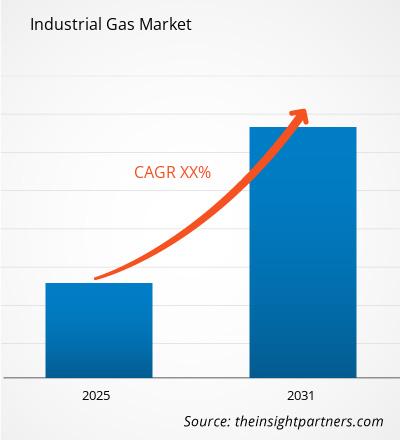
The Industrial Gas Market was valued at US$ 121.49 Billion in 2025 and is projected to reach US$ 176.58 Billion by 2034, registering a CAGR of 4.24% during 2026–2034. Market growth can be facilitated by the importance of oxygen, nitrogen, hydrogen, carbon dioxide, and argon in various industries like processes, healthcare, metallurgy, food manufacturing, chemicals, energy, and advanced manufacturing, where supply availability, purity standards, and production capabilities on site will increasingly factor into decision-making when buying.
In North America, the Industrial Gas Market Size is expected to grow at a CAGR of 3.5% to 4.5% over 2026-2034, driven by applications in semiconductors manufacturing, aerospace industry, healthcare sector, and investment in hydrogen as well as industrial decarbonization. The region has a robust pipeline network and merchant gas distribution system in place, whereas reshoring in advanced manufacturing has increased the use of high-purity gases and onsite supply systems.
Industrial Gas Market Assessment and Insights
- North America: North America accounted for an estimated 27–31% share in 2025 and is projected to grow at a 3.5–4.5% CAGR during 2026–2034. Semiconductor manufacturing, aerospace programs, healthcare infrastructure, and hydrogen investments support demand for bulk, packaged, and onsite industrial gases.
- US: The U.S. represented approximately 78–84% of the North American market in 2025 and is expected to expand at a 3.8–4.8% CAGR during 2026–2034, supported by electronics, refining, chemicals, medical gases, and commercial space activity.
- Europe: Europe held an estimated 23–27% share in 2025 and is projected to grow at a 3.2–4.2% CAGR during 2026–2034. Germany, France, the UK, Italy, and Spain remain major demand centers, supported by manufacturing modernization and decarbonization investments.
- Asia Pacific: Asia Pacific accounted for approximately 34–38% of the market in 2025 and is anticipated to grow at a 5.0–6.0% CAGR during 2026–2034. China, Japan, South Korea, and India lead consumption through electronics, steel, chemicals, refining, and expanding industrial capacity.
- Largest Segment: Manufacturing represented an estimated 27–33% market share in 2025 and is expected to register a 4.0–5.0% CAGR during 2026–2034, supported by fabrication, electronics, automotive, machinery, and process-industry requirements.
- High Growth Segment: Chemicals and Energy accounted for approximately 16–22% market share in 2025 and is projected to grow at a 5.5–6.5% CAGR during 2026–2034, driven by hydrogen, refining, ammonia, petrochemicals, and energy-transition investments.
- Key companies analyzed in detail: Linde plc, Air Liquide S.A., Air Products and Chemicals, Inc., Messer SE & Co. KGaA, Nippon Sanso Holdings Corporation, Gulf Cryo Holding Company W.L.L., Ellenbarrie Industrial Gases Limited, SICGIL India Limited, Bhuruka Gases Limited, Dubai Industrial Gases, Abdullah Hashim Industrial Gases & Equipment Co. Ltd., Buzwair Industrial Gases Factories, Concorde-Corodex Group, India Glycols Limited, Yateem Oxygen Company W.L.L., National Industrial Gas Plants Company, The Southern Gas Limited, Tripti Gases Private Limited.
Source: The Insight Partners' analysis based on proprietary research, government publications, company annual reports, investor presentations, industry databases, and expert interviews.
Industrial gases business has transitioned from being largely a merchant-based supply chain into a fully-fledged production network with large-scale air separation plants, pipeline networks, in-situ facilities, bulk transportation, cylinder deliveries, and real-time tracking. Progress in technologies such as cryogenic separation, pressure swing adsorption, membranes, purification, and remote facility management systems will enhance production efficiency and delivery reliability. The demand structure for industrial gases will become increasingly application-driven with the emergence of more stringent requirements and infrastructure for electronics, aerospace, healthcare, and energy users.
In the future, growth prospects for the industrial gases market will come from the formation of industrial clusters in India, Southeast Asia, the Middle East, and some African countries. Favorable regulation for low emission industrial processes, hydrogen, semiconductors, and safe food production will stimulate demand centers in these markets. The future of the industrial gases market will be determined by the price of electricity, feedstock availability, and ability of industrial gas companies to win multiyear supply agreements.
Industrial Gas Market Report Scope
| Report Attribute | Details |
|---|---|
| Market size in 2025 | US$ 121.49 Billion |
| Market Size by 2034 | US$ 176.58 Billion |
| Global CAGR (2026 - 2034) | 4.24% |
| Historical Data | 2021-2024 |
| Forecast period | 2026-2034 |
Industrial Gas Market Analysis
Industries like manufacturing, medical services, electronics assembly, metal manufacturing, food preservation, and energy infrastructure continue to be the dominant demand bases. Growth of Industrial Gas Market is more often than not tied to growth in premium manufacturing since production of semiconductors, batteries, aerospace components, and specialty chemicals require steady supplies of extremely pure gases. The chain of operations starts from air separation or feedstock processing through to compression, liquefaction, purification, storage, transportation, pipeline distribution, and on-site gas generation.
Dynamics of supply differ greatly depending on type of gas and delivery mechanism. Supply of oxygen and nitrogen enjoys economies of scale from large-scale air separation operations while that of hydrogen is highly reliant on feedstock availability, production methods, cost of power, and take-or-pay contracts. The IEA noted that the demand for hydrogen worldwide was over 100 million tonnes in 2025 although low emissions hydrogen still comprised a very small percentage of total demand.
Competitive rivalry highlighted in the Industrial Gas Market Report is comprised of multinational competitors with wide-ranging supply chains together with regional players catering to packaged gas, merchant, and industrial customers. In this analysis of industrial gases, Linde plc and Air Liquide S.A. have an advantage due to their geographic presence and technology prowess, whereas Air Products and Chemicals, Inc., Messer SE & Co. KGaA, and Nippon Sanso Holdings Corporation have differentiated positioning in their respective industrial and specialty segments.
However, regional specialists continue to play a role in the competition due to their competitive strengths related to logistics, cylinders, client base, and regional regulation knowledge. Gulf Cryo Holding Company W.L.L., Ellenbarrie Industrial Gases Limited, SICGIL India Limited, Bhuruka Gases Limited, Dubai Industrial Gases, Abdullah Hashim Industrial Gases & Equipment Co. Ltd., Buzwair Industrial Gases Factories, Concorde-Corodex Group, India Glycols Limited, Yateem Oxygen Company W.L.L., National Industrial Gas Plants Company, The Southern Gas Limited, and Tripti Gases Private Limited add competition in regional markets. There is growing investment in electronics gases, onsite plants, hydrogen solutions, and digitally enabled distribution facilities.
● REPORT CUSTOMIZATION
Tailor This Report To Align With Your Specific Business Requirements
This report can be customized to align precisely with your business objectives, scope, and target markets. Customization options include tailored segmentation, geography, competitive analysis, and strategic insights to support informed decision-making.
Customize This Report →WHAT YOU CAN ADJUST
- ● Segmentations
- ● Geography
- ● Competitive Analysis
- ● Language Preferences
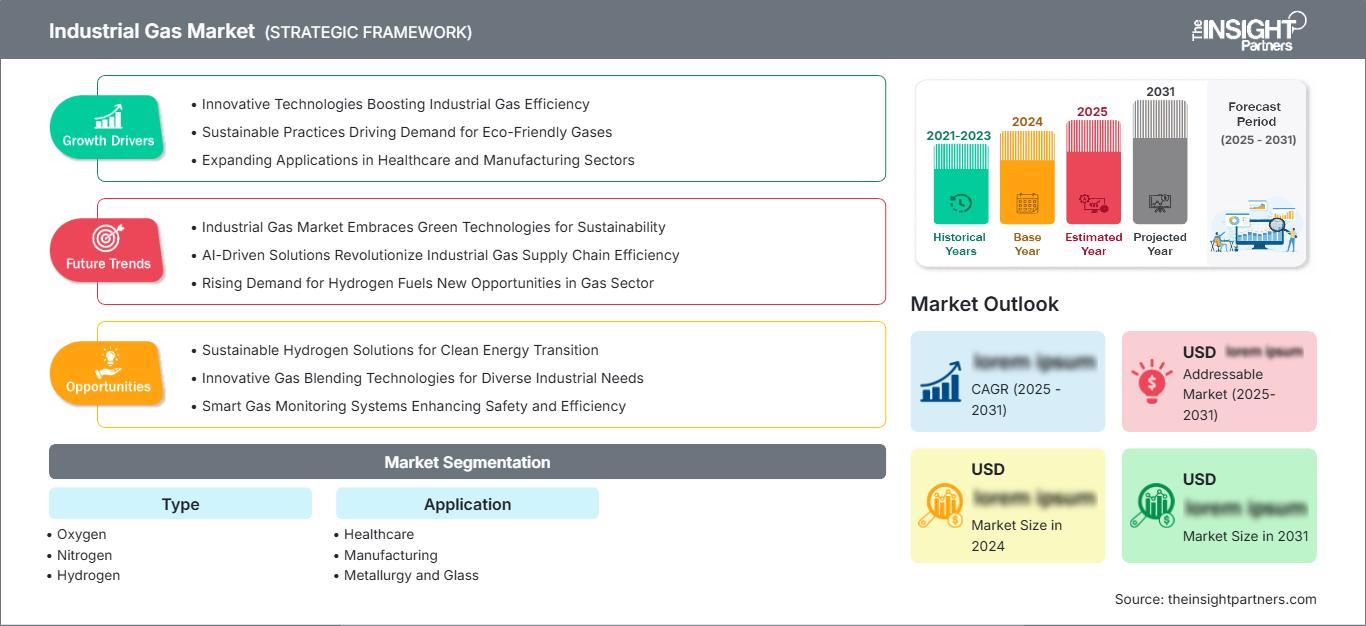
Industrial Gas Market: Strategic Insights
Regional Insights
North America Industrial Gas Market
North America constituted about 27-31% of the total market in 2025 and is estimated to post a 3.5-4.5% CAGR over the forecast period of 2026-2034. This region boasts a mature pipeline along with rising demand from semiconductor, aerospace, medical, chemical, and industrial decarbonization sectors. Investments in manufacturing in the U.S. are driving up demand for nitrogen, oxygen, argon, hydrogen, and specialty gases.
Growth in this region is driven by stable long-term contracts, as well as modernization of the existing production facilities. For instance, Linde has made investments in Florida and Texas in 2025 to boost their supply chain capability for the U.S. commercial space segment, which includes liquid oxygen and nitrogen. Thus, the industrial gas market share in North America is driven by applications which value security of the supply.
U.S. Industrial Gas Market
The United States was estimated to have 78–84% share of North America’s demand in 2025, with the market expected to expand at a 3.8–4.8% CAGR in the period 2026-2034. Some of the applications include semiconductor plants, petrochemical plants, refineries, medical facilities, metal fabrications, and aerospace applications. Major players enjoy the advantage of having existing pipeline network and the option of setting up onsite production facilities to meet large-scale continuous demands.
Hydrogen and high-purity gases are getting more and more strategically important within the country’s industrial complex. Linde plc, Air Liquide S.A. and Air Products and Chemicals, Inc. dominate with significant presence in operations. Investments are increasingly taking place in proximity of advanced manufacturing zones. Air Liquide has announced planned investment up to US$200 million in Louisiana in 2025 for expansion of its pipeline network and production facility for Dow in a new contract.
Europe Industrial Gas Market
The Europe region accounted for 23-27% market share in 2025 and is anticipated to grow with 3.2-4.2% CAGR between 2026 and 2034. The key factors influencing growth include industrial modernization, healthcare requirements, specialized chemicals, automotive manufacturing, and government-driven decarbonization. Higher cost of energy acts as the limitation for energy-intensive gas production, thereby making the role of effective air separation process even more important.
The UK enjoys demand from the healthcare industry, pharmaceutical industry, aerospace industry, and process industries, whereas Germany continues to dominate in the Europe region owing to the presence of extensive chemicals, engineering, steel, automotive, and electronics industries. Other countries contributing towards Europe's regional market include France, Italy, and Spain owing to their diverse manufacturing and food processing industries. Germany continues to gain prominence with the investments made by Air Liquide in semiconductors, where the company announced its plans of setting up production units with more than €250 million in Dresden, 2025.
APAC Industrial Gas Market
Asia Pacific held an estimated market share of 34–38% in 2025, with anticipated 5.0–6.0% CAGR growth from 2026 to 2034, to be the major region in terms of volume growth. Consumption of hydrogen in China is dominated by steel, chemicals, electronics, and refineries, while Japan and South Korea are significant players for high purity gases and manufacturing.
Industrialization in India, semiconductor ecosystem in South Korea, resource sectors in Australia, and hydrogen policies are key to growing regional demand. The IEA sees Asia as a continued source of demand growth in energy and industries, while China remains important for electrolyser installation and manufacturing.
Middle East & Africa Industrial Gas Market
The Middle East and Africa market is expected to grow at a 4.5–5.5% CAGR during 2026–2034. Saudi Arabia and the UAE are supported by refining, petrochemicals, construction, healthcare, and hydrogen-related investments, while South Africa remains an important industrial and mining market.
Energy infrastructure and industrial diversification are shaping investment decisions across the region. The Middle East accounts for a significant share of global hydrogen-based product production and possesses substantial refining and chemical capacity, creating a large established base for industrial gas consumption.
Segmentation Analysis
Type
The Type segment is expected to expand at a 4.0–5.0% CAGR during 2026–2034 as demand patterns increasingly depend on application-specific purity, delivery requirements, and production economics. Oxygen and nitrogen remain foundational products, while hydrogen is gaining strategic relevance in refining, chemicals, and decarbonization. Carbon dioxide and argon continue to benefit from food, beverage, welding, metallurgy, and process applications. The industrial gas market scope is therefore broadening toward higher-value and specialized supply solutions.
- Oxygen: Oxygen maintains a major position through steelmaking, healthcare, wastewater treatment, chemicals, and combustion applications. Its strategic importance is reinforced by demand for high-volume supply and reliable production infrastructure.
- Nitrogen: Nitrogen is widely used for inerting, blanketing, freezing, electronics, chemicals, and food packaging. Its broad industrial relevance supports stable demand across both bulk and onsite generation models.
- Hydrogen: Hydrogen is strategically important for refining, ammonia, methanol, chemicals, and emerging low-emissions applications. Its future demand depends on production costs, infrastructure development, policy implementation, and contracted customer offtake.
- Carbon dioxide: Carbon dioxide serves food and beverage carbonation, refrigeration, welding, chemicals, and selected process applications. Supply management remains important because availability can depend on associated industrial production and recovery systems.
- Argon: Argon supports welding, metallurgy, electronics, and specialty manufacturing. Its importance rises in applications requiring inert atmospheres, controlled processing conditions, and high-quality material performance.
Application
The Application segment is projected to grow at a 4.5–5.5% CAGR during 2026–2034, reflecting increasing gas intensity across industrial and service activities. Manufacturing remains the largest application because gases are embedded in fabrication, machinery, automotive, electronics, and process operations. Chemicals and energy represent the highest-growth application, supported by hydrogen investments, refining requirements, and lower-emission industrial initiatives.
- Healthcare: Healthcare requires medical oxygen, respiratory gases, laboratory gases, and controlled supply systems. Population aging, hospital capacity, home care, and pharmaceutical manufacturing support its strategic relevance.
- Manufacturing: Manufacturing represents the largest application base, with gases used in welding, cutting, heat treatment, electronics, automotive production, machinery, and process control across diverse industrial value chains.
- Metallurgy and Glass: Metallurgy and glass production depend on oxygen, nitrogen, argon, and other gases for combustion, inerting, melting, refining, and controlled thermal processes.
- Food and Beverages: Food and beverage demand is supported by carbonation, modified-atmosphere packaging, chilling, freezing, and dry-ice applications, making supply reliability particularly important for large processing facilities.
- Retail: Retail applications primarily involve packaged gases and smaller-volume supply requirements. Distribution reach, cylinder availability, safety services, and responsive logistics influence supplier competitiveness within this fragmented customer base.
- Chemicals and Energy: Chemicals and energy constitute the high-growth application, driven by refining, ammonia, petrochemicals, hydrogen production, and investments in lower-emission industrial processes and energy infrastructure.
Opportunity Snapshot
| Application | Revenue Contribution | Trend Tag | Adoption Stage |
|---|---|---|---|
| Healthcare | High | Home Oxygen | Mature |
| Manufacturing | High | Advanced Fabrication | Mature |
| Metallurgy and Glass | High | Low-Carbon Furnaces | Mature |
| Food and Beverages | Medium | Modified Atmosphere | Mature |
| Retail | Low | Cylinder Networks | Mature |
| Chemicals and Energy | High | Clean Hydrogen | Scaling |
Industrial Gas Market Growth Drivers and Impact Analysis
Expansion of Advanced Manufacturing and Semiconductor Production
Advanced manufacturing is increasing demand for gases that meet stringent purity, reliability, and continuity requirements. Semiconductor fabrication is particularly significant because nitrogen, oxygen, argon, hydrogen, and specialty gases are integrated into multiple process stages. New fabrication facilities require suppliers to invest in dedicated onsite production and distribution infrastructure, creating longer-term contractual relationships. Air Liquide announced more than €250 million of investment during 2025 for new production facilities supporting semiconductor manufacturing in Dresden, while additional investment was committed in Singapore. These developments illustrate how electronics investment can generate sustained gas demand beyond initial plant construction. The resulting market impact includes greater capital intensity, higher technical barriers, and increased importance of geographic proximity to customers.
Hydrogen Demand from Chemicals, Refining, and Energy Transition
Hydrogen is becoming increasingly important as industrial producers pursue lower-emission processes while maintaining existing refining and chemical production. The IEA reported that global hydrogen demand surpassed 100 million tonnes in 2025, with established industrial and refining applications remaining dominant. Low-emissions hydrogen demand is expanding from a smaller base, supported by projects targeting refining, fertilizers, chemicals, and industrial facilities. This transition creates opportunities for gas suppliers to combine conventional production expertise with electrolysis, carbon capture, storage, and hydrogen logistics. However, project economics remain dependent on electricity prices, policy certainty, infrastructure, and firm offtake agreements. Suppliers capable of integrating production with customer sites are better positioned to reduce logistics constraints and improve supply economics.
Healthcare Infrastructure and Demand for Medical Gas Reliability
Healthcare remains a structurally important demand driver because oxygen and other medical gases are required across hospitals, emergency services, respiratory care, laboratories, and pharmaceutical manufacturing. Growth is increasingly supported by home-based respiratory treatment and the need for resilient supply networks. Air Liquide reported a major five-year home healthcare contract in Madrid during 2025 covering services for 70,000 respiratory patients. Market impact extends beyond gas volumes because healthcare customers require compliance, traceability, storage systems, distribution reliability, and technical support. These requirements favor suppliers with established quality-management systems and local delivery capabilities. As healthcare infrastructure expands in emerging economies, demand for packaged and bulk medical gases is expected to increase.
Industrial Gas Market Future Trends
Digitally Connected Production and Predictive Supply Management
Future gas networks will increasingly use connected sensors, remote monitoring, automated replenishment, and predictive analytics to improve asset utilization and delivery efficiency. Customers are expected to demand greater visibility into consumption, purity, pressure, and inventory conditions. These systems can reduce unplanned interruptions and optimize delivery routes while supporting more flexible pricing structures. For suppliers, digital integration will improve management of distributed cylinder fleets, bulk tanks, and onsite plants. The industrial gas market trends emerging from this transition will favor providers capable of combining physical infrastructure with data-driven services. Over time, digitally connected supply systems may also support tighter integration between gas consumption, energy management, maintenance planning, and emissions reporting across customer facilities.
Rising Importance of Regionalized and High-Purity Gas Networks
Supply chains for critical manufacturing are becoming more regionalized as governments and companies seek greater resilience in semiconductors, pharmaceuticals, energy equipment, and strategic materials. This shift is encouraging gas suppliers to locate high-purity production capacity closer to industrial clusters. Dedicated onsite facilities and pipeline networks can reduce transportation exposure while improving supply continuity. The model is particularly relevant for semiconductor plants, where purity requirements and continuous consumption create high switching costs. Air separation and purification technology will therefore become more closely aligned with customer expansion plans. Future investments are expected to concentrate around electronics corridors, hydrogen hubs, and advanced manufacturing zones rather than being distributed solely according to traditional industrial geography.
Industrial Gas Market Opportunities
Investment in Integrated Hydrogen and Industrial Cluster Infrastructure
Integrated industrial clusters offer an opportunity to develop shared hydrogen production, storage, pipeline, and distribution systems serving multiple customers. Rather than constructing isolated facilities, investors can combine refining, chemicals, steel, ammonia, and transport demand within coordinated infrastructure networks. The IEA indicates that committed low-emissions hydrogen projects are increasingly associated with industrial and refining consumption, although firm demand remains essential for investment decisions. Industrial gas market Forecasts indicate that suppliers able to secure anchor customers and aggregate regional demand can improve asset utilization. Strategic investment should therefore prioritize locations with existing industrial gas consumption, available energy infrastructure, supportive regulation, and identifiable long-term offtake partners capable of underpinning capital-intensive projects.
Expansion of Local Production Networks in Emerging Industrial Economies
Emerging manufacturing economies provide opportunities for regional suppliers to expand beyond cylinder distribution into bulk delivery and onsite generation. India, Southeast Asia, the Middle East, and selected African markets are developing industrial corridors that require increasingly reliable gas infrastructure. Air Liquide's acquisition of NovaAir expanded its presence across important industrial regions of India, including customers in steel, automotive, electronics, photovoltaic manufacturing, and healthcare. Investment opportunities are strongest where industrial concentration can support efficient utilization of air separation capacity. Local partnerships, engineering capability, distribution infrastructure, and regulatory knowledge will be critical for converting growing industrial activity into sustainable gas supply businesses with defensible customer relationships.
Recent Developments
- April 2026: Air Products expanded its US industrial gas footprint with plans to build, own and operate a new air separation unit (ASU) in Cocoa, Florida, reinforcing its push into high-demand industrial and space-sector markets.
- October 2025: Air Liquide announced the acquisition and integration of NovaAir, expanding its industrial gas footprint across East and South India. NovaAir serves customers in steel, automotive, fabrication, electronics, photovoltaic manufacturing, and healthcare, complementing Air Liquide's existing operations in northern and western India and strengthening its ability to provide production, bulk supply, specialty gases, onsite services, and engineering support.
Frequently Asked Questions

- Comprehensive Market Sizing and Forecast Analysis
- Detailed Segmentation Analysis
- In-Depth Market Dynamics Assessment
- Regional and Country-Level Insights
- Competitive Landscape and Company Benchmarking
- Strategic Business Intelligence
Recent Reports
Testimonials

The Insight Partners' SCADA System Market report is comprehensive, with valuable insights on current trends and future forecasts. The team was highly professional, responsive, and supportive throughout. We are very satisfied and highly recommend their services.
RAN KEDEM Partner, Reali Technologies LTDs
I requested a report on a very specific software market and the team produced the report in a few days. The information was very relevant and well presented. I then requested some changes and additions to the report. The team was again very responsive and I got the final report in less than a week.
JEAN-HERVE JENN Chairman, Future Analytica
We worked with The Insight Partners for an important market study and forecast. They gave us clear insights into opportunities and risks, which helped shape our plans. Their research was easy to use and based on solid data. It helped us make smart, confident decisions. We highly recommend them.
PIYUSH NAGPAL Sr. Vice President, High Beam Global
The Insight Partners delivered insightful, well-structured market research with strong domain expertise. Their team was professional and responsive throughout. The user-friendly website made accessing industry reports seamless. We highly recommend them for reliable, high-quality research services
YUKIHIKO ADACHI CEO, Deep Blue, LLC.
This is the first time I have purchased a market report from The Insight Partners.While I was unsure at first, I visited their web site and felt more comfortable to take the risk and purchase a market report.I am completely satisfied with the quality of the report and customer service. I had several questions and comments with the initial report, but after a couple of dialogs over email with their analyst I believe I have a report that I can use as input to our strategic planning process.Thank you so much for taking the extra time and making this a positive experience.I will definitely recommend your service to others and you will be my first call when we need further market data.
JOHN SUZUKI President and Chief Executive Officer, Board Director, BK Technologies
I wish to appreciate your support and the professionalism you displayed in the course of attending to my request for information regarding to infectious disease IVD market in Nigeria. I appreciate your patience, your guidance, and the fact that you were willing to offer a discount, which eventually made it possible for us to close a deal. I look forward to engaging The Insight Partners in the future, all thanks to the impression you have created in me as a result of this first encounter.
DR CHIJIOKE ONYIA MANAGING DIRECTOR, PineCrest Healthcare Ltd.Reason to Buy
- Informed Decision-Making
- Understanding Market Dynamics
- Competitive Analysis
- Identifying Emerging Markets
- Customer Insights
- Market Forecasts
- Risk Mitigation
- Boosting Operational Efficiency
- Strategic Planning
- Investment Justification
- Tracking Industry Innovations
- Aligning with Regulatory Trends





 Get Free Sample for