
Industrial Gas Sensor Market Size, Share & Demand by 2034
Coverage: by Type (Oxygen Sensors, Carbon Dioxide Sensors, Carbon Monoxide Sensors, and NOx Sensors); Technology (Electrochemical, Semiconductor, Solid State, Photo Ionization Detector (PID), Catalytic, and Infrared); Application (Chemical & Petrochemical, Oil & Gas, and Metal), and Geography (North America, Europe, Asia Pacific, and South and Central America)
- Status : Data Released
- Report Code : TIPRE00003159
- Category : Electronics and Semiconductor
- No. of Pages : 150
- Available Report Formats :


- Last update date : September 21, 2026


2025 Market Size
US$ 769.35 Mn
Base year value
2034 Forecast
US$ 1,204.77 Mn
Projected by 2034
CAGR 2026-2034
5.11 %
Growth rate
Addressable Market
US$ 8,957.28 Mn
(2026-2034)
The Industrial Gas Sensor Market was valued at US$ 769.35 Million in 2025 and is projected to reach US$ 1,204.77 Million by 2034. The market is expected to expand at a CAGR of 5.11% during 2026–2034, reflecting sustained industrial requirements for continuous atmospheric monitoring, worker protection, emissions control, and process assurance across hazardous operating environments.
The Industrial Gas Sensor Market Size in North America is expected to increase at a projected Compound Annual Growth Rate of 4.8 to 5.4%. The reasons for this increase include methane legislation, need for aged pipeline inspection, and improvements in integrated safety systems. The increased usage of optical sensing technology in energy infrastructure increases the replacement rate, and digital monitoring improves alerting systems and maintenance of industrial firms.
Industrial Gas Sensor Market Assessment and Insights
- North America: Represented 31–33% share in 2025 and is modelled to grow at 4.8–5.4% CAGR between 2026–2034, supported by pipeline integrity programs, connected worker safety, and methane-leak monitoring.
- US: Accounted for 77–80% of North American revenue in 2025 and is modelled to expand at 4.9–5.5% CAGR between 2026–2034.
- Europe: Held 27–29% share in 2025 and is modelled at 4.6–5.2% CAGR between 2026–2034, led by Germany, the UK, France, Italy, and Spain.
- Asia Pacific: Captured 28–30% share in 2025 and is modelled to register 5.7–6.3% CAGR between 2026–2034, with China, Japan, South Korea, India, and Australia supporting deployment.
- Largest Segment: Electrochemical technology held a modelled 34–37% market share in 2025 and is expected to post 4.7–5.3% CAGR during 2026–2034.
- High Growth Segment: Infrared technology represented a modelled 15–18% market share in 2025 and is expected to register 6.1–6.8% CAGR during 2026–2034.
- Key companies analyzed in detail: ABB Ltd., Aeroqual Limited, ENMET, LLC, Euro-Gas Management Services Ltd., Figaro USA, Inc., Honeywell International Inc., Pem-Tech, Inc., Sensidyne, LP, Sensirion AG, and Siemens AG.
Source: The Insight Partners' analysis based on proprietary research, government publications, company annual reports, investor presentations, industry databases, and expert interviews.
Instead of individual alarm systems, detection in industry has moved towards sensing architecture, which uses electrochemical, catalytic, semiconductor, photoionization, and infrared sensors, and diagnostics. Industrial processes increasingly require calibration of modules, low power consumption, common mechanical dimensions, and software-based maintenance of the equipment. This would facilitate increased reusability of designs both for portable and stationary detectors, and would encourage manufacturers to integrate the sensor with communications, analysis, and maintenance capabilities. The Industrial Gas Sensor Market rewards the manufacturers that find the correct balance between selectivity, quick reaction times, resistance to poisoning, reliability, and lifecycle costs.
From now till 2034, expenditures would be made in Asia on manufacturing facilities, Europe on emissions compliance programs, North America on oil and gas facilities, and the Middle East on energy development projects. Regulations regarding methane gas, toxicity levels, and combustion gases would change specifications. Those manufacturers that can provide on-site calibration, certification, and maintenance have an advantage over their competitors.
Industrial Gas Sensor Market Report Scope
| Report Attribute | Details |
|---|---|
| Market size in 2025 | US$ 769.35 Million |
| Market Size by 2034 | US$ 1,204.77 Million |
| Global CAGR (2026 - 2034) | 5.11% |
| Historical Data | 2021-2024 |
| Forecast period | 2026-2034 |
Industrial Gas Sensor Market Analysis
The growth of Industrial Gas Sensor Market lies in the requirement for mandatory safety of workers, emissions monitoring, and increased process control tolerances. The buyers are facility managers, engineering companies, sensor makers, and maintenance organizations, while the supply chain includes sensing elements, MEMS and optical devices, enclosures, calibration gases, software, certification, and cloud solutions.
The supply environment varies depending on the sensor technology, including stable electrodes and electrolytes in case of electrochemical cells, emitters and filters in case of infrared sensors, and fabrication in case of semiconductor sensors. Buyers are increasingly looking to dual source components, have standardized interfaces, and focus on maintainability.
Analysis of the Industrial Gas Sensor Market Report reveals that there is a fragmented competition comprising automation companies and sensing specialists. ABB Ltd., Honeywell International Inc., and Siemens AG combine the detection function with the control system, whereas Aeroqual Limited, ENMET, LLC, Euro-Gas Management Services Ltd., Pem-Tech, Inc., and Sensidyne, LP focus on application-oriented instruments and field services.
The main trends in investment lie in optical detection systems, multi-gas systems, low power consumption, and diagnostic connectivity. The key distinguishing factors for Sensirion AG and Figaro USA, Inc. are miniaturization and design aspects. Positioning in the competition is now based upon certification, calibration services, sales distribution networks, and conversion of sensor signals to maintenance tasks.
● REPORT CUSTOMIZATION
Tailor This Report To Align With Your Specific Business Requirements
This report can be customized to align precisely with your business objectives, scope, and target markets. Customization options include tailored segmentation, geography, competitive analysis, and strategic insights to support informed decision-making.
Customize This Report →WHAT YOU CAN ADJUST
- ● Segmentations
- ● Geography
- ● Competitive Analysis
- ● Language Preferences
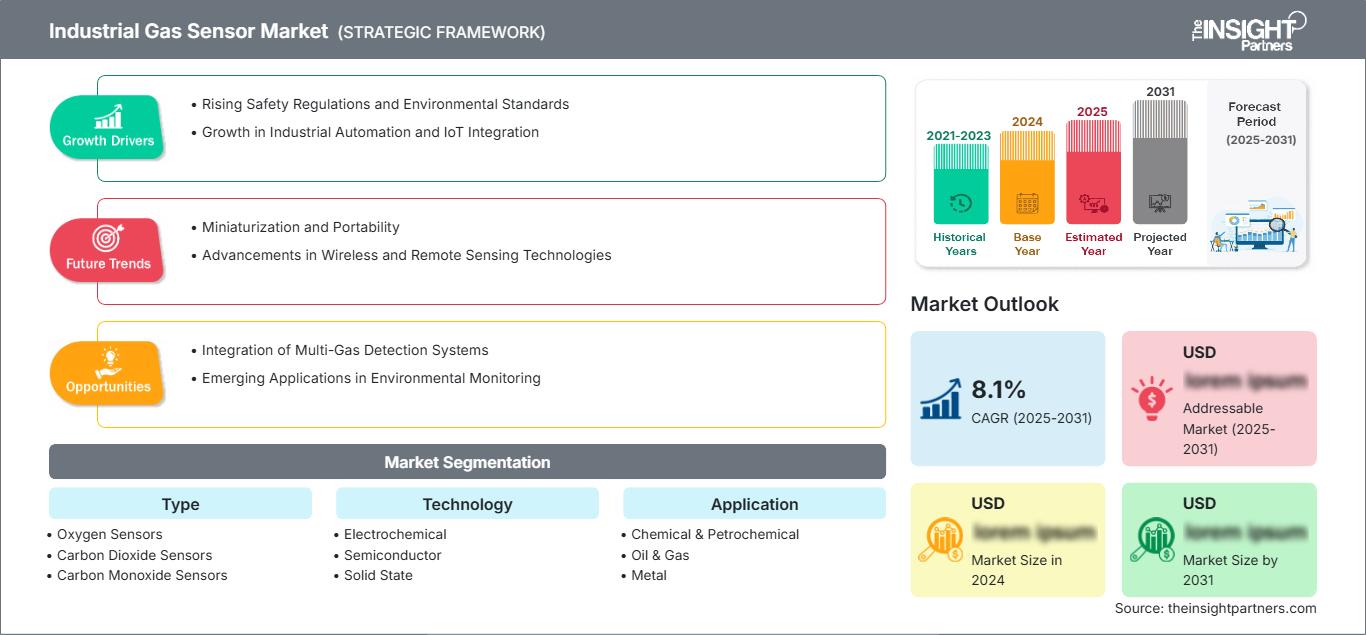
Industrial Gas Sensor Market: Strategic Insights
Regional Insights
North America Industrial Gas Sensor Market
North America had a modelled 31–33% Industrial Gas Sensor Market share in 2025 and is projected to grow at a 4.8–5.4% CAGR until 2034. Pipeline integrity, refinery upgrading, shale pipeline construction, chemical manufacturing, mining safety, and occupational exposure regulations drive both replacements and new-build demands. The presence of substantial base installations for fixed sensors also generates calibration and software-service revenues from their periodic maintenance needs.
The region's procurement practices are moving towards connectivity of devices that can offer remote bump tests, geo-targeted alarms, and predictive maintenance. Regulations on methane emissions, aging of gas pipelines, and semiconductor manufacturing and battery production add to the need for optical and mobile leak detection sensors as well as toxic gas sensors. Canada makes its contribution in the form of oil sands mining and processing, while Mexico offers prospects in petrochemicals and manufacturing.
U.S. Industrial Gas Sensor Market
The U.S. accounted for 77-80% of the North America market revenue in 2025 and will be modeled to register a 4.9-5.5% CAGR over 2026-2034. Refining, midstream pipeline, chemicals, metals, mining, semiconductors manufacturing, and wastewater industries drive wide usage of oxygen, carbon monoxide, carbon dioxide, and NOx gas detection products. The periodic need for replacements benefits companies with national calibration and distribution networks.
Among the companies with a presence in the market are Honeywell International Inc., ABB Ltd., Siemens AG, ENMET, LLC, Pem-Tech, Inc., Sensidyne, LP, and Figaro USA, Inc. New applications include wireless personal monitors, fixed multi-point instruments, portable photoionization detector, and optical methane detectors. Buyers look at the cost of ownership, cybersecurity issues, alarms interface, and sensor protection from moisture, poisoning, and changing temperatures.
Europe Industrial Gas Sensor Market
Europe held a simulated 27–29% market share in 2025 and is expected to exhibit 4.6–5.2% CAGR from 2025 to 2034. Germany holds the top regional market share driven by the presence of chemicals, machinery, metals, and automotive manufacturing industries with certified fixed and portable detectors. The UK is bolstered by offshore energy, utilities, and regulated industrial work sites with a growing focus on measuring methane emissions.
France is driven by refineries, chemicals, nuclear power plants, and environmental monitoring regulations. Italy is driven by process industry manufacturing and gas infrastructure, while Spain’s chemicals, energy transition projects, and hydrogen developments present specification possibilities. Methane regulations within the EU increase emphasis on measurement and timely repair of leaks. Suppliers have to contend with the need to meet ATEX specifications, multilingual services, and country-specific procurement processes.
APAC Industrial Gas Sensor Market
The Asia Pacific region was forecast to have a market share of about 28–30% in 2025, growing at a rate of 5.7–6.3% CAGR – the highest growth rate amongst all regions. China will drive the growth due to its presence in chemical, metal, electronic, and energy infrastructure industries. Japan and South Korea would focus on high precision semiconductors and manufacturing applications.
Increasing investment in refineries, city gas, steel, and chemical industries in India along with mining and liquefied natural gas facilities in Australia would increase the demand for portable and fixed detectors, respectively. Increasing industrial safety regulations, factory automation, and air quality laws would drive the demand.
Middle East & Africa Industrial Gas Sensor Market
The region is modelled to grow at 5.2–5.9% CAGR through 2034. Saudi Arabia leads through refinery, petrochemical, gas-processing, and metals investments, while the UAE advances LNG, industrial-zone, and infrastructure monitoring projects.
South Africa provides mining and chemical industries as well as demand for electricity production with portable sensors for hazardous and flammable gases. RoMEA offers selected business opportunities in hydrocarbons, utilities, and new factories. Equipment that is sturdy, can be remotely diagnosed, and has reliable distributors is preferred due to the heat and dust, and the dispersion of locations.
Segmentation Analysis
Type
The type segment is modelled to grow at 4.9–5.5% CAGR during 2026–2034. The Industrial Gas Sensor Market scope covers oxygen, carbon dioxide, carbon monoxide, and NOx sensing, each addressing distinct safety and process needs. Adoption depends on target concentration, cross-sensitivity, response time, operating atmosphere, calibration interval, and detector architecture, with multi-gas instruments supporting broader workplace coverage.
- Oxygen Sensors: Core demand comes from confined spaces, inerting systems, combustion control, and laboratories, where rapid deficiency or enrichment alerts remain central to worker and process protection.
- Carbon Dioxide Sensors: Infrared-based devices support fermentation, cold storage, food processing, environmental control, and occupational monitoring, with selectivity and long service life reinforcing strategic importance.
- Carbon Monoxide Sensors: Portable and fixed detectors serve combustion areas, steel plants, mines, utilities, and enclosed workspaces, making dependable low-level detection and alarm stability critical purchasing factors.
- NOx Sensors: Emissions monitoring, combustion optimization, and air-quality compliance drive deployment in boilers, industrial furnaces, power assets, and process plants requiring durable operation under changing gas compositions.
Technology
Technology revenue is modelled to advance at 5.2–5.8% CAGR through 2034. Selection balances target gas, detection limit, power draw, poisoning resistance, lifetime, and environmental robustness. Electrochemical platforms remain foundational, while infrared and photoionization solutions gain in applications requiring selectivity, remote quantification, or volatile-organic-compound coverage. Digital compensation and self-diagnostics increasingly differentiate otherwise similar sensing elements.
- Electrochemical: Broad toxic-gas coverage, low power requirements, and compact form factors support portable detectors, although consumable lifetimes and cross-sensitivity require disciplined calibration and replacement planning.
- Semiconductor: Cost-efficient, durable devices suit high-volume alarms and air-quality applications, but temperature, humidity, and selectivity considerations make compensation algorithms and application engineering strategically important.
- Solid State: Miniaturization, rugged construction, and scalable fabrication support embedded monitoring, while material innovation aims to improve selectivity, response consistency, and lower-temperature operation across industrial environments.
- Photo Ionization Detector: High sensitivity to volatile organic compounds makes PID technology valuable in leak surveys, industrial hygiene, remediation, and chemical handling, particularly when rapid screening is required.
- Catalytic: Proven combustible-gas detection supports mining, refining, and processing, although oxygen dependence, power consumption, and catalyst poisoning encourage careful maintenance and selective migration toward optical alternatives.
- Infrared: Long service life, strong poisoning resistance, and selective hydrocarbon or carbon dioxide measurement position infrared devices for harsh fixed and portable applications despite higher initial component costs.
Application
The application segment is modelled to expand at 4.8–5.4% CAGR during 2026–2034. Chemical and petrochemical sites require broad toxic and combustible coverage, oil and gas assets prioritize leak detection and worker mobility, and metals facilities monitor combustion and confined spaces. Procurement increasingly combines fixed networks, portable instruments, area monitors, and documented calibration workflows.
- Chemical & Petrochemical: Complex gas inventories, hazardous-area zoning, and continuous processing support dense detector networks, with integration into shutdown systems and maintenance platforms strengthening strategic value.
- Oil & Gas: Upstream, midstream, LNG, refining, and distribution assets require methane, toxic-gas, and oxygen monitoring, creating demand for rugged devices, remote visibility, and quantified leak localization.
- Metal: Steelmaking, foundries, heat treatment, and fabrication require carbon monoxide, oxygen, and combustion monitoring, where harsh temperatures, dust, and maintenance accessibility strongly influence technology selection.
Opportunity Snapshot
| Application | Revenue Contribution | Trend Tag | Adoption Stage |
| Chemical & Petrochemical | High | Plant Safety | Mature |
| Oil & Gas | High | Methane Control | Scaling |
| Metal | Medium | Furnace Monitoring | Mature |
Industrial Gas Sensor Market Growth Drivers and Impact Analysis
Stricter Industrial Safety and Exposure Management
Plant operators have ongoing responsibilities to detect oxygen depletion, toxic atmospheres, and flammable conditions prior to any accidents. Consequently, sensing devices become an ongoing operational necessity and not simply a capital investment option. Users at chemical plants, refineries, mines, metals operations, and confined space operations require certified equipment, traceable calibration, and proper alarm escalation procedures. The industry's commercial effect goes beyond the initial sale of detectors to include calibration gases, replacement cells, docking stations, software, training, and field service. Manufacturers who make life easier in managing compliance documents and fleet logistics will extract greater value out of their products. At the same time, end-users will be comparing alarm accuracy, drift, and maintenance times since these elements impact worker productivity and downtime.
Methane and Emissions Measurement Requirements
The shift for energy firms is from occasional inspection to continuous monitoring, calculation, and repair confirmation. Methane is odorless and can emanate from distributed pipes, compressors, valves, tanks, and process machinery. This means that the need exists for supplementary stationary, portable, mobile, and imaging technology solutions. There is pressure to do more with regulations in Europe and North America, along with corporate emissions pledges driving beyond compliance uses of these instruments. The market dynamics involve increasing needs for optical systems that feature high sensitivity, geolocation capabilities, cloud analytics, and source identification. Differentiation by suppliers involves fast surveys, data ownership, maintenance system integration, and consistent operations across wind, humidity, and temperature variability.
Industrial Automation and Connected Safety Platforms
Plants increasingly connect gas detectors to distributed control systems, safety instrumented systems, wireless networks, and centralized dashboards. Integration improves situational awareness by linking gas concentration, worker location, equipment status, and maintenance history. It also enables remote configuration, automated test records, and prioritized intervention across dispersed facilities. The commercial effect is a shift from standalone devices toward interoperable platforms with software and service revenue. However, connectivity raises requirements for cybersecurity, protocol compatibility, battery management, and dependable communications in hazardous areas. Suppliers that offer open interfaces, edge analytics, and fleet-level diagnostics can shorten deployment time and reduce ownership cost, particularly for operators standardizing safety technology across multiple sites.
Industrial Gas Sensor Market Future Trends
Multi-Modal Sensing and Sensor Fusion
Industrial Gas Sensor Market trends will increasingly favor devices and platforms that combine several sensing principles, environmental compensation, and contextual data. A single node may pair electrochemical cells with infrared, particulate, temperature, humidity, or pressure measurements, improving confidence when cross-sensitivity or changing ambient conditions complicate interpretation. Algorithms will compare signal patterns, instrument health, and operational context to reduce nuisance alarms and identify drift earlier. This transition should support modular detector designs and upgradeable analytics. Commercial advantage will accrue to suppliers that validate fusion models across real industrial environments and provide transparent diagnostics, rather than presenting proprietary scores without traceable measurement evidence.
Predictive Calibration and Digital Sensor Identity
Future detector fleets will use digital identities, stored calibration histories, and condition indicators to schedule intervention according to risk rather than fixed intervals alone. Smart modules can retain manufacturing data, operating exposure, temperature history, and remaining-life estimates, allowing maintenance teams to replace cells before failure while avoiding unnecessary service. Standardized interfaces may accelerate plug-and-play replacement across detector families. This trend will reshape channel economics by increasing demand for authenticated components, lifecycle software, and remote support. Successful suppliers will combine secure device records with field-verifiable calibration practices, ensuring predictive recommendations complement rather than weaken safety assurance and regulatory documentation.
Industrial Gas Sensor Market Opportunities
Hydrogen Infrastructure Detection Packages
Hydrogen production, storage, transport, refueling, and industrial use create application openings for fast, selective detection across enclosed and outdoor environments. Investors and suppliers can build packaged offerings that combine point sensors, ventilation controls, portable instruments, alarms, and commissioning services for electrolyzers, compressor stations, storage areas, and process plants. Opportunity development in the Industrial Gas Sensor Market Forecast should focus on certification, response under high airflow, cross-sensitivity management, and safe integration with control systems. Partnerships with engineering contractors and equipment manufacturers can embed sensors early in project design. Recurring revenue can follow through calibration, replacement modules, software monitoring, and periodic performance verification across expanding hydrogen asset networks.
Localized Calibration and Service Networks in Emerging Markets
Rapid industrial expansion often outpaces access to accredited calibration, spare parts, and trained technicians. Sensor suppliers can invest in regional service hubs, mobile calibration capabilities, distributor certification, and standardized exchange programs across Asia Pacific, the Middle East, and selected African markets. This approach reduces detector downtime, shipping delays, and compliance uncertainty for customers operating remote mines, refineries, metal plants, and chemical facilities. Commercial models may combine instrument sales with multiyear service agreements and digital fleet records. Local assembly or final configuration can further improve lead times and tender competitiveness, provided quality systems preserve traceability, hazardous-area certification, and consistent performance across locations.
Recent Developments
- August 2026: Industrial Scientific has launched the Axen AX4, a new four-gas monitor designed to provide reliable and straightforward gas detection for everyday industrial applications. The device is aimed at contractors, rental companies, and industrial operators that need dependable worker protection without the complexity of highly connected gas-monitoring systems.
- March 2026: Honeywell has launched its 4-Series NDIR Hydrocarbon Gas Sensor, a new infrared-based sensing technology designed to improve the detection of flammable gases and strengthen safety for workers in hazardous industrial environments. The sensor is intended for use across sectors including oil and gas, petrochemicals, plastics manufacturing, mining, and other industrial applications.
- August 2026: U.K.-based gas detection equipment manufacturer International Gas Detectors (IGD) has introduced two new portable gas-monitoring devices, the BELL LITE and BELLMINI, as part of its BELL product range. The detectors are designed to identify carbon dioxide (CO₂/R744), ammonia (NH₃/R717), and other potentially hazardous gases in industrial and refrigeration environments.
Frequently Asked Questions

- Comprehensive Market Sizing and Forecast Analysis
- Detailed Segmentation Analysis
- In-Depth Market Dynamics Assessment
- Regional and Country-Level Insights
- Competitive Landscape and Company Benchmarking
- Strategic Business Intelligence
Recent Reports
Testimonials

The Insight Partners provided valuable market intelligence that supported our global go-to-market strategy. Their team was professional, responsive, and attentive to our feedback, providing thoughtful analysis and helpful methodological clarifications throughout the project.
Junmo Kim Chief Financial Officer (CFO), Enertech Co., Ltd.
The Insight Partners' SCADA System Market report is comprehensive, with valuable insights on current trends and future forecasts. The team was highly professional, responsive, and supportive throughout. We are very satisfied and highly recommend their services.
RAN KEDEM Partner, Reali Technologies LTDs
I requested a report on a very specific software market and the team produced the report in a few days. The information was very relevant and well presented. I then requested some changes and additions to the report. The team was again very responsive and I got the final report in less than a week.
JEAN-HERVE JENN Chairman, Future Analytica
We worked with The Insight Partners for an important market study and forecast. They gave us clear insights into opportunities and risks, which helped shape our plans. Their research was easy to use and based on solid data. It helped us make smart, confident decisions. We highly recommend them.
PIYUSH NAGPAL Sr. Vice President, High Beam Global
The Insight Partners delivered insightful, well-structured market research with strong domain expertise. Their team was professional and responsive throughout. The user-friendly website made accessing industry reports seamless. We highly recommend them for reliable, high-quality research services
YUKIHIKO ADACHI CEO, Deep Blue, LLC.
This is the first time I have purchased a market report from The Insight Partners.While I was unsure at first, I visited their web site and felt more comfortable to take the risk and purchase a market report.I am completely satisfied with the quality of the report and customer service. I had several questions and comments with the initial report, but after a couple of dialogs over email with their analyst I believe I have a report that I can use as input to our strategic planning process.Thank you so much for taking the extra time and making this a positive experience.I will definitely recommend your service to others and you will be my first call when we need further market data.
JOHN SUZUKI President and Chief Executive Officer, Board Director, BK Technologies
I wish to appreciate your support and the professionalism you displayed in the course of attending to my request for information regarding to infectious disease IVD market in Nigeria. I appreciate your patience, your guidance, and the fact that you were willing to offer a discount, which eventually made it possible for us to close a deal. I look forward to engaging The Insight Partners in the future, all thanks to the impression you have created in me as a result of this first encounter.
DR CHIJIOKE ONYIA MANAGING DIRECTOR, PineCrest Healthcare Ltd.Reason to Buy
- Informed Decision-Making
- Understanding Market Dynamics
- Competitive Analysis
- Identifying Emerging Markets
- Customer Insights
- Market Forecasts
- Risk Mitigation
- Boosting Operational Efficiency
- Strategic Planning
- Investment Justification
- Tracking Industry Innovations
- Aligning with Regulatory Trends





 Get Free Sample for