
Industrial Sludge Treatment Chemicals Market Size, Trends & Growth by 2034
Coverage: By Sludge Type (Activated, Primary, Mixed); Process Treatment (Dewatering and Drying, Conditioning and Stabilization, Thickening, Digestion); Process Chemical (Flocculants, Coagulants, Disinfectants); End User (Automotive, Oil and Gas, Metal Processing, Food and Beverages, Pulp and Paper, Personal Care and Chemicals, Electronics), and Geography (North America, Europe, Asia Pacific, and South and Central America)
- Status : Data Released
- Report Code : TIPRE00015088
- Category : Chemicals and Materials
- No. of Pages : 150
- Available Report Formats :


- Last update date : August 19, 2026


2025 Market Size
US$ 4.93 Bn
Base year value
2034 Forecast
US$ 7.36 Bn
Projected by 2034
CAGR 2026-2034
4.54 %
Growth rate
Addressable Market
US$ 55.76 Bn
(2026-2034)
The industrial sludge treatment chemicals market is valued at US$ 4.93 Billion in 2025 and is projected to reach US$ 7.36 Billion by 2034, registering a CAGR of 4.54% during 2026–2034. The market encompasses chemical solutions used to condition, separate, stabilize, disinfect, and reduce industrial sludge generated across diverse manufacturing and processing operations, with demand shaped by wastewater compliance, sludge volume reduction, resource recovery, and increasingly stringent environmental requirements.
North America remains a structurally important market because industrial facilities increasingly optimize sludge handling to reduce disposal costs and improve wastewater plant reliability. The industrial sludge treatment chemicals market size in North America benefits from established treatment infrastructure, mature chemical dosing practices, and continued investment in industrial water reuse. Food processing, oil and gas, chemicals, metal finishing, and advanced manufacturing provide a diversified demand base, while PFAS-related scrutiny is encouraging closer control of industrial contaminants entering sludge streams.
Industrial Sludge Treatment Chemicals Market Assessment and Insights
- North America: North America is estimated to account for 30–34% share in 2025 and is expected to grow at a 4.0–4.6% CAGR between 2026–2034, supported by mature wastewater infrastructure and compliance-led sludge optimization.
- US: The US represents approximately 72–76% of North American demand in 2025 and is projected to expand at a 4.1–4.7% CAGR between 2026–2034, led by industrial wastewater modernization.
- Europe: Europe holds an estimated 25–29% share in 2025 and is expected to grow at a 3.7–4.3% CAGR between 2026–2034, with Germany, the UK, France, Italy, and Spain supporting demand through circularity and wastewater policies.
- Asia Pacific: Asia Pacific accounts for approximately 24–28% share in 2025 and is forecast to register a 5.0–5.7% CAGR between 2026–2034, led by China, Japan, South Korea, India, and Australia.
- Largest Segment: Dewatering and Drying is estimated to hold a 34–38% market share in 2025, expanding at a 4.6–5.2% CAGR between 2026–2034 as plants prioritize volume reduction.
- High Growth Segment: Electronics is estimated to represent 7–10% share in 2025, with a 5.8–6.5% CAGR between 2026–2034, supported by semiconductor and precision manufacturing expansion.
- Key companies analyzed in detail: BASF SE, Accepta Ltd., AMCON INC., Beckart Environmental, Inc., Ecolab Inc., Hubbard-Hall Inc., Kemira Oyj, Kurita Water Industries Ltd., Ovivo Inc., SUEZ S.A.S.
Source: The Insight Partners' analysis based on proprietary research, government publications, company annual reports, investor presentations, industry databases, and expert interviews.
From a state of only providing assistance to sludge treatment through coagulation and dewatering, the industrial sludge treatment chemicals industry has developed into an industry providing chemistry programs coupled with centrifugation, belt pressing, screw pressing, drying and biotreatment. Suppliers have started optimizing charge of polymers, molecular weight, and dosages to achieve higher cake solids and reduce the amount of chemicals used. Process controls using digital instrumentation, laboratory jar testing, and automatic dosing are being implemented to increase consistency in process performance.
As far as the future is concerned, investment is forecast to be directed towards areas of high growth of manufacturers, water stressed industrial areas, and plants aiming for reduced sludge management intensity. Regulation of persistent chemicals, nutrient recovery and beneficial use of sludge will promote treatment programs that incorporate conditioning, stabilization and resource recovery. There will be increased importance of the Asia-Pacific region due to rising industrial activity and efficiency, traceability and life cycle economics in North America and Europe.
Industrial Sludge Treatment Chemicals Market Report Scope
| Report Attribute | Details |
|---|---|
| Market size in 2025 | US$ 4.93 Billion |
| Market Size by 2034 | US$ 7.36 Billion |
| Global CAGR (2026 - 2034) | 4.54% |
| Historical Data | 2021-2024 |
| Forecast period | 2026-2034 |
Industrial Sludge Treatment Chemicals Market Analysis
Demand emerges from the confluence of industrial processes, wastewater treatment, sludge management, and disposal/recovery. Suppliers of chemicals operate upstream of wastewater treatment operators and equipment integrators, offering coagulants, flocculants, disinfectants, and conditioning agents. Hence, in addition to wastewater quantity, the industrial sludge treatment chemicals market growth will be determined by sludge properties, percentage of solids, equipment type, discharge standards, and cost of haulage or disposal.
In the context of the entire value chain, treatment facilities assess the cost-effectiveness of chemicals based on total costs of operation rather than on price alone. It could pay off to use a more expensive polymer if it results in a drier cake, reduced torque of the centrifuge, energy savings, or less frequent disposal. Dynamics of supply are shaped by polymer raw materials, availability of inorganic coagulants, production capacity of suppliers, logistics, and application testing capabilities.
Competitors in the industry are influenced by global chemicals companies, specialized water treatment firms, equipment vendors, and full environmental service firms. BASF SE and Kemira Oyj have chemistry expertise, while Ecolab Inc. has wastewater chemistry expertise along with technical services. On the other hand, Kurita Water Industries Ltd. and SUEZ S.A.S. have integrated water treatment expertise, while Accepta Ltd., AMCON INC., Beckart Environmental, Inc., and Hubbard-Hall Inc. focus on specialized applications.
The industrial sludge treatment chemicals market trend of investments in recent times is moving towards application-specific chemistry expertise, technical services, and local customers. Kemira Oyj has been investing in acquisitions related to water treatment, while Kurita Water Industries Ltd. has been building capabilities for industrial water treatment. SUEZ S.A.S. is integrating sludge management and resource recovery activities. This trend shows that the competitive advantage is becoming more about treatment results, life cycle optimization, process knowledge, and integration of chemical products with equipment and monitoring systems.
● REPORT CUSTOMIZATION
Tailor This Report To Align With Your Specific Business Requirements
This report can be customized to align precisely with your business objectives, scope, and target markets. Customization options include tailored segmentation, geography, competitive analysis, and strategic insights to support informed decision-making.
Customize This Report →WHAT YOU CAN ADJUST
- ● Segmentations
- ● Geography
- ● Competitive Analysis
- ● Language Preferences
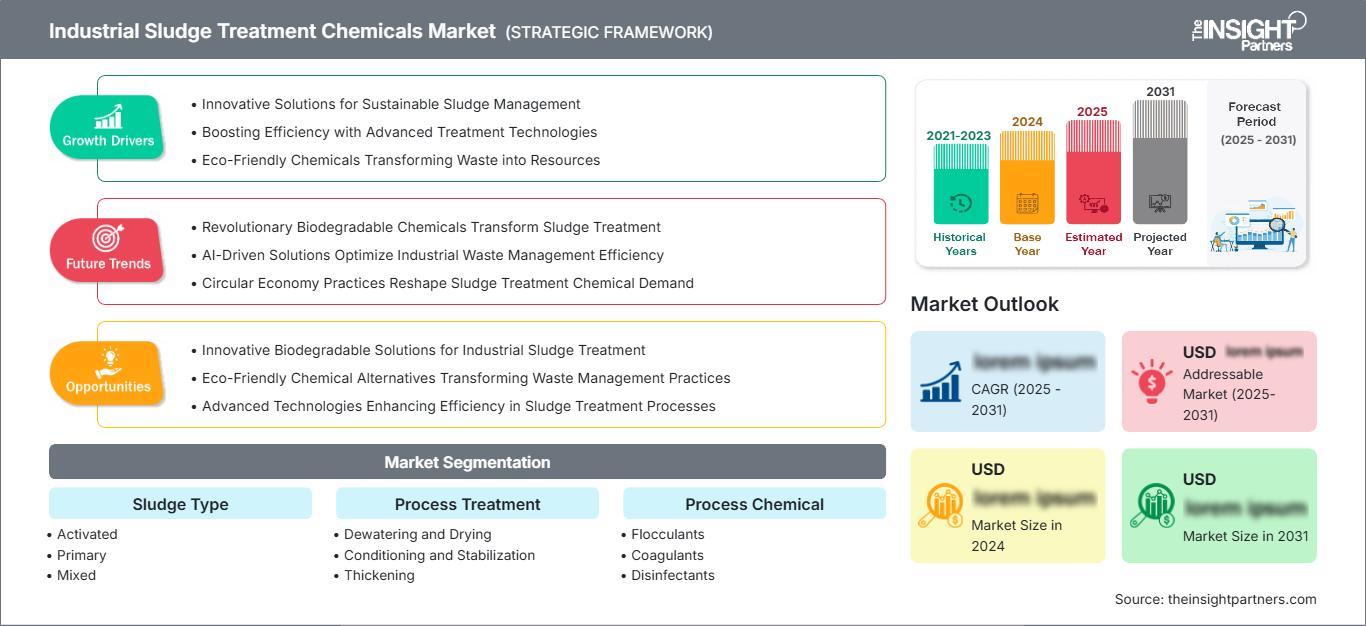
Industrial Sludge Treatment Chemicals Market: Strategic Insights
Regional Insights
North America industrial sludge treatment chemicals market
The North American region will be estimated to account for a 30–34% in the industrial sludge treatment chemicals market share in 2025. This market will experience a growth rate of 4.0–4.6% CAGR till 2034. The United States is the primary consumer in the region, followed by Canada, owing to its industrial waste-water treatment facilities and chemical treatment systems.
Food & beverages, refining, chemicals, metal processing, and manufacturing will drive demand in the market. More demand is being witnessed due to high demands for solid content and lesser volumes of sludge for disposal by manufacturers, thus making chemistry for conditioning and dewatering crucial.
U.S. industrial sludge treatment chemicals market
The US constitutes 72%-76% of North American consumption in 2025, with growth forecast to range from 4.1%-4.7% CAGR until 2034. Compliance with wastewater regulations in the industries, upgrading, and operating costs discipline are driving the use of these chemicals.
The market enjoys good representation from suppliers, which include Ecolab Inc., Kemira Oyj, BASF SE, among others. Usage is common in food processing, oil & gas, metal finishing, chemicals, pulp & paper, and electronics. Dewatering of sludges is especially significant, since less water content means lower transportation, storage, and final disposal needs.
Europe industrial sludge treatment chemicals market
Europe is estimated to account for 25–29% of the industrial sludge treatment chemicals market in 2025 and is projected to grow at a 3.7–4.3% CAGR through 2034. Germany is the leading national market, supported by industrial concentration and advanced wastewater infrastructure.
There is considerable demand in the UK for chemicals in relation to the chemicals industry, food processing, energy generation, and manufacturing plants, in addition to increasing sludge recovery and environmental monitoring needs. Germany benefits from good industrial wastewater treatment requirements and an established practice of chemical dosing. In addition, France, Italy, and Spain create further demand due to the food, chemical, pulp and paper, metallurgical industries, and manufacturing requirements.
APAC industrial sludge treatment chemicals market
APAC represents approximately 24–28% of the industrial sludge treatment chemicals market in 2025 and is forecast to grow at a 5.0–5.7% CAGR through 2034. China leads regional demand, followed by Japan, South Korea, India, and Australia.
The growth of industry, water shortage, and the increased stringency of wastewater standards drive chemical use in electronics, chemicals, food processing, metals, and oil and gas. While China has ample manufacturing capacity, India is working on its industrial wastewater systems. Japan and South Korea focus on high-efficiency treatment and water recycling, while Australia relies on its water conservation goals.
Middle East & Africa industrial sludge treatment chemicals market
Middle East & Africa is expected to record a 3.8–4.5% CAGR through 2034. Saudi Arabia is the leading market, supported by energy and industrial infrastructure, followed by the UAE and South Africa. The broader region remains comparatively underpenetrated.
The oil and gas industry produces complicated sludge streams that necessitate coagulation, flocculation, stabilisation, and dewatering. The diversification of industries, water shortages, water desalination, and investment in infrastructure are raising demands for water treatment. It is noteworthy that Saudi Arabia and the United Arab Emirates are highly relevant due to the need for water reuse and industrial development. South Africa also represents a demand in this market.
Segmentation Analysis
Sludge Type
The Sludge Type segment is expected to grow at a 4.2–4.8% CAGR during 2026–2034. Treatment chemistry varies substantially according to solids composition, organic loading, particle size, oil content, and biological characteristics. Activated sludge typically requires tailored polymer conditioning, while primary and mixed sludge streams require chemistry programs matched with downstream separation and disposal requirements.
- Activated: Activated sludge requires controlled polymer selection and dosage because biological solids can exhibit variable settling and dewatering behavior. Consistent conditioning improves separation efficiency and supports stable downstream cake formation.
- Primary: Primary sludge generally responds to coagulation and flocculation strategies designed around suspended solids concentration and particle characteristics. Efficient treatment supports rapid thickening and reduces hydraulic loading on downstream processes.
- Mixed: Mixed sludge combines characteristics of primary and biological streams, creating greater variability in dewatering performance. Suppliers therefore emphasize customized chemistry, onsite testing, and dosing optimization for reliable treatment.
Process Treatment
The Process Treatment segment is projected to register a 4.4–5.0% CAGR during 2026–2034. Chemical requirements differ across dewatering, drying, conditioning, stabilization, thickening, and digestion. Plants increasingly evaluate these steps collectively because upstream chemistry influences equipment performance, energy requirements, final solids quality, and disposal economics.
- Dewatering and Drying: Dewatering and drying remain central to sludge volume reduction, particularly where disposal costs are high. Chemical conditioning can improve separation and generate a more manageable cake for transport, storage, recovery, or disposal.
- Conditioning and Stabilization: Conditioning and stabilization improve sludge handling properties and reduce operational variability. Demand is strongest where plants need predictable solids behavior before mechanical separation, thermal processing, reuse, or final disposal.
- Thickening: Thickening concentrates solids before subsequent treatment and can reduce hydraulic loads on downstream systems. Chemical optimization supports improved settling performance and helps treatment plants increase effective process capacity.
- Digestion: Digestion applications emphasize biological stabilization and resource recovery. Chemical support can improve process stability, conditioning, and downstream solids management, particularly where facilities seek biogas production or reduced residual disposal requirements.
Process Chemical
The Process Chemical segment in the industrial sludge treatment chemicals market report is reported to to expand at a 4.5–5.1% CAGR during 2026–2034. Flocculants remain fundamental to solid-liquid separation, while coagulants support particle destabilization and aggregation. Disinfectants address pathogen and odor-control requirements where sludge is destined for controlled reuse or further processing.
- Flocculants: Flocculants are strategically important for improving particle aggregation and mechanical dewatering. Product selection depends on sludge chemistry, equipment type, polymer charge, molecular weight, and the desired balance between cake dryness and chemical consumption.
- Coagulants: Coagulants destabilize colloidal particles and improve clarification and solids capture. Demand spans industrial wastewater plants where suspended solids, metals, oils, and complex organic materials require enhanced separation before sludge dewatering.
- Disinfectants: Disinfectants support microbial control, odor management, and hygienic handling in selected sludge treatment applications. Their strategic role increases where treated residuals require additional safeguards before reuse, transport, or downstream processing.
End User
The End User segment in the industrial sludge treatment chemicals market is forecast to grow at a 4.6–5.2% CAGR during 2026–2034. Industrial users increasingly adopt treatment chemicals according to wastewater variability, production intensity, compliance exposure, and disposal economics. Electronics and metal processing should show comparatively strong expansion as advanced manufacturing capacity increases.
- Automotive: Automotive plants generate wastewater containing oils, metals, coatings, and process residues. Sludge treatment chemistry supports solids separation, metal removal, dewatering, and compliance while reducing residual handling burdens.
- Oil and Gas: Oil and gas facilities manage oily and chemically complex sludge streams. Chemical treatment is important for emulsion breaking, solids separation, dewatering, and improving the economics of residual disposal or recovery.
- Metal Processing: Metal processing generates sludge containing suspended solids, metal hydroxides, and treatment residues. Coagulants and flocculants improve separation performance and support compliant handling of concentrated residuals.
- Food and Beverages: Food and beverage wastewater often contains high organic loading and variable suspended solids. Chemical conditioning helps operators manage biological and primary sludge while maintaining stable plant throughput.
- Pulp and Paper: Pulp and paper operations generate fiber-rich and inorganic sludge requiring effective thickening and dewatering. Chemistry optimization helps control residual volume and supports resource-efficient production.
- Personal Care and Chemicals: These facilities produce chemically diverse wastewater with variable organic and suspended-solid characteristics. Customized treatment programs help address changing production recipes, improve separation, and maintain discharge consistency.
- Electronics: Electronics manufacturing produces highly controlled wastewater streams containing fine particles and process chemicals. Advanced treatment chemistry supports high-quality separation and water recovery, making the segment strategically important for future demand.
Opportunity Snapshot
| End User | Revenue Contribution (High/Medium/Low) | Trend Tag (MAX 2 words) | Adoption Stage (Emerging/Scaling/Mature) |
| Automotive | High | Metal Capture | Mature |
| Oil and Gas | High | Oily Sludge | Mature |
| Metal Processing | High | Metal Recovery | Mature |
| Food and Beverages | High | Organic Loading | Mature |
| Pulp and Paper | Medium | Fiber Recovery | Mature |
| Personal Care and Chemicals | Medium | Process Variability | Scaling |
| Electronics | Medium | Ultrafine Solids | Scaling |
Industrial Sludge Treatment Chemicals Market Growth Drivers and Impact Analysis
Rising cost of sludge disposal and transportation
Higher costs associated with sludge transportation, storage, thermal treatment, landfill disposal, and regulatory compliance are encouraging industrial operators to improve solids concentration before final handling. Chemical conditioning directly affects dewatering performance, allowing facilities to reduce water retained in sludge and consequently lower the volume requiring transport. This creates an economic incentive for plants to optimize polymer and coagulant selection even when wastewater throughput remains stable. The impact is particularly strong at geographically dispersed facilities where hauling distances are significant. Suppliers that can demonstrate lower chemical consumption alongside improved cake solids have greater potential to secure recurring contracts. The market therefore benefits from a shift toward performance-based chemical programs in which treatment efficiency, equipment throughput, and residual disposal costs are evaluated together rather than considering chemical price in isolation.
Expansion of industrial wastewater treatment capacity
Industrialization across Asia Pacific, the Middle East, and selected emerging economies is expanding the installed base of wastewater treatment systems serving manufacturing, food processing, chemicals, metals, and electronics. New treatment capacity creates recurring requirements for coagulants, flocculants, disinfectants, and sludge-conditioning products. Existing facilities are also being upgraded to meet tighter discharge requirements and improve water reuse. This combination increases chemical intensity even where industrial production grows at moderate rates. New plants frequently integrate automated dosing, laboratory testing, and mechanical dewatering equipment, creating opportunities for suppliers to sell chemistry together with technical services. The resulting demand is more resilient because treatment chemicals are consumed continuously rather than only during capital-project installation. Suppliers with local manufacturing, application laboratories, and service teams can therefore capture stronger positions in rapidly developing industrial clusters.
Increasing focus on sludge resource recovery
Industrial operators are increasingly evaluating sludge as a potential source of energy, nutrients, recovered materials, or reusable water rather than treating it solely as a disposal liability. This shift changes chemical-selection criteria because excessive chemical addition can affect downstream recovery options. Treatment providers are consequently developing programs that balance solids separation with the quality requirements of digestion, drying, thermal conversion, and beneficial reuse. Resource recovery also increases demand for process monitoring because operators need predictable sludge characteristics before investing in downstream equipment. The commercial impact extends beyond product sales toward integrated service models involving testing, dosing optimization, equipment compatibility, and residual-quality monitoring. Suppliers capable of linking chemical treatment performance to recovery economics should gain an advantage as industrial sustainability programs move from compliance-focused wastewater management toward measurable circularity outcomes.
Industrial Sludge Treatment Chemicals Market Future Trends
Low-carbon sludge processing and chemistry optimization
Future treatment programs are expected to place greater emphasis on reducing the carbon intensity associated with sludge handling. Chemical suppliers will increasingly optimize formulations and dosage around total process energy rather than separation performance alone. Lower polymer consumption, improved cake solids, and compatibility with low-temperature drying can reduce downstream energy requirements. Digital dosing systems will support this transition by continuously adjusting treatment according to sludge characteristics and equipment performance. Industrial operators may also favor formulations with improved renewable or lower-impact feedstock profiles when performance and economics remain competitive. As sustainability reporting becomes more integrated into procurement decisions, suppliers will need to demonstrate measurable environmental benefits through lifecycle data. The resulting competitive environment should favor companies capable of combining chemistry, process analytics, equipment knowledge, and operational support rather than relying exclusively on commodity chemical volumes.
Integrated sludge-to-resource treatment platforms
The next phase of development in the industrial sludge treatment chemicals market forecast is likely to connect sludge conditioning with resource recovery technologies through integrated process designs. Chemical treatment will increasingly be selected according to the requirements of digestion, pyrolysis, drying, nutrient recovery, or material conversion. This creates a more complex specification environment because treatment chemistry must improve separation without compromising downstream product quality. Industrial facilities with high organic loading may prioritize chemistry that supports stable digestion, while facilities pursuing thermal recovery may emphasize dewatering performance and controlled ash characteristics. Equipment suppliers and chemical companies are therefore likely to collaborate more closely on integrated treatment packages. Such partnerships can reduce commissioning risk and provide customers with a single performance framework covering wastewater clarification, sludge conditioning, residual processing, and resource recovery. This approach should gradually replace isolated chemical purchasing in sophisticated industrial facilities.
Industrial Sludge Treatment Chemicals Market Opportunities
Expansion of localized treatment services in emerging industrial hubs
Emerging manufacturing clusters offer an opportunity for suppliers to build localized chemical production, technical laboratories, and mobile treatment-support capabilities. Industrial customers often face variable wastewater composition and limited access to experienced treatment specialists, creating demand for application testing and onsite optimization. Regional service hubs can shorten delivery times while allowing suppliers to tailor formulations to local water chemistry and industrial processes. India, Southeast Asia, the Middle East, and selected Latin American markets are particularly relevant because manufacturing investment is increasing alongside water-stress concerns. Companies can strengthen market access by combining chemical supply with equipment commissioning, laboratory testing, dosing audits, and operator training. Such models can generate recurring service revenues and improve customer retention while reducing dependence on standardized products. The opportunity is strongest where local environmental requirements are becoming more stringent but specialized treatment expertise remains limited.
Advanced chemistry for electronics and precision manufacturing
The expansion of semiconductor, electronics, battery, and precision manufacturing creates opportunities for highly specialized sludge treatment chemistry. These facilities typically require tighter control over wastewater contaminants because process chemicals, fine particles, metals, and other residues can affect water reuse and production reliability. Treatment suppliers can differentiate through high-purity coagulants, precision flocculants, automated dosing, and analytical services designed for low-tolerance industrial environments. The opportunity extends beyond conventional sludge dewatering because advanced factories increasingly seek water recycling and closed-loop treatment. Suppliers that establish relationships during plant design and commissioning can influence chemical specifications over the facility lifecycle. Asia Pacific is particularly attractive because electronics production is expanding in China, South Korea, Japan, India, and other manufacturing centers. Long-term contracts combining chemistry, monitoring, and technical support could become an important route to market.
Recent Developments
- April 2026: Solenis LLC announced the groundbreaking of a new 60,000-tonne-per-year production facility in Beihai, Guangxi. The facility is intended to expand Solenis' regional manufacturing capabilities for water and hygiene solutions and strengthen supply capacity for customers in Asia.
- March 2026: Kemira Oyj announced completion of the first full-scale US trial of its chlorine-free KemConnect DEX wastewater treatment solution with Capital Region Water in Pennsylvania. The trial demonstrated the technology's application for wastewater disinfection while reducing reliance on chlorine-based treatment.
Frequently Asked Questions

- Comprehensive Market Sizing and Forecast Analysis
- Detailed Segmentation Analysis
- In-Depth Market Dynamics Assessment
- Regional and Country-Level Insights
- Competitive Landscape and Company Benchmarking
- Strategic Business Intelligence
Recent Reports
Testimonials

The Insight Partners' SCADA System Market report is comprehensive, with valuable insights on current trends and future forecasts. The team was highly professional, responsive, and supportive throughout. We are very satisfied and highly recommend their services.
RAN KEDEM Partner, Reali Technologies LTDs
I requested a report on a very specific software market and the team produced the report in a few days. The information was very relevant and well presented. I then requested some changes and additions to the report. The team was again very responsive and I got the final report in less than a week.
JEAN-HERVE JENN Chairman, Future Analytica
We worked with The Insight Partners for an important market study and forecast. They gave us clear insights into opportunities and risks, which helped shape our plans. Their research was easy to use and based on solid data. It helped us make smart, confident decisions. We highly recommend them.
PIYUSH NAGPAL Sr. Vice President, High Beam Global
The Insight Partners delivered insightful, well-structured market research with strong domain expertise. Their team was professional and responsive throughout. The user-friendly website made accessing industry reports seamless. We highly recommend them for reliable, high-quality research services
YUKIHIKO ADACHI CEO, Deep Blue, LLC.
This is the first time I have purchased a market report from The Insight Partners.While I was unsure at first, I visited their web site and felt more comfortable to take the risk and purchase a market report.I am completely satisfied with the quality of the report and customer service. I had several questions and comments with the initial report, but after a couple of dialogs over email with their analyst I believe I have a report that I can use as input to our strategic planning process.Thank you so much for taking the extra time and making this a positive experience.I will definitely recommend your service to others and you will be my first call when we need further market data.
JOHN SUZUKI President and Chief Executive Officer, Board Director, BK Technologies
I wish to appreciate your support and the professionalism you displayed in the course of attending to my request for information regarding to infectious disease IVD market in Nigeria. I appreciate your patience, your guidance, and the fact that you were willing to offer a discount, which eventually made it possible for us to close a deal. I look forward to engaging The Insight Partners in the future, all thanks to the impression you have created in me as a result of this first encounter.
DR CHIJIOKE ONYIA MANAGING DIRECTOR, PineCrest Healthcare Ltd.Reason to Buy
- Informed Decision-Making
- Understanding Market Dynamics
- Competitive Analysis
- Identifying Emerging Markets
- Customer Insights
- Market Forecasts
- Risk Mitigation
- Boosting Operational Efficiency
- Strategic Planning
- Investment Justification
- Tracking Industry Innovations
- Aligning with Regulatory Trends





 Get Free Sample for