
Industrial Wax Market Developments, Trends, Opportunities, and Forecast by 2034
Coverage: by Type (Fossil Based Wax, Synthetic Based Wax, Bio-Based Wax); Application (Candles, Packaging, Coatings and Polishes, Hot Melt Adhesives, Tires and Rubber, Cosmetics and Personal Care, Food, Others) , and Geography (North America, Europe, Asia Pacific, and South and Central America)
- Status : Data Released
- Report Code : TIPRE00004490
- Category : Chemicals and Materials
- No. of Pages : 150
- Available Report Formats :


- Last update date : August 27, 2026


2025 Market Size
US$ 8.42 Bn
Base year value
2034 Forecast
US$ 12.96 Bn
Projected by 2034
CAGR 2025-2034
4.9 %
Growth rate
Addressable Market
US$ 96.99 Bn
(2025-2034)
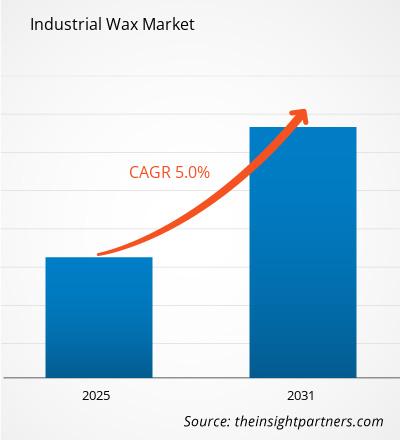
The industrial wax market was valued at US$ 8.42 Billion in 2025 and is projected to reach US$ 12.96 Billion by 2034, registering a CAGR of 4.9% during 2026–2034. The market encompasses fossil-based, synthetic-based, and bio-based waxes used across candles, packaging, coatings and polishes, hot melt adhesives, tires and rubber, cosmetics and personal care, and food applications.
In North America, the industrial wax market size is expected to expand at an estimated 3.8–4.4% CAGR during 2026–2034, supported by demand for packaging materials and hot melt adhesive formulations. Modernization of converting operations, continued e-commerce activity, and increasing requirements for high-performance coatings are strengthening consumption. Product reformulation toward lower-emission and renewable feedstocks is also creating opportunities for synthetic and bio-based wax suppliers.
Industrial Wax Market Assessment and Insights
- North America: The region accounted for an estimated 24–28% share in 2025, supported by packaging conversion, adhesive consumption, and specialty coating demand, with the industrial wax market advancing at a 3.8–4.4% CAGR between 2026–2034.
- US: The US represented approximately 78–82% of North American demand in 2025 and is projected to expand at a 3.9–4.5% CAGR between 2026–2034, driven by packaging, candles, adhesives, and personal care applications.
- Europe: Europe held an estimated 22–26% share in 2025, with Germany, the UK, France, Italy, and Spain forming key demand centers. The region is expected to grow at a 3.6–4.2% CAGR between 2026–2034.
- Asia Pacific: Asia Pacific accounted for approximately 38–42% share in 2025, led by China, India, Japan, and South Korea. Expanding manufacturing activity supports an estimated 5.5–6.1% CAGR between 2026–2034.
- Largest Segment: Fossil Based Wax represented an estimated 48–52% market share in 2025 and is projected to register a 3.7–4.3% CAGR during 2026–2034, supported by established refining infrastructure and broad industrial compatibility.
- High Growth Segment: Bio-Based Wax accounted for approximately 12–16% market share in 2025 and is expected to expand at a 6.8–7.4% CAGR during 2026–2034, supported by renewable-material substitution and formulation innovation.
- Key companies analyzed in detail: China Petrochemical Corporation, Exxon Mobil Corporation, HCI Wax, Numaligarh Refinery Limited, Petróleo Brasileiro S.A. – Petrobras, PJSC LUKOIL, Sasol Limited, Shell International B.V., The Blayson Group Ltd., The International Group, Inc.
Source: The Insight Partners' analysis based on proprietary research, government publications, company annual reports, investor presentations, industry databases, and expert interviews.
Production technology is increasingly separating commodity wax suppliers from producers capable of controlling molecular distribution, hardness, melting behavior, and application-specific purity. Refinery integration remains important for paraffin availability, while gas-to-liquids processing provides another route to highly pure hydrocarbon chains. Shell identifies Fischer–Tropsch synthesis as a process that forms wax-like long-chain hydrocarbons, demonstrating the continued importance of conversion technology in the industrial wax market. At the same time, catalytic dewaxing and upgrading are influencing feedstock allocation and the economics of producing specialized hydrocarbon streams.
In the coming years, expansion is anticipated to be more prevalent in economies that are manufacturing-oriented and are growing in terms of production of packaging, consumer goods, infrastructure, and autos. Investments are expected to go to plants that can change feedstocks or produce more valuable grades, not just commodity grades. Policies that focus on renewable carbon and the decarbonization of industries will further aid bio-based materials, while government-funded bio economy programs will promote the commercial development of bio-based products and chemicals.
Industrial Wax Market Report Scope
| Report Attribute | Details |
|---|---|
| Market size in 2025 | US$ 8.42 Billion |
| Market Size by 2034 | US$ 12.96 Billion |
| Global CAGR (2026 - 2034) | 4.9% |
| Historical Data | 2021-2024 |
| Forecast period | 2025-2034 |
Industrial Wax Market Analysis
Demand expansion is being shaped by the industrial wax market growth of packaging conversion, adhesive manufacturing, consumer products, and protective surface treatments. Waxes provide moisture resistance, lubrication, slip control, release properties, gloss, and viscosity modification, making demand dependent on performance requirements rather than volume alone. Petroleum refining, gas-to-liquid processing, synthetic manufacturing, or renewable feedstocks form the initial stage of the value chain and proceed through the stages of fractionation, refining, blending, compounding, transportation, and application-oriented formulation. Consumption of petrochemicals gives rise to the wider structural context, as the International Energy Agency has observed that "the growth of plastics consumption has outstripped that of all other major bulk materials."
Supply conditions differ substantially by wax category. Fossil-based production depends on crude selection, refinery configuration, lubricating-oil processing, and available slack-wax streams, whereas synthetic products can offer tighter control over composition and performance. Bio-based supply depends more heavily on agricultural, forestry, and waste-derived feedstock availability. This diversification is strategically significant because biomass resources can support a wider bioeconomy and production of higher-value chemicals alongside fuels. The industrial wax market therefore, benefits from multiple production pathways, although each route carries different capital, feedstock, certification, and processing requirements.
The industrial wax market analysis indicates a competitive environment divided between integrated energy companies, refinery-linked suppliers, and specialized wax formulators. China Petrochemical Corporation, Exxon Mobil Corporation, Petróleo Brasileiro S.A. – Petrobras, PJSC LUKOIL, Sasol Limited, Shell International B.V., and Numaligarh Refinery Limited possess advantages associated with upstream resources or processing infrastructure. HCI Wax, The Blayson Group Ltd., and The International Group, Inc. strengthen the specialist segment through product development, blending, distribution, and customer-specific grades. Competitive positioning increasingly depends on consistency, application support, regulatory documentation, and the ability to manage feedstock transitions.
Investment patterns are moving toward higher-value processing rather than simple capacity expansion. Producers are evaluating purification, blending, renewable feedstock integration, and technologies that improve selectivity or product flexibility. Shell reported US$ 1.17 billion in R&D investment during 2025, including approximately US$ 485 million directed toward projects contributing to decarbonization, illustrating the scale of technology spending available within integrated energy businesses. For the industrial wax market, such investment can indirectly improve catalyst systems, process efficiency, and low-carbon product pathways.
● REPORT CUSTOMIZATION
Tailor This Report To Align With Your Specific Business Requirements
This report can be customized to align precisely with your business objectives, scope, and target markets. Customization options include tailored segmentation, geography, competitive analysis, and strategic insights to support informed decision-making.
Customize This Report →WHAT YOU CAN ADJUST
- ● Segmentations
- ● Geography
- ● Competitive Analysis
- ● Language Preferences
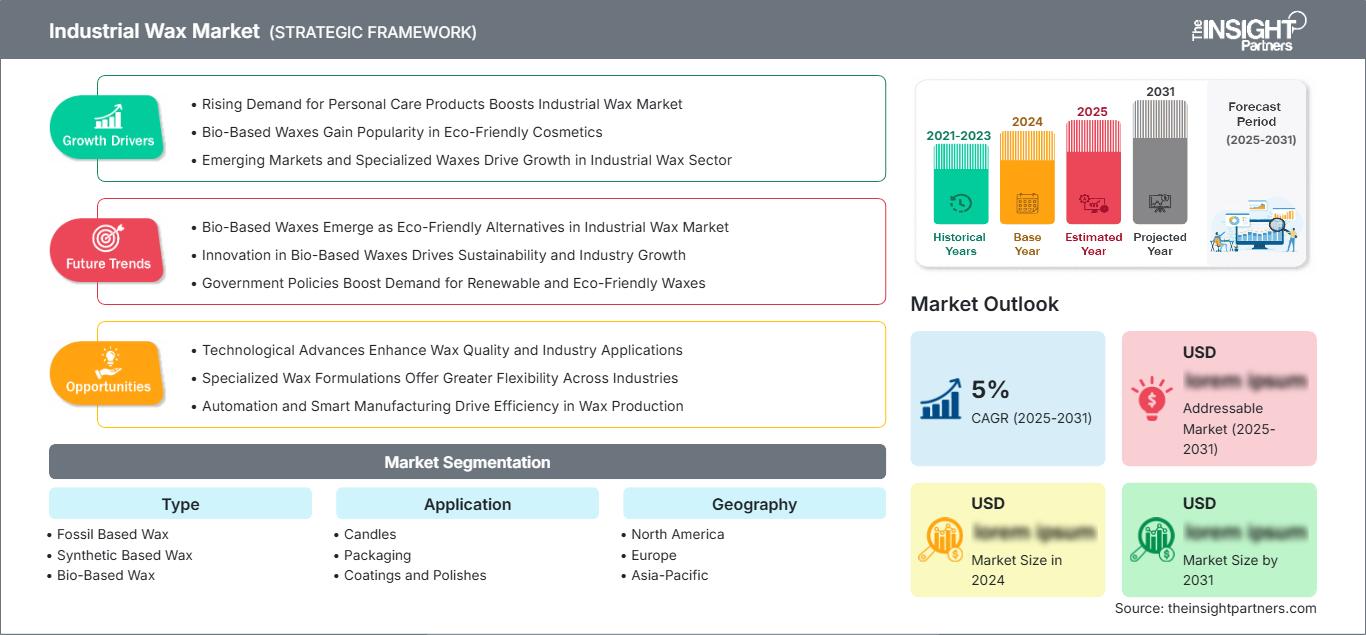
Industrial Wax Market: Strategic Insights
Regional Insights
North America Industrial Wax Market
North America accounted for an estimated 24–28% industrial wax market share in 2025 and is expected to grow at a 3.8–4.4% CAGR during 2026–2034. Packaging conversion, hot melt adhesive production, and demand for surface protection products support regional consumption. The US continues to be the main source of demand, whereas Canada and Mexico add through industries related to manufacturing, food processing, automotive, and consumer goods.
There is an increasing trend in regional suppliers of maintaining a balance between traditional paraffin supply and demand for synthetic/renewable forms of wax. There is a growing need for e-commerce packaging, infrastructure maintenance, and high-end consumer goods, where application-specific waxes that have specific properties are used. The trend towards material conservation and emission reduction leads to formulation modification. Refinery infrastructures are well established, but the economics of refineries may encourage alternatives.
U.S. Industrial Wax Market
The US represented approximately 78–82% of the North American Industrial Wax Market demand in 2025 and is projected to register a 3.9–4.5% CAGR during 2026–2034. The industry’s industrial base contributes to consumption in terms of packaging, candles, coatings, hot melt adhesives, food products, and personal care products. The US is a significant player in the overall US hydrocarbon industry chain, while The International Group, Inc. and HCI Wax cater to specialty wax manufacturing and applications.
Applications for packaging and adhesives are gaining prominence owing to the need for effective bonding properties, moisture barrier properties, lubrication properties, and processing properties on the part of manufacturers. The US also has well-established logistics and the availability of feedstock made of petroleum. Going forward, there will be increased demand for differentiated products catering to specific melting properties, hardness, purity and sustainability needs.
Europe Industrial Wax Market
Europe held an estimated 22–26% share of the Industrial Wax Market in 2025 and is anticipated to expand at a 3.6–4.2% CAGR during 2026–2034. Germany is the leading regional market, supported by its chemical, automotive, packaging, and industrial manufacturing base. The UK, France, Italy, and Spain also provide significant demand through consumer products, food processing, construction, coatings, and specialty manufacturing applications.
In the UK market, one can mention the existence of a specialty chemicals industry, as well as that of a packaging and candles industry. Increasing demand focuses on tailor-made specifications, consistency, and compliance with customer needs. The significance of Germany lies in the diversification of its manufacturing industries, which results in the consumption of waxes for coatings, polishes, rubber production, adhesives, and the engineering of packages.
In the European countries of France, Italy, and Spain, the demand is driven by cosmetics, food processing, packaging conversion, and construction applications. In France, one should point to a highly-developed manufacturing system of beauty and personal care products, whereas in Italy and Spain, opportunities arise due to consumer goods and industrial manufacturing.
APAC Industrial Wax Market
Asia Pacific accounted for approximately 38–42% share in 2025 and is expected to record the fastest regional expansion at a 5.5–6.1% CAGR during 2026–2034. China is the leading market, supported by its refining, chemicals, packaging, and manufacturing industries, while Japan, South Korea, India, and Australia contribute specialized and expanding demand.
Industrialization and investments in downstream manufacturing are strengthening consumption across packaging, adhesives, rubber, and consumer products. China Petrochemical Corporation and other regional producers benefit from integrated processing capabilities. Policy support for advanced manufacturing, renewable materials, and industrial efficiency is also encouraging the development of higher-value and bio-derived formulations.
Middle East & Africa Industrial Wax Market
The Middle East & Africa are projected to grow at a 4.6–5.2% CAGR during 2026–2034, supported by refining investments, construction activity, packaging demand, and expanding downstream industries. Integrated energy infrastructure and petrochemical infrastructure are available in Saudi Arabia and the UAE. South Africa is a major demand center in the industry with support from Sasol Limited and existing chemical processing facilities.
Integration of the energy sector offers suppliers in the region an opportunity to create specialized hydrocarbon products and realize value from the local feedstocks. Investment in infrastructure is available in Saudi Arabia and the UAE to satisfy downstream demand, but South Africa continues to offer applications for industrial processing and consumer goods. Growth in the Rest of the MEA region depends on manufacturing, distribution, and reliable product supply.
Segmentation Analysis
Type
The industrial wax market scope across types is shaped by differences in feedstock availability, performance requirements, production economics, and sustainability objectives. The overall Type segment is projected to grow at a 4.5–5.1% CAGR during 2026–2034. Fossil-based products retain broad industrial relevance, while synthetic materials address demanding technical specifications. Bio-based alternatives are gaining strategic importance as manufacturers seek renewable carbon sources without compromising processability or functional performance.
- Fossil Based Wax: This category remains the largest supply base, supported by established refining infrastructure, broad application compatibility, and dependable processing characteristics across candles, packaging, coatings, adhesives, rubber, and other industrial formulations.
- Synthetic Based Wax: Synthetic products address applications requiring controlled molecular structure, consistent melting performance, hardness, lubrication, and purity, making them strategically important for technical formulations where conventional refinery-derived materials provide insufficient specification control.
- Bio-Based Wax: Renewable feedstocks support growing interest in bio-based products, particularly where customers prioritize renewable content, traceability, and reduced dependence on fossil resources while maintaining compatibility with existing manufacturing and application processes.
Application
Application diversity reduces dependence on any single end-use industry and supports a broad demand base. The Application segment is expected to expand at a 4.8–5.4% CAGR during 2026–2034, with packaging and hot melt adhesives benefiting from manufacturing activity and consumer goods distribution. Coatings, personal care, food, and rubber applications increasingly require specialized formulations that combine functional performance with regulatory and sustainability considerations.
- Candles: Candle manufacturing remains an established volume outlet, with demand influenced by household consumption, decorative products, premium fragrances, and manufacturers seeking blends that provide controlled burning, appearance, fragrance retention, and processing efficiency.
- Packaging: Packaging applications use waxes for moisture resistance, surface treatment, lubrication, and protective performance, with continued demand from food, consumer goods, logistics, and industrial distribution supporting strategic importance across regional converting industries.
- Coatings and Polishes: Waxes enhance gloss, abrasion resistance, slip, water repellency, and surface protection, making this application important for automotive, construction, furniture, flooring, and industrial maintenance formulations requiring differentiated performance characteristics.
- Hot Melt Adhesives: Hot melt adhesive formulations use waxes to modify viscosity, setting behavior, adhesion balance, and processing characteristics, supporting demand from packaging, hygiene products, woodworking, assembly, and other manufacturing operations.
- Tires and Rubber: Rubber processing applications require waxes that support surface protection, processing, and performance, with automotive production and replacement demand influencing consumption across tire manufacturing and specialized industrial rubber products.
- Cosmetics and Personal Care: Waxes provide texture, structure, emolliency, stability, and sensory characteristics in cosmetic and personal care formulations, creating demand for purified and specialty grades meeting application-specific quality and regulatory requirements.
- Food: Food applications require carefully selected materials for coatings, glazing, release, and protective functions, making product purity, regulatory compliance, traceability, and consistent supply strategically important for processors and ingredient formulators.
Opportunity Snapshot
| Application | Revenue Contribution (High/Medium/Low) | Trend Tag | Adoption Stage |
| Candles | High | Premium Blends | Mature |
| Packaging | High | Barrier Coatings | Mature |
| Coatings and Polishes | High | Surface Protection | Mature |
| Hot Melt Adhesives | High | Fast Setting | Scaling |
| Tires and Rubber | Medium | Anti-Ozone Protection | Mature |
| Cosmetics and Personal Care | Medium | Texture Control | Scaling |
| Food | Medium | Protective Glazing | Mature |
Industrial Wax Market Growth Drivers and Impact Analysis
Expansion of Packaging and Adhesive Manufacturing
Demand for wax materials with properties such as moisture barrier, viscosity modifier, lubricant, release agent, and protective film will be driven by packaging conversion and hot melt adhesive production. Demand for such products would be fueled by growth in e-commerce, food distribution, consumer goods logistics, and industrial packaging applications. The choice of wax product will become more application-based as suppliers seek better processing efficiency and performance of their products at the end. There will be higher demands for materials having controlled melting properties and compatibility with polymer and tackifier from hot melt adhesive suppliers. This kind of demand scenario would favor suppliers able to differentiate themselves with customized wax grades rather than commodity wax products.
Rising Need for High-Performance Surface Treatments
Both the manufacturers of industrial products and consumer goods are resorting to using waxes in order to enhance their gloss, abrasion resistance, slip, water repellence, and general surface durability. This creates the need for demand in terms of coatings, polishes, automotive parts, flooring, furniture, building materials, and other industrial maintenance applications. There are significant differences in performance requirements between different types of applications, which leads to the creation of waxes with distinct melting points, hardnesses, particulate properties, and compatibility profiles. The manufacturers that can manage to achieve this will find their niche in high-end formulations that rely more on technical performance than on the availability of the raw material. This will also lower the dependence on traditional commodity applications.
Shift Toward Renewable and Diversified Feedstocks
Diversification of the feedstock source becomes a strategically relevant factor as the manufacturing companies try to minimize their dependence on petroleum feedstocks and increase supply reliability. The bio-based waxes obtained from renewable sources give an opportunity for applications where clients focus on the use of renewables, traceability of the material, and compliance with sustainable development goals. However, the synthetic route gives an advantage of having more control over the molecular structure and its properties. Having various possibilities for obtaining the raw materials allows the companies to cater to various price and specification criteria. The investment in feedstock flexibility is also an option that minimizes the risks related to possible disruptions in certain supply chains.
Industrial Wax Market Future Trends
Increasing Adoption of Bio-Based and Certified Waxes
The industrial wax market trends are expected to increasingly reflect demand for renewable feedstocks, traceable sourcing, and materials compatible with corporate sustainability targets. The bio-wax producers will tend to emphasize the enhancement of performance and processability to move away from specialty niches. Documentation and certification will become key purchasing requirements, especially in consumer goods. The producers can also integrate renewable components with existing components to achieve a performance versus price balance. Long-term feedstock diversification would help minimize dependency on individual supply streams. This will drive developments in formulation science, purification methods, and collaborations that can enable commercial-scale production of renewable wax.
Greater Product Specialization Through Molecular Control
The future direction of product development is thought to involve an emphasis on wax grades that are based on defined melt characteristics, hardness, viscosity control, particle structure, and compatibility with final formulations. There are technologies related to synthetic processing and refining that are able to facilitate precise control of these characteristics. Consumers of adhesives, coatings, packaging, cosmetic and industrial formulations are increasingly looking at materials on the basis of their performance characteristics as opposed to product classification. This means that producers need to pay attention to technical services, formulation tests, and customized blending operations. It could create additional obstacles for suppliers that compete through price alone.
Industrial Wax Market Opportunities
Development of High-Value Specialty Wax Portfolios
Investment in specialty wax portfolios represents an opportunity to improve margins through products designed for defined performance requirements. Producers can target coatings, hot melt adhesives, cosmetics, food processing, and advanced packaging applications where melting behavior, purity, hardness, and compatibility influence customer purchasing decisions. The industrial wax market Forecasts indicate that suppliers with flexible blending and purification capabilities can address multiple end uses without relying exclusively on commodity demand. Strategic investment should focus on laboratory development, application testing, technical sales capabilities, and partnerships with downstream formulators. Companies can also expand geographically through distributors serving specialized manufacturing clusters. Success will depend on balancing product customization with scalable production and maintaining reliable quality across different feedstock sources and operating conditions.
Expansion into Emerging Manufacturing and Consumer Markets
Developing nations represent good avenues for wax manufacturers since industrial processing, the use of packaged goods, construction activity, and consumer products are developing within the market space. The Asia Pacific region represents an especially interesting area due to the combination of extensive manufacturing operations and increasing downstream demand present in China and India. Strategies could involve warehouse facilities in the local region, blending operations, technology alliances, and distribution channels, which would increase delivery times and customer service. The Middle East regions could represent another potential opportunity, which could be associated with petrochemical developments and investment in the region.
Recent Developments
- March 2026: Muc-Off launched Dark Energy Chain Wax - a next generation dropper wax engineered to hit the sweet spot between efficiency, durability and low wear.
- April 2025: Clariant announced the launch of Ceridust 1310, an innovative wax solution designed to address the increasing supply chain complexities facing formulators who rely on carnauba wax for printing ink applications. This development demonstrates Clariant's understanding of market challenges and commitment to providing reliable solutions for its customers.
Frequently Asked Questions

- Comprehensive Market Sizing and Forecast Analysis
- Detailed Segmentation Analysis
- In-Depth Market Dynamics Assessment
- Regional and Country-Level Insights
- Competitive Landscape and Company Benchmarking
- Strategic Business Intelligence
Recent Reports
Testimonials

The Insight Partners provided valuable market intelligence that supported our global go-to-market strategy. Their team was professional, responsive, and attentive to our feedback, providing thoughtful analysis and helpful methodological clarifications throughout the project.
Junmo Kim Chief Financial Officer (CFO), Enertech Co., Ltd.
The Insight Partners' SCADA System Market report is comprehensive, with valuable insights on current trends and future forecasts. The team was highly professional, responsive, and supportive throughout. We are very satisfied and highly recommend their services.
RAN KEDEM Partner, Reali Technologies LTDs
I requested a report on a very specific software market and the team produced the report in a few days. The information was very relevant and well presented. I then requested some changes and additions to the report. The team was again very responsive and I got the final report in less than a week.
JEAN-HERVE JENN Chairman, Future Analytica
We worked with The Insight Partners for an important market study and forecast. They gave us clear insights into opportunities and risks, which helped shape our plans. Their research was easy to use and based on solid data. It helped us make smart, confident decisions. We highly recommend them.
PIYUSH NAGPAL Sr. Vice President, High Beam Global
The Insight Partners delivered insightful, well-structured market research with strong domain expertise. Their team was professional and responsive throughout. The user-friendly website made accessing industry reports seamless. We highly recommend them for reliable, high-quality research services
YUKIHIKO ADACHI CEO, Deep Blue, LLC.
This is the first time I have purchased a market report from The Insight Partners.While I was unsure at first, I visited their web site and felt more comfortable to take the risk and purchase a market report.I am completely satisfied with the quality of the report and customer service. I had several questions and comments with the initial report, but after a couple of dialogs over email with their analyst I believe I have a report that I can use as input to our strategic planning process.Thank you so much for taking the extra time and making this a positive experience.I will definitely recommend your service to others and you will be my first call when we need further market data.
JOHN SUZUKI President and Chief Executive Officer, Board Director, BK Technologies
I wish to appreciate your support and the professionalism you displayed in the course of attending to my request for information regarding to infectious disease IVD market in Nigeria. I appreciate your patience, your guidance, and the fact that you were willing to offer a discount, which eventually made it possible for us to close a deal. I look forward to engaging The Insight Partners in the future, all thanks to the impression you have created in me as a result of this first encounter.
DR CHIJIOKE ONYIA MANAGING DIRECTOR, PineCrest Healthcare Ltd.Reason to Buy
- Informed Decision-Making
- Understanding Market Dynamics
- Competitive Analysis
- Identifying Emerging Markets
- Customer Insights
- Market Forecasts
- Risk Mitigation
- Boosting Operational Efficiency
- Strategic Planning
- Investment Justification
- Tracking Industry Innovations
- Aligning with Regulatory Trends





 Get Free Sample for