
Infrared (IR) Sensing Imaging Market Share, Size & Demand by 2034
Infrared (IR) Sensing Imaging Market Size and Forecasts (2021–2034), Global and Regional Share, Trends, and Growth Opportunity Analysis Report Coverage : By Technology (Uncooled Infrared Imaging, Cooled Infrared Imaging, Thermal Imaging, Multispectral Imaging, Hyperspectral Imaging); Wavelength Range (Near Infrared (NIR), Mid Infrared (MIR), Long Wave Infrared (LWIR), Very Long Wave Infrared (VLWIR)); Application (Military and Defense, Automotive, Industrial, Medical, Research and Development); Geography (North America, Europe, Asia-Pacific, Middle East & Africa, South and Central America)
- Status : Data Released
- Report Code : TIPRE00039479
- Category : Electronics and Semiconductor
- No. of Pages : 150
- Available Report Formats :


- Last update date : September 18, 2026


2025 Market Size
US$ 8.71 Bn
Base year value
2034 Forecast
US$ 15.19 Bn
Projected by 2034
CAGR 2026-2034
6.37 %
Growth rate
Addressable Market
US$ 108.11 Bn
(2026-2034)
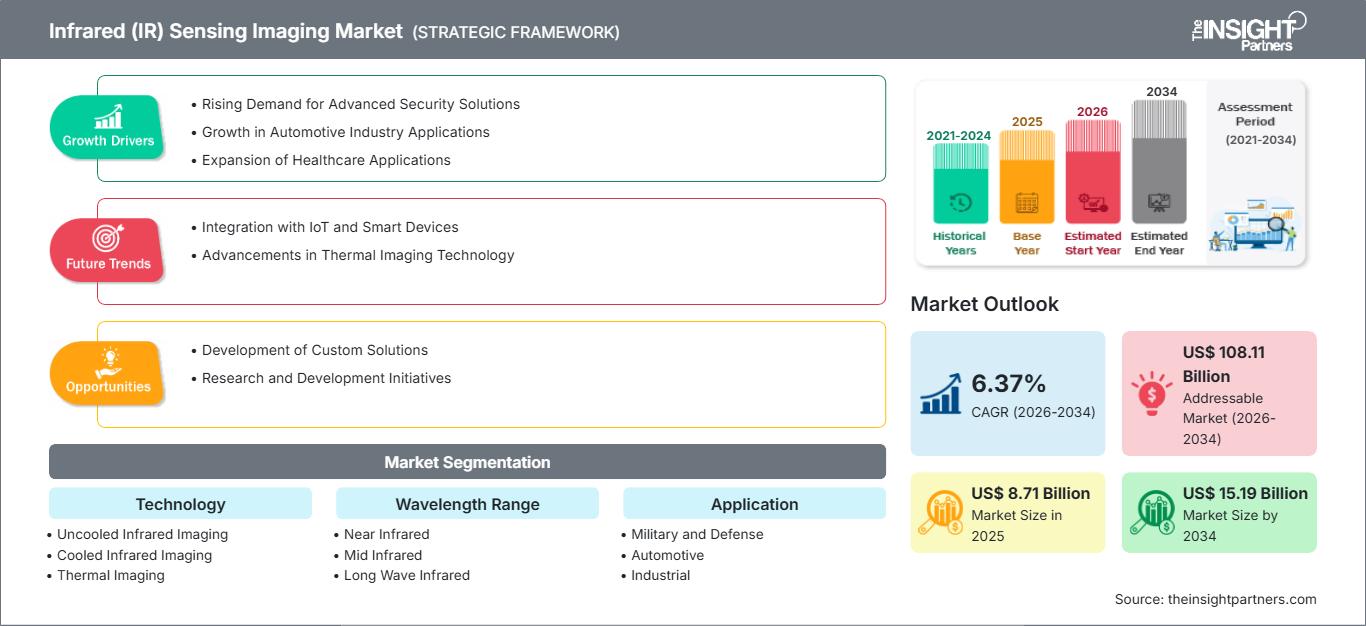
The Infrared Sensing Imaging Market size was valued at US$ 8.71 Billion in 2025 and is projected to reach US$ 15.19 Billion by 2034, registering a CAGR of 6.37% during 2026–2034. Expansion is supported by increasing deployment of thermal and spectral sensing across defense, automotive, industrial, medical, and research applications. Advances in detector materials, focal-plane arrays, cooling technologies, and computational imaging are improving sensitivity, resolution, miniaturization, and operating flexibility.
North America is expected to remain a major demand center, supported by defense electro-optical modernization and expanding thermal imaging adoption across autonomous platforms. The regional market is projected to grow at a CAGR of 6.2–6.7% during 2026–2034. Increasing requirements for persistent surveillance, night vision, target recognition, and advanced driver-assistance sensing are reinforcing investment in infrared technologies.
Infrared (IR) Sensing Imaging Market Assessment and Insights
- North America: North America held a 36–40% Infrared Sensing Imaging Market share in 2025 and is projected to grow at a CAGR of 6.2–6.7% during 2026–2034, supported by defense modernization, thermal surveillance, aerospace electronics, autonomous platforms, and advanced sensing requirements.
- US: The US represented 78–82% of North American demand in 2025 and is forecast to grow at a CAGR of 6.3–6.8%, supported by defense procurement and electro-optical modernization.
- Europe: Europe accounted for a 24–28% share in 2025 and is expected to expand at a CAGR of 5.8–6.3%, with France, Germany, the UK, Italy, and Spain supporting defense, automotive, industrial, and scientific applications.
- Asia Pacific: Asia Pacific represented a 25–29% share in 2025 and is projected to grow at a CAGR of 7.0–7.6%, led by China, Japan, South Korea, and India through industrial automation, automotive electronics, defense, and semiconductor development.
- Largest Segment: Military and Defense represented a 34–38% market share in 2025 and is expected to grow at a CAGR of 6.4–6.9%, driven by surveillance and targeting applications.
- High Growth Segment: Hyperspectral Imaging represented a 9–13% market share in 2025 and is projected to grow at a CAGR of 8.0–8.6%, supported by advanced detection and material identification.
- Key companies analyzed in detail: RTX Corporation, Heimann Sensor GmbH, imec, Thales Group, Teledyne Technologies, Inc., BAE Systems plc, Mitsubishi Electric Corporation, L3Harris Technologies, Inc., Xenics NV, and FLIR Systems.
Source: The Insight Partners' analysis based on proprietary research, government publications, company annual reports, investor presentations, industry databases, and expert interviews.
The industry has transitioned from traditional thermal imagers to small focal plane array, high resolution detectors, multi-spectrum systems, and enhanced computational capabilities. Un-cooled systems have broadened the lower cost applications space, whereas cooled systems will still be used for defense and scientific applications. Manufacturing considerations will focus on detector yield, pixel count, spectral discrimination capability, packaging, calibration, and embedding of image processing capability.
Future trends include the increasing use of thermal imaging systems in Asia-Pacific, the Middle East, and new European defense and industrial applications. There is an increasing trend for strategic investments in the development of local semiconductor and sensors manufacturing capabilities, while defense and aerospace procurement focuses on persistence and autonomous operations. The use of thermal imaging and spectral imaging in automotive and industrial applications is also growing.
Infrared (IR) Sensing Imaging Market Report Scope
| Report Attribute | Details |
|---|---|
| Market size in 2025 | US$ 8.71 Billion |
| Market Size by 2034 | US$ 15.19 Billion |
| Global CAGR (2026 - 2034) | 6.37% |
| Historical Data | 2021-2024 |
| Forecast period | 2026-2034 |
Infrared (IR) Sensing Imaging Market Analysis
The demand is being influenced by the necessity of detecting heat, materials, and objects under low light or poor visibility. Growth factors in the Infrared Sensing Imaging Market include surveillance in the defense industry, night vision in the automotive sector, industrial inspection, medical diagnostics, and observations in science. It encompasses detector manufacturers, focal-plane array manufacturers, optics manufacturers, cooling systems manufacturers, electronics manufacturers, software vendors, and system integrators. The growing use of AI in image processing shifts the focus toward sensing solutions.
The Infrared Sensing Imaging Market report shows that supply conditions differ significantly based on the detector technology and the wavelength range. The uncooled microbolometer detectors offer scalable production for thermal imaging applications, while the cooled detectors such as InSb, HgCdTe, and related technologies provide better performance for more challenging applications in the military and science sectors. The near-infrared and short-wave infrared detectors target the low light and semiconductor applications, respectively, while mid-wave and long-wave infrared detectors are used for thermal imaging.
Competitive environment includes defense prime contractors, semiconductor vendors, photonics vendors, and imaging systems vendors. RTX Corporation and BAE Systems plc have prominent market presence in defense sensing while Thales Group and L3Harris Technologies, Inc. are active in electro-optical and surveillance solutions architecture. Teledyne Technologies, Inc. is an imaging, detection and camera company while Heimann Sensor GmbH, Xenics NV, imec, and Mitsubishi Electric Corporation are differentiated sensing companies.
The competitive positioning strategy is now becoming more and more reliant on vertical integration, detector technology, optics, software, and systems qualification. Teledyne Technologies, Inc. has focused on vertically integrated infrared technologies including detectors, read-out electronics, packaging, optics and imaging systems. Companies are also exploring the low SWaP architectures, spectral integration and AI-based processing capability. The investment is being shifted to systems that can function in various environments.
● REPORT CUSTOMIZATION
Tailor This Report To Align With Your Specific Business Requirements
This report can be customized to align precisely with your business objectives, scope, and target markets. Customization options include tailored segmentation, geography, competitive analysis, and strategic insights to support informed decision-making.
Customize This Report →WHAT YOU CAN ADJUST
- ● Segmentations
- ● Geography
- ● Competitive Analysis
- ● Language Preferences
Infrared (IR) Sensing Imaging Market: Strategic Insights
Regional Insights
North America Infrared Sensing Imaging Market
North America accounted for a 36–40% share in 2025 and is projected to grow at a CAGR of 6.2–6.7% through 2034. There is dominance by the USA in the region due to the requirement of infrared sensors by the defense organizations and aerospace companies for surveillance, missile warnings, targeting, navigation, and autonomous technologies. The contribution from Canada in the region is through aerospace, industrial inspections, scientific imaging, and defense electronics. There is strong local capability in detector technology, optics, electronics, and systems engineering in the region.
The main market for infrared cameras is defense, whereas automotive and industrial segments also contribute to the demand for volume. The infrared cameras are increasingly being integrated into unmanned platforms, maritime surveillance platforms, and advanced driver assistance systems architecture. Investment by the federal government in resilient sensing and space observation increases the demand for high-performance detectors. The region also benefits from qualification infrastructure, photonics research, and relations between the sensor providers and defense systems integrators.
U.S. Infrared Sensing Imaging Market
The US represented 78–82% of North American Infrared Sensing Imaging Market in 2025 and is forecast to grow at a CAGR of 6.3–6.8%. Defensive uses dominate, which include missile warning, electro-optical target identification, reconnaissance, surveillance, and airborne sensing. Companies such as RTX Corporation, BAE Systems plc, L3Harris Technologies, Inc., and Teledyne Technologies, Inc. make contributions to the larger US infrared ecosystem through sensing, imaging, and defense applications.
Increased commercial use includes applications like automotive thermal sensing, industrial inspection, predictive maintenance, and autonomous platforms. Defense programs have growing needs for imaging systems that are smaller, lighter, and low power while maintaining sensitivity in harsh environments. This trend has been shown in recent developments, such as the 2026 demo of Raytheon’s event-based MWIR camera, which is meant to follow fast-moving objects with decreased processing and power.
Europe Infrared Sensing Imaging Market
Europe represented a 24–28% Infrared Sensing Imaging Market in 2025 and is expected to grow at a CAGR of 5.8–6.3%. UK has a robust capacity in aerospace and defense electronics sector, Germany has capabilities in industrial automation and sensing for automotive industry, while France has capabilities in defense and aerospace sectors. Italy and Spain provide capabilities through aircraft production, security, industrial inspection, and research applications.
France is an important player in the Infrared Sensing Imaging Market due to its robust aerospace and defense ecosystem and capability in electro-optical sector. Germany has benefited from automotive industry, industrial automation, and sensing. The UK is sustaining demand in defense and aerospace sectors, while Italy and Spain have been supporting specific aerospace, security, and industrial applications.
APAC Infrared Sensing Imaging Market
APAC accounted for a 25–29% share in 2025 and is projected to grow at a CAGR of 7.0–7.6%. China takes the lead in the region through industrial automation, defense, electronics, and manufacturing. Japan and South Korea bring expertise in semiconductor and automotive technology, while India builds its capability in defense electronics and sensing systems development.
Australia contributes to the demand for sensing technologies through defense, mining, environment, and science sectors. Regional policies tend to favor domestic semiconductor and photonic technology capabilities, with industrial automation driving up the demand for non-contact inspection and thermal sensing technologies.
Middle East & Africa Infrared Sensing Imaging Market
Middle East & Africa Infrared Sensing Imaging Market is projected to grow at a CAGR of 5.1–5.7%. Saudi Arabia and the UAE are leading markets, supported by defense modernization, airport infrastructure, border surveillance, and industrial investment. South Africa contributes through mining, security, defense, and industrial inspection, while the Rest of MEA provides opportunities in energy and infrastructure monitoring.
Energy infrastructure, oil and gas facilities, utilities, and large construction projects create demand for thermal inspection and remote monitoring. Defense applications remain important because infrared systems support surveillance under low-light conditions. Saudi Arabia is expected to remain the leading market, while the UAE benefits from aerospace, security, and smart-infrastructure investments.
Segmentation Analysis
Technology
The Technology segment is expected to grow at a CAGR of 6.1–6.7% during 2026–2034. Demand is shifting toward compact uncooled systems and advanced multispectral and hyperspectral architectures. High-end defense and scientific applications will continue to require cooled technologies where sensitivity and detection performance remain critical.
- Uncooled Infrared Imaging: Uncooled systems support high-volume thermal applications because they eliminate mechanical cooling requirements. Their compact design, lower power consumption, and comparatively lower system complexity encourage adoption across automotive, industrial, security, and commercial platforms.
- Cooled Infrared Imaging: Cooled systems provide high sensitivity and rapid detection for demanding defense, aerospace, and scientific applications. They remain strategically important where long-range detection and precise thermal discrimination justify higher system complexity.
- Thermal Imaging: Thermal imaging converts infrared radiation into temperature-related imagery and supports surveillance, inspection, safety, and diagnostics. Its broad applicability makes it a major technology category across commercial and defense environments.
- Multispectral Imaging: Multispectral systems combine information from multiple wavelength bands to improve object discrimination and material characterization. Demand is increasing in defense reconnaissance, agriculture, industrial inspection, and advanced environmental monitoring.
- Hyperspectral Imaging: Hyperspectral systems capture numerous narrow spectral bands, enabling detailed material identification. Their strategic importance is increasing in defense, mineral exploration, environmental science, agriculture, and advanced medical research.
Wavelength Range
The Wavelength Range segment is forecast to register a CAGR of 6.3–6.9% through 2034. Different spectral bands address distinct atmospheric, thermal, and material-detection requirements, creating application-specific demand across defense, automotive, industrial, medical, and research environments.
- Near Infrared: Near-infrared systems support low-light imaging, machine vision, semiconductor inspection, and biometric applications. Their compatibility with relatively mature detector technologies supports broad integration into commercial and scientific imaging platforms.
- Mid Infrared: Mid-infrared sensing is important for thermal signatures, gas detection, chemical identification, and defense applications. High sensitivity in this band supports applications requiring detailed detection of specific materials and heat sources.
- Long Wave Infrared: Long-wave infrared is widely used for thermal imaging because objects at typical environmental temperatures emit strongly within this range. Applications include surveillance, industrial inspection, automotive sensing, and building diagnostics.
- Very Long Wave Infrared: Very long wave infrared technologies address specialized detection requirements involving low-temperature phenomena and advanced scientific observation. Their strategic role is concentrated in research, defense, and specialized environmental sensing applications.
Application
The Application segment is projected to grow at a CAGR of 6.4–7.0% during 2026–2034. Military and defense remain high-value users, while automotive, industrial, medical, and research applications broaden demand. Increasing sensor integration and computational processing are improving the practicality of infrared imaging across multiple sectors.
- Military and Defense: Defense users require infrared imaging for surveillance, targeting, missile warning, reconnaissance, and night operations. Increasing autonomous-platform deployment is strengthening requirements for compact, multispectral, and low-SWaP sensing architectures.
- Automotive: Automotive infrared sensing supports night vision, pedestrian detection, thermal monitoring, and autonomous driving. Growing emphasis on vehicle safety and automated perception is expanding opportunities for compact thermal and multispectral systems.
- Industrial: Industrial users apply infrared imaging to predictive maintenance, electrical inspection, process monitoring, quality control, and equipment diagnostics. Non-contact measurement improves operational visibility and can identify abnormal thermal conditions before equipment failure.
- Medical: Medical applications use infrared imaging for thermal assessment, physiological monitoring, diagnostics, and research. Demand remains application-specific but can expand as imaging algorithms and clinical validation improve reliability and interpretation.
- Research and Development: Research institutions use infrared imaging for astronomy, materials analysis, environmental observation, semiconductor development, and experimental science. Specialized detectors and hyperspectral systems remain important where conventional visible imaging is insufficient.
Opportunity Snapshot
| Application | Revenue Contribution (High/Medium/Low) | Trend Tag | Adoption Stage |
|---|---|---|---|
| Military and Defense | High | Target Tracking | Mature |
| Automotive | Medium | Night Vision | Scaling |
| Industrial | Medium | Thermal Inspection | Mature |
| Medical | Low | Thermal Diagnosis | Emerging |
| Research and Development | Medium | Spectral Analysis | Scaling |
Infrared (IR) Sensing Imaging Market Growth Drivers and Impact Analysis
Defense demand for persistent electro-optical and infrared surveillance
The Infrared Sensing Imaging Market forecast shows that modernizing the defense sector is continuing its investments in infrared imaging owing to the growing need for persistent observations during daylight, nighttime, smoky, hazy, and bad weather conditions from platforms. The uses of infrared sensors include target detection, classification, tracking, missile warning, and guided missile. Their utility increases owing to the emergence of unmanned aerial vehicles, maritime surveillance, and autonomous platforms. BAE Systems became successful when it delivered the 1,000th THAAD infrared seeker in 2025, thus showing the relevance of infrared imaging in the field of missile defense programs. Such developments push suppliers to enhance detector sensitivity, spectroscopy, processing speeds, and SWaP while preserving ruggedness.
Automotive thermal perception is expanding beyond conventional night vision
Car makers are investigating infrared sensors as an additional sensor modality to augment driver assistance and autonomous driving systems. Infrared cameras can detect people, animals, cars, and other objects based on thermal signature under conditions where visible cameras suffer limited capability. Such technology can also be used for battery and components temperature monitoring. The application is dependent on the detector cost, packaging, software development and validation within automotive perception system architecture. With advances in semiconductor manufacturing and reduction in the cost of uncooled detectors, infrared cameras will be more affordable for medium-class car platforms, providing a wider addressable market compared to traditional expensive night vision systems. Automotive suppliers capable of developing automotive-ready modules with standard interfaces and software will be able to gain from incorporation into a car platform beyond the camera-only sale.
Industrial inspection is increasing demand for continuous thermal monitoring
Infrared imaging is used by industrial operators to detect unusual temperatures in their electrical machines, motors, transformers, furnaces, pipelines, and industrial processes. The continuous thermal monitoring could be an added advantage to periodic inspections as it will enable the early identification of problems and enable predictive maintenance. The cost aspect will be of particular importance in situations where unexpected downtime causes disruption in critical operations such as energy production and other high-value production activities. It means that utilities, oil and gas companies, manufacturing plants, and logistics firms are developing interests in the application of infrared thermal cameras and imaging technology in their operations. Infrared imaging can also be integrated into edge computing and industrial software solutions in order to automatically detect anomalies and limit manual analysis.
Infrared (IR) Sensing Imaging Market Future Trends
AI-enabled spectral interpretation will redefine infrared imaging workflows
AI-enabled image processing is expected to become increasingly important because modern infrared and hyperspectral sensors can generate substantial volumes of complex data. Rather than presenting raw imagery alone, future systems will increasingly classify objects, identify anomalies, estimate material properties, and prioritize events automatically. This will be particularly relevant for defense surveillance, industrial inspection, autonomous vehicles, and scientific research. Edge processing will reduce latency and limit the bandwidth required to transmit complete image streams. Model development will also become more application-specific as organizations build datasets for particular environments and targets. Consequently, competitive differentiation will increasingly involve detector quality, processing hardware, algorithms, and data management together. Suppliers that can provide validated AI-enabled workflows may achieve stronger positioning than those competing only on detector specifications.
Multispectral and hyperspectral architectures will expand application boundaries
Infrared imaging is expected to move increasingly toward multi-band architectures capable of capturing complementary information from different portions of the electromagnetic spectrum. Combining wavelength bands can improve discrimination between objects that appear similar in conventional thermal imagery and can support material identification, chemical detection, and environmental analysis. Defense applications are likely to remain early adopters, particularly for reconnaissance and target classification, while industrial, agricultural, and scientific applications broaden the commercial opportunity. Advances in detector integration and computational processing should reduce the size and complexity of multi-band systems. This trend can also increase the value of software because effective interpretation requires calibration, spectral libraries, fusion algorithms, and application-specific analytics. Over time, multispectral capabilities may become a standard feature in higher-end imaging platforms.
Infrared (IR) Sensing Imaging Market Opportunities
Emerging-market localization can strengthen infrared supply chains
The Infrared Sensing Imaging Market trends indicate meaningful opportunities for companies that establish regional manufacturing, assembly, calibration, and integration capabilities in emerging markets. Governments in Asia, the Middle East, and other developing regions increasingly prioritize domestic electronics and defense supply chains. Localized production can improve procurement eligibility, shorten service cycles, and support technology-transfer requirements. Companies can target partnerships with defense integrators, automotive suppliers, industrial automation firms, and research institutions rather than relying exclusively on direct equipment exports. Investment should focus on detector packaging, optics integration, calibration laboratories, and application engineering because these capabilities create greater differentiation than basic assembly. Regional facilities can also provide localized maintenance and training, strengthening customer relationships and creating recurring service opportunities alongside initial hardware revenue.
Integrated infrared platforms can capture higher-value system opportunities
Suppliers can increase value capture by combining detectors, optics, electronics, cooling, processing, and software into application-specific imaging platforms. This approach allows customers to procure a validated solution rather than separately qualifying multiple components. Defense users may require complete electro-optical payloads, while industrial customers can benefit from cameras integrated with monitoring software and automated anomaly detection. Automotive customers similarly favor compact modules that can be incorporated into existing perception architectures. Companies should prioritize modular platforms that can be adapted across applications while maintaining common core components. Acquisitions and partnerships can accelerate access to specialized detector materials, optical engineering, AI algorithms, and application expertise. Such integration can also create stronger barriers to substitution because system performance becomes dependent on the combined hardware and software architecture.
Recent Developments
- April 2026: RTX Corporation demonstrated an event-based mid-wave infrared camera capable of tracking high-speed objects in real time while reducing processing and power requirements. The system was developed through the DARPA-funded FENCE program and demonstrated tracking of ground vehicles, aircraft, and fires. The technology targets defense and national-security applications requiring rapid threat detection and response.
- August 2025: BAE Systems plc announced delivery of its 1,000th infrared seeker for the THAAD ballistic-missile-defense program. The milestone reinforces the role of infrared sensing in precision guidance and missile interception. The seeker provides target detection and guidance capabilities for THAAD interceptors used by the US and allied customers.
- July 2025: RTX Corporation introduced the MTS-A HD multispectral targeting-system variant for US Navy helicopter platforms. The system provides enhanced targeting precision and imaging clarity while expanding operational flexibility for maritime missions. Raytheon stated that collaboration with industry and commercial partners is intended to accelerate production and reduce system costs.
Frequently Asked Questions

- Comprehensive Market Sizing and Forecast Analysis
- Detailed Segmentation Analysis
- In-Depth Market Dynamics Assessment
- Regional and Country-Level Insights
- Competitive Landscape and Company Benchmarking
- Strategic Business Intelligence
Recent Reports
Testimonials

The Insight Partners' SCADA System Market report is comprehensive, with valuable insights on current trends and future forecasts. The team was highly professional, responsive, and supportive throughout. We are very satisfied and highly recommend their services.
RAN KEDEM Partner, Reali Technologies LTDs
I requested a report on a very specific software market and the team produced the report in a few days. The information was very relevant and well presented. I then requested some changes and additions to the report. The team was again very responsive and I got the final report in less than a week.
JEAN-HERVE JENN Chairman, Future Analytica
We worked with The Insight Partners for an important market study and forecast. They gave us clear insights into opportunities and risks, which helped shape our plans. Their research was easy to use and based on solid data. It helped us make smart, confident decisions. We highly recommend them.
PIYUSH NAGPAL Sr. Vice President, High Beam Global
The Insight Partners delivered insightful, well-structured market research with strong domain expertise. Their team was professional and responsive throughout. The user-friendly website made accessing industry reports seamless. We highly recommend them for reliable, high-quality research services
YUKIHIKO ADACHI CEO, Deep Blue, LLC.
This is the first time I have purchased a market report from The Insight Partners.While I was unsure at first, I visited their web site and felt more comfortable to take the risk and purchase a market report.I am completely satisfied with the quality of the report and customer service. I had several questions and comments with the initial report, but after a couple of dialogs over email with their analyst I believe I have a report that I can use as input to our strategic planning process.Thank you so much for taking the extra time and making this a positive experience.I will definitely recommend your service to others and you will be my first call when we need further market data.
JOHN SUZUKI President and Chief Executive Officer, Board Director, BK Technologies
I wish to appreciate your support and the professionalism you displayed in the course of attending to my request for information regarding to infectious disease IVD market in Nigeria. I appreciate your patience, your guidance, and the fact that you were willing to offer a discount, which eventually made it possible for us to close a deal. I look forward to engaging The Insight Partners in the future, all thanks to the impression you have created in me as a result of this first encounter.
DR CHIJIOKE ONYIA MANAGING DIRECTOR, PineCrest Healthcare Ltd.Reason to Buy
- Informed Decision-Making
- Understanding Market Dynamics
- Competitive Analysis
- Identifying Emerging Markets
- Customer Insights
- Market Forecasts
- Risk Mitigation
- Boosting Operational Efficiency
- Strategic Planning
- Investment Justification
- Tracking Industry Innovations
- Aligning with Regulatory Trends





 Get Free Sample for