
Infrared Sensor Market Share, Size & Demand by 2034
Coverage: by Spectrum Range (Long Wave, Short Wave, Mid Wave); Functionality (Thermal, Quantum); Working Mechanism (Active, Passive); End-User Industry (Healthcare, Aerospace and Defense, Automotive, Commercial Applications, Manufacturing, Oil and Gas, Others) , and Geography (North America, Europe, Asia Pacific, and South and Central America)
- Status : Data Released
- Report Code : TIPRE00009878
- Category : Electronics and Semiconductor
- No. of Pages : 150
- Available Report Formats :


- Last update date : September 18, 2026


2025 Market Size
US$ 917.96 Mn
Base year value
2034 Forecast
US$ 2,432.01 Mn
Projected by 2034
CAGR 2026-2034
11.43 %
Growth rate
Addressable Market
US$ 14,753.65 Mn
(2026-2034)
The Infrared Sensor Market was valued at US$ 917.96 Million in 2025 and is projected to reach US$ 2,432.01 Million by 2034, registering a CAGR of 11.43% during 2026–2034. Growth is further propelled by increased application of thermal detection, miniature sensors, machine vision, automotive safety systems, defense imaging, and networked monitoring systems. The integration of sensors into edge devices has further made commercialization of infrared sensing technologies economically viable across different applications and sectors.
North America Infrared Sensor Market Size continues to be a key strategic region with predicted growth of about 10.5-12.0% CAGR during the forecast period from 2026 to 2034. Robust procurement in aerospace and defense, state-of-the-art healthcare infrastructure, advanced industrial automation, and automotive safety programs fuel the adoption. North America is also known for its semiconductor and photonics industry, while autonomous system development and predictive maintenance drive the need for infrared sensing parts.
Infrared Sensor Market Assessment and Insights
- North America: North America is expected to command a 25–29% share in 2025 and expand at 10.5–12.0% CAGR between 2026–2034, supported by defense modernization, industrial inspection, healthcare diagnostics, and automotive sensing.
- US: The US is expected to represent 72–76% of North America's 2025 demand, growing at 10.7–12.2% CAGR between 2026–2034, supported by defense and aerospace programs.
- Europe: Europe is projected to hold a 20–24% share in 2025 and grow at 9.8–11.2% CAGR between 2026–2034, led by Germany, France, the UK, Italy, and Spain across automotive, manufacturing, and security applications.
- Asia Pacific: Asia Pacific is estimated at a 33–37% share in 2025, with 12.0–13.5% CAGR between 2026–2034, led by China, Japan, South Korea, and India through electronics manufacturing and automotive expansion.
- Largest Segment: Long Wave is modeled as the largest spectrum segment, holding a 44–48% market share in 2025 and expanding at 10.5–12.0% CAGR during 2026–2034.
- High Growth Segment: Healthcare is modeled as the high-growth end-user segment, holding a 10–14% share in 2025 and advancing at 13.0–14.8% CAGR during 2026–2034.
- Key companies analyzed in detail: Teledyne FLIR, Fluke Corporation, General Dynamics Corporation, L3Harris Technologies, Inc., Murata Manufacturing Co., Ltd., New England Photoconductor, OMRON Corporation, onsemi, Raytheon Technologies Corporation, and Teledyne Digital Imaging Inc.
Source: The Insight Partners' analysis based on proprietary research, government publications, company annual reports, investor presentations, industry databases, and expert interviews.
The trend in the technology industry is the transition from discrete infrared detection technology to miniaturized, lower-power digital systems. The advancements made in pyroelectric materials, quantum detectors, uncooled thermal sensors, packaging, signal processing, and optical filters have enabled the creation of smaller sensors with greater sensitivity. Mass production is also geared towards automated assembly that is compatible with semiconductors. These technological advancements are driving the Infrared Sensor Market by integrating sensing, embedded processing, and artificial intelligence.
The investment trends include investments into manufacturing facilities located in the Asia-Pacific region, North America for military uses, and in Europe for industrial digitization. The regulatory focus on vehicle safety, energy savings, surveillance, and critical infrastructure has opened new avenues for applications. As the prices drop, the suppliers of the technology are studying supply chain issues, packaging, and application specific design.
Infrared Sensor Market Report Scope
| Report Attribute | Details |
|---|---|
| Market size in 2025 | US$ 917.96 Million |
| Market Size by 2034 | US$ 2,432.01 Million |
| Global CAGR (2026 - 2034) | 11.43% |
| Historical Data | 2021-2024 |
| Forecast period | 2026-2034 |
Infrared Sensor Market Analysis
The demand trend in Infrared Sensor Market is also driven by a need for non-contact temperature sensing, presence detection, thermal imaging, and object recognition. The development path of the Infrared Sensors market growth is influenced by greater use of such components in automation technology, medical equipment, automotive assistance systems, surveillance, and military applications. The value chain consists of material technologies, optical filters, lenses, signal-processing electronics, semiconductor packaging, modules, system integrators, and OEMs.
In terms of components, producers of such parts should be able to provide the desired balance of sensitivity, spectral range, power consumption, reliability, and price. Passive detectors still make sense when human presence or thermal sensing is needed, whereas active designs enable ranging and controlled illumination. When making procurement decisions, one needs to take into account the stability of calibration, environment resistance, time of integration, and lifecycle availability.
Competitive positioning depends on detector technology, optical know-how, volume production, and engineering for particular applications. Based on Infrared Sensor Market Report, Teledyne FLIR and Teledyne Digital Imaging leverage thermal-imaging depth, Fluke Corporation provides good industrial measurement knowledge. Murata Manufacturing Co., Ltd. stresses small-size pyroelectric sensors, and OMRON Corporation joins the market through automation and sensing solutions.
The General Dynamics Corporation, L3Harris Technologies, Inc., and Raytheon Technologies Corporation concentrate their attention on complex uses of their equipment for aerospace and defense purposes. The company New England Photoconductor offers special sensors, while onsemi satisfies the needs in semiconductor sensors. Funding for the competition is moving in the direction of miniaturization, digital output, heterogeneous integration, improved signal processing, and application-oriented modules.
● REPORT CUSTOMIZATION
Tailor This Report To Align With Your Specific Business Requirements
This report can be customized to align precisely with your business objectives, scope, and target markets. Customization options include tailored segmentation, geography, competitive analysis, and strategic insights to support informed decision-making.
Customize This Report →WHAT YOU CAN ADJUST
- ● Segmentations
- ● Geography
- ● Competitive Analysis
- ● Language Preferences
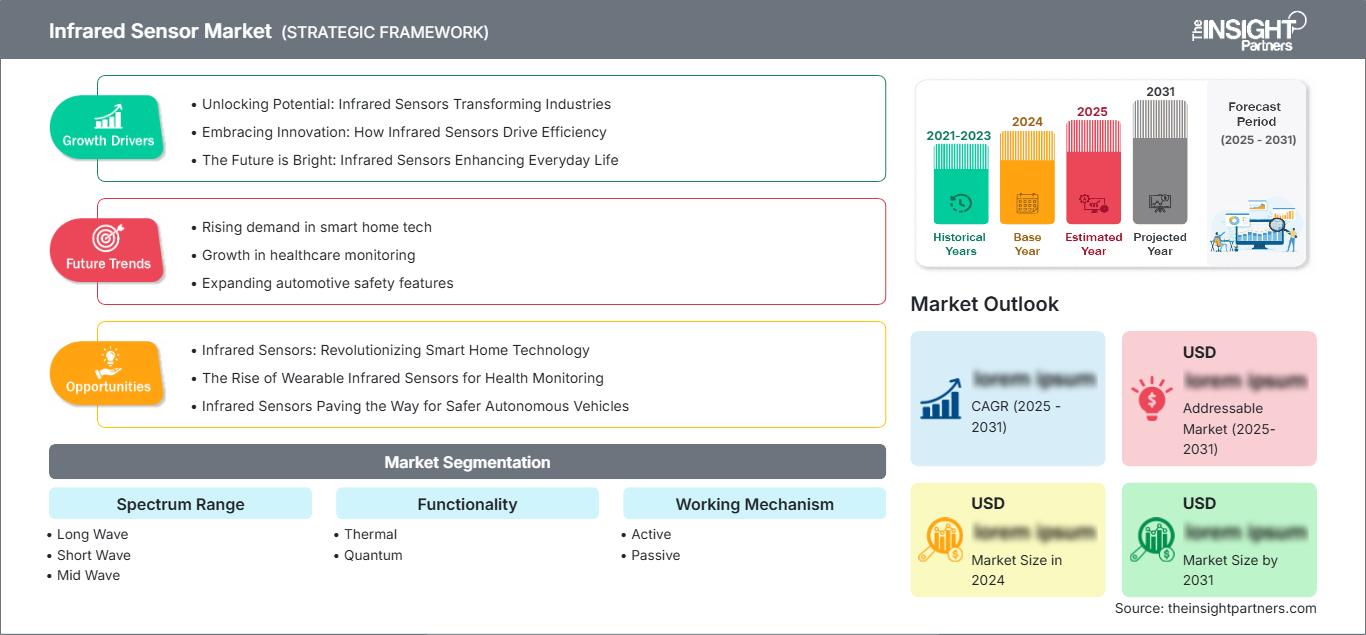
Infrared Sensor Market: Strategic Insights
Regional Insights
North America Infrared Sensor Market
North America Infrared Sensor Market Share is represented with 25 to 29% in 2025, with a regional growth rate of 10.5 to 12.0% CAGR up until 2034. The region will continue to be the primary market because of the aerospace industry, military procurement and modernization, industrial inspection, healthcare, and automotive safety development. Canada is involved through the energy, infrastructure, mining, and environmental monitoring sectors.
North America is supported by the existing semiconductor, photonics, and systems integration expertise of the region. The defense organizations have the requirement for infrared sensors to monitor surveillance, targeting, navigation, and unmanned systems, while the manufacturers need to use thermal detectors for the process control and predictive maintenance.
U.S. Infrared Sensor Market
The US has been predicted to hold an Infrared Sensor Market share of 72-76% of North America's 2025 market, with the expected CAGR of 10.7-12.2% through 2034. Robust government procurement, defense programs, advanced health systems, and industry automation contribute to demand growth. Organizations such as Teledyne FLIR, L3Harris Technologies, Inc., General Dynamics Corporation, and Raytheon Technologies Corporation contribute to the technology ecosystem of the country.
Trends in applications have been expanding their scope beyond defense to include automotive perception, healthcare screening, thermal inspections in industry, and building automation control systems. Research infrastructure in the country encourages development of cooled and uncooled detector devices, while procurement requirements encourage reliability, security, calibration robustness, and longevity of products.
Europe Infrared Sensor Market
The market for Europe is anticipated to have a share of 20%-24% by 2025 and will grow at a CAGR of 9.8%-11.2% till 2034, with Germany dominating regional demand. The UK will continue with its aerospace and defense sector activities, whereas Germany with its automotive and industrial sector helps in deploying infrared sensing technology.
France plays an important role in terms of aerospace and defense, energy, and industrial sectors. Italy and Spain help in adoption via manufacturing, transportation, security, and infrastructure modernization. Demand for Europe places emphasis on energy efficiency, machine safety, automation, and advanced mobility.
APAC Infrared Sensor Market
It is expected that APAC will account for 33–37% of the global consumption market share in 2025 and will grow with 12.0–13.5% CAGR up until 2034, led by China. The involvement of Japan and South Korea comes from electronics and automotive production sectors, and India will drive industrial as well as military uses.
The demand for our product from Australia will emanate from mining activities, infrastructure development, and environmental surveillance. The increase in semiconductor capabilities, electronics manufacturing, car manufacturing, smart city developments, and military enhancements have created a robust industrial base in the area.
Middle East & Africa Infrared Sensor Market
The Middle East and Africa are modeled at a growth rate of 8.5%-10.0% CAGR until 2034, with Saudi Arabia and the UAE leading the charge. The energy sector, the modernization of security systems, the development of industrial sites, and investments into smart cities enable the use of infrared devices, especially those that enable contactless monitoring.
South Africa is considered an important industrial and mining market, whereas the Rest of MEA benefits from infrastructure, utilities, oil & gas, and public safety initiatives. The market is still project-based compared to developed areas, but the rapid expansion of digital infrastructure and automated sites provide chances for durable sensors.
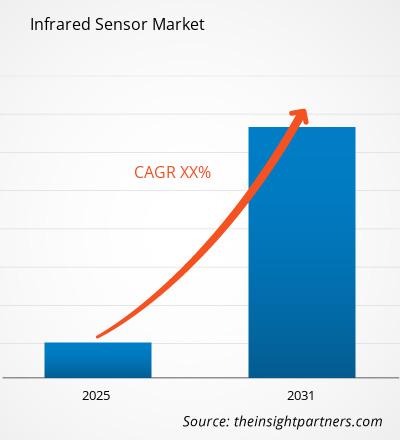
Segmentation Analysis
Spectrum Range
The spectrum range segment is expected to expand at 10.8–12.0% CAGR during 2026–2034. Long-wave technologies remain important for thermal detection, while short-wave and mid-wave solutions serve specialized imaging, industrial, scientific, and defense requirements. The Infrared Sensor Market scope is broadening as application developers select spectral bands according to material response, atmospheric transmission, sensitivity, and operating environment.
- Long Wave: Long-wave infrared sensors hold a strong market position in thermal detection because they support passive temperature measurement, surveillance, building diagnostics, industrial inspection, and human-presence applications.
- Short Wave: Short-wave infrared solutions are strategically important where reflected radiation, material discrimination, machine vision, semiconductor inspection, and low-light imaging require spectral information beyond visible wavelengths.
- Mid Wave: Mid-wave infrared sensors serve demanding defense, gas detection, scientific, and industrial applications where atmospheric transmission and sensitivity to specific thermal signatures are important.
Functionality
Functionality is forecast to grow at 11.0–12.2% CAGR during 2026–2034, supported by complementary demand for thermal and quantum detection. Thermal approaches favor cost-efficient deployment, while quantum technologies address high-sensitivity applications requiring precise spectral response and demanding performance conditions.
- Thermal: Thermal infrared sensors support high-volume presence detection, temperature monitoring, industrial inspection, security systems, and consumer equipment where cost and integration simplicity are important.
- Quantum: Quantum infrared sensors address specialized defense, scientific, spectroscopy, and high-performance imaging requirements where enhanced sensitivity and wavelength selectivity justify more complex architectures.
Working Mechanism
Working mechanism is expected to expand at 10.7–12.0% CAGR during 2026–2034. Passive sensing benefits from low-complexity thermal detection, while active architectures provide controlled illumination or ranging capabilities for increasingly intelligent sensing systems.
- Active: Active infrared sensing is strategically relevant for ranging, object detection, machine vision, and controlled environments where emitted radiation improves measurement consistency and spatial awareness.
- Passive: Passive sensors dominate applications that detect naturally emitted or reflected infrared radiation, supporting security, thermal monitoring, human detection, and energy-management systems without active illumination.
End-User Industry
End-user industries are projected to grow at 11.3–12.5% CAGR during 2026–2034. Healthcare, automotive, aerospace and defense, manufacturing, and commercial applications are widening the addressable market, while oil and gas adds specialized demand for thermal and gas-related monitoring.
- Healthcare: Healthcare adoption is supported by non-contact temperature monitoring, thermography, diagnostic research, patient observation, and wearable technologies requiring compact and low-power sensing.
- Aerospace and Defense: Defense applications demand infrared detection for surveillance, targeting, navigation, threat identification, thermal imaging, and unmanned platforms operating under challenging environmental conditions.
- Automotive: Automotive systems increasingly incorporate infrared sensing for occupant monitoring, night vision, thermal management, driver assistance, and emerging automated-driving functions.
- Commercial Applications: Commercial applications include security cameras, smart buildings, occupancy detection, lighting controls, appliances, and energy-management systems requiring reliable human or temperature detection.
- Manufacturing: Manufacturing uses infrared sensors for process monitoring, predictive maintenance, quality control, machine safety, material inspection, and automated production environments.
- Oil and Gas: Oil and gas operators use infrared technologies for thermal inspection, equipment monitoring, leak-related detection, facility surveillance, and asset management in demanding field environments.
Opportunity Snapshot
| Application Segment | Revenue Contribution | Trend Tag | Adoption Stage |
|---|---|---|---|
| Healthcare | Medium | Medical Thermography | Scaling |
| Aerospace and Defense | High | Thermal Targeting | Mature |
| Automotive | High | Night Vision | Scaling |
| Commercial Applications | Medium | Occupancy Detection | Scaling |
| Manufacturing | High | Process Inspection | Mature |
| Oil and Gas | Medium | Asset Monitoring | Scaling |
Infrared Sensor Market Growth Drivers and Impact Analysis
Expansion of Automotive Safety and Perception Systems
Automotive manufacturers are broadening the use of infrared sensing beyond conventional temperature measurement. Night vision, occupant monitoring, cabin safety, battery thermal management, and advanced driver-assistance functions create additional sensor positions within vehicles. The commercial impact is significant because automotive programs demand long qualification cycles, consistent component supply, and stringent reliability. Suppliers that achieve automotive-grade validation can secure recurring platform volumes while expanding relationships with Tier-1 system integrators. Infrared technologies also complement visible cameras and radar, allowing vehicle architectures to combine different sensing modalities. As automated-driving capabilities become more sophisticated, thermal information can improve detection of pedestrians, animals, and objects under low-visibility conditions. This driver therefore supports both higher unit content and deeper integration of infrared sensors into vehicle electronic architectures.
Defense Modernization and Persistent Thermal Surveillance
Defense modernization is increasing the strategic value of infrared sensing across airborne, ground, naval, and unmanned systems. Thermal signatures can support surveillance when visible-light performance is degraded by darkness, smoke, or environmental conditions. Procurement programs increasingly require sensors with improved resolution, low size, weight, and power characteristics, creating opportunities for advanced detector materials and compact electronics. The market impact extends across cooled and uncooled architectures because platforms differ substantially in range, sensitivity, and mission requirements. Defense contractors also seek supply continuity and secure technology chains, favoring established detector manufacturers with qualification experience. Infrared sensing is consequently becoming a component of broader electro-optical architectures rather than a standalone device. This encourages suppliers to invest in ruggedization, signal processing, calibration, and multispectral integration to meet increasingly demanding platform specifications.
Industrial Automation and Predictive Thermal Monitoring
Manufacturers are deploying infrared sensors to identify abnormal heat, monitor equipment conditions, and improve process visibility without physical contact. Thermal measurements can reveal bearing friction, electrical faults, overheating components, and process deviations before failures become disruptive. The impact is particularly relevant in automated facilities where downtime can affect tightly synchronized production lines. Sensor miniaturization allows infrared detection to move closer to machines, enabling distributed monitoring rather than periodic inspection. Integration with controllers, industrial networks, and analytics platforms further increases the value of sensor data. Suppliers can therefore expand from component sales into application-specific modules and monitoring solutions. Demand should remain diversified across manufacturing, utilities, logistics, and energy facilities because each sector can apply thermal information to improve maintenance scheduling, operational safety, and equipment utilization.
Infrared Sensor Market Future Trends
Embedded Intelligence and Multimodal Sensing
The next stage of Infrared Sensor Market trends will increasingly combine infrared detection with edge processors, artificial intelligence, visible imaging, radar, and other sensing modalities. Instead of delivering raw thermal signals, sensors will increasingly support localized classification, anomaly detection, and event recognition. This architecture can reduce communication loads and enable faster decisions in vehicles, industrial machines, security systems, and medical equipment. Multimodal sensing will also help compensate for the limitations of individual technologies, particularly where environmental conditions affect visible or infrared performance. Developers are likely to prioritize standardized digital interfaces, lower power consumption, compact packaging, and configurable processing. Over time, value should shift toward intelligent modules capable of producing application-specific information rather than basic detector outputs. This transition could reshape supplier differentiation and encourage partnerships between sensor manufacturers, software developers, and equipment OEMs.
Advanced Packaging and Spectral Miniaturization
Future product development will increasingly focus on wafer-level packaging, miniaturized optics, heterogeneous integration, and spectral selectivity. These technologies can reduce module dimensions while maintaining sensitivity, enabling infrared functions to enter smaller automotive, wearable, industrial, and consumer devices. Manufacturers are also likely to develop more application-specific detector architectures instead of relying on broadly configured components. Miniaturization may reduce material consumption, simplify assembly, and improve thermal management, although maintaining calibration and optical performance in smaller packages remains challenging. As manufacturing processes become more automated, suppliers with strong semiconductor and photonics integration capabilities could gain advantages in cost consistency and scalability. The resulting products are expected to combine sensing, filtering, signal conditioning, and digital communication in increasingly compact assemblies. Such architectures can accelerate adoption where conventional infrared modules are constrained by size, power, or integration complexity.
Infrared Sensor Market Opportunities
Healthcare and Wearable Thermal Monitoring
Healthcare provides a substantial opportunity for suppliers developing accurate, compact, and low-power infrared sensing modules. The technology can support non-contact temperature measurement, thermography, patient monitoring, wearable devices, and research-oriented diagnostic equipment. Investment should prioritize calibration stability, skin-temperature compensation, low power consumption, hygienic integration, and regulatory compatibility rather than detector sensitivity alone. Partnerships with medical-device manufacturers can provide access to validated applications while reducing commercialization risks associated with clinical requirements. Wearable healthcare platforms may create additional volume opportunities because compact infrared sensors can complement other physiological measurements. The strongest prospects are likely to emerge where infrared sensing delivers continuous or rapid measurements that are difficult to obtain through contact-based approaches. Suppliers that establish application-specific reference designs and qualification pathways can improve adoption among equipment manufacturers seeking reliable sensing architectures.
Localized Manufacturing and Secure Supply Chains
Another opportunity lies in developing regional production capabilities for infrared detector components, optics, packaging, and modules. Geopolitical uncertainty and growing demand for secure technology supply are encouraging governments and manufacturers to examine domestic or allied sourcing for strategically important sensing technologies. Investment can target wafer processing, detector fabrication, packaging, calibration, and testing rather than focusing exclusively on final assembly. Asia Pacific Infrared Sensor Market Forecast offers substantial scale through electronics manufacturing, while North America and Europe provide strong research, aerospace, defense, and industrial ecosystems. Suppliers with geographically diversified production can improve resilience while serving customers that require continuity across long product lifecycles. The opportunity is particularly relevant for defense and critical infrastructure, where procurement increasingly considers supply-chain security alongside technical specifications. Localized manufacturing can also shorten development cycles by improving collaboration between sensor developers and system integrators.
Recent Developments
- March 2026: Fujitsu announced the development of a world-leading, high-sensitivity and high-resolution infrared sensor to expand monitoring capabilities in the defense and disaster prevention fields. This sensor is a Type-II superlattice (T2SL) infrared sensor with over 1 million pixels, capable of detecting both mid-wavelength infrared (MWIR) and long-wavelength infrared (LWIR) light. Its high-sensitivity allows it to clearly capture minute thermal differences of 0.05°C or less, enabling high-precision monitoring day and night. This over 1-megapixel dual-band T2SL infrared sensor is the first of its kind in the world.
- May 2025: ROHM has expanded its portfolio of surface-mount near-infrared (NIR) LEDs with new compact top-view types. They are optimized for applications such as VR/AR devices, industrial optical sensors, and human detection sensors.
- October 2024: Mitsubishi Electric Corporation (TOKYO: 6503) announced the upcoming launch of a new MelDIR-brand 80×60-pixel thermal-diode infrared sensor (MIR8060C1) with a 100°×73° field of view, more than double that of the company's existing thermal-diode infrared sensors,* to accurately and efficiently identify people and objects. The expanded field of view will reduce the number of sensors required to effectively monitor large areas, contributing to the safety, security and convenience of solutions for monitoring elderly care facilities and building air-conditioning systems, counting people, and measuring body temperatures. The launch is scheduled for January 6, 2025.
Frequently Asked Questions

- Comprehensive Market Sizing and Forecast Analysis
- Detailed Segmentation Analysis
- In-Depth Market Dynamics Assessment
- Regional and Country-Level Insights
- Competitive Landscape and Company Benchmarking
- Strategic Business Intelligence
Recent Reports
Testimonials

The Insight Partners provided valuable market intelligence that supported our global go-to-market strategy. Their team was professional, responsive, and attentive to our feedback, providing thoughtful analysis and helpful methodological clarifications throughout the project.
Junmo Kim Chief Financial Officer (CFO), Enertech Co., Ltd.
The Insight Partners' SCADA System Market report is comprehensive, with valuable insights on current trends and future forecasts. The team was highly professional, responsive, and supportive throughout. We are very satisfied and highly recommend their services.
RAN KEDEM Partner, Reali Technologies LTDs
I requested a report on a very specific software market and the team produced the report in a few days. The information was very relevant and well presented. I then requested some changes and additions to the report. The team was again very responsive and I got the final report in less than a week.
JEAN-HERVE JENN Chairman, Future Analytica
We worked with The Insight Partners for an important market study and forecast. They gave us clear insights into opportunities and risks, which helped shape our plans. Their research was easy to use and based on solid data. It helped us make smart, confident decisions. We highly recommend them.
PIYUSH NAGPAL Sr. Vice President, High Beam Global
The Insight Partners delivered insightful, well-structured market research with strong domain expertise. Their team was professional and responsive throughout. The user-friendly website made accessing industry reports seamless. We highly recommend them for reliable, high-quality research services
YUKIHIKO ADACHI CEO, Deep Blue, LLC.
This is the first time I have purchased a market report from The Insight Partners.While I was unsure at first, I visited their web site and felt more comfortable to take the risk and purchase a market report.I am completely satisfied with the quality of the report and customer service. I had several questions and comments with the initial report, but after a couple of dialogs over email with their analyst I believe I have a report that I can use as input to our strategic planning process.Thank you so much for taking the extra time and making this a positive experience.I will definitely recommend your service to others and you will be my first call when we need further market data.
JOHN SUZUKI President and Chief Executive Officer, Board Director, BK Technologies
I wish to appreciate your support and the professionalism you displayed in the course of attending to my request for information regarding to infectious disease IVD market in Nigeria. I appreciate your patience, your guidance, and the fact that you were willing to offer a discount, which eventually made it possible for us to close a deal. I look forward to engaging The Insight Partners in the future, all thanks to the impression you have created in me as a result of this first encounter.
DR CHIJIOKE ONYIA MANAGING DIRECTOR, PineCrest Healthcare Ltd.Reason to Buy
- Informed Decision-Making
- Understanding Market Dynamics
- Competitive Analysis
- Identifying Emerging Markets
- Customer Insights
- Market Forecasts
- Risk Mitigation
- Boosting Operational Efficiency
- Strategic Planning
- Investment Justification
- Tracking Industry Innovations
- Aligning with Regulatory Trends





 Get Free Sample for