
Interactive Kiosk Market Demand, Size & Forecast by 2034
Coverage: by Component (Hardware, Software and Services); Type (Bank Kiosks, Self-Service Kiosks, Vending Kiosks); Vertical (Retail, Healthcare, Banking and Financial Services, Government, Transportation, Hospitality, Entertainment, Others) , and Geography (North America, Europe, Asia Pacific, and South and Central America)
- Status : Data Released
- Report Code : TIPRE00004623
- Category : Electronics and Semiconductor
- No. of Pages : 150
- Available Report Formats :


- Last update date : September 21, 2026


2025 Market Size
US$ 34.83 Bn
Base year value
2034 Forecast
US$ 55.12 Bn
Projected by 2034
CAGR 2026-2034
5.23 %
Growth rate
Addressable Market
US$ 407.99 Bn
(2026-2034)
The global Interactive Kiosk market was valued at US$ 34.83 billion in 2025 and is expected to reach US$ 55.12 billion by 2034; it is estimated to record a CAGR of 5.23% during 2026-2034.
Interactive Kiosk Market Assessment and Insights
- North America: North America remains the leading regional market, supported by mature self-service deployments and established technology ecosystems. Share in 2025 is estimated at 40–43%, with CAGR between 2026–2034 of 5.0–5.4%.
- US: The US anchors regional demand through retail automation, banking modernization, healthcare intake, and transportation applications. Share in 2025 is estimated at 85–90% of North America, with CAGR between 2026–2034 of 5.1–5.5%.
- Europe: Europe maintains a substantial installed base, with Germany, the UK, France, Italy, and Spain supporting demand through retail digitization, transportation automation, and public-service modernization. Share in 2025 is estimated at 26–29%, with CAGR between 2026–2034 of 4.8–5.2%.
- Asia Pacific: Asia Pacific combines expanding urban infrastructure with strong digital-payment adoption across China, Japan, South Korea, India, and Australia. Share in 2025 is estimated at 22–25%, with CAGR between 2026–2034 of 6.2–6.7%.
- Largest Segment: Self-Service Kiosks hold a leading position, with a 2025 market share estimated at 48–52% and CAGR between 2026–2034 of 6.0–6.4%, reflecting broad multi-industry deployment.
- High Growth Segment: Healthcare represents the high-growth vertical, with a 2025 market share estimated at 10–14% and CAGR between 2026–2034 of 7.0–7.5%, supported by digital patient workflows.
- Key companies analyzed in detail: Advantech Co., Ltd.; Diebold Nixdorf, Incorporated; Embross USA Inc.; IER SAS; KAL ATM Software GmbH; KIOSK Information Systems; Meridian Kiosks; NCR Voyix Corporation; REDYREF; Slabb Kiosks.
Source: The Insight Partners' analysis based on proprietary research, government publications, company annual reports, investor presentations, industry databases, and expert interviews.
Interactive Kiosks have changed from single-use kiosks to interconnected devices with touch interfaces, payments devices, scanning, cameras, printing capability, and device management features. Hardware development has become focused on modularity, durability, accessibility, and maintainability, while software design has become more focused on centralized administration, cloud connectivity, analytics, and applications. Local manufacturing is also becoming important for large-scale installations.
In the future, the Interactive Kiosk Market will be able to take advantage of the coming deployments in the Asia Pacific region, some of the Middle Eastern countries, and digital transformation of public service areas. Increasing regulatory interest in such topics as accessibility, privacy, secure payments, and cybersecurity makes system compliance an important factor, thus making investments in lifecycle solutions which include devices, applications, connectivity, monitoring, maintenance, and analytics, not just hardware purchase.
Interactive Kiosk Market Report Scope
| Report Attribute | Details |
|---|---|
| Market size in 2025 | US$ 34.83 Billion |
| Market Size by 2034 | US$ 55.12 Billion |
| Global CAGR (2026 - 2034) | 5.23% |
| Historical Data | 2021-2024 |
| Forecast period | 2026-2034 |
Interactive Kiosk Market Analysis
Interactive Kiosk Market growth will be spurred on by the need for businesses to conduct more transactions without necessarily increasing their front line staffs. Retail outlets have self-checkout stations and assisted-selling software; banks have automated service delivery through kiosks, hospitals utilize them for registering patients and payments, while airports use them for check-in and passenger processing. The supply chain is comprised of display providers, computer providers, enclosure providers, peripheral providers, software providers, systems integration providers, payment service providers, connectivity providers, and managed services providers.
The supply of interactive kiosks depends on component availability, configuration needs, installation environment, and service level requirements. While standardized platforms will help cut down deployment time, specialized platforms may need further development to address payment, identification, print, accessibility, environmental, or biometrics functionalities. In this light, vendors who integrate design, manufacture, software, and support can therefore offer products that compete not only on hardware but also on deployment capability.
Analysis of the Interactive Kiosk Market reveals a competitive landscape that includes diversified technology vendors along with specialized kiosk vendors. Advantech Co., Ltd. concentrates on industrial computing and kiosk platforms; Diebold Nixdorf, Incorporated and NCR Voyix Corporation bridge self-service devices with retail and banking ecosystems; Embross USA Inc. and IER SAS operate in passenger processing market more intensely than others, while KAL ATM Software GmbH specializes in software compatibility and ATM network management.
Meridian Kiosks, KIOSK Information Systems, REDYREF, and Slabb Kiosks compete in terms of customizability, manufacturing capabilities, and specific applications. Investment trends are clearly shifting from enclosure engineering to software, remote monitoring, cyber security, payment capability, artificial intelligence, and lifecycle services. The strategic positioning therefore is determined by integration capabilities rather than enclosure design capabilities, including heterogeneous peripheral integration, multi-operating environment capability, and fleet management. Strategic partnerships are getting essential, since deployment requires involvement of payment processors, enterprise software vendors, airports, retailers, healthcare facilities, or government platforms.
● REPORT CUSTOMIZATION
Tailor This Report To Align With Your Specific Business Requirements
This report can be customized to align precisely with your business objectives, scope, and target markets. Customization options include tailored segmentation, geography, competitive analysis, and strategic insights to support informed decision-making.
Customize This Report →WHAT YOU CAN ADJUST
- ● Segmentations
- ● Geography
- ● Competitive Analysis
- ● Language Preferences
Interactive Kiosk Market: Strategic Insights
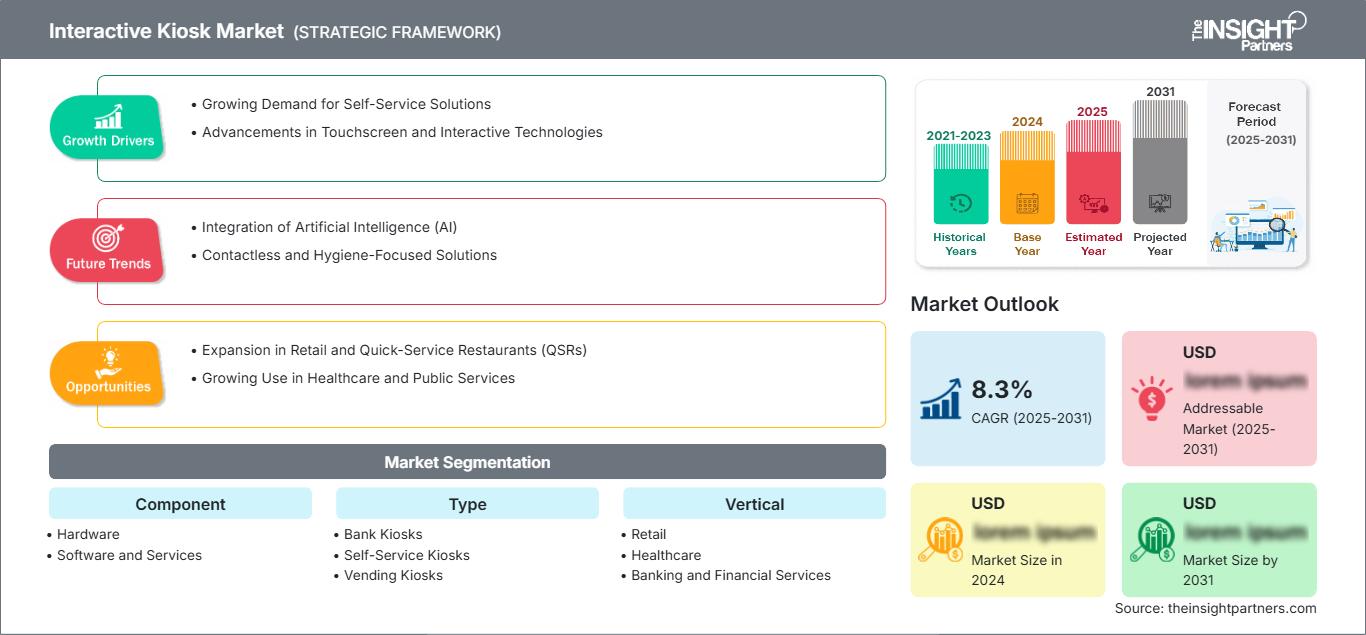
Regional Insights
North America Interactive Kiosk Market
North America accounts for an estimated 40–43% of the Interactive Kiosk Market share in 2025 and is expected to expand at a CAGR of 5.0–5.4% through 2034. These factors are complemented by mature retail automation, well-developed banking self-service technologies, developed payment systems, and wide enterprise adoption of connected devices. Kiosks have been installed by hospitals to facilitate patient registration and other administrative procedures.
The Interactive Kiosk Market forecast shows that regional sales are now more driven by replacement and software upgrades than by new installations only. The issues of accessibility, security measures, remote management, and interoperability are taking the forefront among purchase criteria. North American market share will be led by the United States, while Canada will contribute through transportation, governmental, retail, and healthcare applications. Further development of omnichannel commerce and service automation should ensure North America's market leadership over the forecast period.
U.S. Interactive Kiosk Market
The U.S. Interactive Kiosk Market represents an estimated 85–90% of North America in 2025 and is projected to grow at a CAGR of 5.1–5.5% through 2034. Retail stores, banks, hospitals, airports, restaurants, and government agencies offer wide applications of the product line. The use of payment acceptance, identity confirmation, customer guidance, and transaction processing features is becoming increasingly common.
The use of such solutions is especially prevalent in self-checkouts, upgrading of ATMs, healthcare intake process, passenger check-in process, and custom enterprise kiosks. The application trends seem to be leaning towards centrally controlled fleets of devices that can be updated remotely for diagnostics and content management. Accessibility and security needs are also shaping the demand, favoring companies that can implement such features in their products.
Europe Interactive Kiosk Market
Europe represents an estimated 26–29% of the Interactive Kiosk Market share in 2025, with a projected CAGR of 4.8–5.2% through 2034. The leader in the region is Germany, followed by the UK, France, Italy, and Spain. The adoption of the technology can be driven by retail automation, transport modernization, public service digitalization, and the need for multilingual and accessible user interface.
In the UK, the emphasis is increasingly placed on self-service that decreases queue time and allows to maintain assisted service option as well. Germany has high potential in terms of industrial retail infrastructure, banking modernization, and transportation applications, where reliability and data management remain key purchasing criteria.
France, Italy, and Spain offer diversified demand in terms of tourism, transportation, retail, hospitality, and public services sectors. Airport automation plays a major role, whereas Spanish retail and mobility initiatives show increasing interest in autonomous payment. Germany remains the leader in Europe due to wide industrial infrastructure and enterprise IT infrastructure.
APAC Interactive Kiosk Market
APAC Interactive Kiosk Market share is estimated at 22–25% in 2025, with CAGR of 6.2–6.7% through 2034. China leads regional adoption, followed by Japan, South Korea, India, and Australia. Urban retail, transport hubs, financial services, and government digitization are important demand centers.
Industrial automation and digital public infrastructure strengthen the deployment case across the region. India benefits from expanding digital-service ecosystems, while China, Japan, and South Korea combine advanced electronics capabilities with sophisticated consumer interfaces. Australia contributes through retail, healthcare, transport, and government applications.
Middle East & Africa Interactive Kiosk Market
The Middle East & Africa Interactive Kiosk Market is expected to grow at a CAGR of 5.8–6.3% through 2034. Saudi Arabia and the UAE lead regional investment, supported by smart-city programs, tourism infrastructure, airports, retail modernization, and government digitization. South Africa remains an important African deployment market.
Energy-sector diversification and infrastructure investment are creating additional locations for automated information, payment, ticketing, and service delivery. The UAE leads the region through concentrated investment in digitally enabled transport, hospitality, tourism, and public services. Saudi Arabia provides substantial long-term opportunity through large-scale infrastructure programs, while the rest of MEA remains more selective and project-driven.
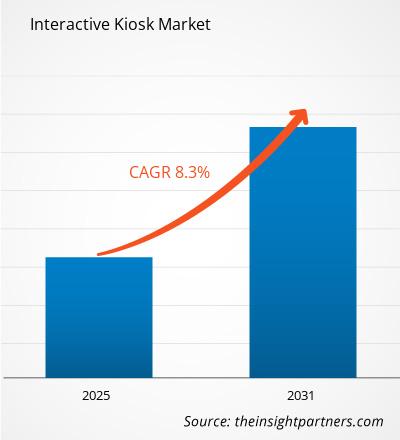
Segmentation Analysis
Component
Component segmentation comprises Hardware, Software and Services. The segment is projected to register a CAGR of 5.4–5.8% during 2026–2034. Hardware remains fundamental because deployments require displays, processors, enclosures, payment devices, scanners, printers, and other peripherals. Software and services increasingly influence purchasing decisions through fleet management, application updates, analytics, cybersecurity, integration, maintenance, and lifecycle optimization.
- Hardware: Hardware remains the physical foundation of deployments, with demand centered on durable displays, computing units, payment peripherals, scanners, printers, enclosures, and accessibility features. Modular designs improve replacement flexibility.
- Software and Services: Software and services increasingly determine operational performance by enabling remote monitoring, content management, analytics, security updates, application integration, technical support, and recurring lifecycle management.
Type
Type segmentation comprises Bank Kiosks, Self-Service Kiosks, Vending Kiosks. The segment is projected to grow at a CAGR of 5.8–6.2% during 2026–2034. Self-service applications have the broadest cross-industry relevance, while bank kiosks remain important for financial access and transaction automation. Vending kiosks benefit from unattended retail models and expanding digital payment acceptance.
- Bank Kiosks: Bank kiosks address cash access, account services, payments, and branch automation, with demand shaped by ATM modernization, multivendor software requirements, cybersecurity, and continued availability of assisted and self-service banking.
- Self-Service Kiosks: Self-service kiosks occupy the broadest application base, spanning retail, healthcare, transportation, hospitality, government, and entertainment. Their strategic value comes from reducing queues while standardizing customer-facing workflows.
- Vending Kiosks: Vending kiosks extend unattended commerce through digital ordering, payment, product selection, and automated fulfillment. Their importance increases where operators seek compact footprints and service availability beyond conventional staffed hours.
Vertical
Vertical segmentation comprises Retail, Healthcare, Banking and Financial Services, Government, Transportation, Hospitality, Entertainment, Others. The segment is forecast to advance at a CAGR of 5.7–6.1% during 2026–2034. Retail provides broad deployment volumes, while healthcare has stronger expansion potential as providers digitize patient intake and administrative processes.
- Retail: Retail adoption centers on self-checkout, product discovery, ordering, returns, payment, and omnichannel fulfillment. Integration with inventory and commerce platforms strengthens the business case for connected in-store service points.
- Healthcare: Healthcare applications include patient registration, appointment management, payments, wayfinding, and information access. Demand is supported by digital health strategies emphasizing efficient, interoperable, patient-centered service delivery.
- Banking and Financial Services: Banking deployments support automated transactions, account services, customer guidance, and branch transformation. Interoperable software and secure peripheral management remain strategically important for large distributed networks.
- Government: Government kiosks support citizen information, document services, payments, visitor processing, and public access. Digital government programs create opportunities where physical access points complement online public-service channels.
- Transportation: Transportation applications include ticketing, check-in, passenger information, parking, and access control. Standardized interfaces and integration with operational systems are critical for high-volume environments.
- Hospitality: Hospitality deployments address check-in, concierge services, wayfinding, ordering, payments, and guest engagement. Integration with property-management and booking systems expands functionality across hotels and venues.
- Entertainment: Entertainment venues use kiosks for ticketing, admissions, ordering, membership services, and interactive engagement. High visitor throughput makes speed, intuitive interfaces, and reliable payment processing important.
- Others: Applications outside the principal verticals provide niche demand where organizations require unattended information, payment, access, ordering, or administrative services in controlled environments.
Opportunity Snapshot
| Industry Vertical | Revenue Contribution (High/Medium/Low) | Trend Tag | Adoption Stage |
| Retail | High | Self Checkout | Mature |
| Healthcare | Medium | Patient Intake | Scaling |
| Banking and Financial Services | High | ATM Modernization | Mature |
| Government | Medium | Citizen Services | Scaling |
| Transportation | High | Passenger Processing | Scaling |
| Hospitality | Medium | Digital Concierge | Scaling |
| Entertainment | Low | Ticket Automation | Scaling |
| Others | Low | Service Automation | Emerging |
Interactive Kiosk Market Growth Drivers and Impact Analysis
Expansion of automated customer-service workflows
Businesses have started to design customer experiences based on fast transactions, less queuing, and regular availability of services. Interactive terminals can take care of repetitive actions such as checkouts, registrations, ticketing, payments, data fetching, and ordering, leaving employees more time to deal with exceptions and other high value-added tasks. The same logic justifies the use of interactive terminals in all business spheres: retail, healthcare, banking, hotels, and transportation. The effect of the market goes far beyond sales of devices since companies today need software integration, remote management, maintenance, analysis, and security services. Moreover, the existence of standardized interfaces lets businesses replicate their successful procedures across several locations.
Greater integration of digital payments and connected peripherals
Modern payment methods have also been enabling the functional benefits of kiosks to be expanded from merely providing information to doing more complex things. Devices such as contactless cards, QR-based payment methods, mobile wallets, scanners, printers, cameras, identification devices, among others, have enabled one device to perform multiple tasks at different stages of customer experience. This is especially useful for industries such as retail, transport, finance, hospitality, and unattended commerce. Systems that result from such integrations are highly dependent on good connectivity and secure transaction processing, hence the need for software that can handle different hardware components effectively. There has been increasing focus on remote diagnosis and configuration as a result of high maintenance costs associated with distributed systems.
Digital transformation of physical service environments
Digital transformation initiatives are becoming less limited to websites and mobile apps, expanding into actual places where customers need access in a physical way. Kiosks offer a way to bridge between the digital world and the physical one by providing the same services via controlled and interactive interfaces. Government departments, healthcare organizations, airports, stores, and financial institutions can employ the endpoints to connect users to their backend systems while maintaining the physical entry points. The effect is especially felt where high volumes of service requests are expected or where operations take place across large geographical locations. Connecting to identity, payment, scheduling, inventory, and customer management platforms will help maintain data consistency. This makes it more likely for procurement managers to consider kiosks as part of the larger digital infrastructure.
Interactive Kiosk Market Future Trends
AI-enabled conversational and adaptive interfaces
In terms of future Interactive Kiosk Market trends, conversational interfaces, contextual suggestions, computer vision, and user experience personalization are set to become prevalent. The systems powered by AI will be able to understand natural language queries, help users navigate complicated processes, suggest services based on context, and detect when a person needs human assistance. In hospitality and transport sectors, conversational capabilities could enable wayfinding and service selection. In the healthcare sphere, guided interactions will make it easier for patients to fill out forms and provide data. Retailers could employ recommendation engines together with inventory management solutions. Modern architectures will see a growing separation between the kiosk interface and the intelligence layer.
Energy-efficient and remotely managed kiosk fleets
Future deployments are likely to prioritize lower power consumption, modular components, remote diagnostics, and predictive maintenance. Operators managing geographically distributed fleets have strong incentives to reduce technician visits, improve uptime, and extend equipment life. Energy-efficient processors and displays can support lower operating costs, particularly for continuously available installations. Remote monitoring platforms can detect component failures, connectivity interruptions, software errors, and unusual usage patterns before they become service disruptions. Modular designs should further enable targeted replacement rather than complete unit renewal. These capabilities will encourage procurement teams to assess total cost of ownership over the full operating lifecycle. Vendors that combine durable hardware with centralized management and upgradeable software can therefore differentiate through operational efficiency rather than initial purchase price alone.
Interactive Kiosk Market Opportunities
Integrated healthcare and public-service access points
Healthcare and government organizations represent attractive investment areas because physical service delivery remains necessary even as digital channels expand. Buyers can deploy integrated kiosks for registration, identity verification, payments, appointment workflows, document services, visitor management, and wayfinding. The strongest opportunities lie in solutions that connect securely with existing enterprise systems while supporting accessibility and multilingual interfaces. Investors and technology providers should prioritize modular platforms capable of adapting to different workflows rather than highly specialized single-purpose devices. Partnerships with systems integrators and application providers can improve access to large institutional contracts. WHO's continued emphasis on interoperable digital health ecosystems further supports the long-term relevance of connected patient-facing infrastructure, particularly where physical access complements digital healthcare services.
Scalable passenger and hospitality automation platforms
Airports, hotels, resorts, convention centers, and other high-traffic environments offer opportunities for integrated self-service platforms combining identification, payment, wayfinding, check-in, ticketing, and ancillary-service purchases. IATA's common-use self-service framework demonstrates the importance of interoperability when multiple operators share passenger-processing infrastructure. Investment strategies should therefore favor platforms designed around standardized interfaces, remote administration, and upgradeable peripherals. Hospitality operators can similarly extend kiosk functionality from check-in toward digital concierge, ordering, guest communication, and service discovery. The commercial opportunity is strongest where one platform can support multiple workflows and sites, allowing operators to spread software and management capabilities across a wider installed base. Such architectures can also reduce future replacement requirements by permitting incremental hardware and software upgrades.
Recent Developments
- August 2026: Nayax agreed to acquire smart parking technology provider IPS Group from Windjammer Capital for $350 million in cash. The acquisition will expand Nayax’s presence in parking payments and smart parking infrastructure.
- August 2025: Zebra Technologies announced a $1.3 billion cash agreement to acquire Elo Touch Solutions. The deal combines Zebra’s frontline mobility and automation capabilities with Elo’s kiosks, touchscreens, payment and self-service technologies to expand connected frontline solutions.
- August 2026: HotelKey is expanding its self-check-in kiosk deployments, with NSR Hotel Group selecting it as the exclusive kiosk provider for more than 20 G6 properties in the U.S. The system automates identity verification, payments, room assignment and keycard dispensing, while HotelKey plans to add agentic AI for more complex guest requests.
Frequently Asked Questions

- Comprehensive Market Sizing and Forecast Analysis
- Detailed Segmentation Analysis
- In-Depth Market Dynamics Assessment
- Regional and Country-Level Insights
- Competitive Landscape and Company Benchmarking
- Strategic Business Intelligence
Recent Reports
Testimonials

The Insight Partners' SCADA System Market report is comprehensive, with valuable insights on current trends and future forecasts. The team was highly professional, responsive, and supportive throughout. We are very satisfied and highly recommend their services.
RAN KEDEM Partner, Reali Technologies LTDs
I requested a report on a very specific software market and the team produced the report in a few days. The information was very relevant and well presented. I then requested some changes and additions to the report. The team was again very responsive and I got the final report in less than a week.
JEAN-HERVE JENN Chairman, Future Analytica
We worked with The Insight Partners for an important market study and forecast. They gave us clear insights into opportunities and risks, which helped shape our plans. Their research was easy to use and based on solid data. It helped us make smart, confident decisions. We highly recommend them.
PIYUSH NAGPAL Sr. Vice President, High Beam Global
The Insight Partners delivered insightful, well-structured market research with strong domain expertise. Their team was professional and responsive throughout. The user-friendly website made accessing industry reports seamless. We highly recommend them for reliable, high-quality research services
YUKIHIKO ADACHI CEO, Deep Blue, LLC.
This is the first time I have purchased a market report from The Insight Partners.While I was unsure at first, I visited their web site and felt more comfortable to take the risk and purchase a market report.I am completely satisfied with the quality of the report and customer service. I had several questions and comments with the initial report, but after a couple of dialogs over email with their analyst I believe I have a report that I can use as input to our strategic planning process.Thank you so much for taking the extra time and making this a positive experience.I will definitely recommend your service to others and you will be my first call when we need further market data.
JOHN SUZUKI President and Chief Executive Officer, Board Director, BK Technologies
I wish to appreciate your support and the professionalism you displayed in the course of attending to my request for information regarding to infectious disease IVD market in Nigeria. I appreciate your patience, your guidance, and the fact that you were willing to offer a discount, which eventually made it possible for us to close a deal. I look forward to engaging The Insight Partners in the future, all thanks to the impression you have created in me as a result of this first encounter.
DR CHIJIOKE ONYIA MANAGING DIRECTOR, PineCrest Healthcare Ltd.Reason to Buy
- Informed Decision-Making
- Understanding Market Dynamics
- Competitive Analysis
- Identifying Emerging Markets
- Customer Insights
- Market Forecasts
- Risk Mitigation
- Boosting Operational Efficiency
- Strategic Planning
- Investment Justification
- Tracking Industry Innovations
- Aligning with Regulatory Trends





 Get Free Sample for