
Ion Exchange Resins Market Demand, Trends & Forecast by 2034
Coverage: by Type (Cationic Resins, Anionic Resins, Others); Application (Water, Non-water); End Use Industry (Power, Chemical and Petrochemical, Food and Beverage, Pharmaceutical, Electrical and Electronics, Metal and Mining, Others) , and Geography (North America, Europe, Asia Pacific, and South and Central America)
- Status : Data Released
- Report Code : TIPRE00009762
- Category : Chemicals and Materials
- No. of Pages : 150
- Available Report Formats :


- Last update date : August 17, 2026


2025 Market Size
US$ 2.16 Bn
Base year value
2034 Forecast
US$ 3.45 Bn
Projected by 2034
CAGR 2026-2034
5.34 %
Growth rate
Addressable Market
US$ 25.44 Bn
(2026-2034)
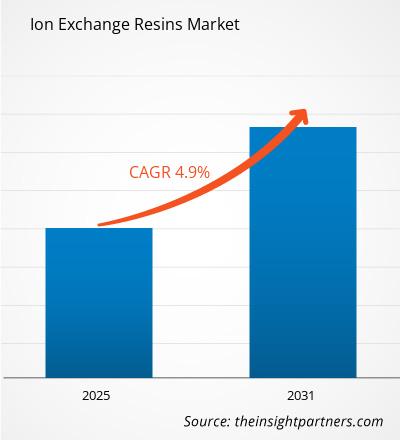
The ion exchange resins market was valued at US$ 2.16 Billion in 2025 and is expected to reach US$ 3.45 Billion by 2034, registering a CAGR of 5.34% from 2026 to 2034. The market is expanding due to increasing adoption of advanced water purification technologies, rising demand from power generation facilities, and growing utilization of high-purity materials in pharmaceutical and semiconductor manufacturing applications.
North America is expected to witness steady expansion supported by investments in municipal and industrial water treatment infrastructure, stricter quality standards for process water, and increased demand for ultrapure water systems in electronics manufacturing. The region is projected to register a CAGR range of 4.8–5.8% during 2026–2034, driven by replacement demand and technology upgrades across established industrial facilities, contributing to the growth of the Ion Exchange Resins Market Size over the forecast period.
Ion Exchange Resins Market Assessment and Insights
- North America The region is estimated to account for a 24–28% share in 2025 and is projected to grow at a CAGR of 4.8–5.8% during 2026–2034. Demand is supported by water reuse initiatives, pharmaceutical manufacturing, and semiconductor production expansion.
- U.S. The country represents approximately 18–22% share in 2025 and is expected to grow at a CAGR of 4.9–5.9% during 2026–2034 due to industrial water purification investments and advanced manufacturing requirements.
- Europe Europe holds an estimated 22–26% share in 2025 and is anticipated to register a CAGR of 4.5–5.5% during 2026–2034, with Germany, the UK, France, Italy, and Spain contributing through chemical processing and environmental compliance initiatives.
- Asia Pacific The region is expected to capture a 32–36% share in 2025 and expand at a CAGR of 5.8–6.8% during 2026–2034. China, Japan, South Korea, and India drive demand through electronics, power generation, and industrial water treatment applications.
- Largest Segment Water Treatment is estimated to represent a 38–42% market share in 2025 and grow at a CAGR of 5.2–6.2% during 2026–2034, supported by municipal and industrial purification requirements.
- High Growth Segment Electronics and Semiconductors is projected to account for a 10–14% market share in 2025 and expand at a CAGR of 6.5–7.5% during 2026–2034 due to increasing ultrapure water demand.
- Key companies analyzed in detail: DuPont de Nemours, Inc., Purolite Corporation, LANXESS AG, Mitsubishi Chemical Group Corporation, Thermax Limited, Ion Exchange (India) Limited, Bio-Rad Laboratories, Inc., Novasep Holding S.A.S., Sunresin New Materials Co., Ltd., Suqing Group Co., Ltd., Evoqua Water Technologies LLC, ResinTech Inc.
Source: The Insight Partners' analysis based on proprietary research, government publications, company annual reports, investor presentations, industry databases, and expert interviews.
The market has evolved through improvements in polymer chemistry, functional group engineering, and application-specific resin development. Manufacturers are increasingly focusing on high-capacity resins, improved regeneration efficiency, and specialized grades for demanding industrial processes. The shift toward advanced purification systems has encouraged producers to optimize cross-linked structures and enhance chemical stability for applications requiring consistent performance under variable operating conditions, supporting the expansion of Ion Exchange Resins Market Share across key end-use industries.
Future development of the sector will be shaped by the investments in developing economies, the development of industrial wastewater purification plants, and the rising demand for high-purity process water. The importance of resource conservation and wastewater reuse in regulation is anticipated to foster implementation within the chemicals, pharmaceuticals, and energy sectors. Innovations in the field of tailored resins will offer business prospects for manufacturers.
Ion Exchange Resins Market Report Scope
| Report Attribute | Details |
|---|---|
| Market size in 2025 | US$ 2.16 Billion |
| Market Size by 2034 | US$ 3.45 Billion |
| Global CAGR (2026 - 2034) | 5.34% |
| Historical Data | 2021-2024 |
| Forecast period | 2026-2034 |
Ion Exchange Resins Market Analysis
The ion exchange resins market growth is closely linked to rising demand for water purification solutions across municipal, industrial, and commercial applications. Issues surrounding water shortage, stringent discharge requirements, and industrial water recycling efforts are making companies adopt improved technology solutions. The value chain encompasses raw material suppliers, resin producers, system integrators, and end-users in various sectors like chemicals, pharmaceuticals, power plants, and electronics.
The ecosystem involves the production of specialty polymers, functionalization technologies, and engineering skills in particular applications. The supply chain is affected by access to raw materials such as styrene and acrylic resins, increased capacity and regional demands. The Asia Pacific region has emerged as an important production and consumption region owing to industrialization and growth in manufacturing sectors that require purified water systems.
The market analysis indicates a competitive environment characterized by technological differentiation, geographic expansion, and strategic portfolio development. Leading companies are strengthening their positions through product innovation, customized resin solutions, and partnerships with water treatment solution providers. DuPont de Nemours, Inc. maintains a strong presence through advanced separation technologies, while Purolite Corporation focuses on specialized resin applications across pharmaceutical and industrial sectors, as highlighted in the Ion Exchange Resins Market Report.
Product development and regional market expansion are becoming important ways through which LANXESS AG, Mitsubishi Chemical Group Corporation, and Thermax Limited are growing their capabilities. Some of the investments that companies have made include capacity building and sustainable manufacturing techniques. Some of the solutions that have been developed are specifically geared towards meeting the needs of new applications such as semiconductor production.
● REPORT CUSTOMIZATION
Tailor This Report To Align With Your Specific Business Requirements
This report can be customized to align precisely with your business objectives, scope, and target markets. Customization options include tailored segmentation, geography, competitive analysis, and strategic insights to support informed decision-making.
Customize This Report →WHAT YOU CAN ADJUST
- ● Segmentations
- ● Geography
- ● Competitive Analysis
- ● Language Preferences
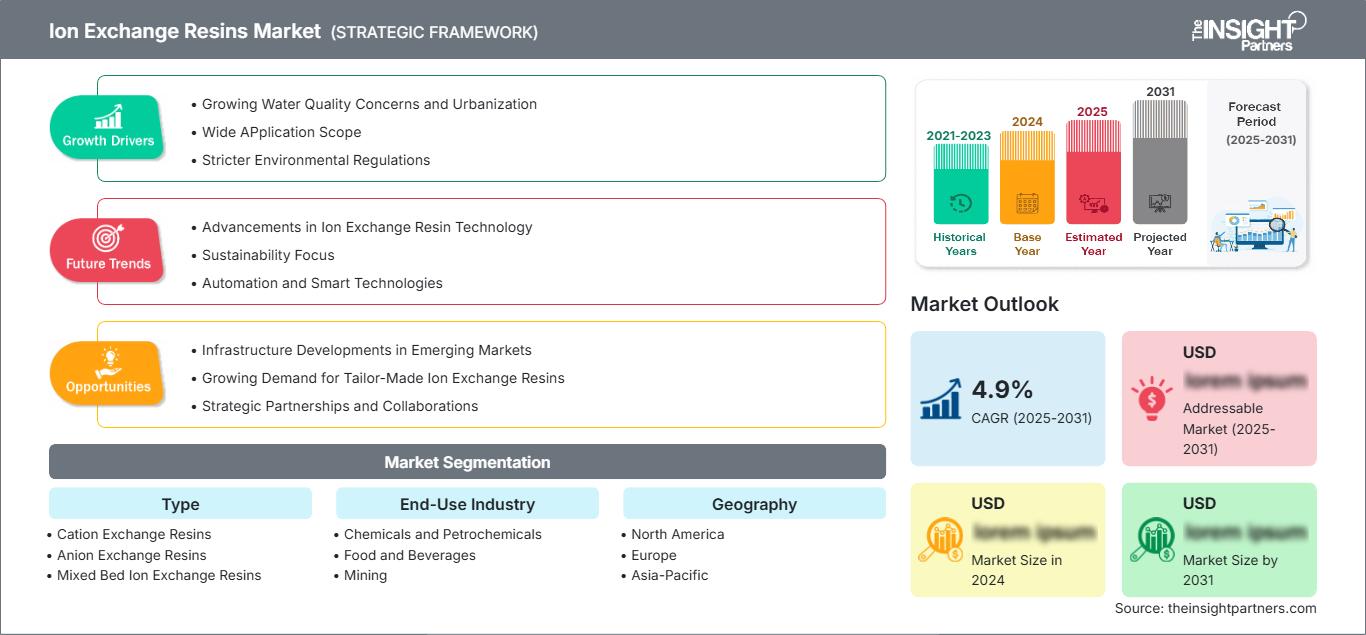
Ion Exchange Resins Market: Strategic Insights
Regional Insights
North America Ion Exchange Resins Market
The North America market is estimated to account for a 24–28% share in 2025 and is expected to register a CAGR of 4.8–5.8% during 2026–2034. The regional demand is supported by mature water treatment infrastructure, industrial wastewater management, and increasing replacement of aging purification systems. The U.S. remains the primary contributor due to extensive industrial activity and advanced manufacturing applications, supporting a positive Ion Exchange Resins Market Forecast over the assessment period.
The area will benefit from demand for pure water in the pharmaceutical, chemical, power generation, and semiconductor sectors. Investment in sustainable water management and recovery of resources is driving the adoption of innovative resin technology. The country is also contributing to this market via mining and industrial processes, while Mexico is seeing rising demand from its manufacturing units. The companies active in the area are concentrating on developing application-based solutions to enhance efficiency.
U.S. Ion Exchange Resins Market
The U.S. market represents approximately 18–22% of the North America share in 2025 and is projected to grow at a CAGR of 4.9–5.9% during 2026–2034. Growth is supported by demand from pharmaceutical production, power plants, food processing facilities, and advanced electronics manufacturing. The country’s established industrial base creates consistent requirements for water purification and separation technologies, reinforcing key Ion Exchange Resins Market Trends throughout the forecast period.
Leading manufacturers such as DuPont de Nemours, Inc., Purolite Corporation, and LANXESS AG have established themselves as key players in the market due to their specific resin products. Investments being made by semiconductor manufacturing companies will increase the demand for ultrapure water treatment. The adoption of improved resin systems is also increasing within industries in order to minimize chemical usage.
Europe Ion Exchange Resins Market
Europe ion exchange resins market is estimated to hold a 22–26% share in 2025 and is expected to expand at a CAGR of 4.5–5.5% during 2026–2034. Germany is at the forefront of regional demands because of its robust chemicals, automobile, pharmaceuticals, and industrial manufacturing industries. The German focus on effective water usage has led to increased use of water purification technologies.
The UK plays an important role in terms of pharmaceutical manufacture, environmental treatments, and industrial water management. Germany still plays an important role in the technology market in terms of demand by specialty chemical manufacturers and power plants. France, Italy, and Spain have been witnessing demand for this technology in terms of food processing, municipal treatments, and industrial applications. European companies are focusing on sustainable resin technologies with higher regeneration efficiency.
APAC Ion Exchange Resins Market
The APAC ion exchange resins market is estimated to capture a 32–36% share in 2025 and is projected to grow at a CAGR of 5.8–6.8% during 2026–2034. The Chinese market emerges as the leader owing to large-scale industrial manufacturing, semiconductor manufacturing, and energy generation. The contributions of Japan and South Korea are through the use of electronics and advanced manufacturing applications.
Adoption of the product is growing in India due to the growth of the industry, water treatment plants, and pharmaceutical manufacturing. The adoption of the product in the region is facilitated by the involvement of the government in efforts geared towards wastewater management, sustainable industry practices, and infrastructure development. There are also increasing manufacturing capacities of the product in the region to cater to growing demand for custom resins.
Middle East & Africa Ion Exchange Resins Market
The Middle East & Africa ion exchange resins market is estimated to expand at a CAGR of 4.2–5.2% during 2026–2034, supported by investments in water infrastructure, desalination facilities, and industrial development. Saudi Arabia stands as the key market due to huge projects involving energy, petrochemicals, and water treatment.
On the other hand, the UAE will help by building its infrastructure and diversification of industries along with its sophisticated water management techniques. South Africa continues to be an important market because of its mining and metallurgical industries that need water purification systems. Other MEA countries are using ion-exchange technology to increase industrial water efficiency.
Segmentation Analysis
Type
The Type segment of the ion exchange resins market includes cation exchange resins, anion exchange resins, and mixed bed ion exchange resins. The segment is projected to grow at a CAGR of 5.0–6.0% during 2026–2034. Demand is influenced by increasing application requirements across water purification, chemical processing, and industrial separation operations. Resin selection depends on ionic removal efficiency, regeneration capability, and process-specific requirements.
- Cation Exchange Resins: Cation exchange resins hold a significant position due to their widespread use in softening, demineralization, and purification systems. These resins are extensively deployed in power generation, chemical processing, and water treatment applications requiring the removal of positively charged ions.
- Anion Exchange Resins: Anion exchange resins are increasingly adopted for deionization and contaminant removal applications. Their ability to eliminate negatively charged ions supports demand across high-purity water systems, pharmaceuticals, electronics manufacturing, and industrial process applications.
- Mixed Bed Ion Exchange Resins: Mixed-bed ion exchange resins are preferred where ultra-high purity water is required. Their combination of cation and anion exchange capabilities makes them valuable for semiconductor manufacturing, laboratories, and advanced industrial purification systems.
End-Use Industry
The End-Use Industry segment is expected to register a CAGR of 5.4–6.4% during 2026–2034. Expanding industrial activities, environmental compliance requirements, and demand for purified water are driving adoption across diverse sectors. Industries increasingly utilize ion exchange technologies to improve operational efficiency, maintain product quality, and meet process water standards.
- Chemicals and Petrochemicals: Chemical and petrochemical industries utilize ion exchange resins for catalyst protection, process purification, and wastewater treatment. Growing chemical production capacity and increasing emphasis on efficient resource utilization support continued adoption.
- Food and Beverages: Food and beverage manufacturers use ion exchange resins for water purification, sugar processing, and quality improvement applications. Increasing consumer quality expectations and stringent production standards encourage the implementation of purification technologies.
- Mining: Mining operations deploy ion exchange resins for metal recovery, wastewater treatment, and resource extraction processes. Growing focus on efficient mineral processing and environmental management is increasing demand across mining regions.
- Power Generation: Power generation facilities use ion exchange systems for boiler feed water treatment and maintaining operational efficiency. Expansion of power infrastructure and requirements for reliable water quality management support market adoption.
- Pharmaceuticals: Pharmaceutical manufacturers require high-purity water systems supported by ion exchange technologies. Increasing pharmaceutical production and stringent quality requirements are driving demand for advanced purification solutions.
- Water Treatment: Water treatment remains a major application area due to municipal and industrial requirements for contaminant removal, softening, and purification. Growing water management challenges continue to support technology adoption.
- Metallurgy: Metallurgical industries apply ion exchange resins for metal separation and recovery processes. Increasing efficiency requirements in mineral processing are encouraging the adoption of specialized resin solutions.
- Electronics and Semiconductors: Electronics and semiconductor manufacturers increasingly depend on ultrapure water systems supported by advanced ion exchange technologies. Rising semiconductor investments and precision manufacturing requirements strengthen demand for high-performance resins.
Opportunity Snapshot
| End-Use Industry | Revenue Contribution (High/Medium/Low) | Trend Tag | Adoption Stage |
| Chemicals and Petrochemicals | Medium | Process Purification | Mature |
| Food and Beverages | Medium | Quality Processing | Scaling |
| Mining | Medium | Metal Recovery | Scaling |
| Power Generation | High | Boiler Treatment | Mature |
| Pharmaceuticals | High | Pure Water | Scaling |
| Water Treatment | High | Water Reuse | Mature |
| Metallurgy | Medium | Resource Recovery | Scaling |
| Electronics and Semiconductors | Medium | Ultrapure Water | Emerging |
Ion Exchange Resins Market Growth Drivers and Impact Analysis
Rising Industrial Water Recycling Requirements
A growing number of water recycling efforts by industries is fueling demand for ion exchange products in various manufacturing industries. Companies working in chemicals, pharmaceuticals, and power industries are using sophisticated systems to conserve their usage of freshwater and ensure greater sustainability in operations. Ion exchange systems help eliminate dissolved contaminants, thereby facilitating water recycling and minimizing volumes of wastewater generated by industries. Increasing needs for compliance with stricter environmental laws have made industries look for higher efficiency purification systems, thereby improving conventional systems. Such developments are especially relevant in the case of water-scarce areas where industries need effective water treatment systems.
Expansion of Semiconductor Manufacturing Capacity
The growth of the global semiconductor industry is creating a need for sophisticated purification technology that can manufacture ultrapure water. In the semiconductor industry, there is a need for water that is under very strict control in order to guarantee accuracy and reduce defects. Technologies that involve ion exchange are very useful in the elimination of ionic impurities in the process of ultrapure water production. The growth of the industry through investments being made in different regions, such as Asia Pacific, North America, and Europe, is motivating manufacturers to manufacture special resin grades with improved properties.
Increasing Demand from Pharmaceutical Production
Increased growth of pharmaceutical manufacturing is leading to increased usage of ion exchange resins in high-purity water applications. The drug manufacturers need efficient purification systems that can ensure their product meets the quality standards required in the manufacturing process. Ion exchange helps in making pure water and eliminating undesirable ions in the manufacturing process. Increased growth of pharmaceutical manufacturing plants, especially in emerging countries, is creating the need for treatment systems that can help in achieving this objective. Quality standards set by the regulatory authorities have a role to play in the increased adoption of technology.
Ion Exchange Resins Market Future Trends
Development of Sustainable Resin Technologies
The development of sustainable resins in the future is anticipated to affect the strategies of industries since there will be efforts made to minimize the impact of the resins on the environment. Resin developments have been focused on developing resins that need fewer regeneration chemicals, which can perform for a long time and are efficient in resource utilization. This technology is seen to help in providing environmentally friendly solutions for industries that seek to adopt such practices, and at the same time maintain their treatment performance. There is an increase in the use of environmentally conscious materials.
Integration of Digital Monitoring Solutions
It is predicted that digital monitoring and process optimization technology will be incorporated into ion exchange systems more and more in the future. Modern sensors, automation software, and data analysis techniques can help with monitoring resin activity, optimizing regeneration schedules, and avoiding disruptions. Industrial users need better insight into the operation processes for efficiency improvement and cost management. The use of smart monitoring technology along with ion exchange systems can facilitate predictive maintenance and better resource utilization. When digital transformation becomes an inherent part of industrial facilities, intelligent technology is likely to be included in the treatment solution by suppliers.
Ion Exchange Resins Market Opportunities
Expansion in Emerging Industrial Economies
Emerging industrial economies provide significant opportunities for ion exchange resin suppliers due to increasing investments in manufacturing, infrastructure, and water treatment systems. Countries across the Asia Pacific, the Middle East, and Latin America are developing industrial facilities that require reliable purification technologies. Expanding pharmaceutical, chemical, and electronics industries are creating additional application opportunities. Companies can strengthen market positions by developing regional production capabilities, establishing partnerships, and offering customized solutions suited to local requirements. Investment in service networks and technical support can further improve customer engagement. These opportunities are expected to encourage suppliers to expand geographic presence and address growing industrial purification needs.
Advanced Applications in High-Purity Industries
High-purity industries, including semiconductor production and pharmaceuticals, provide exciting market possibilities for technology companies. More stringent demands for ultrapure water lead to the development of innovative ion exchange resin solutions featuring improved selectivity and durability. Firms willing to develop their own product lines will be able to cope with the ever-increasing sophistication of industrial processes. Expansion initiatives in the semiconductor industry and the rise of pharmaceutical production contribute to the emergence of a demand for efficient purification technologies. Technology providers may benefit from targeting their efforts towards specific applications, collaborations, and integrated solutions.
Recent Developments
- July 2026: DuPont unveiled end-to-end direct lithium extraction portfolio to boost recovery. The new offering brings together more than 20 products spanning lithium-selective sorbents, nanofiltration and reverse osmosis membranes, ion exchange resins and ultrafiltration technologies.
- March 2026: Birchtech Corp. announced the expansion of its water treatment platform with the launch of its SEA-IX nuclear-grade ion exchange resin product line, marking the Company’s entry into the complementary high-purity ion exchange resin market.
Frequently Asked Questions

- Comprehensive Market Sizing and Forecast Analysis
- Detailed Segmentation Analysis
- In-Depth Market Dynamics Assessment
- Regional and Country-Level Insights
- Competitive Landscape and Company Benchmarking
- Strategic Business Intelligence
Recent Reports
Testimonials

The Insight Partners provided valuable market intelligence that supported our global go-to-market strategy. Their team was professional, responsive, and attentive to our feedback, providing thoughtful analysis and helpful methodological clarifications throughout the project.
Junmo Kim Chief Financial Officer (CFO), Enertech Co., Ltd.
The Insight Partners' SCADA System Market report is comprehensive, with valuable insights on current trends and future forecasts. The team was highly professional, responsive, and supportive throughout. We are very satisfied and highly recommend their services.
RAN KEDEM Partner, Reali Technologies LTDs
I requested a report on a very specific software market and the team produced the report in a few days. The information was very relevant and well presented. I then requested some changes and additions to the report. The team was again very responsive and I got the final report in less than a week.
JEAN-HERVE JENN Chairman, Future Analytica
We worked with The Insight Partners for an important market study and forecast. They gave us clear insights into opportunities and risks, which helped shape our plans. Their research was easy to use and based on solid data. It helped us make smart, confident decisions. We highly recommend them.
PIYUSH NAGPAL Sr. Vice President, High Beam Global
The Insight Partners delivered insightful, well-structured market research with strong domain expertise. Their team was professional and responsive throughout. The user-friendly website made accessing industry reports seamless. We highly recommend them for reliable, high-quality research services
YUKIHIKO ADACHI CEO, Deep Blue, LLC.
This is the first time I have purchased a market report from The Insight Partners.While I was unsure at first, I visited their web site and felt more comfortable to take the risk and purchase a market report.I am completely satisfied with the quality of the report and customer service. I had several questions and comments with the initial report, but after a couple of dialogs over email with their analyst I believe I have a report that I can use as input to our strategic planning process.Thank you so much for taking the extra time and making this a positive experience.I will definitely recommend your service to others and you will be my first call when we need further market data.
JOHN SUZUKI President and Chief Executive Officer, Board Director, BK Technologies
I wish to appreciate your support and the professionalism you displayed in the course of attending to my request for information regarding to infectious disease IVD market in Nigeria. I appreciate your patience, your guidance, and the fact that you were willing to offer a discount, which eventually made it possible for us to close a deal. I look forward to engaging The Insight Partners in the future, all thanks to the impression you have created in me as a result of this first encounter.
DR CHIJIOKE ONYIA MANAGING DIRECTOR, PineCrest Healthcare Ltd.Reason to Buy
- Informed Decision-Making
- Understanding Market Dynamics
- Competitive Analysis
- Identifying Emerging Markets
- Customer Insights
- Market Forecasts
- Risk Mitigation
- Boosting Operational Efficiency
- Strategic Planning
- Investment Justification
- Tracking Industry Innovations
- Aligning with Regulatory Trends





 Get Free Sample for