
LED Video Walls Market Size, Demand & Growth by 2034
Coverage: By Component (Hardware, Services); DEployment (Indoor, Outdoor); End-User (Educational Institution, Transportation and Logistics, BFSI, Media and Advertising, Sports and Entertainment, Retail, Others) , and Geography (North America, Europe, Asia Pacific, and South and Central America)
- Status : Data Released
- Report Code : TIPRE00006129
- Category : Electronics and Semiconductor
- No. of Pages : 150
- Available Report Formats :


- Last update date : September 28, 2026


2025 Market Size
US$ 4.48 Bn
Base year value
2034 Forecast
US$ 8.72 Bn
Projected by 2034
CAGR 2026-2034
7.68 %
Growth rate
Addressable Market
US$ 59.44 Bn
(2026-2034)
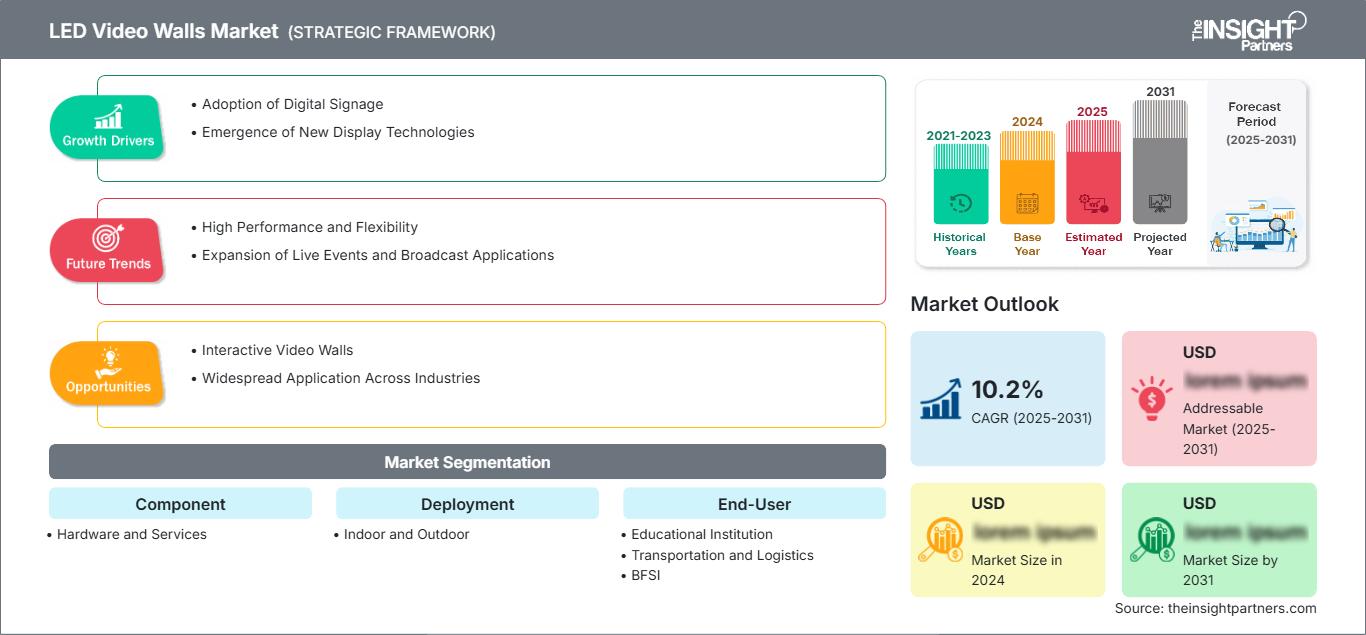
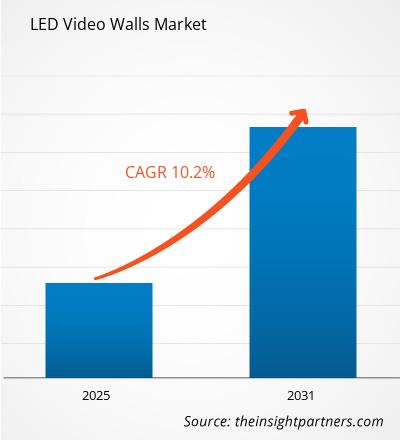
The global LED Video Walls market was valued at US$ 4.48 billion in 2025 and is expected to reach US$ 8.72 billion by 2034; it is estimated to record a CAGR of 7.68% during 2026-2034.
LED Video Walls Market Assessment and Insights
- North America: The region is estimated to hold a 24–28% share in 2025 and expand at a 7.5–8.5% CAGR between 2026–2034, supported by corporate visualization, retail modernization, sports venues, and control-room investments.
- US: The US represents approximately 72–76% of North American revenue in 2025 and is expected to grow at a 7.5–8.5% CAGR between 2026–2034, led by enterprise and entertainment installations.
- Europe: Europe is estimated to account for a 20–24% share in 2025 and grow at a 7.5–8.5% CAGR between 2026–2034, with Germany, the UK, France, Italy, and Spain supporting commercial, broadcast, transport, and public-sector deployments.
- Asia Pacific: Asia Pacific is estimated to represent a 36–40% share in 2025 and advance at a 9.5–10.5% CAGR between 2026–2034, with China, Japan, South Korea, and India benefiting from manufacturing capacity, urbanization, and digital infrastructure.
- Largest Segment: Hardware is estimated to hold a 76–80% market share in 2025 and grow at an 8.0–9.0% CAGR during 2026–2034, reflecting equipment-intensive project economics.
- High Growth Segment: Outdoor deployment is estimated at a 32–36% market share in 2025 and is projected to grow at a 10.0–11.0% CAGR during 2026–2034, supported by public-space and advertising installations.
- Key companies analyzed in detail: Christie Digital Systems USA, Inc.; Delphi Display Systems, Inc.; Delta Electronics, Inc.; LG Electronics Inc.; Panasonic Corporation; Planar; Samsung Electronics Co., Ltd.; Sony Corporation; Toshiba Corporation; ViewSonic Corporation.
Source: The Insight Partners' analysis based on proprietary research, government publications, company annual reports, investor presentations, industry databases, and expert interviews.
Technological advancements are taking place from traditional modular LED boxes to finer pitch, chip on board, and Micro-LED technology for increased pixel density, contrast, reliability, and installation flexibility. Manufacturing techniques have enabled improvements in terms of module thinness and thermal efficiency. According to the industry tracking done in 2025, an increase in shipments took place, with fine-pitch display screens being deployed in the corporate, education, broadcast, and premium retail sectors.
In the forecast period, investments are expected to shift to developing Asian economies and Gulf infrastructure projects as well as replacement in the developed Western markets. Purchase considerations will not only be limited to brightness and resolution but will also focus on other factors like energy efficiency, diagnostics, serviceability, content management, accessibility, and compliance with local requirements.
LED Video Walls Market Report Scope
| Report Attribute | Details |
|---|---|
| Market size in 2025 | US$ 4.48 Billion |
| Market Size by 2034 | US$ 8.72 Billion |
| Global CAGR (2026 - 2034) | 7.68% |
| Historical Data | 2021-2024 |
| Forecast period | 2026-2034 |
LED Video Walls Market Analysis
The demand for such products is driven by the need for uninterrupted high-brightness visualization in situations where traditional LCD mosaic or projector solutions have some limitations. The LED Video Wall market growth ecosystem covers LED chips, LED packages, LED drivers, modules, cabinets, processors, installers, content suppliers, and support companies. Fine pitch is especially useful in cases where the audience sits close to the display and image homogeneity has commercial value.
The supply side of the business is still highly dependent on component production in Asia, while international brands create distinctions in terms of processing, calibration, services, and applications engineering. Purchasers more often assess total cost of ownership than just the cost of the cabinet. Such criteria as power consumption, availability of spare modules, installation time, pixel pitch requirements, heat dissipation, and expected usage hours are especially important for 24/7 control rooms and transportation terminals.
Positioning is becoming dependent on portfolio size and integration of display hardware with integration and lifecycle management. According to the LED Video Walls Market, competitive positioning of Samsung Electronics Co., Ltd., LG Electronics Inc., Panasonic Corporation, Sony Corporation, and Christie Digital Systems USA, Inc. depends on the provision of premium performance visual displays with integrated commercial display ecosystem, while Planar focuses on fine pitch and COB designs.
There are specialist companies and providers of technology that take specific positions in the market. Delta Electronics, Inc. supplies display and electronics know-how, while ViewSonic Corporation and Delphi Display Systems, Inc. serve commercial visualization and digital signage needs. More investments are made in COB, micro LED, low power designs, and simple installation technologies. An example of this is the 2025 DirectLight Essential from Planar.
● REPORT CUSTOMIZATION
Tailor This Report To Align With Your Specific Business Requirements
This report can be customized to align precisely with your business objectives, scope, and target markets. Customization options include tailored segmentation, geography, competitive analysis, and strategic insights to support informed decision-making.
Customize This Report →WHAT YOU CAN ADJUST
- ● Segmentations
- ● Geography
- ● Competitive Analysis
- ● Language Preferences
LED Video Walls Market: Strategic Insights
Regional Insights
North America LED Video Walls Market
North America is estimated to account for 24–28% of global revenue in 2025 and is projected to expand at a 7.5–8.5% CAGR through 2034. The regional foundation will be bolstered by mature corporate AV ecosystem, projector replacement, digital out-of-home advertising, stadium modernization, and continuing mission-critical visualization investments. The LED Video Walls Market shares are driven by need for high-resolution displays that can be legible despite bright ambient illumination.
The USA makes up about 72–76% of the regional market revenues and continues to be the major demand center. Canada makes contributions via transport, retail, government, and institutional projects. The purchase decision puts increasing importance on front serviceability, energy efficiency, cyber security of the connected systems, and long service life. High-end fine-pitch installations become increasingly relevant for corporate collaboration, broadcast operations, command centers, and premium retail operations.
U.S. LED Video Walls Market
The US accounts for approximately 72–76% of North American revenue in 2025 and is expected to grow at a 7.5–8.5% CAGR through 2034. The market of demand has spread to corporate campuses, retail chain stores, airport buildings, casino, sport venues, broadcasting studios, and government visualization centers. The LED Video Walls Market share in North America is strengthened by existing integrators' relationships and high replacement budgets.
There is an increasing specialization of the applications' needs. Corporate customers give preference to fine pixel pitch and collaboration-friendly solutions, whereas entertainment and sport facilities' operators pay more attention to the parameters such as luminance, refresh rates, cameras, and weather resistance. Christie Digital Systems USA, Inc., Planar, Samsung Electronics Co., Ltd., LG Electronics Inc., Sony Corporation, and ViewSonic Corporation have commercial-display product lines.
Europe LED Video Walls Market
Europe is estimated to represent 20–24% of global revenue in 2025 and is projected to grow at a 7.5–8.5% CAGR through 2034. Germany is the leading market, with industrial visualization, trade shows, transport infrastructure, and corporate offices among its key sectors. The UK is still strong in broadcast, retail, sports, and online advertising. France features a mix of modernized public spaces with cultural applications and events, while Italy and Spain offer opportunities in retail, hotels, transport, and stadiums. Increasing emphasis on energy efficiency and environmental concerns is becoming more common in procurement processes.
The regional market can be described as one with high-end specs, tough installation demands, and demand for robust network coverage. Buyers are now paying increasing attention to brightness, power use, modular fixability, and environmental concerns, in addition to picture quality. In Germany, the industrial sector creates good prospects in control rooms and enterprises, while the UK and France create good opportunities in media and entertainment. Italy and Spain represent prospects in the tourism industry and retail modernization.
APAC LED Video Walls Market
Asia Pacific is estimated to hold a 36–40% share in 2025 and is expected to grow at a 9.5–10.5% CAGR through 2034, making it the leading regional market. China continues to be the main manufacturing and deployment hub, but companies in Japan, South Korea, India, and Australia are involved in installations using their corporate, retail, transport, entertainment, and government projects.
Urban development projects, smart cities initiatives, digital marketing, and event-related deployments aid installations within emerging countries. India is becoming more significant as investments in display manufacturing and digital signage increase locally. The level of electronics supply chain in the region is another factor influencing demand.
Middle East & Africa LED Video Walls Market
Middle East and Africa is projected to expand at an 11.0–12.0% CAGR through 2034. Saudi Arabia is the leading market, supported by Vision 2030 investments, tourism developments, entertainment venues, and smart-city projects. The UAE follows through Dubai and Abu Dhabi investments in hospitality, retail, airports, events, and premium commercial environments.
South Africa provides a comparatively mature base for retail, transport, sports, and corporate installations, while the rest of MEA remains project-driven. Energy, infrastructure, tourism, and venue development create opportunities for outdoor high-brightness displays. Regional procurement increasingly favors weather resistance, remote monitoring, modular maintenance, and high operating reliability.
Segmentation Analysis
Component
Hardware remains the dominant component, while services are becoming more strategically important as deployments require installation, calibration, monitoring, repair, and lifecycle support. The segment is projected to grow at an 8.0–9.0% CAGR during 2026–2034. The LED Video Walls Market scope increasingly encompasses integrated equipment and recurring service models rather than standalone display cabinets.
- Hardware: Includes LED modules, cabinets, power systems, processors, receiving cards, mounting structures, and related electronics. Buyers prioritize pixel density, brightness, thermal management, serviceability, and compatibility with existing content infrastructure.
- Services: Covers installation, commissioning, calibration, maintenance, troubleshooting, monitoring, and lifecycle support. Service quality is particularly important for large deployments where downtime can disrupt advertising, broadcasting, transportation, or venue operations.
Deployment
Deployment conditions directly influence pixel pitch, brightness, cabinet protection, thermal design, and maintenance access. Indoor and outdoor configurations together are projected to expand steadily, with the segment expected to grow at an 8.5–9.5% CAGR during 2026–2034 as applications diversify.
- Indoor: Supports corporate, education, retail, broadcast, control-room, and hospitality installations where fine pixel pitch, low viewing distance, quiet operation, and visual uniformity are important.
- Outdoor: Requires high brightness, weather resistance, structural engineering, thermal control, and visibility under direct sunlight. Stadiums, roadside advertising, public spaces, and transportation sites remain important applications.
End-User
End-user demand varies according to content intensity, audience distance, operating hours, and installation environment. The segment is projected to grow at an 8.5–9.5% CAGR during 2026–2034, with commercial and public-facing applications supporting recurring replacement and expansion projects.
- Educational Institution: Universities and schools use large displays for lecture halls, auditoriums, digital signage, collaboration, and event communication, increasing demand for scalable indoor systems.
- Transportation and Logistics: Airports, rail stations, ports, and logistics facilities require high-visibility information, wayfinding, advertising, and operational visualization across demanding continuous-use environments.
- BFSI: Banks and financial institutions use LED walls for customer communication, market visualization, trading environments, corporate presentations, and premium branch experiences requiring controlled visual quality.
- Media and Advertising: Broadcasters, agencies, and digital-out-of-home operators prioritize brightness, refresh performance, camera compatibility, flexible content formats, and rapid campaign changes across multiple locations.
- Sports and Entertainment: Stadiums, arenas, theaters, and event venues require high-refresh displays capable of delivering immersive content, sponsor messaging, replay footage, and live-event graphics.
- Retail: Retailers deploy LED walls for product storytelling, promotional campaigns, storefront visibility, and immersive experiences, with modular systems enabling changes across store formats and locations.
- Others: Additional institutional and commercial users employ LED walls for visualization, public communication, hospitality, government, and specialized applications where scalable display architecture is advantageous.
Opportunity Snapshot
| End-User | Revenue Contribution (High/Medium/Low) | Trend Tag | Adoption Stage |
| Educational Institution | Medium | Campus AV | Scaling |
| Transportation and Logistics | High | Smart Transit | Scaling |
| BFSI | Medium | Digital Branches | Scaling |
| Media and Advertising | High | DOOH Screens | Mature |
| Sports and Entertainment | High | Venue Immersion | Mature |
| Retail | High | Immersive Retail | Scaling |
| Others | Medium | Public Displays | Emerging |
LED Video Walls Market Growth Drivers and Impact Analysis
Expansion of Fine-Pitch Displays Across Close-Viewing Applications
Fine pitch technology increases the applications’ addressability due to the fact that with finer pixels, images become more continuous at closer viewing distances. Fine-pitch displays are used more and more often for corporate meeting rooms, control rooms, educational institutions, premium retail shops, and broadcasting where the absence of bezels in a tiled LCD display is required to provide seam-free images. As stated by Omdia, fine-pitch displays accounted for 55.4% of LED video display sales in Q1 2025, which proves the commercial success of fine-pitch displays. This evolution affects the business of suppliers because it raises the importance of such factors as calibration, production yield, driver IC performance, and heat dissipation.
Digital Transformation of Retail, Transport, and Public Spaces
Retailers, transport providers, and government bodies are moving away from static forms of communication towards visual systems that can accommodate dynamic information and advertising. Big screens are capable of combining passenger information, navigation, advertising, emergency communication, and branding through a single visual network. According to Omdia, urbanization, digital advertising, smart cities programs, and large-scale events have been some of the critical drivers of demand in developing economies in 2025. Suppliers will now find more project possibilities beyond entertainment and broadcasting applications. Remote management of content is also another type of demand created by these developments. As volume of deployments increases in different sites, standardized cabinets and centralized diagnostics will gain importance.
Growth of Immersive Sports, Entertainment, and Experience-Centric Venues
LED systems have become a fundamental component of the infrastructure at sports and entertainment venues rather than supplemental signage. Large format displays can provide live scoring, advertising, replays, event graphics, background imagery, and audience interaction, all requiring features like fast refresh rates, camera compatibility, bright screens, and module-based replacement. Outdoor stadiums will also take advantage of the ability to increase screen size without being limited by the physical limitations of LCD screens. Thus, the owners of these venues will consider these screens as a form of infrastructure that will be able to cater to different types of events. Such a procurement model will favor vendors who can install the screens, integrate content into them, maintain them, and have spare parts for replacements.
LED Video Walls Market Future Trends
AI-Enhanced Display Management and Predictive Maintenance
The next wave of installation will most likely involve connecting display devices with AI-driven monitoring for detecting anomalies in brightness, temperature, module activity, power use, and signal parameters prior to any physical failures. It will allow for prioritizing the need for maintenance and decreasing unnecessary site visits. The LED Video Walls Market trends include software-controlled fleet management, automated calibration, remote diagnostics, and analytics. AI will be able to adjust the brightness based on the surrounding environment, which will result in savings of unnecessary power usage without sacrificing readability. For owners of numerous video walls, centralized monitoring might be even more useful than any improvements in the cabinets’ specs.
COB and Micro-LED Moving Toward Broader Commercial Adoption
It is anticipated that the use of COB and Micro-LED designs will slowly spread beyond premium deployments as yields increase and costs drop. COB will be able to enhance durability, decrease failure points and enable the use of smaller pixels, while the Micro-LED design will enable excellent contrast, brightness and imagery. This technology will be pertinent for corporate, retail, broadcast, control rooms and premium hospitality sectors. In addition, the change in technology will affect cabinet design, heat removal methods, module protection as well as servicing processes. Eventually, there could be standard all-in-one designs that will make it easier for companies that lack the expertise of AV engineers to install them. As costs reduce, the difference between traditional LED and premium fine-pitch technologies will depend on the needs of the application.
LED Video Walls Market Opportunities
Integrated Hardware, Software, and Lifecycle Service Platforms
Suppliers could add more value to their business model if they package displays along with services such as content management, monitoring, remote diagnostics, calibration, and maintenance instead of focusing purely on the technical specifications of hardware. This strategy would be especially helpful for retailers, transportation companies, educational networks, and financial institutions that have several installations across different locations. The LED Video Walls Market Forecasts suggest that there is an opportunity for suppliers to establish ongoing relationships that will generate revenue for them through uptime, asset monitoring, software upgrades, and optimization of performance. A service level agreement could make it easier for the customer to procure the product, as the installations would be spread geographically.
Emerging-Market Expansion Through Localized Integration and Financing
There are potential opportunities in emerging markets that are seeing a confluence of factors such as urbanization, upgrades in retailing, infrastructure development, and event development which have created new display needs. Market penetration can be achieved through regional integration, local technical services, modular product designs, and financial arrangements that minimize capital outlay. Emerging markets include India, Southeast Asia, the Gulf states, and selected parts of Africa, each with their own application characteristics instead of a homogeneous regional need profile. Sustained market penetration will need companies to adapt to local electrical characteristics, environmental conditions, construction, content restrictions, and purchasing schedules. Smaller and standard products can be sold as entry products, leading to the sale of larger systems.
Recent Developments
- September 2026: Planar announced the launch of the Planar Chameleon Series and Planar Mosaic Series, expanding the possibilities for creative LED display design beyond conventional square and rectangle video walls and providing new ways to integrate LED into architectural and experiential environments.
- May 2026: Planar announced the launch of the Planar Mantis Series, a new line of indoor LED video walls purpose-built for rental and staging environments where speed, reliability and ease of use are critical. Designed for tool-less, one-handed setup and teardown, Planar Mantis Series enables crews of all experience levels to quickly deploy and redeploy LED video walls.
- January 2026: LEDMAN’s “Bring the World into Your Living Room” UHD Household Video Wall new product launch was successfully held in Shenzhen. The event gathered local mainstream media, financial and tech media, LED industry media, as well as professional media and well-known KOLs from home furnishing, appliances, audio-visual, and interior design fields. Together, they witnessed the historic moment of Micro LED giant screens over 135 inches entering households, marking the beginning of a revolution in home viewing.
Frequently Asked Questions

- Comprehensive Market Sizing and Forecast Analysis
- Detailed Segmentation Analysis
- In-Depth Market Dynamics Assessment
- Regional and Country-Level Insights
- Competitive Landscape and Company Benchmarking
- Strategic Business Intelligence
Recent Reports
Testimonials

The Insight Partners provided valuable market intelligence that supported our global go-to-market strategy. Their team was professional, responsive, and attentive to our feedback, providing thoughtful analysis and helpful methodological clarifications throughout the project.
Junmo Kim Chief Financial Officer (CFO), Enertech Co., Ltd.
The Insight Partners' SCADA System Market report is comprehensive, with valuable insights on current trends and future forecasts. The team was highly professional, responsive, and supportive throughout. We are very satisfied and highly recommend their services.
RAN KEDEM Partner, Reali Technologies LTDs
I requested a report on a very specific software market and the team produced the report in a few days. The information was very relevant and well presented. I then requested some changes and additions to the report. The team was again very responsive and I got the final report in less than a week.
JEAN-HERVE JENN Chairman, Future Analytica
We worked with The Insight Partners for an important market study and forecast. They gave us clear insights into opportunities and risks, which helped shape our plans. Their research was easy to use and based on solid data. It helped us make smart, confident decisions. We highly recommend them.
PIYUSH NAGPAL Sr. Vice President, High Beam Global
The Insight Partners delivered insightful, well-structured market research with strong domain expertise. Their team was professional and responsive throughout. The user-friendly website made accessing industry reports seamless. We highly recommend them for reliable, high-quality research services
YUKIHIKO ADACHI CEO, Deep Blue, LLC.
This is the first time I have purchased a market report from The Insight Partners.While I was unsure at first, I visited their web site and felt more comfortable to take the risk and purchase a market report.I am completely satisfied with the quality of the report and customer service. I had several questions and comments with the initial report, but after a couple of dialogs over email with their analyst I believe I have a report that I can use as input to our strategic planning process.Thank you so much for taking the extra time and making this a positive experience.I will definitely recommend your service to others and you will be my first call when we need further market data.
JOHN SUZUKI President and Chief Executive Officer, Board Director, BK Technologies
I wish to appreciate your support and the professionalism you displayed in the course of attending to my request for information regarding to infectious disease IVD market in Nigeria. I appreciate your patience, your guidance, and the fact that you were willing to offer a discount, which eventually made it possible for us to close a deal. I look forward to engaging The Insight Partners in the future, all thanks to the impression you have created in me as a result of this first encounter.
DR CHIJIOKE ONYIA MANAGING DIRECTOR, PineCrest Healthcare Ltd.Reason to Buy
- Informed Decision-Making
- Understanding Market Dynamics
- Competitive Analysis
- Identifying Emerging Markets
- Customer Insights
- Market Forecasts
- Risk Mitigation
- Boosting Operational Efficiency
- Strategic Planning
- Investment Justification
- Tracking Industry Innovations
- Aligning with Regulatory Trends





 Get Free Sample for