
MABS Resin Market Size, Share & Trends by 2034
Coverage: by Type (General Purpose Grade, High Impact Grade, High Rigidity Grade, Other); Application (Toys, Office Accessories, Industrial Housings and Covers, Reusable Drinkware, Medical Devices) , and Geography (North America, Europe, Asia Pacific, and South and Central America)
- Status : Data Released
- Report Code : TIPRE00010894
- Category : Chemicals and Materials
- No. of Pages : 150
- Available Report Formats :


- Last update date : July 15, 2026


2025 Market Size
US$ 473.66 Mn
Base year value
2034 Forecast
US$ 583.79 Mn
Projected by 2034
CAGR 2026-2034
2.35 %
Growth rate
Addressable Market
US$ 4,796.55 Mn
(2026-2034)
The global MABS Resin market was valued at US$ 473.66 million in 2025 and is expected to reach US$ 583.79 million by 2034; it is estimated to record a CAGR of 2.35% during 2026-2034.
MABS Resin Market Assessment and Insights
- North America: The region accounted for 32–36% share in 2025 and is anticipated to grow at a CAGR of 2.2–2.8% during 2026–2034. Demand is supported by healthcare manufacturing, durable consumer products, and continuous material innovation emphasizing transparency and impact performance.
- US: The country represented 76–80% of the North American market in 2025 and is projected to expand at a CAGR of 2.3–2.9% through 2034. Strong medical device manufacturing and consumer goods production continue supporting resin consumption.
- Europe: Europe held 25–29% share in 2025 and is forecast to register a CAGR of 2.1–2.7% during 2026–2034. Germany, France, Italy, and the UK remain leading consumers due to established automotive, healthcare, and industrial manufacturing sectors.
- Asia Pacific: Asia Pacific accounted for 34–38% share in 2025 and is expected to record the fastest CAGR of 3.1–3.7% through 2034. China, Japan, South Korea, and India continue expanding production capacities for engineering plastics and consumer products.
- Largest Segment: General Purpose Grade represented 48–52% market share in 2025 and is expected to grow at a CAGR of 2.2–2.8%, supported by widespread use in household products, office accessories, and industrial components.
- High Growth Segment: Medical Devices accounted for 15–19% market share in 2025 while expanding at a CAGR of 3.8–4.4% owing to increasing preference for transparent, sterilizable engineering plastics.
- Key companies analyzed in detail: BASF SE, CHIMEI Corporation, Denka Company Limited, Formosa Chemicals & Fibre Corporation, INEOS Styrolution Group GmbH, LG Chem Ltd., LOTTE Chemical Corporation, Techno-UMG Co., Ltd., TER Plastics POLYMER GROUP, Toray Industries, Inc.
Source: The Insight Partners' analysis based on proprietary research, government publications, company annual reports, investor presentations, industry databases, and expert interviews.
There have been significant advancements in manufacturing techniques for transparent engineering thermoplastic materials in the last ten years, resulting in better optical clarity, chemical resistance, dimensional stability, and impact properties. The growth in the market for MABS resins has been driven by continual development of formulations that aim at producing BPA-free products for use in consumer items, healthcare devices, lab equipment, and industrial enclosures. Manufacturers are continuously working on optimizing their polymerization processes to ensure uniformity in the production process while improving processability during injection molding and extrusion.
Future demand is projected to be increasingly driven by Asia Pacific and some regions in North America due to growing investments in healthcare infrastructure, reusable consumer products, and industrial automation. The push towards sustainability through the promotion of durable and recyclable engineering plastics is also expected to provide more scope for innovation in product development. Investment in specialized grades and formulations of the product is expected to provide a competitive edge.
MABS Resin Market Report Scope
| Report Attribute | Details |
|---|---|
| Market size in 2025 | US$ 473.66 Million |
| Market Size by 2034 | US$ 583.79 Million |
| Global CAGR (2026 - 2034) | 2.35% |
| Historical Data | 2021-2024 |
| Forecast period | 2026-2034 |
MABS Resin Market Analysis
Increasing demand for engineering plastics, which are transparent in nature, for use in the healthcare industry, consumer goods sector, and manufacturing of products, is driving the global market for MABS resins. In comparison to traditional ABS resins, MABS resin exhibits better transparency without sacrificing the impact strength, dimensional stability, and chemical resistance of these resins. Growing production of reusable drinking ware, laboratory instruments, diagnostic tools, and office accessories has bolstered demand for MABS resin from developed as well as emerging countries. Growing preference for plastics with enhanced durability and recyclability features is another factor boosting demand for these resins.
Feed stocks, including methyl methacrylate, acrylonitrile, butadiene, and styrene; polymerization; compounding; distribution; manufacture of components; and assembly of end products comprise the value chain for MABS resins. A stable integration between the petrochemical producers supplying the raw materials and the processors helps maintain the quality of the product, and at the same time eliminates manufacturing interruptions. Improvements in the compounding technology have enabled resin producers to tailor impact resistance, transparency, heat resistance, and processing requirements for specific applications.
The MABS resin market report indicates a moderately consolidated competitive landscape characterized by continuous product innovation, capacity optimization, and customer-focused material development. Leading manufacturers including BASF SE, CHIMEI Corporation, Denka Company Limited, Formosa Chemicals & Fibre Corporation, INEOS Styrolution Group GmbH, LG Chem Ltd., LOTTE Chemical Corporation, Techno-UMG Co., Ltd., TER Plastics POLYMER GROUP, and Toray Industries, Inc. continue investing in specialty engineering plastics to strengthen their presence across medical, industrial, and consumer applications.
Strategic investments increasingly focus on high-performance transparent grades offering improved sterilization resistance, enhanced chemical durability, and better processability for precision molding. Companies are also expanding technical support services and regional distribution networks to improve customer responsiveness and shorten product development cycles. Collaboration with medical device manufacturers, consumer product companies, and industrial equipment producers enables resin suppliers to develop application-specific formulations that comply with evolving quality standards while supporting sustainable manufacturing practices.
● REPORT CUSTOMIZATION
Tailor This Report To Align With Your Specific Business Requirements
This report can be customized to align precisely with your business objectives, scope, and target markets. Customization options include tailored segmentation, geography, competitive analysis, and strategic insights to support informed decision-making.
Customize This Report →WHAT YOU CAN ADJUST
- ● Segmentations
- ● Geography
- ● Competitive Analysis
- ● Language Preferences
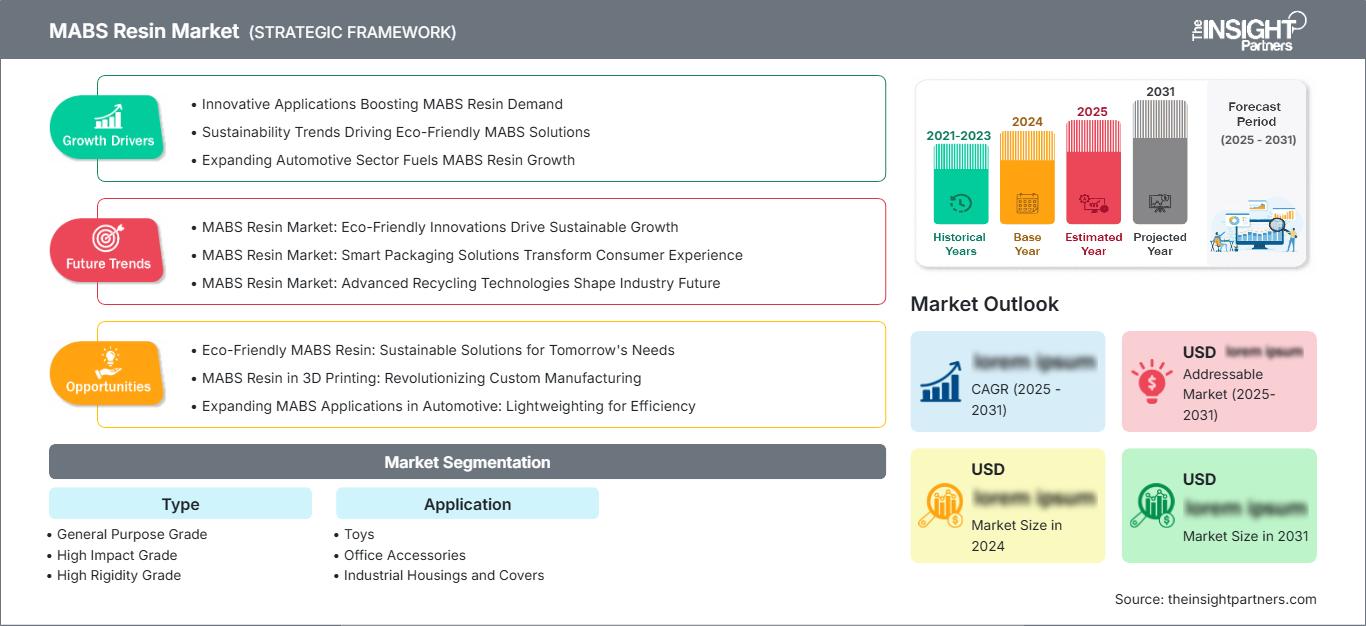
MABS Resin Market: Strategic Insights
Regional Insights
North America MABS Resin Market
North America accounted for 32–36% of the global MABS resin market share in 2025 and is projected to register a CAGR of 2.2–2.8% during 2026–2034. The region benefits from advanced polymer manufacturing capabilities, established medical device production, and growing demand for premium reusable consumer products. Increasing investments in laboratory equipment, diagnostic devices, and industrial automation continue supporting engineering plastic consumption across multiple end-use industries.
The MABS resin market share in North America remains supported by stringent product quality requirements and strong research capabilities among resin manufacturers. Demand is particularly strong for transparent engineering plastics used in healthcare equipment, reusable drinkware, industrial housings, and office products. Continuous investment in sustainable materials, domestic manufacturing initiatives, and product innovation is expected to maintain steady regional demand throughout the forecast period.
U.S. MABS Resin Market
The United States represented 76–80% of the North American market in 2025 and is expected to expand at a CAGR of 2.3–2.9% through 2034. The country's diversified manufacturing base, advanced healthcare industry, and strong consumer products sector continue generating stable demand for transparent engineering thermoplastics. High adoption of precision injection molding technologies further supports the production of complex MABS components.
Several leading resin manufacturers maintain technical centers, distribution facilities, or strategic partnerships across the United States, enabling rapid product development and customer support. Medical devices, reusable drinkware, laboratory equipment, industrial covers, and office accessories remain key application areas. Growing investment in domestic healthcare manufacturing and sustainable consumer products is expected to sustain long-term market expansion.
Europe MABS Resin Market
Europe held 25–29% of the global market in 2025 and is forecast to register a CAGR of 2.1–2.7% during 2026–2034. Germany remains the region's leading market due to its strong engineering plastics industry, advanced industrial manufacturing, and extensive medical device production. Continuous innovation in specialty polymers supports demand across industrial and healthcare applications.
The United Kingdom maintains steady consumption driven by healthcare equipment manufacturing, laboratory products, and premium consumer goods, while France, Italy, and Spain collectively contribute significant regional demand through industrial manufacturing, packaging equipment, consumer products, and medical technologies. Sustainability initiatives encouraging durable, reusable plastic products further strengthen long-term demand across European markets, with Germany continuing to lead regional consumption owing to its diversified manufacturing infrastructure and technological expertise.
APAC MABS Resin Market
Asia Pacific accounted for 34–38% of the global market in 2025 and is anticipated to record the highest CAGR of 3.1–3.7% during the forecast period. China leads regional demand, followed by Japan, South Korea, and India, supported by large-scale polymer production, consumer goods manufacturing, and expanding healthcare industries.
Government initiatives promoting advanced manufacturing, increasing domestic production of engineering plastics, and growing exports of medical devices and consumer products continue supporting regional expansion. Australia also contributes through specialty plastics demand for industrial and healthcare applications, although at a comparatively smaller scale.
Middle East & Africa MABS Resin Market
The Middle East & Africa market is projected to grow at a CAGR of 2.6–3.2% during 2026–2034. Saudi Arabia leads regional production owing to its integrated petrochemical industry, while the UAE continues strengthening downstream polymer processing capabilities. South Africa remains an important consumer market for industrial and healthcare applications.
Ongoing investments in petrochemical diversification, manufacturing infrastructure, and industrial value addition are creating new opportunities for engineering plastics across the region. Rising healthcare investments and expansion of consumer goods manufacturing are expected to gradually increase regional consumption of transparent specialty resins over the coming decade.
Segmentation Analysis
Type
The type segment in the MABS resin market plays a critical role in determining product performance across diverse end-use applications. Different grades are formulated to balance transparency, impact strength, rigidity, processability, and chemical resistance according to customer requirements. The MABS resin market scope continues expanding as manufacturers introduce application-specific formulations that improve product durability while meeting stringent regulatory and quality standards. The segment is projected to grow at a CAGR of 2.5–3.1% during 2026–2034, supported by increasing adoption in medical, consumer, and industrial products.
- General Purpose Grade – This grade remains the largest contributor owing to its balanced combination of transparency, toughness, and ease of processing. It is extensively used in office accessories, household products, consumer goods, and industrial components requiring attractive appearance and reliable mechanical performance.
- High Impact Grade – Designed for applications requiring enhanced resistance to mechanical stress and repeated handling. Demand is increasing in industrial housings, protective covers, durable consumer products, and reusable containers where long service life is essential.
- High Rigidity Grade – Preferred for components requiring excellent dimensional stability and structural strength while maintaining optical clarity. Its usage continues expanding in precision industrial equipment, laboratory devices, and premium engineering applications requiring tight manufacturing tolerances.
Application
Application diversity continues to strengthen long-term market stability by reducing dependence on any single end-use industry. Transparent engineering plastics are increasingly replacing conventional materials in consumer products, healthcare equipment, and industrial components due to their superior impact resistance and attractive appearance. This segment is expected to register a CAGR of 2.8–3.4% during 2026–2034, driven by product innovation, regulatory compliance, and growing demand for lightweight engineered materials.
- Toys – Manufacturers increasingly utilize transparent engineering plastics to improve product durability, safety, and visual appeal. Excellent impact resistance and ease of coloring make MABS resin suitable for premium educational and recreational products.
- Office Accessories – Office equipment manufacturers favor MABS resin for document organizers, stationery products, storage systems, and desktop accessories because of its excellent surface finish, transparency, dimensional stability, and long-term durability.
- Industrial Housings and Covers – Industrial equipment manufacturers increasingly adopt MABS resin for machine covers, instrument housings, protective enclosures, and transparent inspection windows requiring high impact resistance and consistent dimensional performance.
- Reusable Drinkware – Growing consumer preference for BPA-free reusable products has accelerated demand for transparent engineering plastics that combine excellent clarity, durability, chemical resistance, and repeated washing performance.
- Medical Devices – This application represents the fastest-growing segment due to increasing production of diagnostic equipment, laboratory instruments, fluid management systems, and disposable medical components requiring transparency, sterilization compatibility, and regulatory compliance.
Opportunity Snapshot
| Segment Name | Revenue Contribution | Trend Tag | Adoption Stage |
| Toys | Medium | Premium Toys | Mature |
| Office Accessories | Medium | Smart Workspace | Mature |
| Industrial Housings and Covers | High | Industrial Automation | Scaling |
| Reusable Drinkware | High | BPA-Free | Scaling |
| Medical Devices | High | Medical Diagnostics | Scaling |
MABS Resin Market Growth Drivers and Impact Analysis
Expanding Demand for Transparent Engineering Plastics in Healthcare
The healthcare industry continues to increase the use of transparent engineering plastics for diagnostic equipment, laboratory consumables, drug delivery systems, and medical device housings. MABS resin offers an attractive combination of optical clarity, impact resistance, dimensional stability, and compatibility with common sterilization processes, making it suitable for applications where visibility and durability are equally important. Aging populations, expanding healthcare infrastructure, and rising investment in medical technology across developed and emerging economies are encouraging manufacturers to adopt high-performance polymers that comply with stringent quality requirements. Continuous innovation in minimally invasive devices and diagnostic equipment is further strengthening demand for specialty transparent resins, creating stable long-term growth opportunities for producers capable of delivering consistent product quality and application-specific formulations.
Growing Preference for Durable and Reusable Consumer Products
Consumer preferences are gradually shifting toward durable, reusable, and aesthetically appealing products that reduce replacement frequency while supporting sustainability objectives. MABS resin has become a preferred material for reusable drinkware, premium household products, office accessories, and storage solutions because it combines excellent transparency with high impact strength and attractive surface finish. Manufacturers are increasingly replacing conventional plastics with engineering-grade materials capable of withstanding repeated use, cleaning, and handling without significant deterioration. Improvements in injection molding technologies have also enabled efficient production of complex transparent components with lower defect rates and enhanced dimensional precision. These factors continue supporting steady demand across consumer goods industries while encouraging investment in advanced polymer formulations and product differentiation.
Advancements in Polymer Compounding and Processing Technologies
Continuous progress in polymer compounding and processing technologies is enabling manufacturers to produce MABS resin grades with improved mechanical properties, chemical resistance, and processing efficiency. Customized formulations designed for medical, industrial, and consumer applications allow manufacturers to optimize transparency, rigidity, and impact performance according to end-use requirements. Modern production technologies also improve manufacturing consistency, reduce material waste, and enhance product quality, strengthening competitiveness across global markets. Increased collaboration between resin producers, equipment manufacturers, and component suppliers is accelerating product development while reducing commercialization timelines. As customers demand application-specific engineering materials with higher performance and greater processing flexibility, technological innovation will remain a major driver of long-term market expansion.
MABS Resin Market Future Trends
Development of High-Performance Sustainable Resin Formulations
Manufacturers are increasingly investing in transparent engineering plastics that combine superior mechanical performance with improved environmental sustainability. MABS resin market trends indicate growing emphasis on recyclable material formulations, reduced carbon footprints, and production processes that improve resource efficiency without compromising transparency or durability. Polymer producers are also exploring bio-based feedstocks, energy-efficient manufacturing technologies, and advanced additive systems that enhance product performance while supporting circular economy objectives. These developments are expected to strengthen competitiveness among suppliers serving healthcare, consumer goods, and industrial markets over the coming decade.
Increasing Customization for High-Value Industrial Applications
Demand is shifting from standardized resin grades toward customized formulations developed for highly specialized applications. Manufacturers are increasingly collaborating with end users to optimize optical clarity, chemical resistance, sterilization compatibility, and dimensional stability for industry-specific requirements. Growing adoption of precision injection molding, digital product development, and advanced material simulation technologies enables faster commercialization of customized products while reducing development costs. This trend is expected to improve customer retention and create new revenue opportunities for suppliers offering technical expertise alongside high-performance polymer solutions.
MABS Resin Market Opportunities
Expanding Medical Manufacturing Across Emerging Economies
The expansion of healthcare manufacturing facilities across Asia Pacific, Latin America, and selected Middle Eastern countries presents significant opportunities for resin suppliers. Rising investments in diagnostic equipment, laboratory infrastructure, pharmaceutical packaging, and medical device production are increasing demand for transparent engineering plastics that satisfy strict quality and regulatory requirements. MABS resin market Forecast indicate that manufacturers establishing regional production, technical service centers, and strategic partnerships will be better positioned to capture future demand. Companies capable of developing specialized grades with enhanced sterilization resistance, improved processability, and application-specific performance are expected to strengthen their competitive position as healthcare manufacturing capacity continues expanding worldwide.
Innovation in Premium Consumer and Industrial Product Applications
Continuous innovation in premium consumer products and industrial equipment creates attractive investment opportunities for resin manufacturers seeking higher-value applications. Increasing adoption of smart office products, reusable household goods, transparent machine covers, laboratory instruments, and precision industrial components is encouraging demand for advanced engineering plastics with excellent aesthetics and mechanical reliability. Material suppliers investing in application development, customer collaboration, and advanced compounding technologies can expand their presence in specialized market segments where performance requirements are higher and product differentiation plays a greater role. These opportunities are expected to support sustainable revenue growth despite the market's moderate overall expansion rate.
Recent Developments
- March 2026: Trinseo (NYSE: TSE), a specialty material solutions provider, and its affiliate companies in Europe announced a price increase for all polystyrene (PS), ABS and SAN grades.
- January 2026: Japanese materials supplier Toray Industries developed a highly antistatic version of Toyolacparel acrylonitrile butadiene styrene (ABS) resin. The surface resistivity is 109Ω/sq (one billion ohms per square), which is one-fifth of the company’s conventional counterpart.
Frequently Asked Questions

- Comprehensive Market Sizing and Forecast Analysis
- Detailed Segmentation Analysis
- In-Depth Market Dynamics Assessment
- Regional and Country-Level Insights
- Competitive Landscape and Company Benchmarking
- Strategic Business Intelligence
Recent Reports
Testimonials

The Insight Partners' SCADA System Market report is comprehensive, with valuable insights on current trends and future forecasts. The team was highly professional, responsive, and supportive throughout. We are very satisfied and highly recommend their services.
RAN KEDEM Partner, Reali Technologies LTDs
I requested a report on a very specific software market and the team produced the report in a few days. The information was very relevant and well presented. I then requested some changes and additions to the report. The team was again very responsive and I got the final report in less than a week.
JEAN-HERVE JENN Chairman, Future Analytica
We worked with The Insight Partners for an important market study and forecast. They gave us clear insights into opportunities and risks, which helped shape our plans. Their research was easy to use and based on solid data. It helped us make smart, confident decisions. We highly recommend them.
PIYUSH NAGPAL Sr. Vice President, High Beam Global
The Insight Partners delivered insightful, well-structured market research with strong domain expertise. Their team was professional and responsive throughout. The user-friendly website made accessing industry reports seamless. We highly recommend them for reliable, high-quality research services
YUKIHIKO ADACHI CEO, Deep Blue, LLC.
This is the first time I have purchased a market report from The Insight Partners.While I was unsure at first, I visited their web site and felt more comfortable to take the risk and purchase a market report.I am completely satisfied with the quality of the report and customer service. I had several questions and comments with the initial report, but after a couple of dialogs over email with their analyst I believe I have a report that I can use as input to our strategic planning process.Thank you so much for taking the extra time and making this a positive experience.I will definitely recommend your service to others and you will be my first call when we need further market data.
JOHN SUZUKI President and Chief Executive Officer, Board Director, BK Technologies
I wish to appreciate your support and the professionalism you displayed in the course of attending to my request for information regarding to infectious disease IVD market in Nigeria. I appreciate your patience, your guidance, and the fact that you were willing to offer a discount, which eventually made it possible for us to close a deal. I look forward to engaging The Insight Partners in the future, all thanks to the impression you have created in me as a result of this first encounter.
DR CHIJIOKE ONYIA MANAGING DIRECTOR, PineCrest Healthcare Ltd.Reason to Buy
- Informed Decision-Making
- Understanding Market Dynamics
- Competitive Analysis
- Identifying Emerging Markets
- Customer Insights
- Market Forecasts
- Risk Mitigation
- Boosting Operational Efficiency
- Strategic Planning
- Investment Justification
- Tracking Industry Innovations
- Aligning with Regulatory Trends





 Get Free Sample for