
Magnet Wire Market Size, Share & Forecast by 2034
Magnet Wire Market Size and Forecasts (2021 - 2034), Global and Regional Share, Trends, and Growth Opportunity Analysis Report Coverage : by Type (Copper, Aluminum); Shape (Round Magnet Wire, Round Bondable Magnet Wire, Rectangle Magnet Wire, Square Magnet Wire); Application (Motor, Home Appliance, Transformer); End-User (Electrical and Electronics, Industrial, Transportation, Energy, Automotive, Residential, Infrastructure); and Geography (North America, Europe, Asia Pacific, and South and Central America)
- Status : Data Released
- Report Code : TIPRE00039872
- Category : Chemicals and Materials
- No. of Pages : 150
- Available Report Formats :


- Last update date : July 14, 2026


2025 Market Size
US$ 37.50 Bn
Base year value
2034 Forecast
US$ 61.50 Bn
Projected by 2034
CAGR 2026-2034
5.65 %
Growth rate
Addressable Market
US$ 448.73 Bn
(2026-2034)
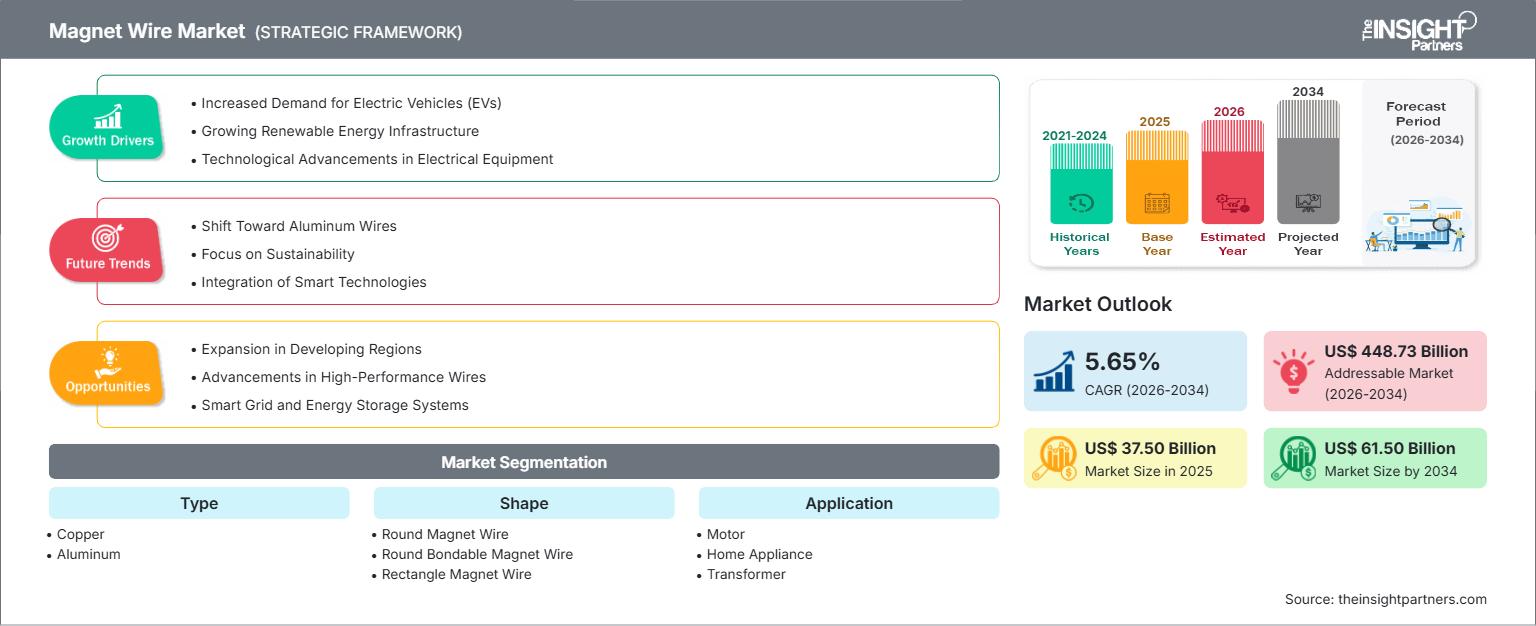
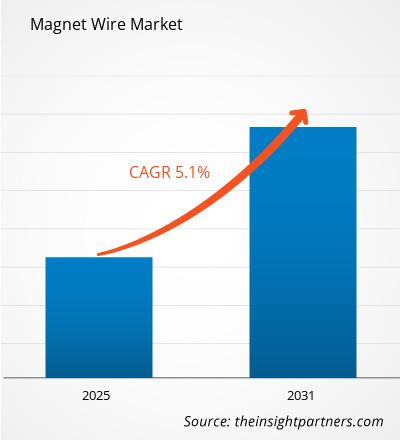
The magnet wire market size was valued at US$ 37.50 Billion in 2025 and is projected to reach US$ 61.50 Billion by 2034, growing at a CAGR of 5.65% during 2026–2034. The market is supported by increasing demand for electrical equipment, rising electrification across transportation systems, and expanding applications in motors, transformers, and home appliances requiring efficient electromagnetic performance and reliable insulation technologies.
North America is expected to witness steady expansion in the coming years, supported by investments in electric mobility, renewable energy infrastructure, and modernization of power transmission systems. The region is estimated to register a CAGR in the range of 4.5–5.5% between 2026–2034, driven by demand from automotive manufacturers, industrial automation providers, and transformer producers adopting advanced winding solutions.
Magnet Wire Market Assessment and Insights
- North America accounted for a 22–26% of the magnet wire market share in 2025 and is expected to grow at a CAGR of 4.5–5.5% during 2026–2034. The region benefits from electric vehicle production, grid upgrades, renewable power integration, and strong industrial manufacturing capabilities.
- US represented approximately 17–21% share in 2025 and is projected to expand at a CAGR of 4.5–5.5% during 2026–2034. Growth is supported by automotive electrification, transformer replacement cycles, and domestic manufacturing investments.
- Europe held around 25–29% share in 2025 and is anticipated to grow at a CAGR of 4.0–5.0% during 2026–2034. Germany, Italy, France, and the UK remain important markets due to automotive manufacturing, industrial motors, and energy transition initiatives.
- Asia Pacific captured approximately 38–42% share in 2025 and is estimated to expand at a CAGR of 6.0–7.0% during 2026–2034. China, Japan, South Korea, and India contribute significantly through electronics manufacturing, electric vehicles, and power infrastructure development.
- Largest Segment: Copper magnet wire accounted for around 70–75% market share in 2025 and is expected to grow at a CAGR of 5.0–6.0% during 2026–2034 due to superior conductivity, thermal performance, and widespread industrial adoption.
- High Growth Segment: Rectangle magnet wire represented nearly 12–16% market share in 2025 and is projected to grow at a CAGR of 6.5–7.5% during 2026–2034 due to increasing adoption in compact motors, electric vehicles, and high-efficiency electrical machines.
- Key companies analyzed in detail: Hitachi Metals Ltd, Sumitomo Electric Industries Co Ltd, IRCE SpA, Von Roll Holding AG, EWWA, Ningbo Jintian Copper Co Ltd, LS Cable & System Ltd, Sam Dong Magnetic Wire Co Ltd, Fujikura Ltd, and Furukawa Electric Co Ltd.
Source: The Insight Partners' analysis based on proprietary research, government publications, company annual reports, investor presentations, industry databases, and expert interviews.
The magnet wire market forecast has evolved with progress in terms of conductor material, insulation system, and manufacturing quality to accommodate rising requirements of efficiency of electrical appliances. There is a trend among manufacturers to move towards high-quality copper conductors, improved enamel insulation, and rectangular-shaped wire to facilitate compact winding structures. Growth in automobile electrification and industry automation is raising the demand for more durable and heat resistant wire designs.
Market development in the future will depend on investment in electric mobility chains, renewable energy devices, and smart grids infrastructure. There is potential to grow production capacities of magnet wires in emerging markets of Asia and Latin America due to industrialization. Regulations on energy efficiency and greenhouse gases emission reduction are also promoting advanced electrical components.
Magnet Wire Market Report Scope
| Report Attribute | Details |
|---|---|
| Market size in 2025 | US$ 37.50 Billion |
| Market Size by 2034 | US$ 61.50 Billion |
| Global CAGR (2026 - 2034) | 5.65% |
| Historical Data | 2021-2024 |
| Forecast period | 2026-2034 |
Magnet Wire Market Analysis
The magnet wire market growth is mainly determined by the increasing electrification of automotive, industrial, and energy sectors. There is an urgent need for efficient winding of electric vehicles' traction motors, while renewable energy sources rely on generators and transformers, which use reliable insulated conductors. This includes the involvement of such stakeholders as the suppliers of copper and aluminum, wire makers, insulation material makers, motor makers, transformers, and electrical equipment producers.
Factors that affect the supply include changes in copper prices, manufacturing capability in certain regions, and technical advances in wire making. Copper continues to be used as the most common conductor because of its good conductivity, though there is an increasing usage of aluminum in cases where there is a need to save on costs and weight.
The magnet wire market report shows that competition among companies relies upon innovation, geographic reach, and customized solutions. The main players include Hitachi Metals Ltd, Sumitomo Electric Industries Co Ltd, IRCE SpA, Von Roll Holding AG, and Furukawa Electric Co Ltd, who pay close attention to innovation in insulation technology and customization of wires for industrial and automotive use.
Competitive strategies involve investments into expansion of production capacities, energy efficiency, and development of the new wires suitable for the usage in future motor systems. Ningbo Jintian Copper Co Ltd and LS Cable & System Ltd benefit from their capability of processing copper, while Sam Dong Magnetic Wire Co Ltd, Fujikura Ltd, and EWWA rely on providing custom-made solutions for electric equipment manufacturers.
● REPORT CUSTOMIZATION
Tailor This Report To Align With Your Specific Business Requirements
This report can be customized to align precisely with your business objectives, scope, and target markets. Customization options include tailored segmentation, geography, competitive analysis, and strategic insights to support informed decision-making.
Customize This Report →WHAT YOU CAN ADJUST
- ● Segmentations
- ● Geography
- ● Competitive Analysis
- ● Language Preferences
Magnet Wire Market: Strategic Insights
Regional Insights
North America Magnet Wire Market
North America represented approximately 22–26% of the magnet wire market share in 2025 and is expected to expand at a CAGR of 4.5–5.5% during 2026–2034. The region benefits from automotive electrification, renewable energy installations, transformer replacement programs, and investments in domestic electrical component manufacturing. The US remains the dominant contributor due to its extensive industrial base.
The regional supply chain is supported by manufacturers serving automotive, aerospace, industrial motor, and energy applications. Increasing adoption of electric vehicles and investments in grid modernization are creating demand for high-performance winding materials. Canada and Mexico are also gaining importance through automotive production expansion and manufacturing integration with North American supply networks.
U.S. Magnet Wire Market
The U.S. market accounted for nearly 75–80% of North America share in 2025 and is projected to grow at a CAGR of 4.5–5.5% during 2026–2034. Demand is supported by electric vehicle manufacturing, industrial automation, renewable power projects, and replacement of aging electrical infrastructure across commercial and utility applications.
Major manufacturers and suppliers maintain production and distribution capabilities across the country to serve automotive, transformer, and motor manufacturers. Companies including Hitachi Metals Ltd, Sumitomo Electric Industries Co Ltd, and Fujikura Ltd participate in supplying advanced winding materials. Increasing focus on energy efficiency is encouraging the adoption of premium insulation systems and compact wire designs.
Europe Magnet Wire Market
Europe accounted for approximately 25–29% share in 2025 and is anticipated to grow at a CAGR of 4.0–5.0% during 2026–2034. Germany remains a leading market due to its automotive manufacturing ecosystem, industrial machinery production, and renewable energy investments. Italy, France, Spain, and the UK contribute through electrical equipment manufacturing and infrastructure modernization.
The UK market is influenced by renewable energy expansion and electric mobility investments, supporting demand for efficient motors and transformers. Germany continues to demonstrate strong adoption through automotive OEMs and industrial equipment manufacturers requiring advanced winding solutions. France, Italy, and Spain are strengthening demand through electric vehicle supply chains, industrial automation, and energy transition projects, supporting regional manufacturing activity.
APAC Magnet Wire Market
APAC held approximately 38–42% share in 2025 and is expected to register the highest regional growth with a CAGR of 6.0–7.0% during 2026–2034. China leads regional demand due to large-scale electronics production, electric vehicle manufacturing, and renewable energy infrastructure development.
Japan, South Korea, and India are expanding their roles through automotive electrification and industrial equipment production. Government initiatives supporting clean energy adoption and domestic manufacturing are increasing demand for advanced electrical components. Australia contributes through renewable energy projects, although its market remains smaller compared with manufacturing-focused economies.
Middle East & Africa Magnet Wire Market
The Middle East & Africa magnet wire market is expected to expand at a CAGR of 4.0–5.0% during 2026–2034, supported by infrastructure development, energy diversification programs, and industrial expansion. Saudi Arabia represents a leading market due to investments in power infrastructure and manufacturing projects.
The UAE and South Africa are emerging markets through construction activity, renewable energy deployment, and industrial modernization. The Rest of MEA region is gradually increasing consumption through electrification initiatives and utility infrastructure development. Demand remains linked to transformer manufacturing, energy projects, and industrial equipment requirements across developing economies.
Segmentation Analysis
Type
The Type segment of the magnet wire market includes Copper and Aluminum. The segment is expected to grow at a CAGR of 5.0–6.0% during 2026–2034. Copper maintains strong adoption because of its excellent electrical conductivity, heat resistance, and reliability in demanding applications, while aluminum gains attention for lightweight designs and cost optimization.
- Copper: Copper magnet wire remains the preferred choice for motors, transformers, and industrial equipment due to its superior conductivity and thermal performance. Manufacturers increasingly use high-purity copper solutions for applications requiring compact designs, improved efficiency, and long operational life.
- Aluminum: Aluminum magnet wire is gaining adoption where reduced weight and lower material costs are important considerations. It is increasingly utilized in applications requiring efficient conductor performance while minimizing overall equipment weight and manufacturing expenses.
Shape
The Shape segment of the magnet wire market includes Round Magnet Wire, Round Bondable Magnet Wire, Rectangle Magnet Wire, and Square Magnet Wire. The segment is expected to expand at a CAGR of 5.5–6.5% during 2026–2034. Demand is supported by increasing customization requirements in electric motors, automotive systems, and compact electrical devices.
- Round Magnet Wire: Round magnet wire represents a widely adopted format because of its versatility across motors, transformers, and household appliances. Its established manufacturing processes and compatibility with conventional winding techniques support continued demand.
- Round Bondable Magnet Wire: Round bondable magnet wire is increasingly preferred in applications requiring stronger winding stability and reduced assembly complexity. It supports automated production processes and improves mechanical strength in compact electrical components.
- Rectangle Magnet Wire: Rectangle magnet wire is gaining importance in high-efficiency motors and electric vehicle applications because it enables higher slot fill ratios. Its ability to support compact designs makes it strategically important for next-generation electrical systems.
- Square Magnet Wire: Square magnet wire serves specialized applications where geometric efficiency and optimized winding arrangements are required. It supports customized motor designs and selected industrial applications requiring precise conductor configurations.
Application
The Application segment of the magnet wire market includes Motor, Home Appliance, and Transformer applications. The segment is projected to grow at a CAGR of 5.5–6.5% during 2026–2034. Increasing electrification, appliance demand, and expansion of power infrastructure are supporting adoption across multiple end-use industries.
- Motor: Motor applications represent a significant demand area due to electric vehicle production, industrial automation, and energy-efficient motor adoption. Advanced winding materials are increasingly required to improve performance, reliability, and thermal management.
- Home Appliance: Home appliances continue to generate stable demand through increasing household electrification and replacement cycles. Washing machines, refrigerators, air conditioners, and other equipment require reliable winding components for efficient operation.
- Transformer: Transformer applications benefit from grid expansion, renewable energy integration, and infrastructure modernization. Rising electricity demand is encouraging utilities and manufacturers to adopt durable winding materials with improved efficiency and operational stability.
Opportunity Snapshot
| Application | Revenue Contribution | Trend Tag | Adoption Stage |
| Motor | High | EV Motors | Scaling |
| Home Appliance | Medium | Smart Appliances | Mature |
| Transformer | High | Grid Upgrade | Scaling |
Magnet Wire Market Growth Drivers and Impact Analysis
Rising Electric Vehicle Production and Motor Electrification
With the increase in electric vehicle production, there has been an increased need for premium winding wires used in traction motors, chargers, and power trains. Electric motors require high-performing magnet wire that is capable of providing greater insulation properties, thermal capacity, and mechanical strength. Most automotive companies have started using the rectangular configuration of wire in order to increase slot fill ratio and the overall performance of the motor. The use of rectangular wire has led to wire manufacturers developing specialized manufacturing technologies and products based on applications. With the increasing use of hybrid and electric power trains in passenger cars, trucks, and industrial mobility systems, there has been an increase in demand for high-performing conductors.
Expansion of Renewable Energy and Power Infrastructure Investments
The growing installation of renewable energy generating and transmitting facilities leads to the increased demand for transformers, generators and other electrical equipment using insulated conductors. The generation and storage of solar and wind energy necessitates effective power conversion systems in which the winding material plays an important role in achieving performance. Energy companies are undertaking projects to modernize the grid in order to increase its reliability and cope with distributed energy resources. All these are driving the demand for solutions using copper and aluminum magnet wire in the field of transformers and generators. At the same time, the growth of consumption is also driven by the development of infrastructure in developing countries where industrial activities and electricity consumption grow along with improved access to electricity.
Increasing Adoption of Energy-Efficient Electrical Equipment
Growing emphasis on energy efficiency is encouraging industries to replace conventional electrical equipment with advanced motors, appliances, and industrial systems. High-efficiency motors require optimized winding designs and superior conductor materials to minimize energy losses during operation. Regulatory initiatives promoting efficient appliances and industrial equipment are influencing manufacturers to adopt improved magnet wire technologies. The demand for compact electrical systems with enhanced performance is also supporting innovation in wire shapes, insulation coatings, and manufacturing processes. Industrial automation, smart appliances, and advanced machinery applications are creating additional opportunities for specialized products. These Magnet Wire Market trends are encouraging market participants to invest in research and development activities focused on improving conductivity, thermal performance, durability, and manufacturing precision.
Magnet Wire Market Future Trends
Advanced Rectangular Wire Adoption in Next-Generation Motors
It is likely that there will be more use of rectangular magnet wires as manufacturers continue to create even smaller, more efficient electric motors. The automotive and equipment industries will be considering designs which can help in increasing efficiency while maximizing copper usage. The rectangular design allows for better winding than traditional round magnet wires, leading to smaller sized motors and increased efficiency. The future design of electric vehicles, robots and industrial equipment will increase the need for these special magnet wires. There are efforts being made by the manufacturers in terms of creating advanced forming techniques and insulation systems to satisfy the new demands.
Integration of Sustainable Materials and Manufacturing Processes
It is expected that issues related to sustainability would affect future manufacturing as producers of electrical components would attempt to reduce environmental consequences associated with their products. Producers of magnet wires are attempting to develop ways to manufacture the wire efficiently, recycle more effectively, and optimize the use of materials in order to consume fewer resources. Growing interest in circular economy ideas in copper value chains can lead to more reuse of materials, yet retaining high quality in terms of electrical characteristics. Energy efficiency and minimizing waste in manufacturing are likely to become competitive advantages for companies when customers assess suppliers. Companies having better production technologies and sustainable operations would have an advantage in international supply chains.
Magnet Wire Market Opportunities
Growth Potential in Electric Mobility Supply Chains
Electric mobility growth offers considerable potential for manufacturers able to offer customized winding solutions for motors and other applications. Automakers are enhancing local sourcing of essential components, thus opening doors for magnet wire manufacturers to enter into supply arrangements on regional basis. Magnet Wire Market forecasts for magnet wire suggest a trend towards increased preference of wires that provide greater resistance against heat and higher efficiency as well as compatibility with new motor designs. Those companies making investments into manufacturing of rectangular wire, automation, and customer support services could gain an edge in the supply chain of electric vehicles. New centers of electric vehicle manufacturing in Asia, Europe, and North America present more opportunities for capacity expansion.
Expansion Opportunities Through Grid Modernization Projects
The grid modernization efforts and renewable energy developments have presented opportunities for those suppliers who provide their products to the transformer and power equipment manufacturers. High demands on electricity, the integration of renewable energy sources into the power grids, and the replacement of old equipment have generated needs in the production of effective electrical components. Companies that specialize in providing reliable solutions in the magnet wire products can take advantage of collaborations with the transformer manufacturers, utilities, and renewable energy equipment manufacturers. Diversifying economies can be considered attractive due to the governmental efforts in building the power transmission network and electrification.
Recent Developments
- July 2026: Sam Dong Ohio announced plans to invest more than $13 million to expand its manufacturing facility on Pittsburgh Drive, creating 30 new jobs and significantly increasing production capacity. The expansion will include the installation of new copper casting equipment that will more than double the company's oxygen-free copper rod production, increasing monthly output from 5.5 million pounds to as much as 14 million pounds. Once complete, the Delaware facility will become the largest producer of oxygen-free copper rod in North America.
- May 2026: Evonik unveiled its new PEEK Rectangular Magnet Wire Lab, marking a strategic push into advanced materials for electric mobility at CHINAPLAS 2026. The facility, designed for the fast-growing Chinese and broader Asian markets, will focus on research and development of polyether ether ketone (PEEK) powder-based applications for electric motors—particularly in new energy vehicles (NEVs), including hybrid and fully electric platforms.
Frequently Asked Questions

- Comprehensive Market Sizing and Forecast Analysis
- Detailed Segmentation Analysis
- In-Depth Market Dynamics Assessment
- Regional and Country-Level Insights
- Competitive Landscape and Company Benchmarking
- Strategic Business Intelligence
Recent Reports
Testimonials

The Insight Partners provided valuable market intelligence that supported our global go-to-market strategy. Their team was professional, responsive, and attentive to our feedback, providing thoughtful analysis and helpful methodological clarifications throughout the project.
Junmo Kim Chief Financial Officer (CFO), Enertech Co., Ltd.
The Insight Partners' SCADA System Market report is comprehensive, with valuable insights on current trends and future forecasts. The team was highly professional, responsive, and supportive throughout. We are very satisfied and highly recommend their services.
RAN KEDEM Partner, Reali Technologies LTDs
I requested a report on a very specific software market and the team produced the report in a few days. The information was very relevant and well presented. I then requested some changes and additions to the report. The team was again very responsive and I got the final report in less than a week.
JEAN-HERVE JENN Chairman, Future Analytica
We worked with The Insight Partners for an important market study and forecast. They gave us clear insights into opportunities and risks, which helped shape our plans. Their research was easy to use and based on solid data. It helped us make smart, confident decisions. We highly recommend them.
PIYUSH NAGPAL Sr. Vice President, High Beam Global
The Insight Partners delivered insightful, well-structured market research with strong domain expertise. Their team was professional and responsive throughout. The user-friendly website made accessing industry reports seamless. We highly recommend them for reliable, high-quality research services
YUKIHIKO ADACHI CEO, Deep Blue, LLC.
This is the first time I have purchased a market report from The Insight Partners.While I was unsure at first, I visited their web site and felt more comfortable to take the risk and purchase a market report.I am completely satisfied with the quality of the report and customer service. I had several questions and comments with the initial report, but after a couple of dialogs over email with their analyst I believe I have a report that I can use as input to our strategic planning process.Thank you so much for taking the extra time and making this a positive experience.I will definitely recommend your service to others and you will be my first call when we need further market data.
JOHN SUZUKI President and Chief Executive Officer, Board Director, BK Technologies
I wish to appreciate your support and the professionalism you displayed in the course of attending to my request for information regarding to infectious disease IVD market in Nigeria. I appreciate your patience, your guidance, and the fact that you were willing to offer a discount, which eventually made it possible for us to close a deal. I look forward to engaging The Insight Partners in the future, all thanks to the impression you have created in me as a result of this first encounter.
DR CHIJIOKE ONYIA MANAGING DIRECTOR, PineCrest Healthcare Ltd.Reason to Buy
- Informed Decision-Making
- Understanding Market Dynamics
- Competitive Analysis
- Identifying Emerging Markets
- Customer Insights
- Market Forecasts
- Risk Mitigation
- Boosting Operational Efficiency
- Strategic Planning
- Investment Justification
- Tracking Industry Innovations
- Aligning with Regulatory Trends





 Get Free Sample for