
Magneto rheological fluid Market Size, Share & Demand by 2034
Coverage: By Base Fluid (Silicon Oil, Mineral Oil, Synthetic Hydrocarbon Oil, Paraffin Oil, Hydraulic Oil, Water, Others); Application (Automotive, Aerospace, Building and Construction, Military and Defense, Optics, Electrical and Electronics, Medical and Prosthetics, Robotics, Others) , and Geography (North America, Europe, Asia Pacific, and South and Central America)
- Status : Data Released
- Report Code : TIPRE00020591
- Category : Chemicals and Materials
- No. of Pages : 150
- Available Report Formats :


- Last update date : July 14, 2026


2025 Market Size
US$ 3.78 Bn
Base year value
2034 Forecast
US$ 6.72 Bn
Projected by 2034
CAGR 2026-2034
6.60 %
Growth rate
Addressable Market
US$ 47.47 Bn
(2026-2034)
Magneto rheological fluid market size was valued at US$ 3.78 Billion in 2025 and is projected to reach US$ 6.72 Billion by 2034, expanding at a CAGR of 6.60% during 2026–2034. The market is supported by increasing adoption of smart materials in automotive damping systems, adaptive suspension technologies, vibration control solutions, and advanced engineering applications requiring rapid changes in material properties under magnetic fields.
The North American magneto rheological fluid market size is influenced by automotive innovation, defense modernization, and aerospace engineering investments. The region is expected to register a CAGR range of 6.0–7.0% between 2026–2034, supported by demand for semi-active suspension systems, advanced shock absorbers, and research activities focused on intelligent materials for industrial applications.
Magneto rheological fluid Market Assessment and Insights
- North America accounted for an estimated 35–39% Magneto rheological fluid market share in 2025 and is projected to grow at a CAGR of 6.0–7.0% during 2026–2034. Strong automotive R&D, aerospace applications, and defense technology programs support regional adoption.
- US represented approximately 28–32% share in 2025 and is expected to expand at a CAGR of 6.2–7.2% during 2026–2034. Demand is supported by automotive manufacturers, military research, and adaptive engineering solutions.
- Europe held around 27–31% share in 2025 and is anticipated to grow at a CAGR of 5.8–6.8% during 2026–2034. Germany, the UK, France, and Italy remain key contributors due to automotive engineering and industrial automation.
- Asia Pacific captured nearly 25–29% share in 2025 and is expected to record a CAGR of 7.0–8.0% during 2026–2034. China, Japan, South Korea, and India drive demand through automotive production and advanced manufacturing.
- Largest Segment: Automotive application held an estimated 35–40% market share in 2025 and is projected to grow at a CAGR of 6.5–7.5% during 2026–2034, driven by adaptive suspension and vibration control systems.
- High Growth Segment: Robotics application accounted for approximately 8–12% market share in 2025 and is expected to expand at a CAGR of 8.0–9.0% during 2026–2034, supported by precision motion control requirements.
- Key companies analyzed in detail: Akebono Brake Industry Co., Ltd., Anton Paar GmbH., Arus MR Tech, CK Materials Lab Co., Ltd., Industrial Metal Powders (India) Pvt. Ltd., Ioniqa Technologies, Kolektor Group, KURIMOTO, Ltd., Liquid Research Limited, Lord Corporation, Parker Hannifin Corporation, and BASF SE.
Source: The Insight Partners' analysis based on proprietary research, government publications, company annual reports, investor presentations, industry databases, and expert interviews.
The development of the magnetorheological fluid market has been driven by advancements in magnetic particle technology, carrier fluid technology, and control electronics. The manufacturers are concentrating on decreasing sedimentation, fast response times, and the development of fluids that can work in compact machines. Damping technology in automobiles continues to be a major path for commercializing the technology, while robotics, prosthetics, and vibration dampening in industry continue to open up new applications.
Future avenues of growth will be dependent upon increased investment in intelligent materials, automated systems, and lightweight systems. The emerging Asian Pacific nations are expected to open up new avenues of demand through increased automotive production and automation. Focus on vehicle safety and energy saving mobility technology will aid future growth.
Magneto rheological fluid Market Report Scope
| Report Attribute | Details |
|---|---|
| Market size in 2025 | US$ 3.78 Billion |
| Market Size by 2034 | US$ 6.72 Billion |
| Global CAGR (2026 - 2034) | 6.60% |
| Historical Data | 2021-2024 |
| Forecast period | 2026-2034 |
Magneto rheological fluid Market Analysis
The magneto rheological fluid market growth will be driven by the increasing requirement for adaptive devices where the system can change the mechanical behavior depending on the conditions of operation. The use of this fluid allows changing its viscosity under the influence of magnetic field, which makes this product suitable for shock absorption, vibration damping, and control applications.
The industry has a typical value chain that involves suppliers of raw materials, manufacturers of magnetic particles, producers of carrier fluid, formula developers, parts manufacturers, and end users. The importance of iron-based magnetic particles has not changed, but special additives have become a necessary addition to the fluid to enhance its qualities. The supply is affected by the availability of engineering materials and R&D efforts along with demand from automotive and industrial segments.
Magneto Rheological Fluid Market report highlights stiffening competition for technology providers concentrating on application-based technologies. Leading firms like Lord Corporation, Akebono Brake Industry Co., Ltd., Kolektor Group, and KURIMOTO, Ltd. consolidate their position by way of developing new products and engaging in engineering collaborations. Material characterization and formulations experts are also contributing to this field through specialized companies like Anton Paar GmbH, Liquid Research Limited, and CK Materials Lab Co., Ltd.
Capital investment activity revolves around smart mobility, robotics, defense technologies, and advanced manufacturing systems. Arus MR Tech, Industrial Metal Powders (India) Pvt. Ltd., and Ioniqa Technologies belong to those companies that are involved in the field of materials innovation and technologies.
● REPORT CUSTOMIZATION
Tailor This Report To Align With Your Specific Business Requirements
This report can be customized to align precisely with your business objectives, scope, and target markets. Customization options include tailored segmentation, geography, competitive analysis, and strategic insights to support informed decision-making.
Customize This Report →WHAT YOU CAN ADJUST
- ● Segmentations
- ● Geography
- ● Competitive Analysis
- ● Language Preferences
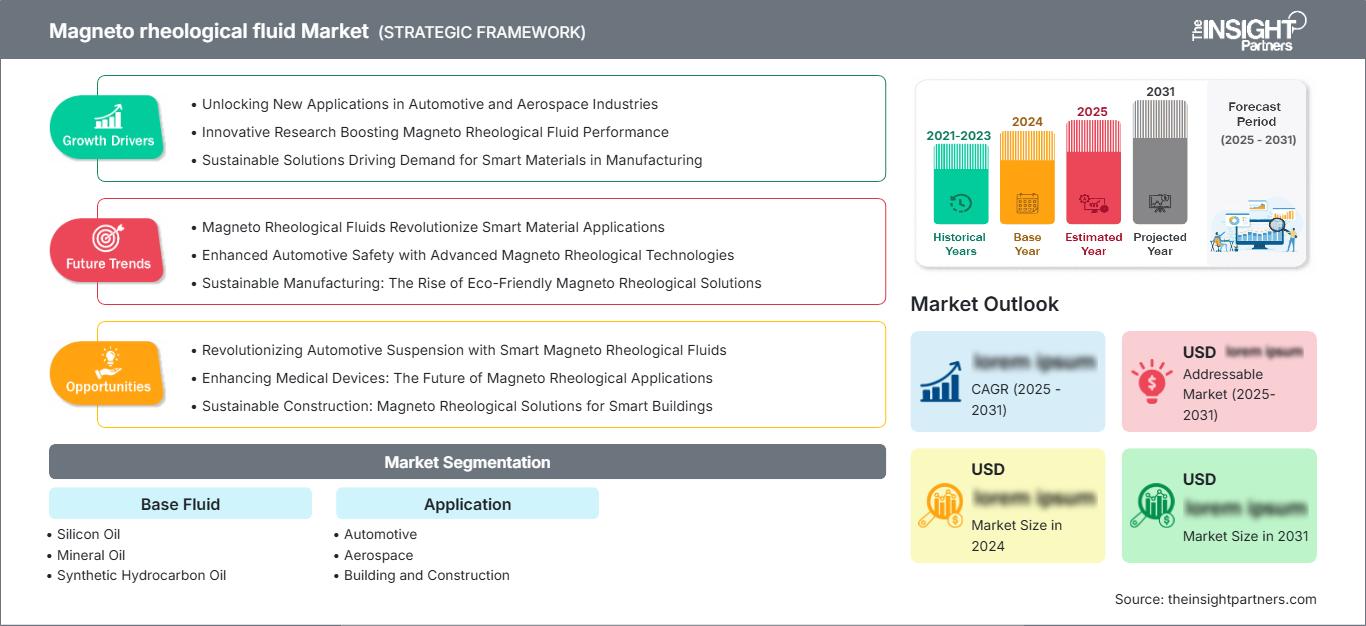
Magneto rheological fluid Market: Strategic Insights
Regional Insights
North America Magneto Rheological Fluid Market
North America represented approximately 35–39% share in 2025 and is projected to expand at a CAGR of 6.0–7.0% during 2026–2034. The region benefits from established automotive engineering capabilities, aerospace manufacturing infrastructure, and defense research activities. The US remains the leading contributor due to technology development programs and adoption of adaptive systems.
Demand is supported by increasing integration of intelligent suspension technologies and vibration control solutions in premium vehicles and industrial equipment. Research institutions and manufacturers are investing in advanced materials to improve response characteristics and durability. Aerospace and defense applications continue to create opportunities through requirements for precision control, structural vibration reduction, and improved equipment performance.
U.S. Magneto Rheological Fluid Market
The US accounted for approximately 75–85% of North America’s magneto rheological fluid market share in 2025 and is expected to grow at a CAGR of 6.2–7.2% during 2026–2034. The country maintains a strong ecosystem of automotive suppliers, defense contractors, and research organizations supporting smart material adoption.
Companies operating in the country focus on automotive suspension systems, aerospace components, and military applications. The presence of advanced manufacturing facilities and engineering expertise supports commercialization. Demand is also influenced by robotics development, medical devices, and industrial automation requiring controlled mechanical responses.
Europe Magneto Rheological Fluid Market
Europe accounted for approximately 27–31% share in 2025 and is estimated to expand at a CAGR of 5.8–6.8% during 2026–2034. Germany represents a leading market due to automotive manufacturing capabilities, industrial automation expertise, and engineering innovation. The UK, France, Italy, and Spain contribute through aerospace, automotive, and research applications.
The UK market benefits from aerospace engineering and defense technology investments, while Germany focuses on automotive systems and industrial applications. France and Italy demonstrate demand through mobility innovation and manufacturing capabilities. Spain contributes through automotive production and research initiatives. European manufacturers are emphasizing efficient, lightweight, and electronically controlled systems.
APAC Magneto Rheological Fluid Market
APAC accounted for approximately 25–29% share in 2025 and is projected to grow at a CAGR of 7.0–8.0% during 2026–2034. China leads regional adoption due to large automotive production capacity and industrial automation growth. Japan and South Korea support demand through advanced manufacturing and robotics applications.
India and Australia are emerging markets supported by infrastructure development, engineering research, and industrial modernization. Government initiatives promoting manufacturing capabilities and technology adoption are expected to encourage further application expansion across automotive, defense, and industrial sectors.
Middle East & Africa Magneto Rheological Fluid Market
Middle East & Africa represented a smaller portion of global demand, with growth supported by infrastructure investment, defense modernization, and industrial development. The region is expected to register a CAGR of 5.0–6.0% during 2026–2034, with Saudi Arabia and the UAE leading adoption.
Saudi Arabia and UAE are investing in advanced infrastructure and defense technologies, while South Africa contributes through industrial applications and engineering activities. Energy sector modernization and construction projects create opportunities for vibration management and advanced mechanical control solutions across selected applications.
Segmentation Analysis
Base Fluid
The base fluid segment of the magneto rheological fluid market is expected to expand at a CAGR of 5.8–6.8% during 2026–2034. Base fluids determine viscosity behavior, temperature stability, and compatibility with different operating environments. Increasing demand for customized formulations suitable for automotive, aerospace, and industrial systems is encouraging manufacturers to develop fluids with improved durability, reduced wear, and enhanced magnetic response characteristics.
- Silicon Oil is widely preferred for applications requiring thermal stability and consistent viscosity performance. Its resistance to oxidation and broad operating temperature range support usage in demanding automotive, aerospace, and precision control systems.
- Mineral Oil remains an established carrier medium due to cost advantages and availability. It is used in applications where balanced performance, mechanical reliability, and economical formulation characteristics are required.
- Synthetic Hydrocarbon Oil is gaining attention for advanced applications requiring improved lubrication properties and operational stability. Its compatibility with engineered systems supports adoption in high-performance damping and industrial control solutions.
- Paraffin Oil provides favorable chemical stability and controlled flow characteristics. It is considered for applications where formulation flexibility and compatibility with magnetic particles are important design considerations.
- Hydraulic Oil supports applications involving fluid power systems and mechanical control mechanisms. Its established industrial usage creates opportunities in vibration management, actuators, and specialized equipment requiring controlled response.
- Water based formulations offer environmental advantages and cost efficiency. They are explored for selected applications where reduced flammability and sustainable material considerations are important factors.
Application
The application segment of the magneto rheological fluid market is projected to register a CAGR of 6.5–7.5% during 2026–2034. Increasing adoption of adaptive materials across automotive, robotics, defense, and medical technologies is expanding market opportunities. Application-specific development is focused on improving response speed, energy efficiency, and system reliability while reducing maintenance requirements in advanced mechanical platforms.
- Automotive applications represent the largest demand area due to adoption in semi-active suspension systems, shock absorbers, and vibration control technologies. Vehicle manufacturers are integrating adaptive solutions to enhance ride comfort, handling, and safety.
- Aerospace applications utilize these fluids for vibration suppression, landing systems, and precision control mechanisms. Demand is supported by requirements for lightweight, reliable, and responsive components in aircraft systems.
- Building and Construction applications involve vibration mitigation solutions for structures and mechanical systems. Smart damping technologies are being explored to improve structural stability and performance under dynamic loading conditions.
- Military and Defense applications benefit from advanced damping systems, vehicle stabilization technologies, and equipment protection solutions. Defense organizations increasingly evaluate smart materials for improved operational performance.
- Optics applications use controlled fluid properties in precision positioning and vibration-sensitive equipment. The segment benefits from increasing requirements for accuracy in optical instruments and scientific devices.
- Electrical and Electronics applications involve vibration control and precision mechanisms in electronic systems. Growing miniaturization and reliability requirements support adoption in specialized equipment.
- Medical and Prosthetics applications utilize adaptive materials for advanced assistive devices and rehabilitation technologies. Development focuses on improving comfort, movement control, and functionality.
- Robotics applications are gaining importance due to demand for precise motion control, actuators, and adaptive mechanisms. Growth is supported by automation expansion and next-generation robotic systems.
Opportunity Snapshot
| Application Segment | Revenue Contribution | Trend Tag | Adoption Stage |
| Automotive | High | Adaptive Suspension | Mature |
| Aerospace | Medium | Aircraft Control | Scaling |
| Building and Construction | Medium | Smart Damping | Emerging |
| Military and Defense | Medium | Defense Systems | Scaling |
| Optics | Low | Precision Control | Emerging |
| Electrical and Electronics | Low | Device Stability | Emerging |
| Medical and Prosthetics | Low | Assistive Devices | Emerging |
| Robotics | Medium | Robotic Actuation | Scaling |
Magneto rheological fluid Market Growth Drivers and Impact Analysis
Expansion of Adaptive Automotive Suspension Technologies
The growing importance of passenger comfort, safety, and vehicle performance has fueled the adoption of magneto-rheological-based suspension systems. The automotive industry is moving towards electronically-controlled damping systems which can vary the vehicle dynamics based on the driving environment and driving style. The commercialization of such systems has been fast-tracked by the premium segment and electric vehicle platforms are creating further business prospects because of the need for weight reduction and optimized ride comfort. The incorporation of sensors, electronics and intelligent mechanical systems is leading to the increasing demand for reactive fluids. Companies developing compact and efficient dampers will gain as the automotive industry moves towards smart mobility platforms.
Growing Adoption of Smart Materials in Industrial Systems
Vibration damping, precision control, and reliability enhancement of equipment by the use of smart materials are being considered by the different industries. The magneto rheological fluid enables the user to have controllable mechanical properties that are suitable for rapid responses under varying conditions. Automation in the industry, robots, and modern machines are encouraging investments in adaptable parts that enhance performance efficiency. The users in the industry are looking forward to using smart materials to minimize maintenance needs and enhance the lifespan of machines. The trend towards automation in manufacturing processes will bring more possibilities for fluid suppliers.
Increasing Defense and Aerospace Engineering Requirements
The military defense and aerospace sector will drive the demand for innovative technologies that enhance the performance of systems operating in difficult environments. Magneto-rheological technologies are well suited for fast responses and can be applied in areas such as vibration isolation, stabilization systems, and specialized equipment. Defense vehicle refurbishment projects and aerospace technology studies are motivating companies to develop advanced materials. There is a demand for components that are light, strong, and energy-efficient. Materials should perform well under changing temperatures and mechanical loads in aerospace applications. The continued development in engineering and defense technology sector will facilitate the use of the technology in selected applications.
Magneto rheological fluid Market Future Trends
Integration with Artificial Intelligence Enabled Control Systems
The Magneto Rheological Fluid Market trends in the magneto-rheological fluid industry would be towards the incorporation of intelligent technologies and sensors. Intelligent control mechanisms could help assess operating parameters and change damping attributes accordingly. Such an amalgamation can facilitate enhanced efficiency, efficient performance management, and effective mechanical behavior. The automotive, robotic, and industries are anticipated to conduct research in artificial intelligence-based adaptive systems that increase accuracy in operations. The current Magneto Rheological Fluid Market trends in research have shifted towards the integration of smart fluids with digital technology platforms.
Development of Sustainable and High Performance Formulations
Innovation in the future will most likely revolve around designing sustainable materials with high stability and long service life. The industries are investigating other options that are more environment-friendly without compromising the magnetic property and mechanical properties of these materials. There may be some impacts of sustainable fluids, better additives, and particles on the design strategy of products. The industries using smart materials are more concerned about the performance and efficiency of the materials.
Magneto rheological fluid Market Opportunities
Expansion into Emerging Robotics Applications
Expanding use of robots in manufacturing, healthcare and service applications can open up growth prospects for innovative fluid-based motion control systems. The robotics industry is increasingly looking for smaller, yet more effective solutions with better precision control, stabilization and adjustability of performance. MR systems are applicable in all joint and actuator control, as well as vibration damping applications. There is an opportunity for companies creating customized solutions designed for robotics application. Robotic use in developing countries will only increase the need for precision engineered components. A fluid manufacturer can collaborate with robotics company and enhance market entry for improved technology.
Commercialization Through Advanced Mobility Solutions
The magneto rheological fluid market forecast indicate opportunities linked with advanced mobility platforms, including electric vehicles and autonomous transportation systems. Vehicle manufacturers are exploring adaptive technologies that improve efficiency, comfort, and safety while supporting evolving mobility requirements. Companies developing lightweight and electronically controlled suspension solutions can benefit from increasing automotive innovation. Expansion of electric vehicle production and smart transportation infrastructure creates potential demand for specialized damping technologies. Strategic investments in research, manufacturing capabilities, and automotive partnerships may help suppliers strengthen market positions. Continued advancement in vehicle electronics and control systems is expected to create additional commercialization opportunities.
Recent Developments
- June 2026: EssilorLuxottica and Applied Materials, Inc. announced a long-term joint development agreement to accelerate the commercialization of next-generation intelligent optical systems for augmented reality and AI-powered smart eyewear.
- December 2025: MEMS Infinity, the commercial microelectromechanical systems (MEMS) foundry division of Sumitomo Precision Products Co., Ltd. (Sumitomo Precision Products), announced the availability of potassium sodium niobate (KNN), supplied by Sumitomo Chemical Company, Limited(Sumitomo Chemical, headquartered in Chuo-ku, Tokyo, a lead-free option for piezoelectric thin films.
Frequently Asked Questions

- Comprehensive Market Sizing and Forecast Analysis
- Detailed Segmentation Analysis
- In-Depth Market Dynamics Assessment
- Regional and Country-Level Insights
- Competitive Landscape and Company Benchmarking
- Strategic Business Intelligence
Recent Reports
Testimonials

The Insight Partners provided valuable market intelligence that supported our global go-to-market strategy. Their team was professional, responsive, and attentive to our feedback, providing thoughtful analysis and helpful methodological clarifications throughout the project.
Junmo Kim Chief Financial Officer (CFO), Enertech Co., Ltd.
The Insight Partners' SCADA System Market report is comprehensive, with valuable insights on current trends and future forecasts. The team was highly professional, responsive, and supportive throughout. We are very satisfied and highly recommend their services.
RAN KEDEM Partner, Reali Technologies LTDs
I requested a report on a very specific software market and the team produced the report in a few days. The information was very relevant and well presented. I then requested some changes and additions to the report. The team was again very responsive and I got the final report in less than a week.
JEAN-HERVE JENN Chairman, Future Analytica
We worked with The Insight Partners for an important market study and forecast. They gave us clear insights into opportunities and risks, which helped shape our plans. Their research was easy to use and based on solid data. It helped us make smart, confident decisions. We highly recommend them.
PIYUSH NAGPAL Sr. Vice President, High Beam Global
The Insight Partners delivered insightful, well-structured market research with strong domain expertise. Their team was professional and responsive throughout. The user-friendly website made accessing industry reports seamless. We highly recommend them for reliable, high-quality research services
YUKIHIKO ADACHI CEO, Deep Blue, LLC.
This is the first time I have purchased a market report from The Insight Partners.While I was unsure at first, I visited their web site and felt more comfortable to take the risk and purchase a market report.I am completely satisfied with the quality of the report and customer service. I had several questions and comments with the initial report, but after a couple of dialogs over email with their analyst I believe I have a report that I can use as input to our strategic planning process.Thank you so much for taking the extra time and making this a positive experience.I will definitely recommend your service to others and you will be my first call when we need further market data.
JOHN SUZUKI President and Chief Executive Officer, Board Director, BK Technologies
I wish to appreciate your support and the professionalism you displayed in the course of attending to my request for information regarding to infectious disease IVD market in Nigeria. I appreciate your patience, your guidance, and the fact that you were willing to offer a discount, which eventually made it possible for us to close a deal. I look forward to engaging The Insight Partners in the future, all thanks to the impression you have created in me as a result of this first encounter.
DR CHIJIOKE ONYIA MANAGING DIRECTOR, PineCrest Healthcare Ltd.Reason to Buy
- Informed Decision-Making
- Understanding Market Dynamics
- Competitive Analysis
- Identifying Emerging Markets
- Customer Insights
- Market Forecasts
- Risk Mitigation
- Boosting Operational Efficiency
- Strategic Planning
- Investment Justification
- Tracking Industry Innovations
- Aligning with Regulatory Trends





 Get Free Sample for