
Medical Engineered Materials Market Trends, Size & Growth by 2034
Medical Engineered Materials Market Size and Forecasts (2021–2034), Global and Regional Share, Trends, and Growth Opportunity Analysis Report Coverage : by Type (Medical Plastics, Medical Foams, Medical Films, Medical Adhesives); Application (Medical Devices, Medical Disposables, Medical Wearables); and Geography (North America, Europe, Asia Pacific, and South and Central America)
- Status : Data Released
- Report Code : TIPRE00040325
- Category : Chemicals and Materials
- No. of Pages : 150
- Available Report Formats :


- Last update date : July 15, 2026


2025 Market Size
US$ 969.28 Mn
Base year value
2034 Forecast
US$ 1,674.86 Mn
Projected by 2034
CAGR 2026-2034
6.27 %
Growth rate
Addressable Market
US$ 11,969.76 Mn
(2026-2034)
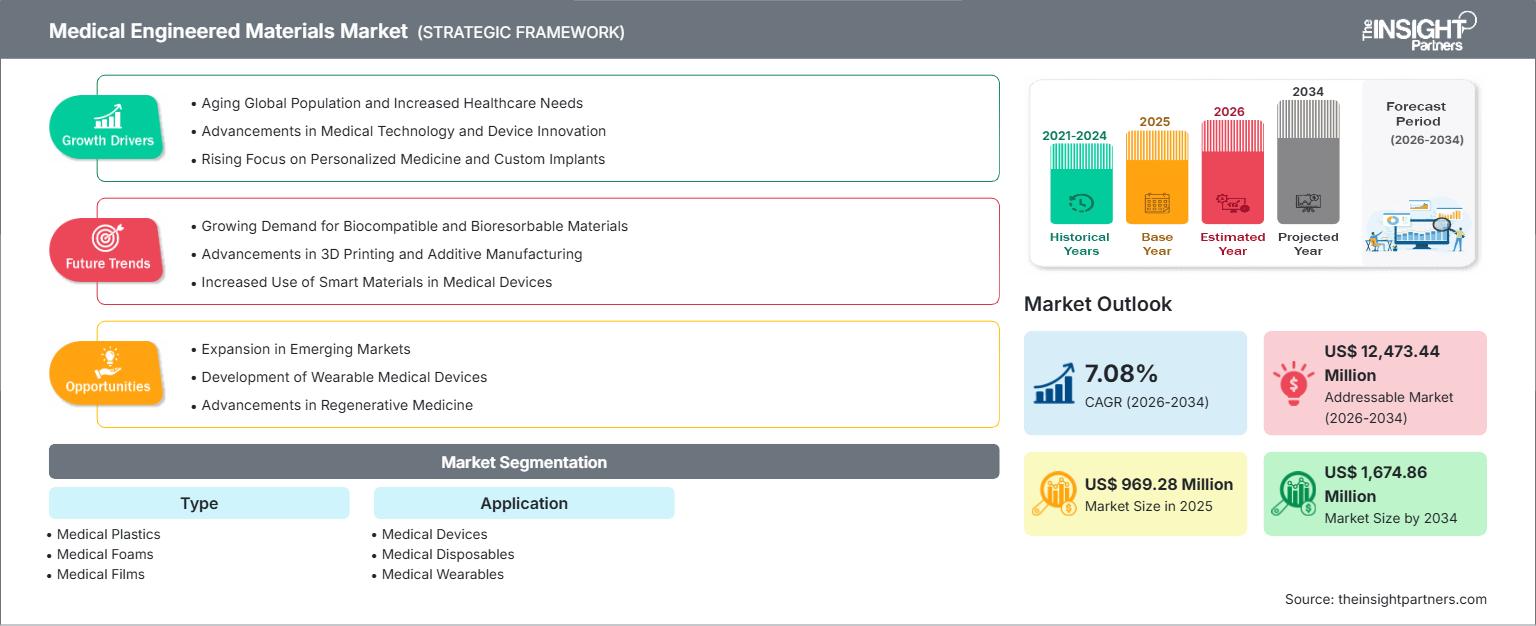
The Medical Engineered Materials market was valued at US$ 969.28 million in 2025 and is expected to reach US$ 1674.86 million by 2034; it is estimated to record a CAGR of 6.27% during 2026-2034.
Medical Engineered Materials Market Assessment and Insights
- North America: Accounted for 35–37% of the Medical Engineered Materials Market share in 2025 and is anticipated to expand at a 6.5–7.3% CAGR during 2026–2034. Strong healthcare expenditure, advanced manufacturing infrastructure, and significant medical technology investments continue to support regional leadership.
- US: Represented 81–85% of North America in 2025 and is projected to grow at a 6.6–7.4% CAGR during 2026–2034. Extensive medical device manufacturing and high healthcare spending support demand for engineered healthcare materials.
- Europe: Held 27–29% share in 2025 and is expected to register a 6.7–7.5% CAGR during 2026–2034. Germany, France, the UK, Italy, and Spain remain key contributors owing to strong healthcare manufacturing ecosystems.
- Asia Pacific: Captured 25–27% share in 2025 and is forecast to grow at a 8.0–8.8% CAGR during 2026–2034. China, Japan, India, and South Korea are leading regional markets supported by healthcare modernization and manufacturing expansion.
- Largest Segment: Medical Plastics accounted for 42–46% market share in 2025 and is anticipated to grow at a 7.2–8.0% CAGR during 2026–2034, driven by broad adoption across healthcare devices and disposable applications.
- High Growth Segment: Medical Wearables held 15–19% market share in 2025 and is projected to expand at a 8.6–9.4% CAGR during 2026–2034 owing to increasing remote monitoring and digital health adoption.
- Key companies analyzed in detail: BASF SE, SABIC, Solvay SA, Evonik Industries AG, Covestro AG, Trelleborg AB, DSM Biomedical, Eastman Chemical Company, 3M Company, and Celanese Corporation.
Source: The Insight Partners' analysis based on proprietary research, government publications, company annual reports, investor presentations, industry databases, and expert interviews.
Progress in material science has helped in improving the performance characteristics of materials in use in the healthcare industry in various forms such as medical equipment, disposables, and wearables. The current focus of manufacturers is on lighter weight materials, better durability, stronger sterilization performance, and superior biocompatibility characteristics. Advancement in polymer science has facilitated the use of advanced materials in diverse healthcare applications. At the same time, more stringent regulations and quality considerations will drive continuous improvement in the performance characteristics of materials within the value chain of healthcare manufacturing.
In the future, increased demand is expected due to higher investments in healthcare in emerging countries, growth in connected healthcare solutions, and higher local manufacturing capacity. Growing emphasis on patient safety, infection control, and sustainable healthcare solutions will provide opportunities for advanced engineered materials. Regulatory support for innovations, along with increased spending in healthcare infrastructure, will drive market growth over the forecast period.
Medical Engineered Materials Market Report Scope
| Report Attribute | Details |
|---|---|
| Market size in 2025 | US$ 969.28 Million |
| Market Size by 2034 | US$ 1,674.86 Million |
| Global CAGR (2026 - 2034) | 6.27% |
| Historical Data | 2021-2024 |
| Forecast period | 2026-2034 |
Medical Engineered Materials Market Analysis
The rise in the market for medical engineered materials is attributed to the increasing need for advanced healthcare products which need special material properties. Medical devices, diagnostic tools, surgical tools, disposables, and wearable devices have increasingly become dependent on engineered materials which can offer biocompatibility, durability, flexibility, and sterilization properties. Aging populations, increase in chronic illnesses, and increase in healthcare utilization rates continue to ensure that there is consistent demand for advanced healthcare materials. Innovations in material technology with focus on miniaturization and weight reduction are also gaining momentum.
The market value chain consists of material suppliers, specialist compounders, engineered material producers, medical component producers, healthcare device manufacturers, and healthcare providers. Increasing cooperation between material developers and medical device manufacturers ensures faster development of products. Increasing attention towards product safety and regulatory compliance ensures that the demand for advanced healthcare materials continues.
The medical engineered materials market report is characterized by a competitive scenario that revolves around innovation in material technology, manufacturing capabilities, and the development of products according to specific application requirements. Companies like BASF SE, SABIC, Evonik Industries AG, Covestro AG, and Celanese Corporation are continuing their efforts to build advanced material technology portfolios for health care applications to cater to changing needs within the industry.
Increasingly, competitive strategy in this segment involves specialty polymer solutions, sustainable material solutions, and production capacity expansion for health care materials. Some of the companies involved in these endeavors include Solvay SA, Trelleborg AB, DSM Biomedical, Eastman Chemical Company, and 3M Company.
● REPORT CUSTOMIZATION
Tailor This Report To Align With Your Specific Business Requirements
This report can be customized to align precisely with your business objectives, scope, and target markets. Customization options include tailored segmentation, geography, competitive analysis, and strategic insights to support informed decision-making.
Customize This Report →WHAT YOU CAN ADJUST
- ● Segmentations
- ● Geography
- ● Competitive Analysis
- ● Language Preferences
Medical Engineered Materials Market: Strategic Insights
Regional Insights
North America Medical Engineered Materials Market
North America accounted for 36–40% of global medical engineered materials market share in 2025 and is projected to expand at a CAGR of 6.8–7.2% during 2026–2034. The market enjoys a developed environment for manufacturing medical devices, robust spending on healthcare, and investment in state-of-the-art biomaterials. The demand for engineered plastics, films, foams, and adhesives remains strong, given the growing manufacture of diagnostic systems, drug delivery systems, and minimally-invasive surgery systems.
There is an enabling environment for innovation owing to the presence of major players in the healthcare manufacturing industry and the supply chain. Regulatory framework provided by institutions such as the U.S. FDA promotes the use of advanced materials that are safe and biocompatible. The demand for wearable health monitoring systems and home healthcare solutions is driving the demand for engineered materials in North America.
U.S. Medical Engineered Materials Market
The United States represented 78–82% of North American demand in 2025 and is anticipated to register a CAGR of 6.9–7.3% through 2034. The nation continues to be the largest contributor as a result of having sophisticated healthcare systems, robust medical technology industry, and numerous research programs. The medical device companies are consistently incorporating the use of synthetic materials in their products in order to enhance performance and achieve sterilization and patient safety objectives.
Several companies such as 3M, Celanese Corporation, Eastman Chemical Company, and DuPont have significant presence in the healthcare industry within the nation. There is high demand in the medical devices, diagnostic equipment, wearable healthcare technologies, and disposables. Growth in the incidences of chronic diseases and increasing aging population are driving innovations in the healthcare industry.
Europe Medical Engineered Materials Market
Europe held a 27–31% share in 2025 and is forecast to grow at a CAGR of 6.5–6.9% during 2026–2034. Germany still tops the regional market due to its extensive production base for medical devices and superior industrial strengths. The UK still receives great benefits from extensive investments in innovation within healthcare and life sciences. France sustains demand due to its developed healthcare sector and growing use of advanced technologies in the industry.
Both Italy and Spain continue increasing their investments in modernization of healthcare sector and local medical devices manufacturing. Sustainability standards and changing medical device regulations are contributing to growing adoption of high performance engineered materials. The presence of key players like BASF SE, Covestro AG, Evonik Industries AG, and Solvay SA in the region also facilitates innovation and product development processes.
APAC Medical Engineered Materials Market
Asia Pacific accounted for 24–28% share in 2025 and is expected to record the fastest regional expansion with a CAGR of 8.1–8.5% during 2026–2034. China continues to be the biggest market because of the significant level of medical devices manufacturing in the country. Meanwhile, both Japan and South Korea still push forward the development of new healthcare technologies.
The countries like India and Australia see growing investments in the healthcare sector and local medical manufacturing. This is mainly fueled by government projects that help in the medical devices manufacturing, together with increased costs and number of patients.
Middle East & Africa Medical Engineered Materials Market
The Middle East & Africa market is projected to expand at a CAGR of 6.0–6.4% during 2026–2034. Saudi Arabia and the United Arab Emirates are leading regional investments in healthcare infrastructure, medical manufacturing, and advanced healthcare services. These initiatives are creating new opportunities for suppliers of engineered healthcare materials.
South Africa remains a key market supported by its established healthcare sector and growing demand for medical devices and disposables. Across the broader region, healthcare modernization programs, increasing private sector participation, and rising demand for high-quality healthcare products are expected to support gradual but consistent market development.
Segmentation Analysis
Type
The Type segment represents the foundational material technologies used across healthcare manufacturing. The medical engineered materials market forecast continues to expand as device manufacturers seek materials offering biocompatibility, sterilization resistance, chemical stability, and design flexibility. The Type segment is projected to grow at a CAGR of 7.1–7.5% during 2026–2034, supported by increasing demand for advanced medical devices, disposable products, and wearable healthcare solutions.
- Medical Plastics – The largest material category, widely used in diagnostic equipment, surgical instruments, drug delivery systems, and disposable products due to versatility, durability, and regulatory acceptance.
- Medical Foams – Utilized in wound care, cushioning, patient positioning, and wearable healthcare applications where comfort, shock absorption, and lightweight characteristics are essential performance requirements.
- Medical Films – Important for protective barriers, diagnostic products, packaging, and wearable devices, offering transparency, flexibility, moisture resistance, and compatibility with sterilization processes.
- Medical Adhesives – Critical for device assembly, wound care products, transdermal systems, and wearable sensors where bonding strength, skin compatibility, and reliability are required.
Application
Application demand is increasingly influenced by healthcare infrastructure investments, aging populations, and growing adoption of connected healthcare technologies. The segment is expected to expand at a CAGR of 7.4–7.8% during 2026–2034, supported by rising production of medical devices and increased utilization of advanced engineered materials across healthcare settings.
- Medical Devices – The leading application area, requiring engineered materials with high performance, regulatory compliance, and long-term reliability for diagnostic, monitoring, and therapeutic equipment.
- Medical Disposables – Driven by infection prevention protocols and growing healthcare utilization, this segment relies heavily on cost-effective and scalable material solutions for single-use products.
- Medical Wearables – A rapidly expanding application area supported by remote patient monitoring, digital health adoption, and demand for lightweight, flexible, and skin-compatible material technologies.
Opportunity Snapshot
| Application | Revenue Contribution | Trend Tag | Adoption Stage |
| Medical Devices | High | Smart Devices | Mature |
| Medical Disposables | High | Infection Control | Mature |
| Medical Wearables | Medium | Remote Monitoring | Scaling |
Medical Engineered Materials Market Growth Drivers and Impact Analysis
Rising Demand for Advanced Medical Devices and Minimally Invasive Procedures
The growing use of minimally invasive surgery and advanced medical devices is driving demand for high-performance engineered materials. Plastics, films, foams, and adhesives that are used in the medical field are lightweight, have dimensional stability, can be sterilized, and are biocompatible – characteristics required by next-generation devices. Increased cases of cardiovascular procedures, orthopedics, endoscopy, and drug delivery have driven higher material usage in hospitals and outpatient facilities. The focus of regulations on safety and reliable operation of medical devices has led to the substitution of traditional materials with advanced engineered materials with better mechanical properties. The growth of chronic care initiatives and aging population in leading healthcare markets are also aiding in future material demand. Suppliers who have capabilities to supply custom-engineered materials will be in a stronger position.
Expansion of Single-Use Medical Products Across Healthcare Systems
The medical practitioners around the world have increasingly started using disposable medical items in order to reduce the risk of infections, enhance efficiency of operations and to be able to comply with regulations. The engineered materials form an important part of disposable syringes, diagnostic materials, wound care products, tubes and other protective gear. The medical plastic and film materials provide cost-efficient production process, whereas modern adhesive technology increases product durability and provides comfort for the patient. An increasing concern regarding the healthcare-related infections has led to increased use of the single-use products both in developed and developing countries. Increased investments into healthcare infrastructure in the Asia-Pacific region, the Middle East and Latin America have created new demand for the disposable medical products.
Innovation in Wearable and Connected Healthcare Technologies
The development of wearable devices in the healthcare industry is creating room for engineered materials that will provide comfort, durability, and continuous monitoring of patients. The use of flexible films, soft-touch foams, skin adhesives, and lightweight polymers in biosensors, remote monitors, and digital health devices is increasing. Digitization in healthcare and the development of healthcare at home are pushing manufacturers to design small and easy-to-use devices, hence the need for more advanced materials. Engineered materials help to enhance sensor integration, improve reliability, and increase wear time without affecting comfort. With the healthcare industry becoming focused on prevention and remote diagnostics, there will be increased demand for new material platforms. Material providers who are developing wearable and biocompatible material technology will gain from the growing partnerships between material and device companies.
Medical Engineered Materials Market Future Trends
Development of Sustainable and Circular Medical Material Solutions
Sustainability is emerging as an important focus area within the field of healthcare manufacturing and is driving global Medical Engineered Materials Market trends within the engineering of medical materials. Material manufacturers are increasingly coming up with recyclable plastics, bio-based sources, and low carbon manufacturing processes, in line with environmental goals. In addition, healthcare organizations are exploring ways to reduce wastage without compromising on patient safety or regulation. Material efficiency and optimization are anticipated to be at the forefront of future product development. With increasing environmental regulation in both Europe and North America, suppliers able to provide sustainable medical materials will have an edge.
Growing Integration of Smart Materials in Healthcare Applications
The evolution of smart materials will have a significant impact on the design of products in such industries as medical devices, wearable devices, and diagnostic devices. The use of materials with sensors, responsiveness, antimicrobial effects, and even self-monitoring features is getting more popular among companies looking to differentiate their products. The better cooperation between materials and digital health care technologies may bring new solutions to patient monitoring, drug delivery, and personalized healthcare, among others. The rate of investment in research in this area keeps growing both in universities and private companies.
Medical Engineered Materials Market Opportunities
Expansion Opportunities in Emerging Healthcare Manufacturing Hubs
Rapid industrialization of healthcare in India, Southeast Asia, Eastern Europe, and certain regions of the Middle East creates exciting business prospects for the suppliers of engineered materials. The governments of such countries promote their local manufacture of medical devices by means of various investments, localization measures, and healthcare system expansion projects. Medical Engineered Materials Market Forecast shows that there is growing regional demand for innovative polymers, films, foams, and adhesives with growing manufacturing capabilities. It would be reasonable for companies to invest into the creation of a local manufacturing base, technical services, and strategic partnerships. In addition, the region creates good chances for export of the devices to healthcare systems of the world.
Specialized Material Development for Next-Generation Wearables
Evolution of wearable health care technology presents substantial business opportunities for companies that manufacture engineering materials. New wearables will need to be constructed using light weight, skin compatible material, flexible electronics, and durable enough materials to ensure consistent performance over extended periods of time of wearing. The use of advanced medical films, foams, and adhesives will be key components in meeting these needs. Suppliers of engineering materials that conduct research and development programs aimed at production of products will be able to capture significant share of growing market of digital health care systems.
Recent Developments
- July 2026: KKR announced the launch of Allyntra (“Allyntra” or the “Company”), a newly formed precision-engineered solutions platform serving medical technology and other precision end markets. Allyntra builds on KKR’s existing investment in Precipart through its Health Care Strategic Growth Fund II, with Precipart serving as one of the foundational businesses within the platform. KKR is committing meaningful additional capital to support Allyntra’s growth by acquiring and integrating complementary best-in-class businesses and through continued investment in innovation and commercial expansion.
- June 2026: Lubrizol, a global specialty chemicals leader, and Polyhose, a leading manufacturer in fluid conveyance systems, inaugurated a new medical manufacturing site in Chennai, Tamil Nadu. The facility will manufacture precision extruded medical tubing for minimally invasive devices, supporting India’s rapidly growing medical technology and healthcare sectors.
Frequently Asked Questions

- Comprehensive Market Sizing and Forecast Analysis
- Detailed Segmentation Analysis
- In-Depth Market Dynamics Assessment
- Regional and Country-Level Insights
- Competitive Landscape and Company Benchmarking
- Strategic Business Intelligence
Recent Reports
Testimonials

The Insight Partners provided valuable market intelligence that supported our global go-to-market strategy. Their team was professional, responsive, and attentive to our feedback, providing thoughtful analysis and helpful methodological clarifications throughout the project.
Junmo Kim Chief Financial Officer (CFO), Enertech Co., Ltd.
The Insight Partners' SCADA System Market report is comprehensive, with valuable insights on current trends and future forecasts. The team was highly professional, responsive, and supportive throughout. We are very satisfied and highly recommend their services.
RAN KEDEM Partner, Reali Technologies LTDs
I requested a report on a very specific software market and the team produced the report in a few days. The information was very relevant and well presented. I then requested some changes and additions to the report. The team was again very responsive and I got the final report in less than a week.
JEAN-HERVE JENN Chairman, Future Analytica
We worked with The Insight Partners for an important market study and forecast. They gave us clear insights into opportunities and risks, which helped shape our plans. Their research was easy to use and based on solid data. It helped us make smart, confident decisions. We highly recommend them.
PIYUSH NAGPAL Sr. Vice President, High Beam Global
The Insight Partners delivered insightful, well-structured market research with strong domain expertise. Their team was professional and responsive throughout. The user-friendly website made accessing industry reports seamless. We highly recommend them for reliable, high-quality research services
YUKIHIKO ADACHI CEO, Deep Blue, LLC.
This is the first time I have purchased a market report from The Insight Partners.While I was unsure at first, I visited their web site and felt more comfortable to take the risk and purchase a market report.I am completely satisfied with the quality of the report and customer service. I had several questions and comments with the initial report, but after a couple of dialogs over email with their analyst I believe I have a report that I can use as input to our strategic planning process.Thank you so much for taking the extra time and making this a positive experience.I will definitely recommend your service to others and you will be my first call when we need further market data.
JOHN SUZUKI President and Chief Executive Officer, Board Director, BK Technologies
I wish to appreciate your support and the professionalism you displayed in the course of attending to my request for information regarding to infectious disease IVD market in Nigeria. I appreciate your patience, your guidance, and the fact that you were willing to offer a discount, which eventually made it possible for us to close a deal. I look forward to engaging The Insight Partners in the future, all thanks to the impression you have created in me as a result of this first encounter.
DR CHIJIOKE ONYIA MANAGING DIRECTOR, PineCrest Healthcare Ltd.Reason to Buy
- Informed Decision-Making
- Understanding Market Dynamics
- Competitive Analysis
- Identifying Emerging Markets
- Customer Insights
- Market Forecasts
- Risk Mitigation
- Boosting Operational Efficiency
- Strategic Planning
- Investment Justification
- Tracking Industry Innovations
- Aligning with Regulatory Trends





 Get Free Sample for