
Medical Superabsorbent Polymers (SAP) Market Trends, Share & Demand by 2034
Coverage: By Product (Woven, Non-woven); Application (Personal Hygiene, Agriculture, Medical, Others) , and Geography (North America, Europe, Asia Pacific, and South and Central America)
- Status : Data Released
- Report Code : TIPRE00023296
- Category : Chemicals and Materials
- No. of Pages : 150
- Available Report Formats :


- Last update date : July 21, 2026


2025 Market Size
US$ 3.02 Bn
Base year value
2034 Forecast
US$ 4.7 Bn
Projected by 2034
CAGR 2026-2034
5.04 %
Growth rate
Addressable Market
US$ 35.04 Bn
(2026-2034)
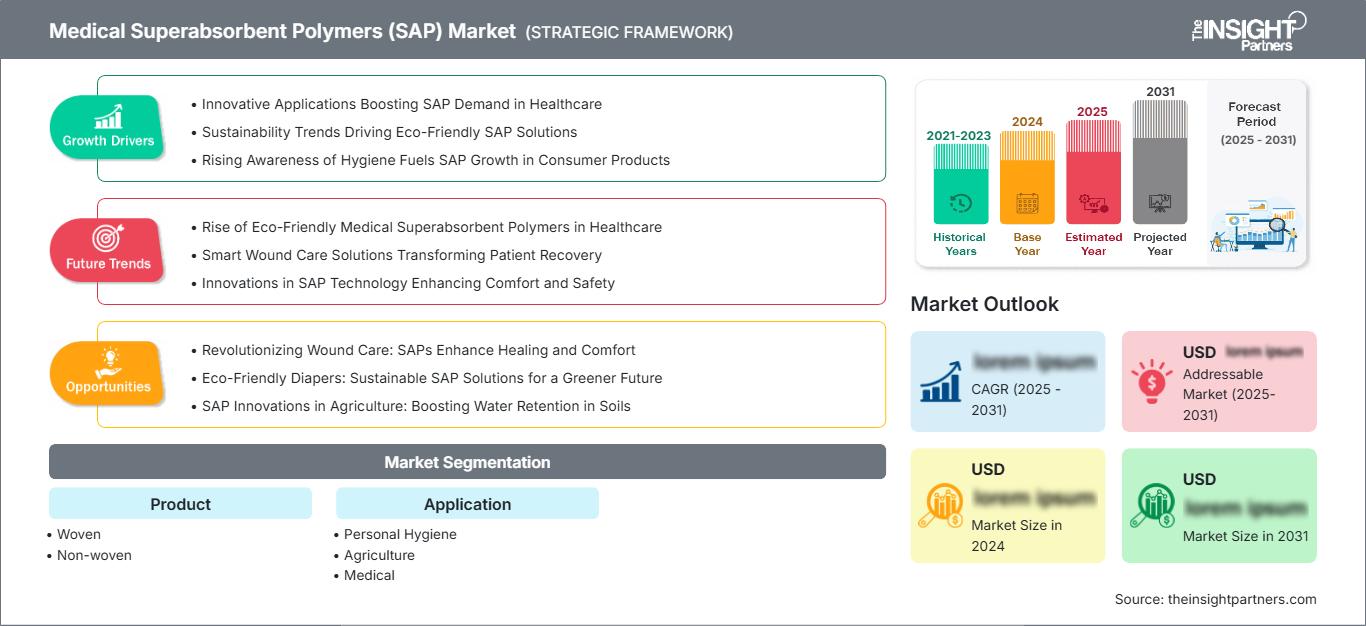
The Medical Superabsorbent Polymers (SAP) market was valued at US$ 3.02 billion in 2025 and is expected to reach US$ 4.7 billion by 2034; it is estimated to record a CAGR of 5.04% during 2026-2034.
Medical Superabsorbent Polymers (SAP) Market Assessment and Insights
- North America: Strong healthcare spending, high adoption of advanced wound care products, and established medical supply chains support market expansion. Share in 2025: 32%–34%. CAGR between 2026–2034: 5.1%–5.8%.
- US: Large healthcare expenditure and extensive use of disposable medical products sustain demand. Share in 2025: 77%–80% of North America. CAGR between 2026–2034: 5.2%–5.9%.
- Europe: Germany, the UK, France, Italy, and Spain remain major consumers due to mature healthcare systems and aging populations. Share in 2025: 27%–29%. CAGR between 2026–2034: 4.9%–5.6%.
- Asia Pacific: China, Japan, India, and South Korea are driving regional demand through healthcare investments and manufacturing expansion. Share in 2025: 28%–30%. CAGR between 2026–2034: 6.4%–7.2%.
- Largest Segment: Personal Hygiene application dominates due to extensive use in absorbent hygiene products and healthcare disposables. Market share in 2025: 52%–56%. CAGR between 2026–2034: 5.4%–6.0%.
- High Growth Segment: Medical application benefits from increasing wound care requirements and infection management solutions. Market share in 2025: 20%–24%. CAGR between 2026–2034: 6.8%–7.5%.
- Key companies analyzed in detail: Nippon Shokubai Co., Ltd.; BASF SE; Evonik Industries AG; Sumitomo Seika Chemicals Co., Ltd.; LG Chem Ltd.; SDP Global Co., Ltd.; Advanced Polymer Systems; Yixing Danson Technology; Satellite Chemical Co., Ltd.; Kao Corporation.
Source: The Insight Partners' analysis based on proprietary research, government publications, company annual reports, investor presentations, industry databases, and expert interviews.
Material technological advancements and healthcare-oriented product developments have been revolutionizing the manufacturing process of absorbent polymers within the last decade. There is an increased focus on high absorption capability, good fluid retention properties, and greater biocompatibility to meet the needs of the modern healthcare industry. An increase in the number of patients suffering from chronic diseases and advances in wound management practices have increased the demand for absorbent polymers in healthcare.
There will be new markets that could offer future growth prospects in terms of increasing investments in hospital infrastructure, elderly care institutions, and healthcare consumables. Regulatory support for hygienic standards, growing infection prevention consciousness among people, and increased accessibility to healthcare services are expected to drive the uptake in such markets. Also, manufacturers are looking into sourcing of sustainable raw material and eco-friendly production processes.
Medical Superabsorbent Polymers (SAP) Market Report Scope
| Report Attribute | Details |
|---|---|
| Market size in 2025 | US$ 3.02 Billion |
| Market Size by 2034 | US$ 4.7 Billion |
| Global CAGR (2026 - 2034) | 5.04% |
| Historical Data | 2021-2024 |
| Forecast period | 2026-2034 |
Medical Superabsorbent Polymers (SAP) Market Analysis
The rising demand for medical superabsorbent polymers due to their ability to handle fluids effectively in medical uses is fueling growth in the market for the medical superabsorbent polymers industry. Increased incidences of chronic wounds, surgical processes, urinary incontinence, and other patient care needs continue to drive the use. The medical superabsorbent polymers value chain includes the supplier of raw materials, polymer manufacturers, healthcare product manufacturers, distributors of healthcare goods, and end-users of healthcare facilities.
The supply chain is dependent on availability of acrylic acid, increase in capacity, and quality standards. The manufacturers are focusing on adopting advanced production technology to increase their absorbency and efficiency.Competitive positioning depends on technologies, product quality, and presence of manufacturing facilities in various regions. The medical superabsorbent polymers market report reveals a rising trend towards specialized medical products that can be used in wound treatment, surgery and infections management. Companies keep improving their product portfolios via research and strategic alliances.
Major players like Nippon Shokubai Co., Ltd., BASF SE, Evonik Industries AG, Sumitomo Seika Chemicals Co., Ltd., and LG Chem Ltd. hold dominant positions due to high manufacturing scale and innovativeness. At the same time, regional companies like SDP Global Co., Ltd. and Kao Corporation keep diversifying their portfolios, whereas new entrants concentrate on custom solutions and local advantages.
● REPORT CUSTOMIZATION
Tailor This Report To Align With Your Specific Business Requirements
This report can be customized to align precisely with your business objectives, scope, and target markets. Customization options include tailored segmentation, geography, competitive analysis, and strategic insights to support informed decision-making.
Customize This Report →WHAT YOU CAN ADJUST
- ● Segmentations
- ● Geography
- ● Competitive Analysis
- ● Language Preferences
Medical Superabsorbent Polymers (SAP) Market: Strategic Insights
Regional Insights
North America Medical Superabsorbent Polymers Market
North America accounted for 32%–34% of the global medical superabsorbent polymers market share in 2025 and is expected to expand at a CAGR of 5.1%–5.8% through 2034. Demand is supported by extensive healthcare spending, widespread use of disposable medical products, and strong adoption of advanced wound care technologies. The region benefits from established healthcare infrastructure and continuous investments in patient care quality.
Growing elderly populations and rising prevalence of chronic conditions continue increasing demand for absorbent healthcare materials. Hospitals, long-term care facilities, and home healthcare providers are adopting products that improve hygiene management and reduce infection risks. Product innovation and strong regulatory oversight further support sustained market development across the region.
U.S. Medical Superabsorbent Polymers Market
The United States represented 77%–80% of North American demand in 2025 and is projected to grow at a CAGR of 5.2%–5.9% through 2034. The country remains the largest regional consumer due to high healthcare expenditure, extensive medical product manufacturing capabilities, and increasing utilization of advanced absorbent technologies.
Leading healthcare product manufacturers maintain significant operations throughout the country, supporting continuous product innovation and commercialization. Rising demand for wound dressings, surgical consumables, and incontinence management products continues strengthening consumption. Healthcare providers increasingly prioritize materials that improve patient comfort while supporting effective fluid management and infection control requirements.
Europe Medical Superabsorbent Polymers Market
Europe accounted for 27%–29% of global demand in 2025 and is expected to register a CAGR of 4.9%–5.6% through 2034. Germany leads regional consumption through its advanced healthcare manufacturing sector and strong medical product industry. The United Kingdom benefits from significant healthcare procurement activity and rising adoption of advanced patient care solutions.
France, Italy, and Spain collectively contribute substantial demand due to expanding healthcare services and aging populations. Growing focus on infection prevention, wound care management, and patient hygiene supports market expansion. Regulatory emphasis on healthcare quality and safety continues encouraging adoption of advanced absorbent materials across diverse medical applications.
APAC Medical Superabsorbent Polymers Market
Asia Pacific represented 28%–30% of global demand in 2025 and is forecast to expand at a CAGR of 6.4%–7.2%, making it the fastest-growing regional market. China remains the largest regional consumer due to manufacturing capacity growth and healthcare infrastructure investments.
Japan, South Korea, India, and Australia continue expanding healthcare access and medical product manufacturing. Government support for healthcare modernization and increasing awareness regarding hygiene standards are creating favorable conditions for long-term market expansion.
Middle East & Africa Medical Superabsorbent Polymers Market
The Middle East & Africa market is expected to grow at a CAGR of 5.3%–6.0% through 2034. Saudi Arabia and the UAE continue investing in healthcare infrastructure, hospital expansion, and localized healthcare manufacturing capabilities.
South Africa remains a key regional healthcare market, while other countries are gradually increasing healthcare expenditure. Rising awareness of patient hygiene and infection prevention measures supports demand for absorbent medical materials across the region.
Segmentation Analysis
Product
The Product segment is projected to grow at a CAGR of 5.5%–6.1% during 2026–2034. Material selection influences absorbency, durability, fluid distribution, and application suitability. The medical superabsorbent polymers market scope continues expanding as manufacturers develop products tailored to healthcare requirements, infection control needs, and patient comfort expectations.
- Woven – Utilized in specialized absorbent applications requiring structural integrity and durability. Demand is supported by products designed for repeated handling, enhanced strength, and controlled fluid management performance.
- Non-woven – Widely preferred due to lightweight characteristics, efficient absorbency, and compatibility with disposable healthcare products. Strong adoption supports its importance across wound care and hygiene-related applications.
Application
The Application segment is expected to register a CAGR of 5.7%–6.4% between 2026 and 2034. Expanding healthcare access, demographic changes, and increasing demand for absorbent products continue supporting market development. Application-specific requirements encourage manufacturers to develop differentiated product formulations and performance characteristics.
- Personal Hygiene – Largest application category driven by extensive utilization in absorbent hygiene products, patient care solutions, and long-term healthcare applications. Consistent demand supports significant market contribution.
- Agriculture – Used for moisture retention and water management applications. Although not healthcare-focused, the segment contributes to production diversification and broader utilization of absorbent polymer technologies.
- Medical – Increasingly important due to rising use in advanced wound care, surgical products, infection control materials, and healthcare consumables requiring high absorbency performance.
Opportunity Snapshot
| Application | Revenue Contribution | Trend Tag | Adoption Stage |
| Personal Hygiene | High | Elder Care | Mature |
| Agriculture | Low | Water Retention | Scaling |
| Medical | Medium | Wound Therapy | Scaling |
Medical Superabsorbent Polymers (SAP) Market Growth Drivers and Impact Analysis
Increasing Demand for Advanced Wound Care Solutions
There is a growing need for absorbent medical products which are capable of managing the exudate due to chronic wounds, ulcers from diabetes, pressure wounds and postoperative recovery. There is an ever-growing interest from healthcare professionals for products that minimize the number of changes of dressings, improve patients' comfort and facilitate good healing results. The use of medical superabsorbent polymers is characterized by great capacity for absorption which ensures optimal wound conditions while minimizing the risk of leakage. With an increased interest in efficient treatment and reduced stays at hospitals, there is an ever-growing demand for wound care products.
Growing Aging Population and Long-Term Care Requirements
The population aging trend is creating continuous demand for absorbents which are used in care of the aged and disease management. The elderly usually need healthcare products that help manage mobility problems, incontinence, and other long-term issues. Super absorbent polymers in the healthcare sector ensure hygiene and comfort of patients in hospitals, nursing homes, and even at home healthcare settings. More attention is being paid by healthcare organizations to building infrastructures that help deal with elderly patients, thus driving continuous demand for the product.
Expansion of Healthcare Infrastructure in Emerging Economies
In Asia, Middle East, and certain regions in Latin America, investment in healthcare infrastructure is generating new prospects for the absorbent medical devices market. Hospitals and other healthcare service providers are increasing the number of hospitals, diagnostic centers, and care centers as part of efforts to make healthcare services more accessible. This leads to an increase in the demand for consumables needed for proper sanitation and clinical efficiency. Absorbent materials manufacturers are setting up regional manufacturing and distribution networks as part of their efforts to expand market access.
Medical Superabsorbent Polymers (SAP) Market Future Trends
Development of Sustainable and Bio-Based Absorbent Materials
The medical superabsorbent polymers market trends increasingly reflect interest in sustainable material development and environmentally responsible manufacturing practices. Producers are pursuing alternative sources for feedstock, low-emission production processes, and recyclable products to meet the changing needs of healthcare procurement. Future product lines may be based on increased sustainability without compromising on absorbency requirements. Environmental issues are increasingly being included by healthcare facilities as a factor in procurement, and there are chances for innovative companies to capitalize on it. Advances in polymer chemistry should help achieve sustainable innovations that strike a balance between performance and environmental concerns.
Integration of Functional Additives in Medical Applications
Future developments are anticipated to involve functional additives, which will be included into medical absorbents in order to increase their effectiveness. Antimicrobial qualities, odor control techniques, and advanced fluid control abilities have been studied by manufacturers, which are intended to be used in specialized healthcare products. Such inventions could potentially contribute to the improvement of patient outcome, as well as expand the use of wound care products, surgical products, and infection control solutions. Ongoing research and partnership with stakeholders in the healthcare industry will promote the rapid commercialization of innovative products.
Medical Superabsorbent Polymers (SAP) Market Opportunities
Regional Manufacturing Expansion Across Emerging Healthcare Markets
Healthcare infrastructure growth in developing economies presents attractive opportunities for localized manufacturing investments. Companies establishing regional production capabilities can improve supply reliability, reduce logistics costs, and strengthen relationships with healthcare product manufacturers. Medical superabsorbent polymers market forecasts indicate that emerging economies will account for an increasing share of healthcare consumable demand over the next decade. Investments in local manufacturing, technical support capabilities, and distribution networks may provide competitive advantages. Strategic expansion into underserved healthcare markets offers opportunities to capture incremental demand while supporting long-term revenue diversification and operational resilience.
Specialized Products for High-Performance Clinical Applications
Need for unique absorbent products tailor-made for challenging clinical conditions remains on the rise. There are possibilities for companies which could come up with products that are highly customized towards wound care, infection prevention, surgery, and other therapy uses. There is growing appreciation for features that enhance performance and lessen operational complexities among health care professionals. Companies may be able to achieve premium positioning through investment in research and development related to their specific uses. Those which align their innovation efforts with clinical needs may build better customer relations and venture into lucrative healthcare fields.
Recent Developments
- March 2026: Elea & Lili, a deep-tech startup originating from VTT Technical Research Centre of Finland, raised €2.5 million in seed funding to industrialise its patented Cellulose Super Absorbent (CSA) - a microplastic-free, biodegradable alternative to conventional superabsorbent polymers (SAP). The company's first commercial applications target two massive global markets: disposable diapers and agriculture - both currently dependent on fossil-based absorbent materials that generate long-lasting plastic waste and microplastic pollution.
- September 2025: Toyoda Gosei Co., Ltd. invested in EF Polymer K.K., a startup developing super-absorbent polymers that are made using orange and banana peels. EF Polymer uses inedible agricultural waste in making these 100% nature-based, environmentally friendly super-absorbent polymers.
Frequently Asked Questions

- Comprehensive Market Sizing and Forecast Analysis
- Detailed Segmentation Analysis
- In-Depth Market Dynamics Assessment
- Regional and Country-Level Insights
- Competitive Landscape and Company Benchmarking
- Strategic Business Intelligence
Recent Reports
Testimonials

The Insight Partners provided valuable market intelligence that supported our global go-to-market strategy. Their team was professional, responsive, and attentive to our feedback, providing thoughtful analysis and helpful methodological clarifications throughout the project.
Junmo Kim Chief Financial Officer (CFO), Enertech Co., Ltd.
The Insight Partners' SCADA System Market report is comprehensive, with valuable insights on current trends and future forecasts. The team was highly professional, responsive, and supportive throughout. We are very satisfied and highly recommend their services.
RAN KEDEM Partner, Reali Technologies LTDs
I requested a report on a very specific software market and the team produced the report in a few days. The information was very relevant and well presented. I then requested some changes and additions to the report. The team was again very responsive and I got the final report in less than a week.
JEAN-HERVE JENN Chairman, Future Analytica
We worked with The Insight Partners for an important market study and forecast. They gave us clear insights into opportunities and risks, which helped shape our plans. Their research was easy to use and based on solid data. It helped us make smart, confident decisions. We highly recommend them.
PIYUSH NAGPAL Sr. Vice President, High Beam Global
The Insight Partners delivered insightful, well-structured market research with strong domain expertise. Their team was professional and responsive throughout. The user-friendly website made accessing industry reports seamless. We highly recommend them for reliable, high-quality research services
YUKIHIKO ADACHI CEO, Deep Blue, LLC.
This is the first time I have purchased a market report from The Insight Partners.While I was unsure at first, I visited their web site and felt more comfortable to take the risk and purchase a market report.I am completely satisfied with the quality of the report and customer service. I had several questions and comments with the initial report, but after a couple of dialogs over email with their analyst I believe I have a report that I can use as input to our strategic planning process.Thank you so much for taking the extra time and making this a positive experience.I will definitely recommend your service to others and you will be my first call when we need further market data.
JOHN SUZUKI President and Chief Executive Officer, Board Director, BK Technologies
I wish to appreciate your support and the professionalism you displayed in the course of attending to my request for information regarding to infectious disease IVD market in Nigeria. I appreciate your patience, your guidance, and the fact that you were willing to offer a discount, which eventually made it possible for us to close a deal. I look forward to engaging The Insight Partners in the future, all thanks to the impression you have created in me as a result of this first encounter.
DR CHIJIOKE ONYIA MANAGING DIRECTOR, PineCrest Healthcare Ltd.Reason to Buy
- Informed Decision-Making
- Understanding Market Dynamics
- Competitive Analysis
- Identifying Emerging Markets
- Customer Insights
- Market Forecasts
- Risk Mitigation
- Boosting Operational Efficiency
- Strategic Planning
- Investment Justification
- Tracking Industry Innovations
- Aligning with Regulatory Trends





 Get Free Sample for