
Metallocene Polyethylene (mPE) Market Demand, Trends & Forecast by 2034
Coverage: by Type (Metallocene Linear Low Density Polyethylene (mLLDPE), Metallocene High Density Polyethylene (mHDPE), Metallocene Low Density Polyethylene (mLDPE), Metallocene Medium Density Polyethylene (mMDPE), Others); Catalyst Type (Zirconocene, Ferrocene, Titanocene, Others); Application (Films, Sheets, Injection Molding, Extrusion Coating, Others); End-Use Industry (Packaging, Food and Beverages, Automotive, Healthcare, Others) , and Geography (North America, Europe, Asia Pacific, and South and Central America)
- Status : Data Released
- Report Code : TIPRE00009969
- Category : Chemicals and Materials
- No. of Pages : 150
- Available Report Formats :


- Last update date : November 12, 2026


2025 Market Size
US$ 23.4 Bn
Base year value
2034 Forecast
US$ 33.62 Bn
Projected by 2034
CAGR 2026-2034
4.11 %
Growth rate
Addressable Market
US$ 258.98 Bn
(2026-2034)
The metallocene polyethylene market size was valued at US$ 23.4 Billion in 2025 and is projected to reach US$ 33.62 Billion by 2034, registering a CAGR of 4.11% during 2026–2034. Market expansion is supported by demand for high-performance flexible packaging, improved sealing and mechanical properties, and the need for efficient polymer processing. Growing applications across packaging, food and beverages, automotive, and healthcare are shaping resin development and purchasing decisions. Technology improvements, application-specific material requirements, and investment in polymer production capacity will influence competitive positioning throughout the forecast period.
North America remains an important metallocene polyethylene market, supported by established polymer manufacturing capabilities, advanced packaging conversion infrastructure, and demand for materials that deliver consistent processing performance. The region is projected to grow at a modeled CAGR of ~4% through 2034. Demand is influenced by flexible packaging requirements, industrial film applications, and continued efforts to improve material efficiency. Established supply chains and technical expertise support the qualification of specialized resin grades, while feedstock economics, competition from alternative polymers, and customer requirements influence investment and adoption decisions.
Metallocene Polyethylene (mPE) Market Assessment and Insights
Regional Outlook
- North America: ~30% of the global metallocene polyethylene market in 2025 | ~4% CAGR through 2034. Market position: North America benefits from integrated ethylene production, established polymer-processing infrastructure, and demand for high-performance flexible packaging. Resin innovation and access to feedstocks support specialty-grade development, although capacity utilization and imports influence pricing.
- US: ~80% of North American market revenue in 2025 | ~4% CAGR through 2034. Market position: The United States is the largest national market in North America within this assessment. Its resin-production base, packaging converters, and established supply chains support adoption of metallocene grades requiring consistent mechanical performance and processability.
- Europe: ~23% of the global market in 2025 | ~3% CAGR through 2034. Market position: Europe is a mature market with sophisticated polymer processing and packaging requirements. Germany, France, Italy, the UK, and Spain contribute through consumer goods, industrial applications, and packaging conversion, while circularity requirements influence material selection.
- Asia Pacific: ~35% of the global market in 2025 | ~6% CAGR through 2034. Market position: Asia Pacific is the fastest-growing region in this assessment, supported by manufacturing investment, packaged-goods consumption, and demand for advanced flexible packaging. China and India provide substantial expansion opportunities, while Japan and South Korea support specialized applications.
Segment Outlook
- Metallocene Linear Low Density Polyethylene: ~48% Metallocene Polyethylene Market share in 2025 | ~5% CAGR through 2034. Market position: This is the largest type segment in the modeled outlook because of its relevance to flexible films requiring toughness, puncture resistance, sealability, and downgauging potential.
- Packaging: ~42% share in 2025 | ~5% CAGR through 2034. Market position: Packaging is the largest end-use industry in this assessment. Brand owners and converters value reliable sealing, mechanical strength, material efficiency, and opportunities to design flexible packaging around compatible polyethylene structures.
Competitive Coverage
Borealis AG, ExxonMobil Corporation, Formosa Plastics Corporation, INEOS, LyondellBasell Industries Holdings B.V., Prime Polymer Co., Ltd., SABIC, Dow Inc., Total Petrochemicals and Refining USA, Inc., Univation Technologies
Methodology
The Insight Partners follows Data Collection & Secondary Research, Primary Research, Data Analysis, and Data Triangulation & Final Review to validate market estimates and insights.
Source: The Insight Partners' analysis based on proprietary research, government publications, company annual reports, investor presentations, industry databases, and expert interviews.
Metallocene polyethylene has evolved via innovations in the single site catalysts, process control, and resin design. Metallocene technology provides a much higher degree of control of polymer chain distribution and copolymerization, allowing for a combination of desired properties such as toughness, clarity, sealability, and processability. The commercial viability of this material depends upon the type of resin used and conversion process but not upon the catalyst itself. The manufacturers should strike a balance between the advantages of the technology versus its cost, productivity, and complexity. This has led to the creation of specific grades of resins for applications.
Future considerations will include investments in advanced polymer systems, packaging demand within the region, and the creation of structure that will aid material recovery. Expansion will take place within the Asia Pacific through local production of goods and increased manufacture of consumer goods, whereas existing markets can focus on specialty resins and technological partnership. Packaging waste regulations and customer commitments regarding packaging waste could prompt similar polyethylene structures, but the recyclability will rely upon the collection, sorting, additive, ink and full structure design. Until 2034, commercial success will rely upon proof of performance, resin competitiveness, customer approval, and the ability of producers to achieve consistent quality at their manufacturing facilities.
Metallocene Polyethylene (mPE) Market Report Scope
| Report Attribute | Details |
|---|---|
| Market size in 2025 | US$ 23.4 Billion |
| Market Size by 2034 | US$ 33.62 Billion |
| Global CAGR (2026 - 2034) | 4.11% |
| Historical Data | 2021-2024 |
| Forecast period | 2026-2034 |
Metallocene Polyethylene (mPE) Market Analysis
Demand is supported by manufacturers seeking polymers that improve product protection, package integrity, and conversion efficiency. The principal mechanism behind Metallocene Polyethylene Market growth is the ability to tailor resin properties for applications where conventional materials may not deliver the required balance of strength, flexibility, sealing, and processability. Film converters use these resins in packaging structures that must withstand handling and transport while maintaining reliable seals. Other buyers assess impact resistance, dimensional stability, and processing consistency. Adoption therefore depends on the performance premium relative to resin cost, the suitability of the grade for existing equipment, and the economic value of reduced material usage or lower conversion losses.
The value chain is initiated with hydrocarbon feedstocks and the manufacturing of ethylene, after which follows polymerization, catalysts and reactors, compounding in case required, resins' distribution, and further conversion. The integrated manufacturers can take advantage of the feedstock availability and scale effects, whereas the technology licensor may affect the availability of special polymerization technologies. It is also important to conduct converter trials due to the effect on process speed and quality of the resulting products because melt flow, sealing ranges, and mechanical properties are significant factors. The supply environment is affected by the operation rate of crackers, maintenance issues, energy prices, logistics, trade balances, and capacity.
Positioning will rely on catalyst and process technologies, product line, feedstock utilization, and technical service. The Metallocene Polyethylene Market report consists of prominent resin manufacturers and technology providers playing various roles in the supply chain. ExxonMobil Corporation, Dow Inc., and Borealis AG supply unique polyethylene technologies and products based on applications. INEOS, SABIC, LyondellBasell Industries Holdings B.V., Formosa Plastics Corporation, Prime Polymer Co., Ltd., and Total Petrochemicals and Refining USA, Inc. make their contribution through polymer production and related materials. Univation Technologies are significant due to polymerization technologies and process licensing. Their participation does not indicate the same level of exposure to all metallocenes.
Investment themes include capacity utilization, catalyst and reactor performance, specialty product development, and reliable delivery. More capacity increases availability but could affect pricing if downstream demand cannot soak up the production. Producers look at additional capacity projects in terms of feedstock economics, customer commitments in the region, logistics, and costs associated with qualifying grades for converter use. Product development helps with margin differentiation when addressing some identifiable processing or performance issue. On the buyer’s side, sourcing from multiple sources and partnering on the technical aspects can assist in dealing with supply disruptions and price instability.
● REPORT CUSTOMIZATION
Tailor This Report To Align With Your Specific Business Requirements
This report can be customized to align precisely with your business objectives, scope, and target markets. Customization options include tailored segmentation, geography, competitive analysis, and strategic insights to support informed decision-making.
Customize This Report →WHAT YOU CAN ADJUST
- ● Segmentations
- ● Geography
- ● Competitive Analysis
- ● Language Preferences
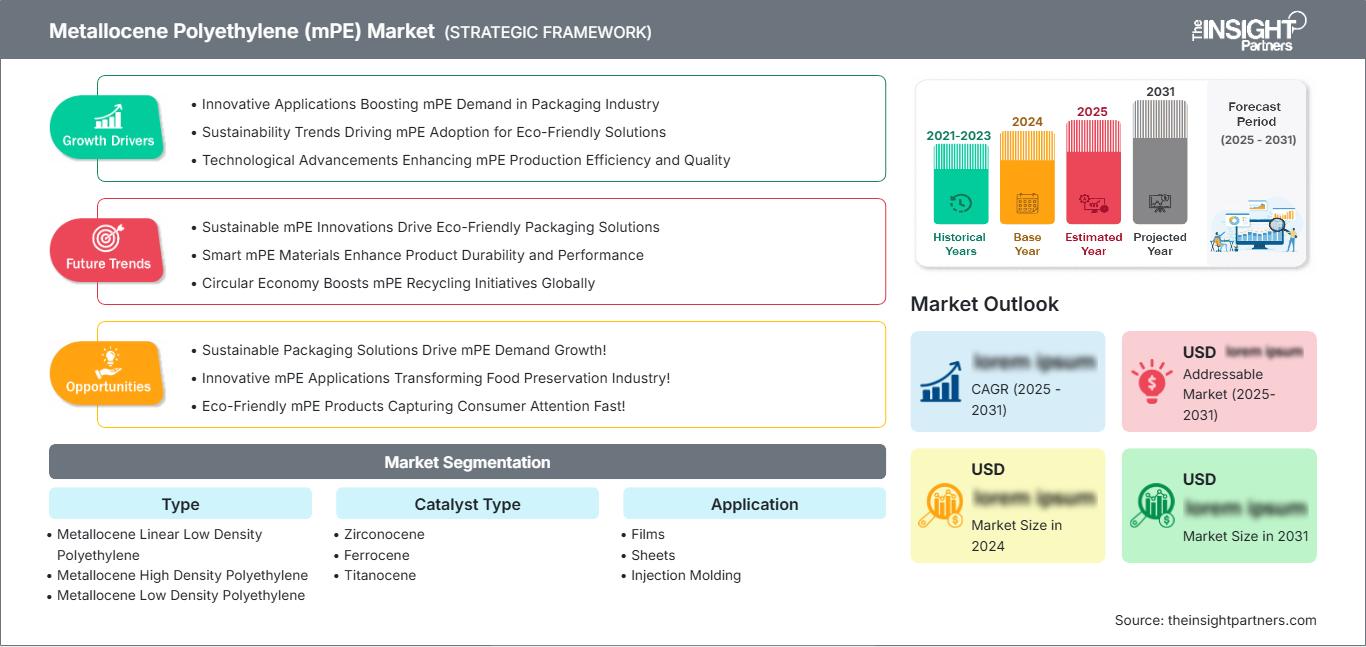
Metallocene Polyethylene (mPE) Market: Strategic Insights
Regional Insights
North America metallocene polyethylene market
North America accounts for a modeled ~30% of global revenue in 2025 and is projected to grow at a ~4% CAGR through 2034. Its proven ethylene/polyethylene business, petrochemical facilities and technology enable production and utilization of specialty grades. Flexible packaging is one of the key sources of demand, as converters require dependable sealing characteristics, strength, puncture resistance, and extrusion capabilities. Industrial films, hygiene products, and certain medical uses are among other applications. The local market has advantages of existing systems for customer qualification, and geographic proximity of resin producers to converter facilities.
U.S. metallocene polyethylene market
The United States represents a modeled ~80% of North American market revenue in 2025 and is projected to record a ~4% CAGR through 2034. Its position reflects domestic polymer production, extensive flexible-packaging conversion, and a broad base of consumer-goods manufacturers. Resin selection is closely linked to film-line performance, seal integrity, toughness, and the ability to achieve the required package specifications without excessive material use. Established supplier relationships and qualification procedures can favor producers that demonstrate consistent performance across batches and provide technical assistance during formulation changes.
The USA is the main source of national demands, while Canada and Mexico come into play via their participation in the production of resins, manufacturing, commerce, and packaging. Regional suppliers have to weigh between internal demand and export potential along with competition in other regional areas. The presence of feedstocks is important for cost competitiveness; however, margins are still vulnerable to the price level of ethylene, energy, maintenance, and utilization. The customer's interest in material savings and polyethylene packages opens possibilities for unique resins; nevertheless, material substitution is dependent on the performance and recycling of packaging, not resin.
Metallocene Polyethylene (PE) grades for film applications are also available from ExxonMobil Corporation and Dow Inc. In the case of domestic consumers, supply reliability, logistics, pricing trends, and suitability for existing extrusion machinery become crucial factors in addition to technical performance. Packaging structures made out of PE can become an impetus for resin research, but their recycling potential is contingent on the overall package design and recycling infrastructure available. Industrial films, hygiene applications, and special molded goods become additional sources of demand. Overcapacity risks should not be overlooked when making investment decisions.
Europe metallocene polyethylene market
Europe represents a modeled ~23% of the global market in 2025 and is expected to grow at a ~3% CAGR through 2034. Germany ranks first in this study in Europe owing to its industrial infrastructure, packaging converters, and demand for engineering polymers. In addition, France and Italy bring their contributions by supplying food packaging products and consumer goods in addition to processing activities, while the United Kingdom brings demand from retail, healthcare and industrial segments. The role of Spain comes from the demand arising from food manufacturing, agricultural applications, and packaging converters. Industrial specializations, import dependency, and recycling infrastructure maturity distinguish these markets.
Regulations regarding packaging waste, together with demands made by customers on packaging, have an effect on the specification of resins and packaging design. Resins such as metallocene may assist in downgauging and mechanical improvement, but the end result is based on the product composition and end-of-life strategy. Converters need to consider factors like sealability, printability, layer compatibility and processability before they modify the structures currently used. Companies that offer application development services will help their customers to reconcile performance with material utilization needs.
There is competition for Europe from foreign polymers, the economic situation in energy markets, and unsteady demand for industry. Hence, decision-making regarding investments will be impacted by the rate of use of production capacity, logistics, and economic considerations between specialized and commodity grades. Companies can distinguish themselves by offering high quality, customized resins, and working with packaging companies. There are several options for growth through industrial demand in Germany, expertise in converting in Italy, and markets for consumer goods in France, the United Kingdom, and Spain.
APAC metallocene polyethylene market
Asia Pacific accounts for a modeled ~35% of the global market in 2025 and is expected to grow at a ~6% CAGR through 2034. In the region of Asia-Pacific, China ranks at the top of this assessment because of the presence of polymer processing capability, manufacturing capability, and packaging/conversion capability. India is considered an emerging opportunity market, driven by packaged foods consumption, retail distribution, and manufacturing capability. Japan and South Korea create demand for unique materials through the application of industrial and packaging needs, whereas Australia is a small market that is driven by customer packaging and resin imports.
Investments in petrochemicals and conversion capability in the region may increase the availability of resins. In addition, industrial policies and incentives for manufacturing, along with consumer needs for effective packaging solutions, can drive adoption of resins, even though there is potential for competitive threats due to additions in capacity. The suppliers have to consider local feedstock economics, import dependency, customer qualification, and downstream processing capabilities to understand the requirements of each market segment.
Middle East & Africa metallocene polyethylene market
The Middle East and Africa region is modeled to grow at a ~5% CAGR through 2034. Saudi Arabia is the leading country in the Middle East & Africa in this assessment, supported by its petrochemical industry and access to hydrocarbon feedstocks. The United Arab Emirates serves as a production, trading, and logistics center for regional polymer supply. South Africa contributes through packaging conversion, food processing, and industrial manufacturing, while the rest of MEA contains diverse markets with different levels of local production and dependence on imported resin.
The presence of energy sources and feedstock may impact the cost competitiveness of regional producers, whereas port facilities and logistical networks affect the efficiency of transport to converters. The demand is contingent on the production of consumer goods, food packaging, agriculture, health care, and industries. Producers that are looking for opportunities for growth must pay attention to the ability to export, processing capabilities, customers' qualification, and competition of already present international suppliers.
Segmentation Analysis
Type
Type is a central basis for commercial differentiation because polymer density, comonomer distribution, molecular architecture, and melt behavior determine performance in conversion and end use. The category's importance reflects the need to match resin properties to mechanical strength, flexibility, sealing, and processing requirements. Metallocene Linear Low Density Polyethylene is the largest type segment in this modeled assessment, with a ~5% CAGR through 2034. Buyers compare product performance with resin cost, line compatibility, and opportunities to reduce material use. Producers must maintain consistent specifications and demonstrate measurable advantages over alternative polyethylene grades.
- Metallocene Linear Low Density Polyethylene: This grade is valued for toughness, puncture resistance, and seal performance in flexible films. Its application suitability depends on the balance of stiffness, extensibility, melt behavior, and the mechanical demands of the finished package.
- Metallocene High Density Polyethylene: This material serves applications requiring stiffness, strength, and dimensional stability. Its suitability depends on the specific resin design and processing conditions, with buyers evaluating mechanical performance and conversion behavior for the intended product.
- Metallocene Low Density Polyethylene: This grade category supports applications where flexibility, sealing behavior, and processability are important. Buyers assess its contribution to finished-product performance alongside density, melt characteristics, and compatibility with other polymers in a formulation.
- Metallocene Medium Density Polyethylene: This material can serve applications that require a balance of flexibility and mechanical strength. Selection depends on the specification of the finished product, processing method, and performance needed under handling and service conditions.
Catalyst Type
Catalyst Type influences polymer-chain architecture, comonomer distribution, process control, and the properties that can be achieved economically. Commercial relevance depends on catalyst productivity, reactor compatibility, grade consistency, and the value of the resin properties produced. Zirconocene is assigned a modeled ~5% CAGR through 2034 within this segment because of its relevance to single-site polymerization and tailored resin development. Catalyst adoption is not determined by chemistry alone: producers must account for operating conditions, catalyst costs, process licensing, and the ability to manufacture commercially competitive grades at scale.
- Zirconocene: Zirconocene-based systems are associated with single-site catalyst technology and controlled polymer structures. Their commercial value depends on the targeted resin properties, catalyst efficiency, reactor design, and the consistency required for specialty polyethylene applications.
- Ferrocene: Ferrocene-based chemistry has specialized relevance within organometallic catalyst research, but its commercial role must be distinguished from the catalyst systems widely deployed for polyethylene production. Application depends on validated process compatibility and demonstrated resin performance.
- Titanocene: Titanocene compounds are relevant to organometallic catalyst chemistry and polymerization research. Commercial use depends on catalyst activity, selectivity, stability, and economic performance under the intended operating conditions rather than the chemical identity alone.
Application
Application determines how resin properties translate into manufacturing efficiency, finished-product performance, and customer value. The category is shaped by equipment design, required mechanical characteristics, production speed, and the economics of the finished article. Films are the largest application in this modeled assessment, with a ~5% CAGR through 2034, reflecting their role in flexible packaging and industrial wrapping. Resin suppliers work with converters to establish suitable processing windows and product specifications. Commercial success depends on consistent output, defect control, and the ability to achieve the required performance without introducing unnecessary production complexity.
- Films: Film applications require a suitable balance of toughness, flexibility, sealing behavior, and processability. Resin selection depends on film structure, extrusion conditions, and the performance demanded during filling, storage, transport, and handling.
- Sheets: Sheet applications emphasize dimensional stability, surface quality, and mechanical properties appropriate to the finished product. Buyers evaluate extrusion consistency, forming behavior, and the ability to maintain the required characteristics throughout fabrication.
- Injection Molding: Injection molding uses resin grades selected for flow characteristics, strength, and dimensional performance. Adoption depends on mold design, cycle efficiency, product geometry, and the balance between material cost and the functional requirements of the molded component.
- Extrusion Coating: Extrusion coating requires appropriate melt behavior, adhesion to the substrate, and stable processing. Resin choice depends on coating uniformity, line speed, finished-layer performance, and compatibility with paper, board, film, or other substrates.
End-Use Industry
End-use demand reflects the performance and compliance requirements of the industries purchasing finished polyethylene products. Packaging is the largest end-use industry in this modeled assessment, with a ~5% CAGR through 2034. Demand is influenced by product protection, material efficiency, manufacturing consistency, and the need to meet customer specifications across large production runs. Suppliers must understand the relationship between resin performance and the complete finished product, including additives, multilayer combinations, and conversion processes. The Metallocene Polyethylene Market scope therefore extends beyond resin production to the application-specific requirements that shape purchasing decisions.
- Packaging: Packaging buyers prioritize seal integrity, toughness, barrier-system compatibility, and efficient material use. Resin qualification considers the packaged product, distribution conditions, filling equipment, and requirements for the complete package at end of life.
- Food and Beverages: Food and beverage applications require suitable material performance, reliable package integrity, and compliance with applicable food-contact requirements. Buyers consider sealing behavior, resistance to handling damage, and compatibility with the intended storage and distribution conditions.
- Automotive: Automotive applications require controlled mechanical properties, durability, and compatibility with component manufacturing. Resin selection depends on the function of the part, service conditions, regulatory requirements, and the economics of the complete component.
- Healthcare: Healthcare applications place importance on consistent quality, traceability, and compliance with product-specific requirements. Material selection depends on the intended medical or hygiene use, processing conditions, and validation of the finished article rather than resin properties alone.
Opportunity Snapshot
| End-Use Industry | Revenue Contribution | Trend Tag | Adoption Stage |
| Packaging | High | Flexible Packaging | Mature |
| Food and Beverages | High | Food Protection | Mature |
| Automotive | Medium | Lightweight Components | Scaling |
| Healthcare | Medium | Hygiene Materials | Scaling |
Metallocene Polyethylene (mPE) Market Growth Drivers and Impact Analysis
Performance Requirements in Flexible Packaging
The converters of flexible packaging demand that the resins possess mechanical strength, sealing capability, and processability without using too much material. It is possible to achieve toughness and sealability using metallocene polyethylene resin, as long as the grades and films are properly designed. These attributes are necessary in situations where the packaging undergoes repeated handling, stress due to transportation, or fast filling operations. The processability and finished-film properties of the resin during extrusion, stretching, sealing, and winding operations become important since slight changes in these processes might result in increased scrap or reduced line efficiency. The suppliers of resin that can provide stability and consistency in processability and finished film properties have an advantage in retaining their customers. However, it will depend on how the resin performs within the entire package system.
Demand for Material Efficiency and Resin Downgauging
Both brand owners and converters strive to minimize packaging weight where possible, provided that product protection and processability remain unaffected. Thinner film structures are possible through high-toughness metallocene resins in certain applications, thus decreasing the amount of resin needed per pack or unit wrapped. This is contingent on package shape, number of layers used, processability of the package, and the needed resistance to puncture and tear. It is crucial to qualify this drive as the lack thereof may lead to increased damage, leaks, or consumer complaints. From producers' perspective, there is an opportunity to develop resins optimized for certain process conditions. The commercial viability of this drive comes from being able to provide proof of improved material usage or process yield.
Growth in Packaged Consumer Goods and Industrial Films
The expansion of organized retail, processed food distribution, hygiene products, and industrial logistics supports demand for polyethylene materials across varied applications. Packaging manufacturers need resins that can run consistently on conversion equipment while meeting requirements for strength, flexibility, and sealing. Industrial film users also value reliable mechanical performance during storage and transportation. These applications create different resin specifications, so market expansion does not translate uniformly into demand for every metallocene grade. Producers must align product portfolios with regional purchasing patterns, processing capabilities, and end-use requirements. Suppliers that combine reliable availability with application engineering can improve customer qualification and repeat-order potential. However, the impact of downstream growth on margins depends on capacity additions, feedstock prices, imports, and the availability of competing polymer grades.
Metallocene Polyethylene (mPE) Market Future Trends
Resin Design for Recyclable Packaging Structures
Future resin development is likely to place greater emphasis on enabling packaging structures that combine performance with compatibility across collection, sorting, and recycling systems. Metallocene polyethylene can contribute to polyethylene-rich structures, but recyclability must be assessed for the complete package, including inks, adhesives, barrier layers, additives, and closures. Resin suppliers are likely to work more closely with converters and brand owners to validate mechanical performance, sealing, and processing under revised package designs. This trend could increase demand for application-specific grades and testing support. Commercial adoption will depend on demonstrated compatibility with existing equipment, access to suitable recovery infrastructure, and the ability to meet product-protection requirements at an acceptable cost.
Advanced Catalyst Control and Application-Specific Polymer Architecture
Advances in catalyst design, polymerization control, and process monitoring may expand the range of polyethylene properties available to resin developers. More precise control over molecular architecture can help manufacturers target stiffness, toughness, sealing behavior, and processability for specific uses. The Metallocene Polyethylene Market trends will also be influenced by the economics of catalyst productivity and the complexity of producing specialized grades at commercial scale. Producers will need to demonstrate that performance improvements translate into better conversion outcomes or finished-product functionality. Technology licensing, reactor flexibility, and analytical quality control can shape the pace of adoption. The most commercially successful innovations are likely to combine reproducible resin properties with practical advantages for converters.
Metallocene Polyethylene (mPE) Market Opportunities
Investment in Specialty Resin Production and Technical Service
Producers can pursue investment opportunities by upgrading polymerization assets, improving process control, and expanding the capability to manufacture specialty polyethylene grades. Investment screening should account for expected utilization, feedstock economics, reactor flexibility, customer qualification requirements, and the cost of serving regional markets. New capacity is more defensible when it is linked to identifiable applications and customer demand rather than broad assumptions about polymer consumption. Technical service can add value by helping converters optimize extrusion conditions, reduce production waste, and validate finished-product performance. Partnerships with packaging manufacturers can also provide early insight into changing specifications. Capital allocation should remain disciplined because additional supply may intensify competition if capacity growth outpaces demand.
Regional Expansion and Customer-Specific Grade Development
Commercial opportunities exist for suppliers that match resin development with the needs of converters in expanding manufacturing markets. Local technical support, dependable distribution, and application trials can help customers qualify materials while reducing supply-chain uncertainty. Producers should evaluate the balance between domestic demand and import competition, the availability of conversion equipment, and the maturity of regional packaging infrastructure. The Metallocene Polyethylene Market Forecasts indicate a growing global market under the supplied baseline, but this does not guarantee equivalent expansion in every country or application. Companies should prioritize partnerships that offer credible demand visibility and a clear technical use case. Regional expansion is more sustainable when supported by customer commitments, appropriate product specifications, and competitive delivered costs.
Recent Developments
- September 2025: Dow Inc. announced DOWSIL 5-1050 Polymer Processing Aid for blown-film and stretch-film applications. The technology is designed to reduce melt-fracture effects and die-lip buildup while providing an alternative to fluoropolymer-based processing aids. The announcement is relevant to polyethylene film processors seeking improved production consistency and changing additive options. Although it is a processing-aid development rather than a new metallocene resin launch, it addresses manufacturing conditions that can affect film quality and conversion efficiency.
- June 2025: Dow Inc. introduced INNATE TF 220 Precision Packaging Resin, a high-density polyethylene innovation intended to support high-performance biaxially oriented polyethylene films and packaging designs developed for recyclability. The announcement highlights continuing investment in resin and film technologies that can change material structures and packaging performance. Its direct relevance to metallocene polyethylene is limited because the product is an HDPE development, but it illustrates competitive innovation across the broader polyethylene market.
Frequently Asked Questions

- Comprehensive Market Sizing and Forecast Analysis
- Detailed Segmentation Analysis
- In-Depth Market Dynamics Assessment
- Regional and Country-Level Insights
- Competitive Landscape and Company Benchmarking
- Strategic Business Intelligence
Recent Reports
Testimonials

The Insight Partners provided valuable market intelligence that supported our global go-to-market strategy. Their team was professional, responsive, and attentive to our feedback, providing thoughtful analysis and helpful methodological clarifications throughout the project.
Junmo Kim Chief Financial Officer (CFO), Enertech Co., Ltd.
The Insight Partners' SCADA System Market report is comprehensive, with valuable insights on current trends and future forecasts. The team was highly professional, responsive, and supportive throughout. We are very satisfied and highly recommend their services.
RAN KEDEM Partner, Reali Technologies LTDs
I requested a report on a very specific software market and the team produced the report in a few days. The information was very relevant and well presented. I then requested some changes and additions to the report. The team was again very responsive and I got the final report in less than a week.
JEAN-HERVE JENN Chairman, Future Analytica
We worked with The Insight Partners for an important market study and forecast. They gave us clear insights into opportunities and risks, which helped shape our plans. Their research was easy to use and based on solid data. It helped us make smart, confident decisions. We highly recommend them.
PIYUSH NAGPAL Sr. Vice President, High Beam Global
The Insight Partners delivered insightful, well-structured market research with strong domain expertise. Their team was professional and responsive throughout. The user-friendly website made accessing industry reports seamless. We highly recommend them for reliable, high-quality research services
YUKIHIKO ADACHI CEO, Deep Blue, LLC.
This is the first time I have purchased a market report from The Insight Partners.While I was unsure at first, I visited their web site and felt more comfortable to take the risk and purchase a market report.I am completely satisfied with the quality of the report and customer service. I had several questions and comments with the initial report, but after a couple of dialogs over email with their analyst I believe I have a report that I can use as input to our strategic planning process.Thank you so much for taking the extra time and making this a positive experience.I will definitely recommend your service to others and you will be my first call when we need further market data.
JOHN SUZUKI President and Chief Executive Officer, Board Director, BK Technologies
I wish to appreciate your support and the professionalism you displayed in the course of attending to my request for information regarding to infectious disease IVD market in Nigeria. I appreciate your patience, your guidance, and the fact that you were willing to offer a discount, which eventually made it possible for us to close a deal. I look forward to engaging The Insight Partners in the future, all thanks to the impression you have created in me as a result of this first encounter.
DR CHIJIOKE ONYIA MANAGING DIRECTOR, PineCrest Healthcare Ltd.Reason to Buy
- Informed Decision-Making
- Understanding Market Dynamics
- Competitive Analysis
- Identifying Emerging Markets
- Customer Insights
- Market Forecasts
- Risk Mitigation
- Boosting Operational Efficiency
- Strategic Planning
- Investment Justification
- Tracking Industry Innovations
- Aligning with Regulatory Trends





 Get Free Sample for