
Metallocene Polyolefin (mPO) Market Demand, Size & Forecast by 2034
Coverage: by Type (MPE, MPP); Application (Film and Sheet, Injection Molding, Others) , and Geography (North America, Europe, Asia Pacific, and South and Central America)
- Status : Data Released
- Report Code : TIPRE00008925
- Category : Chemicals and Materials
- No. of Pages : 150
- Available Report Formats :


- Last update date : November 09, 2026


2025 Market Size
US$ 21.24 Bn
Base year value
2034 Forecast
US$ 47.69 Bn
Projected by 2034
CAGR 2026-2034
9.40 %
Growth rate
Addressable Market
US$ 307.68 Bn
(2026-2034)
The metallocene polyolefin market was valued at US$ 21.24 Billion in 2025 and is projected to reach US$ 47.69 Billion by 2034, registering a CAGR of 9.40% during 2026–2034. Market expansion is supported by increasing demand for high-performance polymer materials, advances in metallocene catalyst technology, and the need for improved sealing performance, toughness, and material efficiency. Growing applications in packaging and industrial manufacturing, combined with continued product development and investment in specialized polymer grades, are expected to influence market development throughout the forecast period.
North America remains an important market for metallocene polyolefins, supported by established petrochemical infrastructure, reliable feedstock availability, and a mature packaging-conversion industry. The regional market is projected to expand at a CAGR of ~8% through 2034. Demand is supported by the adoption of performance-oriented flexible packaging materials, increasing emphasis on packaging efficiency, and continued development of specialized polyethylene grades. Established resin manufacturers and technically advanced converters also support product qualification and commercialization across food packaging, hygiene products, industrial films, and other applications requiring consistent polymer performance.
Metallocene Polyolefin (mPO) Market Assessment and Insights
Regional Outlook
- North America: ~28% of the global Metallocene Polyolefin Market share in 2025 | ~8% CAGR through 2034. Market position: North America benefits from established polyethylene production, access to ethylene feedstocks, advanced film-converting capabilities, and demand for high-performance flexible packaging. The United States anchors regional consumption and specialty resin development.
- US: ~75% of North American market revenue in 2025 | ~8% CAGR through 2034. Market position: The United States benefits from integrated petrochemical infrastructure, established resin producers, and technically sophisticated packaging converters. Food packaging, industrial films, hygiene products, and material-thickness reduction support adoption.
- Europe: ~25% of the global market in 2025 | ~8% CAGR through 2034. Market position: Europe represents a mature market characterized by demanding packaging specifications, established processing expertise, and increasing emphasis on recyclability. Germany is the leading country in Europe, supported by its industrial base and polymer-processing capabilities.
- Asia Pacific: ~38% of the global market in 2025 | ~11% CAGR through 2034. Market position: Asia Pacific is the largest and fastest-growing regional market, supported by packaging conversion capacity, manufacturing expansion, rising consumption, and petrochemical investment. China leads the region, while India and South Korea offer distinct demand and production opportunities.
Segment Outlook
- Film and Sheet: ~72% Share in 2025 | ~9% CAGR through 2034. Market position: Film and Sheet represents the largest application segment, reflecting demand for flexible packaging, improved puncture resistance, sealing performance, and material downgauging. Adoption is supported by applications where mechanical reliability and consistent processing are important.
- Injection Molding: ~28% Share in 2025 | ~10% CAGR through 2034. Market position: Injection Molding offers a comparatively faster growth outlook as processors seek tailored flow behavior, impact resistance, and dimensional consistency. Its prospects depend on grade suitability, formulation economics, and demonstrated performance in specific molded products.
Competitive Coverage
Borealis AG, Chevron Phillips Chemical Company LLC, ExxonMobil Corporation, INEOS Group, LG Chem, LyondellBasell Industries Holdings B.V., Prime Polymer Co., Ltd., SABIC, Dow Inc., TotalEnergies SE.
Methodology
The Insight Partners follows Data Collection & Secondary Research, Primary Research, Data Analysis, and Data Triangulation & Final Review to validate market estimates and insights.
Source: The Insight Partners' analysis based on proprietary research, government publications, company annual reports, investor presentations, industry databases, and expert interviews.
Metallocene polyolefins have advanced because of technological breakthroughs in catalyst chemistry, polymer structure, and manufacturing process control that result in more predictable characteristics in the final product. The use of metallocene catalysts enables manufacturers to design the chemical structure of the polymer and create a variety of grades with specified toughness, flexibility, optical transparency, and sealability. Such qualities have contributed to the increasing importance of metallocene polyethylene and metallocene polypropylene in applications where performance exceeds those of standard commodity polymers.
The future will depend on how well the producers and converters can strike the right balance between material performance, recyclability, cost control, and evolving packaging needs. Increased production capacity of polymers, their grades, applications, and geographical availability could help stabilize supply chains for production increases. Great opportunities exist in the Asia Pacific area because of its increasing base of conversion operations, while North America and Europe are stable demand areas for unique materials. Packaging regulations might spur investment in recycling design and minimizing materials, but their acceptance will depend on logistics, costs, and end-use needs.
Metallocene Polyolefin (mPO) Market Report Scope
| Report Attribute | Details |
|---|---|
| Market size in 2025 | US$ 21.24 Billion |
| Market Size by 2034 | US$ 47.69 Billion |
| Global CAGR (2026 - 2034) | 9.40% |
| Historical Data | 2021-2024 |
| Forecast period | 2026-2034 |
Metallocene Polyolefin (mPO) Market Analysis
The growth in the metallocene polyolefin market is driven by the demand for polymers which can provide reliable performance even at reduced material thicknesses and under more difficult processing conditions. Packaging converters consider seal strength, tear resistance, rigidity, optics, and line efficiency collectively rather than considering the resin cost as the only factor for purchase. Such demands open up scope for differentiated grades in flexible packaging and certain molded applications. The demand is also driven by consumer goods manufacturing, food distribution, industrial packaging, and ability of converters to qualify new resins without disturbing their production cycle.
Starting from feedstock hydrocarbons and their processing into monomers, the value chain continues via catalysts, polymerization, resins' manufacturing and post-processing, and, where appropriate, compounding and conversion into final products. Integrated producers of resins are able to control part of the risk of their raw materials costs; technical expertise in resin development and service will allow suppliers to preserve their margins. The availability of resins is affected by issues of reliability of plants, capacity levels, cost of energy, logistics, and regional trade. The qualification process may slow down substitution of materials since converters have to ensure their performance at existing facilities.
There is competition from petrochemical complexes as well as polymer companies that have resin offerings along with the capability to develop applications and relationships with customers internationally. Competing from polyethylene technology differentiation and film products are ExxonMobil Corporation and Dow Inc., and competing from polymers and manufacturing locations are SABIC, LyondellBasell Industries Holdings B.V., and INEOS Group. There is competition through regional availability and polymer technology from Borealis AG, LG Chem, Prime Polymer Co., Ltd., and TotalEnergies SE, as well as from polyethylene production capabilities from Chevron Phillips Chemical Company LLC.
Beyond polymer capacity addition, investments must be made taking into account the relationship between volume expansion and margins, the oversupply in certain regions, cost of energy, and the danger of increasing competition in standard grades by increasing capacity. The company must invest in catalysts, process improvements, high performance materials, and cooperation with customers where such investments bring value to the converters. Differentiation commercially requires the alignment of the portfolio to local needs rather than having a global one size fits all portfolio. Alliance with packaging design companies, machinery, and recycling partners will help showcase performance.
● REPORT CUSTOMIZATION
Tailor This Report To Align With Your Specific Business Requirements
This report can be customized to align precisely with your business objectives, scope, and target markets. Customization options include tailored segmentation, geography, competitive analysis, and strategic insights to support informed decision-making.
Customize This Report →WHAT YOU CAN ADJUST
- ● Segmentations
- ● Geography
- ● Competitive Analysis
- ● Language Preferences
Metallocene Polyolefin (mPO) Market: Strategic Insights
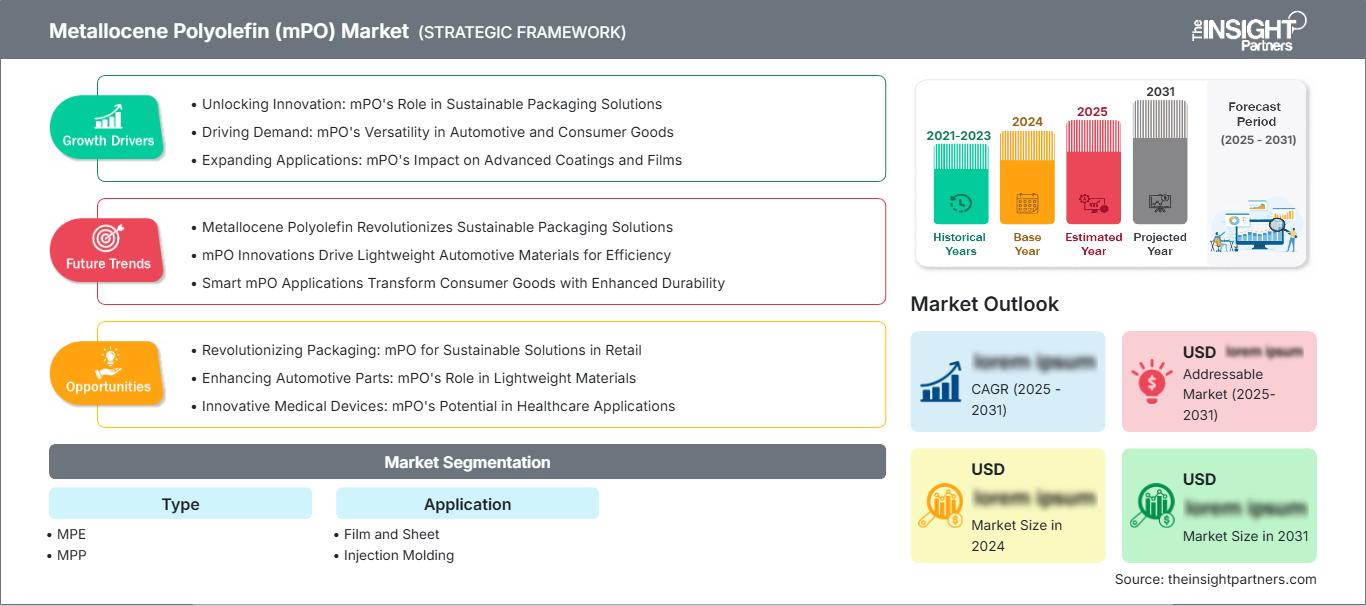
Regional Insights
North America Metallocene Polyolefin Market
North America accounts for an estimated ~28% of the global metallocene polyolefin market in 2025, with a projected CAGR of ~8% through 2034. Advantages for the area include the availability of ethylene manufacturing, petrochemical activities, and packaging conversion. Availability of feedstocks makes the economics of production possible, whereas technical proficiency allows producers to manufacture and qualify special grades of resins. Demand is related to the use of flexible packaging, hygiene applications, industrial films, and end-use sectors where sealing and mechanical resistance are critical.
U.S. Metallocene Polyolefin Market
The United States represents approximately ~75% of North American market revenue in 2025 and is projected to expand at a CAGR of ~8% through 2034. Its position reflects a substantial petrochemical production base, established polymer research capabilities, and a large downstream market for packaged food, consumer goods, healthcare supplies, and industrial products. Domestic resin production and logistics infrastructure support commercial availability, although maintenance outages, feedstock volatility, and competing export demand can affect regional pricing and delivery schedules.
Still, the US continues to dominate as the regional demand and production center, due to the presence of proven producers of resins and a wide array of packaging converters. The Canadian market is enabled by its industrial and petrochemical industry, while Mexico offers additional potential linked to manufacturing and consumer-goods chains. The process will be driven by feedstock prices, resin availability, line capability, and customer interest in paying for improved performance. Suppliers showing reduced material usage, reliable availability, and consistent processing outcomes stand a better chance of keeping their customers.
ExxonMobil Corporation and Dow Inc. have developed technologies and applications for high-performance film-grade polyethylene, whereas Chevron Phillips Chemical Company LLC and other manufacturers support the overall polymer chain supply system. Purchasers measure the performance of resins in terms of their production rate, sealing properties, protection provided, and the amount of materials required. Such considerations promote the technical qualifications and cooperation between suppliers, especially in cases when converters have high-throughput machinery. The business prospects will also be influenced by the economics of special-grade polymers compared with regular polyethylene.
Europe Metallocene Polyolefin Market
Europe accounts for an estimated ~25% of the global metallocene polyolefin market in 2025 and is expected to register a CAGR of ~8% through 2034. It is made up of efficient polymer manufacturing facilities, advanced packaging logistics networks, and increasing concern with resource management. Market drivers include applications such as food packaging, consumer goods packaging, industrial films, and structural features of materials that offer adequate product protection with less material usage. Nevertheless, energy expense, inconsistent industrial activities, and competition from imported polymers can affect the cost-effectiveness and viability of manufacturing.
Germany is the market leader in Europe, thanks to the nation's industrial strength, engineering abilities, and plastics manufacturing sector. United Kingdom has demand driven by food, retail, and consumer packaging, whereas France has food processing and consumer goods manufacture. Italy's packaging equipment and converting infrastructure creates demand for materials that are reliable when used in manufacturing processes. Spain offers opportunities due to food packaging, agricultural films, and consumer products. Adoption at country level is different depending on specialization in manufacturing, purchasing needs, and ability to convert.
European demand is also affected by packaging design considerations and the necessity to prove efficient use of materials without reducing the shelf life or integrity of the package. Such circumstances may help metallocene-based grades to gain a competitive edge due to their specific properties allowing thinner structures and better seals. However, the ability to improve recyclability would ultimately rely on the whole structure of the packaging and its collecting, sorting, and recycling facilities. In this respect, it would be useful for resin producers to cooperate with converters and brands in the design of packages.
APAC Metallocene Polyolefin Market
Asia Pacific represents an estimated ~38% of the global metallocene polyolefin market in 2025 and is projected to grow at a CAGR of ~11% through 2034. It is the fastest-growing regional market, supported by manufacturing expansion, packaging conversion, growing consumer-goods demand, and investment in petrochemical production. China is the leading country in Asia Pacific, combining a large downstream plastics industry with significant domestic polymer capacity and ongoing efforts to improve supply-chain integration.
Japan and South Korea are potential markets through the use of their advanced material development, existing industrial consumers and processing industries with high level of technical expertise. India is a good target market as a result of the rising consumption of packaged foods, manufacturing activities and flexible packaging. Australia is another smaller yet relevant market which relates to food, agriculture, retail and industrial uses. Policy action, capacity addition and infrastructure development can help in the regional growth despite the threat of competition from traditional polymers and new plants.
Middle East & Africa Metallocene Polyolefin Market
The Middle East and Africa market benefits from hydrocarbon feedstock availability, established petrochemical operations in parts of the Middle East, and increasing downstream industrial activity. Its growth outlook is supported by resin conversion, packaging demand, manufacturing localization, and infrastructure-related consumption. The regional CAGR is estimated at ~10% through 2034. Market development remains uneven because industrial capacity, logistics, purchasing power, and access to specialty polymer grades differ substantially between individual countries.
Saudi Arabia is the leading country in the Middle East and Africa market, supported by its petrochemical industry and integration between hydrocarbon resources and polymer production. The United Arab Emirates contributes through logistics, trade, manufacturing, and packaging-related activity. South Africa provides an important downstream market through food packaging, consumer goods, and industrial processing, while the Rest of MEA includes countries with varying levels of polymer conversion capacity. Long-term prospects depend on investment in manufacturing infrastructure, dependable supply channels, and the economics of using differentiated resins rather than conventional alternatives.
Segmentation Analysis
Type
Type is an important dimension of the metallocene polyolefin market because resin chemistry determines performance characteristics, processing behavior, and suitability for different manufacturing requirements. Buyers assess polymer properties against product specifications, equipment constraints, and the total cost of conversion. Continued catalyst development and grade customization support demand for differentiated materials, although commercial uptake depends on consistent quality and qualification outcomes. Within this category, MPE is expected to record a CAGR of ~9% through 2034, reflecting its established relevance to performance-sensitive polyethylene applications and opportunities for further substitution where benefits justify the material premium.
- MPE: Metallocene polyethylene serves applications requiring combinations of toughness, flexibility, sealing performance, and resistance to puncture. Its value depends on grade-specific properties and the ability to maintain package integrity while supporting efficient processing and material use.
- MPP: Metallocene polypropylene provides opportunities where polypropylene characteristics and controlled polymer structure meet particular processing or product requirements. Adoption depends on end-use suitability, processing performance, commercial availability, and the ability to demonstrate advantages over alternative polypropylene grades.
Application
Application determines how polymer properties translate into commercial value across the metallocene polyolefin market. Film and Sheet remains the largest main segment, with an estimated ~72% share in 2025 and a CAGR of ~9% through 2034. Injection Molding represents the high-growth segment, with an estimated ~28% share in 2025 and a CAGR of ~10% through 2034. These modeled estimates reflect the established scale of flexible packaging alongside opportunities to expand specialty polymer use in molded products. Actual adoption depends on grade performance, equipment compatibility, conversion economics, and end-user qualification.
- Film and Sheet: This application serves flexible packaging and other converted structures that require dependable mechanical properties, sealing performance, and controlled thickness. Material selection reflects package design, processing conditions, product-protection requirements, and the need to balance performance with resin consumption.
- Injection Molding: This application is relevant where resin behavior must support repeatable filling, dimensional consistency, impact performance, and efficient cycle operation. Adoption depends on matching polymer characteristics to part geometry, tooling, processing conditions, and the functional requirements of the finished product.
Opportunity Snapshot
| Application | Revenue Contribution | Trend Tag | Adoption Stage |
| Film and Sheet | High | Lightweight Packaging | Mature |
| Injection Molding | Medium | Precision Components | Scaling |
Metallocene Polyolefin (mPO) Market Growth Drivers and Impact Analysis
Demand for High-Performance Flexible Packaging
Packaging manufacturers need materials that protect products, maintain seal integrity, and withstand handling without requiring unnecessarily thick structures. Metallocene polyolefins can support these objectives through grade-specific combinations of toughness, flexibility, and sealing behavior. Their commercial value is greatest when converters can reduce material consumption, improve production consistency, or meet package-performance specifications without extensive equipment changes. Food, personal-care, hygiene, and industrial packaging provide different requirements, making product qualification and application engineering important parts of the purchasing process. For resin producers, this driver encourages investment in tailored grades and technical service rather than undifferentiated volume alone. For converters, adoption decisions depend on verified performance improvements, resin-price differentials, production efficiency, and the consequences of package failure. The resulting demand favors suppliers that can translate polymer properties into measurable operating and product benefits.
Expansion of Industrial Manufacturing and Polymer Conversion
Industrial production and the expansion of downstream polymer conversion support demand for materials with predictable processing behavior and application-specific mechanical properties. As manufacturers develop new products or increase production throughput, resin selection becomes linked to tooling requirements, processing stability, component performance, and production yield. Metallocene polyolefins can become attractive where their properties support these requirements, provided that the selected grade is technically appropriate and commercially competitive. Investment in converting equipment, packaging facilities, consumer-goods manufacturing, and regional supply chains can widen the addressable customer base. The impact is not uniform across industries because each application has different specifications and qualification costs. Suppliers must therefore prioritize technically justified opportunities, provide consistent material documentation, and work with processors to establish performance under operating conditions before expecting sustained commercial volumes.
Access to Integrated Feedstocks and Reliable Polymer Supply
Feedstock integration influences the economics of metallocene polyolefin production by affecting raw-material availability, operating flexibility, and exposure to changes in hydrocarbon and energy prices. Producers with reliable monomer supply and efficient manufacturing assets can support customer contracts more consistently, although integration does not eliminate market-price volatility or operational risk. Resin buyers also consider delivery reliability, regional inventory, technical support, and the cost of qualifying an alternative supplier. Disruptions at a major plant can affect availability even when global capacity appears sufficient, particularly for specialized grades with fewer qualified sources. This dynamic encourages manufacturers to balance supplier diversification with the cost and complexity of maintaining multiple approved materials. Producers that coordinate feedstock planning, production scheduling, and customer service can improve commercial resilience while protecting product consistency.
Metallocene Polyolefin (mPO) Market Future Trends
Greater Emphasis on Circular Packaging Compatibility
Metallocene polyolefin market trends are increasingly shaped by efforts to develop packaging structures that preserve functional performance while improving end-of-life compatibility. Material selection is moving beyond isolated resin properties toward evaluation of the complete package, including layers, inks, adhesives, barriers, and sealing systems. This creates a technical opportunity for suppliers to help customers develop structures that are easier to sort and recycle where suitable infrastructure exists. It also raises the importance of validating package performance and recyclability together rather than assuming that a single-polymer construction automatically achieves circularity. Through 2034, commercial differentiation may increasingly depend on documented material compatibility, customer trials, and collaboration with converters and recyclers. Progress will vary by region because collection systems, recycling capacity, regulation, and consumer-packaging requirements are not uniform.
More Application-Specific Resin Design and Processing Optimization
Future product development is likely to place greater emphasis on matching polymer architecture and processing behavior to the requirements of individual applications. Rather than relying exclusively on broad commodity classifications, suppliers can differentiate through carefully engineered grades, processing windows, and application-specific technical support. Improved consistency can help converters manage quality, minimize production interruptions, and achieve repeatable product specifications. Data-led process optimization and closer collaboration between resin producers and equipment suppliers may also shorten qualification cycles, although performance must still be demonstrated on actual production lines. Through 2034, the opportunity will favor commercially scalable innovations that address a measurable manufacturing problem. Producers must balance development costs and portfolio complexity against customer willingness to pay, available production capacity, and the ability to maintain reliable supply across markets.
Metallocene Polyolefin (mPO) Market Opportunities
Investment in Specialty Resin Capacity and Regional Customer Support
Metallocene polyolefin market Forecasts point to opportunities for producers that can align specialty resin availability with demand from expanding conversion centers. Investment decisions should consider regional feedstock access, customer concentration, logistics costs, existing competing capacity, and the technical requirements of target applications. In developing manufacturing markets, localized inventory, application laboratories, and converter partnerships may improve customer access without requiring every supplier to construct a new polymerization facility. Established producers can also evaluate debottlenecking and product-mix optimization before committing to large capacity expansions. The strongest projects are those with identifiable customer qualification pathways and a credible route to utilization. Investors should assess specialty-grade margins alongside commodity-cycle exposure, because incremental capacity creates value only when it can be operated economically and supported by sustained demand.
Collaborative Development of Material-Efficient Packaging Solutions
Partnerships between resin producers, converters, brand owners, equipment manufacturers, and recycling stakeholders offer a distinct commercial opportunity. Joint development can establish whether a differentiated grade enables lower material use, reliable sealing, improved package protection, or compatibility with a preferred recycling pathway. Such collaboration helps distribute technical knowledge across the value chain and reduces the risk of developing materials that cannot be processed efficiently at industrial scale. Commercial programs should define performance criteria, testing protocols, production-line requirements, and end-of-life considerations before expanding trials. Suppliers can prioritize customer applications where the economic benefit is measurable and where buyers have clear material specifications. This approach can strengthen customer relationships, improve the quality of product-development decisions, and create opportunities for differentiated resin sales without depending solely on additional commodity capacity.
Recent Developments
- September 2025: Dow Inc. - Dow introduced DOWSIL 5-1050 Polymer Processing Aid for blown and stretch film applications. The silicone-based masterbatch is designed to mitigate melt fracture and suppress die-lip buildup in linear low-density polyethylene processing. The development addresses converter interest in alternatives to fluoropolymer-based processing aids while emphasizing film quality, processing efficiency, and regulatory considerations.
- September 2025: TotalEnergies SE - TotalEnergies and SML presented downgauging film solutions for stand-up pouches and deep-freeze bags. Their collaboration focused on reducing material consumption while maintaining relevant packaging performance. The work highlights opportunities for polymer suppliers and equipment manufacturers to collaborate on film structures that support lightweighting, conversion efficiency, and improved end-of-life compatibility where suitable recycling infrastructure is available.
Frequently Asked Questions

- Comprehensive Market Sizing and Forecast Analysis
- Detailed Segmentation Analysis
- In-Depth Market Dynamics Assessment
- Regional and Country-Level Insights
- Competitive Landscape and Company Benchmarking
- Strategic Business Intelligence
Recent Reports
Testimonials

The Insight Partners provided valuable market intelligence that supported our global go-to-market strategy. Their team was professional, responsive, and attentive to our feedback, providing thoughtful analysis and helpful methodological clarifications throughout the project.
Junmo Kim Chief Financial Officer (CFO), Enertech Co., Ltd.
The Insight Partners' SCADA System Market report is comprehensive, with valuable insights on current trends and future forecasts. The team was highly professional, responsive, and supportive throughout. We are very satisfied and highly recommend their services.
RAN KEDEM Partner, Reali Technologies LTDs
I requested a report on a very specific software market and the team produced the report in a few days. The information was very relevant and well presented. I then requested some changes and additions to the report. The team was again very responsive and I got the final report in less than a week.
JEAN-HERVE JENN Chairman, Future Analytica
We worked with The Insight Partners for an important market study and forecast. They gave us clear insights into opportunities and risks, which helped shape our plans. Their research was easy to use and based on solid data. It helped us make smart, confident decisions. We highly recommend them.
PIYUSH NAGPAL Sr. Vice President, High Beam Global
The Insight Partners delivered insightful, well-structured market research with strong domain expertise. Their team was professional and responsive throughout. The user-friendly website made accessing industry reports seamless. We highly recommend them for reliable, high-quality research services
YUKIHIKO ADACHI CEO, Deep Blue, LLC.
This is the first time I have purchased a market report from The Insight Partners.While I was unsure at first, I visited their web site and felt more comfortable to take the risk and purchase a market report.I am completely satisfied with the quality of the report and customer service. I had several questions and comments with the initial report, but after a couple of dialogs over email with their analyst I believe I have a report that I can use as input to our strategic planning process.Thank you so much for taking the extra time and making this a positive experience.I will definitely recommend your service to others and you will be my first call when we need further market data.
JOHN SUZUKI President and Chief Executive Officer, Board Director, BK Technologies
I wish to appreciate your support and the professionalism you displayed in the course of attending to my request for information regarding to infectious disease IVD market in Nigeria. I appreciate your patience, your guidance, and the fact that you were willing to offer a discount, which eventually made it possible for us to close a deal. I look forward to engaging The Insight Partners in the future, all thanks to the impression you have created in me as a result of this first encounter.
DR CHIJIOKE ONYIA MANAGING DIRECTOR, PineCrest Healthcare Ltd.Reason to Buy
- Informed Decision-Making
- Understanding Market Dynamics
- Competitive Analysis
- Identifying Emerging Markets
- Customer Insights
- Market Forecasts
- Risk Mitigation
- Boosting Operational Efficiency
- Strategic Planning
- Investment Justification
- Tracking Industry Innovations
- Aligning with Regulatory Trends





 Get Free Sample for